
Book Talk with Ambassador Dennis Ross — Statecraft 2.0: What America Needs to Lead in a Multipolar World
Book Talk with Ambassador Dennis Ross — Statecraft 2.0: What America Needs to Lead in a Multipolar World
Wednesday, January 14, 20264:00 PM - 5:30 PM (Pacific)
Registration required. Virtual to Public. If prompted for a password, use: 123456.
Only those with an active Stanford ID with access to Encina Hall C231 (William J. Perry Conference Room) may attend in person.

On Wednesday, January 14, the Jan Koum Israel Studies Program at the Center on Democracy, Development and the Rule of Law is pleased to welcome Ambassador Dennis Ross — a veteran U.S. negotiator in Arab-Israeli peace negotiations and advisor on Middle East policy — to discuss his latest book, Statecraft 2.0: What America Needs to Lead in a Multipolar World. The discussion will be in conversation with Michael McFaul and moderated by Amichai Magen.
About the Book
In a world that is multipolar and America has less relative power, the United States no longer has the luxury to practice statecraft badly.
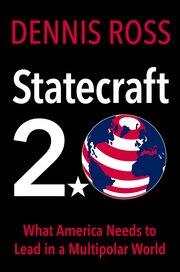
The United States may still be the world's strongest country, but it now faces real challenges at both a global and regional level. The unipolar world which was dominated by America after the Cold War is gone. Unlike the Soviet Union, China is both a military and economic competitor and it is actively challenging the norms and institutions that the US used to shape an international order during and after the Cold War. Directly and indirectly, it has partners trying to undo the American-dominated order, with Russia seeking to extinguish Ukraine, and Iran trying to undermine American presence, influence, and any set of rules for the Middle East that it does not dominate.
The failures of American policy in Afghanistan and Iraq have weakened the domestic consensus for a US leadership role internationally. Traditions in US foreign policy, especially the American sense of exceptionalism, have at different points justified both withdrawal and international activism. Iraq and Afghanistan fed the instinct to withdraw and to end the "forever wars." But the folly of these US interventions did not necessarily mean that all use of force to back diplomacy or specific political ends was wrong; rather it meant in these cases, the Bush Administration failed in the most basic task of good statecraft: namely, marrying objectives and means. Nothing more clearly defines effective statecraft than identifying well-considered goals and then knowing how to use all the tools of statecraft--diplomatic, economic, military, intelligence, information, cyber, scientific, education--to achieve them. But all too often American presidents have adopted goals that were poorly defined and not thought through.
In Statecraft 2.0, Dennis Ross explains why failing to marry objectives and means has happened so often in American foreign policy. He uses historical examples to illustrate the factors that account for this, including political pressures, weak understanding of the countries where the US has intervened, changing objectives before achieving those that have been established, relying too much on ourselves and too little on allies and partners. To be fair, there have not only been failures, there have been successes as well. Ross uses case studies to look more closely at the circumstances in which Administrations have succeeded and failed in marrying objectives and means. He distills the lessons from good cases of statecraft--German unification in NATO, the first Gulf War, the surge in Iraq 2007-8--and bad cases of statecraft--going to war in Iraq 2003, and the Obama policy toward Syria. Based on those lessons, he develops a framework for applying today a statecraft approach to our policy toward China, Iran, and the Israeli-Palestinian conflict. The book concludes with how a smart statecraft approach would shape policy toward the new national security challenges of climate, pandemics, and cyber.
Speakers

Ambassador Dennis Ross
Ambassador Dennis Ross is the counselor and William Davidson Distinguished Fellow at The Washington Institute for Near East Policy. He also teaches at Georgetown University’s Center for Jewish Civilization. For more than twelve years, Amb. Ross played a leading role in shaping U.S. involvement in the Middle East peace process, dealing directly with the parties as the U.S. point man on the peace process in both the George H. W. Bush and Bill Clinton administrations. He served two and half years as special assistant to President Obama and National Security Council senior director for the Central Region, spending the first 6 months of the Administration as the special advisor on Iran to Secretary of State Hillary Rodham Clinton. His newest book is Statecraft 2.0: What America Needs to Lead in a Multipolar World (Oxford University Press, March 2025).

Amichai Magen
Amichai Magen is the founding director of the Jan Koum Israel Studies Program at the Center on Democracy, Development and the Rule of Law. Previously, he served as the visiting fellow in Israel Studies at Stanford University's Freeman Spogli Institute for International Studies, head of the MA Program in Diplomacy & Conflict Studies, and director of the Program on Democratic Resilience and Development (PDRD) at the Lauder School of Government, Diplomacy and Strategy, Reichman University, Herzliya, Israel. His research and teaching interests address democracy, the rule of law, liberal orders, risk and political violence, as well as Israeli politics and policy.
Magen received the Yitzhak Rabin Fulbright Award (2003), served as a pre-doctoral fellow at the Center on Democracy, Development and the Rule of Law, and was the W. Glenn Campbell National Fellow at the Hoover Institution (2008-9). In 2016, he was named a Richard von Weizsäcker Fellow of the Robert Bosch Academy, an award that recognizes outstanding thought leaders around the world. Between 2018 and 2022, he served as principal investigator in two European Union Horizon 2020 research consortia, EU-LISTCO and RECONNECT. Amichai Magen served on the Executive Committee of the World Jewish Congress (WJC) and is a Board Member of the Israel Council on Foreign Relations (ICFR) and the International Coalition for Democratic Renewal (ICDR).

Michael McFaul
Michael McFaul is former director at the Freeman Spogli Institute for International Studies, the Ken Olivier and Angela Nomellini Professor of International Studies in the Department of Political Science, and the Peter and Helen Bing Senior Fellow at the Hoover Institution. He joined the Stanford faculty in 1995. Dr. McFaul is also an international affairs analyst for NBC News. He served for five years in the Obama administration, first as special assistant to the president and senior director for Russian and Eurasian Affairs at the National Security Council at the White House (2009-2012), and then as U.S. Ambassador to the Russian Federation (2012-2014).
He has authored several books, most recently Autocrats versus Democrats: China, Russia, America, and the New Global Disorder. Earlier books include the New York Times bestseller From Cold War to Hot Peace: An American Ambassador in Putin’s Russia, Advancing Democracy Abroad: Why We Should, How We Can; Transitions To Democracy: A Comparative Perspective (eds. with Kathryn Stoner); Power and Purpose: American Policy toward Russia after the Cold War (with James Goldgeier); and Russia’s Unfinished Revolution: Political Change from Gorbachev to Putin.
He teaches courses on great power relations, democratization, comparative foreign policy decision-making, and revolutions.
Dr. McFaul was born and raised in Montana. He received his B.A. in International Relations and Slavic Languages and his M.A. in Soviet and East European Studies from Stanford University in 1986. As a Rhodes Scholar, he completed his D. Phil. In International Relations at Oxford University in 1991. His DPhil thesis was Southern African Liberation and Great Power Intervention: Towards a Theory of Revolution in an International Context.