-

Image
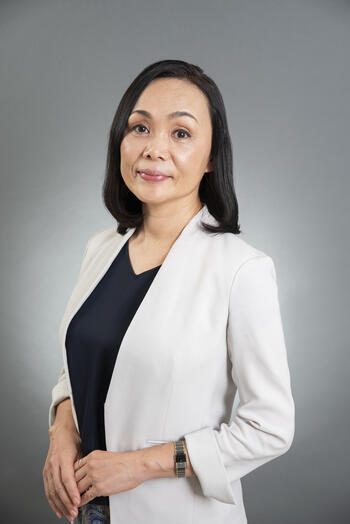
Desi Small-Rodriguez
Desi Small-Rodriguez, PhD, is an Assistant Professor of Sociology and American Indian Studies at the University of California, Los Angeles. As a social demographer, she applies critical quantitative and mixed methods to research at the intersection of race, indigeneity, data, and inequality. An indigenous woman (Northern Cheyenne and Chicana), Small-Rodriguez specializes in survey research in partnership with Indigenous communities and other marginalized populations. She grounds her research in Indigenous studies, sociology of race and ethnicity, political sociology, sociology of knowledge, critical demography, health policy research, and science and technology studies. She directs the Data Warriors Lab, which is an Indigenous social science laboratory that connects researchers, students and Indigenous communities to build data that support "strong self-determined Indigenous futures."


You are invited to a Zoom meeting. 

Registration

After registering, you will receive a confirmation email containing information about joining the meeting.

Desi Small-Rodriguez, PhD Assistant Professor, Sociology and American Indian Studies, UCLA
Seminars
-

Image
larry diamond, charles mok, jason hsu photos for event on april 12 on blue background
Join us on Tuesday, April 12 from 12 PM - 1 PM PT for “Internet Freedom Under Threat: The Divergent Paths of Taiwan and Hong Kong” featuring Charles Mok, Visiting Scholar at the Global Digital Policy Incubator and Jason Hsu, Chief Initiative Officer at Taiwan AI Labs, in conversation with Larry Diamond, co-lead for the Global Digital Policy Incubator and Senior Fellow at the Freeman Spogli Institute for International Studies. This weekly seminar series is jointly organized by the Cyber Policy Center’s Program on Democracy and the Internet and the Hewlett Foundation’s Cyber Initiative.

About The Seminar: 

Both Taiwan and Hong Kong face increasing threats of online misinformation and cybersecurity risks, but the freedoms of the Internet for their citizens appear to be heading in opposite directions. From censorship and surveillance to influencing public opinions and elections, what are the lessons from the experiences of Hong Kong and Taiwan for the world?

Our speakers will provide an overview of the state of internet freedom in Hong Kong from before to after the enactment of the National Security Law in 2020. Censorship and surveillance are on the rise, and a misinformation law is looming on the horizon, to give the government and the police even more unfettered power. We will also cover the techniques used by cyber intrusion groups aimed at toppling election campaigns. Drawing research work from Taiwan AI Labs, we elaborate on how AI is used to track misinformation on social media particularly on Chinese-language speaking portals.

Jason Hsu is Senior Research Fellow at The Ash Center for Democratic Governance and Innovation Harvard Kennedy School. From 2016 to 2020 Hsu served as Legislator At-Large in Taiwan’s Legislative Yuan (national parliament) overseeing technology policy, development, entrepreneurship and innovation. Known as Crypto Congressman, Jason is credited for setting up Asia Blockchain Alliance (ABA),Taiwan Parliamentary Coalition for Blockchain (TPCB) and Self- Regulatory Organization(SRO).

Charles Mok is a Visiting Scholar at the Global Digital Policy Incubator. Prior to his time at Stanford, Charles served as an elected member of the Legislative Council in the Hong Kong Special Administrative Region, representing the Information Technology functional constituency, for two terms from 2012 to 2020. He served alternatively as chair and vice chair of the Information Technology and Broadcasting Panel from 2016 to 2020. As a lawmaker, Charles was a champion for policies and legislations on privacy, open data, freedom of expression and information, cybersecurity, innovation, fintech, electronic health records, as well as human rights and democracy.

Larry Diamond is a senior fellow at the Hoover Institution, the Mosbacher Senior Fellow in Global Democracy at the Freeman Spogli Institute for International Studies (FSI), and a Bass University Fellow in Undergraduate Education at Stanford University. He is also professor by courtesy of Political Science and Sociology at Stanford. He leads the Hoover Institution’s programs on China’s Global Sharp Power and on Taiwan in the Indo-Pacific Region.  At FSI, he leads the Program on Arab Reform and Democracy, based at the Center on Democracy, Development and the Rule of Law, which he directed for more than six years.  He also co-leads with (Eileen Donahoe) the Global Digital Policy Incubator, based at FSI’s Cyber Policy Center. He is the founding coeditor of the Journal of Democracy and also serves as senior consultant at the International Forum for Democratic Studies of the National Endowment for Democracy. His research focuses on democratic trends and conditions around the world and on policies and reforms to defend and advance democracy.

Larry Diamond
0
Research Scholar, Global Digital Policy Incubator
charles_mok.jpg

Charles is a Research Scholar at the Global Digital Policy Incubator of the Center on Democracy, Development and the Rule of Law at Stanford University, a member of the Board of Trustees of the Internet Society, and a board member of the International Centre for Trade Transparency and Monitoring. Charles served as an elected member of the Legislative Council in the Hong Kong Special Administrative Region, representing the Information Technology functional constituency, for two terms from 2012 to 2020. In 2021, he founded Tech for Good Asia, an initiative to advocate positive use of technology for businesses and civil communities. As an entrepreneur, Charles co-founded HKNet in 1994, one of the earliest Internet service providers in Hong Kong, which was acquired by NTT Communications in 2000. He was the founding chair of the Internet Society Hong Kong, honorary president and former president of the Hong Kong Information Technology Federation, former chair of the Hong Kong Internet Service Providers Association, and former chair of the Asian, Australiasian and Pacific Islands Regional At-Large Organization (APRALO) of ICANN. Charles holds a BS in Computer and Electrical Engineering and an MS in Electrical Engineering from Purdue University.

Date Label
Jason Hsu
Seminars
-
Decoupling: Gender Injustice in China's Divorce Courts event image

Using 'big data' computational techniques to scrutinize cases covering 2009–2016 from all 252 basic-level courts in two Chinese provinces, Henan and Zhejiang, Ethan Michelson reveals that women have borne the brunt of a dramatic intensification since the mid-2000s of a decades-long practice of denying divorce requests. This talk discusses key findings from his new book of the same name. Michelson's analysis of almost 150,000 divorce trials reveals routine and egregious violations of China's own laws upholding the freedom of divorce, gender equality, and the protection of women's physical security. Michelson takes the reader upstream to the institutional sources of China's clampdown on divorce and downstream to its devastating and highly gendered human toll, showing how judges in an overburdened court system clear their oppressive dockets at the expense of women's lawful rights and interests.


Image
Portrait of Ethan Michelson
Ethan Michelson is the James and Noriko Gines Department Chair in East Asian Languages and Cultures as well as Professor of Sociology and Law at Indiana University Bloomington, where he has been teaching courses on law and society, law and authoritarianism, and contemporary Chinese society since 2003. He has won several awards for his published research on China’s legal system.

Via Zoom

Ethan Michelson Professor of Sociology and Law, Hamilton Lugar School of Global and International Studies, Indiana University Bloomington
Seminars
-

LECTURE RECORDING

Bechtel Conference Center
Encina Hall
616 Jane Stanford Way
Stanford, CA 94305

Congressman Ted Lieu
Seminars
-

SCCEI Spring Seminar Series 


Wednesday, May 18, 2022      11:00 am -12:15 pm Pacific Time

Goldman Room E401, Encina Hall, 616 Jane Stanford Way | Zoom Meeting 


Understanding the Resurgence of the SOEs in China: Evidence from the Real Estate Sector 

We advance a novel hypothesis that China’s recent anti-corruption campaign may have contributed to the resurgence of the state-owned enterprises (SOEs) in China as an unintended consequence. We explore the nexus between the anti-corruption campaign and the SOE resurgence by presenting supporting evidence from the Chinese real estate sector, which is notorious for pervasive rent-seeking and corruption. We use a unique data set of land parcel transactions merged with firm-level registration information and a difference-in-differences empirical design to show that, relative to the industrial land parcels which serve as the control, the fraction of residential land parcels purchased by SOEs increased significantly relative to that purchased by private developers after the anti-corruption campaign. 


About the Speaker 
 

Image
Hanming Fang

Hanming Fang is an applied microeconomist with broad theoretical and empirical interests focusing on public economics. His research integrates rigorous modeling with careful data analysis and has focused on the economic analysis of discrimination; insurance markets, particularly life insurance and health insurance; and health care, including Medicare. In 2008, Professor Fang was awarded the 17th Kenneth Arrow Prize by the International Health Economics Association (iHEA) for his research on the sources of advantageous selection in the Medigap insurance market. 

Professor Fang received his Ph.D. in Economics from the University of Pennsylvania in 2000. Before joining the Penn faculty, he held positions at Yale University and Duke University.  He is a research associate at the National Bureau of Economic Research, where he served as the acting director of the Chinese economy working group from 2014 to 2016. He is also a research associate of the Population Studies Center and Population Aging Research Center, and a senior fellow at the Leonard Davis Institute of Health Economics at the University of Pennsylvania.


Seminar Series Moderators

Image
Headshot of Dr. Scott Rozelle

Scott Rozelle is the Helen F. Farnsworth Senior Fellow and the co-director of Stanford Center on China's Economy and Institutions in the Freeman Spogli Institute for International Studies and Stanford Institute for Economic Policy Research at Stanford University.  For the past 30 years, he has worked on the economics of poverty reduction. Currently, his work on poverty has its full focus on human capital, including issues of rural health, nutrition and education. For the past 20 year, Rozelle has been the chair of the International Advisory Board of the Center for Chinese Agricultural Policy, Chinese Academy of Sciences (CAS). Most recently, Rozelle's research focuses on the economics of poverty and inequality, with an emphasis on rural education, health and nutrition in China. In recognition of this work, Dr. Rozelle has received numerous honors and awards. Among them, he became a Yangtse Scholar (Changjiang Xuezhe) in Renmin University of China in 2008. In 2008 he also was awarded the Friendship Award by Premiere Wen Jiabao, the highest honor that can be bestowed on a foreigner. 


Image
hongbin li headshot

Hongbin Li is the Co-director of Stanford Center on China's Economy and Institutions, and a Senior Fellow of Stanford Institute for Economic Policy Research (SIEPR) and the Freeman Spogli Institute for International Studies (FSI). Hongbin obtained his Ph.D. in economics from Stanford University in 2001 and joined the economics department of the Chinese University of Hong Kong (CUHK), where he became full professor in 2007. He was also one of the two founding directors of the Institute of Economics and Finance at the CUHK. He taught at Tsinghua University in Beijing 2007-2016 and was C.V. Starr Chair Professor of Economics in the School of Economics and Management. He founded the Chinese College Student Survey (CCSS) in 2009 and the China Employer-Employee Survey (CEES) in 2014.

Hongbin’s research has been focused on the transition and development of the Chinese economy, and the evidence-based research results have been both widely covered by media outlets and well read by policy makers around the world. He is currently the co-editor of the Journal of Comparative Economics.


A NOTE ON LOCATION

This seminar is a hybrid event. Please join us in person in the Goldman Conference Room located within Encina Hall on the 4th floor of the East wing, or join remotely via Zoom.

Register once to receive the Zoom meeting link that will be used for all lectures in this series.

Questions? Contact Debbie Aube at debbie.aube@stanford.edu


Scott Rozelle
Hongbin Li

Hybrid Event: Goldman Room E409, Encina Hall | Zoom Meeting

Hanming Fang
Seminars
-

Air pollution is a silent and invisible killer more lethal than violence, diseases, and smoking.  More than 95 percent of the global population lives in areas with unhealthy air by WHO standards.  Moreover, long-term exposure to polluted air can increase the probability of succumbing to COVID-19.  

Scientific solutions to contain air pollution are available, but limited progress has been made in implementing them.  Temporally, there has been an uneven success in reducing pollution even in the same locality over time, as exemplified by the exercise of political power to change the color of the sky leading up to the 2008 Beijing Olympics (aka Olympic Blue).  

In this talk, Professor Shen will discuss her new book, The Political Regulation Wave: A Case of How Local Incentives Systematically Shape Air Quality in China (Cambridge University Press, 2022).  Departing from extant works, which focus on air data manipulation or the effect of campaigns, the book asks, what explains the systematic temporal variation in actual and reported air quality after controlling for top-down implementation campaigns?  Making use of new data, approaches, and techniques from across social and environmental sciences, the book shows that local leaders ordered different levels of regulation over time based on what their political superiors desired, leading to the titular “waves” of regulation and pollution.  However, the effectiveness of their regulatory efforts depends on the level of ambiguity in controlling a particular pollutant.  When ambiguity dilutes regulatory effectiveness, having the right incentives and enhanced monitoring is insufficient for successful policy implementation.

You can read and download her book in pdf format here.

Image
Portrait of Shiran Victoria Shen
Shiran Victoria Shen forged her own path at Stanford University by simultaneously completing a Ph.D. in political science and an MS in civil and environmental engineering in five years after graduating Phi Beta Kappa, Sigma Xi, and with high honors from Swarthmore College. Her research explores the intersections of political science, public policy, environmental sciences, and engineering, with a particular understanding of how local politics influence environmental governance. Her first book, The Political Regulation Wave: A Case of How Local Incentives Systematically Shape Air Quality in China, was published by Cambridge University Press in March 2022.  In dissertation form, it was the recipient of two major association awards, the American Political Science Association’s Harold D. Lasswell Award and the Association for Public Policy Analysis and Management’s Ph.D. Dissertation Award. Earlier versions of its parts received the American Political Science Association’s Paul A. Sabatier Award for the best paper in science, technology & environmental politics and the Southern Political Science Association’s Malcolm Jewell Award for the best overall graduate student paper.

You can learn more about her work at http://svshen.com and follow her on Twitter @SVictoriaShen.

Via Zoom

Shiran Victoria Shen National Fellow, Hoover Institution, Stanford University; Assistant Professor of Environmental Politics, University of Virginia
Seminars

The rise of far-right populism in European Union (EU) member states such as Poland and Hungary has posed challenges to democracy and the rule of law few had anticipated as recently as a decade ago. European Commission action to counter rule of law violations has been weak. This panel will discuss the recent democratic backsliding in Poland and Hungary and the EU's (lack of) response to it. Particular attention will be paid to the April 3 Hungarian elections and the impact of the war in Ukraine.

Panel

Image
Anna Grzymala-Busse
Anna Grzymala-Busse is a professor in the Department of Political Science, the Michelle and Kevin Douglas Professor of International Studies, senior fellow at the Freeman Spogli Institute for International Studies and the director of The Europe Center. Her research interests include political parties, state development and transformation, informal political institutions, religion and politics, and post-communist politics. Anna's most recent book project, "Nations Under God," examines why some churches have been able to wield enormous policy influence. Others have failed to do so, even in very religious countries. Where religious and national identities have historically fused, churches gained great moral authority, and subsequently covert and direct access to state institutions. It was this institutional access, rather than either partisan coalitions or electoral mobilization, that allowed some churches to become so powerful.

Image
R. Daniel Kelemen
R. Daniel Kelemen is Professor of Political Science and Law, and Chair of the Department of Political Science at Rutgers University. An internationally renowned expert on European Union politics and law, he is author or editor of six books including Eurolegalism: The Transformation of Law and Regulation in the European Union (Harvard University Press), which won the Best Book Award from the European Union Studies Association, and author of over one hundred articles and book chapters. Kelemen is a member of the Council on Foreign Relations, and he is a frequent commentator on EU affairs in US and international media. Prior to Rutgers, Kelemen was Fellow in Politics, Lincoln College, University of Oxford. He has been a Member of the Institute for Advanced Study at Princeton, visiting fellow in the Program in Law and Public Affairs (LAPA) at Princeton University, and a Fulbright Fellow at the Centre for European Policy Studies in Brussels.

Image
Kim Lane Scheppele
Kim Lane Scheppele is the Laurance S. Rockefeller Professor of Sociology and International Affairs at Princeton University. Scheppele's work focuses on the intersection of constitutional and international law, particularly in constitutional systems under stress. After 1989, Scheppele studied the emergence of constitutional law in Hungary and Russia, living in both places for extended periods. After 9/11, she researched the effects of the international "war on terror" on constitutional protections around the world. Since 2010, she has been documenting the rise of autocratic legalism first in Hungary and then in Poland within the European Union, as well as its spread around the world. Her many publications in law reviews, in social science journals and in many languages cover these topics and others. She is a commentator in the popular press, discussing comparative constitutional law, the state of Europe, the rule of law and the rise of populism.

Moderator

Image
Christophe Crombez
Christophe Crombez is Interim Director and Senior Research Scholar at The Europe Center at the Freeman Spogli Institute for International Studies. He is also Professor of Political Economy at the Faculty of Economics and Business at KU Leuven in Belgium. He specializes in European Union (EU) politics and business-government relations in Europe.

Christophe Crombez

Encina Hall
616 Jane Stanford Way
Stanford, CA  94305


(650) 723-4270
0
Senior Fellow at the Freeman Spogli Institute for International Studies
Michelle and Kevin Douglas Professor of International Studies
Professor of Political Science
Senior Fellow, Hoover Institution
anna_gb_4_2022.jpg

Anna Grzymała-Busse is a professor in the Department of Political Science, the Michelle and Kevin Douglas Professor of International Studies, senior fellow at the Freeman Spogli Institute for International Studies and the director of The Europe Center. Her research interests include political parties, state development and transformation, informal political institutions, religion and politics, and post-communist politics.

In her first book, Redeeming the Communist Past, she examined the paradox of the communist successor parties in East Central Europe: incompetent as authoritarian rulers of the communist party-state, several then succeeded as democratic competitors after the collapse of these communist regimes in 1989.

Rebuilding Leviathan, her second book project, investigated the role of political parties and party competition in the reconstruction of the post-communist state. Unless checked by a robust competition, democratic governing parties simultaneously rebuilt the state and ensured their own survival by building in enormous discretion into new state institutions.

Anna's third book, Nations Under God, examines why some churches have been able to wield enormous policy influence. Others have failed to do so, even in very religious countries. Where religious and national identities have historically fused, churches gained great moral authority, and subsequently covert and direct access to state institutions. It was this institutional access, rather than either partisan coalitions or electoral mobilization, that allowed some churches to become so powerful.

Anna's most recent book, Sacred Foundations: The Religious and Medieval Roots of the European State argues that the medieval church was a fundamental force in European state formation.

Other areas of interest include informal institutions, the impact of European Union membership on politics in newer member countries, and the role of temporality and causal mechanisms in social science explanations.

Director of The Europe Center
spealer
R. Daniel Kelemen spealer Rutgers University
Kim L. Scheppele Princeton University
Seminars
-

For spring quarter 2022, CISAC will be hosting hybrid events. Many events will offer limited-capacity in-person attendance for Stanford faculty, staff, fellows, visiting scholars, and students in accordance with Stanford’s health and safety guidelines, and be open to the public online via Zoom. All CISAC events are scheduled using the Pacific Time Zone. 

Recording


About the event: A panel of Stanford experts presents an update on the war in Ukraine. What are the costs of war and what are the prospects for peace?

Speakers: 

  • Scott Sagan​ - Co-director of the Stanford Center for International Security and Cooperation
  • Kathryn Stoner - Mosbacher Director of the Stanford Center on Democracy, Development and the Rule of Law
  • Roman Badanin - Journalist, Researcher, and Founder of Proekt
  • Yuliia Bezvershenko - Visiting Scholar, Stanford Ukrainian Emerging Leaders Program

Bechtel Conference Center
Encina Hall
616 Jane Stanford Way
Stanford, CA 94305
(Virtual to Public. Only those with an active Stanford ID may attend in person.)

Scott Sagan
Kathryn Stoner
Roman Badanin
Yuliia Bezvershenko
Seminars
Governance
-

Image
image of julie owono and hubert etienne on flyer
Join us on Tuesday, April 5th from 12 PM - 1 PM PT for “What Facebook and Instagram Users Tell Us About Misinformation” featuring Hubert Etienne, Philosopher and Researcher, Ecole Normale Supérieure and Meta AI in conversation with Julie Owono, Executive Director of the Content Policy & Society Lab. This weekly seminar series is jointly organized by the Cyber Policy Center’s Program on Democracy and the Internet and the Hewlett Foundation’s Cyber Initiative.

About The Seminar: 

Social media users who report content are key allies in the management of online misinformation. However, no research has been conducted yet to understand their role and the different trends underlying their reporting activity. Hubert Etienne presents an original approach to studying misinformation by examining it from the reporting users’ perspective at the content-level and comparatively across regions and platforms. This leads Etienne to propose the first classification of reported content pieces, resulting from a review of items reported on Facebook and Instagram in France, the UK, and the US in June 2020 to observe meaningful distinctions regarding misinformation reporting between countries and platforms as it significantly varies in volume, type, topic, and manipulation technique. Etienne identifies four reporting behaviors, from which he derives four types of noise capable of explaining the majority of the inaccuracy in misinformation reporting. He finally shows that breaking down the user reporting signal into a plurality of behaviors allows us to build a simple classifier trained on a small dataset with a combination of basic users-reports capable of identifying these different types of noise.

Speakers:

Hubert Etienne is a philosopher conducting research in AI ethics and computational philosophy at École Normale Supérieure and Meta AI. His research focuses on social interactions, especially the moderation of problematic interactions in cyberspace. He is a lecturer in AI ethics à Sciences Po, in data economics at HEC Paris and in digital regulation at the National School of Administration. He is currently a visiting fellow at Harvard University.


Julie Owono is the Executive Director of the Content Policy & Society Lab (CPSL) and a fellow of the Program on Democracy and the Internet (PDI) at Stanford University. She is also the Executive Director of digital rights organization Internet Sans Frontières, one of the inaugural members of the Facebook Oversight Board, and an affiliate at the Berkman Klein Center at Harvard University. She holds a Master’s degree in International Law from la Sorbonne University in Paris, and practiced as a lawyer at the Paris Bar.

Hubert Etienne
Seminars
-

SCCEI Spring Seminar Series 


Wednesday, April 13, 2022      11:00 am -12:15 pm Pacific Time


Models of Bilateral Clean Energy Cooperation with China: A Tale of Three Clean Energy Research Centers

As global interest in clean energy technologies increases, we have seen countries around the world partner with China as the epicenter of clean energy deployment and an important location for learning-by-doing innovation. This paper presents three new case studies of the largest bilateral clean energy research centers developed in partnership with China over the past two decades. These cases facilitate an assessment of the political and technological benefits to international technology collaboration with China, as well as the substantial challenges.


About the Speaker 
 

Image
Lewis photo

Joanna Lewis is Provost’s Distinguished Associate Professor of Energy and Environment and Director of the Science, Technology and International Affairs Program (STIA) at Georgetown University's Edmund A. Walsh School of Foreign Service. She has two decades of experience working on international climate and clean energy policy with a focus on China. At Georgetown she runs the Clean Energy and Climate Research Group and leads several dialogues facilitating U.S.-China climate change engagement. Lewis is also a faculty affiliate in the China Energy Group at the U.S. Department of Energy’s Lawrence Berkeley National Laboratory. She is the author of the award-winning book Green Innovation in China, and was a Lead Author of the Intergovernmental Panel on Climate Change’s Fifth Assessment Report. Lewis has worked for a number of governmental and non-governmental organizations including the Pew Center on Global Climate Change, the Asia Society and the White House Council on Environmental Quality, and has been a visiting scholar at Tsinghua University, the Woodrow Wilson International Center for Scholars and the East-West Center. Her research has been supported by the National Science Foundation, the Rockefeller Brothers Fund and the Center for Security and Emerging Technologies, among others. Lewis holds a Master’s and Ph.D. in Energy and Resources from the University of California, Berkeley and a Bachelor’s degree in Environmental Science and Policy from Duke University.


Seminar Series Moderators

Image
Headshot of Dr. Scott Rozelle

Scott Rozelle is the Helen F. Farnsworth Senior Fellow and the co-director of Stanford Center on China's Economy and Institutions in the Freeman Spogli Institute for International Studies and Stanford Institute for Economic Policy Research at Stanford University.  For the past 30 years, he has worked on the economics of poverty reduction. Currently, his work on poverty has its full focus on human capital, including issues of rural health, nutrition and education. For the past 20 year, Rozelle has been the chair of the International Advisory Board of the Center for Chinese Agricultural Policy, Chinese Academy of Sciences (CAS). Most recently, Rozelle's research focuses on the economics of poverty and inequality, with an emphasis on rural education, health and nutrition in China. In recognition of this work, Dr. Rozelle has received numerous honors and awards. Among them, he became a Yangtse Scholar (Changjiang Xuezhe) in Renmin University of China in 2008. In 2008 he also was awarded the Friendship Award by Premiere Wen Jiabao, the highest honor that can be bestowed on a foreigner. 


Image
hongbin li headshot

Hongbin Li is the Co-director of Stanford Center on China's Economy and Institutions, and a Senior Fellow of Stanford Institute for Economic Policy Research (SIEPR) and the Freeman Spogli Institute for International Studies (FSI). Hongbin obtained his Ph.D. in economics from Stanford University in 2001 and joined the economics department of the Chinese University of Hong Kong (CUHK), where he became full professor in 2007. He was also one of the two founding directors of the Institute of Economics and Finance at the CUHK. He taught at Tsinghua University in Beijing 2007-2016 and was C.V. Starr Chair Professor of Economics in the School of Economics and Management. He founded the Chinese College Student Survey (CCSS) in 2009 and the China Employer-Employee Survey (CEES) in 2014.

Hongbin’s research has been focused on the transition and development of the Chinese economy, and the evidence-based research results have been both widely covered by media outlets and well read by policy makers around the world. He is currently the co-editor of the Journal of Comparative Economics.


Register once to receive the Zoom meeting link that will be used for all lectures in this series.

Questions? Contact Debbie Aube at debbie.aube@stanford.edu


Scott Rozelle
Hongbin Li

Zoom Meeting

Joanna Lewis
Seminars
Subscribe to Seminars