Israel Fellows
Authors
Ari Chasnoff
News Type
News
Date
Paragraphs

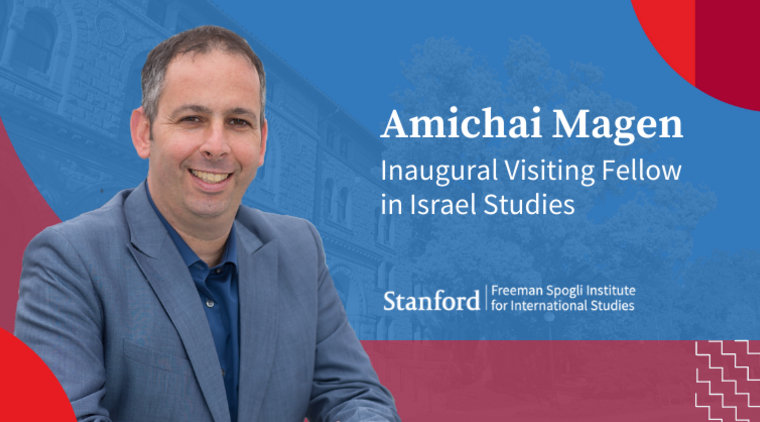
Spring quarter at Stanford will bring a familiar face back to campus, though in a new role and in a new program. Amichai Magen, an alumnus of Stanford Law School (’08), and formerly a pre-doctoral fellow and scholar at the Center on Democracy, Development, and the Rule of Law (CDDRL), will return as the inaugural visiting fellow in Israel Studies and visiting associate professor. 

Based at the Freeman Spogli Institute for International Studies (FSI), the Visiting Fellow in Israel Studies program was established with the generous support of Stanford alumni and donors. 

As a visiting fellow, Dr. Magen will teach the spring quarter course “Israel: Society, Politics and Policy,” and will help guide FSI programming related to Israel, as well as advise and engage Stanford students and faculty. His appointment, which follows the arrival to the program of Or Rabinowitz in fall 2022 as a visiting associate professor, will be based at CDDRL.

In the below Q&A with FSI, Dr. Magen explains what he’s missed most about Stanford, the goals of his spring quarter course, his work back in Israel, and his takeaways on Israel’s development as a democracy as it approaches its 75th year of independence.

In 2004-2008 you were a CDDRL predoctoral fellow and CDDRL affiliated scholar in 2008-2009. What have you missed about being on “the Farm,” and what excites you most about being back? 


My years as a predoctoral fellow and affiliated scholar at CDDRL were among the most formative and productive of my adult life. CDDRL was then, and remains, a model academic community for me; one that has continuously guided me as a scholar, teacher, and academic manager. Indeed, CDDRL shaped me in at least three profound ways: as a scholar, teacher, and institution-builder. 

As a young scholar, I was incredibly fortunate to join a vibrant, multidisciplinary hub of cutting-edge research and open intellectual debate. I remember CDDRL as a place buzzing with creative energy, ideas, and engagement in the key challenges of the time (such as understanding the color revolutions of 2003-2004; the challenges of political violence and governance failures in the Middle East; and how the European Union and United States approached democracy and rule of law promotion). Even though I was a “minion among giants” I was embraced as a valuable intellectual partner who was to be entrusted with real responsibility and empowered through active work as part of the CDDRL community. In that context, I was encouraged to innovate, to cut my teeth on exciting new projects, and to grow as a scholar. In terms of teaching, I was mentored by the best (wisest, toughest, fairest) mentors I could have hoped for, and was given my first opportunities to teach. 

Lastly, in 2004-2009 CDDRL was still very young, which meant that I got to observe, and even play a modest role in, its nascent institutional development. It is very rare that a young scholar gets to experience from the inside how a new world-class institution like CDDRL is built in real time. I still remember CDDRL's 5th anniversary retreat; where we took stock of the foundational years of the Center and debated where it should go next and how to best achieve the center's mission. Naturally, I have really missed Stanford's unique spirit and intellectual DNA. Over the past two decades, I believe that I have taken part of that Stanford spirit with me wherever I went – in my research and writing, teaching, and civic activism – but clearly that spirit is strongest at the source. Returning to "the Farm" is a real homecoming experience for me. This time I'll also be able to share it with my family, which is priceless.

You’ll be teaching a new course, “Israel: Society, Politics and Policy.” Why did you choose to teach this course, and what do you hope students will gain from it? 


Few countries in the world have captured the American imagination, or receive international attention, as much as Israel. At the same time, few countries are as poorly understood. Whether for reasons of geographical or cultural distance, Israel's rapid transformation into a high-tech superpower over the past three decades, or competing political and media agendas, this intriguing and surprisingly influential country is rarely explored for what it is - a human society, polity, constitutional system, and policy actor that is best understood in historical and comparative context. The purpose of the course is to do just that; to go "beyond the headlines" and seek to understand Israel as a society, political order, and international actor. Students who take the course should expect to gain a grounded, up-to-date understanding of modern Israel, but also to deepen their knowledge of the Middle East, aspects of U.S. foreign policy, and acquire tools to better understand the broader international system.

In Israel you are director of the Program on Democratic Resilience and Development at the Lauder School of Government, Diplomacy and Strategy at Reichman University. Can you tell us about your work there, and your research interests? 


The Program on Democratic Resilience and Development (PDRD) at the Lauder School of Government, Diplomacy, and Strategy, Reichman University, is an interdisciplinary research, educational, and policy platform dedicated to the understanding and nurturing of free and responsible societies in Israel and around the world. Established in 2020, in partnership with the Konrad-Adenauer-Stiftung, PDRD seeks to better understand, protect and promote the values, institutions, and processes that enable human beings to create and sustain conditions of human dignity, security, liberty, and wellbeing. We also analyze twenty-first century threats to those values, institutions, and processes, and seek to nurture a cadre of young leaders committed to freedom and responsibility. In many respects, therefore, the Program on Democratic Resilience and Development at Reichman University is an initiative that has learned from, and echoes CDDRL. 

My own research is really centered around the perpetual human quest for good political order. Specifically, I am interested in the package of values, institutions, and processes that have given us the miracle of liberal modernity, and how to protect and adapt that miracle in the face of 21st century challenges. In this context, I have written extensively about statehood and areas of limited statehood, democracy, the rule of law, and political violence. I am increasingly interested in exploring whether and how liberal political orders (domestic, regional, and global) could generate "solution-structures" to the great fears of our age.

Israel is approaching its 75th year of independence. What are your takeaways on the development of Israel’s democratic institutions and governance at this milestone? 


I wrote about this topic recently in Yascha Mounk's "Persuasion." I would add that, at the moment, Israel's 75th anniversary could be remembered in one of two strongly divergent ways. If current efforts to achieve a broad national agreement on democracy-preserving/enhancing constitutional reforms are successful, 2023 would be remembered as "Israel's constitutional moment" – the point at which, following a brief crisis and mass popular mobilization for democracy, responsibility and moderation prevailed, and Israel finally moved to enact a clear constitutional framework in the spirit of its liberal Declaration of Independence. Conversely, if the current legislative agenda advanced by Prime Minister Benjamin Netanyahu to weaken the Israeli judiciary is enacted, Israel will enter an unprecedented, and dangerous, constitutional limbo – a "clash of authorities" between the government and the rule of law, the outcome of which is anyone's guess. 

Israelis can (and do) look back at 75 years of remarkable democratic success under conditions of extreme adversity. Israel has faced several crises in the past that could have destroyed its democracy, but didn't (for example, the Yom Kippur War; economic meltdown/hyperinflation in the mid-1980s; the assassination of PM Yitzhak Rabin). This is testimony to Israel's history of democratic resilience, but what about now? I am still hopeful that our current national leadership will step back from the brink, decide to seek a responsible compromise that is acceptable to a broad majority of all Israelis, and that ultimately we will emerge from this crisis stronger and with better constitutional protections. Over the past three months, hundreds of thousands of Israelis have exhibited outstanding civic responsibility, demonstrating peacefully but vigorously to protect their democracy. If Israel's elected leaders take example from the people of Israel, the country will pass the current "stress test" and its democracy may well emerge stronger from the test. The stakes are extremely high. 

Israel is a country that demands a lot from its citizens and the people of Israel are accustomed to be free. Many Israelis will simply not accept losing their open society and democratic ethos. They will not innovate, fight, or sacrifice for a non-democratic regime. Ultimately, Israel will be a modern liberal democracy, or it will falter, perhaps catastrophically. That is a very powerful incentive to be a democracy.

Media contact: Ari Chasnoff, director of communications, Freeman Spogli Institite for International Studies

Amichai Magen

Amichai Magen

Visiting Fellow in Israel Studies
Full Bio

Read More

Amichai Magen joins the Freeman Spogli Institute as its inaugural Visiting Fellow in Israel Studies.
News

Amichai Magen Selected as Inaugural Visiting Fellow in Israel Studies

Magen, a scholar of law, government and international relations, will arrive at Stanford in the 2022-2023 academic year.
Amichai Magen Selected as Inaugural Visiting Fellow in Israel Studies
News

FSI’s Visiting Fellowship in Israel Studies Brings Or Rabinowitz to the Center for International Security and Cooperation

Dr. Or Rabinowitz of Hebrew University, Jerusalem, whose research explores how nuclear technology interacts with decision-making, strategy, and diplomacy, will come to Stanford in the 2022-2023 academic year as a visiting fellow in Israel Studies.
FSI’s Visiting Fellowship in Israel Studies Brings Or Rabinowitz to the Center for International Security and Cooperation
Larry Diamond, center, with the Mosbacher family - Nancy, Bruce, Emily and Jack.
News

Larry Diamond Named Mosbacher Senior Fellow in Global Democracy at the Freeman Spogli Institute for International Studies

CDDRL’s Larry Diamond, a world-renowned expert on comparative democracy, is recognized for a career of impact on students, policymakers and democratic activists around the world.
Larry Diamond Named Mosbacher Senior Fellow in Global Democracy at the Freeman Spogli Institute for International Studies
Hero Image
Amichai Magen joins the Freeman Spogli Institute as its inaugural Visiting Fellow in Israel Studies.
All News button
1
Subtitle

In spring quarter, Magen, a scholar of law, government, and international relations, will teach “Israel: Society, Politics and Policy.”

Date Label
News Type
News
Date
Paragraphs

The Freeman Spogli Institute for International Studies (FSI) is pleased to announce that Or Rabinowitz will come to Stanford for the 2022-23 academic year as part of the institute’s new Visiting Fellowship in Israel Studies. Dr. Rabinowitz is currently a Senior Lecturer in International Relations at Hebrew University, Jerusalem.

During her time at Stanford as a visiting fellow in Israel Studies, Dr. Rabinowitz will teach a one quarter long undergraduate course on “Israel: National Security and Nuclear Policy.” She will also organize and run an international workshop on “Deterrence and Weapons of Mass Destruction in the Middle East” in the spring or summer quarters of 2023, and engage with Stanford pre- and postdoctoral fellows and FSI faculty.

Dr. Rabinowitz’s appointment will be based at FSI’s Center for International Security and Cooperation.

“Or Rabinowitz is one of Israel’s finest scholars writing about nuclear proliferation, deterrence, and national security policy,” said Scott Sagan, co-director of CISAC.  “Stanford is really fortunate to be able to bring her to campus for a year under this program.”

Or Rabinowitz is one of Israel’s finest scholars writing about nuclear proliferation, deterrence, and national security policy. Stanford is really fortunate to be able to bring her to campus for a year under this program.
Scott Sagan
Co-director of the Center for International Security and Cooperation

Dr. Rabinowitz’s current research lies at the intersection of nuclear and intelligence studies, with a focus on Israel’s nuclear program and the role of science and technology in its national security doctrine. Her book, “Bargaining on Nuclear Tests: Washington and its Cold War Deals” was published in April 2014 by Oxford University Press, and she has since published articles in International Security, Journal of Strategic Studies, The International History Review and the Bulletin of the Atomic Scientists, among others.

She holds a PhD degree from the War Studies Department of King’s College London, an MA degree in Security Studies and an LLB degree in Law, both from Tel-Aviv University. She is currently conducting a study on intelligence collaboration between allies in the realm of counter-proliferation operations, funded by the Israel Science Foundation.

“I am honored to be joining Stanford this coming academic year, and to share my knowledge about Israel with Stanford’s undergraduates,” said Dr. Rabinowitz. “CISAC is a global leader when it comes to producing new knowledge and insight about the challenges of nuclear proliferation, and being chosen as an Israel Studies Fellow is a true privilege.”

Dr. Rabinowitz’s many awards and honors include being named an Israeli Chevening Scholar by the British Foreign and Commonwealth Office, and receiving The Scouloudi Award from the Institute of Historical Research, University of London. In 2018 she also won the Professor Ya’acov Barsimantov Best Article Award from the Israeli Association for International Studies.

The Visiting Fellowship in Israel Studies was launched in September 2021 with the generous support of Stanford alumni and donors. The search committee included senior fellows from throughout the institute. In addition to bringing to Dr. Rabinowitz to Stanford, the committee selected Dr. Amichai Magen, a scholar of law, government and international relations, as the inaugural Visiting Fellow in Israel Studies. Dr. Magen will also arrive at Stanford in the 2022-2023 academic year.

Read More

Amichai Magen joins the Freeman Spogli Institute as its inaugural Visiting Fellow in Israel Studies.
News

Amichai Magen Selected as Inaugural Visiting Fellow in Israel Studies

Magen, a scholar of law, government and international relations, will arrive at Stanford in the 2022-2023 academic year.
Amichai Magen Selected as Inaugural Visiting Fellow in Israel Studies
Hakeem Jefferson
News

Welcoming Hakeem Jefferson to CDDRL

Jefferson, an assistant professor of political science at Stanford University, will join the center as a faculty affiliate.
Welcoming Hakeem Jefferson to CDDRL
All News button
1
Subtitle

Dr. Or Rabinowitz of Hebrew University, Jerusalem, whose research explores how nuclear technology interacts with decision-making, strategy, and diplomacy, will come to Stanford in the 2022-2023 academic year as a visiting fellow in Israel Studies.

Date Label
News Type
News
Date
Paragraphs

The Freeman Spogli Institute for International Studies (FSI) is pleased to announce that Amichai Magen has been selected as the inaugural Visiting Fellow in Israel Studies. Dr. Magen is currently the head of the MA program in Diplomacy and Conflict Studies, and director of the Program on Democratic Resilience & Development at the Lauder School of Government, Diplomacy, and Strategy at Reichman University, in Herzliya, Israel.

As a Visiting Fellow in Israel Studies, Dr. Magen will teach courses on Israeli politics, society, and policy, and also on his recent research regarding liberal orders, governance in areas of limited statehood, and political violence. In addition, he will help guide FSI programming related to Israel, advise and engage Stanford students and faculty.

An alumnus of Stanford Law School, where he obtained his JSD in 2008, he has also been a pre-doctoral scholar at the Center on Democracy, Development, and the Rule of Law (CDDRL) and a National Fellow at the Hoover Institution.

“I’ve had the pleasure of publishing a book with Amichai before, and can attest that he’s a first-rate scholar and academic,” said FSI Director Michael McFaul. “I recall a conversation between us when Amichai was a pre-doctoral fellow at CDDRL, and I told him that once you arrive at Stanford you spend the rest of your life trying to make it back here. I’m delighted that time will come soon.”

The son of refugees from Nazi Germany and Soviet-occupied Latvia, Dr. Magen's scholarship addresses the constitutive elements, vulnerabilities, and evolution of modern liberal political and legal orders – notably statehood, democracy, the rule of law, and regionalism – as well as Israel's place in such orders.

Amichai Magen brings a brilliant scholarly mind, a great love of teaching, and broad expertise on Israeli politics, society, public policy, and regional relations. He's going to contribute greatly to the research work of CDDRL with his expertise.
Larry Diamond
Mosbacher Senior Fellow in Global Democracy at FSI

Dr. Magen’s current research examines limited statehood, governance failures, and political violence in the international system, and his book on the subject is forthcoming from Stanford University Press. During his time at Stanford, Dr. Magen will be based at FSI’s Center on Democracy, Development, and the Rule of Law.

“I am thrilled that CDDRL will have the opportunity to host and welcome back Dr. Amichai Magen,” said Kathryn Stoner, the Mosbacher Director of Center on Democracy, Development, and the Rule of Law. “He was an outstanding contributor to the Center in its earliest days, and I know that he will be an outstanding inaugural Israel Fellow. I look forward to working with him again.”

In addition to his academic duties, Dr. Magen has also served on the executive committee of the World Jewish Congress, and is a board member of the International Coalition for Democratic Renewal, the Israel Council on Foreign Relations, and the Israeli Association for the Study of European Integration. He regularly briefs diplomats, journalists, and academics from around the world on Israeli political, constitutional, and geopolitical affairs.

“I am delighted to return to Stanford and engage with the many talented faculty and students on this unique campus,” said Dr. Magen. “FSI was my intellectual home as a graduate student at Stanford, and a model academic community that has shaped my subsequent career as a researcher and teacher. This is a real homecoming moment for me, and I am deeply grateful to be granted the opportunity to be a part of this wonderful community once again.”

The Visiting Fellow in Israel Studies program was launched in September 2021 with the generous support of Stanford alumni and donors. The search committee was led by Larry Diamond, the Mosbacher Senior Fellow in Global Democracy at FSI, and included other senior fellows from throughout the institute.

“In developing and anchoring the program over the next three years, Amichai Magen will bring a brilliant scholarly mind, a great love of teaching, and broad expertise on Israeli politics, society, public policy, and regional relations,” said Diamond. “In addition, he will contribute greatly to the research work of CDDRL with his expertise on governance crises, limited statehood, and challenges to the liberal international order.”

In addition to Dr. Magen, the Visiting Fellow in Israel Studies program plans to bring a second Israeli visiting fellow to teach and conduct research during the next academic year. Media inquiries about the program can be directed to Ari Chasnoff, FSI’s associate director for communications.

Read More

Hakeem Jefferson
News

Welcoming Hakeem Jefferson to CDDRL

Jefferson, an assistant professor of political science at Stanford University, will join the center as a faculty affiliate.
Welcoming Hakeem Jefferson to CDDRL
Hero Image
Amichai Magen joins the Freeman Spogli Institute as its inaugural Visiting Fellow in Israel Studies.
Amichai Magen will join the Freeman Spogli Institute as its inaugural Visiting Fellow in Israel Studies in the 2022-23 academic year.
All News button
1
Subtitle

Magen, a scholar of law, government and international relations, will arrive at Stanford in the 2022-2023 academic year.

Date Label
News Type
News
Date
Paragraphs

Please note that the submission deadline has passed and applications are no longer being accepted.

The Freeman Spogli Institute for International Studies (FSI) is pleased to announce a new visiting fellowship in Israel studies.  This unique position will appoint an Israel-based scholar to serve as a recurrent visiting fellow at FSI, Stanford, for a period of three years.  The visiting fellow will spend at least one academic quarter (Autumn, Winter or Spring) at Stanford University in each of the next three academic years (2022-23, '23-'24, and '24-'25). Should the visiting fellow be available for a longer visit, the program could support up to a year-long visit during one of these three years, ideally in the first year, and it might be able to support a longer visit in other years. The visiting fellow will be asked to teach at least one course during the quarter of the visit (or at least two during an academic year) on some aspect of Israel’s politics, society, economy, modern history, technological development, and/or regional or international relations.

Quarter-long visitors will be expected to be present on campus full-time (save for possible short trips) over the course of the quarter. The position is open to applicants in all social science disciplines as well as history and other fields bearing on public policy.  Applicants are expected to have outstanding records of scholarship and teaching, and tenured faculty from Israeli universities (with the equivalent rank of Associate Professor or higher) are strongly preferred.

In addition to teaching, the position also requires:

  • Agreement from the professor’s university in Israel to grant the professor leave to teach one quarter per year at Stanford for three consecutive years. Salary for the duration of a quarter-length term (three months) at Stanford would be provided at a rate approved by Stanford University and would take into account the cost of housing in the Stanford area. A quarter-long appointment would not be benefits-eligible as it is less than six months. Travel and relocation expenses would be reimbursed.
  • Willingness to advise and mentor Stanford students (graduate and undergraduate) interested in Israel, during the quarter in residence.
  • A commitment to organize at least one major public event or small-scale workshop on Israel during the professor’s quarter in residence on campus. 
  • Willingness to engage Stanford faculty interested in Israel and the Middle East, and to participate in discussions about how Stanford could deepen academic ties with Israel.

Applicants should submit by November 15, 2021, a current c.v., at least one syllabus or description of a course they might teach, and a letter describing their research, teaching, and interest in the program. 

Read More

Autumn scene on the Stanford campus with a call to apply for APARC's 2022-23 fellowships for Asia schoalrs
News

APARC Announces 2022-23 Fellowships for Asia Specialists

The Center offers fellowships for postdoctoral scholars specializing in contemporary Asia, Japan, and Asia health policy and for experts on Southeast Asia.
APARC Announces 2022-23 Fellowships for Asia Specialists
CDDRL Pre and Postdocs over black and white background of Encina Hall
News

Introducing Our 2021-22 Pre and Postdoctoral Fellows

The Center on Democracy, Development and the Rule of Law (CDDRL) is pleased to welcome six pre- and postdoctoral fellows who will be joining us for the 2021-22 academic year. These scholars will spend the academic year focusing on the Center's four program areas of democracy, development, evaluating the efficacy of democracy promotion, and rule of law.
Introducing Our 2021-22 Pre and Postdoctoral Fellows
Hero Image
encina
All News button
1
Subtitle

The visiting fellow will teach at least one course during the quarter of the visit on some aspect of Israel’s politics, society, economy, modern history, technological development and/or regional or international relations.

Subscribe to Israel Fellows