
Conference organizer: Nancy Ruttenburg

What is conscience, what was conscience, and what is its future?

The purpose of the conference is to examine the authority of conscience as it is presently invoked in various arenas of contemporary life—including law, medicine, journalism, and politics—and as its meaning is inflected by scholarly debates in the fields of history, literature, religious studies, psychology, and philosophy. From their various fields of expertise and interest, participants will address the central question the conference raises: in our post-Freudian and post-Nietzschean age, to what degree does conscience possess the kind of authority that an earlier and less secular age reserved for first things? This question entails a host of others.  Do our invocations of conscience reveal it to be the still-vital residue of a kind of certainty linked to infallible authority from which we cannot alienate ourselves even when we’d like to? If so, is the enduring vitality of conscience a sign that the process of secularization remains incomplete, even in secular rationalists, those who might consider themselves to be exempt from the religiosity that distinguishes United States culture from those of other modern Western democracies? Do we regard conscience as a type of knowledge? Or is it possible to understand conscience ontologically, as a category of self or mind that—insofar as it speaks to all humanity by means of a "small, still voice" issuing from each human heart—bridges the gap between individual and corporate being? Whether or not underwritten by a discipline or a tradition, conscience is commonly invoked to justify a range of acts and behaviors: what relation do these invocations of moral law, even when unexamined, bear to the burgeoning interest in ethics we see across the humanities disciplines and into the legal, medical, and journalistic fields? Between the extremes of authoritarianism and anarchy, where do we place conscience in American political life and how do we understand its peculiar agency?


CONFERENCE VIDEO AND AUDIO RECORDINGS:

Please click on the panel titles and the keynote speaker's name below to view videos and listen to audios of each:

November 8, 2012
Panel 1:  The Pre-Revolutionary Conscience: From Religious Burden to Natural Right (video)
Panel 2:  MIA: Conscience and the First Amendment (video)
Panel 3:  Roundtable: The Religious Conscience in Modernity (audio only)
Panel 4:  Conscience/Ethics: The Secular Conscience (audio only)

November 9, 2012
Panel 5:  Conscience and Reportage (video)
Panel 6:  Roundtable: Embodied Conscience (video)
Panel 7:  Roundtable: Conscientious Objection (video)
Keynote:  Anne Aghion, award-winning documentary filmmaker (video)


PROGRAM AND PARTICIPANTS:

Opening Event: Wednesday, November 7, 6:00-8:30 p.m.
Screening of  keynote speaker Anne Aghion’s documentary film, My Neighbor, My Killer, to be introduced by the filmmaker.  Will be held in the Oksenberg Conference Room, Encina Hall Central, 3rd floor.

  • 6:00 p.m.  Reception
  • 6:30 p.m.  Screening

For more information on the film, please visit this event listing on our website by clicking <here>.


Thursday, November 8, 9:00 a.m. - 7:00 p.m:
Conscience and its Conceptual Evolution: Religion/Rights/Ethics

  • 9:00 – 9:30  Opening Remarks:  Nancy Ruttenburg, Organizer

Thursday Morning Panels:  What Was Conscience?  The American Context

  • 9:30 – 11:30:  The Pre-Revolutionary Conscience: From Religious Burden to Natural Right

1) Andrew Murphy, Associate Professor of Political Science, and Director of the Walt Whitman Center for the Culture and Politics of Democracy, Rutgers University, author of Conscience and Community: Revisiting Toleration and Religious Dissent in Early Modern England and America and Prodigal Nation: Moral Decline and Divine Punishment from New England to 9/11.

2) Mark Valeri, E. T. Thompson Professor of Church History, Union Presbyterian Seminary. Among the editors of the multi-volume Works of Jonathan Edwards, he is the author most recently of Heavenly Merchandize: How Religion Shaped Commerce in Puritan America.

Stanford Respondent:  Caroline Winterer, Professor of History, Professor by courtesy of Classics

  • 11:45 – 1:45:  MIA: Conscience and the First Amendment

1) Jack Rakove, William Robertson Coe Professor of History and American Studies and Professor of Political Science at Stanford, where has taught since 1980. He is the author of six books, including Original Meanings: Politics and Ideas in the Making of the Constitution (1996), which received the Pulitzer Prize in History, and Revolutionaries: A New History of the Invention of America (2010), which was a finalist for the George Washington Prize. He is currently at work on Beyond Belief, Beyond Conscience: The Radical Significance of the Free Exercise of Religion, which will be part of the Oxford University Press series on Inalienable Rights.

2) Michael J. Perry, Robert W. Woodruff Professor of Law, and Senior Fellow for the Center for the Study of Law and Religion, Emory University School of Law.  Author most recently of The Political Morality of Liberal Democracy; Constitutional Rights, Moral Controversy, and the Supreme Court; Toward a Theory of Human Rights: Religion, Law, Courts; and Under God?: Religious Faith and Liberal Democracy.

Stanford Respondent:  Derek Webb, Fellow, Constitutional Law Center, Stanford


 Thursday Afternoon Panels:  What Is Conscience:  The Secular/Religious Divide

  • 2:45 – 4:45: Roundtable: The Religious Conscience in Modernity: 

1) Nathan Chapman, Executive Director of the Stanford Constitutional Law Center who joined the Law School as a Fellow in 2010.  After clerking for the Honorable Judge Gerald Bard Tjoflat on the United States Court of Appeals for the Eleventh Circuit Court, he practiced with WilmerHale in Washington, D.C. He graduated from Duke University School of Law and Duke Divinity School in 2007.  His most recent publications include Disentangling Conscience and Religion, 2013 U. Ill. L. Rev. (forthcoming) and Due Process As Separation of Powers, 121 Yale L. J. 1672 (2012) (with Michael W. McConnell).

2) Steven Knapp, President of the George Washington University since August 2007, former Dean of Arts and Sciences and subsequently Provost at Johns Hopkins University, and Professor of English at UC Berkeley.  Author most recently with Philip Clayton of The Predicament of Belief: Science, Philosophy, Faith.  A specialist in Romanticism, literary theory, and the relation of literature to philosophy and religion, Dr. Knapp earned his doctorate and masters degrees from Cornell University and his Bachelor of Arts degree from Yale University.

3) Arnold Eisen, Chancellor, Jewish Theological Seminary, NYC.  Author most recently of Rethinking Modern Judaism: Ritual, Commandment, Community and Taking Hold of Torah: Jewish Commitment and Community in America.

Stanford Moderator: Nancy Ruttenburg, William Robertson Coe Professor of American Literature, Professor by Courtesy of Comparative Literature and Slavic, Director, Stanford Center for the Study of the Novel

  • 5:00 – 7:00: Conscience/Ethics: The Secular Conscience 

1) Jay M. Bernstein, University Distinguished Professor, New School for Social Research.  Author most recently of Against Voluptuous Bodies: Adorno’s Late Modernism and the Meaning of Painting; Adorno: Disenchantment and Ethics; and a co-authored volume published through UC Berkeley’s Townsend Center entitled Art and Aesthetics After Adorno.

2) Kent Greenawalt, University Professor, former Editor-in-Chief of the Columbia Law Review, Columbia Law School.  Author, among many other works, of Religion and the Constitution: Vol. I: Free Exercise and Fairness and Vol. II: Establishment and Fairness, as well as Does God Belong in Public Schools? and Private Consciences and Public Reasons.

Stanford Respondent:  Nancy Ruttenburg, William Robertson Coe Professor of American Literature, Professor by Courtesy of Comparative Literature and Slavic, Director of Stanford Center for the Study of the Novel


Friday, November 9, 9:00 a.m. - 6:45 p.m.
Contemporary Casuistry: Cases of Conscience in Action

Friday Morning Panels: Narrating Conscience: Modes of Witnessing

  • 9:00 – 11:00: Conscience and Reportage

1) Dr. Sheri Fink, M.D., Ph.D., 2010 Pulitzer Prize- and National Magazine Award-winner in investigative journalism for “The Deadly Choices at Memorial” about difficult choices made at a New Orleans hospital during the aftermath of Katrina; contributor to ProPublica who has reported globally on health, medicine, and science; senior fellow with the New America Foundation and the Harvard Humanitarian Initiative; author of War Hospital: A True Story of Surgery and Survival (2003) during the Balkan crisis, winner of the American Medical Writer’s Association special book award and finalist for PEN Martha Albrand awards.

2) Colin Dayan, Robert Penn Warren Professor in the Humanities, Vanderbilt, and expert in literary, legal, and religious studies of the Americas; books include Haiti, History, and the Gods (1998); The Story of Cruel and Unusual (2007); and, most recently, The Law is a White Dog: How Legal Rituals Make and Unmake Persons, selected as a Choice top-25 "outstanding academic book of 2011."

Stanford Respondent: David Palumbo-Liu, Louise Hewlett Nixon Professor, Professor of Comparative Literature, Professor by courtesy of English 

  • 11:15 – 1:15:  Roundtable: Embodied Conscience 

1) Dr. Abraham Verghese, author of the novel Cutting for Stone (2010)as well as the non-fiction works, My Own Country: A Doctor’s Story (1995)about his experience as a physician working in rural Tennessee at the beginning of the AIDS crisis, and The Tennis Partner: A Story of Friendship and Loss (1998).  Currently Professor for the Theory and Practice of Medicine and Senior Associate Chair of the Department of Internal Medicine, Stanford.

2) Mark Johnson, Philip H. Knight Professor of Liberal Arts and Sciences, Department of Philosophy, University of Oregon.  Author most recently of The Meaning of the Body: Aesthetics of Human Understanding, Philosophy in the Flesh: The Embodied Mind and its Challenge to Western Thought (co-authored with George Lakoff); Moral Imagination: Implications of Cognitive Science for Ethics; and a second edition of Metaphors We Live By (co-authored with George Lakoff).

3) Dr. Fady Joudah, Internal Medicine and Palestinian-American poet; former practitioner with Doctors Without Borders in Darfur, Sudan and Zambia; translator of the poetry of Mahmoud Darwish and Ghassan Zaqtan, and 2007 winner of the Yale Series of Younger Poets Competition for The Earth in the Attic (2008).

Stanford Moderator:  Blakey Vermeule, Professor of English


Friday Afternoon Panels:  Conscience in the World: Problems of Toleration and Intervention

  • 2:30 – 4:30:  Roundtable: Conscientious Objection 

1) Air Force Reserve Col. Steven Kleinman, Senior Intelligence Officer, U.S. Air Force; a widely recognized subject matter expert with extensive experience in human intelligence operations, special operations, strategic interrogation, and resistance to interrogation; Senior Advisor to the Intelligence Science Board’s study “Educing Information” which issued guidelines for improving the government’s interrogation techniques. Publicly opposed “enhanced interrogation” techniques for battling the war on terror in testimony before the Senate Armed Services Committee, the Senate Select Committee on Intelligence, and the House Judiciary Committee.  Authored numerous articles laying out his argument against torture published in several peer-reviewed professional journals, the law review of the City University of New York and Valparaiso University law schools, and the Nieman Foundation for Journalism at Harvard.

2) Eyal Press, author of Beautiful Souls: Saying No, Breaking Ranks, and Heeding the Voice of Conscience in Dark Times and Absolute Convictions; contributor to several journals, including The Nation, The New York Review of Books, The New York Times Magazine, Mother Jones, The Atlantic Monthly, and others. 

3) Yusef Komunyakaa: Global Distinguished Professor of English, NYU, Vietnam veteran and Pulitzer Prize-winning poet whose collections include The Chameleon Couch, Taboo: The Wishbone Trilogy, Pleasure Dome and many others.

Stanford Moderator:  Debra Satz, Associate Dean of Humanities, Marta Sutton Weeks Professor of Ethics in Society; Professor of Philosophy and by courtesy Political Science; Research Affiliate, Program on Global Justice


4:45 – 6:45: KEYNOTE ADDRESS:  ANNE AGHION

For her work on the gacaca trials in post-genocide Rwanda, documentary filmmaker Anne Aghion won the UNESCO Fellini Prize, an Emmy Award, the Human Rights Watch 2009 Nestor Almendros Prize, and she was a nominee for the 2009 Gotham Award. Her feature-length documentary, My Neighbor, My Killer, was one of the few documentaries to be an Official Selection at the Cannes Film Festival.

 
Co-sponsored by The Europe Center, Stanford Arts Institute (formerly Stanford Institute for Creativity and the Arts), Stanford Law School, School of Humanities and Sciences, Office of the Dean of Humanities, Creative Writing Program, Stanford Humanities Center, Department of English, Taube Center for Jewish Studies, Division of Literatures, Cultures, and Languages, Center for Ethics in Society, Department of Art & Art History, the Department of Philosophy, and the Department of History.
 
Please visit the conference website at: https://conscienceconference2012.wordpress.com/


Bechtel Conference Center

Conferences
Authors
Francis Fukuyama
News Type
Commentary
Date
Paragraphs
In the May-June edition of The American Interest, Francis Fukuyama traces the contemporary history of U.S. development policy and its failure to incorporate Huntingtonian-style theory, which emphasizes the interconnectedness of economy, politics, and society. Using Egypt as an example, Fukuyama calls for policymakers to break down their silos to more holistically examine and support democratic transitions.

While academic political science has not had much to tell policymakers of late, there is one book that stands out as being singularly relevant to the events currently unfolding in Tunisia, Egypt and other Middle Eastern countries: Samuel Huntington’s Political Order in Changing Societies, first published over forty years ago.1 Huntington was one of the last social scientists to try to understand the linkages between political, economic and social change in a comprehensive way, and the weakness of subsequent efforts to maintain this kind of large perspective is one reason we have such difficulties, intellectually and in policy terms, in keeping up with our contemporary world.

Huntington, observing the high levels of political instability plaguing countries in the developing world during the 1950s and 1960s, noted that increasing levels of economic and social development often led to coups, revolutions and military takeovers rather than a smooth transition to modern liberal democracy. The reason, he pointed out, was the gap that appeared between the hopes and expectations of newly mobilized, educated and economically empowered people on the one hand, and the existing political system, which did not offer them an institutionalized mechanism for political participation, on the other. He might have added that such poorly institutionalized regimes are also often subject to crony capitalism, which fails to provide jobs and incomes to the newly educated middle class. Attacks against the existing political order, he noted, are seldom driven by the poorest of the poor; they instead tend to be led by rising middle classes who are frustrated by the lack of political and economic opportunity—a phenomenon noted by Alexis de Tocqueville in his masterful analysis of the origins of the French Revolution and raised again in the early 1960s by James Davies’s well known “J-curve” theory of revolution.2

Something like this Huntingtonian process has unfolded in recent months in both Tunisia and Egypt. In both cases, anti-government protests were led not by the urban poor or by an Islamist underground, but by relatively well-educated middle-class young people used to communicating with each other via Facebook and Twitter. It is no accident that Wael Ghonim, Google’s regional head of marketing, emerged as a symbol and leader of the new Egypt. The protesters’ grievances centered around the fact that the authoritarian regimes of Ben Ali and Mubarak offered them no meaningful pathway to political participation, as well as failing to provide jobs befitting their social status. The protests were then joined by other groups in both societies—trade unionists, Islamists, peasants and virtually everyone else unhappy with the old regimes—but the driving force remained the more modern segments of Tunisian and Egyptian society.

Societies lacking institutions that could accommodate new social actors produced a condition Huntington labeled praetorianism, in which political participation took the form of strikes, demonstrations, protests and violence. The military often seized power in such circumstances because it was the only organized actor in society capable of running a government. The Egyptian Republic’s first autocrat, Gamal Abdel Nasser, came to power in precisely this manner back in July 1952, when his Free Officers movement represented the rising Egyptian middle class. The tragedy of modern Egypt is that there has been scarcely any meaningful political development in the more than half-century since then—meaning, in Huntington’s terms, the rise of modern institutions that could peacefully channel citizen participation.

Socioeconomic development, meanwhile, has proceeded apace: Between 1990–2010 Tunisia’s Human Development Index (a composite measure of health, education and income compiled by the UN) rose 30 percent, while Egypt’s rose 28 percent. Both countries produced tens of thousands of college graduates with no discernable future and a lopsided income distribution in which a disproportionate share of the gains from growth went to a small group of politically connected insiders. Huntington’s analysis of Egypt in the 1950s and 1960s thus remains eerily relevant today.

In Political Order Huntington was also making a broader point about the process of development itself. The significance of his book needs to be seen against the backdrop of post-World War II modernization theory, which in turn drew on classic 19th-century European social theory articulated by academics like Edward Shils, Talcott Parsons and Walt W. Rostow. American modernization theory argued that development was a single, seamless process. Economic development, changing social relationships like the breakdown of extended kinship groups and the growth of individualism, higher and more inclusive levels of education, normative shifts toward values like “achievement” and rationality, secularization and the growth of democratic political institutions, were all seen as an interdependent whole.

By pointing out that the good things of modernity did not necessarily go together, Huntington played a key role in killing off modernization theory. Political development was a separate process from socioeconomic development, he argued, and needed to be understood in its own terms. The conclusion that flowed from this point of view seemed at the time counterintuitive to the point of stunning: Without political development, the other aspects of modernization could lead to bad results—to tyranny, civil war and mass violence.

There were other reasons why Western modernization theory fell into disrepute by the 1970s: It came to be regarded as too Eurocentric—indeed, as too Americentric insofar as it seemed to posit American society as the pinnacle of modernization. It failed to recognize the possibility that countries like Japan and China might take roads to modernity that would look very different from the ones pioneered by Britain and the United States. But even if one agreed that the end point of development should be some form of industrialized liberal democracy, Huntington made it clear that arriving at the desired destination was far more elusive and complicated than modernization theorists believed.

The central piece of policy advice that emerged out of Huntington’s work was the concept of the “authoritarian transition.” If political systems opened up to democratic contestation too early, before the development of political parties, labor unions, professional associations and other organizations that could structure participation, the result could be chaotic. Authoritarian regimes that could maintain order and promote economic growth, Huntington argued, might oversee a more gradual institutionalization of society, and make a transition to democracy only when broad participation could be peacefully accommodated. This form of sequencing, in which economic development was promoted before a democratic opening, was the path followed by Asian countries like South Korea and Taiwan, which made democratic transitions in the late 1980s only after they had succeeded in turning themselves into industrialized powerhouses. It was also the development strategy recommended by Huntington’s former student Fareed Zakaria, as well as by the leaders of many authoritarian governments, who liked the idea of economic growth better than the idea of democratic participation.3 We will return to the question of how well that strategy worked in the Middle East later.

Development in Silos 

As interesting and important as Huntington’s work was, it lay outside of mainstream thinking about development, which from the start was a highly Balkanized academic field that was dominated by economists. Few scholars have sought to understand development as an inter-connected process with political, economic and social parts. Few scholars have sought to understand development as an inter-connected process with political, economic and social parts.Development economists looked primarily at economic factors like capital, labor and technology as sources of economic growth, and thought neither about the consequences of growth for politics nor the relationship of political institutions to growth. The Harrod-Domar growth model that was dominant in the 1950s suggested that less-developed countries were poor primarily because they lacked capital, which then led development agencies like the World Bank to try to kick start growth with generous infusions of capital for physical infrastructure. It was only when steel plants and shoe factories in sub-Saharan Africa went idle due to corruption or lack of organizational capacity that they were forced to go back to the drawing board.

The political scientists, for their part, scaled back their ambitions from large Huntingtonian-style theory and focused primarily on political phenomena. Beginning in the 1980s, there was increasing interest in the problem of transitions into and out of democracy; with democratic transitions in Spain, Portugal and nearly all of Latin America, this became a particularly pressing issue. There was some revival of interest in the democracy-development linkage, but it never led to a clear consensus on the causal links connecting the two phenomena.

The academic interest in transitions corresponded to the burgeoning of democracy promotion as a distinct field of international practice, both on the part of the United States and of other democracies around the world. The idea was planted during the 1970s, when the institutes linked with the German political parties played a key role in beating back an attempted Communist takeover in Portugal and facilitating that country’s transition to democracy. The 1980s saw the establishment of the National Endowment for Democracy (NED), a taxpayer-funded but quasi-independent organization devoted to support of pro-democracy groups around the world. One of the NED’s early successes was its funding of the Solidarity trade union in Poland before the collapse of communism. The 1990s saw the growth of a host of international organizations capable of monitoring elections and the funding of the Democracy and Governance branch of the U.S. Agency for International Development to the tune of almost $1.5 billion annually.

By the late 1990s, there was some degree of convergence in the agendas of economists and political scientists. By that point Douglass North and the school of “New Institutional Economics” he founded made economists aware of the importance of political institutions—particularly property rights—for economic growth. Economists increasingly sought to fold political variables like legal systems and checks on executive power into their models. Political science had itself been colonized at this point by economic methodology, and it was natural for such rational-choice political scientists to start looking at the economic impact of political institutions.

The return to a more interdisciplinary approach to development was marked as well by the tenure of James Wolfenson as President of the World Bank from 1995 to 2005.4 Wolfenson early on gave a speech on the “cancer of corruption” and signaled to the institution that, henceforth, political issues like corruption and good governance would be taken seriously. The publication of the 1997 World Development Report, The State in a Changing World, marked an intellectual break with the Washington Consensus focus on economic policy and state downsizing, and the Bank created a new branch devoted to reform of developing country public sectors. These changes constituted an open admission that politics was a critical component of development, and that the state was not simply an obstacle to growth but often a necessary underpinning for it. Increasingly, donor agencies have seen the promotion of democratic accountability as one tool in the fight against corruption.

This modest degree of convergence should not, however, obscure the continuing degree of compartmentalization that exists in the field of development. While paying lip service to the importance of institutions, most economists and field practitioners still see politics as at best an obstacle to the real work of development, which is improvement in incomes, health, education and the like, and not as an independent objective of development strategy. (Amartya Sen is an important exception to this generalization.) The democracy promotion agencies, for their part, spend relatively little time worrying about economic growth, social policy or public health, which in their view are goods often used by authoritarian regimes to buy off populations and prevent democratization.

The intellectual confusion surrounding development has led to severely Balkanized policies both in the United States and in the international community that often work at cross purposes from one another.The intellectual confusion surrounding development has led to severely Balkanized policies both in the United States and in the international community that often work at cross purposes from one another. For example, the authoritarian or semi-authoritarian regimes of Meles Zenawi in Ethiopia, Paul Kagame in Rwanda and Yoweri Museveni in Uganda have been aid darlings over the past decade because of their track records in promoting economic, health and social goals. At the same time, democracy promotion groups have been highly critical of them and have supported opposition groups and civil society organizations seeking accountability and limits on executive power. To be sure, aid agencies don’t object to greater government accountability on the part of these regimes, while the democracy promotion community wouldn’t stand in the way of progress on HIV/AIDS or malaria. Yet no one takes a larger view and asks, for example, whether existing aid programs are helping to keep the regime in power or, conversely, are destabilizing it.

Egypt itself presents a good case of this particular form of policy incoherence. Despite the fact that Egypt ranks as one of the top American aid recipients, it is hard to say that Washington was pursuing development goals of any sort there. The United States was primarily interested in stability. Despite brave speeches on democracy by both Condeleezza Rice and Barack Obama in Cairo, the United States actually pulled its punches in pushing serious democratic reform on Egypt, particularly after the Hamas electoral victory in Gaza in 2006. Nonetheless, U.S. economic aid programs were still pushing education and economic policy reform programs in the country. Had American aid administrators taken the Huntingtonian view that their assistance was covertly designed to promote an expectations gap and delegitimate Hosni Mubarak, this might have been a clever strategy. But no such cleverness existed. Instead, it was simply an example of compartmentalized aid programs doing their thing in ignorance of the interdependent effects of politics and economics.

What Is to Be Done?

Ideas precede action. Before we can hope to generate a coherent set of policies for Egypt, or anywhere else for that matter, we need a better understanding of development—that is, how changes in economy, politics and society over time constitute a set of discrete yet interlinked processes. Whatever the shortcomings of classic modernization theory, it at least began from the insight that the phenomenon under study required development of a master social science that transcended existing disciplinary boundaries. This objective is as far away as ever in academia, where the traditional disciplines keep a chokehold on how younger academics think and do research. Today, the single most popular form of development dissertation in both economics and political science is a randomized micro-experiment in which the graduate student goes out into the field and studies, at a local level, the impact of some intervention like the introduction of co-payments for malaria mosquito netting or changes in electoral rules on ethnic voting. These studies can be technically well designed, and they certainly have their place in evaluating projects at a micro level. But they do not aggregate upwards into anything that can tell us when a regime crosses the line into illegitimacy, or how economic growth is changing the class structure of a society. We are not, in other words, producing new Samuel Huntingtons, with the latter’s simultaneous breadth and depth of knowledge.

On a policy level, we need far more mutual understanding between those who promote socioeconomic development and those who work on democracy promotion and governance.On a policy level, we need far more mutual understanding between those who promote socioeconomic development and those who work on democracy promotion and governance. Traditional development agencies like USAID already think politically to the extent that their aid projects are designed to support U.S. foreign policy. But they, like their counterparts in multilateral organizations like the World Bank, are not trained to do political economy analysis; they do not seek an understanding of the political context within which aid is used and abused, and what is not sought is very rarely found. We call for the liberalization of ports in Haiti, for example, without trying to understand which particular politicians are benefiting from existing arrangements that keep them closed. For their part, democracy promoters focus on democratic transitions, providing help to opposition parties and civil society organizations in authoritarian countries. But once a transition occurs, as it did after the Orange and Rose revolutions in Ukraine and Georgia, they have relatively little to offer new democratic governments in terms of policy agendas, anti-corruption strategies or help in improving the delivery of services that citizens want.

Beyond these relatively minor adjustments, a more robust theory of social change might tell us that, in certain circumstances, the best way to destabilize an authoritarian society would be not the funding of civil society groups seeking short-term regime change, but rather the promotion of rapid economic growth and the expansion of educational access.5 Conversely, there are many societies we know will simply waste development assistance dollars because they are ruled by unaccountable authoritarian regimes. In such circumstances, it might be a more efficient use of aid resources to cut development aid entirely and to work only for political change. This is, in effect, what has happened to Zimbabwe under Robert Mugabe, but the country had to sink very far before anyone considered pulling the aid plug.

Huntington got a number of things wrong. The authoritarian transition was not a universally applicable formula for development. It worked reasonably well in East Asia, where there were a number of figures like Lee Kwan Yew, Park Chung-hee or the Chinese Communist Party leadership, who used their autocratic powers to promote rapid development and social change. Arab authoritarians were cut from a different cloth, content to preside over economically stagnant societies. The result was not a coherent development strategy but a wasted generation.

The aspiration of social science to replicate the predictability and formality of certain natural sciences is, in the end, a hopeless endeavor. Human societies, as Friedrich Hayek, Karl Popper and others understood, are far too complex to model at an aggregate level. Contemporary macroeconomics, despite dealing with social phenomena that are inherently quantified, is today in crisis due to its utter failure to anticipate the recent financial crisis.

The part of social change that is the hardest to understand in a positivistic way is the moral dimension—that is, the ideas that people carry around in their heads regarding legitimacy, justice, dignity and community. The current Arab uprising was triggered by the self-immolation of an overeducated 26-year-old Tunisian vegetable seller whose cart was repeatedly confiscated by the authorities. After Mohamed Bouazizi was slapped by a policewoman when he tried to complain, he reached the end of his tether. Bouazizi’s public suicide turned into a social movement because contemporary communications technologies facilitated the growth of a new social space where middle-class people could recognize and organize around their common interests. We will probably never understand, even in retrospect, why the dry tinder of outraged dignity suddenly ignited in this fashion in December 2010 as opposed to 2009, or ten years before that, and why the conflagration spread to some Arab countries but not to others. But we can certainly do a better job in putting together the few pieces we do understand, in a way that would be useful to policymakers coping with the reality of social change.

1Huntington, Political Order in Changing Societies: With a New Forward by Francis Fukuyama (Yale University Press, 2006).

2Davies, “Towards a Theory of Revolution”, American Sociological Review, Vol. 27 (1962).

3Zakaria, The Future of Freedom: Illiberal Democracy at Home and Abroad (W. W. Norton, 2003); see also Zakaria, “A Conversation with Lee Kuan Yew”, Foreign Affairs (March/April 1994).

4For a description of the Wolfenson presidency, see Sebastian Mallaby, The World’s Banker: A Story of Failed States, Financial Crises, and the Wealth and Poverty of Nations (Penguin Press, 2004).

5See Harold James’s retroview, entitled “Growing Pains”, of a classic December 1963 essay by Mancur Olson (“Rapid Growth as a Destabilizing Force”) in The American Interest (September/October 2006).

Hero Image
fukuyama headshot
All News button
1
-

Bruce Jones will present on the World Bank's 2011 World Development Report, on "Conflict, Security and Development." The report, which is the World Bank's flagship annual research product, reviews and challenges previous Bank findings on the causes of conflict and fragility; provides new research findings on strategies for recovery from conflict and violence; and sets out a series of directions for national policy and international institutional reform. Dr. Jones will brief on these, as well as on the politics of research and implementation at the World Bank and the UN.

Dr. Bruce Jones is director and senior fellow of the NYU Center on International Cooperation, and senior fellow and director of the Managing Global Insecurity Program at the Brookings Institution. Currently, his is also the Senior External Advisor for the World Bank's Development Report (WDR) on Conflict, Security and Development. Jones will provide an overview and account of the WDR and will be joined by Dr. Francis Fukuyama who will participate as a discussant on the topic.

In March 2010, Jones was appointed by the United Nations Secretary-General as a member of the Senior Advisory Group to guide the Review of International Civilian Capacities.
Dr. Jones’ research focuses on US policy on global order and transnational threats; on multilateral institutions in peace and security issues; on the role of the United Nations in conflict management and international security; and on global peacekeeping, post-conflict operations and fragile state engagements.

Prior to assuming the Directorship of the Center, Dr. Jones served in several capacities at the United Nations. He was Senior Advisor in the Office of the Secretary-General during the UN reform effort leading up to the World Summit 2005, and in the same period was Acting Secretary of the Secretary-General’s Policy Committee. In 2004-2005, he was Deputy Research Director of the High-level Panel on Threats, Challenges and Change. From 2000-2002 he was Special Assistant to the UN Special Coordinator for the Middle East peace process; and held assignments in the UN Interim Mission in Kosovo, and in the Office for the Coordination of Humanitarian Affairs.  

Dr. Jones has been interviewed by or cited in US and international media, including the New York Times, LA Times, Globe and Mail, BBC, CNN, Fox, NPR, and Al Jazeera.
Dr. Jones holds a Ph.D. from the London School of Economics; and was Hamburg Fellow in Conflict Prevention at Stanford University. He is co-author with Carlos Pascual and Stephen Stedman of Power and Responsibility: Building International Order in an Era of Transnational Threats (Brookings Press, 2009); co-editor with Shepard Forman of Cooperating for Peace and Security (Cambridge University Press, 2009); author of Peacemaking in Rwanda: The Dynamics of Failures; Series Editor of the Annual Review of Global Peace Operations (Lynne Reinner) and author of several book chapters and journal articles on US strategy, global order, the Middle East, peacekeeping, post-conflict peacebuilding, and strategic coordination.

He is Consulting Professor at Stanford University, Adjunct Faculty at the NYU Wagner School of Public Service, and Professor by Courtesy at the NYU Department of Politics.

CISAC Conference Room

CDDRL
Encina Hall, C152
616 Jane Stanford Way
Stanford, CA 94305-6055

(650) 725-2705 (650) 724-2996
0
Senior Fellow at the Freeman Spogli Institute for International Studies
Professor, by courtesy, of Political Science
Stedman_Steve.jpg PhD

Stephen Stedman is a Senior Fellow at the Freeman Spogli Institute for International Studies (FSI) and the Center on Democracy, Development and the Rule of Law (CDDRL), an affiliated faculty member at CISAC, and professor of political science (by courtesy) at Stanford University. He is director of CDDRL's Fisher Family Honors Program in Democracy, Development and Rule of Law, and will be faculty director of the Program on International Relations in the School of Humanities and Sciences effective Fall 2025.

In 2011-12 Professor Stedman served as the Director for the Global Commission on Elections, Democracy, and Security, a body of eminent persons tasked with developing recommendations on promoting and protecting the integrity of elections and international electoral assistance. The Commission is a joint project of the Kofi Annan Foundation and International IDEA, an intergovernmental organization that works on international democracy and electoral assistance.

In 2003-04 Professor Stedman was Research Director of the United Nations High-level Panel on Threats, Challenges and Change and was a principal drafter of the Panel’s report, A More Secure World: Our Shared Responsibility.

In 2005 he served as Assistant Secretary-General and Special Advisor to the Secretary- General of the United Nations, with responsibility for working with governments to adopt the Panel’s recommendations for strengthening collective security and for implementing changes within the United Nations Secretariat, including the creation of a Peacebuilding Support Office, a Counter Terrorism Task Force, and a Policy Committee to act as a cabinet to the Secretary-General.

His most recent book, with Bruce Jones and Carlos Pascual, is Power and Responsibility: Creating International Order in an Era of Transnational Threats (Washington DC: Brookings Institution, 2009).

Director, Fisher Family Honors Program in Democracy, Development and Rule of Law
Director, Program in International Relations
Affiliated faculty at the Center for International Security and Cooperation
Date Label
Stephen J. Stedman Senior Fellow Moderator Stanford University

Encina Hall, C148
616 Jane Stanford Way
Stanford, CA 94305

0
Olivier Nomellini Senior Fellow at the Freeman Spogli Institute for International Studies
Director of the Ford Dorsey Master's in International Policy
Research Affiliate at The Europe Center
Professor by Courtesy, Department of Political Science
yff-2021-14290_6500x4500_square.jpg

Francis Fukuyama is the Olivier Nomellini Senior Fellow at Stanford University's Freeman Spogli Institute for International Studies (FSI), and a faculty member of FSI's Center on Democracy, Development and the Rule of Law (CDDRL). He is also Director of Stanford's Ford Dorsey Master's in International Policy, and a professor (by courtesy) of Political Science.

Dr. Fukuyama has written widely on issues in development and international politics. His 1992 book, The End of History and the Last Man, has appeared in over twenty foreign editions. His book In the Realm of the Last Man: A Memoir will be published in fall 2026.

Francis Fukuyama received his B.A. from Cornell University in classics, and his Ph.D. from Harvard in Political Science. He was a member of the Political Science Department of the RAND Corporation, and of the Policy Planning Staff of the US Department of State. From 1996-2000 he was Omer L. and Nancy Hirst Professor of Public Policy at the School of Public Policy at George Mason University, and from 2001-2010 he was Bernard L. Schwartz Professor of International Political Economy at the Paul H. Nitze School of Advanced International Studies, Johns Hopkins University. He served as a member of the President’s Council on Bioethics from 2001-2004. He is editor-in-chief of American Purpose, an online journal.

Dr. Fukuyama holds honorary doctorates from Connecticut College, Doane College, Doshisha University (Japan), Kansai University (Japan), Aarhus University (Denmark), the Pardee Rand Graduate School, and Adam Mickiewicz University (Poland). He is a non-resident fellow at the Carnegie Endowment for International Peace. He is a member of the Board of Trustees of the Rand Corporation, the Board of Trustees of Freedom House, and the Board of the Volcker Alliance. He is a fellow of the National Academy for Public Administration, a member of the American Political Science Association, and of the Council on Foreign Relations. He is married to Laura Holmgren and has three children.

(October 2025)
CV
Date Label
Francis Fukuyama Senior Fellow Panelist Stanford University
Bruce Jones Director and Senior Fellow Speaker NYU Center on International Cooperation
Seminars
News Type
News
Date
Paragraphs

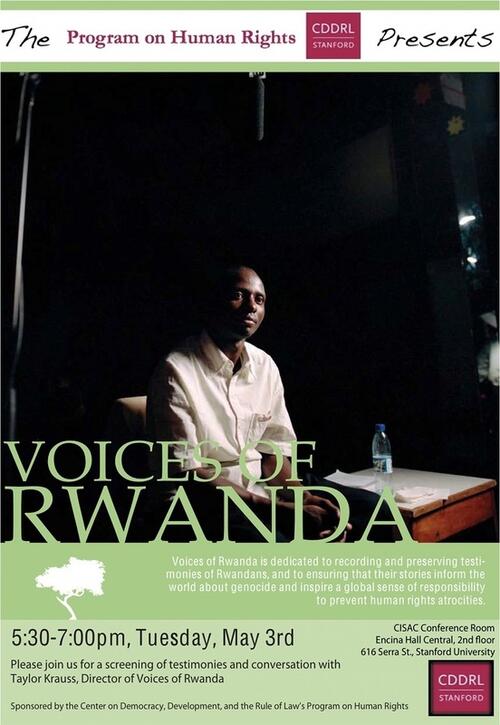
On May 3, 2011, the Program on Human Rights at CDDRL hosted Taylor Krauss, executive director of Voices of Rwanda and an award-winning video-journalist. Krauss screened a short film of testimonies from survivors of the Rwandan genocide to a rapt audience of 40 at the CISAC Central Conference room in Encina Hall. Learn more about Voices of Rwanda and view clips of testimony at http://www.voicesofrwanda.org.

All News button
1
Authors
Larry Diamond
News Type
Commentary
Date
Paragraphs

Each president of the United States enters office thinking he will be able to define the agenda and set the course of America's relations with the rest of the world. And, almost invariably, each confronts crises that are thrust upon him-wars, revolutions, genocides, and deadly confrontations. Neither Woodrow Wilson nor FDR imagined having to plunge America into world war. Truman had to act quickly, and with little preparation, to confront the menace of Soviet expansion at war's end. JFK, for all his readiness to "bear any burden" in the struggle for freedom, did not expect his struggle to contain Soviet imperial ambitions would come so close to the brink of nuclear annihilation. Nixon was tested by a surprise war in the Middle East. Carter's presidency was consumed by the Shah's unraveling and the Iranian revolution. George H.W. Bush rose to the challenge of communism's collapse and Saddam Hussein's invasion of Kuwait. Clinton squandered the opportunity to stop a genocide in Rwanda and waited tragically too long before stopping one in Bosnia. George W. Bush mobilized the country to strike back after September 11, but, in the view of many, he put most of his chips in the wrong war.

In the eye of the historical storm, and in the absence of a challenge as immediate and overpowering as September 11, Pearl Harbor, or the Nazis' march across Europe, it is risky to identify any set of world events as game-changing. Yet that is what many analysts, including myself, believe the Arab revolutions of 2011 are. And a surprising number of specialists-including hard-eyed realists like Fareed Zakaria-have seized upon the crisis in Libya as a defining moment not just for the United States in the region but for the foreign policy presidency of Barack Obama as well.

To date, one could say that Obama has had a surprisingly good run for a foreign policy neophyte. He has revived the momentum for arms control with a new START treaty with Russia, while pressing the issue of human rights within Russia. He has managed the meteoric rise of China decently, while improving relations with India. He has not cut and run from Iraq-as most Republicans were convinced he would. And he has ramped up but at least set limits to our involvement in Afghanistan. As the Arab revolutions have gathered momentum, he has increasingly positioned the United States on the side of democratic change. His statements and actions have not gone as far as democracy promotion advocates (like myself) would have preferred, but they have overridden cautionary warnings of the foreign policy establishment in the State Department, the Pentagon, think tanks, and so on. Without Obama's artful choreography of public statements and private messages and pressures, Hosni Mubarak might still be in power today.

All of this, however, may appear in time only a prelude to the fateful choice that Obama will soon have to make-and, one fears, is already making by default in a tragically wrong way-in Libya. Why is Libya-with its six million people and its significant but still modest share of global oil exports-so important? Why must the fight against Muammar Qaddafi-a crazy and vicious dictator, but by now, in his capacity for global mischief, a largely defanged one-be our fight?

When presidents are tested by crisis, the world draws their measure, and the impressions formed can have big consequences down the road. After watching Jimmy Carter's weak and vacillating posture on Iran, the Soviets figured he'd sit on the sidelines if they invaded and swallowed Afghanistan. They misjudged, but Afghanistan and the world are still paying the price for that misperception. In the face of mixed messages and a long, cynical game of balance-of-power, Saddam too, misjudged that he could get away with swallowing up Kuwait in 1991. When the United States did not prepare for war as naked aggression swept across Asia and Europe, the Japanese thought a quick strike could disable and knock out the slumbering American giant across the Pacific. When Slobodan Milosevic and his Bosnian Serb allies launched their war of "ethnic cleansing," while "the West"-which is always to say, first and foremost, the United States-wrung its hands, many tens of thousands of innocent people were murdered and raped before President Bill Clinton finally found the resolve to mix air power and diplomacy to bring the genocidal violence to a halt.

If Muammar Qaddafi succeeds in crushing the Libyan revolt, as he is well on his way to doing, the U.S. foreign policy establishment will heave a sad sigh of regret and say, in essence, "That's the nasty business of world politics." In other words: nasty, but not our business. And so: not their blood on our hands. But, when we have encouraged them to stand up for their freedom, and when they have asked for our very limited help, it becomes our business. On February 23, President Obama said: "The United States ... strongly supports the universal rights of the Libyan people. That includes the rights of peaceful assembly, free speech, and the ability of the Libyan people to determine their own destiny. These are human rights. They are not negotiable. ... And they cannot be denied through violence or suppression." Yet denying them through murderous violence and merciless suppression-with a massacre of semi-genocidal proportions likely waiting as the end game in Benghazi-is exactly what Qaddafi is in the process of doing.

Barack Obama has bluntly declared that Qaddafi must go. The Libyan resistance, based in Benghazi, has appealed urgently for the imposition of a no-fly zone. Incredibly, the Arab League has endorsed the call, as has the Gulf Cooperation Council. France has recognized the rebel provisional government based in Benghazi as Libya's legitimate government-while Obama studies this all. Can anyone remember a time when France and the Arab League were ahead of the United States on a question of defending freedom fighters?

There is much more that can be done beyond imposing a no-fly zone. No one in their right mind is calling for putting American boots on the ground in Libya. But we can jam Qaddafi's communications. We can, and urgently should, get humanitarian supplies and communications equipment, including satellite modems for connection to the Internet, to the rebels in Benghazi, where they can be supplied by sea. And we should find a way to get them arms as well. Benghazi is not a minor desert town. It is Libya's second largest city, a major industrial and commercial hub, and a significant port. Through it, a revolt can be supplied. If Benghazi falls to Qaddafi, it will fall hard and bloodily, and the thud will be heard throughout the world.

Time may be running out. As the Los Angeles Times reported yesterday, "All that stands between Kadafi and rebel headquarters in Benghazi are disorganized volunteers and army defectors spread thinly along the coastal highway." They have passion and courage, but they lack weaponry, strategy, and training. Like so many rebel movements, they need time to pull these all together. Time is what a no-fly zone and an emergency supply line can buy them.

Libya's rebels are pleading for our help. "Where is America?" asked one of them, quoted in the L.A. Times, who was manning a checkpoint in Port Brega. "All they do is talk, talk, talk. They need to get rid of these planes killing Libyan people." The "they" he was referring to was the Americans, beginning with their leader-one would hope, still the leader of the "free world"-President Obama.

Many prudent reasons have been offered for doing nothing. It is not our fight. They might lose anyway. We don't know who these rebels really are. We have too many other commitments. And so on. The cautions sound reasonable, except that we have heard them all before. Think Mostar and Srebrenica. And we had a lot of commitments in World War II as well, when we could have and should have bombed the industrial infrastructure of the Holocaust. As for the possibility that the rebels might lose-a prospect that is a possibility if we aid them and a near certainty if we do not-which would be the greater ignominy: To have given Libya's rebels the support they asked for while they failed, or to have stood by and done absolutely nothing except talk while they were mowed down in the face of meek American protests that the Qaddafi's violence is "unacceptable"?

Oh yes. There is also the danger that China will veto a U.N. Security Council Resolution calling for a no-fly zone. Part of us should hope they do. Let the rising superpower-more cynical than the reigning one ever was-feel the first hot flash of hatred by Arabs feeling betrayed. Go ahead, make our day.

Presidents do not get elected to make easy decisions, and they certainly never become great doing so. They do not get credit just because they go along with what the diplomatic and military establishments tell them are the "wise and prudent" thing to do. This is not Hungary in 1956. There is no one standing behind Qaddafi-not the Soviet Union then, not the Arab League now, not even the entirety of his own army. That is why he must recruit mercenaries to save him. Qaddafi is the kind of neighborhood bully that Slobodan Milosevic was. And he must be met by the same kind of principled power. For America to do less than that now-less than the minimum that the Libyan rebels and the Arab neighbors are requesting-would be to shrink into global vacillation and ultimately irrelevance. If Barack Obama cannot face down a modest thug who is hated by most of his own people and by every neighboring government, who can he confront anywhere?

For the United States-and for Barack Obama-there is much more at stake in Libya than the fate of one more Arab state, or even the entire region. And the clock is ticking.

Hero Image
Larry Diamond website pic
All News button
1
Authors
News Type
News
Date
Paragraphs

There are more laws and international treaties designed to protect human rights in conflict zones than ever before. Yet civilians continue to pay the ultimate price, with women and children frequently caught in the crossfire. At the beginning of the 20th century, there was one civilian casualty for every eight or nine military casualties, said Richard Goldstone, the South African jurist who played a key role in helping his country overcome apartheid, served as the chief prosecutor of the International Criminal Tribunals on Rwanda and the former Yugoslavia, and became a household name in 2009 for his controversial fact-finding mission after an Israeli offensive in the Gaza Strip. During World War II, the ratio increased to 1-to-1. Today, after what was, Goldstone said, a "very bloody century," every combatant casualty is matched by nine civilian deaths.

What explains this? Goldstone joined Stanford historian James Campbell and Peter Berkowitz, a political scientist, to grapple with this paradox as part of Stanford's Ethics and War Series, co-sponsored by the Center for International Security and Cooperation.

One reason behind this seeming disconnect is that gaping anomalies remain in the international legal system. It is a "very recent development that international laws have been designed to protect civilians and civilian objects," said Goldstone. Another cause of the paradox is that the most critical issue in determining whether the death of a civilian constitutes a war crime is highly subjective. The so-called principle of proportionality, defined by the Law of Armed Conflict, requires that parties refrain from attacks resulting in excessive civilian casualties. But it is up to "reasonable commanders" to judge whether such violence is justified, said Berkowitz, a senior fellow at the Hoover Institution.

Compounding the problem is that in many of the nations where crimes against civilians may have been committed, there is little interest or even open hostility toward allowing international fact-finding missions to make an assessment. Moreover, many of the transnational organizations designed to help protect civilians simply fail to do so. Goldstone said the UN should be commended for assisting the injured in Gaza but "stands condemned for ignoring the plight of Tamils."

A better system might include requiring greater education in military affairs for human rights lawyers, Berkowitz said. Goldstone's report on the Gaza conflict, Berkowitz argued, failed to properly evaluate whether the civilian cost was a military necessity, noting that Goldstone did not assess whether "reasonable" Israeli commanders had intended to avoid civilian casualties. A better understanding of military procedure, Berkowitz suggested, might have helped Goldstone and others in a similar situation make that kind of assessment.

The United States may also have a role to play in filling in the gaps in the international justice system. Campbell said that the Geneva Convention of 1949, which extended legal protection to war victims, was largely an American construction. Indeed, Berkowitz said that America has "special burdens" to spread liberal democracy across the world. However, the U.S. was reluctant to sign the Convention on the Rights of the Child, ratified by 194 U.N. nations that would protect women and children, said Helen Stacy, a senior fellow at the Center for Democracy, Development, and the Rule of Law.

How some of these issues will be resolved is still an open question. Human rights laws are complex and evolving, said Campbell. "Just as freedom is a constant struggle, so is international humanitarian law," he said. The important part was that the legal system continues to grapple with these issues. The struggle toward an effective system of international justice is being "waged in our country," he said, "in dialogues like the ones we are having today."

Hero Image
Afghanistan refugeesthumb
All News button
1
News Type
News
Date
Paragraphs
Nathan Eagle, Founder and CEO of txteagle spoke at the weekly Liberation Technology Seminar Series on Dececember 2, 2010 about mobile phone usage in the developing world.

Although txteagle began in 2007 as a purely academic project, the current goal of the company and of its founder and CEO, Nathan Eagle, is to give one billion people a five percent raise. In his presentation, Eagle described the context for which txteagle was designed, how the company's focus has evolved over the past three years, and what steps the company is taking to move closer to achieving this goal in the future.

Image
6373 small Nathan E1
Eagle began by offering some background information to explain the initial impetus behind txteagle. Today, about 63% of global mobile phone usage takes place in the developing world, making airtime usage in emerging markets worth about $200 billion a year. Mobile phone users at the so-called "Base of the Pyramid" typically spend 10% of their income on mobile phone airtime. Through his experience living in emerging markets and teaching mobile application development in universities across sub-Saharan Africa, Eagle began to see that a significant opportunity space existed to reduce the cost of airtime for people at the base of the pyramid, in effect giving these people a raise.

Mobile applications developed as a part of MIT's Entrepreneurial Research on Programming and Research on Mobiles (EPROM) project offered some insights into the potential of mobile-based tools. In Rwanda, where electricity is a prepaid service, one of Eagle's former students quickly cornered a significant share of the market by creating scratch cards for crediting one's electricity bill via mobile phone. In Eastern Kenya, a program called SMS Blood Bank was created to enable real time monitoring of blood supplies at local district hospitals in Eastern Kenya. Although SMS reporting of low blood levels resolved the huge amount of latency in the system of local district hospitals (where responses to dips in supply had typically taken up to 4 weeks), the price of reporting blood levels via SMS represented a pay cut for local nurses; despite nurses' initial enthusiasm, SMS reporting tapered off within weeks. When the idea of sending about 10 cents of airtime to compensate nurses for each SMS report of blood level data proved a success, the model behind txteagle was born.

Designed as a means to monetize people's downtime, txteagle has grown rapidly through partnerships with over 220 mobile operators in about 80 countries around the world. In turn for helping these operators analyze their customer data, txteagle has gained access to about 2.1 billion mobile subscribers. Partnering with txteagle is a winning proposition for mobile operators, since the airtime compensation mobile subscribers receive from txteagle improves operators' Average Revenue per User (ARPU), a statistic that had been plummeting as more and more poor people became mobile phone users. By enabling people to carry out work via web browsers or SMS and compensating them via mobile money or airtime, txteagle has become a market leader at efficiently gathering data in the developing world.

Since txteagle was first created, the company has attempted to move from an outsourcing/back-office model to an emphasis on work that leverages a person's unique local knowledge and information. Typically outsourced tasks such as forms processing, audio transcription, inventory management, data cleaning, tagging, and internet search, tend to be less rewarding to the worker. By focusing on local data instead, txteagle enables unprecedented insight into emerging markets, all while optimizing engagement with local customers. Typical tasks include: maps and directions, local market prices and businesses, survey research and polling, and other forms of local knowledge gathering.

One of txteagle's central initiatives, GroundTruth, leverages this local knowledge-based model to carry out better market research. Today, global brands are already spending about $125 billion annually in emerging markets to engage the "next billion," but they typically carry out this research in a sub-optimal way. Through the txteagle platform, Eagle suggests, brands and organizations can use advertising money to design better products and services, conduct market research, and carry out brand engagement. Recent success cases include the use of txteagle to help a program of the United Nations to reach survey respondents directly and to enable the World Bank to obtain better local market price data at lower cost. 

Although txteagle's rapid growth and early successes have been encouraging, the company has ambitious goals for the next two years. The company began by focusing on outside sales through its GroundTruth market research program. Next year, the company  hopes to generate syndicated data and ultimately to create a self-source platform enabling anyone to conduct their own population-level surveys.  By continuing to focus on improving the quality of both their data and workers over time, txteagle aims to have an even greater positive impact on the incomes of the hundreds of millions of mobile phone users at the base of the pyramid.

All News button
1
News Type
News
Date
Paragraphs

As a little girl Susie Linfield was captivated by a book she discovered on her parents' bookshelf entitled The Black Book of Polish Jewry. Published in the early 1940s, it included photos of starving Jews in the ghettos. “I was grieved by them. I was shamed by them. But I was also sort of compelled by them,” says Linfield, the director of the Cultural Reporting and Criticism Program at New York University. Decades later, she reflected again on the way photographs informed her view of war and atrocities as she examined the photos emerging from the Balkans, Rwanda, and other trouble spots. In her new book, The Cruel Radiance: Photography and Political Violence (University of Chicago Press), Linfield returns to this theme. She recently gave a talk at Stanford as part of the Stanford Ethics & War Series (2010-2011), sponsored in part by the Center for International Security and Cooperation, and she spoke with CISAC about changes in photojournalism, the political context behind warfare, and what she calls “the ethics of seeing.” Excerpts:

CISAC: In your book you look at two different approaches to war photography—that of Robert Capa, the Hungarian war photographer of the 1930s and 1940s, and the modern war photographer James Nachtwey, who has chronicled more recent conflict. How are world events reflected in their photography?

Linfield: One of the observations in my book is that war and its related atrocities are photographed in a much more graphic way than they used to be. The level of atrocity and bodily disfigurement that we are now used to seeing in photographs is something very different than the kind of photojournalism that was done in the 1920s through the 1950s. That connects in some ways to the lessening of political certainty. In other words, the kind of political and ideological factors that used to determine war are much less prevalent in a lot of the wars that are being fought now. If you look at the war in the Congo, it’s just a horrific, horrific situation with millions of people killed. But it’s very hard to understand that war in any sort of traditional political paradigm, certainly not the paradigm of something like the Spanish civil war. There, one could understand the political dynamics and certainly feel solidarity with one side or another. With a lot of the wars we're presented with now, I think that kind of solidarity and political clarity is very, very hard to come by. So I think what we’re presented with visually is the bodily disfigurement, the tortured bodies, but without any kind of political context in which to understand it.

CISAC: How are today’s photos perceived by viewers, as opposed to back in Capa’s time?

L: I think there’s much more resistance to seeing photographs now than there was in Capa’s time. And again I think that’s connected to the lack of political clarity. People aren’t really sure why they’re seeing them or what to think when they do, and I think that has turned into a resentment against photography and against photojournalism in particular—that we’re just being assaulted by these meaningless images. These images aren’t meaningless. But they do take a lot of work to try to understand.

CISAC: How is this tied to ethics?

L: I think there is something I would call the ethics of seeing. To me that’s not an instantaneous thing. It would be very connected to the idea of really trying to delve into the histories that these photographs suggest and really trying to understand them and understand the causes of the violence. And in terms of the ethics of showing, I am much less critical of photojournalists than I think a lot of other critics are, especially with someone like James Nachtwey. He’s accused of being a pornographer, exploiting—his stuff is disgusting, unbearable, unwatchable. And it is disgusting and unbearable in certain ways, but I don’t think he’s a pornographer. And I don’t think he’s a nihilist. I think he’s showing us images that are very, very difficult to look at. And they’re very, very difficult to look at for two reasons. One, the explicitness of them is very, very painful. To see bodies that tormented is extraordinarily painful. And I think they’re also difficult to look at because it’s very hard to have a political context in which to understand these images. In a certain sense we’re sort of left with our troubled emotions, but not really knowing what to do with them.

All News button
1
Subscribe to Rwanda