


The Chronicle of Philanthropy: Improving Lives Through Better Vision
News Type
News
Date
Paragraphs
After "a longtime partnership with Stanford University's Rural Education Action Program," OneSight is expanding into Rwanda and Brazil to continue our practice of providing free eyeglasses to those in critical need, explains author Julian Wyllie.
"OneSight builds eye-examination centers and helps train ophthalmologists in dozens of countries and is expanding into new areas including Rwanda and Brazil."
Hero Image

All News button
1
FSI fellow underscores importance of foreign area studies
News Type
News
Date
Paragraphs
Nearly 250,000 refugees stopped to rest at the foot of an active volcano in the Democratic Republic of the Congo, recalled Thomas Fingar, referring to a situation in 1994 when he served as the deputy assistant secretary for analysis at the State Department. Officials asked him how to respond. Would the volcano erupt? If so, which way would the lava, ash and gas plumes travel? Must the refugees, exhausted from leaving Rwanda, be relocated to a safer venue? Aid workers had to decide whether to move the refugees and risk death by fatigue, or leave them there and risk death from the volcano. Specialized knowledge was required to make a decision. Fingar directed Bureau staff to find a volcanologist with expertise on that particular volcano–the Nyiragongo–and its surrounding area. It was likely to erupt, the expert informed them, and the path of volcanic debris would be away from where the refugees were assembled. Consequently, the refugees did not have to move.
That example was one of many illustrations that Fingar, the Oksenberg-Rohlen distinguished fellow at the Freeman Spogli Institute, offered in a keynote speech delivered at the College of William & Mary, drawing upon his 15 years of experience in senior U.S. national security roles.
His presentation entitled, “National Security in the Global Era,” was part of a three-day conference at the Reves Center for International Studies that gathered a cadre of experts to examine the future of global education.
Specialized area studies and foreign language education have reached a critical point in the age of globalization. The current trend is one of steady cuts in funding. If it is not reversed, the nation will quickly lose critical capabilities. Fingar argued that the teaching and study of foreign languages and areas are more important than ever before.
 |
|
Fingar (at Left) speaks with colleagues at the conference, which convened a wide range of leaders with global expertise. |
“Meeting challenges, managing threats and taking advantage of opportunities on a global scale require different and deeper kinds of knowledge than was required during the Cold War,” he said.
Any effective strategy or policy – whether addressing economic, health or terrorism-related concerns – requires in-depth understanding of the countries involved, especially as new transnational threats and global developments emerge.
“If we do not understand, and cannot communicate with, the still highly diverse world, the downsides and dangers of globalization will erode our prosperity, endanger our safety and degrade our security.”
The full text of his speech is available below.
Hero Image

All News button
1
Katy Long
Encina Hall
0
katy.long@stanford.edu
Katy Long's research focuses on migration, citizenship and refugee issues, especially responses to long term crisis and conflict -- both by the international humanitarian and political communities and by refugees and migrants themselves. Although her work looks at global policy implications, she has carried out detailed fieldwork in Guatemala, Rwanda and Uganda.
Katy has written extensively on these topics, and in 2013 The Point of No Return: Refugees, Rights and Repatriation -- a monograph based on her Ph.D research into "durable solutions" to refugee crises (Cambridge, 2009) -- was published by Oxford University Press. Prior to taking up posts at Oxford, the London School of Economics and Edinburgh University she worked for the United Nations High Commission for Refugees' (UNHCR) Policy Development and Evaluation Service in Geneva, writing on a number of issues including opening up labour migration routes for refugees, border closures and out-of-country voting. She is also co-editor of The Oxford Handbook of Refugee and Forced Migration Studies (OUP, 2014), the first comprehensive guide to refugee studies scholarship.
Katy also enjoys engaging in public discussions and debate on migration and humanitarian issues: she runs the website migrantsandcitizens.org and tweets as @mobilitymuse. Her work has also appeared at Open Democracy, The Conversation, Democracy in Africa, and Africa@LSE, as well as BBC World Service, ITV and Channel 4. She is also the author ofThe Huddled Masses: Immigration and Inequality, a short accessible ebook.
While at FSI Katy is also working on a new project that considers how the sale of citizenship for money -- on both the legal and black markets -- affects our understandings of political community and freedom of movement.
CV
Document
cvfeb_14_katy_long.pdf
(141.87 KB)
File title
cvfeb_14_katy_long.pdf
New FSI initiative expands global research opportunities for students
News Type
News
Date
Paragraphs
Zack Bonzell came to Stanford with a strong interest in human biology and political science. Last summer, the undergraduate had the chance to fuse his interests while doing field research with faculty at the university’s Freeman Spogli Institute for International Studies (FSI).
During a two-week internship, he travelled to Guatemala with FSI senior fellows Paul Wise, Beatriz Magaloni, Alberto Díaz-Cayeros and Scott Rozelle to learn about the country’s rural health care system by shadowing doctors and interviewing mothers in an impoverished area about the issues leading to the area’s high rates of child malnutrition.
“That experience was an ideal way to blend my interests and gave me a better idea of how to craft my course of study at Stanford,” said Bonzell, who is now a junior. “One of the things that really struck me was when Paul Wise said the health outcomes we were seeing are the result of extreme material deprivation. These people are sick because they are poor. That gave me more of an interest in political economy.”
 |
|
Students conduct interviews about nutrition with REAP in China. Photo Credit: Matt Boswell |
FSI is now expanding its educational opportunities for students, like Bonzell, who want to do research on global issues in Asia, Latin America, Europe and Africa.
The Stanford Global Student Fellows program (SGSF) is being funded in large part through a $1.25 million anonymous gift that will help grow existing programs and create new offerings for graduates and undergraduates.
“This program deepens FSI’s commitment to its mission of educating the next generation of leaders in international affairs,” said FSI Director Mariano-Florentino Cuéllar. “It also offers outstanding opportunities for Stanford students to work closely with the leading thinkers on global policy issues.”
The program, which is part of FSI’s efforts to expand student opportunities, will build on the institute’s undergraduate mentorship programs that allow students to work on faculty research projects each quarter. Those positions will now be available during the summer. Some of the positions will be connected to projects in FSI’s new International Policy Implementation Lab, an initiative that gives students a close-up view of how academics and policy influencers can address some of the world’s thorniest issues.
 |
|
PoliSci 114S students work together in a UN conflict simulation. Photo Credit: Rod Searcey |
Building on FSI’s experience placing students in research opportunities, the program will create and expand summer field research internships. The two- to six-week internships this summer will give undergraduates the opportunity to work with FSI senior fellows in China, Guatemala, India and Mexico who study global health, conflict resolution, governance and poverty reduction. In coming years, the program will likely include additional fieldwork projects in Rwanda, Tanzania and Brazil. The SGSF program covers all travel expenses for students and provides students with an opportunity to work closely with a faculty member and a team of other students on an ongoing research project addressing real-world problems in a specific region.
“What makes FSI such an incredible institution is that it attracts faculty who have very pragmatic interests,” Bonzell said. “It seeks to wed academic work with a more direct impact, and there’s a lot of potential for more students to think along similar lines.”
The Stanford Global Student Fellows will also allow FSI to work closely with its partners, including the Program in International Relations, the Haas Center for Public Service, and Stanford in Government to provide opportunities for graduate and undergraduate students.
 |
|
Mexican Ambassador Eduardo Medina Mora and Jorge Olarte, '13, speaking with students at the US-Mex FoCUS event. Photo Credit: Rod Searcey |
One of the program’s new initiatives geared toward undergraduates is the Global Policy Summer Fellowships. The fellowships help secure placement and a $6,000 stipend for students interested in interning at international policy and international affairs organizations. This summer, The Europe Center at FSI is placing students at the Center for European Policy Studies and Bruegel, two Brussels-based think tanks. Future positions will be created with six offerings abroad and two based in the United States.including the Program in International Relations, the Haas Center for Public Service, and Stanford in Government to provide opportunities for graduate and undergraduate students.
The Stanford Global Student Fellows program will also commit $400,000 to create a Mentored Global Research Fellowship that will provide research opportunities for students to conduct their own overseas research under the close mentorship of a faculty member. The program will award stipends of $6,000 for summer undergraduate projects and $9,000 for summer graduate projects, and $1,500 for smaller projects executed during the school year.
 |
|
Thomas Hendee '13 chatting with children in rural Guatemala. Photo Credit: Maria Contreras |
The faculty advisory committee overseeing the development and implementation of these new programs includes Scott Rozelle, the Helen F. Farnsworth Senior Fellow and the co-director of FSI’s Rural Education Action Program; Stephen Stedman, a senior fellow at FSI and the deputy director of CDDRL; and Lisa Blaydes, assistant professor of political science.
The application deadline for all summer programs is Feb. 28, 2015. The deadline to apply for academic quarterly programs is the end of the first week of each quarter, beginning in the fall of 2014.
For more information, students should contact Elena Cryst at ecryst@stanford.edu and watch for postings on FSI’s student program Facebook page. Students can also sign up for the program’s distribution and announcement list.
All News button
1
Poverty and Violence: The Hidden Plague the World Has Missed
-
We invite you to join Gary Haugen, former director of the UN investigation of the Rwanda Genocide and President and CEO of the International Justice Mission, to discuss his latest book The Locust Effect: Why the End of Poverty Requires the End of Violence. Haugen will discuss the devastating impact that everyday violence is having on the global fight to reduce poverty and how we can help make the poor safe enough to thrive. Haugen has been recognized by the U.S. State Department as a Trafficking in Persons “Hero” – the highest honor given by the U.S. government for anti-slavery leadership. Book purchase and signing available.
Book purchase and signing available.
Image

This event is sponsored by: IJM, Bay Area Anti-Trafficking Coalition & the Stanford Program on Human Rights.
For more Information please contact:
Betty Ann Boeving bettyann@baatc.org
Bechtel Conference Center
Gary Haugen
President and CEO of International Justice Mission
Speaker
Conferences
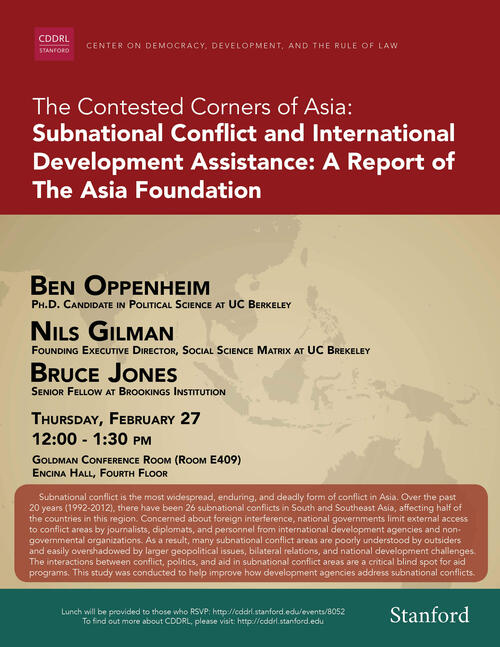
The Contested Corners of Asia: Subnational Conflict and International Development Assistance: A Report of The Asia Foundation
-
Image
Abstract:
Subnational conflict is the most widespread, enduring, and deadly form of conflict in Asia. Over the past 20 years (1992-2012), there have been 26 subnational conflicts in South and Southeast Asia, affecting half of the countries in this region. Concerned about foreign interference, national governments limit external access to conflict areas by journalists, diplomats, and personnel from international development agencies and non-governmental organizations. As a result, many subnational conflict areas are poorly understood by outsiders and easily overshadowed by larger geopolitical issues, bilateral relations, and national development challenges. The interactions between conflict, politics, and aid in subnational conflict areas are a critical blind spot for aid programs. This study was conducted to help improve how development agencies address subnational conflicts.
Speaker Bios:
Ben Oppenheim is a Fellow (non-resident) at the Center on International Cooperation at New York University. His research spans a diverse set of topics, including fragile states, transnational threats (including pandemic disease risks and terrorism), and the strategic coherence and effectiveness of international assistance in fragile and conflict-affected areas.
Oppenheim has consulted for organizations including the World Bank, the United Nations, the Asia Foundation, the Institute for the Future, and the Fritz Institute, on issues including organizational learning, strategy, program design, foresight, and facilitation. In 2009, he served as Advisor to the first global congress on disarmament, demobilization, and reintegration, supported by the World Bank and the UN.
In 2013, Oppenheim was a visiting fellow at the Uppsala University Forum on Democracy, Peace, and Justice. His research has been supported by a Simpson Fellowship, and a fellowship with the Institute on Global Conflict and Cooperation. He was also a research fellow with UC Berkeley's Institute of International Studies, affiliated with the New Era Foreign Policy Project.
Nils Gilman is the Executive Director of Social Science Matrix. He holds a B.A., M.A. and Ph.D. in History from the University of California, Berkeley. Gilman’s first scholarly interest was in American and European intellectual history, with a particular focus on the institutional development of the social sciences, the lateral transfer and translation of ideas across disciplinary boundaries, and the impact of social scientific ideas on politics and policy.
Gilman is the author of Mandarins of the Future: Modernization Theory in Cold War America (Johns Hopkins University Press, 2004), the co-editor of Staging Growth: Modernization, Development, and the Global Cold War (University of Massachusetts Press, 2003) and Deviant Globalization: Black Market Economy in the 21st Century (Continuum Press, 2011), as well as the founding Co-editor of Humanity: An International Journal of Human Rights, Humanitarianism, and Development. He also blogs and tweets.
Prior to joining Social Science Matrix in September 2013, Gilman was research director at Monitor 360, a San Francisco consultancy that addresses complex, cross-disciplinary global strategic challenges for governments, multinational businesses, and NGOs. He has also worked at a variety of enterprise software companies, including Salesforce.com, BEA Systems, and Plumtree Software. Gilman has taught and lectured at a wide variety of venues, from the Harvard University, Columbia University, and National Defense University, to PopTech, the European Futurists Conference, and the Long Now Foundation.
Bruce Jones is a senior fellow and the director of the Project on International Order and Strategy in the Foreign Policy program at the Brookings Institution. He is also the director of the Center on International Cooperation at New York University.
Jones served as the senior external advisor for the World Bank’s 2011 World Development Report, Conflict, Security and Development, and in March 2010 was appointed by the United Nations secretary-general as a member of the senior advisory group to guide the Review of International Civilian Capacities. He is also consulting professor at the Center for International Security and Cooperation at Stanford University and professor (by courtesy) at New York University’s department of politics.
Jones holds a Ph.D. from the London School of Economics, and was Hamburg fellow in conflict prevention at Stanford University.
He is co-author with Carlos Pascual and Stephen Stedman of Power and Responsibility: Building International Order in an Era of Transnational Threats (Brookings Press, 2009); co-editor with Shepard Forman and Richard Gowan of Cooperating for Peace and Security (Cambridge University Press, 2009); and author of Peacemaking in Rwanda: The Dynamics of Failures(Lynne Reinner, 2001).
Jones served as senior advisor in the office of the secretary-general during the U.N. reform effort leading up to the World Summit 2005, and in the same period was acting secretary of the Secretary-General’s Policy Committee. In 2004-2005, he was deputy research director of the High-level Panel on Threats, Challenges and Change. From 2000-2002 he was special assistant to and acting chief of staff at the office of the U.N. special coordinator for the Middle East peace process.
Richard and Rhoda Goldman Conference Room
Ben Oppenheim
Ph.D. Candidate in Political Science
Speaker
UC Berkeley
Nils Gilman
Founding Executive Director, Social Science Matrix
Speaker
UC Berkeley
Bruce Jones
Senior Fellow
Speaker
Brookings Institution
Seminars
Human Rights and Health to Advance Development: Case of Rwanda
-
Hon.Agnes Binagwaho has served as Permanent Secretary of the Ministry of Health in Rwanda since October 2008. She specialized in emergency pediatrics, neonatology, and the treatment of HIV/AIDS; and she chairs the Rwandan Pediatric Society. From 1986 to 2002, she practiced medicine in public hospitals in Rwanda and several other countries before joining Rwanda's National AIDS Control Commission as Executive Secretary. She is a member of the Editorial Board of Public Library of Science, and the Harvard University Health and Human Rights Journal. Dr. Binagwaho co‐chaired the Millennium Development Goal Project Task Force on HIV/AIDS and Access to Essential Medicines for the Secretary‐General of the United Nations under the leadership of Professor Jeffrey Sachs. She was the global co‐chair of the Joint Learning Initiative on Children and HIV/AIDS. In addition to her medical degree and Master in Peadiatry, she received an Honorary Doctor of Sciences from Dartmouth College. Dr. Binagwaho serves as a visiting lecturer in the Department of Global Health and Social Medicine of Harvard Medical School.
Building 200 (History Corner)
Room 205
Stanford University
Hon. Agnes Binagwaho
Minister of Health
Speaker
Rwanda
Seminars
Students across campus support innovation at U.N. refugee agency
News Type
News
Date
Paragraphs
Ben Rudolph was an ambitious computer science major planning to remain in Silicon Valley and join one of the many start-ups eager for young Stanford grads. But in his senior year he took a class, “Rethinking Refugee Communities,” which knocked him off his path and got him thinking about how to use that ambition for the greater good.
The class was co-taught by Tino Cuéllar, a Stanford Law School professor and director of the Freeman Spogli Institute for International Studies. Cuéllar led the class while co-director of FSI's Center for International Security and Cooperation (CISAC), which had just launched a collaboration with the United Nations High Commissioner for Refugees. The agency was looking for innovative ideas to support and protect the more than 42 million refugees, internally displaced and stateless people around the world.
When Rudolph graduated in June, he turned down offers in local tech firms and headed to Geneva as an intern for UNHCR’s nascent innovation lab. He joined Stanford alumna and CISAC faithful, Alice Bosley, in the small office with a big mission: to aid refugees by driving innovation using the latest tools of technology.
“I get to make a difference in the lives of some of the most vulnerable people in the world: refugees,” said Rudolph, a 23-year-old from Naperville, Ill., who came to Stanford on a gymnastics scholarship. “And I love that I get to meet such a diverse group of people with wildly different opinions about so many things.”
Rudolph has now joined UNHCR Innovation full time and has traveled to Ecuador to pilot one of his projects and to Thailand for an innovation workshop. On a recent trip to Esmeraldas on the northwestern coast of Ecuador, he tested out an SMS program that would help displaced people get information from the UNHCR and its partner organizations.
Bosley, the associate operations officer at UNHCR Innovation, first joined the U.N. as an intern speechwriter at the Permanent Mission of East Timor to the United Nations in New York. She was visiting some CISAC colleagues in the spring of 2012 when she learned about the burgeoning collaboration between the center and UNHCR. She volunteered for the project and became an intern with the newly formed UNHCR Innovation team, where she was later offered a full-time position.
 Alice Bosley crossing a river near the Dollo Ado UNHCR refugee camp in Ethiopia.
|
Alice Bosley crosses a river by the Dollo Ado UNHCR refugee camp in Ethiopia. Photo: UNHCR Innovation |
|
|
|
|
“UNHCR Innovation is my dream job; I am constantly traveling to new and interesting locations to work on projects and I’m able to support some of the most creative and impressive people in the organization,” said Bosley, 25, who graduated in 2011 with a degree in international relations. “It’s challenging and sometimes overwhelming. But I wouldn’t pick anything else to do at this point in my life.”
Rudolph and Bosley are models of the CISAC mission: to train the next generation of experts who will make the world a safer place. While not entrenched in the policy arena or at the forefront of arms control or Track II diplomacy, they are quietly, doggedly fulfilling the CISAC pledge to improve lives around the world.
"One of CISAC's greatest strengths over the years has been its record of attracting enormously talented students and fellows from a diverse array of disciplines and giving them a chance to work on problems that affect lives around the world,” said Cuéllar.
The UNHCR came to Cuéllar in early 2012 asking to collaborate. That initial request has led to an array of projects across campus and around the world. Cuéllar last year co-taught the class, “Rethinking Refugee Communities,” with Leslie Witt of the Palo Alto-based global design firm IDEO. That class in turn led to research trips in Ethiopia and Rwanda with UNHCR and the International Rescue Committee to test out some of the student projects to improve food security, communications, camp design and an SMS platform that Rudolph later tested with the innovation lab.
“Ben and Alice were attracted to the refugee project because of its focus on improving conditions for forced migrants,” said Cuéllar. “Both of them are brimming with intellectual curiosity, ability, and dedication, so it's no surprise that UNHCR has put them at the center of its innovation work."
The collaboration now extends far beyond CISAC. Cuéllar, CISAC visiting professor Jim Hathaway of the University of Michigan Law School, Roland Hsu of the Stanford Humanities Center and the NGO Asylum Access are convening a winter quarter working group on refugee rights. Stanford faculty will come from many departments to talk about the tension between providing emergency care and protecting refugee rights.
CISAC led the UNHCR to the Stanford Geospatial Center, where students are working on four mapping projects to help refugees, including an interactive map that displays the density for refugees seeking shelter in that conflict.
“Working with the UNHCR was truly a unique experience for us,” said Patricia Carbajales, geospatial manager at the Branner Earth Sciences Library who linked the students with the UNHCR advisers in Geneva and field offices around the world. “The students were completely engaged, understanding the importance that their projects had for UNHCR and, most importantly, for the refugees themselves.”
The popularity of the projects has led to a new class in the spring, “GIS for Good: Applications for GIS for International Development and Humanitarian Relief.”
Cuéllar and Elizabeth Gardner, associate director for partnerships and special projects at FSI, are working with UNHCR architects and the New York-based Ennead Architects Lab to develop new tools to expedite the complex process of laying out new refugee camps.
Stanford’s Haas Center for Public Service and the student-led Stanford in Government is making moves to permanently place interns or postgraduate fellows at UNHCR. FSI Senior Fellow Paul Wise, a professor of pediatrics at Stanford’s School of Medicine, will mentor that intern in the coming year.
Meanwhile, out in the field, Rudolph doesn’t know if his UNHCR experience has forever changed his career path. He may come back to the valley and pick up where he left off; he may continue his humanitarian work.
Either way, he says, “This work has really opened me up to a world of problems that are so vast it’s hard to grasp. It will be forever difficult to go back to my ignorant bliss.”
 Ben Rudolph, center, with Sudanese refugees in a UNHCR refugee camp in Ethiopia, March 2013.
|
Stanford students Parth Bhakta, left, and Ben Rudolph, talk with Sudanese refugees at the UNHCR camp in Bambasi, on Ethiopia's eastern border with Sudan. Photo: Beth Duff-Brown |
|
|
|
|
Hero Image

All News button
1
Marcel Fafchamps
Encina Hall
616 Jane Stanford Way
Stanford, CA 94305-6055
0
fafchamp@stanford.edu
Senior Fellow Emeritus at the Freeman Spogli Institute for International Studies
Professor, by courtesy, of Economics
Marcel Fafchamps is a Senior Fellow Emeritus at the Freeman Spogli Institute for International Studies (FSI) and a member of the Center on Democracy, Development and the Rule of Law. Previously, he was the Satre Family Senior Fellow at FSI. Fafchamps is a professor (by courtesy) for the Department of Economics at Stanford University. His research interests include economic development, market institutions, social networks, and behavioral economics — with a special focus on Africa and South Asia.
Prior to joining FSI, from 1999-2013, Fafchamps served as professor of development economics in the Department of Economics at Oxford University. He also served as deputy director and then co-director of the Center for the Study of African Economies. From 1989 to 1996, Fafchamps was an assistant professor with the Food Research Institute at Stanford University. Following the closure of the Institute, he taught for two years at the Department of Economics. For the 1998-1999 academic year, Fafchamps was on sabbatical leave at the research department of the World Bank. Before pursuing his PhD in 1986, Fafchamps was based in Addis Ababa, Ethiopia, for 5 years during his employment with the International Labour Organization, a United Nations agency that oversees employment, income distribution, and vocational training in Africa.
He has authored two books: Market Institutions in Sub-Saharan Africa: Theory and Evidence (MIT Press, 2004) and Rural Poverty, Risk, and Development (Elgar Press, 2003), and has published numerous articles in academic journals.
Fafchamps served as the editor-in-chief of Economic Development and Cultural Change until 2020. Previously, he had served as chief editor of the Journal of African Economies from 2000 to 2013, and as associate editor of the Economic Journal, the Journal of Development Economics, Economic Development and Cultural Change, the American Journal of Agricultural Economics, and the Revue d'Economie du Développement.
He is a research associate of the National Bureau of Economic Research, an affiliated professor with J-PAL, a senior fellow with the Bureau for Research and Economic Analysis of Development, a research fellow with IZA, Germany, and with the Center for Economic and Policy Research, UK, and an affiliate with the University of California’s Center for Effective Global Action.
Fafchamps has degrees in Law and in Economics from the Université Catholique de Louvain. He holds a PhD in Agricultural and Resource Economics from the University of California, Berkeley.
Hide publication sections
On