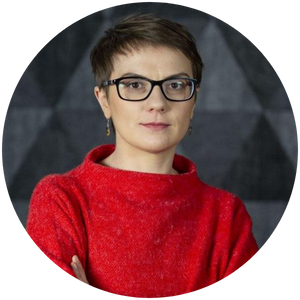
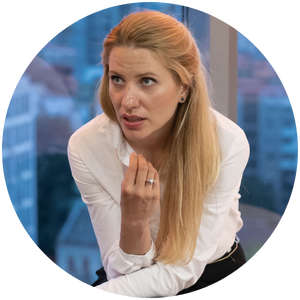
Nataliya Gumenyuk
Founding Director of the Public Interest Journalism Lab
DHSF class of 2018
As a journalist who covers conflict, today I am 100% consumed by the current situation in Ukraine. It is my job to explain what’s going on to a global audience, as well as to the Ukrainian one. Yet I and other Ukrainian professionals feel a bit trapped. The situation is so uncertain, we cannot afford to cancel all other plans; we are always busy with so many things happening, we can neither cancel nor fully engage. I am saddened that so much of our strength and energy is wasted on this situation. And on top of everything we are thinking about our families and considering various scenarios. As for myself – I am on duty.
Russia’s demands are not about Ukraine, they are about changing the international security architecture, canceling the ‘open door’ policy by NATO, which undermines the whole idea of the alliance. If Russia is allowed to invade further (and by the way Russia has already occupied parts of Ukrainian territories since 2014) – we are essentially agreeing that it’s acceptable to conquer other states by force.
The key takeaways for me are that we really should be discussing the current international relations system and to what extent it is able to protect countries outside of these alliances, and young democracies when they are threatened and bullied. This is a discussion not only about Eastern Europe.
Nataliya Gumenyuk is a Ukrainian author and journalist specializing in foreign affairs and conflict reporting. Gumenyuk is the author of the book “The Lost Island: Tales From Occupied Crimea” (2020), based on six years of reporting from the annexed peninsula. You can read some of her recent work here:
Oleksiy Honcharuk
Former Prime Minister of Ukraine
2021 Bernard and Susan Liautaud Visiting Fellow at CDDRL and the Freeman Spogli Institute
Democracy is one of the primary threats for Putin. Russia invaded Ukraine because of our choice to be a free, democratic country. That’s why the war between Ukraine and Russia is not a regional conflict – it is an important part of a larger war for democracy.
Global democracy has been in a recession for at least the last 15 years due to a lack of democratic leadership around the world. It looks like the West has forgotten about the real value of democracy and has taken it for granted. This was a mistake and Ukraine is already paying a big price for it. Ukraine is now a beacon of democracy for millions of people in Eastern Europe and Asia, and we cannot lose this battle.
I want Ukraine to be a successful, free country but Putin is trying to destroy it. I'm not scared and I am ready to fight for democracy.
More from Oleksiy Honcharuk:
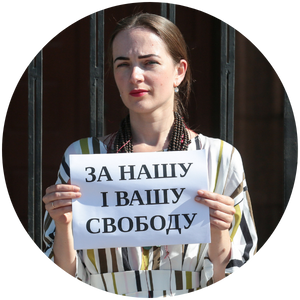
Oleksandra Matviichuk
Head of the Center for Civil Liberties (Ukraine)
UELP 2017-18
Russia under Putin has finally turned back into an empire. Unfortunately, the empire cannot remain stable. Putin thinks in terms of the Soviet Union. But now Russia does not have enough resources to play a full game, so the Kremlin is betting on war.
This is not about the war between Russia and Ukraine – it is about the war between authoritarianism and democracy. Thus, Ukraine acts in an unexpected role as an outpost that protects the values of the free world. Putin does not fear NATO, but the values of freedom in the post-Soviet space because it threatens his authoritarian regime.
We are preparing for a new armed attack by Russia. Recently, the President of Ukraine gave a press conference to foreign media, which raised many questions. However, there is something that the Kremlin cannot understand and that is underestimated in the West: People in America and the EU have lived for years with efficient and stable state institutions. We have never had such a luxury in Ukraine, so we are not used to relying on the government at critical moments.
I have been working in the field of human rights for more than twenty years, the last eight of which were focused on the war with Russia, so I have no illusions. Human rights defenders, journalists, and civil society activists will be the first targets of Russia's armed aggression. We have seen this before during the seizure of Crimea and Donbas when in order to gain rapid control of the region a non-violent minority was physically destroyed or driven out for their resistance. I have talked to my fellow human rights defenders, and I can say the following: We will stay in Ukraine and protect human rights as much as we can.
Nataliya Mykolska
Strategic transformations expert, Member of the Board Ukrhydroenergo JSC
UELP 2018-19
The Russian aggression against Ukraine and potential military invasion is not only about Ukraine. It is about democracy prevailing in the former CIS region and Ukraine being a success story. A truly independent and successful Ukraine is a major threat to Putin’s autocratic regime in Russia and his short and long-term prospects in the region.
We, Ukrainians, are ready to fight for our values, our freedom, our dignity, our country, our land, and the future of our children. We have done so in 2014 and have continued to do so for eight years. There is no other way for us to move forward.
Ivan Prymachenko
Founder, Prometheus
UELP 2018-19
In 1946 George Kennan famously wrote the following about the Soviet state: "impervious to the logic of reason it is highly sensitive to the logic of force. For this reason, it can easily withdraw – and usually does when strong resistance is encountered at any point."
In 2022, this description is still fitting for the self-declared successor of the USSR – Putin's Russia. The best way to provoke Putin now is to show weakness. The best way to achieve peace is to demonstrate strength by preparing a devastating sanctions package against Russia and delivering modern weapons to Ukraine.
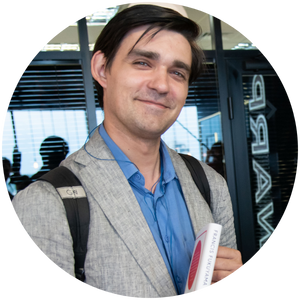
Artem Romaniukov
Co-founder at SaveDnipro / SaveEcoBot, Co-founder at Civil Control Platform
UELP 2019-20
There are two competing points of view here in Ukraine on what is going on. The first is that Ukraine is a bargaining chip between Russia and "the West.” This means there will be no exacerbation of war, just bluffing.
Second is that Putin for some reason felt that this was the right time to push for his agenda and started to raise the stakes, but "the West" appeared to be more united than ever before, providing Ukraine with lethal weapons and making strong claims. This means he may find himself in a stalemate with no choice except to invade Ukraine and become a pariah in the international community.
It looks like president Zelensky believes in the first scenario. But the relevant emptiness on Kyiv streets in recent days shows that Ukrainians do not always share the government's view.
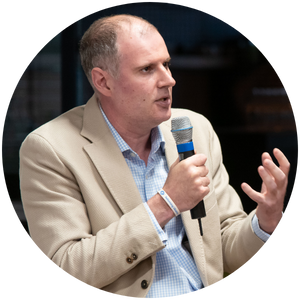
Igor Rozkladaj
Deputy Director at the Center for Democracy and Rule of Law
DHSF class of 2018
Democracy is the best thing that we have in the modern world. But democracy needs to be trained – much like muscles on your body – or else it will become weak.
In a time of economic stress, pandemic, and uncertainty people seek simple explanations and decisions– that is the Achilles' heel of democracy. And in combination with disinformation and easy money, autocratic regimes can take hold. That's how the Soviet Union and modern Russia manipulated the Western world and did it with great success.
Russia always was and still is an authoritarian country. Nowadays under the autocratic Putin regime, we see increased militarization and pressure on independent people to stop their activities or face being arrested.
Ukrainians, whose territories have been occupied by Russia, whose language and culture was under imperial pressure, whose identity is now denied now by Russia’s leadership, whose millions of people were killed in famines and wars know the real face of this country. The reforms we have made in Ukraine since 2014 are vitally important, from anti-corruption to decommunization. This conflict is not only about Ukraine, but about stopping Putin’s vision of “Russkyi mir” from spreading throughout the region.
We Ukrainians have made three attempts to wrench ourselves away from Russian influence: in 1991, 2004, and 2013-14. We have been at war with "unidentified little green men" for the last 8 years. We lose our best people to protect our country from Putin’s ambitions, and yet still fight. The question is what will prevail: corruption and kleptocracy from Putin or the democratic values that millions of Ukrainians have sacrificed for.
Olexandr Starodubtsev
Deputy Head at the National Agency for Corruption Prevention
UELP 2017-18
The war that Russia started in 2014 is hybrid in nature. Misinformation and cyber-attacks by Russia have become commonplace in Ukraine since then. Of course, Ukrainians feel worried today about the latest news, but we see the support of international partners, including supplies of weapons. We hope that these weapons will not have to be used and that the latest signals from Russia are just another attempt to intimidate Ukraine and the global community.
For our part, we at the National Agency on Corruption Prevention (NACP) are preparing for a new Russian cyber-attack. The NACP maintains several strategic portals, such as a register of e-declarations of all public officials, and has access to 17 other government databases. It is important for us that these data do not fall into the hands of the enemy. The last big cyber-attack did not affect us significantly because of the high level of training of our IT specialists. Therefore, we are confident that we will be able to resist future attacks.
Svitlana Zalishchuk
Advisor to the CEO of Naftogaz Group/Foreign Policy Advisor to the Deputy Prime Minister of Ukraine on European Integration
DHSF class of 2011
While the West is trying to negotiate a de-escalation of Russia’s buildup of forces on the borders of Ukraine, Putin renegotiates the world order. It’s not only Ukraine’s NATO integration he is concerned with. Putin wants informal veto power in NATO and the EU as well as a quiet funeral ceremony for the rule-based international order. The West needs two things to counteract such a scenario. First, unity and readiness to defend its redlines, which can be costly. Second, a long-term comprehensive strategy to withstand Putin. Because even if we succeed in stopping his invasion now, make no mistake, it will not be his last move.
More from Svitlana Zalishchuk: