Authors
Gary Mukai
News Type
News
Date
Paragraphs

Stanford e-Entrepreneurship Japan is an online course offered to high school students from throughout Japan. It is offered annually in spring and fall by SPICE and the Japanese NPO e-Entrepreneurship, led by Yusuke Matsuda. The instructors are Maiko Tamagawa Bacha (spring) and Irene Bryant (fall).

On August 11, 2021, the top students in the 2020 spring and fall cohorts were honored in a virtual ceremony. They are listed below alphabetically.  

  • Naho Abe, The American School Foundation in Mexico City
  • Yasuko Kinoshita, graduate of Akita Senior High School, Akita Prefecture
  • Rion Kurihara, Shibuya Senior High School, Tokyo
  • Sungyeon “Sunny” Park, The British School in Tokyo

The goal of Stanford e-Entrepreneurship Japan is to foster creative thinking and problem-solving skills in students with a focus on innovation to address social issues. During the ceremony, the honorees made presentations that focused on history textbook controversies in Japan (Abe); aging communities in rural prefectures like Akita (Kinoshita); gun control in the United States (Kurihara); and poverty alleviation (Park).

While listening to the presentations, Bacha and Bryant were struck by the diversity represented by the honorees. Bryant, who is a former Coordinator of International Relations on the Japan Exchange and Teaching (JET) Program in Sendai, Miyagi Prefecture, reflected, “As an American who has lived outside of the United States for many years, I have no doubt that Naho’s attendance at a high school in Mexico City and Sunny’s attendance at The British School in Tokyo will have a profound effect on their college studies and possibly careers, just as my overseas experiences have had a profound effect on my life.” Bacha similarly reflected, “As a Japanese national who attended graduate school in California and also worked in San Francisco, I think it’s great that Yasuko, who is from the rural prefecture of Akita, will be enrolling at Minerva University in San Francisco this year, and hope that Rion will fulfill her dream of enrolling in a university in the United States as well.”

Bryant and Bacha are most grateful to the following educators in Japan for their support throughout the 2020 courses:

  • Mana Miura, Curriculum Designer, NPO e-Entrepreneurship
  • Roy Lee, former teacher at Seiko Jr. and Sr. High School
  • Sara Inoue, currently a student at Harvard University’s Graduate School of Education

The spring 2020 Stanford e-Entrepreneurship Japan course was generously supported by the Water Dragon Foundation. The fall 2020 Stanford e-Entrepreneurship Japan course was generously supported by Noriko Honda Chen and the Capital Group, Norman Chen, Andrew Ogawa, and Mako Ogawa.

For more information about SPICE’s online courses for students, visit our Student Programs page.

Read More

Stanford e-Entrepreneurship Japan student Naho Abe in Mexico City
Blogs

Stanford e-Entrepreneurship Japan: Fostering Innovative Ways to Address Social Issues

The following reflection is a guest post written by Naho Abe, an alumna of Stanford e-Entrepreneurship Japan.
Stanford e-Entrepreneurship Japan: Fostering Innovative Ways to Address Social Issues
Hero Image
Stanford e-Entrepreneurship Japan honorees with their instructors
All News button
1
Subtitle

On August 11, 2021, SPICE honored the top students in the 2020 Stanford e-Entrepreneurship Japan Program in a virtual ceremony.

-

About the Seminar: Domestic migration separates voters into nationally- and locally-minded electorates because migrants differ from non-migrants regarding the strength of their local identities. To demonstrate how migration alters the importance of local identities, I study sub-national variation in the nationalization of local elections: in out-migration areas, strong local identities mean that non-migrant voters are active in local politics and consider locally defined issues when voting, while weak local identities lower migrant voters' ability to do so in in-migration areas. I support my argument using household panel data and comprehensive data on cross-county migration, national and sub-national elections, and civil society organizations in contemporary Germany. My identification strategy uses a shift-share instrument for migration and exploits a large-scale welfare reform in 2005 that lastingly altered domestic migration flows. My focus on local identities calls for a reappraisal of conventional descriptions of contemporary democratic politics, which mostly examines divides in national politics. The paper identifies a new research agenda on the political consequences of domestic migration, which has important implications for our understanding of democratic polarization and local service delivery.


Image
Hans Lueders
About the Speaker: Hans Lueders holds a Ph.D. in Political Science from Stanford University and is currently a Postdoctoral Scholar at Stanford’s Center on Democracy, Development, and the Rule of Law. His research seeks to understand the causes and consequences of political inequality in different political contexts. Hans is currently working on a book project that links political inequality in contemporary democratic societies to domestic migration. Additionally, Hans researches political inequality in closed authoritarian regimes, where state institutions ensure that citizens have little political say. His work identifies little-acknowledged ways through which citizens can still influence politics despite this extreme inequality. Moreover, his research on unauthorized migration in the United States studies political inequality from the perspective of a politically marginalized group. It seeks to understand how unauthorized immigrants navigate life while being politically disenfranchised.  Hans’ work has been published in the Proceedings of the National Academy of Sciences (PNAS), the Journal of Politics, the Journal of Economics, Race, and Policy, and the European Political Science Review, among others.

Online, via Zoom

Postdoctoral Scholar, CDDRL
Seminars
Authors
Gary Mukai
News Type
News
Date
Paragraphs

On August 9, 2021, a virtual award ceremony was held to honor SPICE’s Spring and Fall 2020 Stanford e-Japan honorees and 2021 Reischauer Scholars Program honorees. The honorees performed at the highest levels of their courses as determined by Stanford e-Japan Instructors Waka Brown and Meiko Kotani, Reischauer Scholars Program Instructor Naomi Funahashi, and research paper review committees.

Spring and Fall 2020 Stanford e-Japan Program Honorees and Their Research Paper Topics

  • Coco Kawaguchi (Keio Girls Senior High School, Tokyo), “To Infinity and Beyond! National Survival in the Era of Venture Space Development”
  • Sotaro Kunieda (Suwa Seiryo High School, Nagano), “Fostering Social Enterprises in Japan: Lessons from the United States”
  • Yun-Tzu (Allison) Lin (Canadian Academy, Kobe), “Nuclear Deterrence Theory: An Evaluation of Its Effectiveness in Preventing Future Deployment of Nuclear Weapons”
  • Minami Matsushima (Senri & Osaka International Schools of Kwansei Gakuin, Osaka), “The Price We Pay for Men to Be Men: Toxic Masculinity in the United States”
  • Yuna Naoi (Tokyo Metropolitan Hibiya High School, Tokyo), “Online Secondary School Education in Japan and the U.S. Amid the COVID-19 Crisis”
  • Kenta Yoshii (Shukutoku Junior and Senior High School, Tokyo), “In Search of a Realistic Substitute for U.S. Extended Deterrence for Japan”

Honorable Mentions: Risako Nomura (Yokohama Senior High School of International Studies, Kanagawa); Satoru Uchida (Tokyo Metropolitan High School, Tokyo)

2021 Reischauer Scholars Program Honorees and Their Research Paper Topics

  • Erica Cai (The Harker School, San Jose, California), “The Darkness in Pursuing Lightness: Western Perspectives on Japanese Colorism”
  • Kristine Pashin (Notre Dame High School, San Jose, California), “The Rite of Rights: An Examination of Socio-Cultural Precedent in Japanese Law”
  • Kasha Tyranski (St. Petersburg High School, St. Petersburg, Florida), “Gastrodiplomacy: Examining the Soft Power of Food in U.S.–Japan Relations”

Honorable Mentions: Noah Kurima (Sage Creek High School, Carlsbad, California); Kalia Lai (The College Preparatory School, Oakland, California); Benjamin Thomas (Garfield High School, Seattle, Washington)

Image
Deputy Consul General Higuchi headshot

The Honorable Keiichi Higuchi, Deputy Consul General of Japan in San Francisco, made opening comments. “I commend each and every one of you for your hard work and dedication to complete your program in spite of your regular school responsibilities,” he remarked. “You have demonstrated your initiative and determination to further your understanding of Japan and the United States. However, this should not be the end but just the beginning of your journey. I strongly encourage you to continue your studies, and I hope that your experiences in these programs will inspire you to think about a career involving Japan and the United States. I look forward to the day when I hear that some of you will be actively engaged in furthering the Japan–U.S. relationship in your careers and in your lives.”

He continued, “I would like you to know that the special expertise and knowledge that you gained makes you uniquely qualified to take a leading role in promoting Japan–U.S. relations… With young people like you, I have full confidence that the Japan–U.S. relationship will continue to grow and thrive for many years to come.”

Following Deputy Consul General Higuchi’s comments, the student honorees made presentations based on their research papers and expertly fielded questions from the audience.

Yu Higashisawa, Osaka University North American Center for Academic Initiatives, commented, “It’s been a pleasure and honor to be invited to Japan Day for several years. It’s wonderful to see that SPICE has provided a platform for high school students in Japan and the United States to exchange ideas and build relationships remotely. The presentations by the honorees of the RSP and Stanford e-Japan always amaze me and open my eyes to new perspectives. They are ready to go out into the world and make changes in our future!”

Funahashi hopes that her students will someday have the opportunity to study abroad at universities like Osaka University, and Brown and Kotani hope that their students will someday have the opportunity to study abroad at universities like Stanford in the United States.  

The Yanai Tadashi Foundation is the current supporter of Stanford e-Japan, and Daisuke Kato represented the Yanai Tadashi Foundation during the ceremony. SPICE is grateful to Tadashi Yanai for his generous support and to Daisuke Kato and Chikano Shiroma of the Yanai Tadashi Foundation for their regular correspondence and encouragement. Naoaki and Yuka Mashita are the current supporters of the Reischauer Scholars Program, and SPICE is thankful to them for their generous support. These courses and the ceremony would not have been possible without them.

The Reischauer Scholars Program’s next application period will begin September 6, 2021. Stanford e-Japan’s next application period will begin mid-November 2021.

Read More

high school girl standing amidst park greenery
Blogs

Finding My Place in the RSP & the U.S.–Japan Relationship

The following reflection is a guest post written by Kristine Pashin, an alumna of the Reischauer Scholars Program, which will begin accepting student applications on September 6, 2021.
Finding My Place in the RSP & the U.S.–Japan Relationship
Japanese scholar and Ambassador Armacost chatting in a conference room
News

Four Stanford e-Japan Alumni Awarded Yanai Tadashi Foundation Scholarships

In 2015, SPICE launched the inaugural online course, Stanford e-Japan, for high school students in Japan.
Four Stanford e-Japan Alumni Awarded Yanai Tadashi Foundation Scholarships
Hero Image
Japan Day honorees Zoom image
Japan Day honorees with Deputy Consul General Higuchi and their instructors
All News button
1
Subtitle

Congratulations to the 2020 Stanford e-Japan and 2021 RSP honorees.

Authors
Gary Mukai
News Type
Blogs
Date
Paragraphs

On March 18, 2021, the California Department of Education adopted the Ethnic Studies Model Curriculum. Chapter 3 of the Model Curriculum includes a section on “Native American Studies.” During a June 18, 2021 webinar, three Native and Indigenous scholars reflected on some of the key themes noted in the section and commented on the state of ethnic studies in their regions. The educators were:

  • Dr. Harold Begay, Superintendent of Schools, Navajo Nation
  • Dr. Sachi Edwards, Faculty Member, Soka University in Tokyo, Japan
  • Dr. Ronda Māpuana Fuji Shizuko Hayashi-Simpliciano, Vice Principal, Ke Kula Kaiapuni ʻo Ānuenue, Honolulu, Hawaiʻi
     

Kasumi Yamashita served as the moderator of the panel. The webinar was divided into three sections: (1) personal stories about the scholars’ Native and Indigenous identities and cultural backgrounds; (2) understandings of ethnic studies in the continental United States, Hawaiʻi, and Japan; and (3) insights and take-aways for K–12 educators to create more diverse, equitable, and inclusive learning environments for students.

In section one, the scholars commented on various factors that contributed to the formation of their identities. These factors ranged from being raised biculturally in the Navajo Nation bound by his traditional Dine’ (Navajo) culture and mainstream Western education in the United States (Begay); to ancestral ties to Ainu Moshir or Moshiri (“Land of the Ainu,” northern region of Honshu, Hokkaido, Kuril Islands, Sakhalin, and southern Kamchatka Peninsula) as well as Hawaiʻi (Hayashi-Simpliciano); and to being a fourth-generation settler in Hawaiʻi with ancestral ties to Japan, but not learning of her Ainu heritage until adulthood (Edwards).

In section two, the scholars placed importance upon epistemology when considering the field of ethnic studies and teaching in general. Begay also emphasized ontology in the Dine’ philosophy, which has shaped his teaching. Hayashi-Simpliciano underscored the importance of teacher education and professional development in preparing educators to be welcoming of various cultural identities in their classrooms. Edwards noted that in Japan ethnic diversity is primarily viewed through the presence of people from other countries, with the assumption that Japanese are ethnically homogeneous, which has shaped the teaching of ethnic diversity in Japan.

In section three, the scholars provided numerous insights and take-aways for K–12 educators. Begay noted that in their teaching, Navajo Nation educators keep the four sacred mountains in mind. Hayashi-Simpliciano reflected that in her Hawaiian language immersion school, the educators are not “doing ethnic studies” but rather “doing heritage restoration.” Edwards argued that Indigenous studies—whether in Japan, Hawaiʻi, or the U.S. mainland—should not be taught just in ethnic studies or relegated to a specific subject; rather Indigenous studies should be interwoven with all subjects.

Educators may find the webinar recording to be useful in their classrooms and may want to use some of the questions and topics provided here.

Following the webinar, many teachers from across the United States commented that the topics that were shared are relevant not only to teachers in California but also to those in other states as well. Reflecting on the webinar, Dr. Kristyn Nicole Mahealani Hara, Outreach & Academic Coordinator at Stanford Global Studies, stated, “I found the speakers very engaging and learned a lot from their inspiring insights on the linkages between their lived experiences, Indigenous ontologies and epistemologies, and ways of foregrounding diversity, equity, and inclusion in educational practice. I especially appreciated their wisdom on ways of honoring the cultural heritage of students so that classrooms—and, by extension, schools—can be safe spaces for self-expression, healing, and learning, and the importance of integrating Indigenous knowledge across diverse fields of study.” SPICE encourages educators to review the resources recommended below.

This webinar was a joint collaboration between the National Consortium for Teaching about Asia (NCTA), the Center for East Asian Studies, and SPICE.


—Additional Resources—
The following resources were recommended by the scholars.

Ethnic Studies Model Curriculum [website]
Native land acknowledgments and why they matter [article]
Appropriation of Marginalized Knowledge and Practice as Innovation [article by Dr. Sachi Edwards]

Navajo Nation
Harold Begay [bio]
Arizona State University Indigenous Land Acknowledgment [video]
When Geniuses Fail: Na-Dene’ (Navajo) Conception of Giftedness in the Eyes of the Holy Deities [book chapter by Harold Begay and C.J. Maker]

Native Hawaiian
Land Acknowledgement [website]
Hawaiian Culture, History, and Language Resources [website]
Indigenous Studies in the Elementary Curriculum: A Cautionary Hawaiian Example [article]

Ainu in Diaspora
Japanese American Memorial Pilgrimages: Ainu in Diaspora [videos including talks by Dr. Hayashi-Simpliciano and Dr. Edwards]
Charanke and Hip Hop [dissertation by Dr. Ronda Māpuana Shizuko Hayashi-Simpliciano]
The Ainu and Their Culture: A Critical Twenty-First Century Assessment [book]
The Fabric of Indigeneity: Ainu Identity, Gender, and Settler Colonialism in Japan [book]

Ainu (Japan)
The Centre for Environmental and Minority Policy Studies (CEMiPoS) [website]
Our Land Was a Forest: An Ainu Memoir [book]
Future in MINE: Ainu My Voice [video]

Hero Image
SPICE Instructor Kasumi Yamashita speaks with Native and Indigenous educators
Screenshot: SPICE Instructor Kasumi Yamashita speaks with Native and Indigenous educators
All News button
1
Subtitle

This article recaps a June 18, 2021 webinar that featured three Native and Indigenous scholars and includes recommendations for using the webinar recording in classrooms.

Authors
News Type
Blogs
Date
Paragraphs

Working across linguistic and cultural differences, students in the China Scholars Program (CSP) and Stanford e-China (SeC) met and collaborated online as partners, from opposite sides of the world, in November and May. The two programs focus on different themes—U.S.–China relations writ large (CSP) and emerging technologies through the lens of design thinking (SeC)—but found common ground in finding local solutions to environmental sustainability problems.

The students were divided into groups, each including both U.S.- and China-based members. Each student shared a sustainability issue that they observed in their home communities—discovering similar issues around recycling, food waste, and environmental pollution, in particular. The group then selected one problem to focus on and brainstormed a specific solution targeted at a specific user group using the design thinking process. Finally, they shared creative presentations of their process and their proposed solutions with both classes. 

Although these projects have real-life applications—with at least one group intending to go forward with actually prototyping their idea to see how far they can take it—the true challenge of this assignment for the students was to figure out how to collaborate across technological, cultural, and (to a lesser extent) linguistic barriers and solve a common problem together. It was not easy. But many students reported that it was one of the most rewarding and memorable experiences in their program. We hope it will seed the skills they need for cross-cultural collaborative problem-solving in the future.

Following the joint project, students sent reflections to CSP Instructor Tanya Lee and SeC Instructor Carey Moncaster, marveling at how much they had in common, and at the value of their differences. An American student noted, “Working with students from [China] showed me what true cross-cultural collaboration is like. It was cool to see how cultural differences affect the way in which people approach and work on a task and how collaborating with people who work differently than you can produce better results or help you see things in a new way.” Reflecting a similar team-driven sentiment, a Chinese student noted, “There are more similarities than differences that divide us. We really need to promote communication between individuals in two countries instead of knowing the other country from the authorities’ slogans.”

Fall 2020 marked the inaugural session of the Stanford e-China Program, an English-language, online program for high school students across China exploring current technological innovation and human-centered brainstorming strategies. The China Scholars Program completed its seventh and eighth sessions this past year, bringing together students from all over the United States to study the politics, economics, and society of contemporary China. Both programs feature lectures and discussions with Stanford University faculty and are offered twice annually, in fall and spring.

Applications for the Fall 2021 Stanford e-China Program are currently open with a final deadline of September 1, 2021. 

Applications for the Spring 2022 China Scholars Program will open in September, due November 1. (Applications for Fall 2021 have closed.)

Read More

Santiago Calderon at Harvard University for debate tournament
Blogs

How SPICE’s China Scholars Program Accelerated My Love for International Relations

The following reflection is a guest post written by Santiago Calderon, an alumnus of the China Scholars Program, which is currently accepting applications for the Fall 2021 course.
How SPICE’s China Scholars Program Accelerated My Love for International Relations
Valerie Wu at Stanford University, August 10, 2018
Blogs

China Scholars Program Instructor Dr. Tanya Lee Interviewed by US-China Today

Lee shares her experience teaching the CSP and discusses an upcoming cross-cultural collaboration between American and Chinese high school students.
China Scholars Program Instructor Dr. Tanya Lee Interviewed by US-China Today
Hero Image
arches at Stanford University
Archway at Stanford University; photo courtesy Jason Leung
All News button
1
Subtitle

Students in SPICE’s China Scholars and Stanford e-China Programs meet in virtual classrooms.

-

Webinar recording: https://youtu.be/ShtOUZ67F-s


Webinar Description:

From amazing athletic feats to beautiful pageantry, the Olympics command the world’s attention like no other event. Students and families alike are sure to watch at least some of this summer’s games from Tokyo. But how might we, as teachers, use the Olympics to introduce topics from East Asian history? In this webinar, Ethan Segal explores the many meanings of the Olympics for China, Japan, and South Korea, from displaying recovery to promoting democracy. Join us for an interesting, engaging session that will provide useful background content, help you rethink some old assumptions, and highlight some connections for teachers to use in bringing the Olympics into your classroom.

Register at https://bit.ly/3gU7SC5.

This webinar is a joint collaboration between SPICE, the National Consortium for Teaching about Asia (NCTA), and Stanford's Center for East Asian Studies.


Featured Speaker:

Professor Ethan Segal

Image
Professor Ethan Segal

Ethan Segal is Associate Professor of History at Michigan State University. He earned his Ph.D. at Stanford University, was a Fulbright Scholar at the University of Tokyo, and taught as a visiting professor at Harvard. Professor Segal’s research topics include economic and social history, nationalism, women and gender, and contemporary popular culture. He is the author of Coins, Trade, and the State: Economic Growth in Early Medieval Japan as well as numerous articles, reviews, and videos in scholarly journals and online. Professor Segal has won multiple teaching awards and is a regular contributor to NCTA and other outreach workshops and seminars.


Via Zoom Webinar. Registration Link: https://bit.ly/3gU7SC5.

Professor Ethan Segal Associate Professor of History, Michigan State University
Workshops
Authors
News Type
Blogs
Date
Paragraphs

On Saturday, May 22, 2021, Stanford Global Studies (SGS) hosted the 2021 Education Partnership for Internationalizing Curriculum (EPIC) Symposium, which featured presentations by 11 2020–21 EPIC Fellows. SPICE, along with the Center for Spatial and Textual Analysis, is SGS’s EPIC Partner. The following reflection is a guest post by EPIC Fellow Maiya Evans, assistant professor at Skyline College, who gave a presentation on “Reimagining Public Health.”


“I’m telling you, professor. I’m telling you, something’s going on.” I listened intently with curiosity as one of my Skyline College students made her case. Another chimed in, “They’re saying it’s killing old people and that the doctor who discovered it died, too.” Sensing the palpable anxiety in their shares, I decided to pivot the following week’s lesson on epidemiology to focus on what was then called the novel coronavirus and its spread in China.

At the time these conversations took place, we were in late January of 2020, so the coronavirus was still novel to the United States, indeed. Every class session thereafter, we watched the Johns Hopkins Center for Systems Science and Engineering’s global map of new and existing COVID-19 cases grow. As the numbers increased from hundreds to thousands, and subsequently thousands to millions over the course of mere weeks, it became clear that looking at every country’s approach to controlling the spread of COVID-19 was essential. Without knowing it, my students and I were planting the seeds of the Reimagining Public Health (RPH) Roundtable series.

When I made the decision to apply to the Stanford EPIC Fellowship, which aims at internationalizing the community college curriculum, I knew that I wanted to work on a project that expanded the borders of public health in the United States. The purpose of the RPH Roundtable series was to invite students to reshape and rethink our approaches to health and health care in the United States by borrowing from public health methodologies from other nations. This pilot for the RPH Roundtable series was implemented in the Spring of 2021 in my Introduction to Public Health course at Skyline College in San Bruno, California.

My hope for the RPH Roundtable series was simple: to challenge students to gain an understanding of how public health systems function in the United States and abroad. Students were invited to observe the following in other nations: (1) public health approaches to controlling the spread of disease, (2) the connection between economics and health resources, and (3) the influence of health policy on public health interventions. The students gathered virtually throughout the semester to engage in podcast-style conversations around three relevant public health topics that impact the United States: communicable and non-communicable disease, mental health, and substance use.  

Students had powerful insights about current approaches to public health issues in the United States and abroad. For example, one group discussed the societal impact of unfair and punitive drug policy in the United States vs. gentler harm reductionist drug policy in the Netherlands. Students also brainstormed innovative community health solutions, such as implementing holistic, non-Western approaches to addressing mental health issues (as is common in China), or creating mental health programs within the workplace, which is done in some parts of Canada.

All in all, I was extremely satisfied with the outcome of the RPH Roundtable series, and I am incredibly proud of the students for challenging themselves to think critically about making positive, meaningful change in public health. Though there were many lessons learned with regards to the challenges of doing a project of this caliber in the virtual space, I thought the students did an incredible job of having deep, meaningful, and well-informed discussions about the potential of a brighter future in our public health system.

Read More

Zoom screenshots of EPIC fellows
Blogs

2021 Education Partnership for Internationalizing Curriculum Symposium

On Saturday, May 22, 2021, SPICE’s Jonas Edman moderated two panels during the 2021 EPIC Fellowship Program Symposium for community college educators.
2021 Education Partnership for Internationalizing Curriculum Symposium
image of six fellows
News

Collegiality and the 2020–21 EPIC Fellows

On August 13 and 14, 2020, Stanford Global Studies welcomed 12 new Education Partnership for Internationalizing Curriculum (EPIC) Fellowship Program community college instructors as members of its 2020–21 cohort.
Collegiality and the 2020–21 EPIC Fellows
Webinar poster with three speakers
Blogs

Training for the Olympics During COVID-19

For episode 4 of the CoviDB Speaker Series, TeachAids Founder and CEO Dr. Piya Sorcar provides a glimpse into how the pandemic has impacted the lives of two of the world’s greatest athletes.
Training for the Olympics During COVID-19
Hero Image
Maiya Evans at the Van Gogh Museum, Amsterdam, Netherlands
Maiya Evans at the Van Gogh Museum, Amsterdam, Netherlands; photo courtesy Maiya Evans
All News button
1
Subtitle

Guest author Maiya Evans reflects on her EPIC project, which challenges students to reimagine public health.

Authors
Gary Mukai
News Type
Blogs
Date
Paragraphs

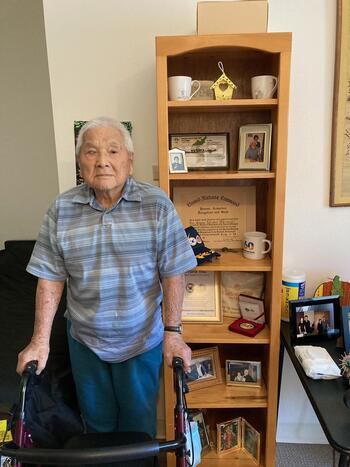
Last week, I had the chance to visit one of my uncles, George Mukai (92), who is a veteran of the Korean War. He recently moved into an assisted-living facility and had very few items delivered from his home to his new residence. One thing that he did have delivered was a curio cabinet that contains Korean War-related items including medals, a cap, a United Nations Command certificate, and a piece of wire from the DMZ.

Image
United Nations Command Certificate
As he has in the past, he shared recollections of his experiences during the Korean War, but unlike when he was young, his recollections felt more poignant. He is a very proud veteran. Another one of my uncles, Roy Mukai (deceased), was also a Korean War veteran, and a third, Toichi Mukai, was stationed in Korea after the Korean Armistice Agreement was signed in 1953.

This month marks the 71st anniversary of the beginning of the Korean War on June 25, 1950. After my visit with George, I started to reflect on the work that my colleagues (past and present) at SPICE have done to promote the study of Korea in U.S. schools and directly to students in the United States. They are:

They have developed extensive curriculum on Korea. The offerings can be found on this webpage and includes offerings such as the following:

  • Colonial Korea in Historical Perspective
  • Divided Memories: Comparing History Textbooks
  • Dynamics of the Korean American Experience
  • Economic Development: The Case of South Korea
  • Inter-Korean Relations: Rivalry, Reconciliation, and Reunification
  • Traditional and Contemporary Korean Culture
  • Uncovering North Korea
  • U.S.–South Korean Relations
     

In addition, the Sejong Korea Scholars Program, an online course for high school students in the United States, has been offered by SPICE since 2013. The SKSP annually selects 20–25 exceptional high school students from throughout the United States and engages them in an intensive study of Korea and U.S.–Korea relations. Selected students participate in the online course on Korea from February to June of each year. The current instructor is Jang.

Lastly, SPICE offers annual summer institutes to middle school and high school teachers in partnership with the National Consortium for Teaching about Asia, and also the East Asia Seminars for Teachers in Hawaii. These are facilitated respectively by Edman, Naomi Funahashi, and Sekiguchi. These programs focus in part on Korea and are funded by the Freeman Foundation.

Image
George Mukai 2021
I wish that I could inform veterans of the Korean War about programs such as these that help to promote a greater understanding of Korea and U.S.–Korea relations among students in the United States, and also to encourage students to reflect upon the sacrifices that were made by the veterans.

Read More

High school student with a diploma standing in front of a banner
Blogs

My Experience with the Sejong Korea Scholars Program in the Midst of a Global Pandemic

The following reflection is a guest post written by Jason Lu, an alumnus of the Sejong Korea Scholars Program, which is currently accepting applications for the 2021 course.
My Experience with the Sejong Korea Scholars Program in the Midst of a Global Pandemic
Student in a red dress presenting at a podium with Stanford signage
Blogs

Coming Full Circle: The Sejong Korea Scholars Program and Stanford

The following reflection is a guest post written by Sandi Khine, an alumna of the Reischauer Scholars Program and the Sejong Korea Scholars Program, which are currently accepting applications for the 2021 courses.
Coming Full Circle: The Sejong Korea Scholars Program and Stanford
5thbuchanan banner
News

SPICE Wins Buchanan Prize for Fifth Time

SPICE Wins Buchanan Prize for Fifth Time
Hero Image
George Mukai in Munsan, a town south of the Imjin River near Panmunjom, during the Korean War, 1951
George Mukai in Munsan, a town south of the Imjin River near Panmunjom, during the Korean War, 1951; image courtesy George Mukai
All News button
1
Subtitle

SPICE offers a series of Korea-focused lesson plans, an online course for U.S. high school students, and teacher professional development opportunities.

Authors
Callista Wells
News Type
News
Date
Paragraphs

In collaboration with Global:SF and the State of California Governor’s Office of Business and Economic Development, the China Program at Shorenstein APARC presented session five of the New Economy Conference, "Navigating Chinese Investment, Trade, and Technology," on May 19. The program featured distinguished speakers Ambassador Craig Allen, President of the US-China Business Council; David K. Cheng, Chair and Managing Partner of China & Asia Pacific Practice at Nixon Peabody LLPJames Green, Senior Research Fellow at the Initiative for U.S.-China Dialogue on Global Issues at Georgetown University; and Anja Manuel, Co-Founder and Principal of Rice, Hadley, Gates & Manuel LLC. The session was opened by Darlene Chiu Bryant, Executive Director of GlobalSF, and moderated by Professor Jean Oi, William Haas Professor of Chinese Politics and director of the APARC China Program.

U.S.-China economic relations have grown increasingly fraught and competitive. Even amidst intensifying tensions, however, our two major economies remain intertwined. While keeping alert to national security concerns, the economic strength of the United States will depend on brokering a productive competition with China, the world’s fastest growing economy. Precipitous decoupling of trade, investment, and human talent flows between the two nations will inflict unnecessary harm to U.S. economic interests--and those of California.  

Chinese trade and investments into California have grown exponentially over the last decade. But they have come under increasing pressure following geopolitical and economic tensions between the two nations, particularly in the science and technology sectors. Ambassador Craig Allen, David Cheng, James Green, and Anja Manuel explored the role of Chinese economic activity in California in the context of the greater US-Chinese relationship. Watch now: 

Read More

American and Chinese flags
News

U.S.-China Relations in the Biden Era

Dr. Thomas Wright examines the recent history of US-China relations and what that might mean for the new administration.
U.S.-China Relations in the Biden Era
Hero Image
Blue image with event title, time, and date
All News button
1
Subtitle

Ambassador Craig Allen, David Cheng, James Green, and Anja Manuel explore the role of Chinese economic activity in California in the context of the greater US-Chinese relationship.

News Type
News
Date
Paragraphs

The California Department of Education adopted the Ethnic Studies Model Curriculum last March. Chapter 3 of the Model Curriculum includes a section on “Native American Studies.”

On June 18, 2021, SPICE will host a panel of three Native and Indigenous scholars to reflect on California’s new model curriculum and the state of ethnic studies in their respective regions. The panel will include Navajo, Native Hawaiian, and Ainu educators who will provide a range of educational perspectives on Native and Indigenous studies in the United States and Japan.

  • Dr. Harold Begay, Superintendent of Schools, Navajo Nation
  • Dr. Sachi Edwards, Faculty Member at Soka University in Tokyo, Japan
  • Dr. Ronda Māpuana Shizuko Hayashi-Simpliciano, Vice Principal, Ke Kula Kaiapuni ʻo Ānuenue, Honolulu, Hawaiʻi

The webinar, titled “Indigenous Voices: Educational Perspectives from Navajo, Native Hawaiian, and Ainu Scholars in the Diaspora,” will address several additional topics, such as the various academic field names of the study of Native and Indigenous people, the complexity and diversity of Native and Indigenous people’s experiences, and recommended resources for K–12 educators.

These topics are not only relevant to teachers in California but to educators in other states as well. K–12 educators and administrators are encouraged to attend. Register in advance at https://bit.ly/3z4kxtc.

This webinar is a joint collaboration with the National Consortium for Teaching about Asia (NCTA) and the Center for East Asian Studies at Stanford University.

To stay informed of SPICE news, join our email list and follow us on Facebook, Twitter, and Instagram.

Read More

Tokyo’s Shin Okubo neighborhood, known for its Korea Town
Blogs

Global Human Rights and Minority Social Movements in Japan: A Webinar by Professor Kiyoteru Tsutsui

Tsutsui introduced the audience to three minority groups in Japan—the Ainu, resident Koreans (Zainichi), and the Burakumin—and illustrated how human rights have galvanized minority social movements there.
Global Human Rights and Minority Social Movements in Japan: A Webinar by Professor Kiyoteru Tsutsui
Chinese railroad workers
Blogs

Stanford’s Center for East Asian Studies and SPICE Co-Sponsor Webinar on “Chinese Railroad Workers in North America Project”

The speakers shared extensive primary source documents from Stanford Libraries’ Department of Special Collections, as well as free lesson plans from SPICE's online curriculum unit on Chinese railroad workers.
Stanford’s Center for East Asian Studies and SPICE Co-Sponsor Webinar on “Chinese Railroad Workers in North America Project”
Hero Image
Flyer for the SPICE webinar "Indigenous Voices: Educational Perspectives from Navajo, Native Hawaiian, and Ainu Scholars in the Diaspora"
The June 18 webinar will feature Dr. Harold Begay, Dr. Sachi Edwards, and Dr. Ronda Māpuana Shizuko Hayashi-Simpliciano.
All News button
1
Subtitle

Navajo, Native Hawaiian, and Ainu educators will join together on June 18 to examine the state of Indigenous studies.

Subscribe to North America