Policy Roundup: September 2026
All Publications button
1
Publication Type
Policy Briefs
Publication Date

Stanford University
Encina Hall, Room E301
Stanford, CA 94305-6055
Pei-Chia Lan is the Wang and Chen Senior Fellow in Taiwan Studies at the Freeman Spogli Institute for International Studies and the director of the Taiwan Program at the Walter H. Shorenstein Asia-Pacific Research Center. As a qualitative sociologist, she studies the complexity of intersecting social inequalities in everyday life, shaped by macropower dynamics such as globalization and international migration.
Before joining Stanford in September 2026, Lan was a distinguished professor in the Department of Sociology at National Taiwan University, where she was the founding director of the Global Asia Research Center and recipient of five teaching awards.
Her scholarly articles have been published in Ethnic and Racial Studies, International Migration Review, The Sociological Review, and Comparative Migration Studies, among others. She is also the author of several books in Chinese and English, the latter including Raising Global Families: Parenting, Immigration and Class in Taiwan and the US (Stanford University Press, 2018), which examines how ethnic Chinese parents in Taiwan and the United States negotiate cultural differences and class inequality to raise children in the contexts of globalization and immigration; and Global Cinderellas: Migrant Domestics and Newly Rich Employers in Taiwan (Duke University Press, 2006), which won a Distinguished Book Award from the Sex and Gender Section of the American Sociological Association and ICAS Book Prize: Best Study in Social Science from the International Convention of Asian Scholars.
Lan received her doctorate in sociology from Northwestern University, and her bachelor’s and master’s degrees in sociology from National Taiwan University. She was a 2024-2025 Stanford-Taiwan Social Science Fellow at the Center for Advanced Study in the Behavioral Sciences, Stanford University; a 2011-2012 Yenching-Radcliffe fellow at Harvard University; a 2026-2007 Fulbright scholar at New York University; and a 2000-2001 postdoctoral fellow at the Center for Working Families, University of California, Berkeley. She also held visiting positions at the Waseda Institute for Advanced Study, Kyoto University, Tubingen University, and IIAS at Leiden University.
She has actively engaged in international professional networks, serving as deputy editor of the journal Gender & Society and an editor or board member for other esteemed journals. Her research cultivates critical dialogue between academia and the public, and her expertise is sought by local government agencies and global organizations alike, as demonstrated by her role on the advisory board of UN Women.
What does it take to get ahead when college admission rules change? Who has the resources to anticipate risks and adapt, and who is left responding after opportunities have already slipped away?
These questions lie at the heart of Ruo-Fan Liu’s research. As APARC's Taiwan Program postdoctoral fellow 2024-2026 – the first scholar to serve in this role since the program’s launch two years ago – Liu examines how young people navigate educational transitions in Taiwan's college admissions landscape, which has shifted from an exam-centered system to holistic screening in recruiting elites. Her work shows that inequality is not simply a matter of who succeeds or fails, but of who can mobilize support early enough to stay ahead of unexpected challenges.
We spoke with Liu about her work and fellowship experience at APARC. The following interview has been lightly edited for length and clarity.
Get APARC fellowship announcements and scholars' insights delivered to your inbox >
Could you describe your research briefly?
My dissertation examines how young people navigate contingency in college admissions: what kinds of support they seek, how they mobilize resources, and how these processes shape postsecondary transitions. I situate this puzzle in Taiwan, where the state has implemented admissions reforms intended to level the playing field, including holistic admissions, school-based nominations, and test-optional and dossier-based application routes. Although these reforms open new opportunities, they also introduce different forms of uncertainty into students' college pathways.
As a sociologist, I care deeply about how people exercise agency under different forms of constraint and opportunity. In asking why class reproduction persists amid contingency and uncertainty, I find that middle-class students preserve class privilege not because they avoid setbacks or always get what they want, but because they anticipate risks early and coordinate familial and school support before risks become failures. I call this process “anticipatory coordination.” By contrast, working-class students are more often reactive mobilizers, seeking help after problems have already crystallized into adverse outcomes. This temporal dimension – who can act early enough to get ahead – shapes who can get around unexpected hurdles.
I use a wide range of methods, but ethnography remains my favorite method. Talking with people, reading social cues, and capturing unspoken assumptions are the moments I have found most meaningful in the research process.
What challenges have you encountered in researching this topic?
One of the major challenges I have encountered is the scarcity of Taiwan-based cases published in general sociology journals. Sociology remains highly U.S.-centered and theoretically demanding, which makes publication difficult, especially during peer review.
As a Taiwan-focused researcher, I am still learning how to make the case for the broader significance of this work in different publication outlets: how to frame Taiwan’s relevance, address concerns about generalizability, and explain empirical evidence in depth without creating unnecessary confusion.
That is why I cherish APARC and FSI as my institutional home at Stanford, where faculty members and mentors value international work and underrepresented cases and support researchers throughout the process.
Tell us about your work at the Stanford Next Asia Policy Lab (SNAPL).
At SNAPL, I co-led a project with Professor Gi-Wook Shin that examines how migrant scholars and transnational elites institutionalize cross-border exchange, negotiate with state officials and other key brokers, and produce knowledge across multiple languages.
Since 2024, our team has collected network, interview, archival, and organizational data, working with two postdoctoral fellows and two research assistants. The project has generated several papers in progress. In the first paper, we find that migrant scholars play crucial intermediary roles in facilitating cross-border exchange, a mechanism we call the “transnational pipeline,” which extends beyond individuals’ sporadic efforts. In the second paper, we turn our teamwork into a methodological technique for studying transnational elites.
We are currently comparing Taiwan’s and Korea’s funding infrastructures and developing a comparative model that contrasts “state sponsorship” and “state capitalism” to explain how states extend their power beyond national borders.
How has your time at APARC supported your research and professional development?
Stanford has helped me become a more collaborative scholar.
My first cultural shock was Stanford’s lab culture, where scholars often do not work alone but make decisions together as a team. I also learned how closely people back each other up. In many moments when I needed help or had to step away from a project briefly, someone was there to take over and support the work.
I learned from this culture and have applied it to my own team-leading skills in other collaborative projects. I learned how to divide labor across different team compositions, recognize collaborators’ strengths and weaknesses as scholars, support a team, secure funding for future research, and resolve tensions across different writing styles.
What advice would you give to prospective APARC postdoctoral scholars?
Many young scholars spend a lot of time chasing trends. The current job market exacerbates this dynamic, because there are fewer available positions. Trendy research can be valuable, but it may become outdated by the time scholars enter the job market.
I am not saying we should ignore research trends. Rather, I believe an academic journey should be your own path: developing the skills you want to invest in, cultivating the networks you are part of, and taking time to work through the puzzle you cannot let go of. In short, take your time to develop your expertise, fields, and intellectual craft.
At the same time, be strategic about your time as you approach graduation. Manage reviewing commitments, submission timelines, writing schedules, and publication timing carefully so that you have more tools when you begin a faculty position. And enjoy this transition, because once you are on the tenure track, the clock starts ticking again, and you may no longer have the same freedom you had as a doctoral candidate.
To put it simply: take your time during graduate training, be a strategic planner about timing when you are on the market, and protect your time once you become a junior faculty member.
What’s next for you?
I will join National Chengchi University, a leading research-intensive university in Taipei, Taiwan, as an assistant professor of sociology.
I will continue collaborating with APARC and SNAPL at Stanford while also bringing my three international research collaborations to NCCU: First-Generation Students in the United States, Organizational Change and College Admissions Under Changing Ranking Systems, and Stanford’s Transnational Project. I hope to involve my future students in these projects so that they can gain valuable experience in collaborative research.
I am excited to apply for my own grants, teach courses in the sociology of education, and cultivate a new generation of Taiwanese scholars. Please stay tuned to my personal website, and feel free to reach out if you are interested in any of these research themes.

Ruo-Fan Liu, APARC’s inaugural Taiwan Program postdoctoral fellow, examines how students navigate uncertainty in college admissions and educational transitions. Drawing on ethnographic research in Taiwan, she reveals how families and schools shape young people's opportunities and how inequality persists even amid efforts to expand access.
On May 13, 2026, the Stanford Center on China's Economy and Institutions and Stanford University Libraries welcomed Professor Chang-Tai Hsieh (University of Chicago) for the 2026 Dr. Sam-Chung Hsieh Memorial Lecture. In a talk titled The Ghost of Plaza, Professor Chang-Tai Hsieh offered a frank and nuanced assessment of Taiwan's economic rise and the structural vulnerabilities hiding beneath it.
Professor Hsieh opened by noting that Taiwan's economic trajectory looks like a genuine success story. Its leading role in the semiconductor industry has positioned the nation at the very center of the global AI boom. Yet Hsieh argued that this surface-level success masks a deeper problem: economic policy in Taiwan remains governed by what he called the "Ghost of Plaza.”


The specter Hsieh described traces back to the 1985 Plaza Accord, when U.S.-Japan negotiations forced Taiwan to allow its currency to appreciate. In response, Taiwan's policymakers developed a deep institutional fear that the economy is always just one step away from disaster; this persistent fear has shaped policy ever since. Rather than allowing the gains of export success to flow broadly through the economy, Taiwan has systematically suppressed domestic consumption and kept the New Taiwan dollar undervalued to protect its competitive edge.
This policy has produced a trade surplus that reached 20% of GDP in 2025 and may climb to an extraordinary 35% of GDP in 2026. The surpluses have been invested most notably through purchases of U.S. treasury bonds by Taiwan's life insurance industry, parking roughly 90% of its assets in U.S. dollar-denominated instruments. The result is a system carrying enormous hidden financial risk: if the New Taiwan dollar appreciates sharply, a significant portion of Taiwan's life insurance sector faces potential collapse.
A central thread of Hsieh's lecture was a pointed question: who has actually benefited from Taiwan's economic boom? His answer was largely: not workers. Labor policy in Taiwan, including widespread use of non-compete agreements, suppressed wages, and constrained mobility between firms, reflects the same logic of sacrifice that underlies macroeconomic policy in Taiwan.
Hsieh illustrated this with a simple analogy: imagine your income rises significantly, but you are culturally and institutionally pressured to act as though it didn't. That, he argued, is the lived experience of many Taiwanese workers: a social norm of sacrifice rationalized by a sense of perpetual economic insecurity.
Present-day Taiwan may face a potential policy response to growing external pressure: rather than holding surpluses in foreign treasury bonds, Taiwan would channel investment into direct foreign investment, including building manufacturing facilities in the United States. While this may ease political tensions around the trade imbalance, Hsieh cautioned that it does nothing to address inequality at home. Any returns from such investments will flow to firms, not to workers.
Professor Hsieh closed with a call for honest reckoning. Taiwan's economy has achieved something genuinely extraordinary, but its success has been built on a foundation of suppressed wages, financial risk, and a policy psychology rooted in fear rather than confidence. Moving beyond the Ghost of Plaza, he suggested, will require confronting those structures directly, and ensuring that the gains of Taiwan's boom are finally shared more broadly.
This lecture was endowed by the family of Dr. Sam-Chung Hsieh (1919–2004), former Governor of Taiwan's Central Bank, in honor of his legacy of economic stewardship and development.
This article was supported by research using Claude. All outputs were reviewed by humans and the final expression was produced by the author.

The Stanford Center on China's Economy and Institutions and Stanford University Libraries welcomed Professor Chang-Tai Hsieh (University of Chicago) for the 2026 Dr. Sam-Chung Hsieh Memorial Lecture on the risks of Taiwan's economic boom.
Taiwan offers a uniquely rich vantage point for studying how post-industrial societies can adapt to twenty-first-century risks and opportunities presented by forces such as political polarization, geopolitical tensions, technological advancement, and cultural power. At the third annual conference of the Taiwan Program at the Shorenstein Asia-Pacific Research Center (APARC), “Visions of Taiwan’s Future,” esteemed experts from Stanford and Taiwan examined Taiwan’s evolving place in the world through three interconnected lenses: democratic resilience, technological transformation, and cultural influence.
In opening remarks, Stanford sociologists Kiyoteru Tsutsui, director of Shorenstein APARC, and Gi-Wook Shin, director of APARC’s Taiwan and Korea Programs, emphasized Taiwan’s pivotal role in bringing interdisciplinary, evidence-based research to bear on the great challenges facing nations in the Asia-Pacific and elsewhere. “That is why we founded the Taiwan Program as part of APARC,” said Tsutsui. “Its launch marked a significant milestone in Stanford’s engagement with Taiwan and its commitment to Taiwan studies.”
Shin, who has led the program since its founding in May 2024 while the university has conducted an international search for a senior faculty expert in Taiwan studies, reflected on the program’s efforts to launch its initial research projects and expand its scholarly community.
Both Tsutsui and Shin framed the conference as an opportunity to understand and learn from Taiwan not only through the lens of geopolitical risk, but also as a dynamic democratic society confronting challenges that increasingly resonate far beyond the island shores.
Sign up for APARC newsletters to receive our event invites and guest speakers' insights >
The conference’s first panel, moderated by Larry Diamond, the Mosbacher Senior Fellow in Global Democracy at the Freeman Spogli Institute for International Studies and the William L. Clayton Senior Fellow at the Hoover Institution, focused on Taiwan’s democracy at this moment of growing global uncertainty. Taiwan is often celebrated as one of Asia’s strongest democracies, yet the panelists presented a more nuanced picture, showing Taiwan exhibits signs of both democratic resilience and potential backsliding.
Kai-Ping Huang, a political scientist at National Taiwan University, presented findings on Taiwan’s democratic resilience score, drawing on data from the Asian Barometer, a public opinion survey platform that measures attitudes toward democracy, governance, political values, and socioeconomic changes across 19 countries in the Asia-Pacific region. The findings reveal that Taiwan's democratic resilience score has significantly increased from 2001 to 2022, even as political polarization has risen. Still, blind spots remain. While over 90% of Taiwanese reject authoritarian alternatives, only half say democracy is "always preferable," and some cannot resist one-party or strongman rule. Huang noted that Taiwan's democratic future faces its "true test" in how the Democratic Progressive Party handles governing with a legislative minority.
Kai-Shen Huang, director of the Democratic Governance Program at Taiwan’s Institute for Democracy, Society, and Emerging Technology, examined Taiwan’s defense system against foreign disinformation and election interference, highlighting its successes and limits. He argued that, rather than a disinformation problem, Taiwan faces what he described as a broader “system of instability.” He identified three converging vulnerabilities: foreign digital platforms operating with limited regulation, state actors capable of influence operations, and local networks that amplify destabilizing narratives.
The challenge, he argued, is therefore structural rather than informational. Taiwan and other democratic societies should move away from attempts to eliminate disinformation and instead focus on making the system of instability structurally harder to construct in the first place.
Kharis Templeman, a research fellow at Stanford’s Hoover Institution and part of its Project on Taiwan in the Indo-Pacific, shifted attention toward institutional durability. Although Taiwan continues to rank highly on comparative democracy indices, he argued that divided government has intensified political conflict and exposed constitutional stress points. Yet several institutions – including the Central Election Commission, the Central Bank, and the National Police Agency – continue to command broad public trust.
The conference’s keynote address broadened the discussion beyond the lens of political risk and geopolitical tensions. W. Brent Christensen, former director of the American Institute in Taiwan, argued that Taiwan is too often viewed internationally through the narrow lens of geopolitical danger. Taiwan, he suggested, should instead be understood as both a democratic and technological success story.
Christensen emphasized Taiwan’s transformation from martial law into one of Asia’s strongest democracies, alongside its emergence as a major center of the global technology economy. At the same time, he also challenged the increasingly common “silicon shield” framing of Taiwan’s strategic importance.
“Taiwan's future does not rest on just high-tech industry and expertise alone,” Christensen said. “Semiconductors alone are not a national strategy.” Instead, Christensen argued, Taiwan’s long-term strength will come from its democratic legitimacy and continuous leadership in innovation, adaptability, and cultural openness.


The conference’s second panel examined AI, semiconductors, and the future of technological competition. Moderated by YouTube cofounder Steve Chen, the discussion focused on Taiwan’s role within shifting global supply chains and the expanding influence of artificial intelligence.
Several speakers raised concerns about economic concentration around semiconductor manufacturing and Taiwan Semiconductor Manufacturing Company (TSMC). Investor Tony Wang argued that “the only threat to TSMC is less TSMC,” reflecting broader anxieties about overreliance on a single industry. He called for ensuring that TSMC and its surrounding ecosystem are positioned to continue winning with the backing of both private and public partnerships. Others emphasized Taiwan’s wider technological strengths in cybersecurity, healthcare, and AI-driven research. ZeroRISC Inc. founder and CEO Dominic Rizzo commented on the innovation ecosystems in Silicon Valley and Taiwan and provided a deep dive into the logistical and financial considerations of early-stage company growth.
Jonathan Liao, managing director of Taiwan’s Employment Gold Card Office, pushed back against narratives of permanent brain drain, arguing that many Taiwanese professionals return after gaining experience abroad. Audience discussion also explored Taiwan’s extensive medical databases and whether AI tools could unlock new forms of biomedical discovery.
The conference’s final panel, moderated by Ruo-Fan Liu, APARC's inaugural Taiwan Program postdoctoral fellow, turned to culture and soft power. Brian Hu, head of Television, Film, and New Media at San Diego State University, argued that cultural influence is fundamentally relational and often politically ambiguous. Discussions of Taiwanese cinema repeatedly returned to questions of identity, diaspora, and representation within global media networks.
For filmmaker Shih-Ching Tsou, however, Taiwan’s specificity is precisely what gives its stories broader resonance. Director and producer Jane Wu similarly argued that Taiwan has the potential to emerge as a larger cultural hub, particularly if it invests more aggressively in creative industries and global storytelling.
The conference also offered a literal "taste of Taiwan" with a boba tea tasting and presentation by Nikki Pham, the co-Founder of the Bay Area bubble tea store chain Boba Bliss. Pham shared how boba tea – one of Taiwan’s most iconic cultural exports – is adapted, reimagined, and evolves across cultural contexts.
By the conference’s conclusion, Taiwan emerged not simply as a site of geopolitical tension or technological production, but as a democratic society negotiating political resilience, economic transformation, and cultural visibility simultaneously. Across discussions of democracy, AI, semiconductors, and film, speakers returned to the same underlying observation: many of the defining pressures shaping our era are unfolding in concentrated form in Taiwan.
![Panelists at APARC's Visions of Taiwan's Future conference. [Photo Credit: Ken Hamel]](https://fsi9-prod.s3.us-west-1.amazonaws.com/s3fs-public/styles/895x498_x2/public/2026-05/tp_visions_taiwan_recap_hero_v2.jpg?h=8abcec71&itok=_XpcSrEw)
Taiwan is emerging as a testing ground for the defining tensions of our time: democratic fragility, artificial intelligence, technological competition, platform governance, and cultural identity. At a recent Stanford conference, scholars, technologists, and filmmakers explored how these pressures are converging in Taiwan, positioning the island not simply as a geopolitical flashpoint but as a society navigating rapid political, economic, and cultural transformation in real time.
As U.S. President Donald Trump prepares to visit Beijing on May 14-15, 2026, for a highly anticipated summit with President Xi Jinping, the world is watching to see if the two leaders can stabilize a U.S.-China relationship strained by disputes over trade, technological race, the future of Taiwan, and the rippling effects of the conflict with Iran.
Trump’s trip to Beijing – already rescheduled once due to the conflict in the Middle East – has been described as having tremendous symbolic significance. Yet, expectations for a breakthrough on specific deliverables should remain low, according to Susan Thornton, a China expert and former U.S. diplomat. Thornton joined APARC Director Kiyoteru Tsutsui on the latest episode of the APARC Briefing video series to analyze the potential outcomes of the Trump-Xi summit and the high-stakes dynamics shaping U.S.-China relations.
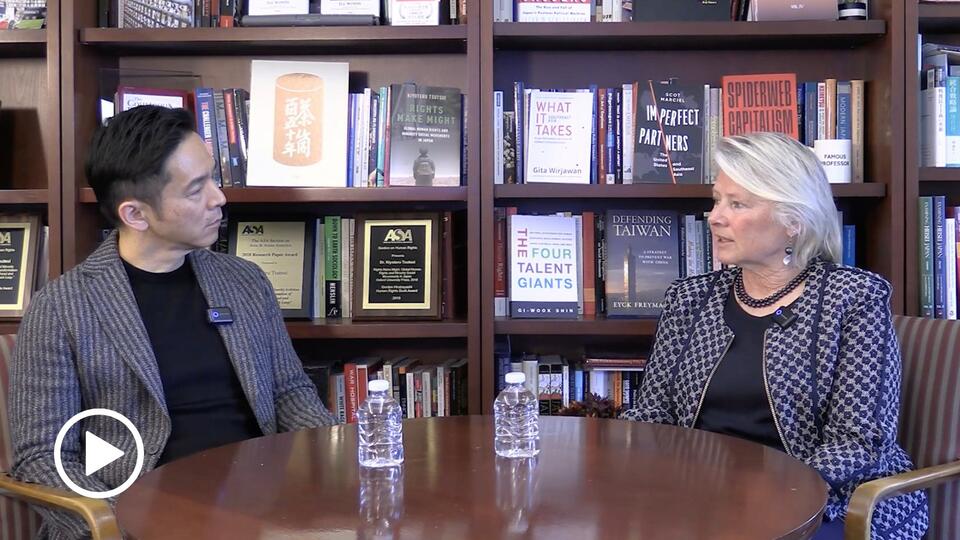
Sign up for APARC newsletters to receive expert analysis and insights from our scholars and guests >
Thornton’s nearly three-decade career with the U.S. State Department in Eurasia and East Asia culminated in her role as Acting Assistant Secretary of State for East Asian and Pacific Affairs during the first Trump administration. She offered a pragmatic forecast for the Trump-Xi summit, arguing that its primary value lies in the act of meeting itself.
While both President Trump and President Xi are committed to keeping their dialogue, the expectations for concrete outcomes on pivotal issues in the U.S.-China bilateral relationship should be tempered, argued Thornton, who is currently a senior fellow at Yale Law School’s Paul Tsai China Center, the director of the Forum on Asia-Pacific Security at the National Committee on American Foreign Policy, and a nonresident senior fellow at the Brookings Institution.
Whether on Taiwan or other pressing matters, China has made it clear it is not interested in a “G2 or a grand bargain” and has relatively low expectations for the list of substantive disputes between the two powers.
The ongoing conflict with Iran has added a new layer of complexity to the tense bilateral relationship. President Trump heads to Beijing after unsuccessful efforts to pressure China into helping reopen the Strait of Hormuz, while Beijing continues backing Tehran politically and potentially militarily.
Thornton assessed that China will not allow the conflict to derail its high-level engagement with Washington, even as it officially disapproves of the U.S. intervention in the Middle East. “Keeping the U.S.-China relationship on track is much more important than having some kind of a protest signal like that,” she stated.
She suggested that Beijing may see a strategic advantage in America’s renewed focus on the Middle East. While China has made nominal peace proposals, it has not stepped up as a mediator. “It seems like they are kind of hanging back and waiting to see what will happen,” Thornton observed. She posited that, from Beijing’s perspective, a U.S. entanglement in the Middle East may serve as a useful distraction, diverting Washington’s attention and pressure away from China.
At the same time, China is hedging its bets by securing alternative energy supplies and gaining influence in regions where the conflict in the Middle East has damaged U.S. credibility.
On the economic front, Thornton drew on her deep experience in trade negotiations to critique the lack of focus in U.S. policy.
"The biggest problem for U.S. negotiators is deciding what it is that we want from China," she said. "We tend to give them a long list of revolving priorities, which [makes it easy for the] other side of the negotiating table to just fob them off and not actually commit to anything over years of negotiations.”
On the technology rivalry between the two powers, Thornton urged a shift in strategy. Rather than pursuing sweeping export controls that are often unilateral and incomplete, she advocated for a narrower, multilateral approach focused on the most sensitive technologies, combined with a greater emphasis on American innovation. AI governance is one of the areas Thornton believes could be a common ground for Washington and Beijing to align their policies.
“It's going to be very hard for the United States to contain China's technological ambitions and growth,” she said. “I don't think that we're exactly competing on the same metrics. I question how it is that we're going to be able to keep China from getting technologies that are dual-use but might be useful in some military application when these things are basically economy-wide products.”
When it comes to technological competition, "We need to try to run faster than China, not be constantly trying to trip China up and looking in the rearview mirror," Thornton urged. "I don't think that's going to bode well for the long-term development of the U.S. tech sector."
While Taiwan remains the most dangerous flashpoint that could trigger a kinetic warfare between the United States and China, Thornton believes that the immediate risk of conflict has receded, in accordance with recent U.S. threat assessments that no longer see 2027 as a likely target date for a potential Chinese takeover of the island.
Beijing, she argued, is closely watching the domestic political situation in Taiwan and how the leadership in Taipei views U.S. reliability and support. “I think the Chinese have determined, based on both of those things they've been watching, that they can afford to wait a bit longer, see what happens.”
Thornton cautioned, however, that, even as a conflict over Taiwan may no longer pose an immediate-term threat, “it is a problem that is going to develop over the coming decade.”
When asked about the future of the global order, Thornton described a trend toward fragmentation. If the United States steps back from its global leadership role, it is difficult to see who else would be willing or able to shoulder the cost of providing global public goods, she said. A “thinner world order,” with the United Nations at its center, may eventually find favor with countries that can afford to pay for some of those goods, she reflected.
In a closing advice for aspiring foreign service officers, Thornton argued that the emergence of a multipolar world reinforces the need for skilled diplomacy. “As the global order changes and more countries come into the mix of the councils of politics in the world, the United States will have to lean back toward diplomacy more,” she predicted.
“We're going to need very good diplomats,” she concluded, because it will be significantly harder to be an American diplomat in a fragmented world order in which the United States is no longer the single overwhelmingly dominant power.
Speaking on the latest episode of the APARC Briefing series, China expert and veteran diplomat Susan Thornton argues for managing expectations of the summit between the two presidents, rethinking the U.S.-China technology competition, and understanding Beijing’s long game on Taiwan.
China is the main global competitor to the United States; but has there been sufficient planning in Washington on how the U.S. might respond to aggression against the island of Taiwan by Beijing? Eyck Freymann wants to make sure there is. He joins Colin Kahl on World Class to discuss his new book, Defending Taiwan: A Strategy to Prevent War, which outlines how the U.S. can integrate its military strength, economic leverage, technological leadership, and diplomatic influence into a single, coherent plan to prevent war.
Eyck Freymann is a Hoover Fellow at Stanford University, where he directs the Allied Coordination Working Group. He is also a non-resident research fellow at Columbia University's Center on Global Energy Policy, the Institute of Geoeconomics in Tokyo, and the China Maritime Studies Institute at the U.S. Naval War College.
This episode's reading recommendation is "A New Era of U.S.-China Interaction: From Competing to Racing" by Evan S. Medeiros, published on April 17, 2026 in Asia Policy.
Kahl: You're listening to World Class from the Freeman Spogli Institute for International Studies at Stanford University. I'm your host, Colin Kahl.
Today, I'm thrilled to be joined by Eyck Freymann to discuss his terrific, timely, and thought-provoking new book, Defending Taiwan: A Strategy to Prevent War with China. This is the book, proof of life. Eyck, congratulations for making it real.
Eyck is a Hoover Fellow at Stanford University, where he directs the Allied Coordination Working Group. He's also a non-resident research fellow at Columbia University's Center on Global Energy Policy, the Institute of Geoeconomics in Tokyo, and the China Maritime Studies Institute at the U.S. Naval War College. In his book, Defending Taiwan, Eyck outlines a strategy to integrate U.S. military strength, economic leverage, technological leadership, and diplomatic influence into a single, coherent plan to prevent war across the Taiwan Strait.
He convincingly argues that America must work with allies to develop a bold new vision of technological and economic statecraft to address the growing risk that China will act aggressively to seize Taiwan and make plans to secure U.S. interests if deterrence fails.
Eyck, welcome to World Class.
Freymann: Thanks so much for having me on, Colin.
Kahl: Let's start with the basics. What inspired you to write this book and why should the average American listening to this podcast care about the fate of Taiwan? Is it the fact that Taiwan is a democracy? Is it its geography and the so-called first island chain? Is it the possible implications on our security commitments throughout the rest of Asia? Or is it about semiconductors and AI and supply chains? Like, why should Americans care about Taiwan?
Freymann: When I got into studying China as an undergraduate, the reason was that I thought China's interests were global. In my graduate studies—the work that turned into my first book— I looked at the Belt and Road Initiative: how China used money and deals for political influence around the world. And I went on the trail of this initiative from Sri Lanka to Tanzania to Greece, and ultimately to Greenland, where I wrote my PhD.
Kahl: So, you were studying Greenland before it was cool.
Freymann: I was, in fact, studying Greenland. And it was very cool, but more in the temperature way. Greenland's a terrific place to be. And I think we discovered increasingly why it matters in the context of China's Arctic strategy. But it just gives a sense of the scope and the scale of China's ambition.
China's interests do not stop with its region. China wants a full transformation of international order to serve its interests for what the party believes will be centuries or millennia of CCP rule. And it is being methodical because it thinks it's laying the groundwork for that. Taiwan happens to occupy this very particular place in the CCP's ontology because it's the unfinished business of their civil war and because it's fundamentally bound up with relations with the United States.
So I became interested in this during my graduate studies. The origins of the project was that I asked a friend of mine—a naval historian—just an encyclopedia of all things military—to give me the book that I should read to understand this issue: what the military balance looked like and how it was changing, what a war with China would actually involve and what it would take to win, and just how dire the situation actually was.
And he said, well, no book like that exists. I can send you a thousand articles. Thus began this collaboration to figure out the military aspects of this story.
But the more that I researched it, the more I realized this is not a purely military issue. In fact, the military analysis is the easy part. China has a whole battery of options for how they could move against Taiwan. But the really significant ones involve creating crisis scenarios that break U.S. resolve and shatter our alliance structure.
And the way that China thinks it can do that is pushing on where we are weakest, which is in the economic domain, our inability to take pain.
And this gets to the heart of why Taiwan matters. Taiwan matters most obviously because they make the chips. 90% of the world's advanced chips, 99% of the true cutting-edge Nvidia chips that train the advanced AI models.
Taiwan matters geographically because if China could ever use it as a forward base for its Navy, it could project power all around the region in a way that it really can't today because of the U.S. position in these islands that we call the First Island Chain.
But then the third reason, the most globally significant, is that the way China would move against Taiwan would set norms about how they are going to seek to achieve regional hegemony and eventually global hegemony,
And the thing to understand here is this is not a continental region. The Indo-Pacific is an archipelagic region. You have economies that are basically not energy secure, not food insecure, the most trade dependent economies in the world, and they make everything. Pretty much nothing significant in the world doesn't include some thing that has to be made in this region. And that means that the sinews of commerce, which are mostly private airlines, private shipping companies, operating through international airspace and international waters, these are the lifelines of this region.
And if China can take control of that without firing a shot, that is how they will eventually achieve world domination.
So the question of how China might move against Taiwan, if they move against Taiwan in a non-military way, really matters because of the precedent it would set and what the United States would reveal in how it responds.
Kahl: I want to dig into that a lot because you have a lot to say about that. But I want to double click on one thing that you didn't mention in your litany of reasons why Americans should care about Taiwan, which is it's an island of 23 million people. And it's one of the most vibrant democracies in the world, frankly. Is that also something that Americans should care about that, China does not do to Taiwan what China did to Hong Kong, which is to snuff out a vibrant democracy and the world just kind of moves on?
Freymann: It’s absolutely a U.S. interest. The U.S. has a principled position on this. We don't take a stake in Taiwan's status, so we don't have a position on what that is. This is for Taipei and Beijing to work out by themselves. But we don't want it resolved by force or coercion, and any resolution has to be democratically acceptable to the people of Taiwan. Why? Because of the precedent that it sets for the broader region, not just for Taiwan itself.
Obviously, given what we have seen in Ukraine and elsewhere, Taiwan is a vulnerable democracy under threat from an authoritarian superpower. Allowing them to be extinguished would be a very bad precedent. But we cared about Taiwan before they were a democracy. And if something happened and Taiwan ceased to be a democracy, we would still care about Taiwan.
And at a moment where support for democracy worldwide is increasingly politicized, I'm emphasizing these three other material interests because these are things that everyone from the most progressive Democrats to the most fire-breathing MAGA Republicans can all agree on.
Kahl: That makes a lot of sense. I mean, look: you've already established that China has perennial interests in Taiwan because it's difficult for the CCP and for President Xi Jinping in particular, to imagine achieving their goals for national rejuvenation and greatness without reabsorbing Taiwan.
And you've established that there are perennial U.S. interests that are both material and values based.
I now want to talk a little bit about the infamous 2027 timeline. So my understanding of how this originated was during testimony by Phil Davidson, who was an Admiral and the Commander of Indo-Pacific Command back in 2021, who basically said that China could make a move in the next five years. And then I think Bill Burns, who was the Director of the CIA, clarified a year later that 2027 was a potential period we should be focused on for the prospect of invasion of the mainland on the island of Taiwan.
Talk a little bit about that 2027 date, because it's almost established this kind mythological status in some circles. And I think there's a lot of misunderstanding about that date. Can you talk a little bit about that?
Freymann: Completely agree. The date 2027 has been overplayed. The date that matters most is 2049. That's the hundredth anniversary of the establishment of the People's Republic of China. And Xi Jinping will be 96. So he probably thinks that he'll be around, but who knows. That is the deadline he has set for achieving national rejuvenation, which is his all around vision for putting China at the forefront of essentially every human endeavor.
The line I like to use is he wants China to win every gold medal at the Olympics and every silver and every bronze. This is not just about foreign policy. This is about technological supremacy, ethnic harmony, cultural flourishing. It's the works.
And Taiwan fits into this story because historically speaking, the division of China is a thorn in the side of the CCP. Taiwan being a free, vibrant, technologically advanced society right across the water, is living proof that the CCP is not the ‘end of history’ for the people of China, that there's an alternative version of China that is actually better in pretty much every way to live in.
So there's a whole bunch of reasons why taking Taiwan in a way that humbles the United States and pushes the United States out of the region could supercharge China's pathway towards achieving the rest of national rejuvenation.
But 2027, as Xi Jinping has described it, is just an intermediate date. For him personally, it's a significant year because there's a party Congress in 2027. He'll be up for a fourth term, which I think he's overwhelmingly likely to get. But it's a date that he's ascribed as a readiness deadline in a number of different domains, not just military.
We knew before Admiral Davidson's statements that China had set 2027 as what they call a “building goal” for the PLA. It was also a goal for various technological and economic benchmarks. And the question is, what exactly does this building goal mean? The way that I interpreted the Davidson testimony is we have some intel that suggests Xi Jinping said, this means build the capability to take and hold Taiwan.
And it was always dubious whether China would get that capability by 2027, just because so much has to go right to make an amphibious operation work. And I think now that we're coming up against that date, most of the military analysts I talked to think they're not quite ready yet. They've come a long way, but there's still some gaps in their force structure that they would really like to fill.
But I think the way to think about it is we are nearing an inflection point where Xi Jinping feels confident enough in his own armed forces that he can start taking more risk. Which means we're entering a new chapter in this competition in the gray zone. And these military capabilities matter. They shape the dynamics of crisis even if they're not actually used.
Kahl: So I think that's really important and I want to drill down on this a little bit because you know my understanding when when I worked at the Pentagon was that 2027 was basically a deadline for his generals to report back that they could do this if he ordered that they should do this. But in part he was lighting a fire under them because he didn't think they could do it, that he doesn't have a lot of faith in his military. We've seen almost an endless series of purges that speak to the fact that she does not completely trust his military [and] thinks a lot of them are corrupt.
And so again, I think the 2027 date has been a little misinterpreted. I also, though, think it was useful in our own system to light a fire under us about the urgency of this issue, even if it wasn't 2027.
Freymann: Anyone who's ever taught undergraduates knows sometimes you just need a deadline.
Kahl: Yeah, but then they always email you three minutes after the deadline to ask for an extension.
I do I want to drill down on whether events in the past couple years outside of China may be affecting Xi Jinping's thinking a little bit. So obviously, in 2022 you get the all out invasion of Ukraine by Russia. On the day of the invasion, Russia looked on paper like the second best military in the world. They certainly had a lot of combat experience in places like Georgia and Ukraine in 2014 and Syria and elsewhere.
And yet a day later, they barely looked like the second best military in Ukraine. And I think what that illustrated is real war is real hard. Meanwhile, this year you've seen the Maduro raid, you know, that's an ally of Beijing. You've seen the Iran war, which has had mixed results strategically, but it's been pretty devastating militarily to the Iranians, a close partner of China.
So when Xi Jinping looks at these wars, do you think he draws the conclusion that war is easier or harder? And does that put more time on his clock?
Freymann: This is ultimately a speculative exercise. I wish we had a Being John Malkovich view into Xi Jinping's head.
Kahl: I mean, for all you know, the NSA does, but we can't talk about that.
Freymann: Yeah, those are secret capabilities. Maybe Claude Mythos will solve that one for us.
I think lacking that, lowly, unclear Stanford scholars like me have to read the tea leaves from the open sources.
Clearly, the U.S. decision to burn 25 to 40 % of our long range precision munitions and considerably more of our air defense interceptors in Iran was not the most enlightened decision from the perspective of deterring China over Taiwan. But I think it's significant that we paused there and we didn't burn the rest.
I also think that as the character of warfare is evolving and unmanned systems—which you can make in quantity very cheaply—continue to proliferate and get more sophisticated, Taiwan's options for defending itself Improve.
And when you think about what is involved in taking tens of thousands of men across the strait . . . which, granted, is only one of several scenarios for how China can move against Taiwan. They can cyber attack Taiwan, they can bombard Taiwan, they can blockade Taiwan.
But if they actually want to take and hold the island, what does it involve? They have to put tens of thousands of men on the ground, which means they need a beachhead or an airhead. It's very hard to deliver a significant number of people by air, as we saw in Ukraine, because it's just so easy to take down planes and helicopters with cheap things like stingers.
And the alternative— amphibious ships across the strait—they got lots of them, but Taiwan basically knows what the harbors and ports are that would be attacked. And it's relatively cheap with surface drones, underwater drones, aerial drones, naval mines, to make the Taiwan Strait a sort of hellscape.
Now there's so many questions. This question of would Taiwan fight? There's also a question of how resilient Taiwan's command and control infrastructure would be if it was bombarded for days on end. But if I'm China and I'm thinking about all of the things that have to go right in sequence for an amphibious invasion to go well.
When I consider these tail risk scenarios in which my guys are stuck in urban combat in Taipei . . . you walk through the streets of Taipei, you can see this is not a nice place to engage in urban combat. And you ask, how long will I have to resupply them? How many more transits across the strait will I need to do to deliver them food and medical and vehicles and fuel?
There are scenarios in which the opening campaign seems to be going well, and then it turns because China has these troops on the beaches who then get massacred. These scenarios, you can simulate them in all these ways, but ultimately no one knows. It's just much easier and simpler and more attractive to take the prize for free if you can.
And that is why the argument of the book is we can't take our eye off these military scenarios. They matter. But Taiwan's fate is more likely to be decided by a crisis than a war. And we got to deter the crisis, not just the war, because the crisis is bad. The crisis presents us with decisions that we are not currently set up or prepared to make. And how do you deter the crisis? You need a concept for deterring Xi Jinping in the gray zone, which right now is where the real action is.
Kahl: So I want to come back to that. I do think you made a really important point. If I'm Xi Jinping, on the one hand the United States burned through years worth of production of the critical munitions necessary to fight a war with China over Taiwan: long range strike capabilities like the new Prism missile or or JASM, advanced air defense interceptors for that, Patriot, and others. Not to mention relocating assets from the Indo-Pacific and all of the rest.
So on one level, the U.S. deterrence posture is inarguably weaker in the Indo-Pacific and across the Taiwan Strait today than it was before the war with Iran.
On the other hand, I think both the war in Ukraine and the war in Iran show that even very powerful actors can be stymied by asymmetric approaches, especially using large numbers of attritable munitions. So, think of cheap missiles, especially cheap drones.
And that's, I think, a good news story for Taiwan and for the reasons that you point out. So I do think that's relevant. And I think it goes to this point the invasion is the riskiest outcome. I've participated in war games on Taiwan in the unclassified and classified settings, and they almost all culminate with whether China gets a lodgement, right? They get to the beaches.
And I think what you just compellingly argued is that, they don't just have to get to the beach once. They have to get to the beach every day with food and fuel and men, and then they have to crawl through the jungles and the mountains and occupy cities. It's a big deal. So if Xi’s going to do this, I'm convinced it's much more likely that he's going to do it through some squeeze—a quarantine, a blockade, a customs regime.
So walk through what you see as the non-amphibious invasion. If the Chinese don't do D-Day, what do they do?
Freymann: Well, the option that has drawn most attention for decades is blockade. And the reason is we've known for 130 years that you can blockade very easily with dumb mines. You seed them in the water and then no one wants to navigate through. And we're seeing this now in the Strait of Hormuz. Iran doesn't have a navy, they don't have an Air Force, they supposedly don't have any missile launchers, they don't have leadership that's willing to show their faces, and yet, they can shut down the flow of commerce through the strait.
And the United States can offer insurance to these vessels. The American president can tweet, show some guts. But these people don't want to die. And so they can make a rational calculation that it's not worth it. At some point, maybe that will change. But clearing mines is very difficult.
So, if China just wants to do a scorched earth medieval style siege, that option is on the table. And we have to take it seriously because if Xi Jinping persuades himself that this is an ugly but assured forced checkmate, he might be tempted by other options because he thinks, well, this is a guaranteed fallback plan. So I take the scenario seriously in the book because you have to show Xi Jinping that it is not assured victory.
And breaking out that blockade would be nasty. It would almost certainly involve large-scale strategic bombing inside mainland China. It would involve the risk of nuclear escalation. The challenge of resupplying Taiwan's population would be orders of magnitude harder than resupplying Berlin during the Berlin airlift of 1948-49. But it is still something that we should work on that I am sure the Pentagon has very detailed operational plans for, because you have to show China that we could do this if we had to while deterring nuclear escalation.
Kahl: What do you make though . . . so, there's the blockade or a scorched earth. But one lesson from the Strait of Hormuz is you can create the psychological risk that ships that get too close to Taiwan could be at risk. But you would also just impose a customs regime, right? That requires every ship coming in and out of Taiwan to check in on the mainland first.
And it wouldn't be putting mines in the water. It wouldn't be putting missiles onto the island of Taiwan. It would simply be to assert China's sovereignty over the island through a kind of lawfare and coercive means. What do you think of the customs possibility?
Freymann: Well, that's exactly right. And this is the scenario that I think is the most likely and dangerous. And I hope that we can dig into it. But the reason I talk about blockade first is that a lawfare customs quarantine thing: it's a completely different beast.
The reason that a blockade is an unattractive first move is that it has a lot of the disadvantages of war for China, but none of the advantages. It's not clear that Taiwan just surrenders overnight and it puts the Americans and the allies on notice that something extreme is happening. It's a totally barbaric humanitarian disaster. It's an act of war against the civilian population of Taiwan. And it causes our gargantuan global financial crisis because all of a sudden it's not just Taiwan. No shipper is going to get covered to go anywhere near Taiwan.
So all of the supply lines in and out of South Korea, Japan, mainland China, everything gets busted. So China creates this shock. It's horrible. It's economically disruptive. And then the rest of the world lines up behind the United States and says, well, we have to make them cut it out.
The reason that the quarantine scenario is attractive for China is it doesn't do any of that stuff. It doesn't break supply chains on day one. It doesn't trigger a financial market panic necessarily on day one. China just says, “We're just enforcing our existing customs law. We're not saying you can't deliver to Taiwan. We're just saying you have to come through a mainland port.”
The goal is: establish the principle without disruption. And then if the Americans accept it, they're checkmated. Because in the long run, China then can make the character of Taiwan's exchanges with the outside world a subject of gray zone pressure, and they can squeeze that dial all the way to black. And that is how China gets Taiwan's fabs intact. That's how they seize control of the engine of the AI revolution without the Americans destroying it.
Now the Americans always have the option of escalating it up into a war or disabling the fabs: blowing them up, cyber attacking them, what have you. Like the U.S. has this capability. But the decision to do that is really significant. The decision to do that is essentially a big red button on the president's desk that says the financial crisis that ends my presidency.
And what China's banking on is that we will just choose option A and allow Taiwan to slip away while pretending that nothing meaningful has changed so that we're totally screwed in the long run because we lose AI, but we avoid this really acute short-term crisis and the politicians get to kick the can.
Kahl: I think it's a real risk and one of the things that's hardest to deal with. So let's talk the solution set, which is essentially the last 60% of your book.
Back in 2022, when I was working at the Pentagon as the undersecretary for policy, we wrote the 2022 National Defense Strategy. At the heart of that document was this idea of integrated deterrence. Integrated deterrence meant a lot of things: integrating across the domains of conflict, but also integrating across the instruments available to the U.S. government, not just military, economic, diplomatic, technological, integrating across our allies and partners since that's kind of our ace in the hole globally, and integrating across the spectrum of conflict, recognizing you are trying to deter from the gray zone to nuclear war. That's a lot.
We were criticized by hawks in Congress and elsewhere for essentially offloading the idea of deterrence—which is traditionally thought of as a military instrument and predominantly as a punishment instrument—offloading that to civilian agencies like the State Department or Treasury or Commerce or others to use other tools so that we could lower the defense budget or something by offloading it to civilians.
My view was always, it was, “Yes, and . . .” The military had to be robustly capable of deterring and prevailing if deterrence failed, but you also needed to supplement that military deterrence with economic and diplomatic measures, which I think is squarely where your book lands.
So, walk our listeners through how you think of integrated deterrence and especially how you think about integrating these non-military instruments—political, economic—into deterring the types of scenarios you've been talking about.
Freymann: Well, first of all, Colin, this is why I'm so thrilled to be on this podcast, because as I describe in the book, your concept of integrated deterrent is the inspiration for what this is trying to do. Obviously, we didn't achieve the aspiration as fully as we might have in the Biden administration. And then in the Trump administration, we are essentially gutting the interagency process. We're antagonizing our allies. We're doing the opposite of whatever integrated strategy is.
But I think what you say is absolutely right. China has an integrated strategy for Taiwan and to achieve national rejuvenation generally. They link together every tool of their national power— their control of supply chains, technology, diplomacy, information operations and propaganda, the military, everything. It's organized towards a specific set of goals. And that gives us that gives them carrots and sticks to use against other countries and us.
We need to do the same thing or we are going to be outmaneuvered because we will not be able to muster the tools of our national power to push back effectively. And by the way, because we will never be able to beat the CCP and how we organize ourselves, we need allied scale to do a lot of this stuff in response. That is very much the spirit of the book. Before we talk about the pillars, though I'm happy to get into them.
My question for you would be, what did you learn over the course of the Biden administration? Is this just a pipe dream? Is it impossible based on how the U.S. interagency is set up to do integrated deterrence? Or is this the kind of thing that we could theoretically do if we had political leadership that was determined to do it?
Kahl: First of all, whose podcast is this, man? But I would just say this. The jury is still out. I think in the lead up to the Russian invasion of Ukraine, there were a lot of efforts to try to convince Putin that there would not just be military costs in the sense of helping Ukraine defend itself, but there would be economic and political costs to the Russians.
Obviously, that attempt to show that there was a wide range of costs that would be significant, also thwart his ability to achieve his objectives. It didn't succeed. Putin invaded the country.
On the other hand, I think if Putin knew what was coming in retrospect and looked back and says, look, four plus years on suffered a million casualties because of all the support we provided the Ukrainians. Russia was, at least for a period of time, significantly isolated from a big chunk of the world economically and also pushed into the arms of China and in weird ways made Russia dependent on countries like North Korea and Iran. Russia was basically unplugged from the West buying a significant amount of oil and gas from them, I don't think he would have done it. So I think the jury is still out about whether it is possible.
Xi Jinping, though, has seen all of those things, right? And so my own view on China is Xi Jinping's theory of rejuvenation requires China to be thoroughly integrated into the world. And you can hold that at risk in some ways. And I take a lot of the substance of your book as pushing in that direction as well. So why don't you let our readers pull back the curtain and let them know a little bit about how you see the pieces of deterrence fitting together.
Freymann: Great. Let me dig into it. The reason that I ask this is I want to know if it's a pipe dream to think that these things can ever be done in combination. But here's basically what I think we should do in each of the domains. In the political diplomatic domain, we need to manage China, engage Taiwan, and establish our core coalition.
What does that mean for managing China? Keep the One China policy, but communicate to China that just because we have strategic ambiguity as to what we would do if they attacked, we're not going to stand idly by as they push in the gray zone. If they push in the gray zone, we will push back proportionately, in a manner that we think is proportionate, in a domain of our choosing to maintain an overall stable situation. And if we get wind of a potential big move on Taiwan, in the same that we had advance notice of Putin moving on Ukraine, we shouldn't say that we're going to wait until they fire the first shot to reveal what our action is. We should reserve the right to act preemptively. And that's all within the format of our existing One China policy. It's just changing how we communicate it.
Kahl: I think you'd call it structured ambiguity instead of just strategic ambiguity.
Freymann: I call this structured ambiguity. It's the same substance, but it's a new way of communicating our existing policy. Just to remind China that when they push in the gray zone, they are hollowing out their commitments to us under the three communiques. And those communiques are the political foundation of our relationship. And they should understand that there's risk associated with doing that.
With engaging Taiwan, you just have to show the people of Taiwan that we understand that they're a democracy under threat and that we stand with them. And that includes respecting the right of the people of Taiwan to make their own choices, which means not picking favorites in Taiwan elections, being willing to work with whoever they work with, supporting them with technology partnerships, energy partnerships, people-to-people exchanges, just being present for Taiwan.
And then the core coalition is making a statement that we have allies that have skin in the game too. Japan, obviously. They now say publicly it's existential for them. The Australians, it's arguably existential for too. If there's any kind of crisis over Taiwan that results in financial flows or trade in and out of China being messed up, I mean, that's a financial crisis in the UK because HSBC and Standard Chartered, the two biggest UK banks essentially . . . that is their bread and butter.
Then Canada, who obviously we've been abusing lately, Canada has skin in the game as well, because we are one big economy with Canada. And if we have to decouple from China, in whole or in part, for any reason, they are going to be collateral damage or they're going to be a country that gains opportunities from working with us.
So we need to bring this coalition together, start treating these partners with the respect that they reserve, and then do what we can to communicate with a common voice what we would do. If we had in the events to do something big and economic, we would have to work with this core coalition because the Europeans, they make these decisions by consensus. So it's less predictable what they would do.
Kahl: Before you go on to the economic, though, I want to ask you to go one layer deeper on the alliances piece. Because one of the things we saw early on in Ukraine was actually it wasn't just the North Atlantic community responding to Russia. It was actually a coalition of advanced liberal democracies in Europe, in North America, and in Asia, imposing costs on the Russians.
And I think my sense is that Beijing worries very much about a similar coalition being aligned against a raid against them. But to say the least, the status of our alliances right now . . . not so hot. what do you think? And I think they're probably better in Asia than they are in Europe in terms of the health of our alliances. But how much of the need to build this political coalition has been complicated by recent tensions with our allies?
Freymann: It has not gotten easier in the last 18 months. And I think we should brace for it to get worse. But we have common interests, these five countries that I named, essentially the big Anglo countries plus Japan, we have a common interest in deterring this crisis. And then if the crisis happens, we have a common interest in dealing with it effectively, working together.
And we have other allies with skin in the game too. I don't mean to leave out South Korea, the Philippines, but these countries, for political reasons and because of their vulnerability to China's economic coercion, they are very close to the core, but they may choose, depending on the circumstances, not to be the core of the core. And that's okay.
When we're thinking about coalition building, we need to be more flexible than saying you're in the tent or you're out. We need to understand this as essentially a group of concentric circles or overlapping Venn diagrams, where different countries might collaborate on different things. And that is essentially a call to expand the viewpoint from just treaty allies to partners too. And we can get to this and talk, we talk about economic deterrence.
Kahl: Yeah, let's turn to that. So you've talked about the political piece. There's a U.S.-China piece, a U.S.-Taiwan piece, and a U.S.-allies piece. What are the other aspects of integrated deterrence in your thinking?
Freymann: Well, there's conventional military deterrence, which is the standard deterrence by denial. Show them you could defeat the invasion of the blockade. And that means replenishing our magazines of these long-range precision munitions, air defenses. Air defense is critical for Taiwan. Making sure the right stuff is forward deployed in the region, including all of the fuel and the spare parts. Because our logistics chain would struggle in any kind of protracted fight. The distances are huge. It's a tyranny of distance.
Helping to build up the supply chains for stuff like drones. Revitalizing our submarine industrial base. It sounds like a lot and is a lot, it's a few hundred billion dollars over five years. And we've already bought about half of it. So on this issue in particular, at least, the Trump administration is doing reasonably well with the big exception, obviously, of spending down all these munitions in Iran.
Kahl: But know, the value of $1.5 trillion to try to make up for lost time.
Freymann: If they get even a much smaller version of their defense budget, that takes us a lot of the way there towards getting the conventional force in a position to sustain deterrence into the 2030s.
The nuclear side is trickier because strategic deterrence is no longer just about nuclear mutually assured destruction. Our nuclear forces depend on a command, control and communication system that extends to space.
ground stations that can be cyber attacked. And that means the resilience of our space architectures, our resilience to cyber, our offensive cyber. This matters hugely for this mutually assured destruction dynamic that looms in the background of any potential crisis or fight. And AI plays a role in this. And we don't really understand how. But as we see with this new Claude Mythos model, maybe AI very quickly could totally disrupt the cyber balance in a way that could be favorable to us, but also potentially unfavorable.
And I don't come down with a clear position, but I think we need to study this. In the short term, we need to stay as far ahead in AI as we can. And then we need to be open-minded about what some kind of arms control or more stable strategic balance might look like in the future, because AI, we don't really understand yet, but it will play a role.
Kahl: You used a really important word, which you heard a lot in the Pentagon in the last administration because it was in the National Defense Strategy. You hear less about it now. And that term is resilience, which is not a terribly sexy concept, but actually quite important to deterrence as it relates to China, because their entire theory of victory over the United States is to paralyze the networks that undergird the American way of war. Undersea cables, constellations in outer space cyber networks, critical infrastructure in the homeland that supports power projection. And so a lot of, think you're right to kind of emphasize that part of strategic deterrence succeeding is convincing China that they can't paralyze either our conventional or nuclear forces.
Freymann: So what is strategic deterrence? I define it as fundamentally a threat to the survival of another state or regime. And in a world where the CCP is increasingly paranoid, AI is increasingly useful for propaganda information operations, China's population has been kept isolated, not knowing about the world.
If you can potentially bust the great firewall and deliver messages about the corruption of the party and Tiananmen Square and all this other stuff to the people of the PRC, you could potentially deliver a devastating threat to the survival of the CCP and you don't have to nuke anyone and you don't have to shut down any critical infrastructure. But if I'm the ministry of state security, I'm very concerned about that.
And all this is to say, what strategic deterrence involves is expanding across domains in ways that we are only beginning to understand, and AI is deeply tied up with it. And potentially that's useful for us, but potentially it's also destabilizing. And I'm sort of kicking the can on this because there's only so much we can say at this particular point in time. But it does matter.
Kahl: Let's talk about two of the chapters in the book really drill down on the economic statecraft associated with integrated deterrence. You want to flesh that out a bit for our listeners?
Freymann: So there's a temptation to think of economic deterrence as an extension of strategic deterrence. The U.S. and China are so economically intertwined that if we shut down that relationship, it's like an economic nuke. And that is how I think members of Congress have thought about it. There was legislation called the Stand with Taiwan Act that would have imposed these crippling across the board sanctions.
I think that that basically doesn't work. Yes, there's some really, really extreme scenarios in which we could plausibly do that. But in the crisis scenarios that I think are most plausible, I don't think that option is strategically attractive or politically available.
And what's dangerous is that we don't seem to have an affirmative economic contingency plan. If we get into a crisis and the president says, “Give me options that don't blow up the world economy,” and the president's advisors say, “I'm sorry, sir, we haven't done our homework.” That seems like a big problem because then the only option left on the table is just capitulate.
And then if China learns that it can extort us by threatening us with economic breakdown, then they can do it again. So we need an affirmative vision for a post-rupture economic order on the table, plausible, discussed, something that in a crisis situation might plausibly be of interest to both Democrats and Republicans and a bunch of other countries, and which is structured to be flexible so that the details can be worked out in the event, because obviously you can't work out the details in advance.
And the framework that I talk about is called avalanche decoupling. The basic idea of avalanche decoupling is it's just fantasy to imagine that you can decouple from China all at once like a light switch. It's just fantasy. We tried that on Liberation Day.
Kahl: Avalanche decoupling for our listeners: massive secondary sanctions, cutting off all trade, cutting off all imports of components for critical technologies, those things?.
Freymann: Exactly. And we tried a version of this on Liberation Day. The president is like, a hundred percent tariffs on China. And then the stock market crashes and then the bond market crashes. And then various captains of industry call up and say, Mr. President, you have to reverse this or we're done for. And then within a week, the president is like, lol, JK, I'm rolling it back.We're making a truce. And that reveals to everyone, including to China . . .
Kahl: Then he later threatened to do it again and China calls his bluff by putting export controls on on rare earths and he and chickened out again
Freymann: And then we see another version of this in Hormuz, where Iran takes 20% of global oil offline, and now the United States is suing for peace and essentially abandoning all of its grand designs of regime change or ending Iran's right to enrich. The U.S. is on the back foot and it's because it can't take even a small amount of economic pressure.
So if we imagine scenarios where it's not politically available to make an already bad situation vastly worse. But China has revealed that this is an abusive relationship and they're going to use our economic dependencies to squeeze and coerce us.
What do we do? Well, basically there's two things you can do. One is you can cushion the short term blow with large scale fiscal and monetary action, like we did at the beginning of COVID, coordinated with as many other countries as possible, essentially help the world economy through the crisis rather than having the world go into depression and it's our fault.
So China's doing this to the world, but we're bailing you out. And then set in motion a process that will break your critical dependencies as fast as reasonably possible, and then leave the non-critical stuff to do later, if ever. In other words, it means not maxing out on punishment of China, but focusing on our own economic interests first. And then hopefully punishing China over time as a side effect.
And the way you do this in avalanche decoupling is with a tariff or a quota that moves. Let's take the example of drones and drone parts. Right now, the United States cannot make a drone without buying parts from China. And that's crazy. It's crazy.
But what are we supposed to do? Because if we say, starting tomorrow, you can't import drone parts from China, then we can't make more drones. The only way to do it is to phase it out, to say, on X date, we will no longer buy drones from China, or there's a tariff that is going to move up in a consistent way, or a quota that will move down in a consistent way, and then by date, it will be effectively impossible to buy from China. You'll have to buy it from some safe country.
I think we can do a version of that now for like the 1% of our trade with China that is most critical, the drones, the medicines, that kind of stuff. And you can do it in a way you coordinate with allies because the French and the Japanese, they don't want to be dependent on China for this stuff either. If you can do that now, then you have a proof of concept that if a crisis happens and we need to do it for 20% of our trade with China or 50% or 70%, that that option is available and that we know how we would do it.
Kahl: My experience, and maybe this is my bias, because I've worked at the Pentagon so many times, but I also worked at a White House, and I worked around a White House that tried to integrate around interagency planning. And it remains true that even in a White House that has a lot of process and really brings the interagency together, mostly you're reacting to crises. You're not doing break glass, day one planning for these things.
The only place that does that is the Pentagon. And I think what you're seeing in a place, in a situation like Iran is that the military piece of things, like what targets to hit, how to hit them, how to generate effects, is pretty remarkable, actually, because the military is really good at planning and executing that type of stuff.
But all the other stuff fell by the wayside. The diplomatic plan, the plan to deal with the economic second and third order effects, the diplomacy in the region with our allies. It's not a critique one way or another necessarily is just of of this war—people can make up their own minds about that.
But it's just to say when we don't bring all instruments together and plan around them ahead of time, it's hard and that that's not gonna happen naturally at places like Treasury and the State Department and Commerce and Energy. That's gonna be something that requires the White House to bring people together, knock heads, and keep people in windowless rooms for as long as it takes to create the type of playbook that you were talking about.
Freymann: That's been my experience. I started briefing this stuff around the interagency and on the Hill in 2024 because the House China Select Committee had done this report and they had found the United States . . . they wrote this in the report, quote, “The United States lacks a contingency plan for the economic and financial effects of a conflict with China.”
This is December, 2023. And I read that and I was appalled. I said, “What do mean there was no plan?” Surely somewhere in Treasury, is a plan. No, there's no one office in Treasury that's responsible. Took it around the Hill, briefed it to everyone from the most progressive Dems to the MAGA Republicans. Everyone's like, yeah, of course there should be a plan.
But it's too big. It's no one's job because it's too big. And also it just gets to the difference in approach to military folks versus economic folks. Economists don't do contingency planning. It's not their thing.
So what is the purpose of what I'm doing here? It's an outsider putting something on paper. Well, I think it's helpful to start talking about these things now. We have to start having this conversation now, because in the event, we're going to find out that we don't have a plan, but maybe we'll have what the president once beautifully termed a concept of a plan. The broad outlines or the principles that would describe what it is that we're trying to achieve, what it is that we're trying to avoid, and how we aim to achieve that.
And if we put this down on paper and we start to convene conversations about it among allies, between Democrats and Republicans in an informal way, just say, imagine that our relationship with China turns openly abusive and we decide we have to start getting divorced. And yeah, divorce sucks, divorce is expensive, but divorce is also sometimes necessary and it's an opportunity. And you're imagining life on the other side.
Let's think from a blank sheet of paper. What do we want the global economy to look like as we are divorcing China? If we have the opportunity to rethink or reverse some of these mistakes that we made in the last forty years of outsourcing all these jobs, letting China steal all our IP, and we get to start again, how would we do it? That's an opportunity. And that's potentially something that politicians could sell to the American people to say, listen, we made some mistakes, now we're going to pay for those mistakes. But it's going to work out better in the end.
There's a brighter future at the end of this, where maybe we'll bring more good jobs home that we had lost. Maybe we'll become less vulnerable to coercion. Maybe we'll make a better, safer, more secure and prosperous world. And it's not an easy sell, but then the other options are not that good either. But at least it's something to start from in a crisis. So we're not starting from nothing.
Kahl: I think it's a really important point and maybe one we’ll conclude the conversation on. It’s a the very different context, but the Biden administration spent four months between when the intelligence was coming in that the Russians intended to invade Ukraine and the actual invasion and spent that four months doing an extraordinary amount of interagency work on the day one playbook for what would happen if the invasion actually happens: how the sanctions would be implemented, how we would deal with getting security assistance into Ukraine, how we would deal with the economic fallout.
And we didn't get it all right. I think we didn't do enough on things like food security that ended up being a big problem. But I know how hard it is, even when you have the intelligence that says something really bad is about to happen. The China piece is way harder, both because the problem is bigger and because we aren't going to be compelled by four months of warning, and that may not be enough.
So I think you're clarion a call in the book, which everybody should go read, for that thinking to happen as far in advance as possible and to start talking about it so that China knows that we're thinking about it and therefore hopefully is deterred by the fact that we have a plan.
All right, everybody's supposed to go read your book. But at the end of World Class, we ask all of our guests to name one article that people should go out and read if they want to understand the world.
So do you have a recommendation for our listeners?
Freymann: Yeah, there's a new piece out from Evan Medeiros, former Asia director on the National Security Council. It's called “A New Era of U.S.-China Interaction from Competing to Racing.” And I would urge everyone to read it. It's a very important piece.
Medeiros' argument is that the trade war that escalated in 2025 between the U.S. and China has created a new chapter in U.S.-China relations where essentially the two countries are are racing to de-risk from one another, to reduce their vulnerabilities in case the really acute crisis happens again. And China is thinking much more seriously, and they're working much more aggressively to break those dependencies than we are.
And we need to get serious and recognize what race we're running, otherwise we're going to get caught behind.
Kahl: Well, Eyck, I think that's a great place to end. First of all, thanks for writing such an important book on such an important topic at such an important time. I hope it does well. I hope our listeners go out and check it out. Thanks, Eyck.
Freymann: Thanks, Colin.
Kahl: You've been listening to World Class from the Freeman Spogli Institute for International Studies at Stanford University. If you like what you're hearing, please leave us a review and be sure to subscribe to Apple, Spotify or wherever you get your podcasts to stay up to date on what's happening in the world and why.
Eyck Freymann joins Colin Kahl on the World Class podcast to explain his plan to bring America's military strength, economic leverage, technological leadership, and diplomatic influence together into a single, coherent plan to curtail China's ambitions toward Taiwan.
Japan’s semiconductor industry, once globally dominant in DRAM during the 1980s, declined through the 1990s and 2000s due to trade friction with the United States, the rise of Korean competitors, and a failure to adapt to the fabless/foundry model. Today, Japan’s logic IC process technology lags at the 40nm node.
The 2020 global semiconductor shortage prompted Japan to launch two major revitalization projects under the banner of economic security: TSMC Kumamoto, a joint venture producing 12–28nm logic ICs for Japan’s automotive, industrial, and consumer electronics sectors; and Rapidus, an ambitious startup targeting 2nm logic IC manufacturing by 2027.
The paper argues that while TSMC Kumamoto meaningfully strengthens Japan’s domestic supply chain — connecting Japanese equipment and materials suppliers with downstream industries — Rapidus tells a different story. Because Japan has virtually no domestic industrial base currently using 2nm chips, Rapidus’s primary market will likely be the United States. Rather than enhancing Japan’s supply chain resilience, Rapidus effectively inserts Japan into a global advanced logic IC supply chain running from the Netherlands through Japan to the United States. Unless Japan develops industries using these chips, the Rapidus project will not directly address Japan’s economic security strategy.
The Validity of the Revitalization Strategy
Rapid population aging in Asia has significantly increased the disease burden. However, there is limited research on the drivers of such changes in disability-adjusted life years (DALYs).
To examine the factors contributing to changes in DALYs in China, Japan, Singapore, South Korea, and Taiwan in 2000 and 2019.
We conducted a cross-sectional analysis using data from the Global Burden of Disease Study 2021. Changes in DALYs between 2010 and 2019 were decomposed into four factors: population size, age-sex structure, disease cases per person, and DALYs per disease case.
From 2000 to 2019, total DALYs increased across all locations. While DALYs from injuries, communicable, maternal and neonatal conditions, and nutritional deficiencies decreased, DALYs from non-communicable diseases increased. Decomposition analysis identified population aging (changes in age-sex structure) as the primary driver of increases in total DALYs, contributing an average of 33.6%. Population growth accounted for 15.3% on average. However, these increases were partially offset by decreases in DALYs per disease case, which fell by an average of -29.4%. Contributions from disease cases per person were relatively modest, averaging -3.4%. Notably, the decline in DALYs per disease case was more pronounced for non-communicable diseases, despite an overall increase in disease cases per person.
The increase in DALYs across these Asian societies was primarily driven by population aging and growth. However, DALYs per disease case decreased, suggesting improvements in disease management. Given the growing burden of non-communicable diseases in these societies, maintaining a focus on effective interventions remains crucial.


![Panelists at APARC's Visions of Taiwan's Future conference. [Photo Credit: Ken Hamel]](https://fsi9-prod.s3.us-west-1.amazonaws.com/s3fs-public/styles/375x211_x2/public/2026-05/tp_visions_taiwan_recap_hero_v2.jpg?h=8abcec71&itok=bzPTXVXS)


