
News Type
News
Date
Paragraphs
Hans Blix, the U.N.'s chief weapons inspector from 2000-03, led the inspections in Iraq prior to the U.S. invasion. On the five-year anniversary of the invasion, Dr. Blix spoke with Rebecca Tuhus-Dubrow, associate editor of Boston Review Books, about what makes a good diplomat, the Iraq inspections, and his new book from Boston Review Books calling for new, global disarmament efforts. He will discuss his book, Why Nuclear Disarmament Matters, at a special Program on Global Justice workshop Friday, April 4.

How did you get involved in diplomacy and inspection work?

I had originally intended to become a professor. I took a PhD at Cambridge and I also studied at Columbia University for two years. Then as I got back to Stockholm and did some teaching, I was asked to come in as a consultant to the Foreign Ministry, and gradually I got gobbled up by the ministry.

Can you describe the experience of doing inspections in Iraq?

My job was mainly to make sure that our inspectors had all their rights to do what they needed to do, that they were not stopped. Remember that in the '90s, Iraq frequently stopped inspectors and we suspected that they had something to hide. But in 2002-2003, we were never stopped for any inspection, not even the so-called palaces of Saddam Hussein. I thought that in the '90s sometimes the inspectors from New York had been a bit too Rambo-like, and of course inspectors from the teams often had people from the intelligence side, both from the U.S. and the U.K. We were determined to be completely independent. And I think we were. We were in nobody's pocket.

There were moments which were thrilling. At one point our inspectors found some munitions which had been for chemical weapons. There was no chemical in them, but they had not been declared. For a moment we thought maybe this is the tip of an iceberg, but gradually came to the conclusion that it was floes from an iceberg that had been there.

Preemption is where you see an attack coming, where an attack is imminent... You can take action when the airplanes or the missiles are approaching your territory. Another matter, however, is to attack a foreign country saying that we suspect that they will attack us.

From the beginning, like most people, our gut feelings were that there were weapons of mass destruction, although when we were asked about it we said, we are not here to tell you gut feelings, but to inspect. But as we inspected more and more cases, and did not find any weapons of mass destruction, the gut feeling changed, naturally.

There's a sad feeling about the whole thing that we were not able to have a greater impact. I was sometimes told, or it was assumed, that my phone had been bugged. And my reflection on that is simply that I wish that they had listened better to what I had to say.

There were also things that were amusing.

Do you have any amusing anecdotes you want to share?

Well, I remember that before we were admitted, Kofi Annan tried to bring me into discussions with Iraqis in the spring of 2002, and the Iraqis would have nothing to do with me, because they were negative to inspections, and they called me a spy. Before that they said I was a nonentity. Eventually when they accepted inspection, I was addressed as Your Excellency. So I thought when I became a spy I'd at least been promoted from a nonentity, and then when I was addressed as Your Excellency I'd really arrived.

What do you think is the key to being an effective diplomat?

You have to know your mandate first. In our case that was set by the resolutions, 1284 and 1441. As a lawyer I knew them very well. Our role was to inspect and report to the Security Council. We were not there to tell the Council what it should do. We were, as it were, the police investigation and they were the judges.

The second is that you must know your dossier. The facts. We spent lots of time going through what had happened in the '90s.

The third point I think is to exercise critical thinking, as police investigations do. They have a hypothesis, but you must collect and examine all the evidence. If you do not have the right diagnosis, how can [the] Security Council find the right therapy? This was the error, the big error, in the U.S. and the U.K. They did not have critical minds. They came, and they relied far too much on defectors. And the defectors were not interested in inspection, they were interested in invasion.

It also has to do something with--this is the fourth point--how inspectors behave. As I said I thought sometimes in the '90s the animosity and difficulty that they had in Iraq was due to the conduct of the inspectors--Rambo-style. I said when I took over that we intended to use all the rights that we had under the Security Council resolutions, but we were not there in order to provoke or harass or humiliate the Iraqis. When you ask what is important in diplomacy, I think that one of the most important things is always to avoid humiliation.

You say in your book that the climate for arms control has deteriorated, even as international cooperation has increased in some other areas like health and the environment. Why do you think that is?

The interdependence that results from more communication and transport and increased trade forces the world into a great deal of agreements, because it wouldn't function otherwise. SARS or avian flu or what have you--all this requires cooperation. The body of international law has increased tremendously, and most of it functions without any courts or any threats of sanctions.

We also have basic rules about how states conduct against each other, like diplomatic relations and the interpretation of treaties and consular relations, but also, nowadays, on the use of force. And that's an area, as I say in my book, where law is much less reliable. It's relatively new. Such rules did not exist before the U.N. Charter. The League of Nations did not prohibit states to go to war. It obliged them to try first with peaceful means. It's only in 1945 that people in San Francisco laid down the rule that states must not use armed force against each other unless they do it in self-defense against an armed attack or unless they do it under authorization of the Security Council. So that was a leap forward in 1945. Now, during the Cold War there were many violations of this. But what was new in 2002 was that the U.S. National Security Strategy declared that the rules of the Charter were too narrow for them, and they declared that they would take armed action regardless of these limitations in the Charter.

And this is no small point. This is a question of preventive war. Preemption is where you see an attack coming, where an attack is imminent. It is generally recognized that you can take action before the bombs fall. You can take action when the airplanes or the missiles are approaching your territory. Another matter, however, is to attack a foreign country saying that we suspect that they will attack us. In the case of Iran, that's taking armed action already at the sight of a few grams of uranium enriched to 4 percent. Now that's not an armed attack.

What do you think about the current prospects for disarmament?

I'm delighted to see that there's a strong body of American opinion, non-partisan, and led by former Secretary of State Shultz, and Kissinger, and Sam Nunn and Bill Perry. Many, including Colin Powell, side with them. They say, yes, the arsenal of nuclear weapons was needed during the Cold War, but no longer, and it can only damage and give ideas to other people; if the great powers need nuclear weapons maybe we also need them. So they urge the United States to take the initiative vis-a-vis Russia to move toward nuclear disarmament. They're not starry-eyed idealists. They know this is going to take time, but there are plenty of things that can be undertaken now.

And what are the most important steps to be taken now?

I have no hesitation that the most important signal would be a ratification and entry into force of the Comprehensive Test Ban Treaty. This was rejected by the U.S. Senate during the Clinton administration. Both Hillary Clinton and Barack Obama have said that they would want to have that treaty ratified. And I think the chances are that if the US ratifies it then China will, if China will, India will, if India does I think Pakistan will, then we will get the whole bunch. So this is at the top of the agenda. But taking nuclear weapons off hair-trigger alert--which really is a relic from the cold war--I think is also very high up on the agenda.

What do you think is the most worrisome development in terms of nuclear weapons today?

I think the most acute questions are the negotiations with North Korea and with Iran. I'm favorable to the approach that's been taken lately by the U.S. in relation to North Korea. I don't think that threatening the North Koreans with any military action is a defensible policy. Military pressure is more likely to be counterproductive and lead them to a hardening of their positions; that's what we have seen in the past. However, the six-power talks in Beijing have been looking much more for carrots, and including, notably, a guarantee against attack, and also a guarantee of diplomatic relations with the U.S. and with Japan, if the North Koreans go along with a nuclear settlement. I think this is much more likely to yield results.

In the case of Iran, I think that while the Europeans have a number of carrots on the table, they say that these carrots are only available to Iran if, first, Iran does its part. There's a precondition that Iran should suspend enrichment. I don't know any negotiations in which one party says, yes, I will do my part and then we'll discuss what you'll give me for it. But the two elements I mentioned in the case of North Korea are not, to my knowledge, on the table in the case of Iran. Namely, a guarantee against attack, and talk about diplomatic relations. So I think that playing these two cards would be enormously valuable.

What about the possibility of nuclear weapons falling into terrorist hands?

One can hardly exclude any risk, but most experts deem it highly unlikely that non-state actors would be able to master this. They have to put together the weapons; they also have to find some means of delivery. And we also know from the case of terrorists in Tokyo a number of years ago that they chose rather the chemical weapons in their attack in the subway. There's some talk about what they call dirty bombs, a way of using radioactive material and exploding it and contaminating an area. That would be a terror weapon, but can by no means be compared to a nuclear weapon.

What's your advice to U.S. voters who are concerned about nuclear weapons?

I certainly think that McCain is a respectable, upright person with integrity. But from the point of view of disarmament, and the need for a new wind in international relations, I think that both Hillary and Obama are far better placed.

What are you up to these days?

I give a lot of lectures around the world. I travel much too much.

Actually, what I would want to do and what I'm starting to do is write a book about the development of international law and disarmament. How can we move the world slowly towards more peaceful relations? Well, you'll find beginnings of my thinking in Why Disarmament Matters. This is something I should do, but all these engagements to speak at various conferences take a lot of my time.

Aside from the former U.S. statesmen who support disarmament, are there any other causes for optimism you can see?

We need, as I said, a new wind. And I think a change of leaders, perhaps, could give a chance to that. In Russia you have a change of leaders even though Putin hovers over the scene. In Washington you will have a new leader. In France it's new, in Germany relatively new, and in the U.K., the new government is much more pro-disarmament. So there are some glimmers of hope.
All News button
1
-

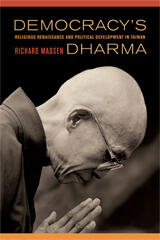
This is a CDDRL's Special Event within our Democracy in Taiwan Program. It is also co-sponsored by the Public Diplomacy/Emerging Publics Project of the Center for the Pacific Rim at University of San Francisco. In this seminar, Dr. Richard Madsen will talk about his new book that explores the religious renaissance that has reformed, revitalized, and renewed the practices of Buddhism and Daoism in Taiwan and how this religious renaissance embraces democracy modernity.  

Image
10896
Richard Madsen is distinguished professor and chair of the sociology department at the University of California, San Diego and a co-author (with Robert Bellah et al.) of The Good Society and Habits of the Heart which received the Los Angeles Times Book Award and was jury nominated for the Pulitzer Prize. He has authored or co-authored five books on China, including Morality and Power in a Chinese Village for which he received the C. Wright Mills Award; China's Catholics: Tragedy and Hope in an Emerging Civil Society; and China and the American Dream.  He also co-edited (with Tracy B. Strong) The Many and the One: Religious and Secular Perspectives on Ethical Pluralism in the Modern World. His latest book is Democracy’s Dharma: Religious Renaissance and Political Development in Taiwan.

Richard Madsen received an MA in Asian studies and a Ph.D. in sociology from Harvard.

"Madsen is a genial and well-informed guide, both to social-political change in Taiwan and to the ins and outs of religious movements. His engaging writing skillfully interweaves profound insights and themes into the descriptive analytical narrative. Democracy's Dharma presents new material based on recent research while offering a fresh spin on thinking about Asian religions."–Thomas Gold, editor of Social Connections in China: Institutions, Culture, and the Changing Nature of Guanxi

Philippines Conference Room

Richard Madsen Distinguished Professor Speaker Department of Sociology at the University of California, San Diego
Conferences
-

Nuclear energy production today and in the near future will still be dominated by light-water reactors and therefore there will be a continued need for uranium enrichment. There is currently a focused attention on gas centrifuge enrichment. Gas centrifuge technology is much cheaper and efficient, but also poses a greater security concern, than the former gas diffusion technology.

In order to address the increased security concerns, the International Atomic Energy Agency (IAEA) is planning and implementing strengthened safeguards procedures involving an increased reliance on continuous and remote monitoring technologies, and environmental sampling. The IAEA is also promoting multilateral enrichment centers as an additional avenue to enhance international security. Much of the current enrichment industry today already involves international partnerships such as between the US and European companies, or the tripartite agreement between Russia, China and the IAEA.

In order for safeguards and multilateral approaches to be viable and effective, they need to be accepted by industry, operators, states and the regulatory agencies. This talk will address how strengthened safeguards could be implemented while accommodating potentially conflicting interests such as: the protection of proprietary information, transparency in monitoring, applicability in multilateral arrangements, cost-effectiveness, and the ultimate goal of ensuring that enrichment activities remain peaceful.

Elena Rodriguez-Vieitez is a postdoctoral science fellow at CISAC, Stanford. Her research concerns proliferation risks associated with the global expansion of nuclear power. She received her PhD in nuclear engineering at the University of California, Berkeley. Her dissertation focused on nuclear physics experimental work conducted at cyclotron facilities at the Lawrence Berkeley National Lab and Michigan State University, where she analyzed nuclear structure and fragmentation reaction data of neutron-rich unstable nuclei. As a nuclear engineering graduate student, she collaborated on a Department of Energy research project on radioactive waste transmutation in molten-salt reactors, where she modeled actinide transmutation efficiency and evaluated proliferation and environmental risks. As a graduate student, Rodriguez-Vieitez was also a research associate on public policy and nuclear threats at the University of California Institute on Global Conflict and Cooperation. Prior to her PhD studies, she was an intern at the National Academy of Sciences' Board on Radioactive Waste Management in Washington, DC.

Reuben W. Hills Conference Room

Elena Rodriguez-Vieitez Speaker
Seminars
-
China’s 11 January 2007 test of a sophisticated anti-satellite weapon has caused a great deal of concern with some analysts predicting the start of an arms race in space while others have tried to minimize its significance. Using the pattern of debris created by the test, this talk will describe the weapon’s capabilities: including it being a hit-to-kill weapon, its most likely mass, and guidance and control capabilities, and its ability to attack satellites at all altitudes; its limitations: it uses visible light and not infrared, deep-space attacks will be severely limited by available launch pads, and the long warning time such an attack would give the US. The talk will also report on the results of a “war game” of an all out Chinese attack on US space assets. The bottom line of that analysis indicates that not only could the US ride out such an attack but it could avoid loosing any of its strategically important communications or navigation satellites.

Geoffrey Forden has been at MIT since 2000 where his research includes the analysis of Russian and Chinese space systems as well as trying to understand how proliferators acquire the know-how and industrial infrastructure to produce weapons of mass destruction. In 2002-2003, Dr. Forden spent a year on leave from MIT serving as the first Chief of Multidiscipline Analysis Section for UNMOVIC, the UN agency responsible for verifying and monitoring the dismantlement of Iraq's weapons of mass destruction. Prior to coming to MIT, he was a strategic weapons analyst in the National Security Division of the Congressional Budget Office after having spent a year at CISAC as a Science Fellow, a time he still looks back upon as a very happy and productive experience. Dr. Forden holds a PhD in physics.

Reuben W. Hills Conference Room

Geoffrey Forden Senior Research Associate, Program on Science, Technology and Society Speaker Massachusetts Institute of Technology
Seminars
-
The world’s energy infrastructure stands on the brink of a major revolution. Much of the large power generation infrastructure in the industrialized world will need replacement over the next two to three decades while in the developing world, including China and India, it will be installed for the first time. Concurrently, the risks of climate change and unprecedented high prices for oil and natural gas are transforming the economic and ethical incentives for alternative energy sources leading to growth of nuclear and renewables, including solar, wind, biofuels and geothermal technologies. The transition from today’s energy systems, based on fossil fuels, to a future decarbonized or carbon-neutral infrastructure is a socio-technical problem of global dimensions, but one for which there is no accepted solution, either at the international, national, or regional levels.

This talk describes a novel methodology to understand global energy systems and their evolution. We are incorporating state-of-the-art open tools in information science and technology (Google, Google Earth, Wikis, Content Management Systems, etc.) to create a global real time observatory for energy infrastructure, generation, and consumption. The observatory will establish and update geographical and temporally referenced records and analyses of the historical, current, and evolving global energy systems, the energy end-use of individuals, and their associated environmental impacts. Changes over time in energy production, use, and infrastructure will be identified and correlated to drivers, such as demographics, economic policies, incentives, taxes, and costs of energy production by various technologies. As time permits Dr. Gupta will show, using Google Earth, existing data on power generation infrastructure in three countries (South Africa, India and the USA) and highlight examples of unanticipated crisis (South Africa), environment (USA) and exponential growth (India). Finally Dr. Gupta will comment on how/why trust and transparency created by democratization of information that such a system would provide could motivate cooperation, provide a framework for compliance and monitoring of global treaties, and precipitate action towards carbon-neutral systems.

Rajan Gupta is the leader of the Elementary Particles and Field Theory group at Los Alamos National Laboratory and a Laboratory fellow.  He came to the USA in 1975 after obtaining his Masters in Physics from Delhi University, India, and earned his PhD in Theoretical Physics from The California Institute of Technology in 1982. The main thrust of his research is to understand the fundamental theories of elementary particle interactions, in particular the interactions of quarks and gluons and the properties hadrons composed of them. In addition, he uses modeling and simulations to study Biological and Statistical Mechanics systems, and to push the envelope of High Performance Computing. Starting in 1998 his interests broadened into the areas of health, education, development and energy security. He is currently carrying out an integrated systems analysis of global energy systems. In 2000 Dr. Gupta started the forum “International Security in the new Millennium” at Los Alamos National Laboratory. Its goals are to understand global issues dealing with societal and security challenges.

Reuben W. Hills Conference Room

Rajan Gupta Group Leader, Elementary Particles and Field Theory Speaker Los Alamos National Laboratory
Seminars
-

Major economic reforms are often politically difficult.  They may cause pain to voters and provoke unrest.  They may be opposed by politicians whose time horizons are shortened by electoral cycles.  They may collide with the established ideology and long-standing practices of an entrenched ruling party.  They may be resisted by bureaucrats who fear change, and by vested interests with stakes in the status quo.  Obstacles to major economic reform can be daunting in democratic and autocratic polities alike. 

And yet, somehow, past leaders of today's Asian dragons did manage to get away with critical and creative economic reforms.  Sly political foxes nudged their countries onto high-growth paths toward global renown as economic dragons.  What lessons can be learned from their experiences?  Are tactics that worked in authoritarian systems applicable to democratic ones, and vice versa?  Can one identify a set of stratagems that would amount to an equivalent, for economic reformers, of the advice Machiavelli gave political princes? 

Arroyo will recount the crafty political maneuvers used by leaders of economic reform in Asia during these pivotal eras:  China under Deng Xiaoping; India in the 1990s; Thailand under General Prem Tinsulanonda; Vietnam's Doi Moi; South Korea under Park Chung Hee; Malaysia under Mahathir Mohamad; and Singapore under Lee Kuan Yew.  Arroyo's remarks will be drawn from the paper he has been writing at Stanford on "The Political Economy of Successful Reform: Asian Stratagems," which he describes as "a playbook of useful maneuvers for economic reformers."

Dennis Arroyo is presently on leave from his government post as a director of the National Economic and Development Authority (NEDA) of the Philippines.  He has held consultancies with the World Bank, the United Nations, and the survey research firm Social Weather Stations, and has written widely on socioeconomic topics.  His critique of the Philippine development plan won a mass media award for "best analysis."  He has degrees in economics from the University of the Philippines.  

Philippines Conference Room

Dennis Arroyo 2007-2008 Shorenstein APARC/Asia Foundation Visiting Fellow Speaker Shorenstein APARC
Seminars
-
In the midst of leadership changes and rethinking of the Six-Party Talks, the time is ripe for reassessing how multilateralism can be advanced in Northeast Asia. The earlier stress on economic integration as the engine of regionalism has lost credibility, although the forces of interdependence continue to grow. The tendency to treat security in isolation also may be receding, as the Six-Party Talks and Sino-U.S. relations both reveal the multi-sided nature of building trust. At the same time, the pessimism associated with overemphasis on the history issue between Japan and its neighbors has receded in the face of renewed Sino-Japanese and South Korean-Japanese diplomacy. Yet, finding common ground in strategic thinking about the future of multilateralism demands a new approach that takes into account lessons from recent years.

As the building blocks of a new approach, this presentation will focus on four themes: 1) re-examination of ways to accelerate regionalism, with attention to leadership, energy cooperation, and the role of Russia; 2) development of a more comprehensive outlook on values, with attention to shared modernity, gradualism, and the role of Japan; 3) discussion of the next phase in managing North Korea, attentive to Sino-U.S. accord and the role of South Korea; and 4) evaluation of U.S. priorities and how a new president may view Northeast Asia within an overall agenda.   The objective of this talk will be to stimulate thinking on a region at a crossroads in order to capitalize on recent currents of change.

Gil Rozman attended Princeton's Critical Languages Program, returning to Carleton College as an independent major in Chinese and Russian studies. He received his PhD in sociology at Princeton with a field on Chinese, Japanese, and Russian societies and a plan to concentrate on historical comparisons first and on the domestic roots of international relations later. His books have appeared in clusters, including: four on comparative pre-modern urban development and stages of modernization; three on debates in the Soviet Union, China, and Japan over bilateral relations and changes in socialism; two on regionalism; and four on strategic thinking in Northeast Asia. Although he is still learning about Korea, many recent writings have looked at Korea within a regional context.

Philippines Conference Room

Gil Rozman Professor of Sociology Speaker Princeton University
Seminars
Authors
News Type
News
Date
Paragraphs

Sometimes doing field research involves dodging cow pies in an actual field. At least, that was the case for a group of Jean C. Oi's students.

Oi discussed the importance of taking students beyond the classroom in a March 6 talk titled "Cow Pies and Democracy: Teaching in the Field," presented as part of the Center for Teaching and Learning's "Award-Winning Teachers on Teaching" lecture series.

Michele Marincovich, associate vice provost of undergraduate education and director of the Center for Teaching and Learning, introduced Oi, calling "Cow Pies and Democracy" the "most colorful title" in the lecture series.

Oi, the William Haas Professor in Chinese Politics, began her talk by laughingly apologizing for her word choice. "I still can't believe I chose that title, but I think it aptly describes what I do with my students," she said.

Oi teaches courses on political change in China, and much of her research has focused on village elections. Though China has been a single-party state since the Communist Party took control in 1949, the country has held direct elections for village officials since the 1980s, a move that has been greeted by some as a possible first step toward a more democratic state.

In 2001, Oi taught a course about village elections for Sophomore College, a three-week summer seminar for incoming sophomores.

Although the class was "very successful," her students kept saying, "I wish we could do this in China," Oi recalled. She agreed.

Without leaving Stanford's campus, "I think it's difficult to convey the different world [the Chinese] are living in," Oi added.

The year after she first taught Sophomore College, Oi had the chance to take students abroad for a class as part of the Overseas Seminar Program.

They spent two weeks at Peking University learning about village elections and China's political situation. They heard guest speakers from the country's Ministry of Civil Affairs, and the students designed research projects requiring them to interview villagers and village officials.

In the third week of the program, Oi and her students took a bus to Heilonjiang, a northeastern province on China's border with Russia. As the bus approached the village, the road became blocked by a long line of carts delivering corn to the local dairy farm. Oi had all the students get off the bus, and they walked through fields and pastures to get the rest of the way to the village.

"This is where we had to dodge the cow pies," Oi explained.

Oi characterized what she did with her students as "demystifying" the process of doing research. Students learned how to interview people in the field.

"When we got to the village, I said, 'OK! Go!' and they all just scattered," Oi said. "If you set your expectations high, students are going to produce."

Oi's students got to witness a village election. Villagers lined up to mark paper ballots to elect a village committee head. The votes were tallied on a chalkboard, and the winner got 509 votes, just a few more than the runner-up.

Many of the villagers that greeted the students had never seen Americans before, Oi said. "Russians were the only foreigners they had ever seen," she said.

One student was a 6-foot-7-inch Olympic gymnast who drew crowds wherever he went.

"I've seen them on TV, but I'd never seen a real one," one awestruck observer said, marveling at the tall athlete.

Oi said her students felt like they had earned "bragging rights" after their trip to China. "They felt like they had done something none of their peers had done," she said.

One even changed her career plans after the seminar.

"Her parents were very worried about what would happen to her in China, and maybe they should have been," Oi quipped. The student had been planning to go to medical school, but she instead decided to declare a major in political science and study rural China.

"I think I did change some student lives," Oi said.

Oi is also a senior fellow at the Freeman Spogli Institute for International Studies and the director of the Stanford China Program.

Hero Image
oilogo
All News button
1
-

During the Cold War, China was regarded in many corners of Southeast Asia as a sponsor of subversion and communist insurgency. Until the “four modernizations,” its anemic economy and limited ability to project power offered little incentive for Southeast Asian governments to cozy up to Beijing. Relations were often frosty or worse. Clearly, times have changed. Essentially all of the states in Southeast Asia have robust diplomatic and economic engagements with the PRC. Yet security concerns have not evaporated. Most Southeast Asian governments now embrace China, but “hedge” by setting up fall-back security options with the United States and other partners in case the PRC becomes more menacing.

This seminar will explore some of the nuances in Southeast Asian “hedging” strategies. How do various governments view China’s intentions and capabilities? How have they variously sought to engage the United States and others to gain and retain security without antagonizing Beijing? How do these strategies relate to multilateral diplomacy in ASEAN and related forums, and how do they affect the overall “balance of power” in the Asia-Pacific region? Lastly, what pitfalls might hedging entail? These questions are critical, because the reaction of Southeast Asian states to China’s rise will have a major effect on the shape and stability of regional security for years to come.

John D. Ciorciari is a 2007-08 Shorenstein Fellow and is currently completing a manuscript entitled Hedging: Southeast Asian Alignments with the Great Powers since the Fall of Saigon.  He has extensive work experience in Southeast Asia, both as an academic and as a U.S. government official.  He also served as a Visiting Fellow at the Institute of Defence and Strategic Studies in Singapore in 2003-04.  He holds a JD from Harvard Law School and DPhil from the University of Oxford.

Daniel and Nancy Okimoto Conference Room

Hoover Institution
Stanford, CA 94305

0
Affiliate - Southeast Asia Forum
CiociariHeadshot.jpg JD, PhD

John D. Ciorciari was a Shorenstein Postdoctoral Fellow at Shorenstein APARC for 2007-2008.  Dr. Ciorciari will remain at Stanford for the academic year 2008-09 as a National Fellow of the Hoover Institution. His current research centers on the alignment policies of small states and middle powers in the Asia-Pacific region. He focuses particularly on the phenomenon of "hedging," whereby secondary states pursue a balance of security and autonomy vis-a-vis the great powers.

Dr. Ciorciari also has interests in international human rights law and international finance. Before coming to Stanford, he served as Deputy Director of the Office of South and Southeast Asia at the U.S. Treasury Department. He has published articles on the reform of the Bretton Woods institutions and is currently undertaking a project on financial cooperation in East Asia.

In addition, he serves as a Senior Legal Advisor to the Documentation Center of Cambodia, which assists the Khmer Rouge tribunal and conducts research into the history of Democratic Kampuchea. He has published a range of scholarly works on international criminal law and the Khmer Rouge accountability process.

Dr. Ciorciari received an AB and JD from Harvard, where he was editor-in-chief of the Harvard International Law Journal. He received his MPhil and DPhil from Oxford, where he was a Fulbright Scholar and Wai Seng Senior Research Scholar.

John Ciorciari 2007-2008 Shorenstein Fellow Speaker
Seminars
News Type
News
Date
Paragraphs

Shorenstein APARC is pleased to announce the winners of the 2008-09 Shorenstein Fellowship. Christian von Luebke and Li Han will join the center in fall 2008, each for a one-year term.

Dr. von Luebke completed his Ph.D. in 2007 in policy and governance at the Crawford School of Economics and Government, the Australian National University. He also holds a masters in Economics and a B.A. in Business and Political Science from Muenster University. He is currently working on a book that analyzes the determinants for local policy variation in Post-Suharto Indonesia. During his stay at the center, he will extend his work on local governance to other Asian transition countries, in particular China and the Philippines.

Li Han is currently a Ph.D. candidate at Harvard University. She expects to receive her Ph.D. in economics in June 2008. She also holds an M.A. in economics from Peking University and a B.A. from Xi'an Jiaotong University in China.

Li Han's primary fields are development economics and political economy. She is particularly interested in political incentives in nondemocracies and public policy issues in developing countries. She is currently working on a project that analyzes the link between economic liberalization and autocracies.

APARC looks forward to their arrival in the fall.

All News button
1
Subscribe to China