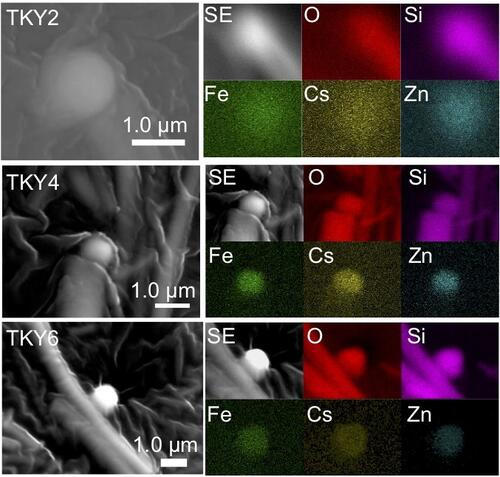
An interesting paper was recently published by a team headed by Dr. Satoshi Utsunomiya of Kyushu University on the subject of Fukushima-derived cesium-enriched microparticles (CsMPs). As many readers will know, several researchers have located and analyzed these microparticles, in which the cesium is often bonded within glass-like silicates and therefore generally significantly less soluble than other Cs chemical species in water, though technically not actually “insoluble.” After an accident like Fukushima, it is much more common to find cesium in water-soluble compounds like cesium hydroxide (CsOH), and predictions about how quickly the cesium will be dispersed through the environment, in soil, in watersheds, taken up by plants and animals, etc, are based primarily on this assumption. The discovery of sparingly-soluble Fukushima-derived cesium microparticles, first documented by Adachi et al in 2013, and since then confirmed by many others, has raised a number of questions. How abundant are they? Does their presence increase health risk to humans? How much do they reveal about the process of the accident itself? From the standpoint of researchers the microparticles are very intriguing.
Utsunomiya et al.’s paper is titled “Caesium fallout in Tokyo on 15th March, 2011 is dominated by highly radioactive, caesium-rich microparticles,” and as noted in a recent Scientific American article, it was originally accepted for publication in 2017 by Scientific Reports journal. Weeks before publication, however, Tokyo Metropolitan Industrial Technology Research Institute (TIRI), operated by the Tokyo Metropolitan Government, raised objections with Scientific Reports. However no questions about the quality of the science or the validity of the paper’s findings appear to have been brought forward. This in itself was highly irregular. Two years elapsed without resolution, and in March of this year Scientific Reports took the highly unusual step of withdrawing its offer to publish the paper, despite the lack of confirmed evidence that would warrant it. Utsunomiya and several co-authors decided that the best course of action was to place the study in the public domain by publishing it via arXiv, a highly respected pre-print website. The paper is now open and free to download.
This study makes a valuable contribution to the body of scientific literature regarding the consequences of the Fukushima disaster in general and CsMPs in particular. I think it was a mistake for Scientific Reports not to publish it two years ago, especially considering the rapid pace of research into these particles and the tremendous interest in them. To summarize the findings briefly, the researchers analyzed air filter samples from March 15, 2011, in Setagaya, Tokyo, when the radioactive plume from Fukushima caused a noticeable peak in airborne radioactivity in the city. The researchers used radiographic imaging (placing the filters on a photographic plate) to identify any highly radioactive spots. Using these images as a guide they were able to isolate seven CsMPs, which they subjected to atomic-scale analysis using high-resolution electron microscopy (HRTEM) to identify their nano-scale structure and chemical composition. Based on these detailed measurements and quantitative analysis, the researchers concluded that 80-89% of the total cesium fallout in Tokyo that day was in the form of highly radioactive microparticles. The second half of the paper is devoted to estimates of how long such particles might be retained in the human lungs if inhaled, based on previous studies that reported the effects of inhalation of non-radioactive atmospheric particles, and some possible physical consequences. The paper is valuable for the quantitative analysis of the Tokyo particles alone, since it is one of few studies that deal with the issue for Tokyo specifically. Research into possible health consequences of the particles, meanwhile, has gained momentum while the paper remained unpublished, using approaches such as stochastic biokinetics, and DNA damage studies. In a recent paper, Utsunomiya and colleagues produced estimates of the rate of dissolution of the particles inside the human lung, in pure water, and in seawater. A working group at the Japan Health Physics Society has also devoted attention to the issue, noting the need for further study of the risk from intake of these particles, particularly to the lung. Likewise, others have been studying the particles to learn about the accident progression and possible consequences for decommissioning.
Why did Tokyo Metropolitan Industrial Technology Research Institute object to the paper’s publication? When we first heard that publication of the paper was being held up by Tokyo Metropolitan Government, we thought politically-motivated suppression was a likely explanation. Since then the public has learned that the actual complaint given to Scientific Reports stems from a chain of custody issue of the original air filter samples. We don’t want to speculate further about Tokyo’s motivation, because we have seen no direct evidence yet of political suppression in this case. But based on past occurrences with other government institutions, we would find it plausible. We will let readers know if TIRI responds to our inquiries.
We spoke with Dr. Utsunomiya and co-author Dr. Rodney Ewing recently. I was aware of their co-authorship of several strong papers on CsMPs, including Utsunomiya’s plenary talk at the Goldschmidt Conference in Yokohama in 2016, which I attended. I asked how this new arXiv paper fits in with their other papers, and where they think this research is heading next:
Satoshi Utsunomiya:
Thank you for asking. The Tokyo paper was actually our first paper regarding CsMPs. As I mentioned, the paper was accepted two years ago. There were no previous papers of ours on CsMPs that time. Currently we are working on several topics on CsMPs. I cannot reveal the content yet, as we are thinking about a press release for the next paper. But I think it is important to continue this kind of research, providing some insights for decommissioning at Fukushima Daiichi Nuclear Power Plant.
Azby Brown:
I didn’t realize that this was your first paper on the subject. How does it relate to the one presented at the Goldschmidt Conference in Yokohama in 2016? “Cesium-Rich Micro-Particles Unveil the Explosive Events in the Fukushima Daiichi Nuclear Power Plant.” Didn’t that paper receive a prize?
SU:
My talk at Goldschmidt briefly covered the story described in the two papers that were accepted for publication at the same time. One was published in Scientific Reports. The other one was not published. There was no prize. It was a plenary talk.
AB:
I see. I recall that it received a lot of attention. Now it makes more sense to me.
Can you tell me a little bit about the specific characteristics and focus of your research, and how it differs from papers like Adachi 2013, Abe 2014, etc? Generally speaking, that is. I’d like to help people understand the different aspects of the field.
SU:
Adachi reported the discovery of CsMPs. Abe demonstrated X-ray absorption analysis on the CsMPs. We focused on the nanotexture inside CsMPs. We are particularly interested in the detailed evidence remaining within the microparticle, which can provide useful information on the development of the chemical reactions during the meltdowns, because it is still difficult to directly analyze the materials inside the reactors. We, for the first time, succeeded in performing isotopic analysis on individual CsMPs. More specifically, the occurrence of uranium can directly tell the story of how the fuel melted. Our research has two directions: one is to understand the environmental impact of CsMPs, and the other is to provide useful information on the debris properties to help decommissioning at FDNPP. We are also interested in the implications for health.
AB:
Can you tell me a little bit about your working relationship? Satoshi went to the US to work in your lab, right Rod? When was that, and what were you working on?
Rod Ewing:
Satoshi and I have known each other since 2000, when he joined my research group as a post-doctoral fellow at the University of Michigan. He was a member of the research group until 2007. We collaborated on a wide range of topics that had to do with radioactive materials, such as the transport of plutonium at the Mayak site in Russia to the identification of uranium phases within C60 cages, so called buckyballs, that were formed and released from coal power plants. Once Satoshi returned to Japan to take his position at Kyushu University, we continued to collaborate, particularly on topics related to Fukushima Daiichi.
AB:
How did you both get interested in CsMPs?
RE:
Once discovered, CsMPs were clearly of high interest. They had not been noted in earlier reactor accidents. Satoshi is a master with the transmission electron microscope – exactly the tool/technique needed to study these particles.
AB:
For people who aren’t familiar with what’s involved in a research experiment like yours, can you describe the overall process? What were the technical challenges?
RE:
I would just emphasize that it is very difficult to find and characterize these particles. Considering the full literature and efforts by others as well as our team – the results are impressive. It is rare to have both the TEM characterization and the isotopic data.
SU:
As Rod mentioned, it is difficult to obtain both TEM and isotopic data from a few micron-sized spots. The isolation of CsMPs from soils is a time consuming process. But to date, many scientists have found and isolated CsMPs. The important thing is what information we can obtain from the analysis of CsMPs. We have been taking various approaches to elucidate the properties, environmental impact, and the role in releasing fissile actinides to the environment.
As described above, many papers examining various aspects of Fukushima-derived cesium microparticles have been published since they were first identified in 2013. Even so, important aspects remain only partially documented and understood to date. Below is a partial list of relevant publications.
Papers mentioned in this article:
Caesium fallout in Tokyo on 15th March, 2011 is dominated by highly radioactive, caesium-rich microparticles
Utsunomiya, et al., 2019
https://arxiv.org/abs/1906.00212
—————————————————————-
Emission of spherical cesium-bearing particles from an early stage of the Fukushima nuclear accident
Adachi et al., 2013
http://www.nature.com/articles/srep02554
—————————————————————-
Detection of Uranium and Chemical State Analysis of Individual Radioactive Microparticles Emitted from the Fukushima Nuclear Accident Using Multiple Synchrotron Radiation X-ray Analyses
Abe et al., 2014
http://pubs.acs.org/doi/abs/10.1021/ac501998d
—————————————————————-
Dissolution of radioactive, cesium-rich microparticles released from the Fukushima Daiichi Nuclear Power Plant in simulated lung fluid, pure-water, and seawater
Suetake et al., 2019
https://doi.org/10.1016/j.chemosphere.2019.05.248
—————————————————————-
Development of a stochastic biokinetic method and its application to internal dose estimation for insoluble cesium-bearing particles
Manabe & Matsumoto, 2019
https://doi.org/10.1080/00223131.2018.1523756
—————————————————————-
DNA damage induction during localized chronic exposure to an insoluble radioactive microparticle
Matsuya et al., 2019
https://doi.org/10.1038/s41598-019-46874-6
—————————————————————-
Provenance of uranium particulate contained within Fukushima Daiichi Nuclear Power Plant Unit 1 ejecta material
Martin et al., 2019
https://www.nature.com/articles/s41467-019-10937-z
—————————————————————-
Internal doses from radionuclides and their health effects following the Fukushima accident
Ishikawa et al., 2018
https://iopscience.iop.org/article/10.1088/1361-6498/aadb4c
Related papers (by year of publication):
Characteristics Of Spherical Cs-Bearing Particles Collected During The Early Stage Of FDNPP Accident
Igarashi et al., 2014
http://www-pub.iaea.org/iaeameetings/cn224p/Session3/Igarashi.pdf
—————————————————————-
Radioactive Cs in the severely contaminated soils near the Fukushima Daiichi nuclear power plant
Kaneko et al., 2015
https://www.frontiersin.org/articles/10.3389/fenrg.2015.00037
—————————————————————-
First successful isolation of radioactive particles from soil near the Fukushima Daiichi Nuclear Power Plant
Satou et al., 2016
http://www.sciencedirect.com/science/article/pii/S2213305416300340
—————————————————————-
Internal structure of cesium-bearing radioactive microparticles released from Fukushima nuclear power plant
Yamaguchi et al., 2016
http://www.nature.com/articles/srep20548
—————————————————————-
Three-Year Retention Of Radioactive Caesium In The Body Of Tepco Workers Involved In The Fukushima Daiichi Nuclear Power Station Accident
Nakano et al., 2016
http://rpd.oxfordjournals.org/content/early/2016/03/14/rpd.ncw036
—————————————————————-
Monte Carlo Evaluation of Internal Dose and Distribution Imaging Due to Insoluble Radioactive Cs-Bearing Particles of Water Deposited Inside Lungs via Pulmonary Inhalation Using PHITS Code Combined with Voxel Phantom Data
Sakama, M. et al., 2016
https://link.springer.com/chapter/10.1007/978-4-431-55848-4_19
—————————————————————-
Radioactively-hot particles detected in dusts and soils from Northern Japan by combination of gamma spectrometry, autoradiography, and SEM/EDS analysis and implications in radiation risk assessment
Kaltofen & Gundersen, 2017
https://www.sciencedirect.com/science/article/pii/S0048969717317953?via%3Dihub
—————————————————————-
Caesium-rich micro-particles: A window into the meltdown events at the Fukushima Daiichi Nuclear Power Plant
Furuki et al., 2017
https://www.nature.com/articles/srep42731
—————————————————————-
Isotopic signature and nano-texture of cesium-rich micro-particles: Release of uranium and fission products from the Fukushima Daiichi Nuclear Power Plant
Imoto et al., 2017
https://www.nature.com/articles/s41598-017-05910-z
—————————————————————-
Uranium dioxides and debris fragments released to the environment with cesium-rich microparticles from the Fukushima Daiichi Nuclear Power Plant
Ochiai et al., 2018
https://pubs.acs.org/doi/abs/10.1021/acs.est.7b06309
—————————————————————-
Novel method of quantifying radioactive cesium-rich microparticles (CsMPs) in the environment from the Fukushima Daiichi nuclear power plant
Ikehara et al., 2018
https://pubs.acs.org/doi/full/10.1021/acs.est.7b06693
—————————————————————-
Formation of radioactive cesium microparticles originating from the Fukushima Daiichi Nuclear Power Plant accident: characteristics and perspectives
Ohnuki, Satou, and Utsunomiya, 2019
https://www.tandfonline.com/doi/abs/10.1080/00223131.2019.1595767