Stanford's Center on Democracy, Development, and the Rule of Law (CDDRL) is pleased to announce that undergraduate senior honors student, Anna Barrett Schickele, received the Firestone Medal for Excellence in Undergraduate Research. This university award is given to the top ten percent of honors theses in social science, science, and engineering.
Schickele's thesis entitled, "One Drop At A Time," examines the factors that inform farmers' decisions to use modern irrigation systems in the Lurín Valley of Peru, where she spent several months conducting fieldwork with a Lima-based NGO. Schickele — a public policy major —was able to collect primary data through interviews with farmers and fieldworkers to inform her research study that includes policy recommendations to the NGO community and government officials.
Anna Schickele (center) with Francis Fukuyama (left) and Larry Diamond (right).
Martin Carnoy, the Vida Jacks Professor of Education at the Stanford Graduate School of Education, served as Schickele's thesis advisor together with Rosamond L. Naylor, the director of the Center on Food Security and the Environment at FSI.
"Ana's thesis is an important contribution to our understanding of the barriers and openings for stimulating agricultural development among subsistence farmers," said Carnoy. "Her original insights make the thesis particularly valuable for those addressing development issues in the world’s poorest regions."
In August, Schickele will begin a research position at the Abdul Latif Jameel Poverty Action Lab at the Massachusetts Institute of Technology.
CDDRL's best thesis award was given to Kabir Sawhney, a management science and engineering major, who wrote his thesis on the effect of regime type and the propensity to default on sovereign debt. Advised by Professor of Political Science Gary Cox, Swahney cited the cases of Romania in the 1980s and more recently of Greece to conclude that the quality of government — rather than regime type alone — determines whether a country chooses to default.
After graduation. Sawhney will join the consulting firm Accenture as an analyst in their San Francisco office.
Three honors students' received fellowships from Stanford's Haas Center of Public Service to pursue public service-related work after graduation. Keith Calix and Imani Franklin both received the Tom Ford Fellowship in Philanthropy and will be working in New York for grant-making foundations, and Lina Hidalgo received the Omidyar Network Postgraduate Fellowship to work with an international organization.
The CDDRL Undergraduate Senior Honors Program is an interdisciplinary honors program led by Francis Fukuyama, the Olivier Nomellini Senior Fellow at FSI. The program recruits a diverse group of talented students interested in writing original theses on topics impacting the field of democracy, development, and the rule of law. During the year-long program, students write their thesis in consultation with a CDDRL faculty member, participate in research workshops, and travel to Washington, D.C. for "honors college."
The nine members of the graduating class of 2013 CDDRL undergraduate honors students include:
Prime Minister Shinzo Abe's plan for revitalizing the Japanese economy appears to offer something for everyone. Takeo Hoshi argues that before Mr. Abe makes any more announcements, he needs to focus his efforts on a few key priorities.
Hero Image
Kokkai-gijido, Japanese Diet Building, Tokyo, Japan 2006 | Flickr user Henry Stradford
Writing recently in Asia-Pacific Review, Daniel Sneider describes how World War II era events are depicted differently in history textbooks in China and Japan.
Hero Image
A reading room in China's National Library, August 2005. | Flickr / Kurt Groetsch
The Center on Democracy, Development, and the Rule of Law (CDDRL) at Stanford University is pleased to announce the 2014 class of undergraduate senior honors students.
Honors students will spend four quarters participating in research seminars to refine their proposed thesis topic, while working in consultation with a CDDRL faculty advisor to supervise their project. In September, the group will travel to Washington, D.C. for honors college where they will visit leading government and development organizations to witness policymaking in practice and consult with key decision-makers.
Please join CDDRL in congratulating the 2014 Senior Honors students and welcoming them to the Center.
Below are profiles of the nine honors students highlighting their academic interests, why they applied to CDDRL, and some fun facts.
Image
Aline Bass
Major: History, minor in East Asian Studies
Hometown: Dallas, TX
Thesis Title: How do the concepts of law and morality in China reflect and impact the development of private property rights, specifically urban land-use rights, in the post-Mao era?
Why is this topic important to the field of democracy, development, and the rule of law? In the Western tradition, clarification of property rights is an essential catalyst for economic development and foundation for the rule of law. China’s unparalleled economic growth and rapid urbanization since the beginning of the reform era offers a counterpoint experience, which I hope to examine through the lens of land use rights, since, historically and currently, land ownership has played a crucial role in determining social security and wealth in Chinese society. My thesis will combine historical and qualitative analysis and examination of the current real property situation in China’s urban areas, which should contribute perspective to the broader study of China’s development as well as urban property rights in emerging countries.
What attracted you to the CDDRL undergrad honors program? An opportunity to work under the guidance of the CDDRL faculty and alongside fellow honors students in an interdisciplinary program provides an ideal and challenging intellectual environment. In addition, CDDRL’s focus on development and its inextricable ties to good governance offers a unique insight into various development situations, their associated successes, shortcomings, and consequences for social improvement.
Future aspiration post-Stanford: I hope to attend law school after Stanford, work and live abroad, and pursue a career related to China.
What are your summer research plans: I will be working in a law firm in Shanghai this summer and conducting research in both Shanghai and Beijing.
Fun fact about yourself: I can consume more ice cream than a Ben and Jerry’s factory tour group.
Image
Meaghan Conway
Major:Science, Technology & Society
Hometown: New York City, NY
Thesis Title: Blended ROI? Analyzing the economic and social returns of private equity investment in emerging markets
Why is this topic important to the field of democracy, development, and the rule of law? For my honors thesis I plan to research private equity investments in sub-Saharan Africa. I hope to investigate whether private equity investments (and partnerships with international financial institutions such as the IFC and World Bank) generate robust returns for the investors as well as catalyze development in their communities. I hope that my thesis, while adding to the literature in the field, will more importantly serve as support for further investment in developing economies and promote the power of impact investing.
What attracted you to the CDDRL undergrad honors program? The people! I am thrilled to have the opportunity to be mentored by some of Stanford’s most renowned faculty and I am excited to learn from my fellow undergraduates in the CDDRL.
Future aspiration post-Stanford: For my career, I would love to be able to combine my interest in finance and my interest in development. I hope to travel, attend business school, and be a socially responsible investor.
What are your summer research plans: First I will be interning in investment banking in New York and then I hope to head to South Africa to conduct some field research for my thesis!
Fun fact about yourself: I spent this past summer working in Dubai and had the opportunity to ride a camel and play with penguins!
Image
Mahilini Kailaiyangirichelvam
Major: International Relations, minor in Economics
Hometown: Jaffna, Sri Lanka
Thesis Title: The impact of civil war on food production in Sri Lanka
Why is this topic important to the field of democracy, development, and the rule of law? War can pose serious threats to food security within a country. These threats stem from disruption of the economy and institutions as well as from policy changes. It is through understanding the impacts of these factors on food security that food insecurity and hunger can be alleviated or avoided. The understanding gained from this work can guide development work.
What attracted you to the CDDRL undergrad honors program? My research on the impact of war cannot be understood using concepts drawn only from economics or politics. CDDRL views issues using a broader, integrated lens of economics, politics, and law, and it provides a wonderful forum that brings senior scholars and student researchers pursuing a wide variety of topics together for discussions. This interdisciplinary environment offers the perfect academic home for me.
Future aspiration post-Stanford: I hope to pursue doctoral studies either in international economics or development economics. I would like to become a professor and pursue research and development work in Asia.
What are your summer research plans: I will be collecting and analyzing food production data and interviewing policy experts and farmers in Sri Lanka so that I can better understand the changes in food economy that results from the civil war in Sri Lanka.
Fun fact about yourself: I grew up learning sword fighting in the ancient tradition of Tamil kingdom. I also enjoy listening to carnatic music, and playing Veena.
Image
Haiy Le
Major: International Relations
Hometown: Charlotte, NC
Thesis Title: How is the Media Used to Advocate for Land Rights in Vietnam?
Why is this topic important to the field of democracy, development, and the rule of law? Civil society actors are using the media network in Vietnam - from the state-owned press to the increasingly vocal blogosphere - to advocate for policy change on land rights. My research will contribute to the literature on how information technology is affecting the media and how it can be directed towards positive social impact.
What attracted you to the CDDRL undergrad honors program? I want my undergraduate education to culminate in a project in which I take ownership of my learning and contribute to scholarly knowledge on a topic that is meaningful to me. I am not sure if grad school lies in the future, and the honors program is a wonderful opportunity to have the resources of the university and the mentorship of the CDDRL community to ask these questions.
Future aspiration post-Stanford: I hope that the process of completing a thesis will connect me with the resources to pursue my interest in democratic development and liberation technology.
What are your summer research plans: I will be in Vietnam collecting data for my research. I also have plans to travel to Cambodia, Thailand, and Singapore!
Fun fact about yourself: I coincidentally saw Professor Larry Diamond in Hue, Vietnam when I was traveling there. I believe it was fate, and I knew I had to join the CDDRL community and return to Vietnam to work with him on my thesis!
Image
Devanshi Patel
Major: International Relations, minor in Comparative Studies in Race and Ethnicity
Hometown: San Jose, CA
Thesis Title: How the Chain of Command Structure of the U.S. Military Affects the Reporting and Prosecution of Internal Sexual Assault Cases
Why is this topic important to the field of democracy, development, and the rule of law? Though the Department of Defense observes a “zero tolerance policy,” in the year 2011 alone 3,191 military sexual assaults were reported. Because most assaults are not reported, Secretary of Defense Leon Panetta estimates that the number is closer to 19,000, translating into a 16.7% reporting rate. Some legislation has suggested developing joint jurisdiction between the Department of Defense and the Department of Justice to prosecute sexual assault cases. Through my thesis, I hope to explore the "rule of law" aspect of the zero tolerance policy, and assess the effects of internal prosecution.
What attracted you to the CDDRL undergrad honors program? So far, I have enjoyed deepening my understanding of research methods through the CDDRL weekly seminar. I am drawn to the program because of its interdisciplinary nature that will allow me to blend both quantitative and qualitative approaches to research.
Future aspiration post-Stanford: I hope to study human rights law and spend considerable time studying and working abroad.
What are your summer research plans: I will be interviewing members of the military in different regions of the United States, including California and Washington, DC.
Fun fact about yourself: I enjoy cooking vegetarian food and experimenting with new recipes!
Image
Janani Ramachandran
Major: International Relations
Hometown: Fremont, CA and Bangalore, India
Thesis Title: Anti-Americanism in Pakistan
Why is this topic important to the field of democracy, development, and the rule of law? I believe that the general American narrative on anti-American perceptions lacks nuance, and I hope to present a more complex picture with a framework of the various anti-Americanisms, particularly in Pakistan, a critical geo-political partner to the U.S. I hope such a study can help inform U.S. foreign policy for future relationships with Pakistan and other strategic conflict-ridden states in the non-Western world, to minimize levels of distrust and promote mutual respect and sustainable relations.
What attracted you to the CDDRL undergrad honors program? I have always been a fan of the work of CDDRL and its fellows throughout my time at Stanford. As a research assistant for international human rights expert Helen Stacy, I understood the value of close interactions and guidance from scholars at CDDRL. The honors program provided the perfect opportunity to pursue my research passion, along with the guidance of some of the world's most respected scholars in the field.
Future aspiration post-Stanford: To work in the foreign policy and international human rights space in Washington D.C. and abroad
What are your summer research plans:I will conduct virtual interviews with individuals in Pakistan, and prepare for a research trip to Islamabad in December. I will also be interning at the Ashoka Foundation in Caracas, Venezuela on social entrepreneurship projects, and the Ford Foundation in New Delhi, India, on governance projects.
Fun fact about yourself: I've visited 23 countries, speak four languages, and grew up in India and the US. I was voted "most likely to be a future leader" in fourth grade.
Image
Danna Seligman
Major: Political Science
Hometown: Newbury Park, CA
Thesis Title: The Origins of Political Gridlock- Institutional and Societal Mechanisms that Inhibit Government Productivity in the United States
Why is this topic important to the field of democracy, development, and the rule of law? Gridlock has become a paralyzing constraint to our current American political institutions, but little has been done in an attempt to overcome such a significant strain to our democratic system. Legislative productivity and representation in government have been compromised by our government's inability to make, pass and execute laws. In many ways, political gridlock blocks the government from affecting the will of the people and effectively addressing its constituents needs.
What attracted you to the CDDRL undergrad honors program? The interdisciplinary nature of the program was truly key for the thesis I wanted to write. I appreciate the freedom to use different methods to approach relevant questions about society and government, and the CDDRL faculty is the best resource any Stanford student could ask for.
Future aspiration post-Stanford: I plan to attend law school after Stanford, but also hope to do some campaign work during the 2014 midterm elections. I hope to pursue a career in national politics and eventually be in a position to implement the ideas and theories my thesis and CDDRL endorses for better democracy and governance.
What are your summer research plans: I will be in Washington D.C. this summer working for Congressman Xavier Becerra, and hope to use my time in D.C. to conduct interviews with prominent political thinkers and actors.
Fun fact about yourself: I was a Stanford Dollie 2011-2012.
Belina Tang
Belinda Tang
Major: Economics & Public Policy
Hometown: San Jose, CA
Thesis Title: The Implications of Women Policymakers in a Natural Experiment in Lesotho
Why is this topic important to the field of democracy, development, and the rule of law? A lot of previousresearch has shown that, when it comes to making decisions on how to allocate resources, women, at both the household and government-level, make different decisions than males do, particularly for health and education-related public goods. If that's also a result of giving women power in local government in an African country, then increasing the institutional power of women could represent a strong mechanism through which we can improve development indicators in the world's poorest region.
What attracted you to the CDDRL undergrad honors program? The inspiring cohort of students I will be able to work with and learn from (and the abundance of free lunches!).
Future aspiration post-Stanford: To do research with implications for the lives of individuals in poverty.
What are your summer research plans: I will be doing fieldwork in Lesotho in July and August.
Fun fact about yourself: My name in Chinese tells a story of how many small and seemingly insignificant streams can flow together to form a large and powerful one - I like to think this is a metaphor for my life!
Image
Aditya Todi
Major: International Relations
Hometown: Kathmandu, Nepal
Thesis Title: The role and importance of political parties in consolidating democracy with a focus on Nepal and potentially South Africa and Ghana
Why is this topic important to the field of democracy, development, and the rule of law? Political parties are an integral part of democracies anywhere, but even so in countries undergoing democratic transition. Nepal has already had two failed "experimentations" with democracy in the past fifty years. The historic elections of 2008 have paved the way for Nepal to move forward and consolidate democracy. Going forward, it will be crucial for political parties to play their part in strengthening democracy in Nepal and to represent the people of the country to the best of their abilities.
What attracted you to the CDDRL undergrad honors program? Other than the free lunches, it would have to be the faculty and the interdisciplinary aspect of the program. The faculty as well as inter-student engagement makes the program very unique and appealing.
Future aspiration post-Stanford: Pursue further studies in business and public policy as well as have a chance to travel extensively within Nepal.
What are your summer research plans: I will be doing some preliminary research in Nepal during the two weeks I am there this summer. I also hope to gather data and learn about the political parties in Ghana during my time as a Stanford in Government (SIG) Fellow at the Center for Democratic Development.
Fun fact about yourself: I enjoy playing and watching cricket and would be down to watch a Hindi film any time of day.
Amy Zegart, one of the nation’s leading experts on national security, intelligence and foreign policy, has been appointed the next co-director of the Center for International Security and Cooperation.
Zegart, a CISAC faculty member and senior fellow at the Hoover Institution, will take up her new role July 1. She succeeds Mariano-Florentino Cuéllar, who was named director of the Freeman Spogli Institute for International Studies, CISAC’s parent organization.
“Amy Zegart is an award-winning scholar, an accomplished professional with public and private sector experience, and a trusted voice on national security and foreign policy,” said Cuéllar. “Her multi-disciplinary scholarship, diverse experiences, and commitment to getting it right will complement the Freeman Spogli Institute's growing focus on governance problems, and will make her a dynamic leader for CISAC as the center continues its vital work on international cooperation and security.”
Zegart, once named one of the 10 most influential experts in intelligence reform by the National Journal, said she intends to continue expanding the center’s focus on emerging security issues, such as cybersecurity, drones and challenges to governance while building on CISAC’s distinguished reputation in nuclear security.
“The international threat environment is changing faster and in more profound ways than anyone could have imagined 10 or 20 years ago,” said Zegart, who is also a professor of political economy (by courtesy) at the Stanford Graduate School of Business, where she co-teaches a course on managing political risk with former Secretary of State Condoleezza Rice.
“CISAC will continue to be at the forefront of addressing these new challenges with the same secret sauce it’s had since its founding in 1983: world class talent; a commitment to teaching the next generation; and a deep belief that bridging the natural and social sciences is vital to solving the world’s most dangerous problems,” she said.
CISAC, more than any other institution, provided a scholarly environment that was intellectually challenging and personally supportive at the same time. That’s quite a rare cultural combination."
Zegart’s research examines the organization of American national security agencies and their effectiveness. She served on the Clinton administration's National Security Council staff and as a foreign policy adviser to the 2000 presidential campaign of George W. Bush. She has testified before the Senate Intelligence Committee, provided training to the Marine Corps, and advised officials on intelligence and homeland security matters. From 2009 to 2011 she served on the National Academies of Science Panel to Improve Intelligence Analysis. Her commentary has been featured on national television and radio shows and in The New York Times, Washington Post, and Los Angeles Times.
Zegart writes regular commentary for Foreign Policy about national security issues. In this excerpt from one of those posts about the privatization of American intelligence and the growing businesses of political risk management, her approach accentuates her ability to bring complex issues to a general audience:
In the old days, the ‘free world’ and ‘Soviet bloc’ were two different universes. Not anymore. Now everything is connected. Sweden’s Ikea has stores in Russia. My CIA alarm clock was made in China. Unrest in Cairo can cause legging shortages in California. And communications happen everywhere. Wifi can be found in Bedouin tents, on the top of Mount Everest, and on buses in rural Rwanda. Kenyan fisherman may lack electricity, but they can check weather conditions and fish market prices on their cell phones. All of this connectedness means that political risks – civil strife, instability, insurgency, coups, weak legal standards, corruption – have more spillover effects. What happens in Vegas does not stay in Vegas.
Zegart recalls being fascinated with politics since she was a kid. She spent her childhood tracking election night tallies and writing her congressman. When she was 13, she followed on TV the late Chinese leader Deng Xiaoping’s historic visit to the United States in 1979 and was thrilled when he donned a cowboy hat at a Texas rodeo.
“I was enthralled,” Zegart said. “My mother, an antique dealer who can find anyone and anything, tracked down a local Taiwanese graduate student and convinced her to teach me Mandarin after school.”
She would continue studying Chinese at Andover, majored in East Asian Studies at Harvard, and would win a Fulbright Scholarship to travel to China and study the 1989 Chinese democracy movement and Tiananmen Square tragedy. Zegart then earned her M.A. and Ph.D. in political science from Stanford and became a full professor of public policy at UCLA’s Luskin School of Public Affairs as well as a fellow at the Burkle Center for International Relations.
Zegart notes she’s been connected to CISAC for more than two decades. She first showed up at the center’s former Galvez House headquarters during her first quarter as a Stanford graduate student. She kept coming back even after she got her Ph.D.; both of her award-winning books were germinated in presentations she gave to CISAC seminars.
“CISAC, more than any other institution, provided a scholarly environment that was intellectually challenging and personally supportive at the same time,” Zegart said. “That’s quite a rare cultural combination.”
This academic year, she co-taught with Martha Crenshaw the popular CISAC-sponsored class International Security in a Changing World, which culminates in a U.N. Security Council simulation in which students debate a pressing global issue.
CISAC has a tradition of appointing co-directors – one from the social sciences and the other from the natural sciences – to advance the center’s interdisciplinary mission to conduct and promote cutting-edge research to make the world a safer place.
“Amy brings to CISAC a wealth of expertise in international security issues, a deep commitment to scholarship and a sincere desire to strengthen and expand the center’s activities and impact,” said David Relman, CISAC’s other co-director, a Stanford microbiologist and professor of infectious diseases, as well as expert on emerging biological threats. “We share an interest in emerging technologies and the effective international mechanisms that address 21st century challenges and threats.”
Zegart is the author of two award-winning books. Flawed by Design, which chronicles the development of the Central Intelligence Agency, Joint Chiefs of Staff, and National Security Council, won the highest national dissertation award in political science. Spying Blind, which examines why American intelligence agencies failed to adapt to the terrorist threat before 9/11, won the National Academy of Public Administration’s Brownlow Book Award. She has also published in International Security, Political Science Quarterly, and other leading academic journals. She serves on the editorial boards of Terrorism and Political Violence and Intelligence and National Security. Her most recent book is Eyes on Spies: Congress and the United States Intelligence Community.
Before her academic career, Zegart spent three years at McKinsey & Company advising Fortune 100 companies about strategy and organizational effectiveness.
She serves on the FBI Intelligence Analysts Association National Advisory Board and the Los Angeles Police Department’s Counter-terrorism and Community Police Advisory Board and is a lifetime member of the Council on Foreign Relations.
After two years, North and South Korea have agreed to resume official meetings with one another. Gi-Wook Shin suggests that the North could also be interested in reopening dialogue with the United States.
Hero Image
A reunification arch over the highway between Pyongyang and Panmunjom Peace Village, where the resumed inter-Korean talks will take place this week. | Flickr / yeowatzup
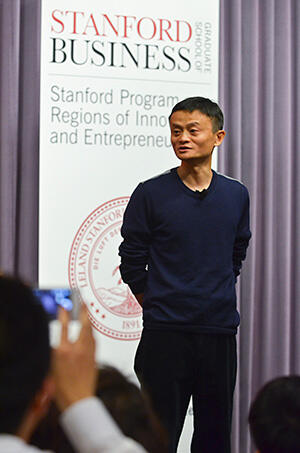
Jack Ma spoke at Stanford University on May 4, 2013 at an event co-hosted by the Stanford Program on Regions of Innovation and Entrepreneurship (SPRIE) and Alibaba Group.
Speaking without notes or visual aids on May 4th at Stanford University's NVIDIA Auditorium, founder and former CEO of Alibaba Group Jack Ma unspooled a farewell talk that at moments turned highly personal and deeply reflective: Ma spoke openly about his persistent failures in school, including spending seven years in elementary school and being rejected by Harvard ten times, and about his struggles to jumpstart Alibaba with only 50,000 RMB.
Less than two minutes into his talk at the event co-hosted by Alibaba Group and the Stanford Program on Regions of Innovation and Entrepreneurship (SPRIE) of the Stanford Graduate School of Business, Ma touched on the trials and travails he had faced early on as an internet and e-commerce pioneer in China. "Back in 1995," revealed Ma, "I felt I was a loner and people thought I was a cheater. They said I was trying to make something out of nothing.” In fact, added Ma, his first interview with CCTV was censored at the behest of the producer, who feared Ma's talk about giving the Chinese government internet access was "not a positive influence" and made Ma "look like a bad guy."
Ma's personal struggles, however, began well before he knew anything about e-commerce—in elementary school—where Ma confessed to being such a bad pupil that no school in his hometown of Hangzhou wanted him. In high school, he spent three years taking the college entrance exam before scoring high enough to enroll in a local teachers college. Harvard rejected him ten times. "Nobody said that I would be a very capable person that would do something significant or meaningful in the future," Ma admitted to a silent and still audience of about 100 people. Ma also recalled his father asking him to focus and do calligraphy. "I couldn't really do it—I didn’t have good penmanship," he said.
Image
It's clear the former English teacher turned internet billionaire never let the doubts of his detractors or the rejections from Harvard spoil his high aspirations—in fact, Ma credited the Silicon Valley for inspiring him to bring internet innovation to China amid the setbacks: "I knew nothing about technology, but every time I came to Silicon Valley, on the weekends I would see cars fill each and every parking lot… I saw the lights were on at each and every office building. When everyone spoke, their eyes were filled with sparkles. They were really hopeful about the future. So I was really inspired when I went back to China—I thought that I should do an internet business."
So Ma did, founding Alibaba Group in 1999 with 17 other co-founders. Today, Alibaba is China's largest e-commerce firm, something Ma readily admitted exceeded his wildest dreams: "I never thought that Jack Ma would have, in the future, a day like today. I never thought that Alibaba or Taobao or any type of transaction developed by Taobao would have a day like today. I never thought the internet would have a day like today."
Midway through the speech, the 49-year-old seasoned entrepreneur also struck a philosophical and political chord, making tacit references to god, social conflict, war, and generational change. He encouraged the audience to be grateful for living in an era of great opportunity, adding "the worst thing is that mankind experiences war… if we can actually solve problems through economic development, we will not need wars and we can actually use economic development to influence many people." He warned, nonetheless, that in the next 30 years the world would face a host of unknown vicissitudes, including "lots of social conflicts," which Ma described as opportunities for young people. "If everything stays stable, we are not going to have any opportunities."
Ma also gave the audience his views on the state of China's present social milieu: "This is the best of times, this is the worst of times," remarked Ma. “Nobody is happy in China… there's a lack of trust and nobody is happy. The poor people are unhappy; the rich people are unhappy. The government doesn't trust media; the media doesn't trust government. We are in an era of constant change."
Image
At least twice during his speech, the founder of China's most profitable e-commerce company also took spirited swipes at some of his personal critics. "You know, we are experiencing economic and political restructuring and they want me to commit suicide. Lots of people are asking, 'why are you not advocating for political restructuring?' I don't feel that's actually something that can be done. I feel that lots of people encouraging me to do that have foreign passports. And they aren't going to stay in China as long as they see the situation changing. They're going to flee the country." Ma also took to task those that ask why he runs a technology company if he knows so little about technology. He said it's like asking a real estate developer "you know nothing about constructing a house—how can you be a real estate developer?"
Fourteen years removed from when he founded Alibaba, Ma's personal belief is that one shows respect and admiration for technology and the people that develop it. "That you don't know about technology," said Ma, "doesn't mean you don't respect technology."
Daniel Limón is a senior in East Asian Studies at Stanford University and a research assistant for SPRIE.
China is North Korea's most important ally, but relations between the two countries have appeared strained in recent months. David Straub spoke to Radio Free Asia about Pyongyang's decision to send a special envoy to Beijing in May.
Hero Image
An Air Koryo plane parked at the Beijing Capital International Airport, September 2012. China is one of the few countries that the North Korean state-operated airline flies into. | Flickr / Gabriel Britto
From executive boardrooms to national capitols, leaders are debating the relative merits of contending models and strategies for attracting, developing, and empowering innovation talent--the people who drive economic growth and value creation through innovation.
On June 28, 2013, the Stanford Program on Regions of Innovation and Entrepreneurship (SPRIE) convened a circle of over 50 policymakers, executives and Stanford community members from 12 countries for an interactive roundtable on innovation talent at the Stanford Graduate School of Business.
Topics of discussion included:
What are key data and trends for innovation talent in Silicon Valley?
What strategies are places such as London, Taiwan and Israel employing to become hotbeds of innovation that attract innovation talent?
Image
How can companies successfully manage and empower their innovation talent? What best practices have been learned?
What insights and implications into innovation talent can be gathered from recent research?
How are universities innovating through programs such as Stanford's StartX and the d.school?
Agenda
8:30 – 8:45
Registration
8:45 – 9:00
Welcome & Opening Remarks
9:00 – 10:15
“The Right Talent, Essentially” Evan Wittenberg, Senior Vice President, People, Box Kyung H. Yoon, CEO, Talent Age Associates Moderator: Greg McKeown (MBA '08), CEO, THIS, Inc.
10:15 – 11:10
“The Rx for Innovation” Baba Shiv, Sanwa Bank, Limited, Professor of Marketing, Stanford Graduate School of Business
11:10 – 11:30
Break
11:30 – 12:30
“Innovation Talent Spanning Boundaries” Chunyan Zhou, Director, International Institute of Triple Helix (IITH) Morten Petersen, Assistant Professor, Aalborg University Kung Wang, Chair Professor, China University of Technology Moderator: Henry Etzkowitz, Senior Researcher, H-STAR Institute, Stanford University
12:30 – 1:30
Lunch
1:30 – 2:10
“Accelerating the Next Generation of Innovation Talent” Cameron Teitelman (BS '10), Founder & CEO, StartX Divya Nag, Founder, StartX Med
2:10 – 2:40
“Silicon Valley Perspective” Russell Hancock, President & CEO, Joint Venture Silicon Valley
2:40 – 3:00
Break
3:00 – 4:30
“Global Policy Perspectives” Sigal Admony-Ravid, Consul for Economic Affairs to the West Coast, State Of Israel Chao-Han Liu, Vice President, Academia Sinica Priya Guha, British Consul General in San Francisco Angus Lapsley, Director European & Global Issues, Cabinet Office, United Kingdom



 Belina Tang