-

At the NATO Summit in Wales in September 2014, NATO leaders were clear about the security challenges on the Alliance’s borders. In the East, Russia’s actions threaten our vision of a Europe that is whole, free and at peace.  On the Alliance’s southeastern border, ISIL’s campaign of terror poses a threat to the stability of the Middle East and beyond.  To the south, across the Mediterranean, Libya is becoming increasingly unstable. As the Alliance continues to confront theses current and emerging threats, one thing is clear as we prepare for the 2016 Summit in Warsaw: NATO will adapt, just as it has throughout its 65-year history.

Image
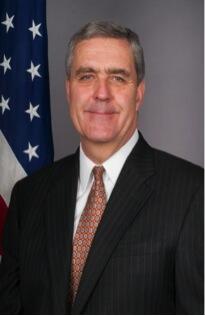
Douglas Lute, Ambassador of the United States to NATO


In August 2013, Douglas E. Lute was sworn-in as the Ambassador of the United States to the North Atlantic Treaty Organization (NATO).  From 2007 to 2013, Lute served at the White House under Presidents Bush and Obama, first as the Assistant to the President and Deputy National Security Advisor for Iraq and Afghanistan, and more recently as the Deputy Assistant to the President focusing on Afghanistan, Pakistan and India.  In 2010, AMB Lute retired from the U.S. Army as a Lieutenant General after 35 years on active duty.  Prior to the White House, he served as the Director of Operations on the Joint Staff, overseeing U.S. military operations worldwide. He served multiple tours in NATO commands including duty in Germany during the Cold War and commanding U.S. forces in Kosovo.  He holds degrees from the United States Military Academy and Harvard University.

A light lunch will be provided.  Please plan to arrive by 11:30am to allow time to check in at the registration desk, pick up your lunch and be seated by 12:00 noon.

Co-sponsored by The Europe Center, the Freeman Spogli Institute for International Studies, the Center for International Security and Cooperation and the Center for Russian, East European and Eurasian Studies.


Douglas Lute United States Ambassador to NATO Speaker
Lectures
Authors
News Type
Commentary
Date
Paragraphs

Elizabeth Blake, Habitat for Humanity International’s General Counsel and team leader of its Government Relations and Advocacy operations, spoke to students at the Freeman Spogli Institute on February 25 as part of the Program on Human Rights Winter Speaker Series that examined U.S Human Rights NGO’s and International Human Rights. 

Habitat for Humanity is a Christian not-for-profit organization that started in 1974 with the credo that every person has a human right to secure shelter and tenure of land. Most of its work is overseas, where Habitat for Humanity has built homes for over 3 million people in over 70 countries. Using security of tenure as its cornerstone, it especially assists women and children who are the most vulnerable to homelessness and insecure tenure. Habitat for Humanity has also recently expanded into housing microfinance, water and sanitation, risk reduction and response, and in creating Habitat Resource Centers.    

Blake’s provocative starting salvo was that “NGOs often do harm and frequently waste money.” Instead, they need to work better among themselves and invite partnerships with other NGOs, governments, and multi-lateral partners. This is not simply a moral imperative but also a practical necessity given the size of the U.S. not-for-profit sector, which as an employer of 13 million people is a significant part of the national economy.   

Habitat for Humanity’s approach maximizes its impact abroad through four principles:

1.     Community development starts with its people – people are the true assets;

2.     International community development must be based upon priorities set by the local community itself;

3.     The test of success of any community development is that local capacity is improved; and

4.     “Accompaniment” – a term first coined by Paul Farmer of Partners in Health: Habitat for Humanity works with and works for the people of that community.

This last principle is the most important: Habitat for Humanity has 1 million volunteers each year who work together with communities, or as Blake says, “scraping walls together with people from a local community is a different relationship to handing out soup” and ensures “going from aid to empowerment.”

Responding to questions from Dana Phelps, program associate for the Program on Human Rights and moderator of the event, Blake emphasized the relevance of her corporate background to working in the non-profit world.  As a graduate of Columbia University’s School of Law, she brings her extensive corporate experience to her work at Habitat, and stressed that “non-profits are businesses – a major corporate undertaking” for which her business background had trained her “not to take no for an answer.” 

Blake also explained that while Habitat for Humanity is a multi-denominational Christian organization, it is not registered as a church.  This means it is subject to anti-discrimination laws in its hiring practices and daily operations. It does not engage in prosthletyzing but instead sees itself as a morals-based organization.   

When Blake was further pressed on how “accompaniment” works in practice, she emphasized that Habitat for Humanity does not impose its values and morals on communities, but instead has intentionally slow processes that ensure communities adapt new practices in their own time. For example, when questioned on the impact of gender-equality housing improvements, Blake said, “Habitat for Humanity doesn’t make the first running – it tends to go in to communities that are already taking the running on gender equality.” 

Helen Stacy, Director of the Program on Human Rights


Hero Image
dsc 0411
Elizabeth Blake, former SVP of Habitat for Humanity, speaks at Stanford
Dana Phelps
All News button
1
Authors
News Type
Commentary
Date
Paragraphs

Julie Cordua, executive director of Thorn, a non-profit organization founded by Ashton Kutcher and Demi Moore, spoke passionately on the topic child exploitation and sexual abuse imagery for the Stanford Program on Human Rights’ Winter Speaker Series U.S Human Rights NGOs and International Human Rights on February 4, 2015.

Cordua addressed the Stanford audience about the importance of technology for acting as the “digital defenders of children." She provided a chilling account of child sexual exploitation, first describing the problem and then going on to challenge preconceived notions about it. For example, she highlighted that in order to tackle the issue, it must first be understood that it concerns a highly vulnerable population; most child victims of sexual exploitation come from extremely abusive backgrounds and many have been sexually abused by one or more parents.

Cordua emphasized that technology innovations have contributed to a proliferation of child exploitation and sexual abuse imagery through the use of encrypted networks that make it extremely difficult to hunt down perpetrators and find victims. Cordua feels that while technology is intensifying the problem, technology is also the solution.  Examples she gave were the development of algorithms that aim to track perpetrators and their victims and advertisements that encourage pedophiles to seek help.

Helen Stacy, director of the Program on Human Rights, queried Cordua on Thorn’s relationship with the government and private sector, as well as on Thorn’s approach for testing the efficacy of their programs. Cordua responded that Thorn does not apply for government funds so as to maintain independence over their projects but that they actively cultivate strong relationships with politicians and law enforcers. In relation to evaluation metrics, Cordua acknowledged that metrics are especially difficult in such a cryptic field as it is nearly impossible to know what numbers they are dealing with from the onset. Questions from the audience included effective strategies for changing the conversation of pedophilia in the public sphere, the emotional stamina required for pursuing such work, and strategies for connecting with and providing a safe platform for victims of child sexual exploitation.

Dana Phelps, Program Associate, Program on Human Rights


Hero Image
dsc 0476
Julie Cordua, executive director of Thorn, speaks at Stanford
Dana Phelps
All News button
1
Authors
News Type
Commentary
Date
Paragraphs

Carolyn Miles, CEO and president of Save the Children, spoke on her organization’s efforts to protect children’s rights in many countries of the world at the Stanford Program on Human Rights’ Winter Speaker Series U.S Human Rights NGOs and International Human Rights on February 11, 2015.

Throughout her talk, Miles addressed the Stanford audience about the importance of protecting the basic needs of children, proclaiming the Save the Children mission: Every child deserves a childhood.  She spoke about the urgent needs of child refugees in Syria, the organization’s biggest and most challenging hurdle at present. The audience grew still when Miles played a Save the Children commercial capturing a Syrian child’s experience in one year of her life during the wake of the crisis. Miles raised other important issues, such as the critical importance of developing longer-term strategies that support children in the aftershock of crises, which often can be more damaging than the initial crisis itself. For example, in the aftermath of Hurricane Katrina when thousands of children were displaced, organizations such as the Red Cross had no plan in place for caring for children in shelters beyond a short period of time. Save the Children trained Red Cross workers in preparedness techniques and strategies for emergency aftermath.

Helen Stacy, director of the Program on Human Rights and moderator of the event, questioned Miles on the organization’s strategy for accessing marginalized communities; prioritizing children that are forgotten or ignored; and the concern of overeducating and preparing children in countries with a depleted workforce. Miles believes that focusing on the hard-to-reach populations will close the gap between the majority and the minority, and that studies show that this is achievable when governments are made to feel accountable to their marginalized peoples when witnessed on an international level. In relation to unrealistically preparing children for the workforce, Miles stated that in the Middle East this may potentially be a problem, but that Save the Children endeavors to prepare students through matching their skillsets to jobs that are already available. When Stacy challenged Miles on the Western mindset that frames the Save the Children mission that “every child deserves a childhood," Miles agreed that it is a Western attitude but stood by her stance that she believes that all children under the age of eighteen are entitled to certain basic rights, regardless of non-Western cultural norms indicating otherwise. Questions from the audience included fundraising issues, learning from undesirable program evaluation results, dealing with diversity when designing projects and innovation in children’s rights.

Dana Phelps, Program Associate, Program on Human Rights


Hero Image
dsc 0475
Carolyn Miles, CEO and president of Save the Children
Dana Phelps
All News button
1
Authors
News Type
Blogs
Date
Paragraphs

Lauren Wedekind is a Stanford undergraduate studying Human Biology and Democracy, Development, and the Rule of Law. Her research focuses on social medicine and the potential for telemedicine to mitigate health care coverage gaps. Lauren believes that human rights advocacy requires a two-way street of listening and communication within and across national and cultural borders—which she explores with Stanford CDDRL, UNA-USA, and WFUNA on projects involving the right to health. Wedekind received funding from CDDRL's Program on Human Rights to travel and participate in the WFUNA Human Rights Youth Training Conference in Geneva, Switzerland.


By age seventeen, Nam had been forced into marrying a stranger, bearing his child, and risking her life to be a refugee on a remote island.  In April 1975, the North Vietnamese Communist Party took over the Republic of South Vietnam, and violently threatened residents of Saigon, South Vietnam’s then-capital and Nam’s hometown.  Like thousands of other residents, Nam’s family desperately uprooted from their relatively comfortable living situation, only to cram like sardines into an over-capacity boat headed toward international waters, hoping to be rescued by the United Nations.  With their lives in very real danger, the to-be refugees who boarded that boat did so without any guarantee that they would safely cross the passage across the Pacific Ocean.  In fact, these “boat people” were held hostage, robbed, raped, and beaten on three separate occasions by pirates in the Sea of China.  After the attacks, they floated aimlessly on the ocean for days, and were finally rescued by a UNHCR vessel, which guided them to refugee camps in Indonesia.  One year later, Nam and her boat’s survivors—those who were not killed by violence or disease—reached the United States.  The survivors who finally reached peacekeeping nations accepting refugees had often endured poverty, abuse, and posttraumatic mental and physical health issues.

tumblr inline nge57nndyk1r1nrdn Wedekind with her cohort of training attendees in Geneva.
At first, upon hearing about the human rights violations that Nam and many other Southeast Asian refugees have endured, I channeled my disbelief only into outrage toward the perpetrators.  Why did one group violently drive thousands of families out of their own homes?  How could pirates attack the innocent “boat people”?  How many human rights violations could have occurred in transit?   These common reactions are completely justified; however, simply demanding the answers to these questions alone will protect neither human dignity of the refugees nor future victims of human rights violations.  Members of society at all levels of governance must agree that there is a need for change, and that they will support its enactment.  This is the core principle of human rights dialogue. 

This summer, I was honored to be nominated by UNA-USA to attend the WFUNA High Commissioner of Human Rights Training in Geneva, in which 30 young human rights advocates representing 25 countries learned about international human rights instruments and the UN Human Rights Council.  Through WFUNA’s training curriculum, and even more, through interactions with our peers, our cohort agreed on concepts of fundamental human rights—that people of all ages and backgrounds should be guaranteed: (1) Fundamental human rights and (2) The right to defend these rights.  Point (2) necessitates governments exercising structural competence to guarantee the protection of human rights for all members of society.  As part of Point (2), listening to many different viewpoints within society has been humbled me: As a human rights advocate, I am responsible for ensuring that I also understand the stories of the marginalized so that I can best voice collective advocacy points to others – advocacy is a two-way street. 

When watching the UN Human Rights Council Emergency Session on Gaza with the Human Rights Training in July, I was first awestruck that I was able to watch a history-making decision before my eyes.  As I held the wired translator earpiece to my ear for the last hour of the Session in which NGOs were stating their own perceptions of human rights violations on-the-ground, though, I realized that many stakeholders were actually leaving the assembly hall.  I wondered: “How can multilateral, international organizations realistically ensure that they respect the human dignity of all members of society without each ambassador engaging with community members who directly experience conflicts on-the-ground?”  I respect the major responsibilities of Ambassadors to the UN Human Rights council: (1) Developing realistic pictures of events he/she has often not directly perceived, (2) Communicating these pictures to members of his/her society, and (3) Voicing the collective opinions of his/her constituency on human rights issues in international engagements.  These three actions are not simple, but when put into practice, they enable action over apathy.

Since returning to the U.S., I have asked: “How can I be most useful to my society?”  After witnessing both multinational cooperation as well as largely unheard voices of NGOs in international human 

Wedekind at one of the training sessions at the UN.
rights dialogue, my belief that human rights advocates are responsible for communicating with all members of their societies, especially the marginalized, has only grown stronger.  Infuriated by Nam’s tales of human rights violations experienced by refugees, yet inspired by the potential for more productive international dialogue in venues such as the Human Rights Council, I have committed to teaching young people about human rights, specifically the right to health, on a grassroots level. 

In partnership with the Program on Human Rights at Stanford's Center for Democracy, Development, and the Rule of Law, Afia Khan (Economics ’16) and I are developing a student-initiated course on health and human rights advocacy, which we will launch in 2015, for intermediate school through university-level students.  We hope to provide young people with a knowledge base and advocacy toolkit for young people on health and human rights, and to let them know what I have learned from UN Human Rights Council and Nam: Every single person can advocate for human rights – we must start small by exercising compassion to understand others’ experiences, and then share with others what we have learned.

Nam’s name changed to respect confidentiality.


Also see Wededkind's blog posted on the WFUNA website and on FSI Global Student Fellows' 'In The World' Blog

Hero Image
tumblr inline nge5v6qn891r1nrdn
Lauren Wedekind (left) speaks at the World Federation of United Nations Associations' Youth Human Rights Training in Geneva, Switzerland.
World Federation of United Nations Associations
All News button
1
Authors
News Type
News
Date
Paragraphs


Stanford senior Sarah Kunis said she and other CISAC honors students were introducing themselves to some senior White House advisors when President Barack Obama walked in the room.

“I couldn’t stop my jaw from dropping,” said Kunis. It was honor enough to have an hourlong  sit-down with National Security Advisor Susan Rice, Senior Advisor to the President Valerie Jarrett, and Homeland Security Advisor Lisa Monaco.

The CISAC Honors Students spend their senior year working on theses that focus on critical international security issues. They were eager to get the chance to talk to the three powerful Washington advisors.

The students had just been in the audience to hear Obama address a large Stanford and Silicon Valley gathering at the White House Summit on Cybersecurity and Consumer Protection on Feb. 13. They were then taken to a conference room in the same auditorium where Obama spoke.

“I was surprised to see Susan Rice’s nameplate, so I thought she was who the invitation referred to, but there was an empty chair with no nameplate, between her and Jarrett,” recalled Patrick Cirenza, another CISAC honors student and a research assistant for retired U.S. Gen. Jim Mattis, a visiting fellow at the Hoover Institution.

Then Obama walked in the room. The students were stunned – and nervous.

“I remember how sweaty my palms were,” said Cirenza. “I already had a visceral reaction seeing him at the podium so you can only imagine being in the same room with him. His presence fills the room.”

Taylor Grossman, another CISAC honors student whose thesis looks at the incentives and payoffs of warning the public about terrorist threats, said the conversation started off with Obama asking them whether they might consider careers that would protect the digital domain.


“But then we branched out and talked about a lot of different things,” she said. “The situation in Syria, public warning systems, education, the civil-military divide. It was really a whole range of issues.”

Before being joined by Jarrett and Rice, the students spoke with Cheri Caddy, director for cybersecurity outreach and integration in the National Security Council, for about an hour.


“We asked her pretty frank questions about cybersecurity, North Korea … defensive and offensive capabilities, and getting students interested in the field,” said Grossman. “She was quite candid and provided her own opinions.”

Grossman is a research assistant for CISAC Co-Director Amy Zegart, who is also a senior fellow at Hoover and garnered a shout-out from the president during his keynote address, thanking her for helping to convene the summit.

Jarrett talked to the students about sexual assault on campus. It was the second time the honors students had met the Stanford alumna; they first met her during their two-week Honors College in Washington, D.C. before the start of their senior year.

Obama initially directed the conversation, focusing on cybersecurity. He then opened it up for questions on any topic.

CISAC Honors Students take a selfie before President Obama addresses the White House Summit on Cybersecurity and Consumer Protection, Feb. 13, 2015.
Cirenza told the president his honors thesis evaluates the analogy between earlier nuclear deterrence and the development of cyber deterrence today.

“I told him I thought we are in the 1950s nuclear stage now with regards to cyber-deterrence,” he said. The president disagreed.

“He said, ‘That’s interesting, but I don’t think it’s the case, since there are gradations with cyber wars whereas nuclear warfare is more black and white.’”

Grossman asked the president about the role of the National Terrorism Advisory System, which replaced the color-coded Homeland Security system, and whether he envisioned a scenario in which the government would have to use it.

“He and Lisa Monaco focused on specific warning systems, which was interesting to me,” she said.

The topic turned to Syria when the president noticed that Kunis had brought along a copy of U.N. Ambassador Samantha Power’s book, “A Problem From Hell: America and the Age of Genocide.”

“I asked why we are not intervening in Syria and why we are not fulfilling our Right to Protect (R2P) obligation,” said Kunis. “President Obama said that the situation there was heartbreaking and that everyone looked at the problem to figure out what we should do to stop the suffering, while evaluating our interests. We cannot intervene without having a plan for the future – and we can’t overthrow governments.”

Cirenza said Obama noted that there are routine calls to intervene in Syria, but few to intervene in other nations, such as the Democratic Republic of Congo, where more than 5.4 million people have died from conflict-related causes since a civil war erupted in the central African nation in 1998.

President Obama also shared his view that he doesn't believe the United States would have been locked into the Iraq and Afghanistan wars as long as it has if there were a mandatory national draft in place. He asked students what they thought of instituting such a draft.

Almost none thought it a good idea.

Overall, the students said, it was the most incredible day of their Stanford careers“It’s going to be hard to look forward to much else,” said Cirenza, who now has adjustments to make to his honors thesis. “Pretty much downhill from here. Thanks, Obama.” 


Joshua Alvarez is a 2012 Stanford graduate and was a CISAC honors student.

Hero Image
students obama
President Obama meets with Stanford students, including three from the Honors Program at FSI's Center for International Security and Cooperation, at the White House Summit on Cybersecurity and Consumer Protection at Stanford University on Feb. 13, 2015.
Linda Cicero
All News button
1
-

International Education Initiative (IEI) Instructional Workshop 

IEI is a new cross-campus initiative to increase dialogue and collaboration around international education at Stanford. 

About the Topic: There is a wide variety of readily available secondary data sources that can be harnessed to provide rich descriptions and often meaningful causal explanations of interesting educational phenomenon in developing countries. Some of the larger data sources such as TIMSS, PIRLS or PISA are widely known, but in addition to these, many other under-utilized national and cross-national datasets are also available.

In this brief workshop I hope to a) introduce alternative secondary data resources that are useful and relevant for educational research b) discuss some of the advantages and disadvantages of working with such large-scale data.

About the Speaker: Amita Chudgar is an Associate Professor of Educational Administration and Education Policy. As an economist of education, her long-term interest focus is on ensuring that children and adults in resource-constrained environments have equal access to high-quality learning opportunities irrespective of their backgrounds. 


Lunch will be served.

Sponsored by: Freeman Spogli Institute for International Studies, Stanford Graduate School of Education, Rural Education Action Program, Center for Education Policy Analysis 

Encina Hall East Wing, 5th Floor, Falcon Lounge

Amita Chudgar Visiting Scholar, Graduate School of Education
Workshops
Subscribe to The Americas