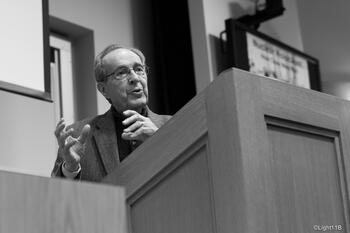
At 90, William J. Perry has seen a lot in this world.
Maybe, in fact, too much. When it comes to nuclear warfare and annihilation, few people alive have contemplated such tragic outcomes quite like Perry, a senior fellow at the Center for International Security and Cooperation (CISAC), a former U.S. secretary of defense, and one of the world’s top nuclear weapons experts.
Perry, who becomes a nonagenarian on Oct. 11, has been called America’s “nuclear conscience.” He has sometimes referred to himself as a “prophet of doom,” and certainly not in a congratulatory sense, but more as a scientist on a mission. A brilliant mathematician who's worked with nearly every administration since Eisenhower, Perry's been up-close to nuclear weapons and near-miss crises for the last several decades.
Today, Perry is devoted to education on the subject of nuclear weapons – he understands exactly how much horror they would wreak on humanity and beyond.
And while no one would call Perry a crusader type (he is pragmatic, modest and private), there’s no doubt he’s on an energetic crusade for a nuclear-free world. Reaching young minds – those who will inherit the leadership of this world – is his calculus in the formula of world peace.
So, Perry reaches out in ways that resonant with youth. Last year created a series of virtual lectures, "Living at the Nuclear Brink," known as a MOOC, or massive open online course. His new online course, "The Threat of Nuclear Terrorism," launches Oct. 17.
“Nuclear weapons may seem like 20th century history, but the choices we make about these weapons in the 21st century will decide your future in truly fundamental ways,” Perry wrote in the earlier course's introduction.
Conversations with conscience
An engineer and policy maker, Perry has academic affiliations that range widely across the Stanford campus. He is the Michael and Barbara Berberian Professor (emeritus), a senior fellow at the Freeman Spogli Institute for International Studies, and a senior fellow at the Hoover Institution. He's always in demand for a panel discussion or speaker event.
On Nov. 1, he's the featured subject of a CISAC event, "A Conversation with William J. Perry: Assessing Nuclear Risk in a New Era." That talk will include a Perry discussion with CISAC co-director Amy Zegart and another panel discussion, led by CISAC co-director Rod Ewing, with scholars Siegfried Hecker, David Holloway and Scott Sagan.
Perry's been known to participate in “Ask Me Anything” chats on Reddit, a place popular with youth. He connects with all types of audiences, conveying in direct encounters the exact nature of the nuclear dangers now facing civilization, and what can be done to reduce those dangers. This mission to educate led him to write a memoir, My Journey at the Nuclear Brink, all the while giving countless media interviews and delivering major speeches before major think tanks, nongovernmental organizations and policymakers.
One core Perry message is that U.S. foreign policies do not reflect the existing danger of nuclear threats -- the reason is that this risk isn’t widely recognized across society. And young people need to understand this dynamic that creates a distorted, too complacent view of a very real nuclear weapons problem throughout the world.
Perry, with the help of both his daughter, Robin Perry, his son, David Perry, granddaughter, Lisa Perry, and grandson Patrick Allen, established the William J. Perry Project, which informs the public about the role of nuclear weapons in today's world, while urging the elimination of these weapons.
It’s a family on a mission, and the Perrys believe the only way to avoid nuclear war is by directly contemplating the scenario in a personal, direct sense through learning and education.
"We're really just out there trying to reach a generation that isn't engaged on this issue right now," said Lisa Perry in an article on the Perry Project web site. She is the digital media manager for the project. "It's something we learned in history class. There was no conversation about what's happening now."
As her grandfather explained, "The dangers will never go away as long as we have nuclear weapons. But we should take every action to lower the dangers, and I think it can be done."
Early entrepreneurship days
Perry was born in Vandergrift, Pennsylvania, in 1927, the year that Charles Lindbergh completed the first solo flight across the Atlantic.
As a child, Perry fell in love with math. Math for him represented analytical discipline and the beauty of overcoming challenge. By solving math problems, one can master not only numerical problems, but other seemingly all-too difficult challenges. The key, as Perry discovered, was breaking down the larger problem into smaller parts. This evolved complexity into simplicity, which is more easily understood. Perry went on to cultivate this problem-solving mindset the rest of his life.
Perry saw the world as a young man – he left college at 18 to enlist in the U.S. Army, serving in the army of occupation of Japan. There he witnessed firsthand the devastating aftermath of the conventional and nuclear bombings in Japan. Those experiences in Japan shaped his perspectives forever on issues like arms control and national security.
After his military service, Perry received his B.S. (1949) and M.A. (1950) degrees from Stanford, and a Ph.D. in mathematics from Pennsylvania State University in 1957. He chose a career in defense electronics, and became one of the Silicon Valley’s early entrepreneurs, founding a company that pioneered digital technologies to analyze the Soviet nuclear missile arsenal. And so, he was often asked to counsel the federal government on national security.
In October 1962 during the Cuban missile crisis, Perry received an urgent request from the U.S. government to help analyze U-2 photos of the Soviet installation of nuclear-armed missiles in Cuba. Perry later recollected that he thought the world could end during that crisis, and that those days might well be his last.
From 1977 to 1981 during the Carter administration, Perry served as the Pentagon’s undersecretary of defense for research and engineering, where he oversaw weapon systems and research. After leaving the Pentagon in 1981 to work in the private sector, Perry became a Stanford engineering professor and a co-director of the Preventive Defense Project at Stanford's Center for International Security and Cooperation (CISAC).
He was the co-director of CISAC from 1988 to 1993. Today, he is the Michael and Barbara Berberian Professor emeritus at Stanford, with a joint appointment at the Freeman Spogli Institute for International Studies and the School of Engineering. He is also a senior fellow at the Hoover Institution.
In 1994, President Bill Clinton tapped Perry to become the 19th U.S. Secretary of Defense. However, it was not so easy for the White House to recruit him.
Perry treasured his privacy so much that he originally turned down the job of defense secretary. Only when Clinton and Al Gore assured him that his family’s privacy could be maintained, he finally accepted the offer. With the Cold War having ended a fear years earlier, he found it would become a historic time to serve as America’s defense secretary.
Years later he recalled standing with his Russian and Ukrainian counterparts as their teams destroyed missile silos in the former Soviet Union. By the end of the 1980s, Perry thought the world had survived the horrific prospect of nuclear annihilation – and that it was behind everyone, left in the ashes of the Cold War.
Not so fast. Welcome to 2017.
Beyond doomsday
Today, Perry believes, the world is arguably more dangerous than ever before. His view is supported by The Bulletin of Atomic Scientists, which announced in January 2017 that the Doomsday clock now stands at two-and-a-half minutes to midnight, suggesting that existential threats now pose a greater danger to humanity than they have at any time since the height of the Cold War.
In fact, in 2016, Perry warned that the Doomsday clock should stand at five minutes to midnight for nuclear war – but only one minute to midnight for the threat of nuclear terrorism. He said during that press conference that the clock now issued a “more dangerous, more ominous forecast than two thirds of the years during the Cold War.”
As a result, Perry’s profile has risen higher than ever as the world confronts increasingly unsettling nuclear threats like a war between the U.S. and North Korea, reckless nuclear rhetoric by state leaders, and the possibility that terrorists may use nukes.
On North Korea in particular, Perry has urged a return to deterrence on the part of the United States:
“The threat to use nuclear weapons has always been tied to deterrence or extended deterrence; historical U.S. policy is that the use of nuclear weapons would only be in response to the first use of nuclear weapons against the United States or an ally covered by our extended deterrence,” he said in a statement.
With North Korea, Perry notes that the U.S. should not make empty threats, because empty threats weaken America’s credibility and reduce the ability to actually take strong action. “As Theodore Roosevelt said, ‘Speak softly but carry a big stick,’” he said.
During the early Cold War, he said, when the Soviets used “shrill” language, U.S. presidents like Eisenhower merely responded in tempered, moderate tones. “Just as in those tense times, today’s crisis also calls for measured language,” Perry said.
On top of this, Perry said the U.S. and Russians seem to be “sleepwalking into this new nuclear arms race,” and that while a new Cold War and arms race may look different than the prior one in U.S.-Soviet history, they are both dangerous and “totally unnecessary.”
Whether on the North Korean peninsula or elsewhere, a miscalculation could be catastrophic, Perry warns. That’s one reason he joined other former "Cold Warriors" like George Schulz, Henry Kissinger and Sam Nunn to write an op-ed in the Wall Street Journal in 2007. They argued that the goal of U.S. nuclear policy should be not merely the reduction and control of atomic arms, but the ultimate elimination of all nuclear weapons everywhere.
What type of world does Perry dream about in his brightest visions? One without nuclear weapons. He believes collective humanity must “delegitimize” nuclear war as an acceptable risk of modern civilization. A safer world, one that requires great purpose, persistence, and patience to make a reality, is possible, if people understand the threats and take action to reduce them, Perry has said.
“This global threat requires unified global action,” Perry wrote in July 2017 in support of a new United Nations treaty banning the use of nuclear weapons.
Education and knowledge – that’s how Perry believes humanity can safely evolve past its nuclear phase.
MEDIA CONTACT:
Clifton B. Parker, Center for International Security and Cooperation: (650) 725-6488, cbparker@stanford.edu