-

Image


Abstract:

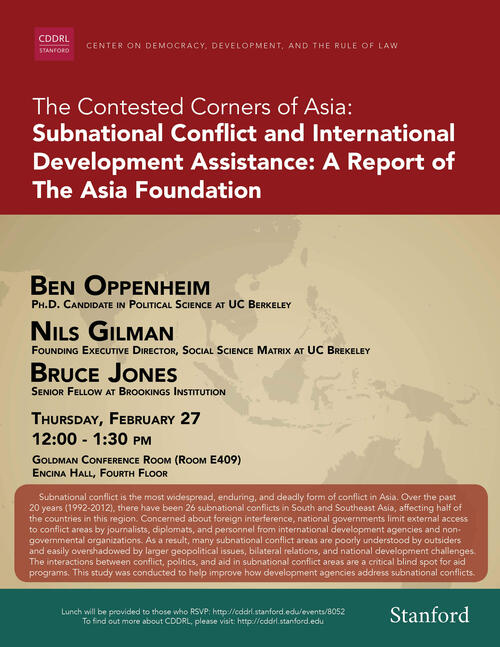
Subnational conflict is the most widespread, enduring, and deadly form of conflict in Asia. Over the past 20 years (1992-2012), there have been 26 subnational conflicts in South and Southeast Asia, affecting half of the countries in this region. Concerned about foreign interference, national governments limit external access to conflict areas by journalists, diplomats, and personnel from international development agencies and non-governmental organizations. As a result, many subnational conflict areas are poorly understood by outsiders and easily overshadowed by larger geopolitical issues, bilateral relations, and national development challenges. The interactions between conflict, politics, and aid in subnational conflict areas are a critical blind spot for aid programs. This study was conducted to help improve how development agencies address subnational conflicts.


Speaker Bios:

Ben Oppenheim is a Fellow (non-resident) at the Center on International Cooperation at New York University. His research spans a diverse set of topics, including fragile states, transnational threats (including pandemic disease risks and terrorism), and the strategic coherence and effectiveness of international assistance in fragile and conflict-affected areas.

Oppenheim has consulted for organizations including the World Bank, the United Nations, the Asia Foundation, the Institute for the Future, and the Fritz Institute, on issues including organizational learning, strategy, program design, foresight, and facilitation. In 2009, he served as Advisor to the first global congress on disarmament, demobilization, and reintegration, supported by the World Bank and the UN.

In 2013, Oppenheim was a visiting fellow at the Uppsala University Forum on Democracy, Peace, and Justice. His research has been supported by a Simpson Fellowship, and a fellowship with the Institute on Global Conflict and Cooperation. He was also a research fellow with UC Berkeley's Institute of International Studies, affiliated with the New Era Foreign Policy Project.


Nils Gilman is the Executive Director of Social Science Matrix. He holds a B.A., M.A. and Ph.D. in History from the University of California, Berkeley. Gilman’s first scholarly interest was in American and European intellectual history, with a particular focus on the institutional development of the social sciences, the lateral transfer and translation of ideas across disciplinary boundaries, and the impact of social scientific ideas on politics and policy.

Gilman is the author of Mandarins of the Future: Modernization Theory in Cold War America (Johns Hopkins University Press, 2004), the co-editor of Staging Growth: Modernization, Development, and the Global Cold War (University of Massachusetts Press, 2003) and Deviant Globalization: Black Market Economy in the 21st Century (Continuum Press, 2011), as well as the founding Co-editor of Humanity: An International Journal of Human Rights, Humanitarianism, and Development. He also blogs and tweets.

Prior to joining Social Science Matrix in September 2013, Gilman was research director at Monitor 360, a San Francisco consultancy that addresses complex, cross-disciplinary global strategic challenges for governments, multinational businesses, and NGOs. He has also worked at a variety of enterprise software companies, including Salesforce.com, BEA Systems, and Plumtree Software. Gilman has taught and lectured at a wide variety of venues, from the Harvard University, Columbia University, and National Defense University, to PopTech, the European Futurists Conference, and the Long Now Foundation.


Bruce Jones is a senior fellow and the director of the Project on International Order and Strategy in the Foreign Policy program at the Brookings Institution. He is also the director of the Center on International Cooperation at New York University.

Jones served as the senior external advisor for the World Bank’s 2011 World Development Report, Conflict, Security and Development, and in March 2010 was appointed by the United Nations secretary-general as a member of the senior advisory group to guide the Review of International Civilian Capacities. He is also consulting professor at the Center for International Security and Cooperation at Stanford University and professor (by courtesy) at New York University’s department of politics.

Jones holds a Ph.D. from the London School of Economics, and was Hamburg fellow in conflict prevention at Stanford University.

He is co-author with Carlos Pascual and Stephen Stedman of Power and Responsibility: Building International Order in an Era of Transnational Threats (Brookings Press, 2009); co-editor with Shepard Forman and Richard Gowan of Cooperating for Peace and Security (Cambridge University Press, 2009); and author of Peacemaking in Rwanda: The Dynamics of Failures(Lynne Reinner, 2001).

Jones served as senior advisor in the office of the secretary-general during the U.N. reform effort leading up to the World Summit 2005, and in the same period was acting secretary of the Secretary-General’s Policy Committee. In 2004-2005, he was deputy research director of the High-level Panel on Threats, Challenges and Change. From 2000-2002 he was special assistant to and acting chief of staff at the office of the U.N. special coordinator for the Middle East peace process. 

Richard and Rhoda Goldman Conference Room

Ben Oppenheim Ph.D. Candidate in Political Science Speaker UC Berkeley
Nils Gilman Founding Executive Director, Social Science Matrix Speaker UC Berkeley
Bruce Jones Senior Fellow Speaker Brookings Institution
Seminars

China is a rising global power with a rich culture and history, yet it is not generally well understood by outsiders. The 2008 Beijing Olympics brought increased attention to this ancient nation. To promote a deeper understanding of Chinese culture, history, and contemporary issues, we recommend the following diverse set of teaching resources and curriculum tools to bring China to life in K-12 classrooms. In addition, SPICE offers a national distance-learning course for high school students called the China Scholars Program.

News Type
News
Date
Paragraphs

REAP co-director Scott Rozelle builds on a ten-part series for Caixin Magazine titled, "Inequality 2030: Glimmering Hope in China in a Future Facing Extreme Despair." In his third column, Rozelle explains why rural children are unprepared for preschool. When they do attend, rural preschools are not only hard to find but also of notably poor quality. 

REAP co-director Scott Rozelle builds on a ten-part series for Caixin Magazine titled, "Inequality 2030: Glimmering Hope in China in a Future Facing Extreme Despair." In his third column, Rozelle explains why rural children are unprepared for preschool. When they do attend, rural preschools are not only hard to find but also of notably poor quality. 

To read the column in Chinese, click here.

> To read Column 1: Why We Need to Worry About Inequality, click here.

> To read Column 2: China's Inequality Starts During the First 1,000 Days, click here.  

> To read Column 4: Behind Before They Start - The Preschool Years (Part 2), click here.  

> To read Column 5: How to Cure China's Largest Epidemic, click here.

> To read Column 6: A Tale of Two Travesties, click here


Image

Inequality 2030:

Glimmering Hope in China in a Future Facing Extreme Despair


Caixin Column 3: Behind Before They Start - The Preschool Years


I have two sons. Both were raised in the sunny suburbs of California. By the time the oldest was three years old, I knew he was self-motivated, goal-oriented and driven. I decided to enroll him in a Montessori preschool. In Montessori schools, children are encouraged to be independent, given a lot of freedom to choose which activities to perform, and allowed to freely proceed from one activity to another, learning and completing tasks at their own pace.

My second son was a bit different. He loved nature, exploring, and interacting with children, but he did not like competing with his peers. He was less interested in the goal-oriented focus of his older brother’s Montessori program and certainly would have been uncomfortable with the competition that was always just under the surface. So I sent son number two to a Waldorf preschool. The philosophy of Waldorf is that the best way to launch kids on a path of lifetime learning is simply to let them explore, play, and learn from nature. In these schools, children play and learn collaboratively and there is plenty of unstructured time to get out into the playground and beyond, running and shouting and playing games together.

And both my very different sons thrived in their very different preschool environments. And when it came time to enter elementary school, both were ready to learn and to thrive all over again.

Across the world, the toddlers of our friends in Beijing have equal access to a wide variety of preschools and other early childhood educational institutions. One couple we know has enrolled their children in Fun-First, an innovative preschool that lets kids learn how to play and learn from play. There are Beijing and Shanghai Montessori schools and Waldorf schools. There are Saturday classes for moms and daughters and for dads and sons that teach both parties—parents and their children—how to play and learn together. And all of these widely varied programs help these toddlers develop the basic skills they will need once it comes time to start elementary school: how to socialize with others, how to think and to learn, and how to engage in a classroom environment.

Unfortunately, kids in rural China are not so lucky. In the past, most did not go to preschool. They were strapped to Grandma’s back while she worked in the field. Older sister took care of younger brother while Dad went off to work. In most cases, these kids were simply left on their own to amuse themselves in the lanes of the village. At the very most, they went to private, for-pay daycare centers in nearby townships with poor conditions: dirty; dark; emotionless. Although preschool offerings in rural areas began to expand in the mid 2000s, preschools in rural areas remain poor quality and are often poorly attended. 

And so we have stumbled upon another gap between urban and rural China. But how much difference does preschool really make? Is there any reason to believe that rural kids are suffering from their less structured toddler-hoods?

Unfortunately, strong evidence produced by Rural Education Action Program—REAP—show that rural toddlers are lagging behind their urban counterparts when it comes to what is called “educational readiness.” What does that mean exactly? For the past several decades, Dr. Ou Mujie, formerly a child psychologist at Beijing Medical University, has developed, refined and benchmarked a test of educational readiness for children of different age groups.  The test is multidimensional, assessing each child’s cognitive ability, language skills, communication ability, independence, and fine and gross motor capacity. The test is designed to determine whether or not a child is ready for the next phase in their formal education. For four and five-year-olds, the test indicates whether or not a child is ready, as compared to the rest of their peers, to start kindergarten.

Based on this work, Dr. Ou produced a definitive distribution of educational readiness scores for four to five-year-olds. According to her work, most urban Chinese children have readiness test scores between 85 and 115, with the distribution centered around 100 points. A child is deemed “not ready” for the next phase of education if he or she scores below 70 points. Dr. Ou believes this distribution is representative of urban four to five-year-olds in urban China. Sure enough, only about three percent of urban children aged four to five years were found to be “unready” for school on this test.  

In a study done by REAP, we used Dr. Ou’s test to measure the readiness of nearly 750 rural four-year-olds from 40 townships in Shaanxi, Gansu and Henan Provinces. We produced what we believe is the first set of scores and distributions of educational readiness for children from poor rural areas in China. We show that China's rural children scored much lower on standardized tests of educational readiness than their urban counterparts. More than one half of the rural children (57 percent) in our sample were “not ready” to continue on to the next stage of formal education. In fact, fully 86 percent of rural children were less ready for the next step of education than the average urban child. In shortest and simplest terms, rural children failed their educational readiness tests in an enormous way.

From this we can understand a lot about the pervasive inequality of education in China. Educational inequality in China today is not solely due to the fact that rural compulsory schools are inferior to urban schools. The inequality is likely in no small part due to the fact that rural children are behind before they start.

Which gets us back to a more fundamental question: Why is it that rural toddlers are doing so poorly in their cognitive development? In other words: Why are rural children not ready for school?

One key set of reasons, of course, was spelled out in last month’s column. Read it if you missed it. Children in poor rural areas are cognitively underdeveloped as toddlers because they were cognitively underdeveloped as infants. Infants in poor rural areas are cognitively behind their urban peers because of the combined effects of poor nutrition and poor parenting skills.

However this is not the end of the story. We argue that another key reason that toddlers in poor rural areas are cognitively underdeveloped is that they are not going to good quality preschools. 

In recent years there has been a lot of research around the world demonstrating that preschool education produces many positive benefits. There is evidence that preschool education helps raise the academic and cognitive test scores of young children. It also reduces their chance of grade repetition during elementary school. Stunningly, these positive effects last: children who attend preschool are found to demonstrate better skills and achievements during high school and even college. It has even been shown that children that attend preschool go on to earn higher incomes and commit fewer crimes after they grow up. Given these documented benefits, many educators in developed countries advocate for the universal provision of preschool to all children.

Importantly for China, these results have also been found to be valid in developing countries. Though it may seem they are doing little more than playing, children that attend preschool do in fact come away from the experience with tangible benefits that support them in the rest of their academic lives and beyond. In response to these findings, educators in developing countries across the world have begun promoting preschool education as a necessary foundation and first step for the entire educational system. 

So might the observed inequality in preschool attendance be having an impact on students’ educational readiness? It certainly looks that way, with troubling ramifications for Inequality 2030.

In 2008, REAP conducted a survey across rural areas of Henan, Shaanxi, Gansu, and Qinghai Provinces to find out exactly what rural children were getting in the way of preschool education. Unfortunately, the state of preschool offerings across much of rural China remains discouraging. Our survey found that few families in rural China enrolled their young children in formal childcare or early childhood education (ECE) programs. The study showed that there were practically no facilities available in rural villages for children under three years of age. This was the case in all of our study’s locations. Even for slightly older children attendance was troublingly low. Only 44% of rural children aged four to six years in our sample counties were attending preschool (15%) or kindergarten (29%) in 2008. When examining the poorest counties, attendance in preschool and kindergarten was even lower. 

So why is it that so few children from poor rural areas are going to preschool? According to the REAP survey, a lack of access to ECE services is the main problem: only 11% of villages were found to have their own local preschool services. Almost no villages in designated poor areas had them.

However, lack of services is not the only challenge. We have also found that what few preschools can be found in poor areas generally provide programs that are notably low in quality. The teacher-to-student ratios are high. The facilities are poor. The teachers are poorly trained. Other essential services—in particular health and nutrition—are almost always absent. Perhaps most disheartening of all, there are few efforts to promote innovative curricula. We have been into many preschools that look much more like minimalistic day care centers: children are left to play on their own in musty, sterile environments without any guidance. But unlike my second son, exploring nature and learning freely in his Waldorf preschool, these children have only a dirty dark room in an abandoned shop or government building for a playground.

Of course, if such services were free and provided by the government, one could understand the poor quality. What do you expect of a free program with little incentive to produce high quality classes that attract customers? However, these schools are not government-provided and are anything but free. While primary schools across the country are now tuition-free, preschools and kindergartens are not. In most rural areas and in almost all poor areas, preschools are private—and expensive. Almost all the expenses of running ECE institutions are met by tuition and fees. Our survey found that ECE tuition and fees can be so high that many parents—especially those in poor rural areas—choose not to send their children to preschool and kindergarten because of the expense.

So what’s to be done? As budding literature is testifying to the importance of preschool education, rural Chinese children are being left to their own devices, and left to a less promising future. To the government’s credit, in recent years there has been an effort to expand preschool offerings. Chinese educators are finally getting on the preschool bandwagon. Facilities are being built. Vocational education programs are producing preschool teachers that are in high demand. The schools are still charging considerable tuition, but our impression is that attendance is in fact rising as access is being facilitated. Better late than never.

Or is it? Of course, the real question is whether the new commitment to preschool is really producing children that are more educationally ready.  Unfortunately, there is reason to be skeptical.

> To read Column 4: Behind Before They Start - The Preschool Years (Part 2), click here

Hero Image
14687441256 d0f396e1f8 z
All News button
1
News Type
News
Date
Paragraphs

Once again, 15-year-olds in Shanghai have scored at the top of the PISA global education assessment, ranking number one in the world in reading, math and science -- but is it the same across China? CNN cites data from REAP to paint a stark picture of how Shanghai's education success is not repeated in China's less wealthy, rural interior.

Read the full article on CNN's website here.

Hero Image
5341186731 7d6580249c z
All News button
1
Authors
News Type
News
Date
Paragraphs

William J. Perry was only 18 when he found himself surrounded by death, a young U.S. Army mapping specialist in Japan during the Army of Occupation. The atomic bombs had been dropped on Hiroshima and Nagasaki and World War II had just come to an end. 

“The vast ruins that once had been the great city of Tokyo – nothing, nothing had prepared me for such utter devastation that was wrought by massive waves of firebombing rained down by American bomber attacks,” said Perry, who was then shipped off to the island of Okinawa in the aftermath of the last great battle of WWII.

More than 200,000 soldiers and civilians had been killed in that closing battle of 1945, codenamed Operation Iceberg. 

“Not a single building was left standing; the island was a moonscape denuded of trees and vegetation,” Perry told a rapt audience during a recent speech. “The smell of death was still lingering.” 

The young man quickly understood the staggering magnitude of difference in the destruction caused by traditional firepower and these new atomic bombs.

 “It had taken multiple strikes by thousands of bombers and tens of thousands of high explosive bombs to lay waste to Tokyo,” he recalls. “The same had been done to Hiroshima and then to Nagasaki with just one plane – and just one bomb. Just one bomb. 

“The unleashing of this colossal force indelibly shaped my life in ways that I have now come to see more clearly,” said Perry, who would go on to become the 19th secretary of defense. “It was a transforming experience. In many ways – I grew up from it.” 

William J. Perry in 1945 in his U.S. Army Air Corps uniform.

William J. Perry in 1945 in his U.S. Army Air Corps uniform. 
Photo Credit: U.S. Army

Now, nearly seven decades later, the 86-year-old Perry has come full circle. His new winter course will take students back to his fateful days in Japan after the United States became the first – and last – nation to use atomic weapons. He’ll go through the Cold War, the arms race and expanding nuclear arsenals, and today’s potential threats of nuclear terrorism and regional wars provoked by North Korea, Iran or South Asia. 

Living at the Nuclear Brink: Yesterday & Today (IPS 249) – to serve as the backdrop for an online course at Stanford next year – concludes with the declaration Perry made in 2007: The world must rid itself entirely of nuclear weapons. And students will get a primer on how to get involved in organizations that are working on just that. 

“They did not live through the Cold War, so they were never exposed to the dangers and therefore it doesn’t exist to them; it’s just not in their world,” Perry said of millennial and younger students. “I want to make them aware of what the dangers were and how those dangers have evolved.”


Perry and former U.S. Sen. Sam Nunn, both Democrats, joined former Republican Secretaries of State George P. Shultz and Henry A. Kissinger in launching a series of OpEds in The Wall Street Journal (the first in 2007) that went viral. Together they outlined how nations could work together toward a world without nuclear weapons.

“I think I have some responsibility since I helped build those weapons – and I think that time is running out,” Perry said in an interview. 

Perry helped shore up the U.S. nuclear arsenal as undersecretary of defense for research and engineering, procuring nuclear weapons delivery systems for the Carter administration. Later, as secretary of defense for President Bill Clinton, his priority became the dismantling of nuclear weapons around the world. 

Today, he works on the Nuclear Security Project along with Shultz, Kissinger and Nunn. Former New York Times correspondent Philip Taubman documents their bipartisan alliance in the book, “The Partnership: Five Cold Warriors and Their Quest to Ban the Bomb.” That fifth cold warrior is Sidney Drell, the renowned Stanford physicist and co-founder of CISAC. 

Taubman, a consulting professor at CISAC, will guest lecturer in Perry’s class, along with CISAC’s Siegfried Hecker, David Holloway, Martha Crenshaw and Scott Sagan. Other speakers are expected to include Shultz, a distinguished fellow at Stanford’s Hoover Institution; Andrei Kokoshin, deputy of the Russian State Duma; Ashton B. Carter, who just stepped down as deputy secretary of defense; Joseph Martz of the Los Alamos National Laboratory; and Joeseph Cirincione, president of the Ploughshares Fund.

The world is far from banning the bomb. According to the Ploughshares Fund, an estimated 17,300 nuclear weapons remain in the global stockpile, the majority of which are in Russia and the United States.

Video Player

                                                                                                CyperusMedia.com


President Barack Obama declared shortly after taking office in his first foreign policy speech in Prague that because the United States was the only country to have used nuclear weapons, Washington “has a moral responsibility to act.” 

“So today, I state clearly and with conviction, America’s commitment to seek the peace

and security of a world without nuclear weapons,” Obama said back in May 2009. 

Perry – a senior fellow at CISAC who received his BS and MS from Stanford and a PhD from Pennsylvania State University, all in mathematics – laments the regression of the movement to dismantle the nuclear legacy of the Cold War. 

Obama has so far not acted on his pledge in his contentious second term, as China and Russia expand their stockpiles. North Korea and Iran are attempting to build nuclear weapons and India and Pakistan are building more fissile material. The U.S. Senate still has not ratified the Comprehensive Test Ban Treaty and the U.S. and Russia have not moved forward on a follow-up to the New START Treaty. 

Perry recognizes that the issue is slipping from the public conscience, particularly among young people. So he’s putting his name and experience behind a Stanford Online course slated to go live next year. It will correspond with the release of his memoir, “My Journey at the Nuclear Brink” and will take a more documentary approach, weaving together key moments in Perry’s career with lectures, archival footage and interviews and conversations between Perry and his colleagues and counterparts. 

"Bill Perry has had a remarkable career and this project draws on his unparalleled experience over a pivotal period in history," said John Mitchell, vice provost for online learning. "We hope his brilliant reflections will be useful to everyone with an interest in the topic, and to teachers and students everywhere." 

At the heart of his winter course, online class and memoir are what Perry calls the five great lessons he learned in the nuclear age. The first four are grim remnants of what he witnessed over the years: the destructive nature of the atomic bombs on Japan; his mathematical calculations about the number of deaths from nuclear warfare; his work for the CIA during the Cuban Missile Crisis; and one pre-dawn call in 1978 from the North American Aerospace Defense Command saying there were 200 missiles headed toward the United States from the Soviet Union. That turned out to be a false, but terrifying alarm. 

His fifth final lesson is hopeful, if not cautionary. It goes like this: 

As secretary of defense from 1994 to 1997, Perry oversaw the dismantling of 8,000 nuclear weapons in the former Soviet Union and the United States and helped the former Soviet states of Ukraine, Kazakhstan and Belarus to go entirely non-nuclear. In that mission, he often visited Pervomaysk in the Ukraine, which was once the Soviet Union’s largest ICBM site, with 700 nuclear warheads all aimed at targets in the United States. 

On his final trip to Pervomaysk in 1996, he joined the Russian and Ukrainian defense ministers to plant sunflowers where those missiles had once stood. 

“So reducing the danger of nuclear weapons is not a fantasy; it has been done,” Perry said. “I will not accept that it cannot be done. I shall do everything I can to ensure nuclear weapons will never again be used – because I believe time is not on our side.”

Hero Image
1 CGP 2074 Edit Edit
All News button
1
-

Abstract:
The peoples of Burma/Myanmar have faced military rule, human rights violations, and poor health outcomes for decades. The country Is now undergoing a political liberalization, and multiple changes in political, social and economic life. The human rights and health situation of the country's many ethnic nationalities remain challenging, and represent one of the clearest threats to the prospect of successful transition to peace, and to democracy. We will explore the current health and human rights situation in the country, the ongoing threats to peace, and ways forward for this least developed nation as it emerges from 5 decades of military rule.

Chris Beyrer MD, MPH, is a professor of Epidemiology, International Health, and Health, Behavior, and Society at the Johns Hopkins University Bloomberg School of Public Health. He is the founding Director of the University¹s Center for Public Health and Human Rights, which seeks to bring the tools of population-based sciences to bear on Health and rights threats. Dr. Beyrer also serves as Associate Director of the Johns Hopkins Centers for AIDS Research (CFAR) and of the Center for Global Health. He has been involved in health and human rights work with Burmese populations since 1993. Prof. Beyrer is the author of more than 200 scientific papers, and author or editor of six books, including War in the Blood: Sex, Politics and AIDS in Southeast Asia, and Public Health and Human Rights: Evidence-Based Approaches. He has served as a consultant and adviser to numerous national and international institutions, including the National Institutes of Health, the World Bank, WHO, UNAIDS, the Open Society Foundations, the Walter Reed Army Institute for Research, amfAR The Foundation for AIDS Research, Physicians for Human Rights and Human Rights Watch. Dr. Beyrer received a BA in History from Hobart and Wm. Smith Colleges, his MD from SUNY Downstate in Brooklyn, NY, and completed his residency in Preventive Medicine, public health training, an MPH and a Infectious Diseases Fellowship at Johns Hopkins University in Baltimore. He received an honorary Doctorate (PhD) in Health Sciences from Chiang Mai University in Thailand, in 2012, in recognition of his 20 years of public health service in Thailand

Building 200 (History Corner)
Room 205
Stanford University

Chris Beyrer Director Speaker Johns Hopkins Center for Public Health & Human Rights
Seminars
-

**** PLEASE NOTE CHANGE OF SPEAKER***

Dr. Susan Kasedde currently serves as Senior Advisor and Team Leader on HIV and Adolescents for UNICEF based in New York since November 2009. In this role, she has contributed towards global level evidence generation, technical guidance development, advocacy, global partnership development, and technical assistance towards the global response towards HIV prevention, treatment and care in adolescents aged 10 - 19. Since 2011, on behalf of UNICEF, Susan has coordinated a series of efforts including documentation of global practices in the care of adolescents living with HIV; mathematical modeling with the Futures Institute to assess the impact and cost of scale up of proven high impact HIV prevention, treatment and care interventions within a holistic response, on new HIV infections and AIDS deaths in adolescents; and a systematic review with the London School of Hygiene and Tropical Medicine to confirm evidence on effective approaches for programming to reduce HIV infection, illness and death in adolescents. This work has contributed to stronger advocacy and technical guidelines for programming for adolescents, a group of children previously largely neglected. In 2013, the documentation on adolescents living with HIV was a major contribution to the new WHO guidelines on HIV testing and counseling and care in adolescents. The impact modeling and systematic review are among a series of key papers that will be released in a special supplement on HIV prevention, treatment and care in adolescents at the International AIDS Society Conference in Melbourne, Australia in 2014.


 Susan joined UNICEF having served since 2007 as Regional Adviser with the UNAIDS Regional Office for Eastern & Southern Africa. In that role, she was responsible for coordinating analytic work on the epidemic and response and modes of HIV transmission in several high HIV burden countries, working extensively with government teams and partners in the highest HIV burden countries in the world to use an incidence model to predict the next 1000 new HIV infections and assess alignment of national strategies with the national epidemic. Susan has over 18 years of experience working on adolescents sexual and reproductive health of which 16 of those have been focused on HIV in adolescents. Susan holds a doctorate in Epidemiology and Population Health from the London School of Hygiene & Tropical Medicine, a Masters degree in Public Health from Boston University and Bachelors degrees in Biomedical Science and French. Susan is a national of Uganda and speaks English and French.

Building 200 (History Corner)
Room 205
Stanford University

Susan Kasedde Senior Advisor and Team Leader on HIV and Adolescents Speaker UNICEF
Seminars
-

Abstract
According to international human rights law, countries have to provide palliative care and pain treatment medications as part of their core obligations under the right to health. The failure to take reasonable steps to ensure that people who suffer pain have access to adequate pain treatment may also result in the violation of the obligation to protect against cruel, inhuman and degrading treatment. The lecture will discuss Human Rights Watch’s research on this issue in India, Ukraine, Senegal, Kenya, and Mexico; our national and international advocacy efforts; and how we evaluate the impact of our work.

Joe Amon, PhD MSPH, is the Director of the Health and Human Rights Division at Human Rights Watch. Since joining Human Rights Watch in 2005, Joe has worked on a wide range of issues including access to medicines; discrimination, arbitrary detention and torture in health settings; censorship and the denial of health information; and the role of civil society in the response to infectious disease outbreaks and environmental health threats. Between January 2009 and June 2013 he oversaw Human Rights Watch's work on disability rights. He is an associate in the department of epidemiology at the Bloomberg School of Public Health at Johns Hopkins University and a lecturer in public and international affairs at Princeton University. In 2012 he was a distinguished visiting lecturer at the Paris School of International Affairs of SciencesPo.            

Building 200 (History Corner)
Room 205
Main Quad
450 Serra Mall
Stanford University

Joe Amon Director of Health and Human Rights Speaker Human Rights Watch
Seminars
Subscribe to Asia-Pacific