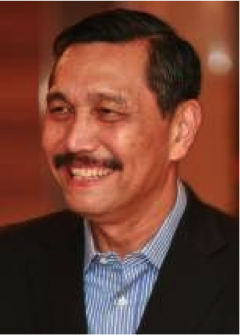
Since its formation in 2014, the administration of Indonesian President Joko Widodo (“Jokowi”) has faced opportunities and challenges in many sectors and on many issues: security and economy, terrorism and radicalism, maritime resources and incursions, not to mention foreign-policy dynamics with the US, China, and the rest of Southeast Asia. How has Indonesia responded to these chances and concerns? How will it manage them going forward? Few Indonesians are better equipped to address these questions than retired Brig. Gen. Pandjaitan, who has dealt with them daily since joining Jokowi’s administration in 2014 as the president’s chief of staff and in subsequent cabinet positions.
Image
Luhut Binsar Pandjaitan began his current ministership in July 2016 after serving as Coordinating Minister for Political, Legal, and Security Affairs in 2015-16. Earlier civilian positions include vice-chair of the Golkar Party’s advisory council (2008-2014); founding president of a resources company (2004-2014); trade and industry minister (2000-01); and ambassador to Singapore (1999-2000). His Indonesian army service dates back in time from an assignment as training and education commander (1997-99) through a series of leadership positions to his award as the best graduate of the army academy (1970). Other honors include Ernst & Young Entrepreneur of the Year (2011) and a national best coaching award related to his work on behalf of karate in Indonesia (2001-2010). In 1990-91 he studied in Washington DC at the National Defense University and George Washington University, earning an MPA from GWU (1991), and he is an alumnus of the Indonesia Army Staff College (1983).
As he explained during the recent Rosenkranz Prize Symposium, Stefano M. Bertozzi used this slogan to promote health reform in the Mexico City prison system. By encouraging inmates to step up and get themselves tested for HIV and other chronic illnesses, Bertozzi, dean and professor of health policy and management at the UC Berkeley School of Public Health, was able to decrease the spread of illnesses in Mexican prisons and the surrounding communities.
The Rosenkranz Prize Symposium celebrated research projects that—like Bertozzi’s—address the health care needs of the world’s most vulnerable populations. With support from the Rosenkranz Prize for Health Care Research in Developing Countries, Stanford scholars have stepped up to tackle health issues in regions in need.
Since 2010, the award has funded six young Stanford researchers who aim to improve health in developing countries. The symposium celebrated their achievements.
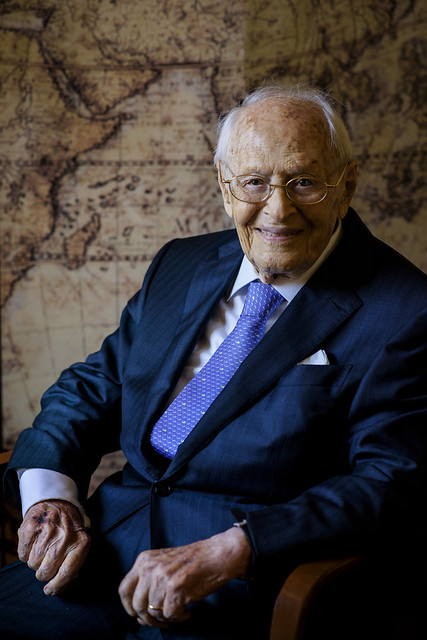
The award honors the work of Dr. George Rosenkranz who spent his career reducing health disparities around the globe. Rosenkranz, who was the first to synthesize cortisone and the active ingredient in the first oral contraceptive, also celebrated his 100th birthday at the symposium.
Producing research that will increase care for vulnerable populations globally is the ultimate goal of the Rosenkranz Prize.
Andrés Moreno-Estrada, the 2012 winner, has used the award to study genetics in Latin American and Caribbean populations, aiming to increase knowledge of potential genetic illnesses. He said, “The Rosenkranz Prize is a clear, important step forward to demonstrate that we can do cutting edge science in developing countries that is of international relevance.”
Other winners include Eran Bendavid, Sanjay Basu, Marcella Alsan, Jason Andrews and Ami Bhatt. Their projects range from the effect of AIDS relief efforts on health care delivery to the treatment of diabetes in India to low-cost diagnostic tools for regions lacking infrastructure.
“I can’t think of a better way to celebrate (my father’s) birthday than listening to the bright future of science,” said Ricardo T. Rosenkranz, son of Dr. George Rosenkranz and a prize donor. “We can’t wait to hear what the next Rosenkranz Prize winners tell us.”
Dr. George Rosenkranz celebrated his 100th birthday at the symposium. The first to synthesize cortisone as well as the active ingredient in the first oral contraceptive, Rosenkranz spent his life reducing health disparities around the globe. | Ryan Zhang
Sunil Khilnani’s new book, Incarnations, tells India’s history through 50 biographical essays, ranging from the Buddha to a contemporary billionaire. Building on rich recent scholarship about Indian history and culture, Khilnani’s work ventures to integrate the fragmented character of disciplinary knowledge of India, and to suggest an alternative to both popular religious and secular nationalist accounts of India’s past. Recovering the stories of remarkable individuals, his talk will highlight experiments in living and radical, dissenting ideas as drivers of Indian history, and contend that many of India’s choices about its future depend on which historical lessons get drawn from its past.
Speaker Bio:
Sunil Khilnani is currently Avantha Professor and Director of the India Institute, established by him at King’s College London in 2011. From 2002 to 2011 he was Starr Foundation Professor and Director of South Asia Studies at the Nitze School of Advanced International Studies, Johns Hopkins University, in Washington D.C.; and before that, Professor of Politics at Birkbeck College, University of London. He received his BA and PhD from the University of Cambridge, and he has been a Fellow of Christ’s College Cambridge; the Woodrow Wilson International Center for Scholars; the Institute for Advanced Study in Berlin; and the American Academy in Berlin, as well as holding a Leverhulme Fellowship.
His publications include: Arguing Revolution: The Intellectual Left in Postwar France (Yale, 1993), The Idea of India (Penguin/FSG, 7th edn. 2016), and several collaborative volumes, including: Civil Society: History and Possibilities (Cambridge, 2000); NonAlignment 2.0: a Foreign Policy for India in the 21st Century (Penguin, 2013); An Indian Social Democracy (Academic, 2013); and Comparative Constitutionalism in South Asia (Oxford, 2013). His most recent book is Incarnations: A History of India in Fifty Lives (Penguin/FSG 2016), accompanied by his 50-part BBC radio and podcast and radio series.
Sunil Khilnani
Avantha Professor and Director of the India Institute, King's College, London
By 2050, two out of three people will live in cities worldwide. The addition of 2.5 billion urban dwellers requires cities to accommodate the needs of a rapidly growing population. As Chinese and American cities confront environmental problems, housing costs, congestion, and widening social inequity, the Stanford Human Cities Initiative (HCI) works to address these urgent issues by advancing a human-centered approach to cities in order to benefit the environment, economy, and society at large.
The Stanford Human Cities Initiative is an interdisciplinary effort based out of the Program on Urban Studies. Recognizing that cities are complex, the HCI works to cultivate a 21st-century century mindset and tools to address urban challenges. Drawing from rigorous methods from engineering, architecture, planning, and design, its mission is to combine these approaches and enable cities to reach their full potential beyond the siloed approach of one discipline. The HCI works simultaneously at the global and local scales to ensure that these approaches are complementary, while prioritizing human relationships and social inclusion.
Join Deland Chan and Kevin Hsu, co-founders of the Stanford Human Cities Initiative, in a conversation about the future of cities. They will discuss the framing of the “human city” and the benefits of an interdisciplinary and multi-sector approach. Learn how you can get involved with the Initiative’s efforts to engage departments from within and outside Stanford, as well as partnerships with international NGOs, community-based organizations, and the private sector.
The talk will follow student presentations from the International Urbanization Seminar, a Human Cities course offered in long-term collaboration with Tsinghua University.
How do weak organizations engage in mobilization under duress? Based on ethnographic work inside labor organizations in China, this talk makes the case that in a repressive environment, civil society organizations can mobilize through a counter-intuitive mechanism. Instead of amassing the crowds to take to the streets, groups can mobilize without the masses. Rather than citizens forming groups in order to trigger larger-scale contention, they form groups in order to better contend as individuals or as small bands of the aggrieved. The clear advantage of this strategy is that it lowers the cost of activism in an authoritarian state. Because it is highly risky for civil society groups to organize large-scale contention, they must devise ways to work around this constraint. Civil society groups coach citizens to adopt a grammar of contention that effectively threatens local social stability and challenges the moral authority of officials. However, at the point of contention, these groups disperse. By sending out only a sole contender or a limited number of contenders to confront state authorities, organizations minimize their risk of being targeted by authorities.
Diana Fu is an assistant professor of Asian Politics at the University of Toronto. Her research examines the relationship between popular contention, state power, and civil society, with an emphasis on contemporary China. Her book manuscript, Mobilizing Without the Masses in China examines state control and civil society contention under authoritarian rule. Based on two years of ethnographic research that tracks the development of informal labor organizations, the book explores counterintuitive dynamics of organized contention in post-1989 China.
Prior to joining the Univeristy of Toronto, Professor Fu was a Walter H. Shorenstein Postdoctoral Fellow at the Shorenstein Asia-Pacific Research Center, Stanford University and a Predoctoral Fellow at the Massachusetts Institute of Technology, Political Science. She holds a D.Phil. in Politics and an M.Phil. in Development Studies with distinction from Oxford University, where she studied as a Rhodes Scholar.
Diana Fu
<i>Assistant Professor, Department of Political Science, University of Toronto</i>
China's government alternately appears in western scholarship as an idealized meritocracy or a corrupt cohort of venal officials. Yet empirical attempts to place China's government in comparative perspective are limited. We develop and exploit a new empirical source--survey testimony from political insiders--to measure three Weberian qualities of Chinese bureaucracy: meritocracy, autonomy, and morale. By translating questions from a major survey of U.S. officials, we place the responses of Chinese officials in comparative perspective. In contrast to claims that political connections dominate official promotions in China, Chinese bureaucrats are markedly more likely than U.S. bureaucrats to report that their agencies recruit people with the right skills and promote people based on performance. Responses from municipal governments in China resemble those of high-performing federal bureaucracies in the United States, such as NASA and the Nuclear Regulatory Commission. However, the Chinese advantage shrinks in autonomy and nearly disappears in workplace morale.
Speaker(s) Bio:
Image
Francis Fukuyama is the Olivier Nomellini Senior Fellow at the Freeman Spogli Institute for International Studies (FSI) and the Mosbacher Director of FSI's Center on Democracy, Development, and the Rule of Law (CDDRL). He is also a professor by courtesy in the Department of Political Science. He was previously at the Paul H. Nitze School of Advanced International Studies (SAIS) of Johns Hopkins University, where he was the Bernard L. Schwartz Professor of International Political Economy and director of SAIS' International Development program.
Image
Greg Distelhorst is the Mitsubishi Career Development Professor and an Assistant Professor of Global Economics and Management at the MIT Sloan School of Management. He studies contemporary Chinese politics and public policy, as well as the social impacts of multinational business. He was a CDDRL Predoctoral Fellow in 2012-2013.
Image
Margaret Boittin is Assistant Professor at Osgoode Hall Law School, York University, Canada. She studies Chinese law and politics. She was a predoctoral and postdoctoral fellow at CDDRL (2012-2015).
Encina Hall, C148
616 Jane Stanford Way
Stanford, CA 94305
0
f.fukuyama@stanford.edu
Olivier Nomellini Senior Fellow at the Freeman Spogli Institute for International Studies
Director of the Ford Dorsey Master's in International Policy
Research Affiliate at The Europe Center
Professor by Courtesy, Department of Political Science
yff-2021-14290_6500x4500_square.jpg
Francis Fukuyama is the Olivier Nomellini Senior Fellow at Stanford University's Freeman Spogli Institute for International Studies (FSI), and a faculty member of FSI's Center on Democracy, Development and the Rule of Law (CDDRL). He is also Director of Stanford's Ford Dorsey Master's in International Policy, and a professor (by courtesy) of Political Science.
Dr. Fukuyama has written widely on issues in development and international politics. His 1992 book, The End of History and the Last Man, has appeared in over twenty foreign editions. His book In the Realm of the Last Man: A Memoir will be published in fall 2026.
Francis Fukuyama received his B.A. from Cornell University in classics, and his Ph.D. from Harvard in Political Science. He was a member of the Political Science Department of the RAND Corporation, and of the Policy Planning Staff of the US Department of State. From 1996-2000 he was Omer L. and Nancy Hirst Professor of Public Policy at the School of Public Policy at George Mason University, and from 2001-2010 he was Bernard L. Schwartz Professor of International Political Economy at the Paul H. Nitze School of Advanced International Studies, Johns Hopkins University. He served as a member of the President’s Council on Bioethics from 2001-2004. He is editor-in-chief of American Purpose, an online journal.
Dr. Fukuyama holds honorary doctorates from Connecticut College, Doane College, Doshisha University (Japan), Kansai University (Japan), Aarhus University (Denmark), the Pardee Rand Graduate School, and Adam Mickiewicz University (Poland). He is a non-resident fellow at the Carnegie Endowment for International Peace. He is a member of the Board of Trustees of the Rand Corporation, the Board of Trustees of Freedom House, and the Board of the Volcker Alliance. He is a fellow of the National Academy for Public Administration, a member of the American Political Science Association, and of the Council on Foreign Relations. He is married to Laura Holmgren and has three children.
(October 2025)
Global Populisms
A new project examining the global surge in populist movements and what it means for established democratic rules and institutions.
Encina Hall
616 Serra Street
Stanford, CA 94305-6055
0
gdistel@stanford.edu
Research Affiliate
Distelhorst_HS.jpg
Greg Distelhorst is a Ph.D. candidate in the MIT Department of Political Science and a predoctoral fellow at Stanford University's Center on Democracy, Development, and the Rule of Law. His dissertation addresses public accountability under authoritarian rule, focusing on official responsiveness and citizen activism in contemporary China. This work shows how citizens can marshal negative media coverage to discipline unelected officials, or "publicity-driven accountability." These findings result from two years of fieldwork in mainland China, including a survey experiment on tax and regulatory officials. A forthcoming second study measures the effects of citizen ethnic identity on government responsiveness in a national field experiment. His dissertation research has been funded by the U.S. Fulbright Program, the Boren Fellowship, and the National Science Foundation. A second area of research is labor governance under globalization, where he has examined private initiatives to improve working conditions in the global garment, toy, and electronics supply chains.
Encina Hall
616 Serra Street
Stanford, CA 94305-6055
0
The Governance Project Postdoctoral Fellow, 2013-15
Boittin_HS.jpg
Margaret Boittin has a JD from Stanford, and is completing her PhD in Political Science at UC Berkeley. Her dissertation is on the regulation of prostitution in China. She is also conducting research on criminal law policy and local enforcement in the United States, and human trafficking in Nepal.
The Governance Project Postdoctoral Fellow, 2013-15
Japan and South Korea face serious demographic crises. Japan has the oldest population in the world and South Korea is one of the most rapidly aging. Together they top the list in terms of proportion of elderly by 2050, with 40.1% and 35.9% respectively being 65 and over, according to a U.S. Census Bureau forecast. Both nations are seeing shrinking working-age populations, with their birthrates among the lowest in the world. This puts them at great risk as they struggle to find new engines of economic growth.
Some experts argue that Japan and South Korea should encourage immigration. The former head of Tokyo's Immigration Bureau, Hidenori Sakanaka, said that "we need an immigration revolution to bring in 10 million people in the next 50 years, otherwise the Japanese economy will collapse." Jongryn Mo, a professor at Yonsei University in Seoul has written a book, "Strong Immigration Nation," urging a similar policy for South Korea.
Is migration the answer?
Japan and South Korea are already supplementing their shrinking workforce with foreign labor, mostly unskilled migrant workers from China and Southeast Asia doing jobs that locals shun.
But it is time to attract more skilled workers. In Japan, only 18.4% of foreign workers were technicians or professionals in 2015, while the figure in Korea is just 7.8% this year. Skilled foreign workers can fill many jobs from staffing hospitals to working as technicians in middle-tier companies and software engineers in large ones.
The challenge, however, is that both countries remain exclusionary, closed societies despite a substantial rise in the numbers of foreigners. Politicians fear losing votes from workers worried about foreigners taking their jobs.
According to a recent report by the French business school INSEAD, Japan and South Korea are ranked 53rd and 61st, respectively in their level of tolerance for immigrants. Most foreign skilled workers have little intention to settle down in Japan or South Korea on a permanent basis, although unskilled ones might be more willing to stay.
Maria, a Guatemalan professional, decided to leave South Korea after working for six years in the overseas marketing department of a large Korean corporation. "Some Koreans complain that foreigners leave after a few years, but we leave because we're never included in the first place. Korean companies pay a lot to bring foreigners here. And then they don't even ask these people about their opinion."
Srey, a Cambodian student studying in Japan, said, "The Japanese are very helpful and very friendly, but at the same time they look at me as a 'gaijin' no matter how good I am at Japanese or able to speak to them. I am not planning to work in Japan."
Bridging strategy
South Korea and Japan need to find a more creative strategy in utilizing foreign talent. In particular, they should pay close attention to their transnational networks rather than pushing for permanent migration. Not only should both countries focus on the knowledge and skills of foreign labor talent, but also the social networks they can possess.
This calls for a particular type of social capital: transnational bridging. A person who has social ties in more than one place can serve as a bridge between those different places. Such bridging can be performed within a city or a country or across borders, but the latter is becoming more important with globalization. By bridging distant networks, people can connect disparate cultures, build trust and facilitate cross-national cooperation that are essential in business transactions. Many Indian and Chinese entrepreneurs and engineers working in Silicon Valley are active in transnational bridging with their home country.
Transnational bridging can be a good new strategy for South Korea and Japan in attracting foreign skilled labor since they can offer valuable experiences and networks as advanced economies, if not permanent places to live. They can help foreign talent to build social ties while studying and working and encourage them to serve as a bridge between South Korea and Japan and their next destination once they leave in what could be called "brain linkage."
They can still contribute to South Korea or Japan even after they depart. Maria said she was willing to do business involving both South Korea and her home country. Srey is also eager to do business with Japan after graduating, even though he will not work in the country.
South Korea and Japan should adopt a policy of "Study-Work-Bridge" rather than the "Study-Work-Migration" pathway commonly encouraged by settler societies. This new policy framework would establish programs providing systematic networking opportunities for skilled foreigners while in Japan or South Korea. It would upgrade the quality of campus life for foreign students and work environments for foreign professionals so they leave with positive experiences.
Most importantly, it would provide institutional support to help maintain transnational networks between foreigners and South Koreans and Japanese.
In Japan, a Study-Work framework has already begun to take shape. Among foreign students seeking employment in Japan in 2013, approximately 24% found jobs. According to the country's ministry of justice, 10,696 of 11,698 foreign students are successful in applying for a change of visa status after graduating from college. This is very encouraging. Still, foreign students feel that Japanese companies are reluctant to embrace their full potential and largely expect them to assimilate, often leading them to stay in Japan only for a short time.
In South Korea, with a shorter history of foreign student intake, a Study-Work framework has yet to emerge. While 64.3% of South Korean companies say they need and want to hire foreign students, only a very small portion of foreign students work in South Korean companies after graduation, perhaps as low as 1%. South Korea's immigration laws for foreign students have eased slightly in recent years, but there is an urgent need to develop solid, institutionalized support for responding to the substantial demand by foreign students who wish to find employment after their studies.
Challenges ahead
Both countries are moving in the right direction, but until they are ready to embrace a more comprehensive migration policy down the road, they should develop the "bridging" component of a Study-Work-Bridge framework as an interim strategy. That means considering how foreign skilled labor can contribute to their economies even if they stay only temporarily.
This non-migration-bridging concept can be also appealing to foreign workers who like to move on after gaining valuable experiences and networks. By activating the social networks they have left behind, foreigners can later become powerful "transnational bridges." With economic globalization, such linkages will be all the more important.
Research shows that science and engineering majors may have more to contribute as human capital, but business and social science majors are more inclined to play a bridging role. Universities and corporations should establish diversity offices, as seen in the U.S. and elsewhere, to promote a culture of tolerance and non-discrimination.
The challenges associated with aging, depopulation and a shrinking workforce are expected to intensify in the coming years. Yet foreign talent is readily at hand for both countries. They need to look no further than the skilled foreigners who already have connections with South Korea or Japan either through schooling or employment and to continue to cultivate such connections through a Study-Work-Bridge approach.
The sixteenth session of the Korea-U.S. West Coast Strategic Forum, held at Stanford University on June 28, 2016, convened senior South Korean and American policymakers, scholars and regional experts to discuss North Korea policy and recent developments on the Korean Peninsula. Hosted by the Korea Program at the Walter H. Shorenstein Asia-Pacific Research Center at Stanford University, the Forum is also supported by the Sejong Institute.
Three-time U.S. Ambassador (Korea, Philippines, Tunisia), former North Korea Special Envoy, and Fletcher School Dean Emeritus, Stephen Bosworth, was the 2014 Payne Distinguished Lecturer at the Freeman Spogli Institute for International Studies, Stanford University. During his Stanford appointment, he gave three lectures, drawing lessons from his own diplomatic career, examining efforts to deal with North Korea’s nuclear ambitions, and discussing the role of U.S. alliances in Asia. Ambassador Bosworth also actively engaged with students and colleagues throughout the Stanford community, sharing his wisdom, wit, and experience. We mourn his passing earlier this year.
The panel, all of whom knew and worked closely with Ambassador Bosworth – and in who succeeded him in several of his postings – will carry forward a discussion of the themes from Bosworth’s Payne lectures, including the challenges facing U.S. diplomacy, particularly in East Asia, and how to address them.
Panelists:
Ambassador Sung Kim
U.S. Special Envoy for North Korea
Former U.S. Ambassador to Republic of Korea
Ambassador-designate to Philippines
Ambassador Michael Armacost
Former U.S. Ambassador to Japan and Philippines
Ambassador Kathleen Stephens
Former U.S. Ambassador to Republic of Korea
Ambassador Bosworth’s Payne Lecture transcripts are available for free download from ourwebsite
This event has reached capacity. Please join us to watch the live-stream at this link.
The symposium will focus on the key questions that impact health through the year 2020. How could the 2016 election affect health care in the U.S.? How will payment reform affect health systems, physicians and patients? Are the insurance exchanges viable? What challenges pose the biggest threat to global health? Experts from Stanford and beyond address these topics and more as they discuss the future of health policy.
Lloyd Minor, Dean, Stanford University School of Medicine
Image
Minor, MD, is a scientist, surgeon and academic leader. He is the Carl and Elizabeth Naumann Dean of the Stanford University School of Medicine, a position he has held since December 2012. Minor leads more than 1,500 faculty and 1,000 students at the oldest medical school in the West and has made precision health — the prevention of disease before it strikes — a hallmark of research, education and patient care at Stanford Medicine.
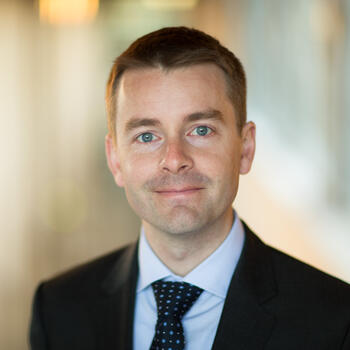
Bob Kocher,a partner at the Silicon Valley venture capital firm, Venrock
Bob Kocher
Kocher, MD, is a partner at Venrock who focuses on healthcare IT and services investments and is a consulting professor at Stanford University School of Medicine. He served in the Obama Administration as special assistant to the president for health care and economic policy and was one of the key shapers of the Affordable Care Act.
David Entwistle, President and CEO, Stanford Health Care
Image
Entwistle joined Stanford Health Care as its President and CEO in July, bringing extensive executive experience at leading academic medical centers. Most recently he served as CEO of the University of Utah Hospitals & Clinics, the only academic medical center in the Intermountain West region. While serving at UUHC, Entwistle received the Modern Healthcare “Up and Comers Award,” for significant contributions in health-care administration, management or policy.
Chris Dawes, President and CEO, Lucile Packard Children’s Hospital
Image
Christopher G. Dawes became President and Chief Executive Officer of Lucile Packard Children’s Hospital Stanford in 1997 after five years of service as Chief Operating Officer. Under his guidance, the hospital, research center and regional medical network has been ranked as one of the best in the nation, as an industry leader in patient safety and innovation in providing a full complement of services for children and expectant mothers.
Panelists:
Marcella Alsan, Assistant Professor of Medicine, Stanford University
Marcella Alsan’s research focuses on the relationship between health and socioeconomic disparities with a focus on infectious disease. Another vein of research focuses on the microfoundations of antibiotic overuse and resistance. She received a BA degree in cognitive neuroscience from Harvard University, a master’s degree in international public health from Harvard School of Public Health, a medical degree from Loyola University, and a PhD in economics from Harvard University. She is board-certified in both internal medicine and infectious disease. She trained at Brigham and Women’s Hospital, completing the Hiatt Global Health Equity Residency Fellowship in internal medicine. She combined her PhD with an Infectious Disease Fellowship at Massachusetts General Hospital. She currently is an infectious disease specialist at the Department of Veterans Affairs, Palo Alto.
Laurence Baker, Chair of Health Research and Policy, Stanford University
Laurence Baker is an economist interested in the organization and economic performance of the U.S. health-care system, and his research has investigated a range of topics including financial incentives in health care, competition in health-care markets, health insurance and managed care and health-care technology adoption. Baker is a past recipient of the ASHE medal from ASHEcon and the Alice Hersch Award from AcademyHealth. He received his BA from Calvin College, and his MA and PhD in economics from Princeton University.
Eran Bendavid, Assistant Professor of Medicine, Stanford University
Eran Bendavid is an infectious diseases physician. His research interests involve understanding the relationship between policies and health outcomes in developing countries. He explores how decisions about foreign assistance for health are made, and how those decisions affect the health of those whom assistance aims to serve. Dr. Bendavid is also a disease modeler, and uses that skill to explore issues of resource allocation in low and middle-income countries with cost-effectiveness analyses. His recent research projects include an impact evaluation of the US assistance program for HIV in Africa, and an exploration of the association between drug prices, aid and health outcomes in countries heavily affected by HIV.
Jay Bhattacharya, Professor of Medicine, Stanford University
Jay Bhattacharya’s research focuses on the constraints that vulnerable populations face in making decisions that affect their health status, as well as the effects of government policies and programs designed to benefit vulnerable populations. He has published empirical economics and health services research on the elderly, adolescents, HIV/AIDS and managed care. Most recently, he has researched the regulation of the viatical-settlements market (a secondary life-insurance market that often targets HIV patients) and summer/winter differences in nutritional outcomes for low-income American families. He is also working on a project examining the labor-market conditions that help determine why some U.S. employers do not provide health insurance.
M. Kate Bundorf, Associate Professor of Medicine, Stanford University
M. Kate Bundorf is a Faculty Research Fellow at the National Bureau of Economic Research. She received her M.B.A. and M.P.H. degrees from The University of California at Berkeley and her Ph.D. from The Wharton School. She was a Fulbright Lecturer and Visiting Professor at Fudan School of Public Health in Shanghai, China in 2009 and 2010. Her research, which focuses on health insurance markets, has been published in leading economics and health policy journals and has received funding from the U.S. National Institutes of Health, the Agency for Health Care Research and Quality and the Robert Wood Johnson Foundation. She received the 13th Annual Health Care Research Award from The National Institute for Health Care Management in 2007.
David Chan, Assistant Professor of Medicine, Stanford University
David Chan is a physician and economist whose research focuses on productivity in US health care. His research draws on insights from labor and organizational economics. He is particularly interested in studying what drives physician behavior, how this explains differences in productivity in health care delivery, and what the implications are for the design of health care. He is the recipient of the 2014 NIH Director’s High-Risk, High-Reward Early Independence Award to study the optimal balance of information in health information technology for patient care. David Chan is also an investigator at the Department of Veterans Affairs and a Faculty Research Fellow at the National Bureau of Economic Research.
Kathryn M. McDonald, Executive Director of the Center for Health Policy and the Center for Primary Care and Outcomes Research, Stanford University
Kathryn McDonald, MM, is the Executive Director of the Center for Health Policy (CHP) and Center for Primary Care and Outcomes Research (PCOR) and a senior scholar at the Centers. She is also Associate Director of the Stanford-UCSF Evidence-based Practice Center (under RAND). Her work focuses on measures and interventions to achieve evidence-based patient-centered healthcare quality and patient safety. Mrs. McDonald has served as a project director and principal investigator on a number of research projects at the Stanford School of Medicine, including the development and ongoing enhancement of the Quality and Patient Safety Indicators for the Agency for Healthcare Research and Quality. She has authored numerous peer reviewed articles and government reports, including several with wide enough followership to merit recent updates: Care Coordination Measures Atlas, Closing the Quality Gap, and Patient Safety Practices.
Michelle Mello, Professor of Law and of Health Research and Policy, Stanford University
Michelle Mello is Professor of Law at Stanford Law School and Professor of Health Research and Policy at Stanford University School of Medicine. She conducts empirical research into issues at the intersection of law, ethics, and health policy. She is the author of more than 150 articles and book chapters on the medical malpractice system, medical errors and patient safety, public health law, research ethics, the obesity epidemic, pharmaceuticals, and other topics. From 2000 to 2014, Dr. Mello was a professor at the Harvard School of Public Health, where she directed the School’s Program in Law and Public Health. In 2013-14 she completed a Lab Fellowship at Harvard University’s Edmond J. Safra Center for Ethics. Dr. Mello teaches courses in torts and public health law. She holds a J.D. from the Yale Law School, a Ph.D. in Health Policy and Administration from the University of North Carolina at Chapel Hill, an M.Phil. from Oxford University, where she was a Marshall Scholar, and a B.A. from Stanford University. In 2013, she was elected to the National Academy of Medicine (formerly known as the Institute of Medicine).
Grant Miller, Associate Professor of Medicine, Stanford University
Grant Miller is Director of the Stanford Center for International Development, an Associate Professor of Medicine at the Stanford University School of Medicine, a Core Faculty Member at the Center for Health Policy/Primary Care and Outcomes Research, a Senior Fellow at the Freeman Spogli Institute for International Studies (FSI) and the Stanford Institute for Economic Policy Research (SIEPR), and a Research Associate at the National Bureau of Economic Research (NBER). His primary interests are health economics, development economics, and economic demography. As a health and development economist based at the Stanford Medical School, Dr. Miller’s overarching focus is research and teaching aimed at developing more effective health improvement strategies for developing countries. His agenda addresses three major interrelated themes. (1) First, what are the major causes of population health improvement around the world and over time? (2) Second, what are the behavioral underpinnings of the major determinants of population health improvement? (3) Third, how can programs and policies use these behavioral insights to improve population health more effectively?
Douglas K. Owens, Director of the Center for Health Policy and the Center for Primary Care and Outcomes Research, Stanford University
Douglas K. Owens, MD, MS, is the Henry J. Kaiser, Jr., Professor at Stanford University, where he is a professor of medicine. He is director of the Center for Health Policy in the Freeman Spogli Institute for International Studies and director of the Center for Primary Care and Outcomes Research (PCOR) in the Department of Medicine. He is a general internist and associate director of the Center for Innovation to Implementation at the Veterans Affairs Palo Alto Health Care System. A past member of the U.S. Preventive Services Task Force, he has helped lead the development of national U.S. guidelines on screening for HIV, hepatitis C, hepatitis B, lung cancer, colorectal cancer, breast cancer, and use of aspirin and statins to prevent cardiovascular disease.
Maria Polyakova, Assistant Professor of Health Research and Policy, Stanford University
Maria Polyakova, PhD, is an Assistant Professor of Health Research and Policy at the Stanford University School of Medicine. Her research investigates questions surrounding the role of government in the design and financing of health insurance systems. She is especially interested in the relationships between public policies and individuals’ decision-making in health care and health insurance, as well as in the risk protection and re-distributive aspects of health insurance systems. She received a BA degree in Economics and Mathematics from Yale University and a PhD in Economics from MIT.
David M. Studdert, Professor of Medicine and of Law, Stanford University
David M. Studdert is a leading expert in the fields of health law and empirical legal research. His scholarship explores how the legal system influences the health and well-being of populations. A prolific scholar, he has authored more than 150 articles and book chapters, and his work appears frequently in leading international medical, law and health policy publications. Professor Studdert has received the Alice S. Hersh New Investigator Award from AcademyHealth, the leading organization for health services and health policy research in the United States. He was awarded a Federation Fellowship (2006) and a Laureate Fellowship (2011) by the Australian Research Council. He holds a law degree from University of Melbourne and a doctoral degree in health policy and public health from the Harvard School of Public Health.






 Bob Kocher

