U.S. National Security Advisor Susan Rice '86 will give a special public lecture at the Freeman Spogli Institute on Climate Change and National Security.
Doors open at 4:00pm. Space is limited.
Susan Rice
U.S. National Security Advisor
U.S. National Security Advisor
Encina Hall
616 Serra Street
Stanford, CA 94305-6165
(650) 724-9217
(650) 723-0089
0
sj1874@stanford.edu
66b3d82b-4420-408a-a353-979aad60f276_1_201_a.jpeg
Shannon Johnson earned a masters from Stanford's Liberal Arts program, with a thesis entitled "'We were all White once': Race, Polygamy, and the Salvific Mormon Family." Her BA from Brigham Young University is in English literature; she wrote an honors thesis there on "Emily Dickinson: Transcendental Trinitarian." She worked in admin at Columbia University and as an English teacher in Japan and Egypt before taking time away to raise four children. Shannon has been at The Europe Center since 2014, and joined the staff at the Center on Democracy, Development and the Rule of Law in 2020.
The fate of a soldier serving in the Russian army in the First World War largely depended on luck and circumstances. But even though his own means of influencing his fate were limited, there were available certain active choices – such as shirking and desertion – that could turn his life around in both positive and negative ways. For Russian civil and military authorities, of course, desertion was a nuisance that was fought against by all available means. Sometimes, such as with physical punishment, these means only succeeded in lowering the already low morale and increasing the number of deserters.
Dr. Mart Kuldkepp's presentation will focus on a small and somewhat exceptional group of deserters from the Russian army: the soldiers who served in the border guard regiments in Northern Finland and deserted alone or in small groups over the border to neutral Sweden. He will consider their motivation in doing so, and their subsequent fate, as much as it is known. At the same time, he will also look at how Sweden administratively handled this very unforeseen phenomenon and how the deserters were treated by Swedish authorities.
Mart Kuldkepp completed his PhD dissertation at University of Tartu, Estonia, in 2014 and joined University College London in 2015. Dr. Kuldkepp has been active as an academic in the field of Scandinavian Studies since 2007. Dr. Kuldkepp’s primary research focus is on 20th century Scandinavian political history, with a particular interest in contacts between the Scandinavian and the Baltic states, but also has interest in the history of secret services and espionage and Old Norse-Icelandic literature and culture. His teaching has mostly concerned the history of Scandinavian culture, society, and politics from the earliest times up to today. He has taught subjects related to Old Norse studies and overview courses in humanities.
Organized by the Center for Russian, East European and Eurasian Studies and co-sponsored by The Europe Center and Stanford University Libraries
Mart Kuldkepp
Lecturer
Speaker
Scandinavian Studies, University College London
This is the second meeting of the workshop series on Civility, Cruelty, Truth. A one-day event hosted by the Stanford Humanities Center, the workshop will explore the genealogies, promises, and limits of civic virtue—at the heart of which is the city, the classical polis, itself— as a universal ideal. European in its moral contours, constituted by a deep fascination with the rule of law, borders, and security, at once coercive and oblique in whom it excludes and includes, how it punishes and protects, the city held out the promise of a humane center for ethical and sovereign life, one upon which anticolonial struggles against European empires too were first conceived and mounted. This workshop will examine the ambiguous foundations and resolutions of that vision in Asia, Europe, and the fatal waters in between; a vision that has come to be marked today by extreme violence and tragic displacements, and which now presses new questions against the very limit of modern political imagination.
Student Assistant: Ahoo Najafian (Department of Religious Studies)
Schedule (coming soon)
Co-sponsored by the Department of History, Department of Religious Studies, The Europe Center, The France- Stanford Center for interdisciplinary Studies, Program in Global Justice, McCoy Family Center for Ethics in Society, Stanford Global Studies, School of Humanities and Sciences, Stanford Humanities Center, Center for South Asia
In a recent piece in Stanford News, FSI Senior Fellow Larry Diamond expresses his thoughts on the ebbing of global democratic expansion, highlighting that not all countries have equal opportunities at achieving democracy and that democratic change should be approached multilaterally.
Hero Image
Larry Diamond speaks on his new book "In Search of Democracy," at the National Endowment for Democracy (NED) in Washington, D.C. | National Endowment for Democracy
**Reservations for this event is closed** We are at capacity and cannot accept further reservations.
Twenty-four years ago the Soviet Union collapsed. Since then, Russia has been transformed in many dimensions but it is difficult to describe the country today. According to its Constitution, Russia is a democratic republic and federation, but modern Russia looks more like an absolute monarchy. The Russian economy is dominated by state corporations, the oligarchs of the 90's, and the cronies of the 2000’s. The economy has been in recession for more than a year and hasn’t exhibited any signs of recovery. Is the country stable? Can it face its governance and economic challenges? Can we forecast the medium-term future of the Russian economy? Could the economy collapse?
Sergey Aleksashenko is a Senior Fellow at the Development Center (a Moscow-based think tank) and Nonresident Senior fellow at the Brookings Institution. Since graduating Moscow State University in 1986, he has been involved in academia, the public sector, and in business. From 1990-1991 he was appointed to the Commission on Economic reforms of the Government of the USSR as one of the "500 days" plan members. In 1993-1995 he worked as deputy Minister of Finance of Russia in charge of budgetary planning, macroeconomic, and tax policy. From 1995-1998 he was responsible for monetary policy as the first deputy Governor of the Central bank of Russia. From 2000 to 2004 he was the deputy CEO of the Interros Holding where he lead the strategy and business development teams. In 2006-2008 he was the Chairman and CEO of Merrill Lynch Russia, the largest financial institution in Moscow, where he greatly increased the bank's scope and presence. Before the financial crisis of 2008, he returned to academia and became the Director of Macroeconomic Research at the Higher School of Economics in Moscow. At the same time, he sat on the boards of Aeroflot, United Grain company, United Aircraft Corporation, and the National Reserve bank. At the end of 2012 he faced political persecution and in September 2013 he left Russia for Washington D.C. where he currently resides.
Sergey Aleksashenko
Former Deputy Chairman of the Russian Central Bank
Encina Commons,
615 Crothers Way Room 182,
Stanford, California 94305-6006
(650) 498-7528
0
maria.polyakova@stanford.edu
Associate Professor, Health Policy
MS in Health Policy Program Director
maria_4_-_copy.jpg
PhD
Maria Polyakova, PhD, is Associate Professor of Health Policy at Stanford School of Medicine and Associate Professor (by courtesy) in the Department of Economics at Stanford University, where she is also a Senior Fellow at the Stanford Institute for Economic Policy Research (SIEPR). She is a Research Associate at the National Bureau of Economic Research (NBER) and serves as an Editor of the Journal of Health Economics. Her research spans many areas of health economics, including health insurance, healthcare labor markets, and individual decision-making in health and healthcare. A unifying thread is evaluating whether markets and government policy effectively serve individuals and families or introduce distortions. Her ongoing work focuses on how families navigate prolonged health shocks. Maria received her BA in Economics & Mathematics and German Studies (with a concentration in History) from Yale University in 2008 and her PhD in Economics from MIT in 2014.
The Pussy Riot protest, and the subsequent heavy handed treatment of the protestors, grabbed the headlines, but this was not an isolated instance of art being noticeably critical of the regime. As this book, based on extensive original research, shows, there has been gradually emerging over recent decades a significant counter-culture in the art world which satirises and ridicules the regime and the values it represents, at the same time putting forward, through art, alternative values. The book traces the development of art and protest in recent decades, discusses how art of this kind engages in political and social protest, and provides many illustrations as examples of art as protest. The book concludes by discussing how important art has been in facilitating new social values and in prompting political protests.
Lena Jonson is Associate Research Fellow at UI. Her research currently focuses on Russian domestic politics and issues of political and societal change (modernisation) as well as the contemporary role of culture and its standing in Russia.
Lena Jonson has published several articles and works examining Russian society and politics (mainly foreign and security policy), Russia's relations with Europe and Russian relations with the former Soviet territories. She has also published widely on Central Asia, and on Tajikistan in particular.
Lena Jonson is one of the founders of the network "Sällskapet för studier av Ryssland, Central-och Östeuropa samt Centralasien" (1997) and was its first chairperson. She has been a guest researcher at George Washington University and the Kennan Institute at the Wilson Centre, as well as a scholarship recipient at the universities of (then) Leningrad and Moscow. From 2005-2009, she served as Cultural Attaché at the Swedish Embassy in Moscow. In 2002, she worked as a Political Officer at the OSCE-office i Dushanbe, Tajikistan. In 1997-1998, she was a Senior Researcher at the Royal Institute of International Affairs in London.
Sponsored by the Center for Russian, East European and Eurasian Studies and co-sponsored by The Europe Center.
Lena Jonson
Associate Research Fellow
Speaker
Swedish Institute of International Affairs (UI)
This event is now full, and we are unable to accept any further RSVPs. Please email khaley@stanford.edu if you would like to be added to a wait list.
Russia's aggressive foreign policy is backed by Putin's domestic popularity ratings and his strong grip on Russia's political system. But in reality, how firmly does Putin control Russian politics? Can the ongoing economic crisis in Russia pose challenges to his system and the upcoming federal elections of 2016-2018? What impact will Russian domestic politics play in Russia's international behavior?
Vladimir Milov is a Russian opposition politician, publicist, economist & energy expert. He was the Deputy Minister of Energy of Russia (2002), adviser to the Minister of Energy (2001-2002), and head of strategy department at the Federal Energy Commission, the natural monopoly regulator (1999-2001). Milov is the author of major energy reform concepts, including the concept of market restructuring and unbundling of Gazprom, which was banned from implementation by President Vladimir Putin. He is the founder and president of the Institute of Energy Policy, a leading independent Russian energy policy think tank (since 2003). Milov is a columnist of major Russian political and business publications, including Forbes Russia, and a frequent commentator on Russian political and economic affairs in major Western media outlets (The New York Times, The Financial Times, The Washington Post, The Economist, etc.). Since leaving the Russian Government in 2002, Milov has became a vocal public critic of Vladimir Putin’s dirigiste and authoritarian course. Milov is also active in the Russian opposition politics, serving as Chairman of the “Democratic Choice” opposition party (www.en.demvybor.ru), and is also known as co-author of the critical public report on Vladimir Putin’s Presidential legacy called “Putin. The Results”, written together with Boris Nemtsov (several editions published since 2008).
Vladimir Milov
former Russian Deputy Minister of Energy
Speaker
New President of the United States Institute of Peace, Nancy Lindborg, will discuss the global challenge of fragility and conflict, including a vision of the way forward. Ms. Lindborg’s remarks reflect a lifetime of working in the world’s most fragile regions and a time when the global humanitarian system is at a breaking point, with record numbers of people forcibly displaced globally.
Speaker Bio
Nancy Lindborg
Nancy Lindborg has served since February, 2015, as President of the United States Institute of Peace, an independent institution founded by Congress to provide practical solutions for preventing and resolving violent conflict around the world.
Ms. Lindborg has spent most of her career working in fragile and conflict affected regions around the world. Prior to joining USIP, she served as the Assistant Administrator for the Bureau for Democracy, Conflict and Humanitarian Assistance (DCHA) at USAID. From 2010 through early 2015, Ms. Lindborg led USAID teams focused on building resilience and democracy, managing and mitigating conflict and providing urgent humanitarian assistance. Ms. Lindborg led DCHA teams in response to the ongoing Syria Crisis, the droughts in Sahel and Horn of Africa, the Arab Spring, the Ebola response and numerous other global crises.
Prior to joining USAID, Ms. Lindborg was president of Mercy Corps, where she spent 14 years helping to grow the organization into a globally respected organization known for innovative programs in the most challenging environments. She started her international career working overseas in Kazakhstan and Nepal.
Ms. Lindborg has held a number of leadership and board positions including serving as co-president of the Board of Directors for the U.S. Global Leadership Coalition; co-founder and board member of the National Committee on North Korea; and chair of the Sphere Management Committee. She is a member of Council on Foreign Relations.
She holds a B.A and M.A. in English Literature from Stanford University and an M.A. in Public Administration from the John F. Kennedy School of Government at Harvard University.
Nancy Lindborg
President of the United States Institute of Peace
President of the United States Institute of Peace


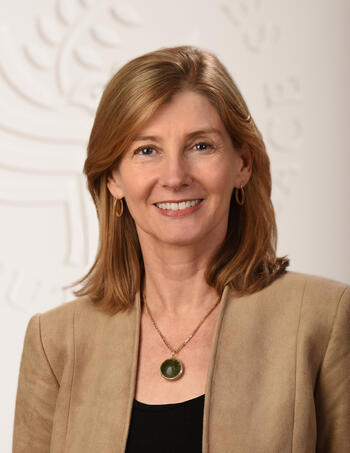 Nancy Lindborg