Technology
Paragraphs
Cover of book "Drivers of Innovation"

Innovation and entrepreneurship rank highly on the strategic agenda of most countries today. As global economic competition intensifies, many national policymakers now recognize the central importance of entrepreneurship education and the building of financial institutions to promote long-term innovation, entrepreneurship, and economic growth. Drivers of Innovation brings together scholars from the United States and Asia to explore those education and finance policies that might be conducive to accelerating innovation and developing a more entrepreneurial workforce in East Asia. 

Some of the questions covered include: How do universities in China and Singapore experiment with new types of learning in their quest to promote innovation and entrepreneurship? Is there a need to transform the traditional university into an “entrepreneurial university”? What are the recent developments in and outstanding challenges to financing innovation in China and Japan? What is the government’s role in promoting innovative entrepreneurship under the shadow of big business in South Korea? What can we learn about the capacity of services to drive innovation-led growth in India? 

Drivers of Innovation will serve as a valuable reference for scholars and policymakers working to develop human capital for innovation in Asia.

Contents

  1. Educating Entrepreneurs and Financing Innovation in Asia 
    Fei Yan, Yong Suk Lee, Lin William Cong, Charles Eesley, and Charles Lee
  2. Fostering Entrepreneurship and Innovation: Education, Human Capital, and the Institutional Environment 
    Charles Eesley, Lijie Zhou, and You (Willow) Wu
  3. Entrepreneurial Scaling Strategy: Managerial and Policy Considerations 
    David H. Hsu
  4. Innovation Policy and Star Scientists in Japan 
    Tatsuo Sasaki, Hiromi S. Nagane, Yuta Fukudome, and Kanetaka Maki
  5. Financing Innovation in Japan: Challenges and Recent Progress 
    Takeo Hoshi and Kenji Kushida
  6. Promoting Entrepreneurship under the Shadow of Big Business in Korea: The Role of the Government 
    Hicheon Kim, Dohyeon Kim, and He Soung Ahn
  7. The Creativity and Labor Market Performance of Korean College Graduates: Implications for Human Capital Policy 
    Jin-Yeong Kim
  8. Financing Innovative Enterprises in China: A Public Policy Perspective 
    Lin William Cong, Charles M. C. Lee, Yuanyu Qu, and Tao She
  9. Forging Entrepreneurship in Asia: A Comparative Study of Tsinghua University and the National University of Singapore 
    Zhou Zhong, Fei Yan, and Chao Zhang
  10. Education and Human Capital for Innovation in India’s Service Sector 
    Rafiq Dossani
  11. In Need of a Big Bang: Toward a Merit-Based System for Government-Sponsored Research in India 
    Dinsha Mistree
  12. The Implications of AI for Business and Education, and Singapore’s Policy Response 
    Mohan Kankanhalli and Bernard Yeung


All Publications button
1
Publication Type
Books
Publication Date
Subtitle

Entrepreneurship, Education, and Finance in Asia

Authors
Yong Suk Lee
Fei Yan
Book Publisher
Shorenstein APARC
-

Please note the event time has been changed to 10:30AM (PT) to 12:00PM (PT).


This is a virtual event. Please click here to register for the talk. 


This event is presented in partnership with Global:SF and the State of California Governor’s Office of Business and Economic Development.
 

U.S.-China economic relations have grown increasingly fraught and competitive.  Even amidst intensifying tensions, however, our two major economies remain intertwined.  While keeping alert to national security concerns, the economic strength of the United States will depend on brokering a productive competition with China, the world’s fastest growing economy.  Precipitous decoupling of trade, investment, and human talent flows between the two nations will inflict unnecessary harm to U.S. economic interests -- and those of California.  

Chinese trade and investments into California have grown exponentially over the last decade.  But they have come under increasing pressure following geopolitical and economic tensions between the two nations, particularly in the science and technology sectors.  This session will explore the role of Chinese economic activity in California in the context of the greater US-Chinese relationship. 


Portrait of Ambassador Craig AllenCraig Allen began his tenure in Washington, DC, as the sixth President of the United States-China Business Council, a private, nonpartisan, nonprofit organization representing over 200 American companies doing business with China. Ambassador Allen began his government career in 1985 at the Department of Commerce’s International Trade Administration (ITA) where, from 1986 to 1988, he worked as an international economist in ITA’s China Office. In 1988, Allen transferred to the American Institute in Taiwan, where he served as Director of the American Trade Center in Taipei. He returned to the Department of Commerce for a three-year posting at the US Embassy in Beijing as Commercial Attaché in 1992. In 1995, Allen was assigned to the US Embassy in Tokyo where he was promoted to Deputy Senior Commercial Officer in 1998. Allen became a member of the Senior Foreign Service in 1999. Starting from 2000, he served a two-year tour at the National Center for APEC in Seattle where he worked on the APEC Summits in Brunei, China, and Mexico. In 2002, Allen first served as the Senior Commercial Officer in Beijing where he was later promoted to the Minister Counselor rank of the Senior Foreign Service. After a four-year tour in South Africa, Ambassador Allen became Deputy Assistant Secretary for Asia at the US Department of Commerce’s International Trade Administration. He later became Deputy Assistant Secretary for China. Ambassador Allen was sworn in as the United States ambassador to Brunei Darussalam on December 19, 2014 where he served until he transitioned to take up his position as President of the US-China Business Council.
 

Image
Portrait of David Cheng
David Cheng is the chair and managing partner of Nixon Peabody’s China and Asia-Pacific practice. He is qualified in both the United States and Hong Kong. He focuses on cross-border transactions, litigations and investigations, advising on issues ranging from acquisitions, capital financing (initial public offering), intellectual property protection and disputes to fraud, FCPA and SEC investigations. He has a client portfolio from all over the world, including the United States, Middle East, Europe, Japan, Singapore, Taiwan, mainland China and Hong Kong.
 

james greenJames Green has worked for over two decades on U.S.-Asia relations. For five years, Green was the Minister Counselor for Trade Affairs at the U.S. Embassy in Beijing (2013-2018).  As the senior official in China from the Office of the United States Trade Representative (USTR), Green was deeply involved in all aspects of trade negotiations, trade enforcement, and in reducing market access barriers for American entities.  In prior government service, Green worked on the Secretary of State’s Policy Planning Staff and at the State Department’s China Desk on bilateral affairs. He also served as the China Director of the White House’s National Security Council.  In the private sector, Green was a senior vice president at the global strategy firm founded by former Secretary of State Madeleine Albright and was the founding government relations manager at the American Chamber of Commerce in Shanghai, Asia’s largest AmCham.  Currently, Green is a Senior Research Fellow at Georgetown University's Initiative for U.S.-China Dialogue on Global Issues and hosts a U.S.-China Dialogue Podcast.  He was most recently named as APARC's inaugural China Policy Fellow
 

Image
Portrait of Anja Manuel
Anja Manuel is Co-Founder and Principal, along with former Secretary of State Condoleezza Rice, former National Security Advisor Stephen Hadley and former Secretary of Defense Robert Gates, in Rice, Hadley, Gates & Manuel LLC, a strategic consulting firm that helps US companies navigate international markets. She currently serves on two corporate boards: Overseas Shipping Group, Inc., a NYSE listed energy transportation company, and Ripple Labs Inc., a leading blockchain payments company. Manuel also serves on several advisory boards, including Former Governor Brown’s California Export Council. From 2005-2007, she served as an official at the U.S. Department of State, responsible for South Asia Policy. She is a frequent commentator on foreign policy and technology policy, for TV and radio (NBC/MSNBC, Fox Business, BBC, Bloomberg, Charlie Rose, NPR, etc.) and writes for publications ranging from the New York Times, to the Financial Times, Fortune, The Atlantic, and Newsweek, among others. She is the author of the critically acclaimed This Brave New World: India, China and the United States, published by Simon and Schuster in 2016. A graduate of Harvard Law School and Stanford University, Manuel now also lectures and is a Research Affiliate at Stanford University. She is the Director of the Aspen Strategy Group and Aspen Security Forum -- the premier bipartisan forum on foreign policy in the U.S. -- and is a member of the Council on Foreign Relations.


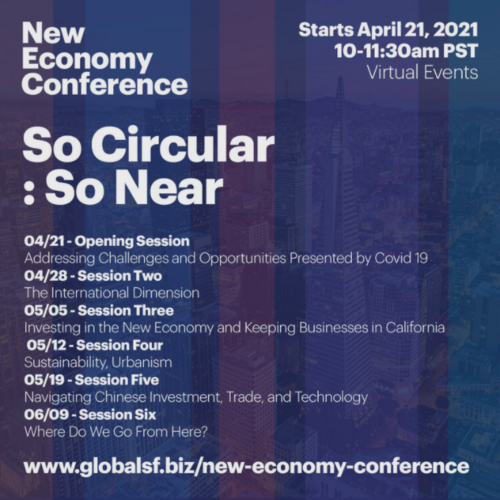
This Session is part of a larger conference series titled “The New Economy Conference – California’s Place in the New Global Economy”.   The New Economy Conference will broadcast public programs from April 21-May 25 on a weekly basis, designed to inform and identify the impact of COVID-19 on the economic competitiveness and resilience of the State of California.  Topics addressed will include Challenges and Opportunities Post-COVID in California (4/21); the International Dimension (4/28), Investing in the New Economy and Keeping Businesses in California (5/5); Sustainability and Urbanism (5/12); Navigating Chinese Investment, Trade and Technology (5/19); and Where do We Go from Here? (6/09).

 

Via Zoom Webinar. Register at: https://www.globalsf.biz/session-5-nec 

Amb. Craig Allen <br><i>President of US-China Business Council</i><br><br>
David K. Cheng <br><i>Chair and Managing Partner of China & Asia Pacific Practice, Nixon Peabody LLP</i><br><br>
James Green <br><i>Senior Research Fellow, Initiative for U.S.-China Dialogue on Global Issues, Georgetown University</i><br><br>
Anja Manuel <br><i>Co-Founder and Principal, Rice, Hadley, Gates & Manuel LLC</i><br><br>
Seminars
Authors
News Type
News
Date
Paragraphs

For many, the impact of the Black Lives Matter movement and the murders of George Floyd and too many other people of color was a wake-up call. “It was clear it was another moment in the long, terrible history of racial injustice in the U.S.,” said Paul N. Edwards, director of Stanford’s Science, Technology and Society program in the School of Humanities and Sciences. “Since STS is all about how societies interact with science, technology and medicine, I saw it as an important time to showcase how Black scholars, in particular, see and study issues of race.”

Read the rest at Stanford News

Hero Image
man with glasses smiling
Rod Searcey
All News button
1
Subtitle

A new three-quarter sequence of courses provides insights from scholars around the nation on research related to race in the fields of science, technology and medicine, as well as their own lived experiences.

Authors
Callista Wells
News Type
News
Date
Paragraphs

The China Program at Shorenstein APARC had the privilege of hosting Jude Blanchette, the Freeman Chair in China Studies at the Center for Strategic and International Studies (CSIS). The program, entitled "What’s ‘Communist’ about the Communist Party of China?," explored the goals and ideology of the Chinese Communist Party (CCP), as well as what they might mean for the future of China in the global community. Professor Jean Oi, William Haas Professor of Chinese Politics and director of the APARC China Program, moderated the event.

After the death of Mao Zedong in 1976, the goals of the CCP became less clear. As the country began to adopt market reforms in the 1980s and 1990s, CCP theorists were forced into contortions providing ideological justifications for policies that appeared overtly capitalist. Deng Xiaoping’s concept of “Socialism with Chinese characteristics” came to be seen as a theoretical fig leaf rather than a description of an egalitarian economic system, and by the 2000s, a consensus emerged that the CCP had completely abandoned any pretense of pursuing the Marxist vision it purported to hold. With the rise of Xi Jinping, however, the Party talks with renewed vigor about Marxism-Leninism and the goal of achieving actual, existing socialism. Has the CCP re-discovered communism?  In his talk, Blanchette discussed the abandoned and existing legacies of Mao Zedong, Marxism-Leninism, and the CCP’s vision of socialism. Watch now: 

Read More

Min Ye speaking
News

Domestic or International? The Belt and Road Initiative Is More Internally Focused Than We Think, Says Expert Min Ye

Domestic or International? The Belt and Road Initiative Is More Internally Focused Than We Think, Says Expert Min Ye
Banner of Hau L. Lee
News

The Pandemic, U.S.-China Tensions and Redesigning the Global Supply Chain

The Pandemic, U.S.-China Tensions and Redesigning the Global Supply Chain
American and Chinese flags
News

U.S.-China Relations in the Biden Era

Dr. Thomas Wright examines the recent history of US-China relations and what that might mean for the new administration.
U.S.-China Relations in the Biden Era
Hero Image
National Emblem of the People's Republic of China on the Great Hall of the People
All News button
1
Subtitle

Is the Chinese Communist Party really communist at all? Expert Jude Blanchette, Freeman Chair in China Studies at the Center for Strategic and International Studies, weighs in.

Paragraphs
Book cover showing a robotic hand holding an older human hand.

Demographic transition, along with the economic and geopolitical re-emergence of Asia, are two of the largest forces shaping the twenty-first century, but little is known about the implications for innovation. The countries of East Asia have some of the oldest age structures on the planet: between now and 2050, the population that is age 65 and older will increase to more than one in four Chinese, and to more than one in three Japanese and Koreans. Other economies with younger populations, like India, face the challenge of fully harnessing the “demographic dividend” from large cohorts in the working ages.

This book delves into how such demographic changes shape the supply of innovation and the demand for specific kinds of innovation in the Asia-Pacific. Social scientists from Asia and the United States offer multidisciplinary perspectives from economics, demography, political science, sociology, and public policy; topics range from the macroeconomic effects of population age structure, to the microeconomics of technology and the labor force, to the broader implications for human well-being. Contributors analyze how demography shapes productivity and the labor supply of older workers, as well as explore the aging population as consumers of technologies and drivers of innovations to meet their own needs, as well as the political economy of spatial development, agglomeration economies, urban-rural contrasts, and differential geographies of aging.

Desk, examination, or review copies can be requested through Stanford University Press.

Table of contents and chapter 1, introduction
Download pdf
All Publications button
1
Publication Type
Books
Publication Date
Authors
Karen Eggleston
Gi-Wook Shin
Book Publisher
Shorenstein APARC
Authors
Callista Wells
News Type
News
Date
Paragraphs

On February 10, 2021, the China Program at Shorenstein APARC hosted Professor Oriana Skylar Mastro, Center Fellow at the Freeman Spogli Institute for International Studies​ for the virtual program "Military Competition with China: Harder to Win Than During the Cold War?" Professor Jean Oi, William Haas Professor of Chinese Politics and director of the APARC China Program, moderated the event.

As US-China competition intensifies, experts debate the degree to which the current strategic environment resembles that of the Cold War. Those that argue against the analogy often highlight how China is deeply integrated into the US-led world order. They also point out that, while tense, US-China relations have not turned overtly adversarial. But there is another, less optimistic reason the comparison is unhelpful: deterring and defeating Chinese aggression is harder now than it was against the Soviet Union. In her talk, Dr. Mastro analyzed how technology, geography, relative resources and the alliance system complicate U.S. efforts to enhance the credibility of its deterrence posture and, in a crisis, form any sort of coalition. Mastro and Oi's thought-provoking discussion ranged from the topic of why even US allies are hesitant to take a strong stance against China to whether or not Taiwan could be a catalyst for military conflict. Watch now: 

Read More

Min Ye speaking
News

Domestic or International? The Belt and Road Initiative Is More Internally Focused Than We Think, Says Expert Min Ye

Domestic or International? The Belt and Road Initiative Is More Internally Focused Than We Think, Says Expert Min Ye
Banner of Hau L. Lee
News

The Pandemic, U.S.-China Tensions and Redesigning the Global Supply Chain

The Pandemic, U.S.-China Tensions and Redesigning the Global Supply Chain
Hero Image
Photograph of Xi Jinping and Vladmir Putin walking in front of two lines of armed Chinese soldiers
Getty Images
All News button
1
Subtitle

On February 10th, the APARC China Program hosted Professor Oriana Mastro to discuss military relations between the US and China, and why deterrence might be even more difficult than during the Cold War.

0
bruno_headshot.jpg

Bruno is a Research Data Analyst at the Center on Food Security and The Environment where he supports David Lobell in tackling issues related to food security using satellite imagery along with applied data analytics. He is a past intern at the Monterey Bay Aquarium Research Institute where he used satellite imagery to analyze phytoplankton blooms in the Gulf of Alaska. Bruno graduated from the University of California, Santa Cruz in June 2020, with a B.S In Earth Science. Here he examined regions heavily affected by rising Sea Surface Temperature Extremes throughout the globe.

Research Data Analyst, Center on Food Security and the Environment

Encina Hall East, 4th floor
616 Jane Stanford Way
Stanford, CA 94305-6055

0
Senior Fellow at the Freeman Spogli Institute for International Studies
Associate Professor at the Graduate School of Education
prashant_loyalka.png PhD

Prashant Loyalka is an Associate Professor at the Graduate School of Education and a Senior Fellow at the Freeman Spogli Institute for International Studies at Stanford University. His research focuses on examining/addressing inequalities in the education of children and youth and on understanding/improving the quality of education received by children and youth in multiple countries including China, India, Russia, and the United States. He also conducts large-scale evaluations of educational programs and policies that seek to improve student outcomes.

CV
-

This is a virtual event. Please click here to register and generate a link to the talk. 
The link will be unique to you; please save it and do not share with others.

As US-China competition intensifies, experts debate the degree to which the current strategic environment resembles that of the Cold War. Those that argue against the analogy often highlight how China is deeply integrated into the US-led world order. They also point out that, while tense, US-China relations have not turned overtly adversarial. But there is another, less optimistic reason the comparison is unhelpful: deterring and defeating Chinese aggression is harder now than it was against the Soviet Union. In this talk, Dr. Mastro analyzes how technology, geography, relative resources and the alliance system complicate U.S. efforts to enhance the credibility of its deterrence posture and, in a crisis, form any sort of coalition.


Photo of Oriana MastroOriana Skylar Mastro is a Center Fellow at Stanford University’s Freeman Spogli Institute for International Studies (FSI). Within FSI, she works primarily in the Shorenstein Asia-Pacific Research Center (APARC) and the Center for International Security and Cooperation (CISAC) as well. She is also a fellow in Foreign and Defense Policy Studies at the American Enterprise Institute and an inaugural Wilson Center China Fellow.
Mastro is an international security expert with a focus on Chinese military and security policy issues, Asia-Pacific security issues, war termination, and coercive diplomacy. Her research addresses critical questions at the intersection of interstate conflict, great power relations, and the challenge of rising powers. She has published widely, including in Foreign Affairs, International Security, International Studies Review, Journal of Strategic Studies, The Washington Quarterly, The National Interest, Survival, and Asian Security, and is the author of The Costs of Conversation: Obstacles to Peace Talks in Wartime (Cornell University Press, 2019).

She also continues to serve in the United States Air Force Reserve, for which she works as a Strategic Planner at INDOPACOM. Prior to her appointment at Stanford in August 2020, Mastro was an assistant professor of security studies at the Edmund A. Walsh School of Foreign Service at Georgetown University. She holds a B.A. in East Asian Studies from Stanford University and an M.A. and Ph.D. in Politics from Princeton University.


Image
American and Chinese flags
This event is part of the 2021 Winter/Spring Colloquia series, Biden’s America, Xi’s China: What’s Now & What’s Next?, sponsored by APARC's China Program.


Via Zoom Webinar. Register at: bit.ly/2MYJAdw

Oriana Skylar Mastro Center Fellow at the Freeman Spogli Institute for International Studies
Seminars
-

This is a virtual event. Please click here to register and generate a link to the talk. 
The link will be unique to you; please save it and do not share with others.

The past decade has witnessed a great digital transformation in China. In 2006, China’s online retail sales were merely 3% of U.S. sales. China now hosts the world’s largest e-commerce retail market with a 40% share of global sales. Mobile pay has taken the country by storm so that even beggars are accepting alms through QR codes. What accounts for the leapfrog development in China’s e-commerce market? What are the larger implications of the rise of this 700-million-user online market? This talk will discuss the institutional foundation of China's giant e-commerce market, as well as its political and economic effects.

This event is part of Shorenstein APARC's winter webinar series "Asian Politics and Policy in a Time of Uncertainty."


Image
Portrait of Lizhi Liu
Lizhi Liu is an Assistant Professor in the McDonough School of Business and a faculty affiliate of the Department of Government. Her research specializes in the politics of trade, technology and innovation, and the political economy of China. Her work has been published by American Economic Review: Insights and Minnesota Law Review, and has been funded by numerous institutions, including the Bill and Melinda Gates Foundation, Weiss Family Program Fund, and the Stanford Institute for Innovation in Developing Economies. She received the 2020 Ronald H. Coase Best Dissertation Award from the Society for Institutional and Organizational Economics (SIOE), and the 2019 Best Dissertation Award in the area of Information Technology and Politics by American Political Science Association (APSA). 

Via Zoom Webinar. Register at: https://bit.ly/38yUFdn

Lizhi Liu Assistant Professor, McDonough School of Business, Georgetown University
Seminars
Subscribe to Technology