
Agriculture
Authors
News Type
News
Date
Paragraphs

Generations of political support for sugar cultivation have helped India become the second-largest producer of sugar worldwide. Now, the country’s commitment to renewable energy could create additional benefits, like conserving natural resources and providing better nutrition to the poor.

Stanford researchers conducted the first comprehensive analysis of India’s sugar industry and its impact on water, food and energy resources through the lens of its political economy – that is, how entrenched political interests in sugar production threaten food, water and energy security over time. The results show that a national biofuel policy encouraging production of ethanol made directly from sugarcane juice may make India’s water and energy resources more sustainable. Using sugarcane juice instead of molasses would also free up land and irrigation water for growing nutrient-rich foods. The research was published July 24 in Environmental Research Letters.

“There are spillover effects between sectors, unintended consequences,” said co-author Rosamond Naylor, a food security expert and the William Wrigley Professor in Stanford’s School of Earth, Energy & Environmental Sciences (Stanford Earth). “It’s very instructive to think about the connection between food, water and energy because the solution may not be in the sector you’re focusing on.”

Moving toward renewables

Somewhat analogous to the corn industry in the U.S., which has shifted about 40 percent of its output to ethanol production in recent years, policymakers in India – many of whom benefit financially from the sugar industry – are currently exploring how to use sugarcane to increase energy independence and shift toward renewable energy use.

The Indian government has set a goal to increase the ethanol-to-gasoline blending rate from its current rate of about 6 percent to 20 percent by 2030 and introduced several policies to promote production of ethanol from sugarcane. The increased blending rate is a “desirable goal for improved energy security,” the researchers write. However, its effects on human health and the environment will largely depend on which sugar product ends up being the main feedstock: juice extracted from crushed sugarcane, or molasses, a by-product from sugar processing.

Figure showing irrigation water use of Indian sugar Meeting E20 by 2030: additional sugarcane, water and land resources needed, and extra sugar produced. Meeting the 20% ethanol-to-gasoline blending rate by 2030 with ethanol produced from molasses would require additional water and land resources and produce extra sugar. In contrast, ethanol produced from sugarcane juice could meet the blending target without risking water and land resources and would reduce extra sugar. (Image credit: Lee et al. / Environmental Research Letters)

India’s national policy on biofuels only recently began allowing use of sugarcane juice in ethanol production, in addition to molasses.

“If the energy industry continues to use molasses as the bioethanol feedstock to meet its target, it would require additional water and land resources and result in the production of extra sugar,” said co-author Anjuli Jain Figueroa, a postdoctoral researcher in Earth system science. “In contrast, if the industry used the sugarcane juice to produce ethanol, the target could be met without requiring additional water and land beyond current levels.”

Using sugarcane juice to create ethanol could also help alleviate government spending to subsidize sugar and sell it below cost in its public distribution system.

Entrenched incentives

The public distribution system of sugar in India dates to the 1950s, when frequent famines plagued the country. Back then, sugar helped to meet basic calorie requirements. But today – with micronutrient deficiency leading to illness, disabilities and even death – the Indian government is more concerned with nutrition.

“In India right now, even poor populations have met their basic calorie needs,” said Naylor, who is also a senior fellow at the Stanford Woods Institute for the Environment. “They have been able to buy sugar at subsidized prices, but meanwhile they don’t have access to adequate protein and micronutrients for cognitive growth and for physical well-being.”

Figure showing micronutrient content and calories of crops Micronutrient content and calories of sugar and selected crops. Sugar provides empty calories with no nutritional value. (Image credit: Lee et al. / Environmental Research Letters)

Sugarcane cultivation in India has expanded in part because of policies that incentivize production, including a minimum price, guaranteed sales of sugarcane and public distribution of sugar. These regulations have become entrenched over many generations, making the crop highly profitable to the 6 million farmers in the country, but the empty-calorie crop reduces the amount of resources available for micronutrient-rich foods. 

“Using scarce natural resources to produce a crop that doesn’t fulfill nutritional needs for the second most populated country in the world can place pressure on the global food system if more and more food imports are required to meet the rising demand in India,” Naylor said.

Balancing act

The researchers focused their analysis on Maharashtra in western India, one of the country’s largest sugarcane-producing states. Sugarcane cultivation in Maharashtra has increased sevenfold in the past 50 years to become the dominant user of irrigation water. The study found that in 2010-11, sugarcane occupied only 4 percent of Maharashtra’s total cropped areas but used 61 percent of the state’s irrigation water. Meanwhile, irrigation for other nutritious food crops remained lower than the national averages.

Figure showing irrigation water use of major crops in Maharashtra Irrigation water use by major crops or crop groups in Maharashtra from 1970–71 to 2010–11. In Maharashtra, irrigation water use by sugarcane has increased more rapidly than any other crop over time, and sugarcane has used the highest share of total irrigation water in all time periods. (Image credit: Lee et al. / Environmental Research Letters)

“Irrigation of sugarcane in our study region is about four times that of all other crops and has doubled from 2000 to 2010. This resulted in about a 50 percent reduction of river flow over that period,” said co-author Steven Gorelick, the Cyrus Fisher Tolman Professor at Stanford Earth. “Given that this region is susceptible to significant drought, future water management is likely to be quite challenging.”

As part of continued efforts to examine the Indian sugar industry and its impacts, lead author Ju Young Lee, a PhD student in Earth system science, also developed satellite imagery analyses to identify sugarcane from space.

“Despite the importance of sugarcane in the water, food and energy sectors in India, there are no reliable sugarcane maps for recent years and in time series,” Lee said. “Using remote sensing data, I am developing current time-series sugarcane maps in Maharashtra – an important step forward.”


The researchers worked with stakeholders in India, including NGOs, academics and government officials, to focus the goals of the project. The research is part of Food Water Energy for Urban Sustainable Environments (FUSE), an international consortium supported in part by the National Science Foundation through the Belmont Forum to address competition for scarce resources in stressed urban food-water-energy systems – including the impacts of climate variability.

Naylor is also a senior fellow at the Freeman Spogli Institute for International Studies and a professor, by courtesy, of economics. Gorelick is also lead principal investigator of FUSE and a senior fellow at the Stanford Woods Institute for the Environment.

The research was supported by the U.S. National Science Foundation.
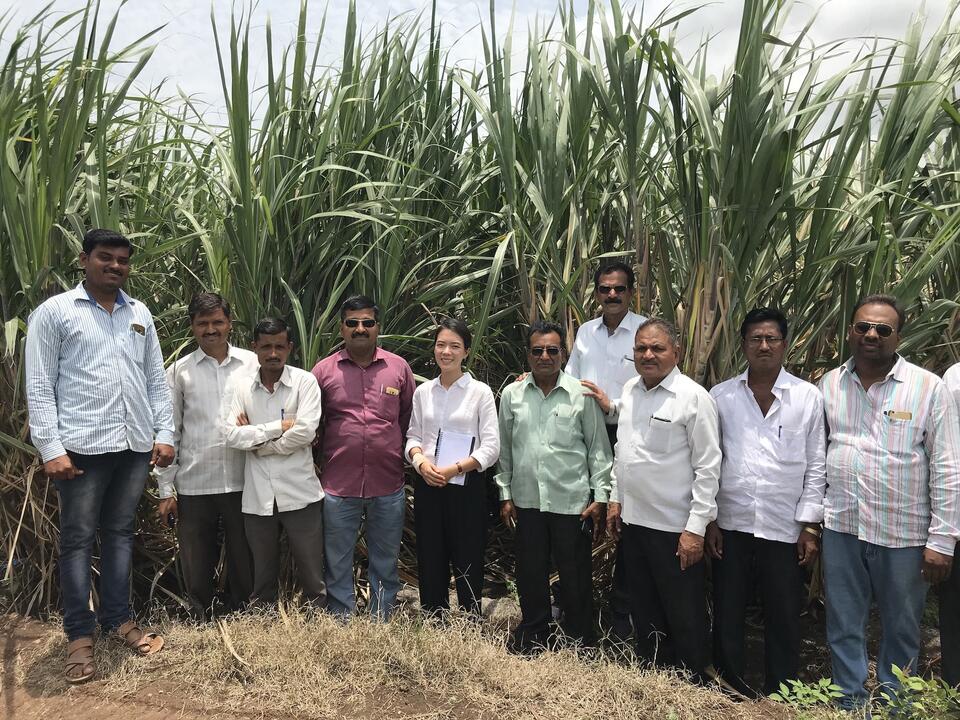
Lead author with a group of farmers in Indian sugar field Lead study author Ju Young Lee, center, is pictured with local farmers and agricultural experts while visiting a sugarcane field in Maharashtra in western India in August 2018. (Image courtesy of Ju Young Lee)

Hero Image
Freshly cut pieces of sugarcane. (Image credit: iStock / Getty Images)
All News button
1
Subtitle

Researchers analyzed the interconnected food, water and energy challenges that arise from the sugar industry in India – the second-largest producer of sugar worldwide – and how the political economy drives those challenges.

Authors
News Type
News
Date
Paragraphs

COVID-19, combined with the effects of ongoing civil conflicts, hotter and drier weather in many areas, and an unfolding locust invasion in Africa and the Middle East, could cut off access to food for tens of millions of people. The world is “on the brink of a hunger pandemic,” according to World Food Program (WFP) Executive Director David Beasley, who warned the United Nations Security Council recently of the urgent need for action to avert “multiple famines of biblical proportions.”

(Watch Beasley’s conversation on food insecurity as a national security threat with his WFP predecessor, Ertharin Cousin, a visiting scholar with Stanford’s Center of Food Security and the Environment.)

Understanding how these conditions – alone or in combination – might affect crop harvests and food supply chains is essential to finding solutions, according to David Lobell, the Gloria and Richard Kushel Director of the Center on Food Security and the Environment. Below, Lobell discusses the connection between immigration and U.S. food security, a counter-intuitive effect of COVID-19 and more.


How could COVID-19 affect global food security?

I think the biggest effects will probably be related to lost incomes for many low-income people. Even if food prices don’t change, potentially hundreds of millions could be pushed into a much more precarious food situation. I’d be especially worried about remittances – the money immigrants in wealthy nations send home to developing nations – falling, since these are a surprisingly large source of stability for many poor people. Beyond the income effects, there are definitely prospects for reduced supply of foods, but I think these are secondary, especially because global stocks right now are quite large.

Another counter-intuitive effect is that the drop in gasoline demand due to social distancing may be a big driver of changes in food prices. A lot of corn demand is for use in ethanol fuel, and corn prices can affect the prices of many other crops. The price of corn has dropped by about 20 percent since February.


What are the biggest risks in terms of food supply?

Three things come to mind. First, for crops that require a lot of labor, there are some indications that planting and harvest activities are being affected. Even though these are usually included as essential activities, they often rely on migrant populations that can no longer cross state or national borders. California is going to be a prime case study in this.

Second, some countries, like Russia, have started to restrict food exports in an effort to calm domestic consumers worried about food shortages. Even if there is enough global supply, there is a risk that supply for importing countries could be curtailed. This was a big part of the food price spikes a decade ago. Now, we have the added potential that exports will be limited by a lack of mobility to get products to the port – for instance, there are reports from South America that towns won’t let trucks through for fear of the virus.

Third, COVID-19 could really limit the ability of governments and international groups to address other crises that emerge. Nearly every year there are at least a few surprises around the world affecting food that are usually handled before they make big news. Things like livestock diseases and crop pest outbreaks, for example. But without the ability to deploy people to assess and fix problems, there is more scope for issues to go unchecked. Right now, the biggest example of this is the desert locust outbreak in Eastern Africa.


What current and/or likely future weather conditions might have significant impacts on food production?

As the globe warms, we continue to see more “surprises” in most years in terms of record hot or dry growing seasons. It’s a bit too soon to say if and where those will emerge this year. Since global food stocks are high, we have some ability to cope with a shock, but if governments are already nervous it may take less to induce export bans and all of the negative effects those entail.


Ahead of the summer harvest, what is the prospect for controlling locust swarms in threatened countries, and how might the swarms further complicate the global food security picture?

If not for COVID-19, this would likely be the biggest development related to food this year. My understanding is that they are spreading fast in Africa and the Middle East, and while they haven’t yet had big effects in the main production regions, the next couple of months will be critical. The hope is that the winds change and drive them back toward the desert areas they came from. If not, there are at least 20 million people at risk of major food security impacts in the region.


Could we see locust swarms in the U.S.? What can we do to prevent them?

Locusts can occur anywhere. A few years back there was a major outbreak in Israel. They haven’t been a big issue in the U.S. because control methods are available, such as widespread spraying. But again, in a time of COVID-19, these types of responses are harder.


What does history teach us about the situation we are in with multiple threats to food security, and how to deal with it?

I think it comes down to a combination of investing in science-based solutions to avoid problems to begin with, and then having good social safety nets for when problems arise. At that level, it’s not really any different than dealing with infectious disease. The absence of any problems is our goal. At the same time, that absence always seems to breed complacency and neglect. Hopefully, the experiences of 2020 will help strengthen support for a society based on facts, science and compassion.


Media Contacts

David Lobell, Center on Food Security and the Environment: (650) 721-6207; dlobell@stanford.edu

Rob Jordan, Stanford Woods Institute for the Environment: (650) 721-1881; rjordan@stanford.edu

Hero Image
dry corn
All News button
1
Subtitle

COVID-19 and other looming threats could make it much harder for people to access food. David Lobell, director of Stanford’s Center on Food Security and the Environment, outlines likely scenarios and possible solutions.

-

Join us for a talk with agricultural and development economist Christopher B. Barrett, this quarter’s visiting scholar with the Center on Food Security and the Environment. Barrett is the Stephen B. and Janice G. Ashley Professor of Applied Economics and Management and an International Professor of Agriculture with Cornell’s Dyson School of Applied Economics and Management.

Professor Barrett will discuss food systems advances over the past 50 years that have promoted unprecedented reduction globally in poverty and hunger, averted considerable deforestation, and broadly improved lives, livelihoods and environments in much of the world. He’ll share perspectives on the reasons why, despite those advances, those systems increasingly fail large communities in environmental, health, and increasingly in economic terms and appear ill-suited to cope with inevitable further changes in climate, incomes, and population over the coming 50 years. Barrett will explore the new generation of innovations underway that must overcome a host of scientific and socioeconomic obstacles.
 
Also a Professor of Economics in the Department of Economics, Barrett is co-editor in chief of the journal Food Policy, is a faculty fellow with David R. Atkinson Center for a Sustainable Future and serves as the director of the Stimulating Agriculture and Rural Transformation (StART) Initiative housed at the Cornell International Institute for Food, Agriculture and Development.
 

Lectures
Authors
News Type
News
Date
Paragraphs

By monitoring crops through machine learning and satellite data, Stanford scientists have found farms that till the soil less can increase yields of corn and soybeans and improve the health of the soil – a win-win for meeting growing food needs worldwide.

Agriculture degrades over 24 million acres of fertile soil every year, raising concerns about meeting the rising global demand for food. But a simple farming practice born from the 1930’s Dust Bowl could provide a solution, according to new Stanford research. The study, published Dec. 6 in Environmental Research Letters, shows that Midwest farmers who reduced how much they overturned the soil – known as tilling – increased corn and soybean yields while also nurturing healthier soils and lowering production costs.

“Reduced tillage is a win-win for agriculture across the Corn Belt,” said study lead author Jillian Deines, a postdoctoral scholar at Stanford’s Center on Food Security and the Environment. “Worries that it can hurt crop yields have prevented some farmers from switching practices, but we found it typically leads to increased yields.”

The U.S. – the largest producer of corn and soybeans worldwide – grows a majority of these two crops in the Midwest. Farmers plucked about 367 million metric tons of corn and 108 million metric tons of soybeans from American soil this past growing season, providing key food, oil, feedstock, ethanol and export value.

Monitoring farming from space


Farmers generally till the soil prior to planting corn or soybeans – a practice known to control weeds, mix nutrients, break up compacted dirt and ultimately increase food production over the short term. However, over time this method degrades soil. A 2015 report from the Food and Agriculture Organization of the United Nations found that in the past 40 years the world has lost a third of food-producing land to diminished soil. The demise of once fertile land poses a serious challenge for food production, especially with mounting pressures on agriculture to feed a growing global population.

In contrast, reduced tillage – also known as conservation tillage – promotes healthier soil management, reduces erosion and runoff and improves water retention and drainage. It involves leaving the previous year’s crop residue (such as corn stalks) on the ground when planting the next crop, with little or no mechanical tillage. The practice is used globally on over 370 million acres, mostly in South America, Oceania and North America. However, many farmers fear the method could reduce yields and profits. Past studies of yield effects have been limited to local experiments, often at research stations, that don’t fully reflect production-scale practices.

The Stanford team turned to machine learning and satellite datasets to address this knowledge gap. First, they identified areas of reduced and conventional tilling from previously published data outlining annual U.S. practices for 2005 to 2016. Using satellite-based crop yield models – which take into account variables such as climate and crop life-cycles – they also reviewed corn and soybean yields during this time. To quantify the impact of reduced tillage on crop yields, the researchers trained a comput

(Image credit: Jillian Deines) Average impacts on corn yields from conservation tillage across the U.S. Corn Belt from 2008 to 2017. Red colors indicate increased yields under conservation tillage, blue colors indicate yield declines.
er model to compare changes in yields based on tillage practice. They also recorded elements such as soil type and weather to help determine which conditions had a larger influence on harvests.

Improved yields


The researchers calculated corn yields improved an average of 3.3 percent and soybeans by 0.74 percent across fields managed with long-term conservation tillage practices in the nine states sampled. Yields from the additional tonnage rank in the top 15 worldwide for both crops. For corn, this totals approximately 11 million additional metric tons matching the 2018 country output of South Africa, Indonesia, Russia or Nigeria. For soybeans, the added 800,000 metric tons ranks in between Indonesia and South Africa’s country totals.

Some areas experienced up to an 8.1 percent increase for corn and 5.8 percent for soybeans. In other fields, negative yields of 1.3 percent for corn and 4.7 for soybeans occurred. Water within the soil and seasonal temperatures were the most influential factors in yield differences, especially in drier, warmer regions. Wet conditions were also found favorable to crops except during the early season where water-logged soils benefit from conventional tillage that in turn dries and aerates.

“Figuring out when and where reduced tillage works best could help maximize the benefits of the technology and guide farmers into the future,” said study senior author David Lobell, a professor of Earth system science in the School of Earth, Energy & Environmental Sciences and the Gloria and Richard Kushel Director of the Center on Food Security and the Environment.

It takes time to see the benefits from reduced tillage, as it works best under continuous implementation. According to the researchers’ calculations, corn farmers won’t see the full benefits for the first 11 years, and soybeans take twice as long for full yields to materialize. However, the approach also results in lower costs due to reduced need for labor, fuel and farming equipment while also sustaining fertile lands for continuous food production. The study does show a small positive gain even during the first year of implementation, with higher gains accruing over time as soil health improves. According to a 2017 Agricultural Censuses report, farmers appear to be getting on board with the long-term investment and close to 35 percent of cropland in the U.S. is now managed with reduced tillage.

“One of the big challenges in agriculture is achieving the best crop yields today without comprising future production. This research demonstrates that reduced tillage can be a solution for long-term crop productivity,” Deines said.


To read all stories about Stanford science, subscribe to the biweekly Stanford Science Digest.

David Lobell is also the William Wrigley Senior Fellow at the Stanford Woods Institute for the Environment, a senior fellow at the Freeman Spogli Institute for International Studies and the Stanford Institute for Economic Policy and Research. Graduate student Sherrie Wang is also a co-author. Research was funded by NASA Harvest.

 
Hero Image
30141460015 bc55de5c03 o
According to new Stanford research, tilling soils less can increase corn and soybean crops across the Midwest Corn Belt.
Flickr/Steven Baird
All News button
1
Authors
News Type
News
Date
Paragraphs

Not many people go into farming to get rich. Low commodity prices, high operational costs and limited profit opportunities cloud the outlook. William Wrigley Professor and FSE Founding Director ROSAMOND NAYLOR gave a keynote presentation on the path toward a more profitable future at an agricultural symposium hosted by the Federal Reserve Bank of Kansas City. See slides from Naylor’s presentation here.

View video of the presentation
Download PDF of the article


Hero Image
1 agriculture and rural farms of india
Farmers in Madhya Pradesh, India.
Rajarshi Mitra / Wikimedia Commons
All News button
1
Authors
News Type
Blogs
Date
Paragraphs

Widespread cultivation of oil palm trees has been both an economic boon and an environmental disaster for tropical developing-world countries. New research points to a more sustainable path forward through engagement with small-scale producers.

Nearly ubiquitous in products ranging from cookies to cosmetics, palm oil represents a bedeviling double-edged sword. Widespread cultivation of oil palm trees has been both an economic boon and an environmental disaster for tropical developing-world countries, contributing to large-scale habitat loss, among other impacts. New Stanford-led research points the way to a middle ground of sustainable development through engagement with an often overlooked segment of the supply chain (read related overview and research brief).

"The oil palm sector is working to achieve zero-deforestation supply chains in response to consumer-driven and regulatory pressures, but they won’t be successful until we find effective ways to include small-scale producers in sustainability strategies,” said Elsa Ordway, lead author of a Jan. 10 Nature Communications paper that examines the role of proliferating informal oil palm mills in African deforestation. Ordway, a postdoctoral fellow at The Harvard University Center for the Environment, did the research while a graduate student in Stanford’s School of Earth, Energy & Environmental Sciences.

Image
33707742795 db455551f6 o

An oil palm plantation in Cameroon (Image credit: Elsa Ordway)

Using remote sensing tools, Ordway and her colleagues mapped deforestation due to oil palm expansion in Southwest Cameroon, a top producing region in Africa’s third largest palm oil producing country (read about related Stanford research). Contrary to a widely publicized narrative of deforestation driven by industrial-scale expansion, the researchers found most oil palm expansion and associated deforestation occurred outside large, company-owned concessions, and that expansion and forest clearing by small-scale, non-industrial producers was more likely near low-yielding informal mills, scattered throughout the region. This is strong evidence that oil palm production gains in Cameroon are coming from extensification instead of intensification.

Possible solutions for reversing the extensification trend include improving crop and processing yields by using more high-yielding seed types, replanting old plantations, and upgrading and mechanizing milling technologies, among other approaches. To prevent intensification efforts from inciting further deforestation, they will need to be accompanied by complementary natural resource policies that include sustainability incentives for smallholders.

In Indonesia, where a large percentage of the world’s oil palm-related forest clearing has occurred, a similar focus on independent, smallholder producers could yield major benefits for both poverty alleviation and environmental conservation, according to a Jan. 4 Ambio study led by Rosamond Naylor, the William Wrigley Professor in the School of Earth, Energy & Environmental Sciences and a senior fellow at the Stanford Woods Institute for the Environment and the Freeman Spogli Institute for International Studies(Naylor coauthored the Cameroon study led by Ordway).

Using field surveys and government data, Naylor and her colleagues analyzed the role of small producers in economic development and environmental damage through land clearing. Their research focused on how changes in legal instruments and government policies during the past two decades, including the abandonment of revenue-sharing agreements between district and central governments and conflicting land title authority among local, regional and central authorities, have fueled rapid oil palm growth and forest clearing in Indonesia.

They found that Indonesia’s shift toward decentralized governance since the end of the Suharto dictatorship in 1998 has simultaneously encouraged economic development through the expansion of smallholder oil palm producers (by far the fastest growing subsector of the industry since decentralization began), reduced rural poverty, and driven ecologically destructive practices such as oil palm encroachment into more than 80 percent of the country’s Tesso Nilo National Park.

 A worker in East Kalimantan, Indonesia, loads palm fruit for transport to a factory that will process it into palm oil (Image credit: Joann de Zegher) A worker in East Kalimantan, Indonesia, loads palm fruit for transport to a factory that will process it into palm oil (Image credit: Joann de Zegher)

 A worker in East Kalimantan, Indonesia, loads palm fruit for transport to a factory that will process it into palm oil (Image credit: Joann de Zegher)

Among other potential solutions, Naylor and her coauthors suggest Indonesia’s Village Law of 2014, which devolves authority over economic development to the local level, be re-drafted to enforce existing environmental laws explicitly. Widespread use of external facilitators could help local leaders design sustainable development strategies and allocate village funds more efficiently, according to the research. Also, economic incentives for sustainable development, such as an India program in which residents are paid to leave forests standing, could make a significant impact.

There is reason for hope in recent moves by Indonesia’s government, including support for initiatives that involve large oil palm companies working with smallholders to reduce fires and increase productivity; and the mapping of a national fire prevention plan that relies on financial incentives.

“In all of these efforts, smallholder producers operating within a decentralized form of governance provide both the greatest challenges and the largest opportunities for enhancing rural development while minimizing environmental degradation,” the researchers write.

Coauthors of “Decentralization and the environment: Assessing smallholder oil palm development in Indonesia” include Matthew Higgins, a research assistant at Stanford’s Center on Food Security and the Environment; Ryan Edwards of Dartmouth College, and Walter Falcon, the Helen C. Farnsworth Professor of International Agricultural Policy, Emeritus, at Stanford.

Coauthors of “Oil palm expansion at the expense of forests in Southwest Cameroon associated with proliferation of informal mills” include Raymond Nkongho, a former fellow at Stanford’s Center for Food Security and the Environment; and Eric Lambin, the George and Setsuko Ishiyama Provostial Professor in the School of Earth, Energy & Environmental Sciences and a senior fellow at the Stanford Woods Institute for the Environment.


Hero Image
33707742795 db455551f6 o
iStockphoto/slpu9945
All News button
1
Paragraphs

Indonesia’s oil palm expansion during the last two decades has resulted in widespread environmental and health damages through land clearing by fire and peat conversion, but it has also contributed to rural poverty alleviation. In this paper, we examine the role that decentralization has played in the process of Indonesia’s oil palm development, particularly among independent smallholder producers. We use primary survey information, along with government documents and statistics, to analyze the institutional dynamics underpinning the sector’s impacts on economic development and the environment. Our analysis focuses on revenue-sharing agreements between district and central governments, district splitting, land title authority, and accountability at individual levels of government. We then assess the role of Indonesia’s Village Law of 2014 in promoting rural development and land clearing by fire. We conclude that both environmental conditionality and positive financial incentives are needed within the Village Law to enhance rural development while minimizing environmental damages.

All Publications button
1
Publication Type
Journal Articles
Publication Date
Journal Publisher
Ambio
Authors
Rosamond L. Naylor

Braun Hall, Stanford University, Stanford, CA 94305

0
gorelick_0.jpg

Professor Gorelick runs the Hydrogeology and Water Resources program and directs the interdisciplinary Global Freshwater Initiative. He is also a Senior Fellow at the Woods Institute for the Environment. Dr. Gorelick is a US National Academy of Engineering (NAE) member and received Fulbright and Guggenheim Fellowships for research on water and oil resources. He is a Fellow of the American Association for the Advancement of Science (AAAS), American Geophysical Union (AGU) and the Geological Society of America (GSA. Dr. Gorelick has produced over 140 journal papers and 3 books in the areas of water management in underdeveloped regions, hydrogeology, optimal remediation design, hydrogeophysics, ecohydrology, and global oil resources.


News Type
Q&As
Date
Paragraphs

The recently launched Stanford Alumni in Food & Ag group aims to bring together Stanford graduates with a background or interest in food and agriculture issues. Tannis Thorlakson, one of the group’s creators, works as the environmental lead for Driscoll’s in the U.S. and Canada, and recently earned her Ph.D. from Stanford’s E-IPER program. She hopes the group will help alumni stay connected with cutting-edge research and stay up-to-date on news within the food and agriculture space. Thorlakson sat down with FSE to chat about the group and upcoming launch event taking place at the O'Donohue Family Stanford Educational Farm later this month.

Q: What inspired you to create the group and who else was involved?
Thorlakson: It has been exciting to see the increasing enthusiasm for agriculture and food around Stanford's campus during my time there. Between the newly expanded Stanford Farm and the buzz around ag tech, more and more students are interested in careers in food and agriculture. My cofounders Manuel Waenke, Anthony Atlas and I wanted to harness some of this enthusiasm to bring alumni together.

Q: Who is eligible to join?
Thorlakson: At this point, we are focused only on Stanford alumni, but will build collaborations with student groups over time. 

Q: What are your goals or focus areas?
Thorlakson: We have two primary goals; to connect alumni to share insights and opportunities in the food and agriculture space; and to keep alumni connected to campus through events and sharing of cutting-edge Stanford research. 

Q: You have your first event on Oct. 26. What are you hoping to accomplish, who can come, and how can people learn more?
Thorlakson: All alumni and faculty are invited to join. This will be a chance to connect with fellow alumni and learn a bit more about the club. More information here: https://www.stanfordfoodag.com/events.

Q: Anything else you’d like to let others know about?
Thorlakson: We're just getting started, so if you have ideas on how to make this group more relevant to you, please reach out to us at mwaenke@stanford.edu


Hero Image
ag alumni
All News button
1
Subscribe to Agriculture