Media
-
South Korean voters have chosen six presidents since the country’s democratization in 1987. Unlike the United States, where newly elected presidents pass signature legislation thanks to a "honeymoon" with Congress, new South Korean presidents immediately face parliamentary obstructionism. Korea’s current president, Park Geun-hye, who recently completed her first year in office, has not been an exception. During the past year, the ruling and opposition parties did not even engage in genuine dialogue, much less reach substantial compromises in the National Assembly. The damage to national governance is all the more serious as Korean presidents may serve only a single, five-year term. 
 
What explains this first year "jinx" for Korean presidents? While the causes include deficiencies in governmental and political institutions, 2013-2014 APARC Fellow Guem-nak Choe argues that a primary factor is the role played by Korean journalism. Himself a former senior journalist and the top public relations aide to the previous Korean president, Mr. Choe will compare Korean and American journalism and offer recommendations for Korean media reform.

Philippines Conference Room

Shorenstein APARC
Stanford University
Encina Hall C332
Stanford, CA 94305-6055

(650) 725-0938 (650) 723-6530
0
2013-2014 APARC Fellow
CHOE,_Guem-Nak_1_3x4.jpg

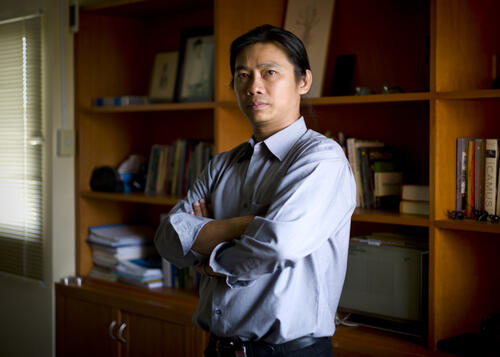
Gordon Guem-nak Choe joins the Walter H. Shorenstein Asia-Pacific Research Center as an APARC Fellow for the 2013-14 academic year. He will be involved with our Korean Studies Program. 

His research encompasses the relationship between media and politics. During his time at Shorenstein APARC, Gordon will work on a comparative study on communication skills between presidents of Korea and the United States.

Choe has over 25 years of experience as a journalist, reporting with Korea’s major broadcasting stations including MBC (Munhwa Broadcasting Company) and SBS (Seoul Broadcasting System). He was SBS's chief correspondent to Washington, DC during the Clinton admistration. He also worked as editor-in-chief and vice president for news and sports at SBS. Later he joined the public sector as Senior Secretary for Public Relations to then-South Korean President Lee Myung-bak. Choe holds a BA in economics from the Seoul National University.

Guem-Nak Choe 2013-2014 APARC Fellow Speaker the Shorentein Asia-Pacific Research Center, Stanford University
Seminars
-

In recent years Chinese courts, in particular those in Henan Province, have begun to place a vast quantity of court options online.  This talk examines one-year of publicly available criminal judgments from one basic-level rural county court and one intermediate court in Henan in order to better understand trends in routine criminal adjudication in China.  The result is an account of ordinary criminal justice that is both familiar and striking:  a system that treats serious crimes, in particular those affecting state interests, harshly while at the same time acting leniently in routine cases.  Most significantly, examination of more than five hundred court decisions shows the vital role that settlement plays in criminal cases in China today.  Defendants who agree to compensate their victims receive strikingly lighter sentences than those who do not.  Likewise, settlement plays a role in resolving even serious crimes, at times appearing to make the difference between life and death for criminal defendants.  These findings provide insight into a range of debates concerning the roles being played by the Chinese criminal justice system and the functions of courts in that system.  Examination of cases from Henan also provides a base for discussing the future of empirical research on Chinese court judgments, demonstrating that there is much to learn from the vast volume of cases that have in recent years become publicly available.

Benjamin L. Liebman is the Robert L. Lieff Professor of Law and the Director of the Center for Chinese Legal Studies at Columbia Law School. His recent publications include “Malpractice Mobs: Medical Dispute Resolution in China,” Columbia Law Review (2013); “A Return to Populist Legality? Historical Legacies and Legal Reform,” in Mao’s Invisible Hand (edited by Sebastian Heilmann and Elizabeth Perry, 2011); and “Toward Competitive Supervision?  The Media and the Courts,” China Quarterly (2011).

Philippines Conference Room

Benjamin L. Liebman Robert L. Lieff Professor of Law and Director, Center for Chinese Legal Studies Speaker Columbia Law School
Seminars
-

The opening up of Myanmar (Burma) and the steps undertaken taken toward political reform in that formerly isolated dictatorship have been among Asia's most dramatic and least expected events.  But the establishment of full democracy is still on the agenda and faces many challenges.  How willing is the current government in Burma to allow a full and free exercise of political rights, including media freedom?  A panel of experts, including Aung Zaw, the editor and founder of The Irrawaddy and this year's recipient of the Shorenstein Award for Journalism in Asia, will address that question in discussing "Burma's Democracy:  How Real?"

Stanford University’s Walter H. Shorenstein Asia-Pacific Research Center (Shorenstein APARC) is pleased to announce Aung Zaw as the 2013 recipient of the Shorenstein Journalism Award. Zaw has been selected for his leadership in establishing independent media in Myanmar (Burma) and his dedication to integrity in reporting on Southeast Asia.

Image
 Aung Zaw

Aung Zaw is the founding editor-in-chief and executive director of The Irrawaddy, an independent Burmese media organization operating in Myanmar and northern Thailand. Zaw has been an active campaigner for democratic reform in Burma/Myanmar over the last two decades. He was awarded the 2010 Prince Claus Fund Award for journalism along with two journalists from Iran and Cuba – and is recognized for his active dedication to achieving democratic governance in Burma and his work to uphold press freedom.

Zaw studied Botany at Rangoon University. As a student activist in Burma, he was part of the 1988 protests in Rangoon against the Burmese military regime of General Ne Win. He was arrested and detained for a week in Rangoon’s notorious Insein prison where he was severely tortured during interrogation about his pro-democracy activities. Upon release Aung Zaw continued to work with the resistance movement until the military staged a coup in September that year and he was forced to leave the country for neighboring Thailand.

Two years later, Aung Zaw founded the Burma Information Group (BIG) in Bangkok, to document human rights violations in Burma. He began to write political commentaries for national newspapers in Thailand and internationally, and in late 1993 launched The Irrawaddy News Magazine in Bangkok, covering Burma affairs. He worked in Bangkok for two years producing The Irrawaddy Magazine until relocating to the more secure position in Chiang Mai in the north of Thailand.

In February 2012, Aung Zaw was able to return to his homeland for the first time in more than 20 years for a temporary visit as an independent journalist. By the end of 2012, The Irrawaddy was able to establish a media and news office in central Yangon, returning to Burma/Myanmar to practice independent journalism, whilst retaining a regional office in Thailand.

In 2013, the government lifted ban on The Irrawaddy and other exiled websites, the Irrawaddy English magazine and the Irrawaddy Dateline Current Affairs TV program is available for audiences in Myanmar. Aung Zaw writes for New York Times, International Herald Tribune, Time, The Guardian, Bangkok Post, The Nation and several publications in the Europe. His interviews have also appeared on CN, BBC and Al Jazeera. He is the author of the Face of Resistance and is a recent Visiting Scholar at UC Berkeley, School of Journalism.

Bechtel Conference Center

Aung Zaw 2013 Journalism Prize Winner and Founder and Editor, The Irrawaddy News Magazine Panelist
Nayan Chanda Director of Publications and the Editor of YaleGlobal Online Magazine Panelist Yale Center for the Study of Globalization
0
Senior Fellow Emeritus at the Freeman Spogli Institute for International Studies
Affiliated Faculty, CDDRL
Affiliated Scholar, Abbasi Program in Islamic Studies
aparc_dke.jpg PhD

At Stanford, in addition to his work for the Southeast Asia Program and his affiliations with CDDRL and the Abbasi Program in Islamic Studies, Donald Emmerson has taught courses on Southeast Asia in East Asian Studies, International Policy Studies, and Political Science. He is active as an analyst of current policy issues involving Asia. In 2010 the National Bureau of Asian Research and the Woodrow Wilson International Center for Scholars awarded him a two-year Research Associateship given to “top scholars from across the United States” who “have successfully bridged the gap between the academy and policy.”

Emmerson’s research interests include Southeast Asia-China-US relations, the South China Sea, and the future of ASEAN. His publications, authored or edited, span more than a dozen books and monographs and some 200 articles, chapters, and shorter pieces.  Recent writings include The Deer and the Dragon: Southeast Asia and China in the 21st Century (ed., 2020); “‘No Sole Control’ in the South China Sea,” in Asia Policy  (2019); ASEAN @ 50, Southeast Asia @ Risk: What Should Be Done? (ed., 2018); “Singapore and Goliath?,” in Journal of Democracy (2018); “Mapping ASEAN’s Futures,” in Contemporary Southeast Asia (2017); and “ASEAN Between China and America: Is It Time to Try Horsing the Cow?,” in Trans-Regional and –National Studies of Southeast Asia (2017).

Earlier work includes “Sunnylands or Rancho Mirage? ASEAN and the South China Sea,” in YaleGlobal (2016); “The Spectrum of Comparisons: A Discussion,” in Pacific Affairs (2014); “Facts, Minds, and Formats: Scholarship and Political Change in Indonesia” in Indonesian Studies: The State of the Field (2013); “Is Indonesia Rising? It Depends” in Indonesia Rising (2012); “Southeast Asia: Minding the Gap between Democracy and Governance,” in Journal of Democracy (April 2012); “The Problem and Promise of Focality in World Affairs,” in Strategic Review (August 2011); An American Place at an Asian Table? Regionalism and Its Reasons (2011); Asian Regionalism and US Policy: The Case for Creative Adaptation (2010); “The Useful Diversity of ‘Islamism’” and “Islamism: Pros, Cons, and Contexts” in Islamism: Conflicting Perspectives on Political Islam (2009); “Crisis and Consensus: America and ASEAN in a New Global Context” in Refreshing U.S.-Thai Relations (2009); and Hard Choices: Security, Democracy, and Regionalism in Southeast Asia (edited, 2008).

Prior to moving to Stanford in 1999, Emmerson was a professor of political science at the University of Wisconsin-Madison, where he won a campus-wide teaching award. That same year he helped monitor voting in Indonesia and East Timor for the National Democratic Institute and the Carter Center. In the course of his career, he has taken part in numerous policy-related working groups focused on topics related to Southeast Asia; has testified before House and Senate committees on Asian affairs; and been a regular at gatherings such as the Asia Pacific Roundtable (Kuala Lumpur), the Bali Democracy Forum (Nusa Dua), and the Shangri-La Dialogue (Singapore). Places where he has held various visiting fellowships, including the Institute for Advanced Study and the Woodrow Wilson International Center for Scholars. 


Emmerson has a Ph.D. in political science from Yale and a BA in international affairs from Princeton. He is fluent in Indonesian, was fluent in French, and has lectured and written in both languages. He has lesser competence in Dutch, Javanese, and Russian. A former slam poet in English, he enjoys the spoken word and reads occasionally under a nom de plume with the Not Yet Dead Poets Society in Redwood City, CA. He and his wife Carolyn met in high school in Lebanon. They have two children. He was born in Tokyo, the son of U.S. Foreign Service Officer John K. Emmerson, who wrote the Japanese Thread among other books.

Selected Multimedia

Date Label
Donald K. Emmerson Senior Fellow at FSI, Emeritus; Affiliated Faculty, CDDRL; Affiliated Scholar, Abbasi Program in Islamic Studies and Director, Southeast Asia Forum Panelist Stanford University

Stanford University
Encina Hall, Room E301
Stanford, CA 94305-6055

0
Lecturer in International Policy at the Ford Dorsey Master’s in International Policy
2011_Dan_Sneider_2_Web.jpg MA

Daniel C. Sneider is a lecturer in international policy at Stanford's Ford Dorsey Master’s in International Policy and a lecturer in East Asian Studies at Stanford. His own research is focused on current U.S. foreign and national security policy in Asia and on the foreign policy of Japan and Korea.  Since 2017, he has been based partly in Tokyo as a Visiting Researcher at the Canon Institute for Global Studies, where he is working on a diplomatic history of the creation and management of the U.S. security alliances with Japan and South Korea during the Cold War. Sneider contributes regularly to the leading Japanese publication Toyo Keizai as well as to the Nelson Report on Asia policy issues.

Sneider is the former Associate Director for Research at the Walter H. Shorenstein Asia-Pacific Research Center at Stanford. At Shorenstein APARC, Sneider directed the center’s Divided Memories and Reconciliation project, a comparative study of the formation of wartime historical memory in East Asia. He is the co-author of a book on wartime memory and elite opinion, Divergent Memories, from Stanford University Press. He is the co-editor, with Dr. Gi-Wook Shin, of Divided Memories: History Textbooks and the Wars in Asia, from Routledge and of Confronting Memories of World War II: European and Asian Legacies, from University of Washington Press.

Sneider was named a National Asia Research Fellow by the Woodrow Wilson International Center for Scholars and the National Bureau of Asian Research in 2010. He is the co-editor of Cross Currents: Regionalism and Nationalism in Northeast Asia, Shorenstein APARC, distributed by Brookings Institution Press, 2007; of First Drafts of Korea: The U.S. Media and Perceptions of the Last Cold War Frontier, 2009; as well as of Does South Asia Exist?: Prospects for Regional Integration, 2010. Sneider’s path-breaking study “The New Asianism: Japanese Foreign Policy under the Democratic Party of Japan” appeared in the July 2011 issue of Asia Policy. He has also contributed to other volumes, including “Strategic Abandonment: Alliance Relations in Northeast Asia in the Post-Iraq Era” in Towards Sustainable Economic and Security Relations in East Asia: U.S. and ROK Policy Options, Korea Economic Institute, 2008; “The History and Meaning of Denuclearization,” in William H. Overholt, editor, North Korea: Peace? Nuclear War?, Harvard Kennedy School of Government, 2019; and “Evolution or new Doctrine? Japanese security policy in the era of collective self-defense,” in James D.J. Brown and Jeff Kingston, eds, Japan’s Foreign Relations in Asia, Routledge, December 2017.

Sneider’s writings have appeared in many publications, including the Washington Post, the New York Times, Slate, Foreign Policy, the New Republic, National Review, the Far Eastern Economic Review, the Oriental Economist, Newsweek, Time, the International Herald Tribune, the Financial Times, and Yale Global. He is frequently cited in such publications.

Prior to coming to Stanford, Sneider was a long-time foreign correspondent. His twice-weekly column for the San Jose Mercury News looking at international issues and national security from a West Coast perspective was syndicated nationally on the Knight Ridder Tribune wire service. Previously, Sneider served as national/foreign editor of the Mercury News. From 1990 to 1994, he was the Moscow bureau chief of the Christian Science Monitor, covering the end of Soviet Communism and the collapse of the Soviet Union. From 1985 to 1990, he was Tokyo correspondent for the Monitor, covering Japan and Korea. Prior to that he was a correspondent in India, covering South and Southeast Asia. He also wrote widely on defense issues, including as a contributor and correspondent for Defense News, the national defense weekly.

Sneider has a BA in East Asian history from Columbia University and an MPA from the John F. Kennedy School of Government at Harvard University.

Daniel C. Sneider Associate Director for Research, Shorenstein Asia-Pacific Research Center Moderator Stanford University
Panel Discussions
-
China 2.0 Forum in Beijing

Friday, April 11, 2014
Registration: 13:00 - 14:00
Forum: 14:00 - 18:00
Networking Reception: 18:00 - 19:00
Stanford Center at Peking University

In celebration of the 20th anniversary of the first continuous connection between China and the internet, facilitated by researchers at Stanford and in Beijing, China 2.0 at Stanford Graduate School of Business is hosting the 2014 China 2.0 Forum in Beijing.

About the 2014 China 2.0 Forum
Receive the latest updates and more information on the event website.

Registration
Participation is by invitation only. Invitations are non-transferable. Seats are limited.

About China 2.0
China 2.0 at Stanford Graduate School of Business focuses on innovation and entrepreneurship in China by looking at the drivers and dynamics of China as a digital power and its implications for commerce, communications, and content in the global economy. China 2.0 convenes thought leaders in China and Silicon Valley, supports cutting-edge research and curriculum development by faculty, and organizes programs to educate students as next generation leaders.

Media Inquiries
Image
 
To register as media to cover this event, please contact Rachel Wu at +86 10 5907 0055 Ext. 865 or Sheenia Liu at +86 10 5907 0055 Ext. 809.
Past China 2.0 Speakers
Image
Image
Image
Charles Chao
CEO & Chairman
of the Board, SINA
Joe Chen
Founder
Renren
John Hennessy
President
Stanford University
Image
Image
Image
Jon Huntsman
Former U.S.
Ambassador to China
Victor Koo
Founder
Youku
Martin Lau
President, Tencent
Image
Image
 
Image
Robin Li
Co-founder
Baidu
Gary Locke
U.S. Ambassador to the People's Republic of China
Jack Ma
Founder
Alibaba Group

The Stanford Center at Peking University

Workshops
Paragraphs

Daniel Sneider writes that relations between South Korea and Japan have noticeably deteriorated in the past few months. After a recent trip to Seoul, Sneider postures that diplomatic ties may be at their lowest since 1965.  While the United States has attempted to promote dialogue, its hesitant intervention is unlikely to change the overall dynamic of the Japan-Korea relationship. Sneider suggests a more active U.S. mediation role, such as appointing a special envoy or negotiating reparations, may better encourage reconciliation and normalization of relations.

This commentary was produced by The National Bureau of Asia Research (NBR) and originally was published on the NBR website (www.nbr.org). NBR retains all rights to this material in all languages.

All Publications button
1
Publication Type
Policy Briefs
Publication Date
Journal Publisher
National Bureau of Asian Research
Authors
Daniel C. Sneider
Paragraphs

The digital information technology (IT) revolution currently underway is profoundly reshap- ing economic activity, influencing politics, and transforming societies around the world. It is also forcing a reconceptualization of the global and local: many of the technologies, platforms, and fundamental disruptions are global in nature, but national or local contexts critically influence the uses and effects of IT.

The Asia-Pacific region provides a fascinating array of countries for examination of the political, economic, and sociocultural effects of digital media on the modern world. Economies range from developing to advanced. Governments include varied democracies as well as one-party regimes. The press enjoys relative freedom in some countries, undergoes limited constraints in others, and is tightly controlled in a few. Populations range from dense to sparse, and from diverse to relatively homogenous.

Held September 12–13, 2013, in Kyoto, Japan, the fifth Stanford Kyoto Trans-Asian Dialogue focused on the catalyzing effects of digital media for change in the Asia-Pacific. Four major themes were addressed:

  1. Digital Media versus Traditional Media
  2. Digital Media and Political Change in Asia
  3. Social Change and Economic Transformation
  4. Digital Media and International Relations
All Publications button
1
Publication Type
Policy Briefs
Publication Date
Journal Publisher
Shorenstein Asia-Pacific Research Center

Encina Hall
616 Serra Street
Stanford, CA 94305-6055

0
Communications and Program Associate
CEO_HS.jpg

Christian Ollano joined the Center on Democracy, Development, and The Rule of Law (CDDRL) in October 2013. As a communications and program associate, he will help manage digital and social media communications between CDDRL, Stanford, and the broader international community.

Christian will bring in his skills in communication and cultural competency to increase CDDRL visibility to a wide network of alumni, faculty, and professionals. As a student, Christian was heavily involved in the Asian American community, serving in a number of capacities to strengthen community ties. From April - August 2010, Christian studied abroad in Japan as part of the Bing Overseas Studies Program where he interned at Mitsubishi Motors as a public relations intern. From 2012-2013, he worked at the Stanford Office of Undergraduate Admission on the diversity team, engaging in a number of diversity outreach initiatives aimed at increasing representation of under-served communities in the applicant pool. Most recently, Christian served as an intern for the Draper Hills Summer Fellows Program at the CDDRL assisting with logistical and programmatic efforts.

Christian holds a Bachelor of Arts in urban studies and a Masters of Arts in sociology.

-

Vietnamese news accounts of labor-management conflicts, including strikes, and even reports of owners fleeing their factories raise potent questions about labor activism in light of this self-proclaimed socialist country’s engagement in the global market system since the late 1980s. In explaining Vietnamese labor resistance, how important are matters of cultural identity (such as native-place, gender, ethnicity, and religion) in different historical contexts? How does labor mobilization occur and develop? How does it foster “class moments” in times of crisis? What types of "flexible protests" have been used by workers to fight for their rights and dignity, and how effective are they?

Based on her just-published book, Ties that Bind: Cultural Identity, Class, and Law in Vietnam's Labor Resistance, Prof. Trần will highlight labor activism since French colonial rule in order to understand labor issues and actions in Vietnam today. Her analysis will focus on labor-management-state relations, especially with key foreign investors/managers (such as from Korea, Taiwan, and Hong Kong) and ethnic Chinese born and raised in Vietnam. She will convey the voices and ideas of workers, organizers, journalists, and officials and explain how migrant workers seek to empower themselves using cultural resources and appeals to state media and the rule of law. Copies of her book will be available for sale at her talk.

Prof. Trần's current research on global south-south labor migration focuses on Vietnamese migrants working in Malaysia and returning to Vietnam. In 2008 she was a Lee Kong Chian NUS-Stanford Distinguished Fellow on Southeast Asia. Her co-authored 2012 book, Corporate Social Responsibility and Competitiveness for SMEs in Developing Countries: South Africa and Vietnam, compared the experiences of small-and-medium enterprises in these two countries. Her many other writings include (as co-editor and author) Reaching for the Dream: Challenges of Sustainable Development in Vietnam (2004). She earned her PhD in Political Economy and Public Policy at the University of Southern California in 1996 and an MA in Developmental Economics at USC in 1991.

Copies of Ties that Bind: Cultural Identity, Class, and Law in Vietnam's Labor Resistance will be available for signing and sale by the author following her talk.

Daniel and Nancy Okimoto Conference Room

Shorenstein APARC
Stanford University
Encina Hall E301
Stanford, CA 94305-6055

(831) 582-3753 (650) 723-6530
0
Lee Kong Chian NUS-Stanford Distinguished Fellow on Southeast Asia
Angie_BioPhoto_Adjusted.jpg MA, PhD

Angie Ngoc Trần is a professor in the Division of Social and Behavioral Sciences and Global Studies at California State University, Monterey Bay (CSUMB).  Her plan as the 2008 Lee Kong Chian National University of Singapore-Stanford University Distinguished Fellow is to complete a book manuscript on labor-capital relations in Vietnam that highlights how different identities of investors and owners—shaped by government policies, ethnicity, characteristics of investment, and the role they played in global flexible production—affect workers’ conditions, consciousness, and collective action differently.

Tran spent May-July 2008 at Stanford and will return to campus for the second half of November 2008.  She will share the results of her project in a public seminar at Stanford under SEAF auspices on November 17 2008.

Prof. Trần’s many publications include “Contesting ‘Flexibility’:  Networks of Place, Gender, and Class in Vietnamese Workers’ Resistance,” in Taking Southeast Asia to Market (2008); “Alternatives to ‘Race to the Bottom’ in Vietnam:  Minimum Wage Strikes and Their Aftermath,” Labor Studies Journal (December 2007); “The Third Sleeve: Emerging Labor Newspapers and the Response of Labor Unions and the State to Workers’ Resistance in Vietnam,” Labor Studies Journal (September 2007); and (as co-editor and author) Reaching for the Dream:  Challenges of Sustainable Development in Vietnam (2004).  She received her Ph.D. in Political Economy and Public Policy at the University of Southern California in 1996 and an M.A. in Developmental Economics at USC in 1991.

Angie Ngoc Tran Professor of Political Economy Speaker California State University-Monterey Bay
Seminars
Subscribe to Media