
'A world at risk': Freeman Spogli Institute's second annual International Conference and dinner
On November 16, 2006, FSI convened its annual international conference, A World at Risk, devoted to systemic and human risk confronting the global community. Remarks by Stanford Provost John Etchemendy, FSI Director Coit D. Blacker, former Secretary of State Warren Christopher, former Secretary of Defense William J. Perry, and former Secretary of State George Shultz set the stage for stimulating discussions. Interactive panel sessions encouraged in-depth exploration of major issues with Stanford faculty, outside experts, and policymakers.
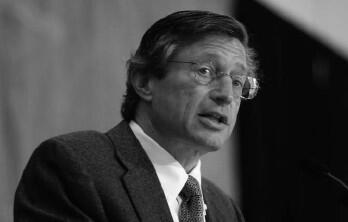
Invoking Jane and Leland Stanford’s desire to educate students to become useful, contributing citizens, Etchemendy said, “We can best serve that mission today by producing graduates well-versed in the complex problems of a world at risk and willing to make the difficult choices that might lead to their solution.”
“It has been acutely apparent to us at FSI that we must actively engage a world at risk,” stated FSI director Coit D. “Chip” Blacker, “risk posed by the growing number of nuclear issues on the international agenda; the insurgency in Iraq; global poverty, hunger, and environmental degradation; the tensions of nationalism versus regionalism in Asia; infectious diseases; terrorism; and the geopolitical, financial, and ecological risks of the West’s current energy policies, especially its voracious appetite for oil.”
Introducing three Stanford luminaries, Blacker said, “One of the remarkable things about Stanford is the privilege of working with some of the outstanding intellects and statesmen of our time. Warren Christopher, William Perry, and George Shultz tower among them.”
“As Stanford University’s primary forum for the consideration of the major international issues of our time, we at FSI are dedicated to interdisciplinary research and teaching on some of the most pressing and complex problems facing the global community today.” – Coit D. “Chip” Blacker, Director, Freeman Spogli Institute“The Middle East has descended into hate, violence, and chaos,” said Warren Christopher, the nation’s 63rd secretary of state. “It really is a dangerous mess.” Discussing the Israeli incursion into Lebanon, the war in Iraq, and Iran’s regional and nuclear ambitions, he said the U.S. has aggravated these threats by “action and inaction.” Nonetheless, the U.S. remains the most influential foreign power in the region. “We must not give up on the Middle East,” he said. “We have to return to old-fashioned diplomacy with all its frustrations and delays.”
“We live in dangerous times,” stated William J. Perry, the nation’s 19th secretary of defense and an FSI senior fellow. “Last month about 1,000 of our service personnel in Iraq were killed, maimed, or wounded; the Taliban is resurging in Afghanistan; North Korea just tested a nuclear bomb; and Iran is not far behind. China’s power is rising and Russia’s democracy is falling.” As Elie Wiesel wrote, he said, “Peace is not God’s gift to its children. Peace is our gift to each other.” Comparing major security issues of 1994 to today, Perry assessed the nuclear arms race, North Korea, Iran, and Iraq. He noted that the Clinton administration had eliminated more than 10,000 nuclear weapons and urged that the work continue, because “the danger of terrorists getting a nuclear bomb is very real.”
Citing North Korea’s 2006 missile and nuclear tests, Perry said he was concerned that a robust North Korean nuclear program will stimulate a “dangerous arms race in the Pacific” and increase “the danger of a terrorist group getting a nuclear bomb.” “Iran is moving inexorably toward becoming a nuclear power,” Perry said. “We are facing new dangers,” he concluded, “and we must adjust our thinking accordingly.”
“The world has never been at a more promising moment than it is today,” said George Shultz, the nation’s 60th secretary of state. “All across the world, economic expansion is taking place. The U.S. is giving fantastic leadership to the global economy.” For Shultz, the imperative is to prevent the security challenges “from aborting all these fantastic opportunities.”
“The Middle East has descended into hate, violence, and chaos. The U.S. remains the most influential foreign power in the region. We have to return to old-fashioned diplomacy with all its frustrations and delays.” – Former Secretary of State Warren ChristopherU.S. leadership should inspire the world, Shultz said, advocating four initiatives. We should aspire to have a world with no nuclear weapons. We should take a different approach to global warning, based on the Montreal Protocols. “This is a gigantic problem we need to do something about and can do something about,” he said. We should build greater understanding of the world of Islam. We must combat rising protectionism. The postwar system reduced tariffs and quotas, promoting trade and growth. “The best defense is a good offense,” Shultz stated. “We need a lot of leadership in that arena.”
Plenary I, chaired by Chip Blacker, examined systemic risk. Elisabeth Paté-Cornell, Burton and Deedee McMurtry Professor and Chair of Management Science and Engineering, discussed how scientists measure risk, asking what can happen, what are the chances it will, and what are the consequences? “The good news is that the worst is not always the most certain,” she noted. Citing challenges of intelligence analysis, she said, “Certainty is rare; signals are imperfect; there is a tendency to focus on one possibility (groupthink) and underestimate others; and it is difficult to assess and communicate uncertainties.” “Success is not guessing in the face of uncertainties,” she said. “It is describing accurately what is known, what is unknown, and what has changed.”
Scott D. Sagan, professor of political science and director of CISAC, examined “Iran and the Collapse of the Global Non-proliferation Regime?” The crux of the issue, Sagan noted, is the emergence of two dangerous beliefs, “deterrence optimism” and “proliferation fatalism.” In Sagan’s view, too little attention has been given to why Iran seeks a nuclear weapon. Arguing that U.N. sanctions are unlikely to work and military options are problematic, Sagan said a negotiated settlement is still possible if the U.S. offers security guarantees to Iran, contingent on Tehran’s agreement to constraints on future nuclear development. As Sagan concluded, “Instead of accepting what appears inevitable, we should work to prevent the unacceptable.”
Siegfried S. Hecker, CISAC co-director, tackled the challenge of “Keeping Fissile Materials out of Terrorist Hands.” Although nuclear terrorism is an old problem, today there is easier access to nuclear materials, greater technological sophistication, and a greater proclivity toward violence. The greatest risk, he said, “is an improvised nuclear device built from stolen or diverted fissile materials.” “Given a few tens of kilograms of fissile material, essentially a grapefruit-sized chunk of plutonium,” he stated, “terrorists will be able to build and detonate an inefficient, but devastating Hiroshima- or Nagasaki-like bomb.” The most likely threat is a so-called “dirty bomb,” he said, which would be a “weapon of mass disruption, not destruction,” but still able to cause panic, contamination, and economic disruption, making risk analysis imperative to mitigate its consequences.
“We are facing new dangers and we must adjust our thinking accordingly. As President Lincoln said, ‘The occasion is piled high with difficulty, and we must rise with the occasion. As our case is new, so we must think anew, and act anew.’” – Former Secretary of Defense William J. PerryTurning to human risk, Michael Osterholm, director of the University of Minnesota’s Center for Infectious Disease Research and Policy, addressed “Pandemic Influenza: Harbinger of Things to Come?” “The risk is one that a pandemic is going to happen,” he told a riveted audience. Comparing the great influenza of 1918 with the pandemics of 1957 and 1968, he noted that pandemics have differed in season of onset, mortality rates, and number of cases. Avian influenza has a 65 percent mortality rate and could affect 30–60 percent of the world’s 6.5 billion people, producing 1.6 billion deaths worldwide and 1.9 million deaths in the U.S. Inevitably, mutation will reduce its lethality.
“It is not a matter of if, just when and where” the pandemic will strike, said Osterholm. Noting that vaccines will not be available in numbers needed, he argued for measures to safeguard families, communities, and essential infrastructure, such as police, firefighters, and health-care workers. Just-in-time inventory practices, he said, have increased vulnerability to disruptions in food supply, transportation, equipment, and communications, making it vital to plan in earnest, now.
Plenary II, chaired by FSI deputy director Michael A. McFaul, assessed risks to humans from “Natural, National, and International Disasters.” Stephen E. Flynn, Jeane J. Kirkpatrick Senior Fellow at the Council on Foreign Relations and a trade and transportation security expert, decried the “artificial firewalls between homeland and national security.” The Hart-Rudman Commission of 1998 warned of a catastrophic attack on U.S. soil, yet we did not rethink national security even after 9/11. We must approach security as a transnational issue, with no clear “domestic” and “international” lines, he urged. More than 65 percent of critical infrastructure is privately owned and has been given inadequate attention by federal authorities. Hurricane Katrina exposed the vulnerabilities. “We face more threats from acts of God than acts of man,” Flynn stated. We need to move from a concept of “security” to one of “resiliency,” he said, greatly improving our ability to withstand a man-made or natural disaster.
David G. Victor, FSI senior fellow and professor of law, addressed three faces of energy security: oil, natural gas, and climate change. Oil prices are volatile, future fields are in places difficult to do business, and the global supply infrastructure is vulnerable, posing the risk of a one- to six-month supply disruption. For Victor, who directs FSI’s Program on Energy and Sustainable Development, the big threat is less supply than a potential demand-side shock, driven by the U.S. and China. Europe relies on an unreliable Russia for 25–30 percent of its natural gas needs, making it imperative to switch to cheaper, more reliable LNG from North Africa and the Middle East. Oil and gas price volatility has driven further dependence on coal-fired plants, with dire consequences for carbon emissions. New coal plant lifetime emissions, Victor said, are equal to all historic coal emissions, making it critical to invest in advanced technology to protect the environment.
“The world has never been at a more promising moment than it is today. All across the world economic expansion is taking place. Poverty is being reduced dramatically as China and India expand, along with Brazil.” – Former Secretary of State George ShultzPeter Bergen, CNN terrorism analyst and producer of Osama bin Laden’s first television interview, offered the dinner keynote, “Successes and Failures of the War on Terrorism Since 9/11.” Assessing negatives, Bergen noted that al Qaeda continues to carry on attacks from its base in Pakistan; Afghanistan is beset by instability; more than 20 million Muslims in Europe remain dangerously un-integrated; bin Laden has not been apprehended and continues to inspire followers through terrorist attacks; Iraq is an unstable breeding ground for jihad; and anti-Americanism is on the rise. Enumerating positives, there has been no follow-on attack on the U.S.; the government has made the country safer; many Muslims have rejected jihad; plots have been foiled and suspects apprehended across the globe. Weighing whether fighting the terrorists abroad has made the U.S. safer here, Bergen was equivocal: The U.S. can identify and eliminate only so many people and cannot stay in Bagdad forever. A network of educated, dedicated terrorists remains, he warned, capable of bringing down commercial aircraft or deploying a radiological bomb.


