Education
News Type
News
Date
Paragraphs

SPICE’s Manager of Curriculum and Instructional Design Rylan Sekiguchi was announced this week as the recipient of the 2021 Franklin R. Buchanan Prize for his authorship of What Does It Mean to Be an American? The prize is awarded annually by the Association for Asian Studies, which will formally honor Sekiguchi in a ceremony at 2pm PDT on March 24, 2021. This is the third time that Sekiguchi has won the award.

SPICE co-developed the website for What Does It Mean to Be an American? with the Mineta Legacy Project. What Does It Mean to Be an American? was inspired by the life of Secretary Norman Mineta, former U.S. Secretary of Commerce under President Bill Clinton and U.S. Secretary of Transportation under President George W. Bush. President Clinton, President Bush, and Secretary Mineta contributed video interviews for the website.


Established in 1995 by the AAS Committee on Educational Issues and Policy and the Committee on Teaching about Asia, the Franklin R. Buchanan Prize is awarded annually to recognize an outstanding pedagogical, instructional, or curriculum publication on Asia designed for K–12 and college undergraduate instructors and learners.

Read More

Banner
Blogs

What Does It Mean to Be an American?: A Web-based Curriculum Toolkit

“What Does It Mean to Be an American?” is a free educational web-based curriculum toolkit for high school and college students that examines what it means to be an American developed by the Mineta Legacy Project and Stanford’s SPICE program.
What Does It Mean to Be an American?: A Web-based Curriculum Toolkit
5thbuchanan banner
News

SPICE Wins Buchanan Prize for Fifth Time

SPICE Wins Buchanan Prize for Fifth Time
Hero Image
rylan sekiguchi
All News button
1
Subtitle

Rylan Sekiguchi was announced this week as the recipient of the 2021 Franklin R. Buchanan Prize for his authorship of What Does It Mean to Be an American?

Authors
News Type
News
Date
Paragraphs

February 19th marks the 79th anniversary of President Franklin D. Roosevelt’s signing of Executive Order 9066 in 1942 that led to the incarceration of Japanese Americans during World War II. The Mineta Legacy Project and SPICE are providing an educational opportunity for people across the country to learn about the Japanese American experience during World War II by presenting a webinar on Saturday, February 20, at 10am PST. (Register for free at http://bit.ly/DORteacherwebinar.) As part of the webinar, representatives from both organizations will be giving a virtual tour of the free online curriculum, What Does It Mean to Be an American?, which was inspired by Secretary Norman Mineta, who was incarcerated as a young boy and rose to become the U.S. Secretary of Commerce under President Bill Clinton and U.S. Secretary of Transportation under President George W. Bush. The curriculum is also a companion component to the documentary film, Norman Mineta and His Legacy: An American Story. The Mineta Legacy Project is also making the film available to stream throughout the month of February.

Representing SPICE will be Rylan Sekiguchi, who was recently announced as the recipient of the 2021 Franklin R. Buchanan Prize for his authorship of What Does It Mean to Be an American? The prize is awarded annually by the Association for Asian Studies, which will formally honor Sekiguchi in a ceremony at 2pm PDT on March 24, 2021.

The curriculum is comprised of six lessons: Immigration, Civil Liberties and Equity, Civic Engagement, Justice and Reconciliation, Leadership, and U.S.–Japan Relations. There are more than 200 primary source images and 23 videos created specifically for the curriculum. During the webinar, in addition to hearing from Sekiguchi, educators will hear Karen Korematsu talking about her father and civil rights icon Fred Korematsu; Secretary Norman Mineta sharing why Japan is so important to him; the reaction from Japanese American women on receiving their apology and redress checks; and the powerful story of 99-year old Yae Wada from Berkeley, who reveals the decades of anger she felt from the time she and her family were evicted from the Bay Area and how she found peace upon receiving her apology. Importantly, the curriculum is broader than the Japanese American experience, exploring issues of inclusion and delving into the definitions of civil liberties and justice and how they are implemented.

Register for the free webinar at http://bit.ly/DORteacherwebinar.

Read More

seven students headshot
Blogs

What Does It Mean to Be an American?: Reflections from Students (Part 2)

Reflections of eight students on the website "What Does It Mean to Be an American?"
What Does It Mean to Be an American?: Reflections from Students (Part 2)
mlp team with bush manual rotate 360
News

Presidents Bill Clinton and George W. Bush interviewed for the Mineta Legacy Project

Presidents Bill Clinton and George W. Bush interviewed for the Mineta Legacy Project
Hero Image
Secretary Norman Mineta and Rylan Sekiguch
Secretary Norman Mineta and Rylan Sekiguchi; photo courtesy Gary Mukai
All News button
1
Subtitle

The Mineta Legacy Project and SPICE are providing an educational opportunity for people across the country to learn about the Japanese American experience during World War II by presenting a webinar on Saturday, February 20, at 10am PST.

Authors
News Type
Q&As
Date
Paragraphs

We often think of language as a democratic field, but it is not quite the common property of its speakers, argues Jeffrey Weng, APARC’s 2020-21 postdoctoral fellow on contemporary Asia. Rather, language is a skill that must be learned, says Weng, and it creates social divisions as much as it bridges divides. 

Weng studies the social, cultural, and political nature of language, with a focus on the evolution of language, ethnicity, and nationalism in China. His doctoral dissertation investigates the historical codification of Mandarin as the dominant language of contemporary mainland China. This summer, he will begin his appointment as an assistant professor at National Taiwan University. In this interview, Weng discusses the dynamics between linguistic and social change and the implications of his research for Asian societies today.


[Subscribe to APARC's newsletters to stay informed on our scholars' research.]


What has shaped your interest and research into the study of language and linguistic dissemination?

As a first-grade student in the early 1990s attending Chinese school in central New Jersey on Saturday mornings, I learned how to write my first complete sentence in the language: “I am an overseas Chinese.” Now, this was a curious sentence to teach to a class full of American-born children of Taiwanese parents, and it’s a reminder that language is never a neutral conveyor of meaning. Language cannot but be freighted with social, cultural, and political import, a lesson reinforced in my high-school Spanish classes, in which I made my first forays into literature in a foreign language: stories by the great writers of Spain and Latin America not only spoke a wholly different language, but they told wholly different stories from those of their British and American counterparts.

Linguistic difference also is a signal of individual and social difference: my childhood visits with family in Taiwan opened my ears to a cacophonous Babel in the media and on the streets—though we spoke Mandarin at home, whenever we went out, people speaking Taiwanese were everywhere to be seen and heard. This was further amplified when I visited mainland China for the first time in my early 20s. Beijing, the supposed wellspring of the nation’s language, was bewildering—I could not understand much of the unselfconscious speech of the locals. And traveling several hundred miles in any direction would only deepen my incomprehension. And yet, on the radio and on TV, during formal events and on university campuses, there was always Mandarin to clear the way. I wanted to learn more about how this language situation came to be. For me, studying the social, cultural, and political nature of language is a way to a deeper understanding of how people are united and divided in vastly different contexts across the globe.

As you’ve looked deeper into how language shapes society and society shapes language, what is something surprising you’ve come to realize about that relationship?

People often see language as the ultimate democratic field when it comes to cultural practice. No matter how much you might tell people not to split their infinitives or end their sentences with prepositions, popular practice will always win the day. Or so we English speakers think. Ever since Merriam-Webster came out with its infamously descriptivist Third New International Dictionary in 1961, Anglophone language nerds have fought over whether dictionaries should be “prescriptive”—that is, rule-setting—or “descriptive”—reflective of popular usage. But really, these are two sides of the same coin. We take it for granted that privately-owned publishers of dictionaries spell out the supposed norms of our language. Not only that, we even think this ought to be the case. French is the usual counterexample: when government language authorities in Quebec or Paris try to stem the Anglophone tide, we think it absurd that so-called authorities would ever try to rule over something so fundamentally unruly as language.

In my research, however, I learned how fundamentally invented Mandarin as a language is—from its highly artificial pronunciation to the way its orthography has been stabilized. There used to be a lot of variability in how characters were written and how they could be used, much like English spelling before the 18th century. Mandarin, both spoken and written, was standardized only in the 1920s to facilitate mass literacy and national cohesion. So linguistic change might often follow and reflect social change, but the process can also operate in reverse—a government can change language in hopes of facilitating social change.

In your latest journal publication, you argue that language nationalization in Japan, Korea, and Vietnam between 1870-1950 was a state-led, top-down process directed at remaking society rather than the more traditional view of diffusion through trade, economics, and cultural exchange. Why is this an important distinction to make?

Again, we often see language as a democratic field, the common property of its speakers, but it isn’t really. Sociolinguists are often quick to remind us that linguistic differences reflect class differences—“proper” language is that of “educated” speakers. But language is a skill, and skills must be learned. Some people can learn skills more easily than others, whether through natural ability or, more importantly, the life circumstances they were born into. Rich people can more easily get a good education. Educational disparities are now part and parcel of today’s broader debates about inequality. But the very fact that we think this is a problem is a product of developments in the late 19th and early 20th centuries.

Before then, broad swaths of humanity were totally illiterate and had no chance at being educated, and most people did not think this was a problem. In Europe, the language of the Church and academia, even to some extent in Protestant areas, was Latin until the 18th century. Local vernaculars had gradually developed as independent media of communication in government chancelleries and popular literature since the Middle Ages, but they did not really gain ascendancy until the age of print-capitalism and nationalism in the 18th and 19th centuries. Marxian-influenced scholars have therefore concluded that the rise of national languages coincided with the rise of the bourgeoisie, whose own languages became those of the nations they constructed.

In France, for example, while revolutionaries in the 1790s advocated the use of Parisian French to unify a country divided by hundreds of local forms of speech, into the mid-19th century, even journeying 50 miles outside Paris found travelers having trouble making themselves understood to the locals. It took more than a century for French to gain a foothold in most of the country. Asia, too, was a polyglot patchwork for millennia, unified at the top by an arcane language much like Latin—Classical Chinese. This situation became politically untenable in the 19th century as European imperialism encroached on traditional sovereignties in China, Japan, Korea, and Vietnam. In order to counter the foreign threat, governments sought to strengthen their societies by educating their populations, which required making it easier to learn how to read and write. While standard languages have been described by historians and sociolinguists as “artificial” for less-privileged learners, Asia’s standard languages were artificial even to their bourgeois inventors.

Our understanding of the present is invariably colored by our interpretation of the past: if we understand a national language to be a bourgeois imposition that diffused via economic development, then we more easily see its continued imposition as a perpetuation of class prejudices. If on the other hand, we see an invented national language as a tool for bridging regional divisions and expanding economic opportunity for our children, then we feel much more positively about the spread of such languages. Both interpretations can be true at the same time, but we must remember that one is inseparable from the other.

Do you see any parallels between how language nationalization has occurred in the past to how language and society are shaping one another in the present?

The number of “standard” Mandarin speakers in the early 1930s could be counted on one hand. Today, it’s the world’s largest language by a number of “native” speakers. Though it began as an elite nationalizing project that was largely ignored by the masses of people in China, Mandarin is now more often seen as a hegemonic threat to local languages and cultures. Language can thus bridge divides, but also create new divisions. People in China are often ambivalent about the pace of change these days. When I visited cousins in rural Fujian during the Lunar New Year a few years ago, I noticed that all my nieces and nephews spoke Mandarin in almost all situations, to their parents, and especially to one another. Only my grandparents’ generation used the local Fuqing dialect as a matter of course. My parents’ generation spoke dialect to their parents, but a mix of Mandarin and dialect to their children—the cousins of my generation, who were able to speak the dialect, but were more comfortable speaking Mandarin among themselves and to their children. One of my young nieces who’d grown up in Beijing, where her parents had moved for work, even had a perfect Beijing accent. In a span of three generations, migration due to expanded opportunity had wrought enormous change in language habits. Much had been gained, but also much had been lost.

How has your time at APARC as one of our Shorenstein Postdoctoral Fellows aided your research project?

It’s certainly been a strange year to be a postdoc, given how we’ve all been operating remotely. Nevertheless, life and work have continued, and we’ve all been able to find new ways of building community and getting things done. I’ve personally benefited from the access to the vast academic resources of Stanford—library access, even online alone, is a lifeline to any researcher. Moreover, I’ve had the opportunity to chat on Zoom with Stanford faculty about research and connect with my fellow postdocs to support one another as we figure out how to move forward in our careers in these challenging times.

With your recent appointment as an assistant professor at National Taiwan University in Taipei, how do you anticipate your research interests growing and developing given the tension between Taiwan and China?

I am gratified to begin my academic career in a place of such diversity and openness as Taiwan. Language and identity are constant sites of contention in Taiwan's politics, and I look forward to expanding my on-the-ground understanding of these issues as I begin teaching in the sociology department at National Taiwan University. It is nothing short of miraculous that democracy has flourished at such an intersection of empires, colonialism, repressions, and struggles. And it is unsettling to see that flourishing takes place in such a precarious geopolitical location. NTU's sociology department is at the forefront of understanding all of these vital issues as we barrel forward into an ever more uncertain future.

Read More

Stanford campus, main quad with cloudy sky
News

APARC Offers Fellowship and Funding Opportunities to Support, Diversify Stanford Student Participation in Contemporary Asia Research

The Center has launched a suite of offerings including a predoctoral fellowship, a diversity grant, and research assistant internships to support Stanford students interested in the area of contemporary Asia.
APARC Offers Fellowship and Funding Opportunities to Support, Diversify Stanford Student Participation in Contemporary Asia Research
Spring blooms in the courtyard near History Corner, Stanford University.
News

APARC Names 2021-22 Shorenstein Postdoctoral Fellows

Political scientist Dr. Diana Stanescu and sociologist Mary-Collier Wilks will join APARC as Shorenstein postdoctoral fellows on contemporary Asia for the 2021-22 academic year.
APARC Names 2021-22 Shorenstein Postdoctoral Fellows
Hero Image
[Left] Postdoc Spotlight, Jeffrey Weng, Shorenstein Postdoctoral Fellow in Contemporary Asia, [Right] Jeffrey Weng
Jeffrey Weng's research examines the relationship between how language shapes society and society shapes language.
All News button
1
Subtitle

Shorenstein Postdoctoral Fellow in Contemporary Asia Jeffrey Weng shares insights from his research into how language and society shape one another, particularly how the historical use of Mandarin affects contemporary Chinese society and linguistics.

Authors
News Type
Blogs
Date
Paragraphs

Grandparents have an endearing position of high stature in Mexican culture. Grandchildren have countless stories about the cariño (endearment) they receive from Abuelito (Grandpa) and Abuelita (Grandma). My immigrant grandparents sacrificed a lot when they migrated to the United States. Their courageous journeys and perseverance to attain the American dream left an invaluable mark on me. My abuelito’s journey to the United States initially on the Bracero Program led me to conduct research on the program. The Bracero Program was a binational labor agreement between the United States and Mexico that was in effect from 1942 to 1964. It was established due to the labor shortage brought about by World War II. Thousands of Mexican men were recruited and joined the program to work primarily in agriculture in states like California.

It was my abuelito’s cariño, work ethic, and courage as an immigrant that I have never forgotten. My abuelito worked in the highlands of Jalisco, Mexico, where his skilled farm labor contributed to making the highlands of Jalisco productive for the cultivation of agave. Thousands of the region’s men—including my abuelito—joined the Bracero Program and left Mexico for the United States. Once in the United States, they worked in the agricultural industry and transformed it into the multibillion-dollar business that it is today.

In my research, I have had the chance to interview members of the family of Rafael Silva, who was also a bracero from Jalisco. One of his grandsons, Isa Silva, will be entering Stanford next fall as a recruit for the Stanford Men’s Basketball team. I recently had the chance to talk with Isa and reflect upon the legacy of his abuelito and mine. The work that they performed was brutal, often working with the short-handled hoe for long periods. Reflecting on his abuelito’s contribution to making the Salinas Valley into the “Salad Bowl of the World,” Isa noted, “My grandparents’ immigrant journey and hard work means everything to me. It’s one thing that motivates me and inspires me. I respect the generations before me and am forever grateful for their sacrifices. Because of my grandparents and parents, I work hard in the classroom and it has taught me to give back.”

After the Bracero Program formally ended in 1964, agricultural executives sponsored thousands of braceros like Rafael Silva to stay in California. Not only had the braceros’ lives been transformed from rural poverty in Mexico to making working-class earnings, but their hard work would also eventually transform the lives of their children and grandchildren like Isa. Considered the “Ellis Island” for many Mexican immigrants, the U.S.–Mexico border became an important migration corridor for thousands wanting to find work in the agricultural fields in places like the Salinas Valley. For many young braceros, their earnings provided them with the hope of one day marrying and starting a family. For Rafael Silva, that hope became a reality when he married Eva Silva Ruelas and they settled near the U.S.–Mexico border in San Luis, Sonora, Mexico. While Rafael worked in the agricultural fields in Arizona, Eva and her young children resided in San Luis. Eventually they were able to move together to the Salinas Valley where Rafael continued working in the agricultural fields and Eva worked at the Matsui Nursery, a company founded by Andy Matsui, an immigrant from Japan.

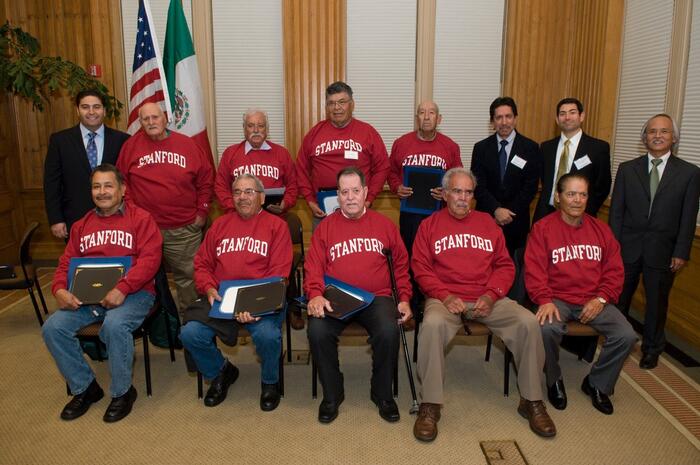
My research has uncovered numerous stories of braceros like Rafael Silva overcoming poverty. Among children and grandchildren of braceros are professors at U.C. Berkeley and Stanford, members of the U.S. Congress and California legislature, as well as successful entrepreneurs, attorneys, educators, physicians, and a former NASA astronaut. Despite these successes, braceros themselves have received little recognition. With this in mind, I decided to organize an event with SPICE to honor braceros, with hopes that it would also make an indelible impression on a Mexican American generation whose bracero fathers or grandfathers had made major contributions to the U.S. economy. They, too, were part of America’s “Greatest Generation.”

Image
photo of braceros in Stanford sweatshirts


On February 26, 2014, ten former braceros and their families were invited to an event at Encina Hall at Stanford. The invitees included Rafael Silva and Eva Silva Ruelas. Former FSI Director Mariano Florentino Cuellar, who is currently a California Supreme Court Justice, spoke along with Stanford Biology Professor Rodolfo Dirzo and me. SPICE Director Gary Mukai moderated the event and spoke about his youth as a farm laborer working with braceros. The evening was historic in that it was one of only a few times that former agricultural workers were recognized at a university. In the photo, I am standing next to my abuelito, José Guadalupe Rodriguez Fonseca, top left. Isa’s abuelito, Rafael Silva, is in the front center.

Image
extended Silva family


What else stood out that evening was the Silva grandchildren’s palpable love for their grandparents. One photo of the evening captures the Silva family legacy. Rafael (wearing a Stanford sweatshirt) and Eva Silva are in the middle with six of their children and numerous grandchildren surrounding them. Isa is standing in front of his grandfather. Three of their grandchildren are currently attending Stanford, with Isa soon to become the fourth. Reminiscing about the event, Isa noted, “I was a ten-year-old boy. It was cool to see the whole family get together and be there. We were there to support my abuelito and recognize all his hard work. It was great to see him honored for what he did so long ago. As we grow older, we appreciate him more and more.” Isa knows that his abuelito and abuelita’s journey is what transformed the Silva family and made his own American dream possible. Reflecting that pride in his family’s story, Isa closed our conversation by saying, “On and off the court, I will always represent being Mexican American.”

Read More

Hero Image
Isa Silva and his family
Isa Silva and his family; photo courtesy Karen Hickey/Stanford Athletics
All News button
1
Subtitle

Isa Silva, grandson of a bracero from Jalisco, will enter Stanford next fall as a recruit for the Stanford Men’s Basketball team.

News Type
News
Date
Paragraphs

Foreign Policy: China Will Run Out of Growth if it Doesn't Fix its Rural Crisis

No country with China’s vast education and public health problems has ever broken out of the ranks of middle-income countries.

"At a time when every other major economy is shrinking, China announced in late January that its GDP grew 2.3 percent in 2020. Beneath that impressive achievement, however, lies a very unbalanced recovery: As in the past, Beijing relied heavily on state investment and a state-led push for higher industrial production, while private investment and consumer spending remained weak. Easy credit to fuel growth has likely formed even more so-called zombie companies with little prospect of future profitability and filled the books of Chinese banks with even more bad loans.

That much is familiar to many who have taken a closer look at China’s skewed model for economic growth. What’s much less well known is the disproportionate burden of the COVID-19-induced downturn that has fallen on rural Chinese, including the 290 million migrant workers with rural hukou (household registrations) who work in cities throughout China. Lockdowns forced by the pandemic paralyzed economic sectors where many migrants work, such as services and retail. According to one estimate, Chinese migrant workers lost about $100 billion in wages that they are unlikely ever to recover.

Among migrant workers and the underdeveloped rural communities that depend on the wages they send home, a quiet crisis is taking place—with potentially dramatic consequences for China’s future growth. Despite what the GDP number suggests about the country’s successful handling of the pandemic, China’s longer-term economic risks have only grown—and are a direct result of the crisis in rural China. As Stanford University researchers Scott Rozelle and Natalie Hell document in their meticulously researched book, Invisible China: How the Urban-Rural Divide Threatens China’s Risehundreds of millions of rural Chinese face a dangerous lack of human capital and suffer from pervasive health problems, including widespread iron-deficiency anemia, uncorrected myopia, and parasitic intestinal worms. Exacerbated by the pandemic, China’s rural crisis remains largely invisible to outside observers, and even to many Chinese."


Read the full article from Foreign Policy.

Hero Image
A mother and child preparing food inside a yurt in rural China.
GettyImages - Matteo Colombo
All News button
1
Subtitle

Chorzempa & Huang write on China's rural human capital crisis stating that "no country with China's vast education and public health problems has ever broken out of the ranks of middle-income countries." The article references FSI Senior Fellow and SCCEI Director Scott Rozelle's book "Invisible China: How the Urban-Rural Divide Threatens China’s Rise" throughout.

Authors
Gary Mukai
News Type
Blogs
Date
Paragraphs

Stanford e-Oita is an online course for high school students in Oita Prefecture in the southwestern island of Kyushu, Japan, that is sponsored by the Oita Prefectural Government. Launched in fall 2019, it is offered by the Stanford Program on International and Cross-Cultural Education (SPICE) in collaboration with the Oita Prefectural Board of Education.


On January 8, 2021, Stanford e-Oita students were treated to a lecture by Sumire Hirotsuru, a professional violinist who was born and raised in Oita Prefecture. After graduating from Oita Uenogaoka High School, Hirotsuru attended and graduated from Harvard University and The Julliard School. She has performed with Yo-Yo Ma and the Silkroad Ensemble, and as a soloist at major venues in the United States and Japan, including Carnegie Hall, John F. Kennedy Center for the Performing Arts, and Suntory Hall, and at the Beppu Argerich Music Festival in Oita. After graduation from The Julliard School, Hirotsuru started her own company in New York City where she manages her own music promotional business. She is currently living in Japan.

Hirotsuru’s talk was titled “Sumire’s Journey in the U.S. and Japan.” While sharing thoughts on her upbringing in Oita, she had invaluable advice to the students like encouraging them to think about their strengths and the importance of balancing academics and extracurricular activities, in her case, practicing the violin. While introducing a typical day at Harvard, she emphasized the importance of building community in formal settings (e.g., through classes and musical practices and performances) as well as informal settings (e.g., having meals in her dorm with friends with diverse interests).

Since completing college, she has published several books. While sharing one of her publications, she underscored the critical importance of time management and setting benchmarks to reach one’s goals. She engaged students in thinking about a 2021 new year’s resolution and considering what needs to be achieved by June 2021, and even thinking about what needs to be done daily to meet their resolution.

Setting benchmarks resonated with Stanford e-Oita Instructor and fellow Harvard alumna, Kasumi Yamashita. Yamashita commented, “My e-Oita students were inspired by Sumire, who shared her personal journey from her hometown of Oita to the world stage. There’s a tendency to look outward and far away for new experiences but Sumire showed them how change can start in their own backyard. She talked about a cross-cultural program that she co-founded called ‘Summer in JAPAN,’ where Harvard undergraduates are invited to Oita to teach workshops and engage with Japanese students from many countries in English. It was one way that she brings her global experiences back to Oita, which is something I encourage my students to do.” Hirotsuru noted that she was inspired to begin Summer in JAPAN in Oita because she didn’t have any resource like that when she was growing up in Oita. “That was definitely one of my motivations to start a program like this.”

The emphasis on goal setting inspired a student to ask Hirotsuru about her current goal as a violinist. Hirotsuru replied that she aspires “to reach more people through music because right now, I feel like… classical music is often considered the music of people who have money… and access to concert halls. But I would like to bring my music to many people who are not only rich… I think music is something really important when you’re growing up.”

Hirotsuru’s talk also prompted one of the student musicians—a flutist of her high school brass band—to ask how Hirotsuru managed to balance both academics and violin practice. Hirotsuru responded by sharing, “You have a capacity of more than 100 percent… I think that you can put your effort completely on academics and flute at the same time by managing your time very efficiently.” Yamashita hopes that this lesson will be one that students will embrace far into their futures.

Reflecting on her experience with the students in Oita, Hirotsuru noted the following, “I was impressed by the students’ active participation in class—even through Zoom, I was able to see how their eyes were filled with excitement and passion for the future. I truly believe that there will be more opportunities for the students to expand their perspectives from Oita and beyond, as long as they keep their minds open.”


SPICE is grateful to Oita Governor Katsusada Hirose whose vision made this course possible. SPICE is also appreciative of Teacher Consultants Keisuke Toyoda and Hironori Sano for their unwavering support of Stanford e-Oita.

Read More

Visitors from Oita Prefecture visit Stanford for the opening ceremony of the Stanford e-Oita online course for high school students.
News

Announcing Stanford e-Oita, a New Online Course for High School Students in Oita Prefecture, Japan

Announcing Stanford e-Oita, a New Online Course for High School Students in Oita Prefecture, Japan
Hotojima, Oita Prefecture
Blogs

Stanford e-Oita: Distance Learning Amid the Coronavirus Pandemic

Stanford e-Oita: Distance Learning Amid the Coronavirus Pandemic
un sustainable development goals
Blogs

Bringing UNSDGs and Entrepreneurship into Oita’s Virtual Classroom

Bringing UNSDGs and Entrepreneurship into Oita’s Virtual Classroom
Hero Image
Sumire Hirotsuru performing in Tokyo; photo courtesy Sumire Hirotsuru
All News button
1
Subtitle

The accomplished young violinist, who was born and raised in Oita Prefecture, encouraged students to think about their strengths and emphasized the importance of balancing academics and extracurricular activities.

Encina Hall East, 4th floor
616 Jane Stanford Way
Stanford, CA 94305-6055

0
Senior Fellow at the Freeman Spogli Institute for International Studies
Associate Professor at the Graduate School of Education
prashant_loyalka.png PhD

Prashant Loyalka is an Associate Professor at the Graduate School of Education and a Senior Fellow at the Freeman Spogli Institute for International Studies at Stanford University. His research focuses on examining/addressing inequalities in the education of children and youth and on understanding/improving the quality of education received by children and youth in multiple countries including China, India, Russia, and the United States. He also conducts large-scale evaluations of educational programs and policies that seek to improve student outcomes.

CV
-

Join the REDI Task Force for the next event in the "Critical Conversations: Race in Global Affairs" series for a conversation with Howard University Higher Education Leadership and Policy Studies professor, Dr. Sosanya Jones. 

As we enter into a new decade and presidential administration with unprecedented attention to racial equity, we must ask ourselves how to move from anti-racist, equity policy goals to practices that help us achieve those goals. This conversation with Dr. Jones will outline the challenges and lessons of diversity and inclusion work, based on empirical research and professional practice, to illuminate a path toward institutional change. 

There will be time for a Q&A following the dialogue. This event will be recorded and uploaded to the REDI website.

About the Speaker:

Image
Sosanya Jones Headshot

Dr. Sosanya Jones is an assistant professor of Leadership and Policy Studies at Howard University where she teaches courses on diversity, governance, higher education policy, and qualitative research. Her research interests focus on the nexus between policy and practice for diversity, equity, and inclusion. In particular, her work draws upon the practical knowledge and voices of policy makers and institutional practitioners in order to glean insight about policy formation, adoption, and implementation and its connection to equity, diversity and inclusion practices in higher education. Dr. Jones’ research has appeared in The Review of Higher Education, The American Behavioral Scientist, International Education Journal: Comparative Perspectives, The Russell Sage Foundation Journal of the Social Sciences, and Interest Groups and Advocacy. A 2015-2016 Fulbright Visiting Chair at the University of Alberta, Dr. Jones currently serves as an executive member of the Association for the Study of Higher Education (ASHE)'s Council for Public Policy in Higher Education (CPPHE).

Register here: https://stanford.zoom.us/meeting/register/tJ0kcO6pqzMoG9TrzTu06gCz43M0KnX2JFCj

 
Professor of Education

Zoom Meeting

Authors
Gary Mukai
News Type
Blogs
Date
Paragraphs

The following is Part 2 of a multiple-part series. For Part 1, please visit here.

Since the unprecedented events on January 6, 2021, I have had the chance to communicate with many young students. Like many Americans, they too are concerned about the divisions in U.S. society and what has been projected abroad about what it means to be an American. On December 8, 2020, SPICE posted an article that highlights eight reflections from students. This article features eight more students from diverse backgrounds.

As I mentioned last month, my hope is that the free educational website—“What Does It Mean to Be an American?”—will help students reflect upon their civil liberties during this challenging time. The lessons were authored by SPICE’s Rylan Sekiguchi for use at the high school and college levels, and the website was developed by the Mineta Legacy Project in partnership with SPICE.

One of the students, Junow Iwasaki, is an American who is enrolled in SPICE’s Stanford e-Japan course, which introduces U.S. society and culture and U.S.–Japan relations to high school students in Japan. The other seven students are living in the United States. The reflections below do not necessarily reflect those of the SPICE staff.

Ana Maria Griffin Morimoto, New York:
Being an American means eating turkey and sushi for Thanksgiving dinner.
It means decorating the Christmas tree, and finding presents.
It means wearing a kimono on New Year’s Day, and eating osechi-ryori [traditional Japanese New Year’s foods].
Being an American means I get the chance to fight and reach my dream of becoming a performer.
It means choice—free and independent to be exactly who I want to be.
It means beauty on many levels.
The beauty of loving whoever I want to love.
The beauty of knowing I can make it.
Being an American means being an immigrant.
I can choose to speak Spanish or English with my classmates or co-workers.
Being an American is being a former orphan from Colombia who gets to share what it is to be an American.

Mana Iketani, Hawaii:
December 7, 2020 marked the 75th anniversary of the Imperial Japanese Navy attack on Pearl Harbor in 1941, killing 2,403 people, and led to the United States’ formal entry into World War II. It is a terrifying topic to learn in school in Hawaii as a Japanese immigrant, causing me to inevitably think, “Would my classmates start discriminating against me or disdain me?” Against my prediction, I never faced any discrimination since I moved here at age nine, even after my classmates learned the history. People in my state are respectful to each individual, tolerant of the diversity of backgrounds, cultures, and ideas. Respecting others and yourself is what it means to be an American in one of the most diverse countries of the world.

Junow Iwasaki, Tokyo, Japan:
I was born in New York as a dual citizen but have lived in Japan ever since I was a baby. Though I am an American, I have hesitated to talk openly about my nationality because I want to “fit in” with others. However, having experienced funny looks from kids and adults who ignore me, I have come to realize that I cannot simply be perceived as Japanese either. I am still figuring out my identity, but I think being American is not just speaking English or acting outspoken and bold. Americans living abroad like me contribute to the fabric of what it means to be an American. Despite how I have been perceived, I wish that I could simply be who I am, an American who embraces two cultures.

Sienna Mack, Washington:
Being an American should have nothing to do with your race, your citizenship, or your religion. The only thing that defines an American should be the will to stand up for what is right no matter what. It should mean striving for the American dream of “life, liberty, and the pursuit of happiness” regardless of how big or small your efforts are. True patriotism means understanding that this country was founded on ideals yet to be achieved, and as Americans, humans, and citizens of the world, it is our right and duty to realize that dream. Throughout the history of our country, built on revolution, people have rebelled against injustice. And time and time again, as we do so, we reach a little bit closer to the American Dream.

Carrie Masters, Ohio:
Being an American means that I live in a land of freedom, opportunity, and diversity. I have the ability to shape my future. I determine where I live, my career, my religion, my political views, etc. A core Midwestern value is to work hard so that I am prepared to take advantage of opportunities that arise. These chances create responsibility, and it is imperative that we reciprocate by helping others. That help can be in the pursuit of big goals or something simple. Being an American means living with, learning from, and respecting different cultures. America benefits from our different cultural backgrounds and ideas, which become part of who we are. I am fortunate to live where I can make my own decisions and achieve my goals through hard work.

Erykah Lalah Secody, Arizona:
As Native Americans, Navajo, we are citizens of two sovereign nations, the U.S. and the Navajo Nation. We are the only language-minority group in the U.S. with this unique dual citizenship status. But being an American to me means being a citizen in two of the greatest nations in the world, a nation built on meritocracy, as we are taught in our Native homeland, “...if it’s to be, it’s up to me.” Being an American means we are a nation of diversity, a nation of, for, and by the people, a nation of immigrants in their journey to America in pursuit of life, liberty, and happiness.

Eli Stein, Hawaii:
I live in a country rich with opportunities, guided by the ideology that Americans, like the bald eagle, are born with wings granting flight in return for hard work. I have learned this is not the case. While the United States offers opportunity, it is plagued by inherent inequality. Some are born with clipped wings, while others fly with little effort: an inequality driven by systemic racial injustice. The United States is rooted in a repetitious cycle; the rich become richer while the poor suffer hardship. Growing up in Hawaii, a racially and economically diverse state, I witness the unequal opportunities minorities face, a problem often ignored. Homeless children live on Waikiki’s streets, a block from lavish penthouses. Despite the inequality, I still believe that with unity, we can create change.

Michelle Thurber, California:
My favorite part about being American is that when I think of the word “American,” no particular race or religion comes to mind. I feel connected to my ethnic background (half-Chinese), while still considering myself entirely American. However, I realize that my perspective may come partly from the fact that I live in the San Francisco Bay Area, where there is always someone around who looks like me. Hateful rhetoric in American politics frustrates me because I experience firsthand the richness that comes from diversity and open-mindedness. What brings me hope is being part of a generation of young people willing to take a stand in favor of diversity—on social media now, and on the political stage in the future.

Read More

Banner
Blogs

What Does It Mean to Be an American?: A Web-based Curriculum Toolkit

“What Does It Mean to Be an American?” is a free educational web-based curriculum toolkit for high school and college students that examines what it means to be an American developed by the Mineta Legacy Project and Stanford’s SPICE program.
What Does It Mean to Be an American?: A Web-based Curriculum Toolkit
mlp team with bush manual rotate 360
News

Presidents Bill Clinton and George W. Bush interviewed for the Mineta Legacy Project

Presidents Bill Clinton and George W. Bush interviewed for the Mineta Legacy Project
Hero Image
seven students headshot
Clockwise from top left: Ana Maria Griffin Morimoto, Mana Iketani, Junow Iwasaki, Carrie Masters, Erykah Lalah Secody, Eli Stein, Michelle Thurber; not pictured: Sienna Mack
All News button
1
Subtitle

Reflections of eight students on the website "What Does It Mean to Be an American?"

Subscribe to Education