Education
-

Webinar recording: https://youtu.be/ShtOUZ67F-s


Webinar Description:

From amazing athletic feats to beautiful pageantry, the Olympics command the world’s attention like no other event. Students and families alike are sure to watch at least some of this summer’s games from Tokyo. But how might we, as teachers, use the Olympics to introduce topics from East Asian history? In this webinar, Ethan Segal explores the many meanings of the Olympics for China, Japan, and South Korea, from displaying recovery to promoting democracy. Join us for an interesting, engaging session that will provide useful background content, help you rethink some old assumptions, and highlight some connections for teachers to use in bringing the Olympics into your classroom.

Register at https://bit.ly/3gU7SC5.

This webinar is a joint collaboration between SPICE, the National Consortium for Teaching about Asia (NCTA), and Stanford's Center for East Asian Studies.


Featured Speaker:

Professor Ethan Segal

Image
Professor Ethan Segal

Ethan Segal is Associate Professor of History at Michigan State University. He earned his Ph.D. at Stanford University, was a Fulbright Scholar at the University of Tokyo, and taught as a visiting professor at Harvard. Professor Segal’s research topics include economic and social history, nationalism, women and gender, and contemporary popular culture. He is the author of Coins, Trade, and the State: Economic Growth in Early Medieval Japan as well as numerous articles, reviews, and videos in scholarly journals and online. Professor Segal has won multiple teaching awards and is a regular contributor to NCTA and other outreach workshops and seminars.


Via Zoom Webinar. Registration Link: https://bit.ly/3gU7SC5.

Professor Ethan Segal Associate Professor of History, Michigan State University
Workshops
Authors
News Type
Blogs
Date
Paragraphs

On Saturday, May 22, 2021, Stanford Global Studies (SGS) hosted the 2021 Education Partnership for Internationalizing Curriculum (EPIC) Symposium, which featured presentations by 11 2020–21 EPIC Fellows. SPICE, along with the Center for Spatial and Textual Analysis, is SGS’s EPIC Partner. The following reflection is a guest post by EPIC Fellow Maiya Evans, assistant professor at Skyline College, who gave a presentation on “Reimagining Public Health.”


“I’m telling you, professor. I’m telling you, something’s going on.” I listened intently with curiosity as one of my Skyline College students made her case. Another chimed in, “They’re saying it’s killing old people and that the doctor who discovered it died, too.” Sensing the palpable anxiety in their shares, I decided to pivot the following week’s lesson on epidemiology to focus on what was then called the novel coronavirus and its spread in China.

At the time these conversations took place, we were in late January of 2020, so the coronavirus was still novel to the United States, indeed. Every class session thereafter, we watched the Johns Hopkins Center for Systems Science and Engineering’s global map of new and existing COVID-19 cases grow. As the numbers increased from hundreds to thousands, and subsequently thousands to millions over the course of mere weeks, it became clear that looking at every country’s approach to controlling the spread of COVID-19 was essential. Without knowing it, my students and I were planting the seeds of the Reimagining Public Health (RPH) Roundtable series.

When I made the decision to apply to the Stanford EPIC Fellowship, which aims at internationalizing the community college curriculum, I knew that I wanted to work on a project that expanded the borders of public health in the United States. The purpose of the RPH Roundtable series was to invite students to reshape and rethink our approaches to health and health care in the United States by borrowing from public health methodologies from other nations. This pilot for the RPH Roundtable series was implemented in the Spring of 2021 in my Introduction to Public Health course at Skyline College in San Bruno, California.

My hope for the RPH Roundtable series was simple: to challenge students to gain an understanding of how public health systems function in the United States and abroad. Students were invited to observe the following in other nations: (1) public health approaches to controlling the spread of disease, (2) the connection between economics and health resources, and (3) the influence of health policy on public health interventions. The students gathered virtually throughout the semester to engage in podcast-style conversations around three relevant public health topics that impact the United States: communicable and non-communicable disease, mental health, and substance use.  

Students had powerful insights about current approaches to public health issues in the United States and abroad. For example, one group discussed the societal impact of unfair and punitive drug policy in the United States vs. gentler harm reductionist drug policy in the Netherlands. Students also brainstormed innovative community health solutions, such as implementing holistic, non-Western approaches to addressing mental health issues (as is common in China), or creating mental health programs within the workplace, which is done in some parts of Canada.

All in all, I was extremely satisfied with the outcome of the RPH Roundtable series, and I am incredibly proud of the students for challenging themselves to think critically about making positive, meaningful change in public health. Though there were many lessons learned with regards to the challenges of doing a project of this caliber in the virtual space, I thought the students did an incredible job of having deep, meaningful, and well-informed discussions about the potential of a brighter future in our public health system.

Read More

Zoom screenshots of EPIC fellows
Blogs

2021 Education Partnership for Internationalizing Curriculum Symposium

On Saturday, May 22, 2021, SPICE’s Jonas Edman moderated two panels during the 2021 EPIC Fellowship Program Symposium for community college educators.
2021 Education Partnership for Internationalizing Curriculum Symposium
image of six fellows
News

Collegiality and the 2020–21 EPIC Fellows

On August 13 and 14, 2020, Stanford Global Studies welcomed 12 new Education Partnership for Internationalizing Curriculum (EPIC) Fellowship Program community college instructors as members of its 2020–21 cohort.
Collegiality and the 2020–21 EPIC Fellows
Webinar poster with three speakers
Blogs

Training for the Olympics During COVID-19

For episode 4 of the CoviDB Speaker Series, TeachAids Founder and CEO Dr. Piya Sorcar provides a glimpse into how the pandemic has impacted the lives of two of the world’s greatest athletes.
Training for the Olympics During COVID-19
Hero Image
Maiya Evans at the Van Gogh Museum, Amsterdam, Netherlands
Maiya Evans at the Van Gogh Museum, Amsterdam, Netherlands; photo courtesy Maiya Evans
All News button
1
Subtitle

Guest author Maiya Evans reflects on her EPIC project, which challenges students to reimagine public health.

News Type
News
Date
Hero Image
Chinese senior man tapping on mobile phone in wooden house.
GettyImages
All News button
1
Subtitle

"Other countries might be able to address their shrinking workforce by replacing quantity with quality. But according to Invisible China, a new book by Scott Rozelle and Natalie Hell, the Chinese labour force has one of the lowest levels of education of any comparable country..."

Authors
Melissa Morgan
News Type
News
Date
Paragraphs

On June 12, faculty and students of the Ford Dorsey Master’s in International Policy (MIP) program celebrated the 2021 graduating class. While the general commencement ceremony was held in-person at the Stanford Stadium, this marked the second time in MIP’s thirty-nine year history that its program-level graduation proceedings were held virtually.

The graduating cohort of 31 students originates from 14 countries, including India, China, Japan, Singapore, Cambodia, Sri Lanka, Vietnam, Lebanon, Austria, France, Spain, Mexico, Canada, and the United States. They were hosted at the online celebration by MIP Director Francis Fukuyama and Associate Director Chonira Aturupane, who were joined by FSI Director Michael McFaul and deputy director Kathryn Stoner. For both the graduates and their mentors, the proceedings were an opportunity to celebrate the resilience of the class of ‘21 in overcoming the challenges of learning, collaborating and supporting one another while physically apart.

In his remarks, faculty speaker Jeremy Weinstein, a senior fellow at the Center on Development, Democracy, and the Rule of Law (CDDRL), acknowledged the importance of highlighting the positives from the last year, but also challenged the graduates to thoughtfully consider their personal relationship to the profound losses and inequity made apparent by the pandemic.

“For some, loss is an everflowing source of resentment. But for others, loss delivers recognition of all that there is to be grateful for. . . I humbly hope that a life full of gratitude comes to define your path forward and the choices you make,” Weinstein advised.

In a congratulatory note written to the graduating cohort, Tom Fingar, the Shorenstein Fellow at the Asia-Pacific Research Center (APARC), similarly encouraged the students to lean into the unique perspective they’ve gained from their experiences during this year.

“This year was extraordinary in many ways, but the disruptions and coping mechanisms of the COVID pandemic may be more indicative of the world you will inherit than the one we are leaving behind. Discovering new ways to do normal things has prepared you for whatever comes next as well as or better than any other experiences and accomplishments might have. Go forth with confidence that you are ready for whatever lies ahead.”

For most of the MIP graduates, what lies ahead are careers in government, the military, technology, clean energy, law, diplomacy, and research which will take them afield to Washington D.C., New York, Los Angeles, Texas, Florida, the United Kingdom, Ukraine, Belgium, Sudan and the United Arab Emirates in the coming months. For some, there are a few more years of school as they work to complete joint degrees in additional areas of policy and governance.

Students stand with Francis Fukuyama, the Director of the Ford Dorset Master’s in International Policy.
Students stand with Francis Fukuyama, director of the MIP Program.

For all, the shared experiences of the last fifteen months have created a unique bond. Corie Wieland, a graduating second-year student and the president of the International Policy Student Association, affirmed to her fellow graduates that, “Whether in one month, one year, or ten years, all of us will always be merely a Zoom call or group chat away. No matter the time zone or the country, our friendships have already proven true.”

That commitment and gratitude to the MIP community is shared throughout the Class of ‘21. Anna Nguyen Yip, a specialist in cyber policy and security, says that despite the upheaval of the past year, she feels prepared to move out of the classroom and into the world. 

“As I am graduating from Stanford, I am more confident than ever to embark on the next chapter of my career,” said Nguyen Yip. "This has been the perfect opportunity to combine my passions in education, frontier technologies, and public policy. I will be eternally grateful for the amazing experience I had at MIP.”

Encina Commons, Stanford University

Learn More About MIP

The application for admission into the Ford Dorsey Master's in International Policy will open in late September. Please join us at our upcoming admissions events to learn more.
Learn More

Read More

anna nguyen min
Blogs

MIP Feature Friday: Anna Nguyen

Anna Nguyen is a student in the Ford Dorsey Master’s in International Policy (MIP) program specializing in cyber policy and security. Before coming to Stanford, Anna worked as a management consultant in Singapore and around the Asia-Pacific region. She earned her bachelor’s degree in business administration from the National University of Singapore.
MIP Feature Friday: Anna Nguyen
mipphotocropped
Blogs

Meet the Ford Dorsey Master’s in International Policy Class of 2021

Meet the Ford Dorsey Master’s in International Policy Class of 2021
maffy fernanda
Blogs

MIP Feature Friday: Maffy Porras

Maffy is a student in the Ford Dorsey Master’s in International Policy (MIP) program specializing in governance and development. She is originally from Mexico and graduated from Centro de Investigación y Docencia Económicas with a degree in economics. Before coming to Stanford, Maffy worked on financial inclusion policies and financial regulation at the Central Bank of Mexico.
MIP Feature Friday: Maffy Porras
Hero Image
Graduates from the 2021 class of the Ford Dorsey Master’s in International Policy (MIP).
Some of the graduates from the 2021 class of the Ford Dorsey Master’s in International Policy (MIP) gathered to celebrate in-person on Stanford's campus.
All News button
1
Subtitle

At the program’s second virtual graduation ceremony, Professor Jeremy Weinstein praised students for their perseverance and desire to enter public service during a globally redefining moment in history.

News Type
News
Date
Hero Image
Two young boys stand in a driveway in rural China.
Rural Education Action Program
All News button
1
Subtitle

Author Nathan Vanderklippe quotes Scott Rozelle and references his research about the need for improved parenting education in rural China to reduce the number of cognitively delayed babies across rural China.

Authors
Gary Mukai
News Type
Blogs
Date
Paragraphs

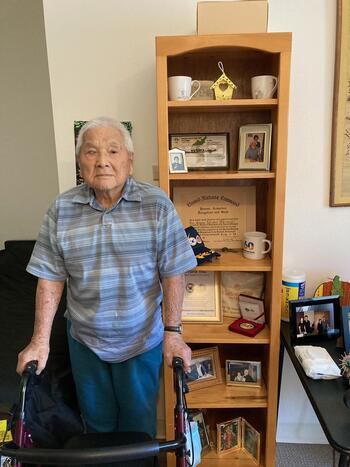
Last week, I had the chance to visit one of my uncles, George Mukai (92), who is a veteran of the Korean War. He recently moved into an assisted-living facility and had very few items delivered from his home to his new residence. One thing that he did have delivered was a curio cabinet that contains Korean War-related items including medals, a cap, a United Nations Command certificate, and a piece of wire from the DMZ.

Image
United Nations Command Certificate
As he has in the past, he shared recollections of his experiences during the Korean War, but unlike when he was young, his recollections felt more poignant. He is a very proud veteran. Another one of my uncles, Roy Mukai (deceased), was also a Korean War veteran, and a third, Toichi Mukai, was stationed in Korea after the Korean Armistice Agreement was signed in 1953.

This month marks the 71st anniversary of the beginning of the Korean War on June 25, 1950. After my visit with George, I started to reflect on the work that my colleagues (past and present) at SPICE have done to promote the study of Korea in U.S. schools and directly to students in the United States. They are:

They have developed extensive curriculum on Korea. The offerings can be found on this webpage and includes offerings such as the following:

  • Colonial Korea in Historical Perspective
  • Divided Memories: Comparing History Textbooks
  • Dynamics of the Korean American Experience
  • Economic Development: The Case of South Korea
  • Inter-Korean Relations: Rivalry, Reconciliation, and Reunification
  • Traditional and Contemporary Korean Culture
  • Uncovering North Korea
  • U.S.–South Korean Relations
     

In addition, the Sejong Korea Scholars Program, an online course for high school students in the United States, has been offered by SPICE since 2013. The SKSP annually selects 20–25 exceptional high school students from throughout the United States and engages them in an intensive study of Korea and U.S.–Korea relations. Selected students participate in the online course on Korea from February to June of each year. The current instructor is Jang.

Lastly, SPICE offers annual summer institutes to middle school and high school teachers in partnership with the National Consortium for Teaching about Asia, and also the East Asia Seminars for Teachers in Hawaii. These are facilitated respectively by Edman, Naomi Funahashi, and Sekiguchi. These programs focus in part on Korea and are funded by the Freeman Foundation.

Image
George Mukai 2021
I wish that I could inform veterans of the Korean War about programs such as these that help to promote a greater understanding of Korea and U.S.–Korea relations among students in the United States, and also to encourage students to reflect upon the sacrifices that were made by the veterans.

Read More

High school student with a diploma standing in front of a banner
Blogs

My Experience with the Sejong Korea Scholars Program in the Midst of a Global Pandemic

The following reflection is a guest post written by Jason Lu, an alumnus of the Sejong Korea Scholars Program, which is currently accepting applications for the 2021 course.
My Experience with the Sejong Korea Scholars Program in the Midst of a Global Pandemic
Student in a red dress presenting at a podium with Stanford signage
Blogs

Coming Full Circle: The Sejong Korea Scholars Program and Stanford

The following reflection is a guest post written by Sandi Khine, an alumna of the Reischauer Scholars Program and the Sejong Korea Scholars Program, which are currently accepting applications for the 2021 courses.
Coming Full Circle: The Sejong Korea Scholars Program and Stanford
5thbuchanan banner
News

SPICE Wins Buchanan Prize for Fifth Time

SPICE Wins Buchanan Prize for Fifth Time
Hero Image
George Mukai in Munsan, a town south of the Imjin River near Panmunjom, during the Korean War, 1951
George Mukai in Munsan, a town south of the Imjin River near Panmunjom, during the Korean War, 1951; image courtesy George Mukai
All News button
1
Subtitle

SPICE offers a series of Korea-focused lesson plans, an online course for U.S. high school students, and teacher professional development opportunities.

News Type
News
Date
Hero Image
Rural China REAP
Rural Education Action Program
All News button
1
Subtitle

This article features Scott Rozelle's research on China's demographics and labor force in China. Rozelle's work indicates that China has a lower quality work force "because China has failed to provide education for all youth through high school, particularly in rural areas."

News Type
News
Date
Hero Image
Old man on urban street in China.
Rural Education Action Program
All News button
1
Subtitle

The Manila Times references Scott Rozelle's newest book "Invisible China" while discussing China's ability, or lack there of, to replace its aging labor force.

News Type
News
Date
Paragraphs

The California Department of Education adopted the Ethnic Studies Model Curriculum last March. Chapter 3 of the Model Curriculum includes a section on “Native American Studies.”

On June 18, 2021, SPICE will host a panel of three Native and Indigenous scholars to reflect on California’s new model curriculum and the state of ethnic studies in their respective regions. The panel will include Navajo, Native Hawaiian, and Ainu educators who will provide a range of educational perspectives on Native and Indigenous studies in the United States and Japan.

  • Dr. Harold Begay, Superintendent of Schools, Navajo Nation
  • Dr. Sachi Edwards, Faculty Member at Soka University in Tokyo, Japan
  • Dr. Ronda Māpuana Shizuko Hayashi-Simpliciano, Vice Principal, Ke Kula Kaiapuni ʻo Ānuenue, Honolulu, Hawaiʻi

The webinar, titled “Indigenous Voices: Educational Perspectives from Navajo, Native Hawaiian, and Ainu Scholars in the Diaspora,” will address several additional topics, such as the various academic field names of the study of Native and Indigenous people, the complexity and diversity of Native and Indigenous people’s experiences, and recommended resources for K–12 educators.

These topics are not only relevant to teachers in California but to educators in other states as well. K–12 educators and administrators are encouraged to attend. Register in advance at https://bit.ly/3z4kxtc.

This webinar is a joint collaboration with the National Consortium for Teaching about Asia (NCTA) and the Center for East Asian Studies at Stanford University.

To stay informed of SPICE news, join our email list and follow us on Facebook, Twitter, and Instagram.

Read More

Tokyo’s Shin Okubo neighborhood, known for its Korea Town
Blogs

Global Human Rights and Minority Social Movements in Japan: A Webinar by Professor Kiyoteru Tsutsui

Tsutsui introduced the audience to three minority groups in Japan—the Ainu, resident Koreans (Zainichi), and the Burakumin—and illustrated how human rights have galvanized minority social movements there.
Global Human Rights and Minority Social Movements in Japan: A Webinar by Professor Kiyoteru Tsutsui
Chinese railroad workers
Blogs

Stanford’s Center for East Asian Studies and SPICE Co-Sponsor Webinar on “Chinese Railroad Workers in North America Project”

The speakers shared extensive primary source documents from Stanford Libraries’ Department of Special Collections, as well as free lesson plans from SPICE's online curriculum unit on Chinese railroad workers.
Stanford’s Center for East Asian Studies and SPICE Co-Sponsor Webinar on “Chinese Railroad Workers in North America Project”
Hero Image
Flyer for the SPICE webinar "Indigenous Voices: Educational Perspectives from Navajo, Native Hawaiian, and Ainu Scholars in the Diaspora"
The June 18 webinar will feature Dr. Harold Begay, Dr. Sachi Edwards, and Dr. Ronda Māpuana Shizuko Hayashi-Simpliciano.
All News button
1
Subtitle

Navajo, Native Hawaiian, and Ainu educators will join together on June 18 to examine the state of Indigenous studies.

-

Webinar recording: https://youtu.be/sQBR-NZBWks


Webinar Description:

On March 18, 2021, the California Department of Education adopted the Ethnic Studies Model Curriculum. Chapter 3 of the Model Curriculum includes a section on “Native American Studies.” Three Native and Indigenous educators will reflect on this and the state of ethnic studies in their regions. The educators are Dr. Harold Begay, Dr. Sachi Edwards, and Dr. Ronda Māpuana Shizuko Hayashi-Simpliciano. Kasumi Yamashita will serve as the moderator of the panel. She is an Instructor for SPICE and was trained as a cultural anthropologist at Harvard University and was a Fulbright Scholar to Brazil.

Some of the topics that will be addressed include (1) the various academic field names of the study of Native and Indigenous people; (2) the complexity and diversity of Native and Indigenous people’s experiences, highlighting key concepts like indigeneity, settler colonialism, diaspora, social justice and activism; and ontological and epistemological philosophy; and (3) recommended resources for K–12 educators.

These topics are not only relevant to teachers in California but to teachers in other states as well. K–12 educators and administrators are encouraged to sign up at https://bit.ly/3z4kxtc.

This webinar is a joint collaboration between the National Consortium for Teaching about Asia (NCTA), Center for East Asian Studies, and SPICE.
 

Featured Speakers:

Dr. Harold Begay

Image
Harold headshot

Dr. Harold Begay, Superintendent of Schools, Navajo Nation, was raised on the Navajo Nation in northern Arizona, amid a deep bicultural chasm irrevocably bound by his traditional Dine’ (Navajo) culture upbringing and mainstream Western Greco-Roman education in the United States. He completed his Ph.D. in school finance/economics, concentrating his advanced studies in educational administration, bilingual education, and social foundations of education from the University of Arizona. Dr. Begay has worked in several Native American school districts in different teaching and administrative capacities over a span of 25 years. Has been a Visiting Scholar at U.C. Berkeley and is currently doing transnational educational work with Stanford University.


Dr. Sachi Edwards

Image
sachi headshot

Dr. Sachi Edwards is a Faculty Member at Soka University in Tokyo, Japan, and also a Lecturer in the Educational Foundations department at the University of Hawaiʻi, Mānoa. Her areas of research include higher education, internationalization, and religious identity, diversity, and oppression. Dr. Edwards received a Ph.D. in higher education from the University of Maryland, College Park. She teaches classes about higher education, international and intercultural education, educational theory/philosophy, qualitative research methods, and academic writing. She was recently featured with Dr. Ronda Māpuana Shizuko Hayashi-Simpliciano in discussion on “Ainu in Diaspora: Rising from Shame, Honoring Ainu Resilience,” hosted by the Japanese American Memorial Pilgrimages.


Dr. Ronda Māpuana Shizuko Hayashi-Simpliciano

Image
mapuana headshot

Dr. Ronda Māpuana Shizuko Hayashi-Simpliciano is Vice Principal of the Hawaiian language immersion school, Ke Kula Kaiapuni ʻo Ānuenue, Honolulu, Hawaiʻi. She is an Ainu-Hawaiian scholar and educator who works in the field of indigenous language and culture restoration. She did her doctoral work at the University of Hawaiʻi, Mānoa. Dr. Hayashi-Simpliciano recently gave a talk on “Ainu in Diaspora History,” hosted by the Japanese American Memorial Pilgrimages.

Via Zoom Webinar. Registration Link: https://bit.ly/3z4kxtc.

Dr. Harold Begay Superintendent of Schools, Navajo Nation
Dr. Sachi Edwards Faculty Member at Soka University in Tokyo, Japan
Dr. Ronda Māpuana Shizuko Hayashi-Simpliciano Vice Principal, Ke Kula Kaiapuni ʻo Ānuenue, Honolulu, Hawaiʻi
Workshops
Subscribe to Education