Kidnapping
Authors
Aurelia Leowinata
News Type
News
Date
Paragraphs

In the wake of Venezuela’s 2024 presidential election — marred by widespread fraud to ensure Nicolás Maduro’s re-election over opposition candidates Edmundo González and María Corina Machado — the regime has escalated its repression of political dissent. In the aftermath of the election, the regime arrested over 2,400 people. More than 807 political prisoners remain unjustly detained, including 95 women, 4 minors, and over 83 foreign nationals. These individuals, many held as leverage in international negotiations, are subjected to degrading conditions and denied due process.

Amongst them is Jesús Armas, a 2022 Fisher Family Summer Fellow at the Center on Democracy, Development and the Rule of Law (CDDRL) and a recently admitted student to Stanford’s Ford Dorsey Master’s in International Policy program (MIP). As a key campaign organizer for González and Machado, Jesús promoted civic participation and democratic unity in Caracas. He has now been held incommunicado, in conditions of physical and legal abuse, for over eight months. His arrest is emblematic of the Maduro regime’s broader strategy to silence opposition and dismantle civil society.

On August 4, 2025 Fisher Family Summer Fellows Lilian Tintori and Waleed Shawky joined Gulika Reddy, Director of the International Human Rights and Conflict Resolution Clinic at Stanford Law School (SLS), for a panel on how local and global communities can support political prisoners and their families. As Beatriz Magaloni, Graham H. Stuart Professor of International Relations, stated in her opening remarks: “This event should act as a call to action for deeper reflection and justice.”

CDDRL faculty wear shirts that read "Liberen a Jesús Armas"
CDDRL faculty standing in solidarity with Jesús Armas and political prisoners around the world. | Nora Sulots

Strategies for Release


Lilian Tintori, an internationally recognized human rights advocate and the wife of former political prisoner Leopoldo López (the 2022 Robert G. Wesson Lecturer in International Relations Theory and Practice at the Freeman Spogli Institute for International Studies), spoke candidly about her seven-year struggle to secure her husband’s release. “It is not easy,” she stated, “You become the voice of the political prisoner. You can’t talk, you have to scream in every crevice, every place, every moment you get.” 

Tintori argues that the most important aspect for release is a community of resilience, which is to provide mental health and emotional support to political prisoners’ families, as they cannot act as the voice if they feel broken themselves. At the heart of this strength, she argued, is love. In her efforts, she now distributes the Pathway to Freedom handbook, produced through her organization, the World Liberty Congress, to help families navigate the grueling road to release.

“Torture only occurs because the Maduro regime knows we are the majority,” Tintori clarified. Since the beginning of 2025, five political prisoners in Venezuela have died in custody. Tintori emphasized the importance of protecting the life of the person being detained — the human being behind the titles of activist, mayor, or opposition leader, beyond a simple number. To raise awareness about political prisoners alike, Tintori often employs the strategy of always mentioning “other political prisoners” after their loved ones’ names. This keeps the broader community of victims in public consciousness.

With international and local channels to plead for help closing, such as the EU or historically, the U.S., all three panelists stressed that silence is not an option for all communities — including academic spheres — and the broader public. Tintori testified that after public pressure, the regimes do pay attention and often send proof of life to suppress further outrage, hence helping to protect prisoners until their release.

You become the voice of the political prisoner. You can’t talk, you have to scream in every crevice, every place, every moment you get.
Lilian Tintori

Ways to Support A Political Prisoner 


Having been a political prisoner himself after co-founding the April 6th Youth Movement in Egypt, Waleed Shawky recounted what he believed carried him through his time behind bars — the cause he fought for. Upholding the values and vision that led to their arrest, he argued, can provide hope and dignity in the most inhumane conditions. “Being a victim is a choice as a prisoner, because you can choose to be a survivor,” Shawky asserted, “It is important to remind them of the bigger picture.” 

Echoing Tintori’s previous statements, Shawky praised the courage of the families, particularly women, who visit and support prisoners, often at great personal risk. He also warned against idolizing or victimizing political prisoners. “They’re human,” he emphasized. “Don’t cry in front of them. Be strong; they need your strength.”

[Political prisoners are] human. Don’t cry in front of them. Be strong; they need your strength.
Waleed Shawky

Authoritarian Crackdowns and Resistance


Gulika Reddy highlighted the challenges advocates operating in authoritarian contexts face and how they navigate these challenges. She broke it down into three different categories: movements, organizations, and individuals.

  • Movements are often delegitimized and co-opted. Reddy stressed the importance of engaging in grounded movement building, offering counter-narratives to sustain public trust, and fostering solidarity and collective action.

  • At the organizational level, regimes may block formal registration, restrict funding, and launch physical or digital attacks — including office raids and data seizures. To survive these assaults, organizations can diversify financial models, invest in digital security, and cultivate collective care to mitigate burnout and trauma. Additionally, there is a need to adopt diverse theories of change in contexts where traditional human rights tactics prove ineffective.

  • For individuals, threats include intimidation and retaliation, which can also extend to their loved ones. Reddy recommended conducting risk assessments and creating mitigation and response plans, including access to free legal aid and safe housing.


What we learned from our speakers is clear: authoritarianism thrives on silence, but freedom depends on our voices. For political prisoners around the world, solidarity, resilience, and an unwavering defense of human dignity are not just ideals; they are lifelines that can bring them home.

Read More

Jesus Armas participates in the 2022 Fisher Family Summer Fellows Program at CDDRL
News

Statement Demanding the Immediate Release of Jesús Armas (FFSF 2022, Venezuela)

A joint statement from the Center on Democracy, Development and the Rule of Law (CDDRL) and the Ford Dorsey Master’s in International Policy program (MIP) at Stanford University.
Statement Demanding the Immediate Release of Jesús Armas (FFSF 2022, Venezuela)
Leopoldo López
News

“Venezuela can be the spark for a fourth wave of democratization,” says Leopoldo López

López, a political leader and prominent advocate for democracy in Venezuela, shared his vision for uniting global efforts to champion freedom and push back against authoritarianism with a Stanford audience on December 2, 2024.
“Venezuela can be the spark for a fourth wave of democratization,” says Leopoldo López
María Corina Machado spoke to a Stanford audience in a special video address on November 18, and engaged in a conversation with Larry Diamond.
News

Venezuela: Cultivating Democratic Resilience Against Authoritarianism

María Corina Machado, the leader of the Venezuelan pro-democracy movement, suggests that a strong international response to Venezuelan authoritarianism will help overcome electoral fraud against democracy in her country.
Venezuela: Cultivating Democratic Resilience Against Authoritarianism
Hero Image
Lilian Tintori, Waleed Shawky, and Gulika Reddy
Lilian Tintori, Waleed Shawky, and Gulika Reddy spoke to a Stanford audience about strategies to support political prisoners in a panel discussion on August 4, 2025.
Nora Sulots
All News button
1
Subtitle

A panel discussion featuring 2025 Fisher Family Summer Fellows Lilian Tintori and Waleed Shawky, along with Gulika Reddy, Director of the International Human Rights and Conflict Resolution Clinic at Stanford Law School, explored the human cost of political imprisonment, the barriers advocates face, and the strategies available to combat them.

Date Label
Authors
News Type
News
Date
Paragraphs

Sheryl Sandberg, former Chief Operating Officer of Meta and founder of LeanIn.org — an NGO dedicated to empowering women and girls — told a Stanford audience that the Oct. 7 Hamas terror attacks and sexual violence against women drew her back to the spotlight with a message for the world:

“What is at stake is actually important for all of humanity,” she said at a Nov. 19 film screening of her documentary, Screams Before Silence. The event was hosted by the Visiting Fellows in Israel Studies program, housed at the Center on Democracy, Development and the Rule of Law, and Hillel at Stanford.

The film included eyewitness accounts from released hostages, survivors, and first responders. During the Hamas attacks on Israeli towns and at the Nova Music Festival, women and girls were raped, assaulted, mutilated, and killed. Released hostages have revealed that Israeli captives in Gaza have also been sexually assaulted.

Yet, as Sandberg noted, the atrocities have received little scrutiny or attention from human rights and feminist groups, international organizations, and others. Some denialists have even said Hamas’ sexual violence never took place or that it was invented by Israel itself — an echo of 9/11 denialism and antisemitic conspiracy theories. So, Sandberg undertook the challenge of creating a 60-minute documentary, which has now registered almost three million YouTube views while also being screened around the world.

‘Make people see this’


Sandberg interviewed survivors and witnesses and survivors and traveled to the site of the Nova Music Festival, where 364, mostly young revelers, were murdered in the worst terrorist attack in the country’s history. She viewed hundreds of photos of dead bodies of women who displayed clear signs of sexual abuse and harm.

She noted that even war has rules of law and that what she discovered while making the film was often incomprehensible, tragic, and heartbreaking.

Rape should never be used as an act of war, she said, and silence is complicity. “We know we have to keep fighting and trying to make people see this.”


We know we have to keep fighting and trying to make people see this.
Sheryl Sandberg
Founder, LeanIn.org


‘A Moral Eclipse’


In his introduction of Sandberg, Amichai Magen, the inaugural Visiting Fellow in Israel Studies at the Freeman Spogli Institute for International Studies (FSI), explained the film’s title.

“There is the obvious meaning, capturing the silence of death after the acts of violence. But there is also the silence of the international community, the complete shock experienced by Jewish communities all around the world, that on Oct. 8, some people denied this ever happened … After the screams, we experienced a moral silence, a moral eclipse. And then there is the silence of the invisible wounds, the broken minds, the broken souls, the broken families,” Magen said.

Amichai Magen delivers opening remarks at a podium before a screening of "Screams Before Silence."
Amichai Magen delivers opening remarks before a screening of "Screams Before Silence." | Rod Searcey

After leaving Meta a few years ago, Sandberg said she was completely committed to being private and not public anymore. “I'd had it, and it was done.” And then, Oct. 7 took place, and subsequent reports about sexual violence seemed to be met with an eerie silence.

Why the silence? Sandberg offered that people are so politically polarized today that they want every fact to fit into their particular narrative. And for some, sexual violence may not fit into their narrative.

“What is happening is that politics — polarization and extreme politics — are blinding us to something that should be completely obvious. I shouldn't even have to say this. Rape is not resistance. Never. Under any circumstances. Rape is not resistance. It never has been, it never will be,” she said.


Rape is not resistance. Never. Under any circumstances. Rape is not resistance. It never has been, it never will be.
Sheryl Sandberg
Founder, LeanIn.org


Anyone who has a mother, a sister, a daughter, a wife, or a friend should join together to unite against rape in war or elsewhere, she added.

“It threatens all of our values,” Sandberg said about Hamas’ massacres of Israelis.

In one interview that Sandberg conducted, she spoke with Ayelet Levy Sachar, the mother of 19-year-old Naama Levy, whose kidnapping that morning was filmed by Hamas. The horrific sight of her pajama bottoms, drenched in blood at the back, was a clear indicator that sexual brutality was carried out by Hamas.

‘He’s just a hero’


After the film concluded, Sandberg joined Ayelet Gundar-Goshen, and Rabbi Idit Solomon for a conversation and question-and-answer session with the audience. Gundar-Goshen is a clinical psychologist who has personally treated Nova survivors. This quarter she is lecturer and artist-in-residence at Stanford’s Taube Center for Jewish Studies. Rabbi Idit Solomon is the interim associate director at Hillel at Stanford.

Ayelet Gundar-Goshen in conversation with Sheryl Sandberg.
Ayelet Gundar-Goshen in conversation with Sheryl Sandberg. | Rod Searcey

Sandberg expressed heartache over the current situation in Gaza and said she is a supporter of a two-state solution for Israel and the Palestinians.

“War is a terrible thing. Terror is a terrible thing. Oct. 7 is a terrible thing. What happened after that is a terrible thing. None of this should happen. We have to believe in peace. We have to get to peace. But in order to have peace, you need two people who are willing to let the other side live in peace,” she said.

In the film, she spoke with Rami Davidson, who heroically saved over 100 lives at the Nova Music Festival.

“He's just a hero,” Sandberg said about her interview with Davidson near the spot of the Nova festival. They stood close to the trees where he recalled seeing naked and mutilated bodies tied to them on Oct. 7.

“And he starts crying. He said, ‘I could have saved them. He rescued over 100 people, mostly from the Nova … For 10 hours, he went in and out in his little car, rescuing people, risking his own life. And he was just crying about the ones he didn't get to.”


We have to believe in peace. We have to get to peace. But in order to have peace, you need two people who are willing to let the other side live in peace.
Sheryl Sandberg
Founder, LeanIn.org


‘A threat to our values’


Sandberg urged the audience to embrace the point that such terror will never have a place in a civilized world.

“It may take time and it may take a lot of work by people like you and all the brave people who are here today. But we are going to persuade people that this is terror. We are going to get to a world where people don't tolerate this terror and recognize the threat to our values that this is,” she said.

The documentary was released for private and public use without any licensing fees. “We're trying to get everyone we can to see it,” she said. It can be viewed for free on YouTube.

Sandberg recalled a discussion with Denis Mukwege, a Congolese physician who won the Nobel Peace Prize for his efforts to end the use of sexual violence as a weapon of war and armed conflict. Mukwege said the most horrible aspect of sexual violence as a war tool is that it's incredibly effective and free.

“It doesn't just take real lives, but it destroys communities in many places around the world. When a woman is raped, in some cultures, she's then outcast from her society. It systematically destroys the fabric of communities. You have the single most effective tool of war, and it is available for free. You don't have to buy a bomb or a gun. That is so devastating because you realize what we're up against,” Sandberg said.

She concluded, “We will come through this. Not everyone will come through this. These people, some of these people will not. But we will come through this. And so, this event gives me hope.”

Ayelet Gundar Goshen, Sheryl Sandberg, and Rabbi Idit Solomon discuss Sandberg's documentary "Screams Before Silence" following a Stanford screening on November 19, 2024.
Ayelet Gundar Goshen, Sheryl Sandberg, and Rabbi Idit Solomon discuss Sandberg's documentary "Screams Before Silence" following a Stanford screening on November 19, 2024. | Rod Searcey

If you are someone you know has been affected by sexual violence, the following resources are available for support:
 

  1. CAPS: Stanford Counseling and Psychological Services
    CAPS provides an array of mental health services available to students: clinical services, groups and workshops, and options for care outside of CAPS. Additionally, satellite clinics in multiple community centers offer "Let’s Talk in community."
    Phone: 650.723.3785
     
  2. Confidential Support Team (CST)
    Supports connection, healing, and thriving among Stanford community members impacted by sexual, relationship, and gender-based violence through confidential, trauma-informed consultation, counseling, and outreach. Legally confidential (non-reporting) support for sexual assault or relationship abuse.
    Phone: 650.736.6933
    24/7 urgent support hotline: 650.725.9955
     
  3. Hillel@Stanford Brief Therapy Program
    Up to 5 sessions are free for students who identify as part of the Hillel community.
    Email: ekrohner@brieftherapycenter.org
     
  4. 211 Santa Clara County
    Free sexual assault hotline.
    Phone: Dial 211
     
  5. Shalom Bayit
    Support for Jewish battered women.
    Helpline: 866.742.5667 (SHALOM-7)

Read More

Family and friends of May Naim, 24, who was murdered by Palestinians militants at the "Supernova" festival, near the Israeli border with Gaza strip, react during her funeral on October 11, 2023 in Gan Haim, Israel. (Getty Images)
News

FSI Scholars Analyze Implications of Hamas’ Terror Attack on Israel

Larry Diamond moderated a discussion between Ori Rabinowitz, Amichai Magen and Abbas Milani on the effects of Hamas’ attacks on Israel and what the emerging conflict means for Israel and Middle Eastern geopolitics.
FSI Scholars Analyze Implications of Hamas’ Terror Attack on Israel
Panelists at the event "1973 Yom Kippur War: Lessons Learned"
News

The 1973 Yom Kippur War and Lessons for the Israel-Hamas Conflict

Scholars of Israel and the Middle East discussed the strategic takeaways of the 1973 Yom Kippur War and their relevance to the region’s current security crisis.
The 1973 Yom Kippur War and Lessons for the Israel-Hamas Conflict
Tzipi Livni speaks at a lunch time event with Stanford faculty and students.
News

FSI's Visiting Fellow in Israel Studies Reflects on What Lies Ahead for Israel and the Middle East

The October 7, 2023, attack by Hamas has already indelibly altered Israel and the Middle East, and will continue to reverberate for decades to come, says Amichai Magen, a fellow at the Freeman Spogli Institute for International Studies.
FSI's Visiting Fellow in Israel Studies Reflects on What Lies Ahead for Israel and the Middle East
Hero Image
Sheryl Sandberg answers audience questions with Rabbi Idit Solomon, Interim Associate Director of Hillel at Stanford, following a screening of her documentary film, "Screams Before Silence," on November 19.
Sheryl Sandberg answers audience questions with Rabbi Idit Solomon, Interim Associate Director of Hillel at Stanford, following a screening of her documentary film, "Screams Before Silence," on November 19, 2024.
Rod Searcey
All News button
1
Subtitle

Sheryl Sandberg said that filming a documentary about the sexual brutality of Hamas’ attacks on Israelis on Oct. 7 was the most important work of her life and that she wants to turn the world’s attention to the inhumanity that took place.

Date Label
-
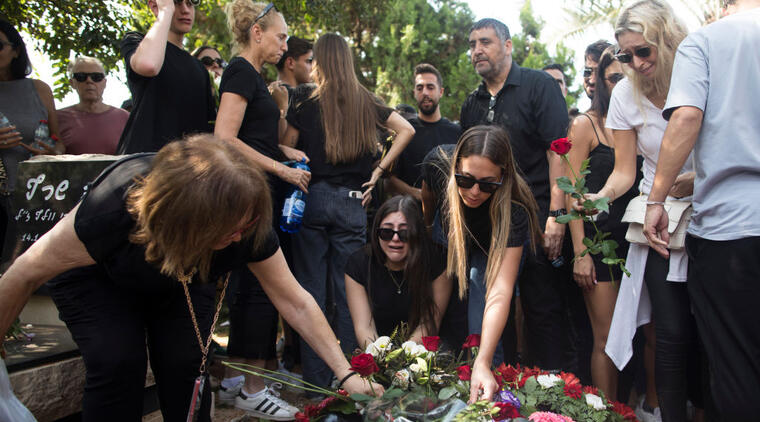
Family and friends of May Naim, 24, who was murdered by Palestinians militants at the "Supernova" festival, near the Israeli border with Gaza strip, react during her funeral on October 11, 2023 in Gan Haim, Israel. (Getty Images)

On Saturday October 7, 2023, two Iranian-backed terrorist organizations based in the Gaza Strip — Hamas and Palestinian Islamic Jihad (PIJ) — inflicted the most lethal attack suffered by the State of Israel since its founding in May 1948. 

Over 1200 Israelis, overwhelmingly civilians, were murdered, 3000 wounded, and approximately 150 kidnapped into Gaza, to be used as human shields and bargaining chips. The attacks also involved unspeakable acts of sexual violence and infanticide. Retaliatory Israeli air strikes have killed over 800 Gazans so far. 

The conflict risks escalating to an all-out regional confrontation, involving several other Iranian proxies (most notably Hezbollah in Lebanon) and even a direct Iran-Israel war. This could have devastating and transformative implications for the Middle East, U.S. foreign policy, and the entire international system. What led to the events of October 7? How was Israel caught so completely off guard? Did Iran order the attack? What are the possible scenarios for the conflict? And what can the Biden Administration do?

SPEAKERS

Amichai Magen

Amichai Magen

Inaugural visiting fellow in Israel Studies at FSI
Lauder School of Government, Diplomacy, and Strategy, Reichman University in Herzliya, Israel
Full Profile
Abbas Milani photo by Babak Payami

Abbas Milani

Hamid and Christina Moghadam Director of Iranian Studies
Stanford University
Full Profile
Or Rabinowitz

Or Rabinowitz

Visiting associate professor at FSI's Center for International Security and Cooperation
International Relations Department of Hebrew University, Jerusalem
Full Profile

MODERATOR

Portrait of Hesham Sallam

Larry Diamond

Mosbacher Senior Fellow in Global Democracy at FSI
William L. Clayton Senior Fellow at the Hoover Institution
FULL PROFILE
Larry Diamond
Larry Diamond

Zoom Only

0
Director, Jan Koum Israel Studies Program, CDDRL
Visiting Fellow in Israel Studies, FSI (2022-2025)
W. Glenn Campbell National Fellow, Hoover Institution (2008-2009)
CDDRL Affiliated Scholar, 2008-2009
CDDRL Predoctoral Fellow, 2004-2008
amichai_magen.jpg

Amichai Magen is the founding director of the Jan Koum Israel Studies Program at the Center on Democracy, Development and the Rule of Law. Previously, he served as the visiting fellow in Israel Studies at Stanford University's Freeman Spogli Institute for International Studies, head of the MA Program in Diplomacy & Conflict Studies, and director of the Program on Democratic Resilience and Development (PDRD) at the Lauder School of Government, Diplomacy and Strategy, Reichman University, Herzliya, Israel. His research and teaching interests address democracy, the rule of law, liberal orders, risk and political violence, as well as Israeli politics and policy.

Magen received the Yitzhak Rabin Fulbright Award (2003), served as a pre-doctoral fellow at the Center on Democracy, Development and the Rule of Law, and was the W. Glenn Campbell National Fellow at the Hoover Institution (2008-9). In 2016, he was named a Richard von Weizsäcker Fellow of the Robert Bosch Academy, an award that recognizes outstanding thought leaders around the world. Between 2018 and 2022, he served as principal investigator in two European Union Horizon 2020 research consortia, EU-LISTCO and RECONNECT. Amichai Magen served on the Executive Committee of the World Jewish Congress (WJC) and is a Board Member of the Israel Council on Foreign Relations (ICFR) and the International Coalition for Democratic Renewal (ICDR).

Date Label
Amichai Magen

615 Crothers Way,
Encina Commons, Room 128A
Stanford University
Stanford, CA 94305

(650) 721-4052
0
Research Fellow, Hoover Institution
abbas_milani_photo_by_babak_payami.jpg PhD

Abbas Milani is the Hamid and Christina Moghadam Director of Iranian Studies at Stanford University and a visiting professor in the department of political science. In addition, Dr. Milani is a research fellow and co-director of the Iran Democracy Project at the Hoover Institution.

Prior to coming to Stanford, Milani was a professor of history and political science and chair of the department at Notre Dame de Namur University and a research fellow at the Institute of International Studies at the University of California at Berkeley. Milani was an assistant professor in the faculty of law and political science at Tehran University and a member of the board of directors of Tehran University's Center for International Studies from 1979 to 1987. He was a research fellow at the Iranian Center for Social Research from 1977 to 1978 and an assistant professor at the National University of Iran from 1975 to 1977.

Dr. Milani is the author of Eminent Persians: Men and Women Who Made Modern Iran, 1941-1979, (Syracuse University Press, Syracuse, NY, 2 volumes, November, 2008); King of Shadows: Essays on Iran's Encounter with Modernity, Persian text published in the U.S. (Ketab Corp., Spring 2005); Lost Wisdom: Rethinking Persian Modernity in Iran, (Mage 2004); The Persian Sphinx: Amir Abbas Hoveyda and the Riddle of the Iranian Revolution (Mage, 2000); Modernity and Its Foes in Iran (Gardon Press, 1998); Tales of Two Cities: A Persian Memoir (Mage 1996); On Democracy and Socialism, a collection of articles coauthored with Faramarz Tabrizi (Pars Press, 1987); and Malraux and the Tragic Vision (Agah Press, 1982). Milani has also translated numerous books and articles into Persian and English.

Milani received his BA in political science and economics from the University of California at Berkeley in 1970 and his PhD in political science from the University of Hawaii in 1974.

Hamid and Christina Moghadam Director of Iranian Studies
Co-director of the Iran Democracy Project
CDDRL Affiliated Scholar
Date Label
Abbas Milani
0
Visiting Scholar
or-rabinowitz_headshot.jpg

Or (Ori) Rabinowitz, (PhD), a Chevening scholar, is an associate professor at the International Relations Department of the Hebrew University of Jerusalem, Israel. During the academic year of 2022-2023 she will hold the post of visiting associate professor at Stanford’s CISAC. Her research interests include nuclear proliferation, intelligence studies, and Israeli American relations. Her book, Bargaining on Nuclear Tests was published in April 2014 by Oxford University Press. Her studies were published leading academic journals, including International Security, Journal of Strategic Studies, and International History Review, as well as op-eds and blog posts in the Washington Post, Foreign Policy and Ha’aretz. She holds a PhD degree awarded by the War Studies Department of King’s College London, an MA degree in Security Studies and an LLB degree in Law, both from Tel-Aviv University. She was awarded numerous awards and grants, including two personal research grants by the Israeli Science Foundation and in 2020 was a member of the Young Academic forum of the Israeli Academy for Sciences and Humanities.  

CV
Date Label
Or Rabinowitz
Seminars
Date Label
Paragraphs

Why do drug trafficking organizations (DTOs) sometimes prey on the communities in which they operate but sometimes provide assistance to these communities? What explains their strategies of extortion and co-optation toward civil society? Using new survey data from Mexico, including list experiments to elicit responses about potentially illegal behavior, this article measures the prevalence of extortion and assistance among DTOs. In support of our theory, these data show that territorial contestation among rival organizations produces more extortion and, in contrast, DTOs provide more assistance when they have monopoly control over a turf. The article uncovers other factors that also shape DTOs’ strategies toward the population, including the degree of collaboration with the state, leadership stability and DTO organization, and the value and logistics of the local criminal enterprise.

Read here.

All Publications button
1
Publication Type
Journal Articles
Publication Date
Authors
Beatriz Magaloni
Alberto Díaz-Cayeros
Authors
News Type
Commentary
Date
Paragraphs

Julie Cordua, executive director of Thorn, a non-profit organization founded by Ashton Kutcher and Demi Moore, spoke passionately on the topic child exploitation and sexual abuse imagery for the Stanford Program on Human Rights’ Winter Speaker Series U.S Human Rights NGOs and International Human Rights on February 4, 2015.

Cordua addressed the Stanford audience about the importance of technology for acting as the “digital defenders of children." She provided a chilling account of child sexual exploitation, first describing the problem and then going on to challenge preconceived notions about it. For example, she highlighted that in order to tackle the issue, it must first be understood that it concerns a highly vulnerable population; most child victims of sexual exploitation come from extremely abusive backgrounds and many have been sexually abused by one or more parents.

Cordua emphasized that technology innovations have contributed to a proliferation of child exploitation and sexual abuse imagery through the use of encrypted networks that make it extremely difficult to hunt down perpetrators and find victims. Cordua feels that while technology is intensifying the problem, technology is also the solution.  Examples she gave were the development of algorithms that aim to track perpetrators and their victims and advertisements that encourage pedophiles to seek help.

Helen Stacy, director of the Program on Human Rights, queried Cordua on Thorn’s relationship with the government and private sector, as well as on Thorn’s approach for testing the efficacy of their programs. Cordua responded that Thorn does not apply for government funds so as to maintain independence over their projects but that they actively cultivate strong relationships with politicians and law enforcers. In relation to evaluation metrics, Cordua acknowledged that metrics are especially difficult in such a cryptic field as it is nearly impossible to know what numbers they are dealing with from the onset. Questions from the audience included effective strategies for changing the conversation of pedophilia in the public sphere, the emotional stamina required for pursuing such work, and strategies for connecting with and providing a safe platform for victims of child sexual exploitation.

Dana Phelps, Program Associate, Program on Human Rights


Hero Image
dsc 0476
Julie Cordua, executive director of Thorn, speaks at Stanford
Dana Phelps
All News button
1
-

Abstract: Jason Payne, Palantir's Philanthropy Engineering Lead and Stanford Computer Science BS 2005, will discuss how the fusion and analysis of data sets, including open and public data, can shed light on transnational criminal enterprises. Examples will include human trafficking, weapons trafficking, environmental crime to include ivory poaching, and human tissue trafficking. The talk will also include a discussion on how governmental, commercial, and social sector entities can collaborate, while respecting privacy and civil liberties, to address pressing problem sets around the world.

Encina Hall (2nd floor)

Jason Payne Philanthropy Engineering Lead Speaker Palantir
Seminars

Department of History
Stanford University
Stanford, CA  94305-2024
 

(650) 723-1884 (650) 725-0597
0
Senior Lecturer in History
Senior Fellow of the WSD HANDA Center for Human Rights and International Justice
k_jolluck_webpage_photo.jpg PhD

Katherine R. Jolluck is Senior Lecturer and Coordinator of the Public History/Public Service Track in the Department of History at Stanford University.  She is also a Senior Fellow at the Center for Human Rights and International Justice.  She has also taught at the University of North Carolina at Chapel Hill and the Naval Post-Graduate School in Monterey.  A specialist on the history of twentieth-century Eastern Europe and Russia, she focuses on the topics of women and war, women in communist societies, nationalism, the Soviet Gulag, and human trafficking. Her books include: Exile and Identity: Polish Women in the Soviet Union during WWII, and Gulag Voices: Oral Histories of Soviet Incarceration and Exile (with Jehanne M Gheith). She has also written articles on Poland in World War II, antisemitism, and human trafficking in Europe.  Jolluck serves on the Faculty Steering Committee of the Haas Center for Public Service, offers service-learning courses, and is active in the Bay Area anti-trafficking community.  She is a Steering Committee member of No Traffick Ahead, a multi-county, multi-disciplinary workgroup dedicated to combating human trafficking in all forms.


Affiliated Senior Lecturer at The Europe Center
Affiliated Senior Lecturer at the Program on Human Rights
CV

We study the dynamics and logic of extortion in Mexico’s drug war. Mexican drug trafficking organizations have diversified into a host of other illicit activities, protection rackets, oil and fuel theft, kidnapping, human smuggling, prostitution, money laundering, weapons trafficking, auto theft and domestic drug sales. The project seeks to measure, through the use of list-experiments, patterns of extortion by both criminal organization and the police, and the extent to which drug cartels coopt civil society and become embedded in the social fabric.

Authors
News Type
News
Date
Paragraphs

As if the alleged Iranian plan to kill Saudi Arabia’s ambassador to the U.S. wasn’t strange and sinister enough, it offered an outlandish twist: American officials say the Iranian plotters wanted to hire a Mexican drug cartel to carry out the murder.

The charges laid out earlier this week are raising questions about how the United States should respond to Iran, skepticism about the Mexican underworld’s possible involvement and concerns about the growing, borderless network of global terrorism.

Mariano-Florentino Cuéllar, a law professor and co-director of the Center for International Security and Cooperation at the Freeman Spogli Institute for International Studies, and Beatriz Magaloni, an associate professor of political science and affiliated faculty of FSI’s Center on Democracy, Development and the Rule of Law, discuss the developing events.

President Obama is vowing to impose tougher sanctions on Iran. What good will they do?

Cuéllar: Countries use sanctions to achieve multiple goals. Sanctions often put pressure on the regime and disrupt the regime’s capacity to move money, pay for resources, and offer goods and services on the international market. Even if they are imperfectly enforced, sanctions can affect particular individuals or organizations within states. Separately, sanctions signal the resolve of the nation imposing them, and thus the United States can force discussion among governments and diplomats regarding how the international community will respond to a state violating international norms.

Do Mexican drug cartels have the ability and willingness to be the hired guns in global terrorist operations?

Magaloni: Drug cartels are increasingly diversifying their portfolios of crime. They’re not exclusively engaging in the trading of drugs. They’re also engaged in many other criminal activities, including kidnapping, and extortion. And some have engaged in human trafficking.

Can this extend to acts of terror beyond Mexico? At this moment – with the evidence I see – I find it difficult to believe.

Mexican drug gangs do not seem to have that much capacity to operate in the U.S. There is an implicit agreement between government officials in some states and the cartels, and that’s what allows them to operate, often with impunity. But right now, I don’t think they can orchestrate the same type of terror once they cross the border because they do not have the same networks in the US.

How do you expect the criminal case to play out?

Cuéllar:  The criminal complaint alleges that accused individuals sought the assistance of a Mexican drug cartel. Instead of negotiating with that organization, however, the accused ended up interacting with a confidential informant working for American law enforcement agencies. Prosecutors will nonetheless focus on the motivation of the accused and the possibility that individuals with such goals might succeed in forging alliances with transnational criminal organizations in the future.  

How is the criminal activity in Mexico affecting security in the region?

Cuéllar: Although Mexico is a country that faces considerable challenges involving security and state capacity, it is certainly not Somalia or Afghanistan. And the Attorney General indicated that the Mexican government worked closely with U.S. authorities investigating the alleged criminal conspiracy. Nonetheless, Mexico has become a focal point for the activity of certain large criminal organizations with the ability to operate across large territories and to harness different forms of expertise. 

While these criminal networks certainly affect the security environment in both Mexico and the United States, there is often something of a paradox in the nature of the threat they pose. The organizations with the greatest capacity to engage in complicated operations across borders tend to be the ones with the tightest hold on lucrative pieces of the drug trade. And they are probably the most skeptical of getting involved in something that will draw a massive response from the United States.

What may complicate the situation is that some of the criminal organizations are beginning to fragment in response to changing dynamics in illicit markets and conflict with Mexican authorities. Fragmentation tends to weaken hierarchies, disrupting the ability of leaders to discipline the subordinates capable of engaging in violent activity. Continuing fragmentation may further affect the security context, as individuals and smaller organizations compete for resources and seek new markets for illicit activity.

Hero Image
magaloni cuellar
All News button
1
Subscribe to Kidnapping