Air Pollution and Short-Term Mortality in Beijing
Philippines Conference Room
For nearly 70 years, CARE has been serving individuals and families in the world's poorest communities. Today, they work in 84 countries around the world, with projects addressing issues from education and healthcare to agriculture and climate change to education and women's empowerment. Helene Gayle, president and CEO of CARE USA, will discuss her work with CARE and her experiences in the field of international development. Dr. Gayle will discuss how access to global health is integral to CARE's effort in addressing the underlying causes of extreme global poverty.
Dr. Michele Barry, director of the Center for Innovation in Global Health, will moderate a conversation between CARE President and CEO, Dr. Helene Gayle and former Prime Minister of Norway and United Nations Special Envoy, Dr. Gro Brundtland.
This event is sponsoredy by CARE USA, the Center on Democracy, Development and the Rule of Law and the Haas Center for Public Service.
A reception will follow the event.
Dr. Gro Brundtland Bio:
Dr. Gro Harlem Brundtland is the former prime minister of Norway and the current deputy chair of The Elders, a group of world leaders convened by Nelson Mandela and others to tackle the world’s toughest issues. She was recently appointed as the Mimi and Peter E. Haas Distinguished Visitor for spring 2014 at the Haas Center for Public Service at Stanford University. Dr. Brundtland has dedicated over 40 years to public service as a doctor, policymaker and international leader. She was the first woman and youngest person to serve as Norway’s prime minister, and has also served as the former director-general of the World Health Organization and a UN special envoy on climate change.
Her special interest is in promoting health as a basic human right, and her background as a stateswoman as well as a physician and scientist gives her a unique perspective on the impact of economic development, global interdependence, environmental issues and medicine on public health.
Dr. Helene Gayle Bio:
Helene D. Gayle joined CARE USA as president and CEO in 2006. Born and raised in Buffalo, New York, she received her B.A. from Barnard College of Columbia University, her M.D. from the University of Pennsylvania and her M.P.H. from Johns Hopkins University. After completing her residency in pediatric medicine at the Children's Hospital National Medical Center in Washington, D.C., she entered the Epidemic Intelligence Service at the Centers for Disease Control and Prevention, followed by a residency in preventive medicine, and then remained at CDC as a staff epidemiologist.
At CDC, she studied problems of malnutrition in children in the United States and abroad, evaluating and implementing child survival programs in Africa and working on HIV/AIDS research, programs and policy. Dr. Gayle also served as the AIDS coordinator and chief of the HIV/AIDS division for the U.S. Agency for International Development; director for the National Center for HIV, STD, and TB Prevention, CDC; director of CDC's Washington office; and health consultant to international agencies including the World Health Organization, UNICEF, the World Bank and UNAIDS. Prior to her current position, she was the director of the HIV, TB and reproductive health program for the Bill and Melinda Gates Foundation.
Hewlett 201
Hewlett Teaching Center
370 Serra Mall
Stanford, CA 94305
Abstract:
Around the world, public health interventions have dramatically changed the life chances of millions. Life expectancy has increased, and fewer children die prematurely at an early age. However, health performance is characterized by large inequalities. Patients are often treated with little dignity, particularly when they are poor. And health systems tend to be relatively unaccountable to citizens. The project “The Governance of Public Health in Mexico” seeks to offer citizens, researchers and policy makers a set of tools that may enable them to evaluate, visualize and interpret the performance of the Mexican health system from a bottom up accountability perspective. The presentation will center around the development of a municipal dashboard that allows for the measurement of the relative performance of local governments in health, and the use of visualization tools to understand the epidemiological profiles of municipalities, based on the methodology of the Global Burden of Disease.
Speaker Bio:
Alberto Diaz-Cayeros joined the FSI faculty in 2013 after serving for five years as the director of the Center for US-Mexico studies at the University of California, San Diego. He earned his Ph.D at Duke University in 1997. He was an assistant professor of political science at Stanford from 2001-2008, before which he served as an assistant professor of political science at the University of California, Los Angeles. Diaz-Cayeros has also served as a researcher at Centro de Investigacion Para el Desarrollo, A.C. from 1997-1999. His work has primarily focused on federalism and economic reform in Latin America, and Mexico in particular. He has published widely in Spanish and English. His forthcoming book is entitled Strategies of Vote Buying: Democracy, Clientelism and Poverty Relief in Mexico (with Federico Estevez and Beatriz Magaloni).
Encina Ground Floor Conference Room
Encina Hall, C149
616 Jane Stanford Way
Stanford, CA 94305
Alberto Díaz-Cayeros is a Senior Fellow at Stanford University's Freeman Spogli Institute for International Studies (FSI), and co-director of the Democracy Action Lab (DAL), based at FSI's Center on Democracy, Development and Rule of Law (CDDRL). His research interests include federalism, poverty relief, indigenous governance, political economy of health, violence, and citizen security in Mexico and Latin America.
He is the author of Federalism, Fiscal Authority and Centralization in Latin America (Cambridge, reedited 2016), coauthored with Federico Estévez and Beatriz Magaloni, of The Political Logic of Poverty Relief (Cambridge, 2016), and of numerous journal articles and book chapters.
He is currently working on a project on cartography and the developmental legacies of colonial rule and governance in indigenous communities in Mexico.
From 2016 to 2023, he was the Director of the Center for Latin American Studies at Stanford University, and from 2009 to 2013, Director of the Center for US-Mexican Studies at UCSD, the University of California, San Diego.
This project focuses on intestinal roundworms, a neglected disease in China. These infections may have a devastating effect on a population, siphoning valuable nutrients away from the host, leading to malnutrition, stunted growth and poorer school performance. In the study, the researchers aim to contribute to the literature by conducting a Randomized Controlled Trial (RCT) in rural China to measure the impact of worm infection on school children.
CISAC Conference Room
Encina Hall East, E404
Stanford, CA 94305-6055
Scott Rozelle is the Helen F. Farnsworth Senior Fellow and the co-director of Stanford Center on China's Economy and Institutions in the Freeman Spogli Institute for International Studies and Stanford Institute for Economic Policy Research at Stanford University. He received his BS from the University of California, Berkeley, and his MS and PhD from Cornell University. Previously, Rozelle was a professor at the University of California, Davis and an assistant professor in Stanford’s Food Research Institute and department of economics. He currently is a member of several organizations, including the American Economics Association, the International Association for Agricultural Economists, and the Association for Asian Studies. Rozelle also serves on the editorial boards of Economic Development and Cultural Change, Agricultural Economics, the Australian Journal of Agricultural and Resource Economics, and the China Economic Review.
His research focuses almost exclusively on China and is concerned with: agricultural policy, including the supply, demand, and trade in agricultural projects; the emergence and evolution of markets and other economic institutions in the transition process and their implications for equity and efficiency; and the economics of poverty and inequality, with an emphasis on rural education, health and nutrition.
Rozelle's papers have been published in top academic journals, including Science, Nature, American Economic Review, and the Journal of Economic Literature. His book, Invisible China: How the Urban-Rural Divide Threatens China’s Rise, was published in 2020 by The University of Chicago Press. He is fluent in Chinese and has established a research program in which he has close working ties with several Chinese collaborators and policymakers. For the past 20 years, Rozelle has been the chair of the International Advisory Board of the Center for Chinese Agricultural Policy; a co-director of the University of California's Agricultural Issues Center; and a member of Stanford's Walter H. Shorenstein Asia-Pacific Research Center and the Center on Food Security and the Environment.
In recognition of his outstanding achievements, Rozelle has received numerous honors and awards, including the Friendship Award in 2008, the highest award given to a non-Chinese by the Premier; and the National Science and Technology Collaboration Award in 2009 for scientific achievement in collaborative research.
Nipah virus commonly infects large fruit bats in South and Southeast Asia. It does not cause any apparent disease in bats, but when the infection spills over into humans in Bangladesh, over 75 percent of infected people die, and infected humans can pass the infection on to other people. People in Bangladesh most commonly become infected with Nipah virus by drinking raw date palm sap that has been contaminated by bats during harvest.
As the population of older adults in the US increases, there is a growing need for performance measurement systems that take multiple comorbid conditions into account.
A particular theme of the 2014 challenge will be how to generalise diabetes simulation models for different populations and over time. To what degree are existing models able to adjust for differences risk due to ethnic and socio-economic differences as well as any secular improvements in diabetes care?"
The conference will also have open sessions on all aspects of the health economics of diabetes.
Bechtel Conference Center
Abstract:
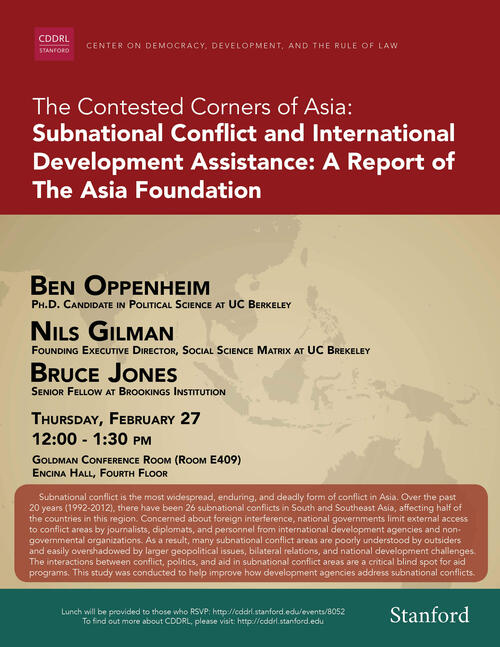
Subnational conflict is the most widespread, enduring, and deadly form of conflict in Asia. Over the past 20 years (1992-2012), there have been 26 subnational conflicts in South and Southeast Asia, affecting half of the countries in this region. Concerned about foreign interference, national governments limit external access to conflict areas by journalists, diplomats, and personnel from international development agencies and non-governmental organizations. As a result, many subnational conflict areas are poorly understood by outsiders and easily overshadowed by larger geopolitical issues, bilateral relations, and national development challenges. The interactions between conflict, politics, and aid in subnational conflict areas are a critical blind spot for aid programs. This study was conducted to help improve how development agencies address subnational conflicts.
Speaker Bios:
Ben Oppenheim is a Fellow (non-resident) at the Center on International Cooperation at New York University. His research spans a diverse set of topics, including fragile states, transnational threats (including pandemic disease risks and terrorism), and the strategic coherence and effectiveness of international assistance in fragile and conflict-affected areas.
Oppenheim has consulted for organizations including the World Bank, the United Nations, the Asia Foundation, the Institute for the Future, and the Fritz Institute, on issues including organizational learning, strategy, program design, foresight, and facilitation. In 2009, he served as Advisor to the first global congress on disarmament, demobilization, and reintegration, supported by the World Bank and the UN.
In 2013, Oppenheim was a visiting fellow at the Uppsala University Forum on Democracy, Peace, and Justice. His research has been supported by a Simpson Fellowship, and a fellowship with the Institute on Global Conflict and Cooperation. He was also a research fellow with UC Berkeley's Institute of International Studies, affiliated with the New Era Foreign Policy Project.
Nils Gilman is the Executive Director of Social Science Matrix. He holds a B.A., M.A. and Ph.D. in History from the University of California, Berkeley. Gilman’s first scholarly interest was in American and European intellectual history, with a particular focus on the institutional development of the social sciences, the lateral transfer and translation of ideas across disciplinary boundaries, and the impact of social scientific ideas on politics and policy.
Gilman is the author of Mandarins of the Future: Modernization Theory in Cold War America (Johns Hopkins University Press, 2004), the co-editor of Staging Growth: Modernization, Development, and the Global Cold War (University of Massachusetts Press, 2003) and Deviant Globalization: Black Market Economy in the 21st Century (Continuum Press, 2011), as well as the founding Co-editor of Humanity: An International Journal of Human Rights, Humanitarianism, and Development. He also blogs and tweets.
Prior to joining Social Science Matrix in September 2013, Gilman was research director at Monitor 360, a San Francisco consultancy that addresses complex, cross-disciplinary global strategic challenges for governments, multinational businesses, and NGOs. He has also worked at a variety of enterprise software companies, including Salesforce.com, BEA Systems, and Plumtree Software. Gilman has taught and lectured at a wide variety of venues, from the Harvard University, Columbia University, and National Defense University, to PopTech, the European Futurists Conference, and the Long Now Foundation.
Bruce Jones is a senior fellow and the director of the Project on International Order and Strategy in the Foreign Policy program at the Brookings Institution. He is also the director of the Center on International Cooperation at New York University.
Jones served as the senior external advisor for the World Bank’s 2011 World Development Report, Conflict, Security and Development, and in March 2010 was appointed by the United Nations secretary-general as a member of the senior advisory group to guide the Review of International Civilian Capacities. He is also consulting professor at the Center for International Security and Cooperation at Stanford University and professor (by courtesy) at New York University’s department of politics.
Jones holds a Ph.D. from the London School of Economics, and was Hamburg fellow in conflict prevention at Stanford University.
He is co-author with Carlos Pascual and Stephen Stedman of Power and Responsibility: Building International Order in an Era of Transnational Threats (Brookings Press, 2009); co-editor with Shepard Forman and Richard Gowan of Cooperating for Peace and Security (Cambridge University Press, 2009); and author of Peacemaking in Rwanda: The Dynamics of Failures(Lynne Reinner, 2001).
Jones served as senior advisor in the office of the secretary-general during the U.N. reform effort leading up to the World Summit 2005, and in the same period was acting secretary of the Secretary-General’s Policy Committee. In 2004-2005, he was deputy research director of the High-level Panel on Threats, Challenges and Change. From 2000-2002 he was special assistant to and acting chief of staff at the office of the U.N. special coordinator for the Middle East peace process.
Richard and Rhoda Goldman Conference Room
Abstract
The scope and complexity of global health can be overwhelming, making it difficult to form an inspiring and unified vision for the future. Mired in this complexity, the international community defines success disease by disease‹without a clear picture of what fundamental reform would actually look like. If the aspiration of global health with justice is the right goal, then answering three simple questions may pierce the haze.
First, what would global health look like? That is, given optimal priority-setting, funding, and implementation, to what level of health should we aspire, and with what provision of health-related services? Posing these three elementary questions, of course, oversimplifies a field that is fraught with tensions and trade offs. But I want to imagine a more ideal future for world health, with bold proposals to get there. After thinking about these three basic questions, I turn to an idea for innovative global governance for health‹a Framework Convention on Global Health.
Second, what would global health with justice look like? Global health seeks to improve all the major indicators of health, such as infant and maternal mortality and longevity. Global health with justice, however, requires that we look beyond improved health outcomes for the population as a whole. Although overall population health is vitally important, justice requires a significant reduction in health disparities between the well-off and the poor. Societies that achieve high levels of health and longevity for most, while the poor and marginalized die young, do not comport with social justice.
Third, what would it take to achieve global health with justice? That is, once we clearly state the goal, and meaning, of global health with justice, what concrete steps are required to reach this ambitious objective? This raises fundamental challenges, intellectually and operationally, as the response cannot be limited to ever-greater resources, but must also involve improved governance‹at the country and international level and across multiple sectors.
Lawrence O. Gostin is University Professor, Georgetown University’s highest academic rank conferred by the University President. Prof. Gostin directs the O’Neill Institute for National and Global Health Law and was the Founding O’Neill Chair in Global Health Law. He served as Associate Dean for Research at Georgetown Law from 2004 to 2008. He is Professor of Medicine at Georgetown University, Professor of Public Health at the Johns Hopkins University, and Director of the Center for Law & the Public’s Health at Johns Hopkins and Georgetown Universities.
Prof. Gostin holds a number of international academic professorial appointments: Visiting Professor (Faculty of Medical Sciences) and Research Fellow (Centre for Socio-Legal Studies) at the University of Oxford, United Kingdom; the Claude Leon Foundation Distinguished Scholar and Visiting Professor at the University of Witwatersrand, Johannesburg, South Africa; and the Miegunyah Distinguished Visiting Fellow and Founding Fellow of the Centre for Advanced Studies (Trinity College), University of Melbourne. Prof. Gostin serves as Secretary and a member of the Governing Board of Directors of the Consortium of Universities for Global Health.
Building 200 (History Corner)
Room 205
Stanford University