History
-

The Program on Human Rights at CDDRL and the Center for South Asia  are honored to host Anand Patwardhan, Gopal Guru and Aishwary Kumar for this special film panel discussion as part of the PHR Collaboratory project.

Building 50, Room 51A - Main Quad, Stanford University

Anand Patwardhan Filmmaker Speaker
Gopal Guru Professor of Social and Political Theory, Centre for Political Studies Speaker Jawaharlal Nehru University
Aishwary Kumar Assistant Professor of Modern South Asian History and Modern Intellectual History Speaker Stanford University
Conferences
-

Although Czechoslovak politicians in exile frequently proclaimed towards the end of the Second World War an ambition for their country to mediate between the U.S.S.R. and the Western powers, their deeds and utterances, imprinted in Soviet, Czech and other archival materials, testify to something else.  With their faith in the West fatally shaken by Munich 1938, which was only amplified by the U.S. failure to liberate Prague in May 1945, they relied on a Soviet security guarantee against any further German aggression and on Stalin's promises of non-interference in internal Czechoslovak affairs. However, numerous concessions to the Soviet wishes and a growing domestic power of the Czechoslovak Communists undermined this cardboard castle that in the atmosphere of the growing East-West confrontation finally collapsed in February 1948.

Co-sponsored by the Center for Russian, East European, and Eurasian Studies (CREEES) and the Department of History

Building 200 (History Corner),
Room 307

Encina Hall
616 Serra Street, C205-4
Stanford, CA 94305

0
Visiting Scholar, The Europe Center
Smetana_3x4_Fotka.jpg

Vit Smetana is a senior research fellow at the Institute of Contemporary History – Academy of Sciences of the Czech Republic, and also teaches modern international history at the Faculty of Social Sciences, Charles University in Prague.  His professional interest lies primarily in the policies of the great powers towards Czechoslovakia and Central Europe in the late 1930s and throughout the 1940s. His research during his stay at Stanford focuses on the topic “The Czech, Slovak and other Central European exiles in the Second World War and beyond”.

Dr. Smetana is the author of In the Shadow of Munich. British Policy towards Czechoslovakia from the Endorsement to the Renunciation of the Munich Agreement (1938-1942) (2008) and co-author of Draze zaplacená svoboda. Osvobození Československa 1944-45  (Dearly Paid Freedom. The Liberation of Czechoslovakia 1944-45) in two volumes (2009).  He also edited  the Czech version of the Robert F. Kennedy memoir of the Cuban Missle Crisis, Thirteen Days (1999).

Vit Smetana Senior Research Fellow at the Institute of Contemporary History – Academy of Sciences of the Czech Republic, and Visiting Scholar at The Europe Center Speaker
Seminars
-

Lynn Eden is Associate Director for Research at the Center for International Security and Cooperation, Freeman Spogli Institute for International Studies, Stanford University. Eden received her Ph.D. in sociology from the University of Michigan, held several pre- and post-doctoral fellowships, and taught in the history department at Carnegie Mellon before coming to Stanford.

In the area of international security, Eden has focused on U.S. foreign and military policy, arms control, the social construction of science and technology, and organizational issues regarding nuclear policy and homeland security. She co-edited, with Steven E. Miller, Nuclear Arguments: Understanding the Strategic Nuclear Arms and Arms Control Debates (Ithaca, N.Y.: Cornell University Press, 1989). She was an editor of The Oxford Companion to American Military History (New York: Oxford University Press, 2000), which takes a social and cultural perspective on war and peace in U.S. history. That volume was chosen as a Main Selection of the History Book Club.

Eden's book Whole World on Fire: Organizations, Knowledge, and Nuclear Weapons Devastation (Ithaca: Cornell University Press, 2004; New Delhi: Manas Publications, 2004) explores how and why the U.S. government--from World War II to the present--has greatly underestimated the damage caused by nuclear weapons by failing to predict damage from firestorms. It shows how well-funded and highly professional organizations, by focusing on what they do well and systematically excluding what they don't, may build a poor representation of the world--a self-reinforcing fallacy that can have serious consequences, from the sinking of the Titanic to not predicting the vulnerability of the World Trade Center to burning jet fuel. Whole World on Fire won the American Sociological Association's 2004 Robert K. Merton Award for best book in science, knowledge, and technology.

Eden has also written on life in small-town America. Her first book, Crisis in Watertown (Ann Arbor: University of Michigan Press, 1972), was her college senior thesis; it was a finalist for a National Book Award in 1973. Her second book, Witness in Philadelphia, with Florence Mars (Baton Rouge: Louisiana State University Press, 1977), about the murders of civil rights workers Schwerner, Chaney, and Goodman in the summer of 1964, was a Book of the Month Club Alternate Selection.

Reuben W. Hills Conference Room

Not in residence

0
Affiliate
rsd15_078_0365a.jpg PhD

Lynn Eden is a Senior Research Scholar Emeritus. She was a Senior Research Scholar at Stanford University's Center for International Security and Cooperation until January 2016, as well as was Associate Director for Research. Eden received her Ph.D. in sociology from the University of Michigan, held several pre- and post-doctoral fellowships, and taught in the history department at Carnegie Mellon before coming to Stanford.

In the area of international security, Eden has focused on U.S. foreign and military policy, arms control, the social construction of science and technology, and organizational issues regarding nuclear policy and homeland security. She co-edited, with Steven E. Miller, Nuclear Arguments: Understanding the Strategic Nuclear Arms and Arms Control Debates (Ithaca, N.Y.: Cornell University Press, 1989). She was an editor of The Oxford Companion to American Military History (New York: Oxford University Press, 2000), which takes a social and cultural perspective on war and peace in U.S. history. That volume was chosen as a Main Selection of the History Book Club.

Eden's book Whole World on Fire: Organizations, Knowledge, and Nuclear Weapons Devastation (Ithaca: Cornell University Press, 2004; New Delhi: Manas Publications, 2004) explores how and why the U.S. government--from World War II to the present--has greatly underestimated the damage caused by nuclear weapons by failing to predict damage from firestorms. It shows how well-funded and highly professional organizations, by focusing on what they do well and systematically excluding what they don't, may build a poor representation of the world--a self-reinforcing fallacy that can have serious consequences, from the sinking of the Titanic to not predicting the vulnerability of the World Trade Center to burning jet fuel. Whole World on Fire won the American Sociological Association's 2004 Robert K. Merton Award for best book in science, knowledge, and technology.

Eden has also written on life in small-town America. Her first book, Crisis in Watertown (Ann Arbor: University of Michigan Press, 1972), was her college senior thesis; it was a finalist for a National Book Award in 1973. Her second book, Witness in Philadelphia, with Florence Mars (Baton Rouge: Louisiana State University Press, 1977), about the murders of civil rights workers Schwerner, Chaney, and Goodman in the summer of 1964, was a Book of the Month Club Alternate Selection.

CV
Lynn Eden Senior Scholar and Associate Director for Research Speaker CISAC
Marc Ventresca University Lecturer in Management Studies Commentator Oxford
Seminars
-

Reuben W. Hills Conference Room

Barton Bernstein Professor of History, Emeritus Speaker Stanford University

CISAC
Stanford University
Encina Hall, E202
Stanford, CA 94305-6165

(650) 725-2715 (650) 723-0089
0
The Caroline S.G. Munro Professor of Political Science
The Bass University Fellow in Undergraduate Education  
Senior Fellow, Freeman Spogli Institute for International Studies
rsd25_073_1160a_1.jpg PhD

Scott D. Sagan is Co-Director and Senior Fellow at the Center for International Security and Cooperation, the Caroline S.G. Munro Professor of Political Science, and the Bass University Fellow in Undergraduate Education at Stanford University. He also serves as Co-Chair of the American Academy of Arts and Sciences’ Committee on International Security Studies. Before joining the Stanford faculty, Sagan was a lecturer in the Department of Government at Harvard University and served as special assistant to the director of the Organization of the Joint Chiefs of Staff in the Pentagon.

Sagan is the author of Moving Targets: Nuclear Strategy and National Security (Princeton University Press, 1989); The Limits of Safety: Organizations, Accidents, and Nuclear Weapons (Princeton University Press, 1993); and, with co-author Kenneth N. Waltz, The Spread of Nuclear Weapons: An Enduring Debate (W.W. Norton, 2012). He is the co-editor of Insider Threats (Cornell University Press, 2017) with Matthew Bunn; and co-editor of The Fragile Balance of Terror (Cornell University Press, 2022) with Vipin Narang. Sagan was also the guest editor of a two-volume special issue of DaedalusEthics, Technology, and War (Fall 2016) and The Changing Rules of War (Winter 2017).

Recent publications include “Creeds and Contestation: How US Nuclear and Legal Doctrine Influence Each Other,” with Janina Dill, in a special issue of Security Studies (December 2025); “Kettles of Hawks: Public Opinion on the Nuclear Taboo and Noncombatant Immunity in the United States, United Kingdom, France, and Israel”, with Janina Dill and Benjamin A. Valentino in Security Studies (February 2022); “The Rule of Law and the Role of Strategy in U.S. Nuclear Doctrine” with Allen S. Weiner in International Security (Spring 2021); “Does the Noncombatant Immunity Norm Have Stopping Power?” with Benjamin A. Valentino in International Security (Fall 2020); and “Just War and Unjust Soldiers: American Public Opinion on the Moral Equality of Combatants” and “On Reciprocity, Revenge, and Replication: A Rejoinder to Walzer, McMahan, and Keohane” with Benjamin A. Valentino in Ethics & International Affairs (Winter 2019).

In 2022, Sagan was awarded Thérèse Delpech Memorial Award from the Carnegie Endowment for International Peace at their International Nuclear Policy Conference. In 2017, he received the International Studies Association’s Susan Strange Award which recognizes the scholar whose “singular intellect, assertiveness, and insight most challenge conventional wisdom and intellectual and organizational complacency" in the international studies community. Sagan was also the recipient of the National Academy of Sciences William and Katherine Estes Award in 2015, for his work addressing the risks of nuclear weapons and the causes of nuclear proliferation. The award, which is granted triennially, recognizes “research in any field of cognitive or behavioral science that advances understanding of issues relating to the risk of nuclear war.” In 2013, Sagan received the International Studies Association's International Security Studies Section Distinguished Scholar Award. He has also won four teaching awards: Stanford’s 1998-99 Dean’s Award for Distinguished Teaching; Stanford's 1996 Hoagland Prize for Undergraduate Teaching; the International Studies Association’s 2008 Innovative Teaching Award; and the Monterey Institute for International Studies’ Nonproliferation Education Award in 2009.     

Co-director of the Center for International Security and Cooperation
CV
Date Label
Scott Sagan Senior Fellow Commentator CISAC
Seminars
Authors
Roland Hsu
News Type
News
Date
Paragraphs

In the midst of the “Arab Spring”, and President Obama’s push for Palestinian-Israeli peace, The Europe Center (TEC) and the Van Leer Jerusalem Institute hosted a May 18-19 conference on “Democracy in Adversity and Diversity” in Jerusalem, the first of a sequence of conferences in TEC’s collaborative project on Reconciliation.

The conference gathered leading analysts of democratization and civil conflict, including FSI’s Francis Fukuyama, Stephen D. Krasner, and Kathryn Stoner.  During two days of conference sessions, scholars and analysts from Europe, the United States, and the Middle East compared historical and contemporary cross-border and civil society cleavages with the goal to promote informed policy.

Co-organizers Kathryn Stoner-Weiss (FSI) and Michael Karayanni (The Hebrew University) convened colleagues to address policy challenges including:

  • What has been and what should be democracy?
  • How do we translate democratic theory into practical governance?
  • How do we manage diversity in contemporary democracies?
  • What is the relationship between democracy and development?
  • How do we anticipate and respond to transitions and movements towards democracy?

Experts in liberal, secular, and fundamentalist political thought in Arab, Palestinian, Christian, Jewish, and Muslim policies proposed answers and areas for further study.  Insights included the following:

  • European and Israeli voters are increasingly electing far right nationalists, while Arab populations are calling for democracy. 
  • The deepest rifts are not between but within societies.  In Europe, Israel, and in the Hamas-Fatah Palestinian National Authority, far-right populist, ultra-orthodox, and fundamentalist parties appeal to anti-democratic world-views.  The result is hardening rhetoric that damages civil society and overwhelms the capacity for reasoned debate and resolution. Leaders compete with the minority far-right and in so doing compete for the narrow populist constituency rather than focusing on the greater interest of society.

Next steps include publications, scholar exchange, and a second international conference, “History and Memory: Global and Local Dimensions” (Stanford 2012), which aims to examine the interplay between history and memory, and how to overcome foundational narratives without requiring amnesia.

All News button
1

Lou Henry Hoover Building
Stanford, CA 94305-6010

0
Visiting Scholar 2012-13
xia.jpg

Yeliang Xia is a professor in the Department of Economics at Peking University. His research fields include institutional economics, macroeconomic analysis and public policy, economic history, and labor economics. He has been teaching Principles of Economics, Labor Economics, Institutional Economics, and Western Economic History at Peking University since 2000.

He was deputy director of the institute of public policy, China Society for Restructuring Economic System (2003 –2009) and deputy director of the Center for Western Economic Theory, Peking University(2004--2009). He is also one of the founders of Cathay Institute of Public Affairs (CIPA or “Jiuding” in Chinese).

His books, the Economic Anatomy of Public Issues (2002) and the Weight that Economics Could Not Bear (2003) analyzed economic reform, institutional change and public issues in contemporary China.

-

Abstract
Drawing on fieldwork among Free and Open Source software hackers and the Anonymous protest movement, I will discuss some attributes of hacker and geek activism that set their actions apart from other modalities of dissent and contextualize their actions in light of broader historical trends concerning censorship, intellectual property law and surveillance.

Gabriella (Biella) Coleman is the Wolfe Chair in Scientific and Technological Literacy in the Art History and Communication Studies Department at McGill University. Trained as an anthropologist, teaches, researches, and writes on computer hackers. Her work examines the ethics of online collaboration/institutions as well as the role of the law and digital media in sustaining various forms of political activism. Her first book, "Coding Freedom: The Aesthetics and the Ethics of Hacking" is forthcoming with Princeton University Press and she is currently working on a new book on Anonymous and digital activism.

Wallenberg Theater

Gabriella Coleman Assistant Professor of Media, Culture, and Communication Speaker McGill University
Seminars
-

Abstract
Drawing on open-ended interviews with more than sixty political staffers, accounts of practitioners, and fieldwork, in this talk I present the previously untold history of the uptake of new media in Democratic electoral campaigning from 2000 to 2012. I follow a group of technically-skilled Internet staffers who came together on the Howard Dean campaign and created a series of innovations in campaign organization, tools, and practice. After the election, these individuals founded an array of consulting firms and training organizations and staffed a number of prominent Democratic campaigns. In the process, they carried their innovations across Democratic politics and contributed to a number of electoral victories, including Barack Obama's historic bid for the presidency, and currently occupy senior leadership positions in the president's re-election campaign. This history provides a lens for understanding the organizations, tools, and practices that are shaping the 2012 electoral cycle.  

In detailing this history, I analyze the role of innovation, infrastructure, and organization in electoral politics. I show how the technical and organizational innovations of the Dean and Obama campaigns were the product of the movement of staffers between fields, organizational structures that provided spaces for technical development, and incentives for experimentation. I reveal how Dean's former staffers created an infrastructure for Democratic new media campaigning after the 2004 elections that helped transfer knowledge, practice, and tools across electoral cycles and campaigns.  Finally, I detail how organizational contexts shaped the uptake of tools by the Obama campaign in 2008 and 2012, analyze the emergence of data systems and managerial practices that coordinate collective action, and show how digital cultural work mobilizes supporters and shapes the meaning of electoral participation.

I conclude by discussing the relationship between technological change and democratic practice, showing how from Howard Dean to Barack Obama, new media have provided campaigns with new ways to find and engage supporters, to run their internal operations, and to translate the energy and enthusiasm generated by candidates and political opportunities into the staple resources of American electioneering.  While these tools have facilitated a resurgence in political activity among the electorate, this participation has come in long institutionalized domains: fundraising, volunteer canvassing, and voter mobilization.  Meanwhile, participation is premised on sophisticated forms of data profiling, targeted persuasive communications, and computational managerial practices that coordinate collective action.  As such, I argue that the uptake of new media in electoral campaigning is a hybrid form of organizing politics that combines both management and empowerment. 

Daniel Kreiss is Assistant Professor in the School of Journalism and Mass Communication at the University of North Carolina at Chapel Hill. Kreiss's research explores the impact of technological change on the public sphere and political practice. In Taking Our Country Back: The Crafting of Networked Politics from Howard Dean to Barack Obama (Oxford University Press, 2012)Kreiss presents the history of new media and Democratic Party political campaigning over the last decade. Kreiss is an affiliated fellow of the Information Society Project at Yale Law School and received a Ph.D. in Communication from Stanford University. Kreiss's work has appeared in New Media and SocietyCritical Studies in Media CommunicationThe Journal of Information Technology and Politics, and The International Journal of Communication, in addition to other academic journals.

Wallenberg Theater

Daniel Kreiss Assistant Professor in the School of Journalism and Mass Communication Speaker University of North Carolina at Chapel Hill
Seminars
-

Fifty years ago, the Soviet Union and the United States stood on the brink of nuclear war. For thirteen days in October 1962, people around the world held their breath and hoped for a peaceful resolution to the Cuban Missile Crisis. This distinguished panel will discuss and debate the crisis from the perspectives of Moscow and Washington, and consider what history has taught us since those thirteen days in 1962.


Drell Lecture Recording: NA


Drell Lecture Transcript: NA


Speaker's Biography: NA


Materials: 


Oak Lounge

CISAC
Stanford University
Encina Hall, E214
Stanford, CA 94305-6165

(650) 723-1737 (650) 723-0089
0
Senior Fellow Emeritus at the Freeman Spogli Institute of International Studies
Raymond A. Spruance Professor of International History
0820stanford-davidholloway-238-edit.jpg PhD

David Holloway is the Raymond A. Spruance Professor of International History, a professor of political science, and an FSI senior fellow. He was co-director of CISAC from 1991 to 1997, and director of FSI from 1998 to 2003. His research focuses on the international history of nuclear weapons, on science and technology in the Soviet Union, and on the relationship between international history and international relations theory. His book Stalin and the Bomb: The Soviet Union and Atomic Energy, 1939-1956 (Yale University Press, 1994) was chosen by the New York Times Book Review as one of the 11 best books of 1994, and it won the Vucinich and Shulman prizes of the American Association for the Advancement of Slavic Studies. It has been translated into seven languages, most recently into Chinese. The Chinese translation is due to be published later in 2018. Holloway also wrote The Soviet Union and the Arms Race (1983) and co-authored The Reagan Strategic Defense Initiative: Technical, Political and Arms Control Assessment (1984). He has contributed to the Bulletin of the Atomic Scientists, Foreign Affairs, and other scholarly journals.

Since joining the Stanford faculty in 1986 -- first as a professor of political science and later (in 1996) as a professor of history as well -- Holloway has served as chair and co-chair of the International Relations Program (1989-1991), and as associate dean in the School of Humanities and Sciences (1997-1998). Before coming to Stanford, he taught at the University of Lancaster (1967-1970) and the University of Edinburgh (1970-1986). Born in Dublin, Ireland, he received his undergraduate degree in modern languages and literature, and his PhD in social and political sciences, both from Cambridge University.

Faculty member at the Center for International Security and Cooperation
Affiliated faculty at the Center on Democracy, Development, and the Rule of Law
Affiliated faculty at The Europe Center
CV
Date Label
David Holloway CISAC, History, and Political Science, Stanford Speaker

CISAC
Stanford University
Encina Hall, E202
Stanford, CA 94305-6165

(650) 725-2715 (650) 723-0089
0
The Caroline S.G. Munro Professor of Political Science
The Bass University Fellow in Undergraduate Education  
Senior Fellow, Freeman Spogli Institute for International Studies
rsd25_073_1160a_1.jpg PhD

Scott D. Sagan is Co-Director and Senior Fellow at the Center for International Security and Cooperation, the Caroline S.G. Munro Professor of Political Science, and the Bass University Fellow in Undergraduate Education at Stanford University. He also serves as Co-Chair of the American Academy of Arts and Sciences’ Committee on International Security Studies. Before joining the Stanford faculty, Sagan was a lecturer in the Department of Government at Harvard University and served as special assistant to the director of the Organization of the Joint Chiefs of Staff in the Pentagon.

Sagan is the author of Moving Targets: Nuclear Strategy and National Security (Princeton University Press, 1989); The Limits of Safety: Organizations, Accidents, and Nuclear Weapons (Princeton University Press, 1993); and, with co-author Kenneth N. Waltz, The Spread of Nuclear Weapons: An Enduring Debate (W.W. Norton, 2012). He is the co-editor of Insider Threats (Cornell University Press, 2017) with Matthew Bunn; and co-editor of The Fragile Balance of Terror (Cornell University Press, 2022) with Vipin Narang. Sagan was also the guest editor of a two-volume special issue of DaedalusEthics, Technology, and War (Fall 2016) and The Changing Rules of War (Winter 2017).

Recent publications include “Creeds and Contestation: How US Nuclear and Legal Doctrine Influence Each Other,” with Janina Dill, in a special issue of Security Studies (December 2025); “Kettles of Hawks: Public Opinion on the Nuclear Taboo and Noncombatant Immunity in the United States, United Kingdom, France, and Israel”, with Janina Dill and Benjamin A. Valentino in Security Studies (February 2022); “The Rule of Law and the Role of Strategy in U.S. Nuclear Doctrine” with Allen S. Weiner in International Security (Spring 2021); “Does the Noncombatant Immunity Norm Have Stopping Power?” with Benjamin A. Valentino in International Security (Fall 2020); and “Just War and Unjust Soldiers: American Public Opinion on the Moral Equality of Combatants” and “On Reciprocity, Revenge, and Replication: A Rejoinder to Walzer, McMahan, and Keohane” with Benjamin A. Valentino in Ethics & International Affairs (Winter 2019).

In 2022, Sagan was awarded Thérèse Delpech Memorial Award from the Carnegie Endowment for International Peace at their International Nuclear Policy Conference. In 2017, he received the International Studies Association’s Susan Strange Award which recognizes the scholar whose “singular intellect, assertiveness, and insight most challenge conventional wisdom and intellectual and organizational complacency" in the international studies community. Sagan was also the recipient of the National Academy of Sciences William and Katherine Estes Award in 2015, for his work addressing the risks of nuclear weapons and the causes of nuclear proliferation. The award, which is granted triennially, recognizes “research in any field of cognitive or behavioral science that advances understanding of issues relating to the risk of nuclear war.” In 2013, Sagan received the International Studies Association's International Security Studies Section Distinguished Scholar Award. He has also won four teaching awards: Stanford’s 1998-99 Dean’s Award for Distinguished Teaching; Stanford's 1996 Hoagland Prize for Undergraduate Teaching; the International Studies Association’s 2008 Innovative Teaching Award; and the Monterey Institute for International Studies’ Nonproliferation Education Award in 2009.     

Co-director of the Center for International Security and Cooperation
CV
Date Label
Scott D. Sagan CISAC and Political Science, Stanford Speaker
Strobe Talbott President, Brookings Institution Speaker
Joe Cirincione President, Ploughshares Fund Moderator
Conferences
-

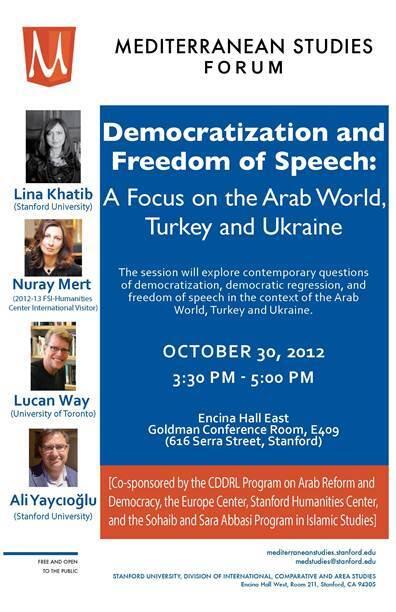
Co-sponsored by CDDRL Program on Arab Reform and Democracy, the Europe Center, Stanford Humanities Center, and the Abbasi Program in Islamic Studies

More info: http://www.stanford.edu/group/mediterranean/cgi-bin/web/2012/08/democratization-and-freedom-of-speech-a-focus-on-turkey-arab-world-and-ukraine/

Image

Richard and Rhoda Goldman Conference Room

Nuray Mert FSI-Humanities Center International Visitor Panelist
Lina Khatib Program Manager for the Program on Arab Reform and Democracy Panelist CDDRL
Lucan Way Associate Professor of Political Science Panelist University of Toronto
Ali Yaycioğlu Assistant Professor of Middle East History Moderator Stanford
Panel Discussions
Subscribe to History