Society

FSI researchers work to understand continuity and change in societies as they confront their problems and opportunities. This includes the implications of migration and human trafficking. What happens to a society when young girls exit the sex trade? How do groups moving between locations impact societies, economies, self-identity and citizenship? What are the ethnic challenges faced by an increasingly diverse European Union? From a policy perspective, scholars also work to investigate the consequences of security-related measures for society and its values.

The Europe Center reflects much of FSI’s agenda of investigating societies, serving as a forum for experts to research the cultures, religions and people of Europe. The Center sponsors several seminars and lectures, as well as visiting scholars.

Societal research also addresses issues of demography and aging, such as the social and economic challenges of providing health care for an aging population. How do older adults make decisions, and what societal tools need to be in place to ensure the resulting decisions are well-informed? FSI regularly brings in international scholars to look at these issues. They discuss how adults care for their older parents in rural China as well as the economic aspects of aging populations in China and India.

News Type
News
Date
Paragraphs


—SPICE: Offering teacher institutes since 1973—


In 1973, the roots of the Stanford Program on International and Cross-Cultural Education (SPICE) were established with the creation of the Bay Area China Education Program, which focused on the development of K–12 curriculum materials and teacher professional development. Only a year prior, President Richard Nixon had made his historic trip to China and many American students were able to view contemporary images of China on television for the first time in their lifetimes. Teachers who attended SPICE institutes on China in the 1970s often commented that they were at a loss about how to teach about China.

Forty-four years later, a new generation of educators expressed similar sentiments at a SPICE institute. However, the challenge wasn’t so much about the teaching of China but rather the teaching of North Korea. Thus, when Pulitzer Prize-winning author Adam Johnson spoke about his book, The Orphan Master’s Son, a New York Times bestselling novel about North Korea, teachers were riveted by his comments. Teachers were interested not only in ways that his novel could help them better understand contemporary North Korea but also in ways they could use the book to help their students gain a more balanced view of North Korea. The 22 teacher participants received copies of The Orphan Master’s Son to use in their teaching and were offered two SPICE curriculum units titled Inter-Korean Relations: Rivalry, Reconciliation, and Reunification and Uncovering North Korea.  

Co-sponsored by the National Consortium for Teaching about Asia (NCTA), the SPICE summer institute, July 24–26, 2017, had the objectives of (1) deepening teachers’ understanding of Asia, U.S.–Asian relations, and the Asian-American experience; (2) providing teachers with teaching resources; and (3) creating a community of learners. The institute featured lectures by Stanford faculty (like Johnson), U.C. Berkeley faculty, and other experts on a range of Asia- and Asian-American-related topics closely aligned with the History-Social Science Framework for California Public Schools standards, which were recently revised. Interactive curriculum demonstrations by SPICE staff were also offered.

One such standard focuses on recent economic growth in China. Following a lecture by Thomas Fingar, Shorenstein Asia Pacific Research Center Fellow, on “Recurring Themes in U.S.–China Relations,” a curriculum demonstration on the SPICE curriculum unit, China in Transition: Economic Development, Migration, and Education, was offered by its author, Rylan Sekiguchi of SPICE. One teacher remarked, “I teach about China, and it was so helpful to hear someone with such deep expertise [Fingar] speak about U.S.–Chinese history in a way that enriches my knowledge and understanding to bring back some bigger themes to my teaching. I can’t wait to bring this content back to my students [through the SPICE curriculum].” Other scholarly lectures on Japan and Korea were also followed by curriculum demonstrations by SPICE staff. This coupling of lectures and curriculum demonstrations has been a hallmark of SPICE since its inception.

Updated History-Social Science Framework standards on the Asian-American experience were also addressed at the institute. Dr. Khatharya Um, Associate Professor of Ethnic Studies at the University of California at Berkeley, introduced the diverse cultural and historical backgrounds of the Asian-American student population which often comprises a significant percentage of students in schools in areas like the San Francisco Bay Area and Los Angeles. She emphasized the importance of acknowledging individual circumstances in minority student populations and breaking down commonly cited stereotypes of Asian Americans as being a critical element of effective teaching. One of the topics that she addressed was stereotypes of Japanese Americans that arose following the Japanese attack of Pearl Harbor. Her lecture was coupled with the sharing of first-hand experiences by Dr. Joseph Yasutake, who was interned at the age of nine. Dr. Yasutake’s talk stimulated discussions on civil liberties, race relations, discrimination, and American identity among the teachers. “Hearing history from one who has experienced it as well as studied and taught the history is really wonderful,” said one institute participant. “This combination brings a great amount of authority and well as authenticity to the narrative he [Yasutake] provides.” The SPICE curriculum unit, Civil Rights and Japanese-American Internment, was recommended as a resource for teachers.

The institute brought together both experienced mentor teachers and those new to the field. Naomi Funahashi, who organized and facilitated the institute, remains in communication with many of the teachers and has noticed that a community of learners, who are committed to a long-term exploration of Asian and Asian-American studies, has grown from the institute. She reflected, “One of the unexpected outcomes of the institute was the recommendations that many of the teachers have written in support of their students’ applications to my online class on Japan called the Reischauer Scholar Program. My hope is that some of my students will someday attend SPICE institutes as teachers and that SPICE institutes will continue to serve teachers as they have since 1973 for many decades to come.”

SPICE is currently recruiting teachers to attend its 2018 summer institute for middle school teachers (June 20–22, 2018) and summer institute for high school teachers (July 23–25, 2018).

To stay informed of SPICE-related news, follow SPICE on Facebook and Twitter.

Hero Image
Teacher participants in the 2017 East Asia Summer Institute examine propaganda posters from China's Cultural Revolution.
All News button
1
News Type
Commentary
Date
Paragraphs

"Protests in Iran have erupted over the past few weeks as citizens from across the country have taken to the streets to voice their opposition against the government. Much of their anger is directed at the status quo, particularly President Hassan Rouhani and the clerical establishment who have shown no sign of following through on initiatives to fight government corruption and improve the economy." Listen to Abbas Milani speak about the issue in World Affairs here.

Hero Image
iran 2697408 1280
All News button
1
-

Speaker(s) Bio:

Image
fukuyama francis self portrait logo
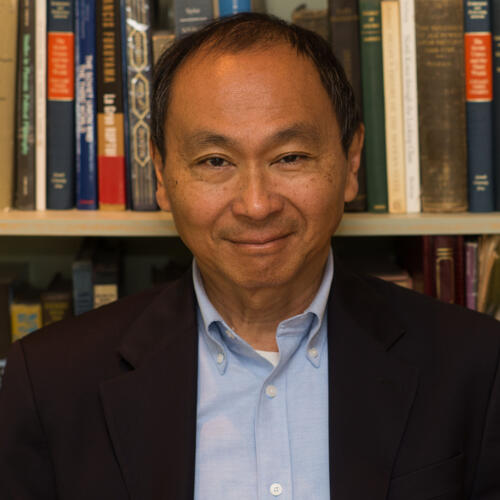
Francis Fukuyama is the Olivier Nomellini Senior Fellow at the Freeman Spogli Institute for International Studies (FSI) and the Mosbacher Director of FSI's Center on Democracy, Development, and the Rule of Law (CDDRL).  He is also a professor by courtesy in the Department of Political Science. He was previously at the Paul H. Nitze School of Advanced International Studies (SAIS) of Johns Hopkins University, where he was the Bernard L. Schwartz Professor of International Political Economy and director of SAIS' International Development program.


Image
bushra batainey
Bushra Bataineh is a PhD student in the Civil and Environmental Engineering department at Stanford University. Her research focuses on innovative project delivery mechanisms for water infrastructure worldwide. Her current research, conducted under the Global Projects Center at Stanford, is on private sector participation in water infrastructure projects in developing countries and the emergence of local private sector players. She is also analyzing cases of water sector public private partnerships in the United States in order to draw lessons learned with regards to innovative financial structuring.


Image
mbennon
Michael Bennon is a Managing Director at the Stanford Global Projects Center, developing new initiatives for the GPC and managing our student programs and industry affiliations. Michael’s research areas of interest for the center and work experience are in Public Sector finance, infrastructure and real estate investment, and project organization design. Michael served as a Captain in the US Army and US Army Corps of Engineers for five years, leading Engineer units, managing projects, and planning for infrastructure development in the United States, Iraq, Afghanistan, and Thailand. Michael received a bachelor’s degree in Civil Engineering from the United States Military Academy at West Point and received an MSCE and MBA from Stanford University.

Encina Hall, C148
616 Jane Stanford Way
Stanford, CA 94305

0
Olivier Nomellini Senior Fellow at the Freeman Spogli Institute for International Studies
Director of the Ford Dorsey Master's in International Policy
Research Affiliate at The Europe Center
Professor by Courtesy, Department of Political Science
yff-2021-14290_6500x4500_square.jpg

Francis Fukuyama is the Olivier Nomellini Senior Fellow at Stanford University's Freeman Spogli Institute for International Studies (FSI), and a faculty member of FSI's Center on Democracy, Development and the Rule of Law (CDDRL). He is also Director of Stanford's Ford Dorsey Master's in International Policy, and a professor (by courtesy) of Political Science.

Dr. Fukuyama has written widely on issues in development and international politics. His 1992 book, The End of History and the Last Man, has appeared in over twenty foreign editions. His book In the Realm of the Last Man: A Memoir will be published in fall 2026.

Francis Fukuyama received his B.A. from Cornell University in classics, and his Ph.D. from Harvard in Political Science. He was a member of the Political Science Department of the RAND Corporation, and of the Policy Planning Staff of the US Department of State. From 1996-2000 he was Omer L. and Nancy Hirst Professor of Public Policy at the School of Public Policy at George Mason University, and from 2001-2010 he was Bernard L. Schwartz Professor of International Political Economy at the Paul H. Nitze School of Advanced International Studies, Johns Hopkins University. He served as a member of the President’s Council on Bioethics from 2001-2004. He is editor-in-chief of American Purpose, an online journal.

Dr. Fukuyama holds honorary doctorates from Connecticut College, Doane College, Doshisha University (Japan), Kansai University (Japan), Aarhus University (Denmark), the Pardee Rand Graduate School, and Adam Mickiewicz University (Poland). He is a non-resident fellow at the Carnegie Endowment for International Peace. He is a member of the Board of Trustees of the Rand Corporation, the Board of Trustees of Freedom House, and the Board of the Volcker Alliance. He is a fellow of the National Academy for Public Administration, a member of the American Political Science Association, and of the Council on Foreign Relations. He is married to Laura Holmgren and has three children.

(October 2025)

CV
Date Label
CDDRL Mosbacher Director and Olivier Nomellini Fellow at FSI
Bushra Bataineh PhD student in the Civil and Environmental Engineering at Stanford
Michael Bennon Managing Director at the Stanford Global Projects Center
Seminars
-
Abstract: Individuals (such as Paul Rusesabagina during the Rwandan genocide and Oskar Schindler and Raoul Wallenberg during the Holocaust) and groups (including Muslims during the Rwandan genocide, Danes during the Holocaust, and the White Helmets in Syria today) have sought to rescue others during genocides and other atrocity crimes. Even if rare, such rescue can be significant, resulting in hundreds or thousands of lives saved. This talk—drawing on case studies from the Holocaust, the Rwandan genocide, and the ongoing conflict in Syria—will consider legal, political, and other approaches to promote rescue during such calamities.
 
Speaker bio: Zachary D. Kaufman, J.D., Ph.D., is a Lecturer in Law and Fellow at Stanford Law School, a Visiting Scholar at the Hoover Institution, and a Senior Fellow at Harvard University’s Kennedy School of Government. Previously, he taught at Yale and George Washington universities and held academic appointments at Yale Law School and Harvard Law School. Dr. Kaufman has served in all three branches of the U.S. government, including at the Supreme Court, the Departments of State and Justice, and the Senate Foreign Relations Committee. He has also served at three international war crimes tribunals (including the International Criminal Court), practiced law at O’Melveny & Myers LLP, and worked at Google. The author or editor of 3 books and over 40 articles and book chapters, Dr. Kaufman received his Ph.D. and M.Phil., both in International Relations, from Oxford University (where he was a Marshall Scholar), his J.D. from Yale Law School (where he was Editor-in-Chief of the Yale Law & Policy Review), and his B.A. in Political Science from Yale University (where he was the student body president).
Zachary D. Kaufman Stanford Law School, Hoover Institution, Harvard University
Seminars
-

Please join visiting scholar Sviatoslav Vakarchuk and Mosbacher Director of CDDRL Francis Fukuyama for a conversation on Ukraine's future success. 


Encina Hall, C148
616 Jane Stanford Way
Stanford, CA 94305

0
Olivier Nomellini Senior Fellow at the Freeman Spogli Institute for International Studies
Director of the Ford Dorsey Master's in International Policy
Research Affiliate at The Europe Center
Professor by Courtesy, Department of Political Science
yff-2021-14290_6500x4500_square.jpg

Francis Fukuyama is the Olivier Nomellini Senior Fellow at Stanford University's Freeman Spogli Institute for International Studies (FSI), and a faculty member of FSI's Center on Democracy, Development and the Rule of Law (CDDRL). He is also Director of Stanford's Ford Dorsey Master's in International Policy, and a professor (by courtesy) of Political Science.

Dr. Fukuyama has written widely on issues in development and international politics. His 1992 book, The End of History and the Last Man, has appeared in over twenty foreign editions. His book In the Realm of the Last Man: A Memoir will be published in fall 2026.

Francis Fukuyama received his B.A. from Cornell University in classics, and his Ph.D. from Harvard in Political Science. He was a member of the Political Science Department of the RAND Corporation, and of the Policy Planning Staff of the US Department of State. From 1996-2000 he was Omer L. and Nancy Hirst Professor of Public Policy at the School of Public Policy at George Mason University, and from 2001-2010 he was Bernard L. Schwartz Professor of International Political Economy at the Paul H. Nitze School of Advanced International Studies, Johns Hopkins University. He served as a member of the President’s Council on Bioethics from 2001-2004. He is editor-in-chief of American Purpose, an online journal.

Dr. Fukuyama holds honorary doctorates from Connecticut College, Doane College, Doshisha University (Japan), Kansai University (Japan), Aarhus University (Denmark), the Pardee Rand Graduate School, and Adam Mickiewicz University (Poland). He is a non-resident fellow at the Carnegie Endowment for International Peace. He is a member of the Board of Trustees of the Rand Corporation, the Board of Trustees of Freedom House, and the Board of the Volcker Alliance. He is a fellow of the National Academy for Public Administration, a member of the American Political Science Association, and of the Council on Foreign Relations. He is married to Laura Holmgren and has three children.

(October 2025)

CV
Date Label
CDDRL Mosbacher Director and Olivier Nomellini Fellow at FSI
0
Visiting Scholar, Ukrainian Emerging Leaders Program, 2017-18
slava_hs.jpg

Vakarchuk is a Ukrainian civic activist, musician and the lead vocalist and founder of the band “Okean Elzy.“ He will be in residence at CDDRL this fall to attend courses and study with some of the leading intellectuals and academics at CDDRL. He holds a doctorate degree in theoretical physics from the Ivan Franko National University of Lviv.

Vakarchuk is also the founder of a charity fund called “Lyudi Maybutnyogo” (People of the Future) and co-founder of the Center for Economic Strategy, an independent policy think tank dedicated to supporting reforms and sustainable economic growth in Ukraine. He served as a Yale World Fellow in 2015.

CDDRL Visiting Scholar and lead singer of "Okean Elzy" rock group
Seminars
News Type
Commentary
Date
Paragraphs

"Surveying America’s political history, Larry Diamond of Stanford University divines 'a general pattern of resilience, punctuated by dark periods of authoritarian temptation.'" From Franklin D. Roosevelt to Richard Nixon, America has had her fair share of presidential rule-breakers. How does the Trump presidency fit into this history? Larry Diamond weighs in in The Economist.

Hero Image
trump 2815558 1280
All News button
1
Paragraphs

The development community has increased its focus on higher education over the past two decades, recognizing that education can contribute to building up a country’s capacity for participation in an increasingly knowledge-based world economy and accelerate economic growth. The value added by higher education to economies—job creation, innovation, enhanced entrepreneurship, and research, a core higher education activity—has been highlighted by an important body of literature. 

Yet experts remain concerned that investing in higher education in less-developed countries may lead to a “brain drain”--highly educated students and professionals permanently leaving their home countries. In the 2016 Kauffman report on international science, technology, engineering, and math (STEM) students in the United States, for instance, 48 percent among a randomly sampled survey of 2,322 foreign doctoral students in the United States wished to stay there after graduation, with only 12 percent wanting to leave and 40.5 percent being undecided. In fact, high percentages of foreign students in the United States with doctorates in science and engineering continue to stay in the United States, creating a brain drain problem for the sending countries. 

Because students tend to move from developing to developed countries to study, brain drain is more problematic for developing countries. In addition, given accelerated talent flows around the world and the increasing integration of less-developed countries into global value chains, the negative impact of brain drain could be further amplified. As demonstrated by the studies reviewed in this paper, the migration of high-skilled professionals from developing countries may indeed create brain drain for them, but at the same time can significantly enhance the social and economic development of their home countries, regardless of whether or not they decide to return home, thus complicating what used to be seen as a straightforward case of brain drain. 

From Brain Drain to Brain Circulation and Linkage examines how brain drain can contribute to development for the sending countries through brain circulation and linkage. It provides an overview of the conceptual framework to map out high-skilled labor flows, identifies empirical cases and policies in Asia that demonstrate high-skilled migrant professionals actually make significant contributions to their home countries (beyond monetary remittances), summarizes key social and economic enabling factors that are important in attracting and motivating migrant high-skilled professionals to return or engage with their home countries, and concludes with policy implications and suggestions for further research based on these findings.

All Publications button
1
Publication Type
Working Papers
Publication Date
Authors
Gi-Wook Shin
Rennie Moon
Number
978-1-931368-49-0
Paragraphs

China has undergone dramatic change in its economic institutions in recent years, but surprisingly little change politically. Somehow, the political institutions seem capable of governing a vastly more complex market economy and a rapidly changing labor force. One possible explanation, examined in Zouping Revisited, is that within the old organizational molds there have been subtle but profound changes to the ways these governing bodies actually work. The authors take as a case study the local government of Zouping County and find that it has been able to evolve significantly through ad hoc bureaucratic adaptations and accommodations that drastically change the operation of government institutions.

Zouping has long served as a window into local-level Chinese politics, economy, and culture. In this volume, top scholars analyze the most important changes in the county over the last two decades. The picture that emerges is one of institutional agility and creativity as a new form of resilience within an authoritarian regime.

About the authors:

Jean C. Oi is William Haas Professor in Chinese Politics and a Senior Fellow at the Freeman Spogli Institute for International Studies at Stanford University.

Steven Goldstein is Sophia Smith Professor Emeritus of Government at Smith College, Director of the Taiwan Studies Workshop, and Associate at the Fairbank Center at Harvard University.

This book is part of the Studies of the Walter H. Shorenstein Asia-Pacific Research Center series with Stanford University Press.

All Publications button
1
Publication Type
Books
Publication Date
Journal Publisher
Stanford University Press
Authors
Jean C. Oi
Subscribe to Society