Climate change
Authors
Beth Duff-Brown
News Type
News
Date
Paragraphs

Global warming and more days of extreme heat are exacerbating the health risks of pregnancy, particularly among African-American women, according to new Stanford-led research.

The maternal mortality rate among all women in the United States is already the worst of any industrialized nation. And black women are three to four times more likely to die from pregnancy-related problems than white women.

“It is truly a crisis that in America, one of the wealthiest countries in the world, more women are dying from pregnancy or childbirth complications than in any other developed country,” said Maya Rossin-Slater, a core faculty member at Stanford Health Policy and a faculty fellow at the Stanford Institute for Economic Policy Research.

In a new working paper published by the National Bureau of Economic Research, Rossin-Slater and two other health economists underscore how little research is out there about the impact of rising temperatures on the health of mothers and their newborns.

Pregnant women, for example, are not able to regulate body temperature as efficiently as non-pregnant individuals due to the physiological changes they undergo during gestation. Heat exposure can alter blood flow in the placenta, which can weaken the placenta and lead to complications. And high heat can lead to other pregnancy complications, such as hypertension, preeclampsia and prolonged premature rupture of membranes.

“All of these issues can translate into women needing to be hospitalized during pregnancy and experiencing complications during childbirth,” wrote Rossin-Slater, an assistant professor of health research and policy at Stanford Medicine. Her co-authors are Jiyoon Kim, assistant professor of economics at Elon University, and Ajin Lee, an assistant professor of economics at Michigan State University.

The researchers said most of the discussion about maternal health focuses on the health-care system, but that other determinants of poor maternal health and racial disparities are much less understood, particularly when it comes to how the environment is impacting pregnancy.

So they launched what they believe is the first study to identify the causal effects of prenatal exposures to extreme temperatures on the health of the mothers themselves.

As the Earth Warms, So Does Exposure to Extreme Heat

Their paper focuses on an environmental factor that is becoming increasingly relevant due to the growing consensus that climate change is contributing to a gradual warming of the earth: exposure to extreme heat.

The researchers studied the effects of exposure to extreme temperatures during pregnancy on maternal and child hospitalizations, using inpatient discharge records from three U.S. states with different climates: Arizona, New York and Washington. Their data comes from the State Inpatient Databases from the Healthcare Cost and Utilization Project, including 2.7 million inpatient records of 2.7 million infants and 2.2 million mothers in those three states.

And to measure temperature exposure, the researchers obtained data from the National Oceanic and Atmospheric Administration (NOAA).

For every county in their data, the researchers calculated the average temperature for every month. Then for every given day in a specific month in that county, they looked at the historic average for how high or low that day’s temperature was relative to the overall temperature in that month in that county.

For example, a 90-degree day in Arizona in September would not be classified as extreme heat since it’s relatively common. But a 90-degree day in New York would be, since temperatures that high are much less common. They classified “extreme heat” as a given day when the temperature is more than three standard deviations (3SD) above that historic county mean.

Then, they compared the outcomes of women who are of the same race giving birth in the same county and calendar month, but in different years. These women are likely similar in terms of their demographics and socioeconomic status, but may be exposed to different temperatures during pregnancy. For example, consider a black woman giving birth in November 2011 in Queens County, New York, and a black woman giving birth in November 2012 in the same county. If there were a heat wave in Queens in the August 2012, then the latter woman is exposed to more extreme heat during pregnancy than the former. 

The economists found that each additional day with heat that is at least 3SDs — or substantially higher than the historic county-month average — during the second trimester of pregnancy increases the likelihood that a newborn is diagnosed with dehydration by .008 percentage points.

“Our results provide new estimates of the health costs of climate change and identify environmental drivers of the black-white maternal health gap,” they wrote. “Understanding the health consequences of this increase in extreme heat is critical information for discussions about the costs of climate change and the possible benefits of mitigating policies.”

The researchers found that each additional day of extreme heat exposure during pregnancy increases black women’s likelihood of hospitalization during pregnancy. Since black women on average are exposed to more extreme heat than white women — due to different residence patterns and access to mitigating technologies like air conditioning — extreme heat may contribute to exacerbating the already large gap in maternal health between black and white women.

Detrimental Consequences of Rising Temperatures

Scientists predict global average temperatures will continue to rise over the next 50 to 100 years as greenhouse gases continue to trap more heat in the Earth’s atmosphere. The U.N. Intergovernmental Panel on Climate Change last year warned that nations worldwide must quickly reduce fossil fuel use to keep the rise in global temperatures below 1.5°C by 2050. 

The panel also said the number of days with mean temperatures above 32°C in the average American county is forecasted to increase from about 1 to 43 days per year by 2070-2099.

That could have detrimental consequences for babies and mothers alike.

“Overall, our findings on infant health suggest that exposure to extreme heat during the second trimester increases the likelihood of the baby being dehydrated at the time of birth,” the researchers wrote. “This, in turn, appears to increase the likelihood of subsequent readmission to the hospital many months later for causes linked to dehydration.”

And these impacts are typically missed when researchers only measure infant health using more standard variables, such as birth weight.

The authors note dehydration is one of the leading causes of morbidity and mortality in children. Studies show that children under 5 years old who have an average of two episodes of gastroenteritis associated with dehydration per year leads to 2 to 3 million pediatric office visits and accounts for 10% of all pediatric hospital admissions in the United States. 

Experts believe black women are three- to four-times more likely to die from pregnancy-related causes due to lack of access to and the poor quality of health care, as well as clinicians not monitoring black women as closely — or actually dismissing their symptoms altogether.

“The fact that the adverse impacts on health during pregnancy are larger for black than for white mothers suggests that climate change may exacerbate the already large racial gap in maternal health,” the researchers said.

Hero Image
gettyimages thermometer Getty Images
All News button
1

Y2E2
473 Via Ortega
Stanford,  California  94305 

0
1cf4c37a72b8ab44c40568c8cfa7f378.jpg

Dr. Noah Diffenbaugh is the Kara J Foundation Professor and Kimmelman Family Senior Fellow at Stanford University. He studies the climate system, including the processes by which climate change could impact agriculture, water resources, and human health. Dr. Diffenbaugh is currently Editor-in-Chief of the peer-review journal Geophysical Research Letters. He has served as a Lead Author for Working Group II of the Intergovernmental Panel on Climate Change (IPCC), and has provided testimony and scientific expertise to the White House, the Governor of California, and U.S. Congressional offices. Dr. Diffenbaugh is a recipient of the James R. Holton Award from the American Geophysical Union, a CAREER award from the National Science Foundation, and a Terman Fellowship from Stanford University. He has also been recognized as a Kavli Fellow by the U.S. National Academy of Sciences, and as a Google Science Communication Fellow.

Paragraphs

Abstract


As an increasing number of California households install solar panels, the current approach to retail electricity pricing makes it harder for the state’s utilities to recover their costs. Unless policymakers change how they price grid-supplied electricity, a regulatory crisis where a declining number of less affluent customers will be asked to pay for a growing share of the costs is likely to occur.


All Publications button
1
Publication Type
Policy Briefs
Publication Date
Journal Publisher
Stanford Institute for Economic Policy Research (SIEPR)
Authors
Frank Wolak
Paragraphs

Abstract

Politicians in a number of jurisdictions with cap-and-trade markets for greenhouse gas (GHG) emissions or carbon taxes have argued that the evidence is in and the conclusion is clear: Carbon pricing doesn’t work. A number of journalists and environmental groups have jumped on the bandwagon, amplifying a misguided message.

A better understanding of how markets and price mechanisms work might change their minds — and the conversation — on the benefits of carbon pricing.


All Publications button
1
Publication Type
Policy Briefs
Publication Date
Journal Publisher
Stanford Institute for Economic Policy Research (SIEPR)
Authors
Frank Wolak
News Type
News
Date
Paragraphs

Marshall Burke, assitant professor of Earth system science and deptuy director at the Center on Food Security and the Enviroment shares his insights on how climate change is already impacting human behavior and what interventions are cost effective when it comes to combating the global change in climate.

Hero Image
dm6s9l7x4aajfea
All News button
1
Authors
News Type
News
Date
Paragraphs

By comparing historical temperature and suicide data, researchers found a strong correlation between warm weather and increased suicides. They estimate climate change could lead to suicide rate increases across the U.S. and Mexico.

Suicide rates are likely to rise as the earth warms, according to new research published July 23 in Nature Climate Change. The study, led by Stanford economist Marshall Burke, finds that projected temperature increases through 2050 could lead to an additional 21,000 suicides in the United States and Mexico.

“When talking about climate change, it’s often easy to think in abstractions. But the thousands of additional suicides that are likely to occur as a result of unmitigated climate change are not just a number, they represent tragic losses for families across the country,” said Burke, assistant professor of Earth system science in the School of Earth, Energy & Environmental Sciences at Stanford.

Researchers have recognized for centuries that suicides tend to peak during warmer months. But, many factors beyond temperature also vary seasonally – such as unemployment rates or the amount of daylight – and up to this point it has been difficult to disentangle the role of temperature from other risk factors.

“Suicide is one of the leading causes of death globally, and suicide rates in the U.S. have risen dramatically over the last 15 years. So better understanding the causes of suicide is a public health priority,” Burke said.

Heat and suicide

To tease out the role of temperature from other factors, the researchers compared historical temperature and suicide data across thousands of U.S. counties and Mexican municipalities over several decades. The team also analyzed the language in over half a billion Twitter updates or tweets to further determine whether hotter temperatures affect mental well-being. They analyzed, for example, whether tweets contain language such as “lonely,” “trapped” or “suicidal” more often during hot spells.

The researchers found strong evidence that hotter weather increases both suicide rates and the use of depressive language on social media.

“Surprisingly, these effects differ very little based on how rich populations are or if they are used to warm weather,” Burke said.

For example, the effects in Texas are some of the highest in the country. Suicide rates have not declined over recent decades, even with the introduction and wide adaptation of air conditioning. If anything, the researchers say, the effect has grown stronger over time.

Effect of climate change

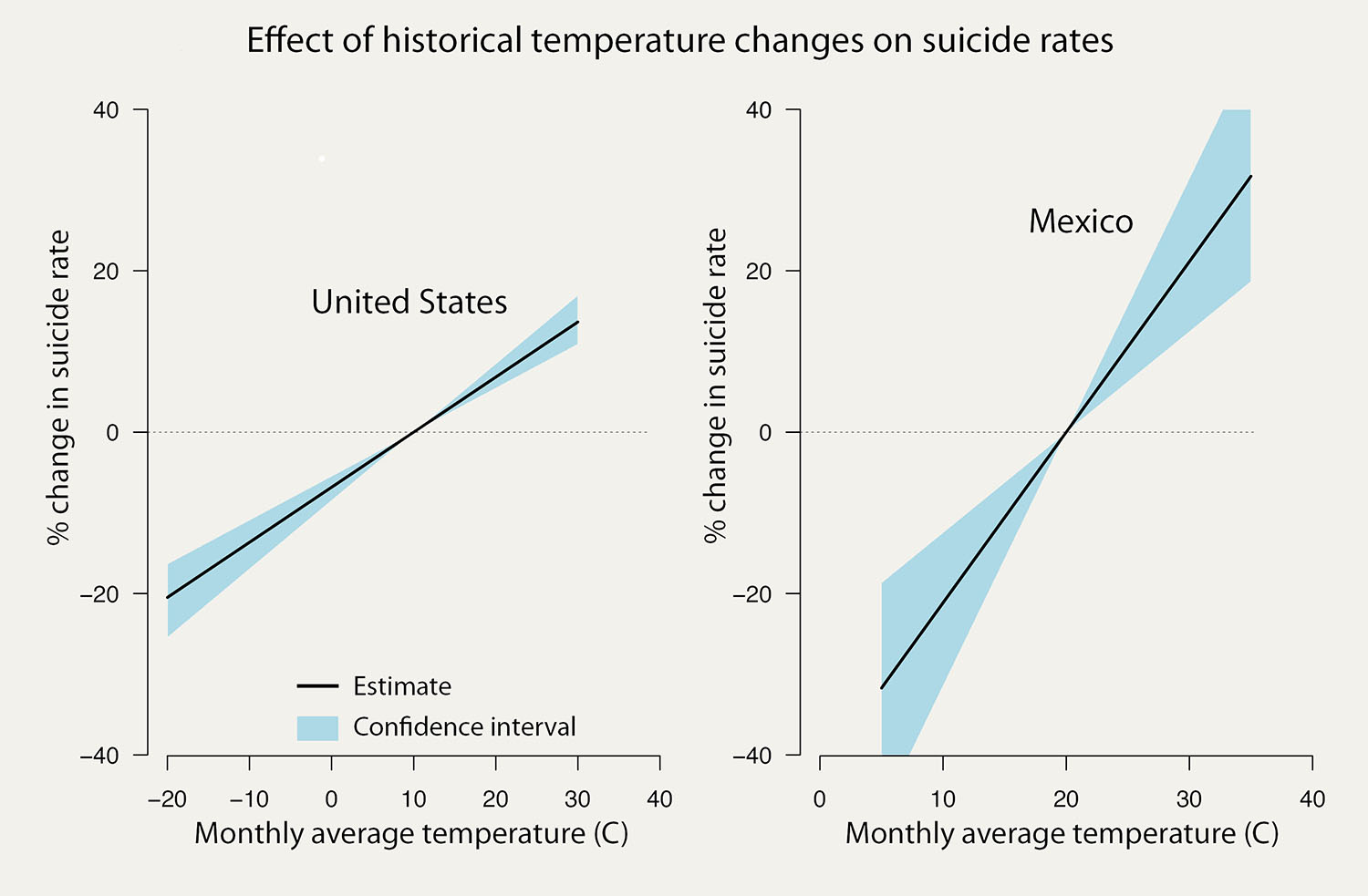
To understand how future climate change might affect suicide rates, the team used projections from global climate models. They calculate that temperature increases by 2050 could increase suicide rates by 1.4 percent in the U.S. and 2.3 percent in Mexico. These effects are roughly as large in size as the influence of economic recessions (which increase the rate) or suicide prevention programs and gun restriction laws (which decrease the rate).

Graph Showing Effects of historical temperature changes on suicide rates are shown for the U.S. and Mexico. Effects of historical temperature changes on suicide rates are shown for the U.S. and Mexico. (Image credit: Marshall Burke)
Effects of historical temperature changes on suicide rates are shown for the U.S. and Mexico. (Image credit: Marshall Burke)

“We’ve been studying the effects of warming on conflict and violence for years, finding that people fight more when it’s hot. Now we see that in addition to hurting others, some individuals hurt themselves. It appears that heat profoundly affects the human mind and how we decide to inflict harm,” said Solomon Hsiang, study co-author and associate professor at the University of California, Berkeley.

The authors stress that rising temperature and climate change should not be viewed as direct motivations for suicide. Instead, they point out that temperature and climate may increase the risk of suicide by affecting the likelihood that an individual situation leads to an attempt at self-harm.

“Hotter temperatures are clearly not the only, nor the most important, risk factor for suicide,” Burke emphasized. “But our findings suggest that warming can have a surprisingly large impact on suicide risk, and this matters for both our understanding of mental health as well as for what we should expect as temperatures continue to warm.”

Marshall Burke is also a fellow at the Center on Food Security and the EnvironmentStanford Woods Institute for the EnvironmentFreeman Spogli Institute for International Studies, and Stanford Institute for Economic Policy Research. Solomon Hsiang is also a faculty research fellow at the National Bureau of Economic Research. Other Stanford co-authors include Sanjay Basu, assistant professor of medicine, and Sam Heft-Neal, research scholar at the Stanford Center on Food Security and the Environment. Additional co-authors are from Pontificia Universidad Católica de ChileVancouver School of Economics, and the University of California, Berkeley. The research was partially supported by the Stanford Woods Institute for the Environment.

Hero Image
istock 682825852 copy iStockphoto/beer5020
All News button
1

Y2E2 Room 350
473 Via Ortega
Stanford, CA 94305

0
tanutama_headshot2.jpg

Vincent Tanutama is a research data analyst at the Center on Food Security and the Environment, where he supports the work of Marshall Burke on climate’s impact on economic outcomes such as workers' labor productivity and subnational economic output. Vincent's interest in the environment sprouts from investigating the distribution of rent among bureaucrats in their management of forest and oil palm resources in Indonesia, his country of origin. He has worked at the Indonesian Ministry for Economic Development Planning (Bappenas), The Abdul Latif Jameel Poverty Action Lab (JPAL Southeast Asia), Oxford Policy Management (OPM), and the United Nations Economic and Social Commission for Asia and the Pacific (UNESCAP).  He holds a B.A. in Ethics, Politics and Economics from Yale University.

Research Data Analyst
News Type
News
Date
Paragraphs

The rising level of carbon dioxide in the atmosphere means that crops are becoming less nutritious, and that change could lead to higher rates of malnutrition that predispose people to various diseases.

That conclusion comes from an analysis published Tuesday in the journal PLOS Medicine, which also examined how the risk could be alleviated. In the end, cutting emissions, and not public health initiatives, may be the best response, according to the paper's authors.

Research has already shown that crops like wheat and rice produce lower levels of essential nutrients when exposed to higher levels of carbon dioxide, thanks to experiments that artificially increased CO2 concentrations in agricultural fields. While plants grew bigger, they also had lower concentrations of minerals like iron and zinc.

Read the entire story at NPR

Hero Image
shutterstock 577538629
All News button
1
News Type
News
Date
Paragraphs

Paul N. Edwards of CISAC has been appointed as a lead author for the Sixth Assessment Report of the Intergovernmental Panel on Climate Change (IPCC). The IPCC is the scientific organization supporting the United Nations Framework Convention on Climate Change (UNFCCC).  Organized by the United Nations and the World Meteorological Organization, the IPCC’s reports provide the scientific underpinnings for the international climate negotiations that led to the 1997 Kyoto Protocol and the 2015 Paris Agreement on climate change.

The IPCC reviews the state of the science of climate change every 5-7 years. Its Sixth Assessment Report—to which Edwards will contribute--will be completed in 2021. Edwards will serve as lead author for four years to develop, review, and complete the assessment.

Through his appointment, Edwards becomes the first social scientist to serve as a lead author in Working Group 1, which assesses the physical science of climate change. The other two working groups deal with impacts, adaptation, and vulnerability (Working Group 2) and mitigation of climate change (Working Group 3).  Edwards will travel to Guangzhou, China, next week for the first meeting of lead author—a trip for which he has purchased carbon offsets.


Paul N. Edwards is William J. Perry Fellow in International Security and Senior Research Scholar at CISAC, as well as Professor of Information and History at the University of Michigan. At Stanford, his teaching includes courses in the Ford Dorsey Program in International Policy Studies and the Program in Science, Technology & Society. His research focuses on the history, politics, and culture of knowledge and information infrastructures. He focuses especially on environmental security, including climate change, Anthropocene risks, and nuclear winter.

Edwards’s book A Vast Machine: Computer Models, Climate Data, and the Politics of Global Warming (MIT Press, 2010), a history of the meteorological information infrastructure, received the Computer Museum History Prize from the Society for the History of Technology, the Louis J. Battan Award from the American Meteorological Society, and other prizes. The Economist magazine named A Vast Machine a Book of the Year in 2010. Edwards’s book The Closed World: Computers and the Politics of Discourse in Cold War America (MIT Press, 1996) — a study of the mutual shaping of computers, military strategy, and the cognitive sciences from 1945-1990 — won honorable mention for the Rachel Carson Prize of the Society for Social Studies of Science. Edwards is also co-editor of Changing the Atmosphere: Expert Knowledge and Environmental Governance (MIT Press, 2001) and Changing Life: Genomes, Ecologies, Bodies, Commodities (University of Minnesota Press, 1997), as well as numerous articles.


Hero Image
Paul Edwards Rod Searcey
All News button
1
Subscribe to Climate change