Trade
Paragraphs

We provide an equilibrium analysis of the efficiency properties of simultaneous bilateral tariff negotiations in a three-country model of international trade. We consider the setting in which discriminatory tariffs are allowed, and we utilize the “Nash-in-Nash” solution concept of Horn and Wolinsky (1988). We allow for a general family of political-economic country welfare functions and assess efficiency relative to these welfare functions. We establish a sense in which the resulting tariffs are inefficient and too low, so that excessive liberalization occurs from the perspective of the three countries.

All Publications button
1
Publication Type
Journal Articles
Publication Date
Journal Publisher
Journal of International Economics
Authors
Kyle Bagwell
Paragraphs

This paper empirically examines recently declassified tariff bargaining data from the GATT/WTO. Focusing on the Torquay Round (1950–1951), we document stylized facts about these interconnected high-stakes international negotiations that suggest a lack of strategic behavior among the participating governments and an important multilateral element to the bilateral bargains. We suggest that these features can be understood as emerging from a tariff bargaining forum that emphasizes the GATT pillars of MFN and multilateral reciprocity, and we offer evidence that the relaxation of strict bilateral reciprocity facilitated by the GATT multilateral bargaining forum was important to the success of the GATT approach.

All Publications button
1
Publication Type
Journal Articles
Publication Date
Journal Publisher
American Economic Journal: Applied Economics
Authors
Kyle Bagwell
Authors
News Type
News
Date
Paragraphs

Samsung is a veritable business empire. In 2017, it passed Apple as the most profitable tech company. But there is more to the company than flat screens and smartphones. In Korea, Samsung is ubiquitous not only as a leading electronics brand, but as a major shaper of culture and politics.

In the episode "The Republic of Samsung" from Business Insider's “Brought to You By . . .” podcast, APARC and Korea Program Director Gi-Wook Shin gives his perspectives on how Samsung transformed from a small family produce shop to become a core pillar of Korean identity. “Samsung really has become a very powerful group in Korea,” reflects Shin. “Their influence is everywhere, not only in business, but in politics, in education, and in culture.”

[Subscribe to our newsletters to receive content like this directly to your inbox.]

This blurry intermingling of business interests, politics, and identity is both the key to Samsung’s success and the source of scandals over bribery, corruption, and nepotism that have rocked the company in recent years. For Shin, the longstanding Korean saying, “What is good for Samsung is good for South Korea,” has additional meaning in the present moment as both the company and the government of the ROK grapple with issues of systemic self-interest, erosion of accountability, and abuses of power that threaten the integrity and identity of each.

Under the leadership of Samsung heir Lee Jae-yong, the company is working to refurbish its image. But these efforts are mired in ongoing legal setbacks and new allegations. “Samsung can’t continue in the way that they have in the past. It’s a different era. Now, people demand more transparency, more fairness, more justice,” Dr. Shin emphasizes. As a predominant force for shaping business, politics, and identity in South Korean, this counsel to Samsung may prove a litmus test for the wellbeing of the Republic of Korea’s future as a whole.

Listen above to hear more of Dr. Shin’s insights and learn the rest of the story.

Read More

President Moon Jae In of South Korea during his inauguration proceedings.
Commentary

Democracy in South Korea is Crumbling from Within

South Korea is following global trends as it slides toward a “democratic depression,” warns APARC’s Gi-Wook Shin. But the dismantling of South Korean democracy by chauvinistic populism and political polarization is the work of a leftist government, Shin argues in a ‘Journal of Democracy’ article.
Democracy in South Korea is Crumbling from Within
A Zoom panel of Jonathan Corrado, Gi-Wook Shin, and Stephen Noerper
Commentary

Gi-Wook Shin Offers Analysis of 2020 Korean National Election

The Korea Society hosts APARC's director for a timely discussion of the recent South Korean national election.
Gi-Wook Shin Offers Analysis of 2020 Korean National Election
A look at the front of Encina Hall, Stanford
News

APARC Announces Diversity Grant to Support Underrepresented Minority Students Interested in Contemporary Asia

To encourage Stanford students from underrepresented minorities to engage in study and research of topics related to contemporary Asia, the Shorenstein Asia-Pacific Research Center is offering a new Diversity Grant opportunity. Application reviews begin on September 1, 2020.
APARC Announces Diversity Grant to Support Underrepresented Minority Students Interested in Contemporary Asia
Hero Image
Show attendees watch a flat-screen television display at the Samsung booth during a convention
Show attendees watch a flat-screen television display at the Samsung booth during a convention.
Getty Images
All News button
1
Subtitle

On the Business Insider's podcast "Brought to You By. . .", APARC and the Korea Program Director Gi-Wook Shin discusses how Samsung Electronics became so entwined with the history and identity of modern South Korea, and what the internal politics of the company indicate about broader Korean society.

Authors
Callista Wells
News Type
News
Date
Paragraphs

The Stanford Center at Peking University (SCPKU), the Center on Democracy, Development and the Rule of Law (CDDRL), and the APARC China Program jointly hosted a workshop on China’s Belt and Road Initiative (BRI) in early March. The workshop, held on March 2 and 3, welcomed researchers from around the world with expertise in the Initiative. Unfortunately, because of the rapidly developing health emergency related to the coronavirus, participants from not only China, but also Japan, were prevented from attending. As described by Professor Jean Oi, founding director of SCPKU and the China Program, and Professor Francis Fukuyama, director of CDDRL and the Ford Dorsey Master's in International Policy, who co-chaired the workshop, the meeting aimed to provide a global perspective on the BRI, consolidate knowledge on this opaque topic, and determine the best method and resources for future research.  

The workshop began with presentations from several of the invited guests. Dr. Atif Ansar from the University of Oxford’s Saïd Business School kicked off the first day by describing not only the tremendous opportunity that the BRI presents to developing economies, but also the serious pitfalls that often accompany colossal infrastructure projects. Pointing out the poor returns on investment of mega infrastructure projects, Ansar examined the frequest cost and schedule overruns, random disasters, and environmental degradation that outweigh the minimal benefits that they generally yield. China’s own track record from domestic infrastructure projects does little to mitigate fear of these risks, Ansar claimed. In response, he urged professional management of BRI investments, institutional reforms, and intensified deployment of technology in BRI projects. Dr. Ansar was followed by Dr. Xue Gong of the S. Rajaratnam School of International Studies, Nanyang Technological University, Singapore. Dr. Gong’s analysis centered on the extent to which China’s geopolitical motivations influenced its outward foreign direct investments (OFDI). Although her research was still in the early stages, her empirical analysis of China’s OFDI inflows into fifty BRI recipient countries from 2007-2018 nevertheless revealed that geopolitical factors often outweigh economic factors when it comes to China’s OFDI destinations.

Image
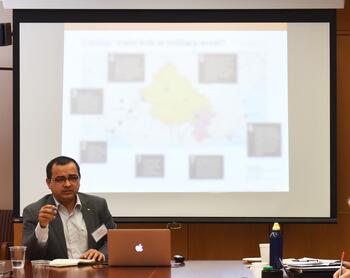
Amit Bhandari of Gateway House: Indian Council on Global Relations presents his research at the Belt and Road Workshop.
Participants then heard presentations from Amit Bhandari of Gateway House: Indian Council on Global Relations and Professor Cheng-Chwee Kuik of the National University of Malaysia. Mr. Bhandari’s talk focused on Chinese investments in India’s six neighboring countries, which tend to center more on energy rather than connectivity projects. He first found that the investments are generally not economical for the host countries because they come with high costs and high interest rates. Secondly, he argued that these projects often lacked a clear economic rationale, appearing instead to embed a geopolitical logic not always friendly to India. Professor Kuik, by contrast, provided a counterexample in his analysis of BRI projects in Southeast Asia. He described how, in Southeast Asia, host countries’ reception of the BRI has varied substantially; and how various stakeholders, including states, sub-states and other entities, have used their leverage to shape outcomes more or less favorable to themselves. Kuik’s analysis injected complexity into the often black-and-white characterizations of the BRI. He highlighted the multidimensional dynamics that play out among local and state-level players in pursuit of their goals, and in the process of BRI implementation.

Professor Curtis J. Milhaupt and Scholar-in-Residence Jeffrey Ball, both at Stanford Law School, followed with individual presentations on the role of State-Owned Enterprises (SOEs) in the BRI and the emissions impact of the BRI on climate change, respectively. Professor Milhaupt  characterized Chinese SOEs as both geopolitical and commercial actors, simultaneously charged with implementing Party policies and attaining corporate profits. Chinese SOEs are major undertakers of significant overseas BRI projects, acting not only as builders but also as investors, partners, and operators. This situation, Milhaupt asserted, carries significant risks for SOEs because these megaprojects often provide dismal returns, have high default rates, and can trigger political backlash in their localities. Milhaupt highlighted the importance of gathering firm-level data on businesses actually engaged in BRI projects to better infer geostrategic, financial, or other motivations. Jeffrey Ball turned the discussion to carbon emissions from BRI projects and presented preliminary findings from his four-country case studies. He concluded that, on aggregate, the emissions impact of the BRI is still “more brown than green.” Twenty-eight percent of global carbon emissions may be accounted for by BRI projects, Ball asserted, underscoring the importance of the BRI to the future of global climate change.

The day concluded with presentations by  Michael Bennon, Managing Director at the Stanford Global Projects Center, and Professor David M. Lampton, Oksenberg-Rohlen Fellow at the Freeman Spogli Institute for International Studies. Bennon first presented findings from two empirical case studies of BRI projects and then went on to describe how the BRI is now practically the “only game in town” for infrastructure funding for developing countries. Lengthy environmental review processes at Western multilateral banks have turned the World Bank, for example, from a lending bank into a “knowledge bank,” he argued. He also highlighted that, in general, economic returns on BRI projects for China are very poor, even though recipient countries may accrue macroeconomic benefits from these projects. Finally, Professor Lampton turned the discussion back to Southeast Asia, where China is currently undertaking massive cross-border high-speed rail projects through eight ASEAN countries. He described how each host country had varying capacity to negotiate against its giant neighbor, and how the sequential implementation of these cross-border rail projects also had varying impacts on the negotiating positions of these host countries. BRI played out differently in each country, in other words, eliciting different reactions, push-backs and negotiated terms.

The second day of the workshop was dedicated to working toward a collaborative approach to future BRI research. The group discussed the key gaps in the existing research, including how to know what China’s true intentions are, how to measure those intentions, who the main players and their interests in both China and the host countries are, and even what the BRI is, exactly. Some cautioned that high-profile projects may not be representative of the whole. Participants brainstormed about existing and future sources of data, and stressed the importance of diversifying studies and seeking empirical evidence.

Hero Image
Participants in the Belt and Road Initiative Workshop at Stanford University, March 2-3, 2020.
All News button
1
Authors
News Type
News
Date
Paragraphs

The signing of President Trump’s Phase One trade deal with China has rekindled speculations about the future of the world’s second-largest economy. Many analysts have cited trade frictions between the United States and China as a driving force behind the slowdown the Chinese economy has experienced in recent years. It is not a tariff crossfire, however, that explains the slowdown, argues Nicholas Lardy, a leading expert on the Chinese economy.

Lardy, the Anthony M. Solomon Senior Fellow at the Peterson Institute for International Economics, offered a different view on China’s slowing economy in a lecture presented at the China Program’s 2020 winter/spring colloquia series, which examines the past, present, and future of the PRC at 70. Using data and trends from the last forty years of China’s economic growth, Lardy presented the case that the slowing trend in the Chinese economy is directly related to changes in how the government lends credit and to what he terms “resource misallocation.”

Image
Nicholas Lardy lecturing at APARC.
According to Lardy, the Chinese economy is slowing from the inside. The government’s recent campaign to deleverage the amount of credit coming out of the shadow banking system was arguably justified, but it has nonetheless reduced the amount of credit available to businesses, particularly private companies. As a result, the credit-to-GDP ratio has plateaued in the last several years and is growing in-pace with the economy instead of ahead of it. 

Coupled with this is the observation that Xi Jinping’s government has actively sought to increase the size and scope of state-owned enterprises. Lardy’s research indicates that the assets of state-owned, non-financial companies in China are growing twice as fast as the overall GDP, a situation he feels is only possible if state companies are being allocated a disproportional share of credit and loans. Lardy shows that pre-2012, funding to private companies was at $3.6 trillion USD, but by 2016 it dropped to a mere $600 billion.

Taking these factors together, Lardy argues that the economic slowdown will continue if the Chinese government continues to aggressively emphasize party control and the importance of the state sector over private companies. While reporting on trade deals may dominate the media, “We will increasingly see friction not on tariffs, but on technology transfer and issues of technology,” he says. “The key thing to watch is whether or not Xi Jinping gets serious about reforming state-owned enterprises and having a financial system that allocates credit more efficiently.”

Listen to highlights from Lardy’s presentation above, also available on our SoundCloud channel. A transcript is available

.


Hero Image
Image of Chinese Yuan Thanakorn Phanthura / EyeEm / Getty Images
All News button
1
-

WE HAVE REACHED VENUE CAPACITY AND ARE NO LONGER ACCEPTING RSVPS


Image
Portrait of Nicholas Lardy
China has grown faster for longer than any country in recorded history.  Is it market-oriented reform, state industrial policy, or some sophisticated blend of the two that explains this success?  In this talk, Dr. Nicholas Lardy will also further examine what might explain China’s slowdown of recent years.  Is China falling into the frequently fatal middle-income trap?  Or have domestic policy choices led to the slowdown?  Have trade frictions with the United States also contributed to China’s slowing growth?  In addition, what should U.S. policy stance be towards China?  Should the United States continue to ramp up restrictions on two-way flows of technology to try to further slow China’s growth?  How successful is such a strategy likely to be and what costs to the United States would be inherent in such an approach?

Nicholas R. Lardy is the Anthony M. Solomon Senior Fellow at the Peterson Institute for International Economics.  He joined the Institute in March 2003 from the Brookings Institution, where he was a senior fellow from 1995 until 2003.  Before Brookings, he served at the University of Washington, where he was the director of the Henry M. Jackson School of International Studies from 1991 to 1995.  From 1997 through the spring of 2000, he was also the Frederick Frank Adjunct Professor of International Trade and Finance at the Yale University School of Management.  He is an expert on the Chinese economy.  Lardy's most recent books are The State Strikes Back: The End of Economic Reform in China? (2019), Markets over Mao: The Rise of Private Business in China (2014), Sustaining China's Economic Growth after the Global Financial Crisis (2012), The Future of China's Exchange Rate Policy (2009), and China's Rise: Challenges and Opportunities (2008). 


Image of red flag over the Shanghai Bund

This event is part of the 2020 Winter/Spring Colloquia series, The PRC at 70: The Past, Present – and Future?, sponsored by APARC's China Program.


Nicholas Lardy Anthony M. Solomon Fellow Peterson Institute for International Economics
Seminars
Authors
Noa Ronkin
News Type
News
Date
Paragraphs

Southeast Asia, home to over 640 million people across 10 countries, is one of the world’s most dynamic and fastest growing regions. APARC just concluded the year 2019 with a Center delegation visit to two Southeast Asian capital cities, Hanoi and Bangkok, where we spent an engaging week with stakeholders in the academic, policy, business, and Stanford alumni communities.

Led by APARC Director Gi-Wook Shin, the delegation included APARC Deputy Director and Asia Health Policy Program Director Karen Eggleston, Southeast Asia Program Director Donald Emmerson, and APARC Associate Director for Communications and External Relations Noa Ronkin. Visiting Scholar Andrew Kim joined the delegation in Bangkok.

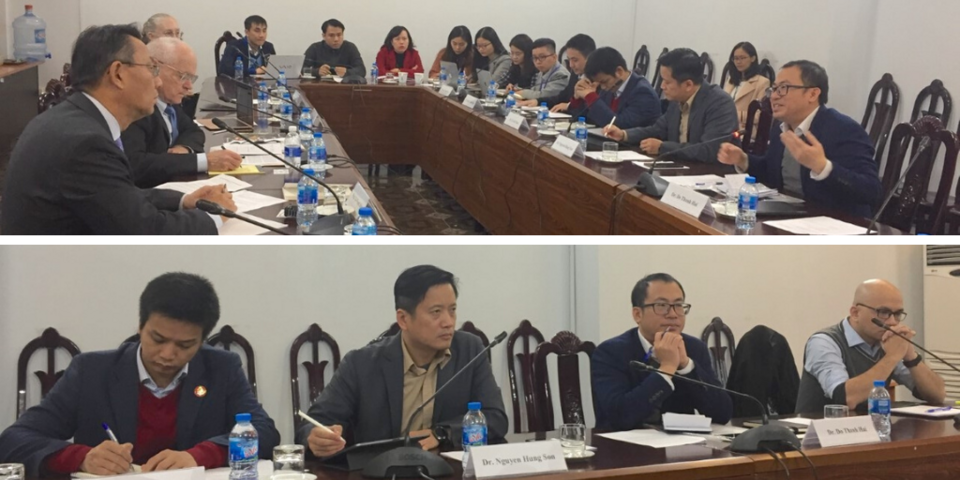
With a focus on health policy, our first day in Hanoi included a visit to Thai Nguyen University, a meeting with government representatives at the Vietnam Ministry of Health, and a seminar on healthy aging and innovation jointly with Hanoi Medical University.

Image
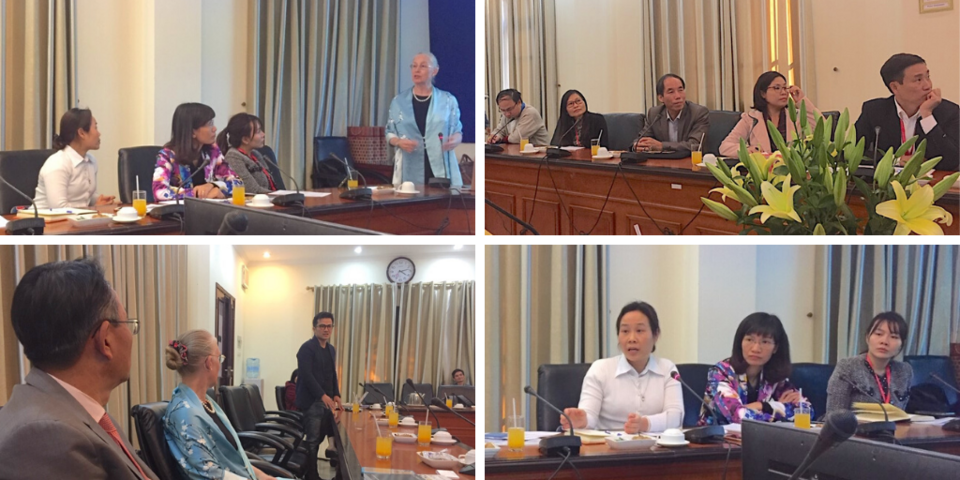
Collage of four images showing participants at a roundtable held at Hanoi Medical University with APARC delegation members

Karen Eggleston and participants at the roundtable held at Hanoi Medical University, December 9, 2019.

Throughout the day, Eggleston presented some of her collaborative research that is part of two projects involving international research teams: one that assesses public-private roles and institutional innovation for healthy aging and another that examines the economics of caring for patients with chronic diseases across diverse health systems in Asia and other parts of the world. We appreciated learning from our counterparts about the health care system and health care delivery in Vietnam.

Shifting focus to international relations and regional security, day 2 in Hanoi opened with a roundtable, “The Rise of the Indo-Pacific and Vietnam-U.S. Relations,” held jointly with the East Sea Institute (ESI) of the Diplomatic Academy of Vietnam (DAV). Following a welcome by ESI Director General Nguyen Hung Son, the program continued with remarks by Shin, Emmerson, ESI Deputy Director General To Anh Tuan, and Assistant Director General Do Thanh Hai.

Image
Participants at a roundtable held at the Diplomatic Academy of Vietnam with APARC delegation members

Roundtable at the Diplomatic Academy of Vietnam, December 10, 2019.

The long-ranging conversation with DAV members included issues such as the future of the international order in Asia; the U.S. withdrawal from multilateralism; the concern about a lack of U.S. engagement in Southeast Asia, sparked by President Trump’s absence from the November 2019 summit of the Association of Southeast Asian Nations (ASEAN) at a time when China is bolstering its influence in the region and when ASEAN hopes to set a code of conduct with China regarding disputed waters in the South China Sea; the priorities for Vietnam as it assumes the role of ASEAN chair in 2020; and the challenges for the Vietnam-U.S. bilateral relationship amid the changing strategic environment in Southeast Asia.

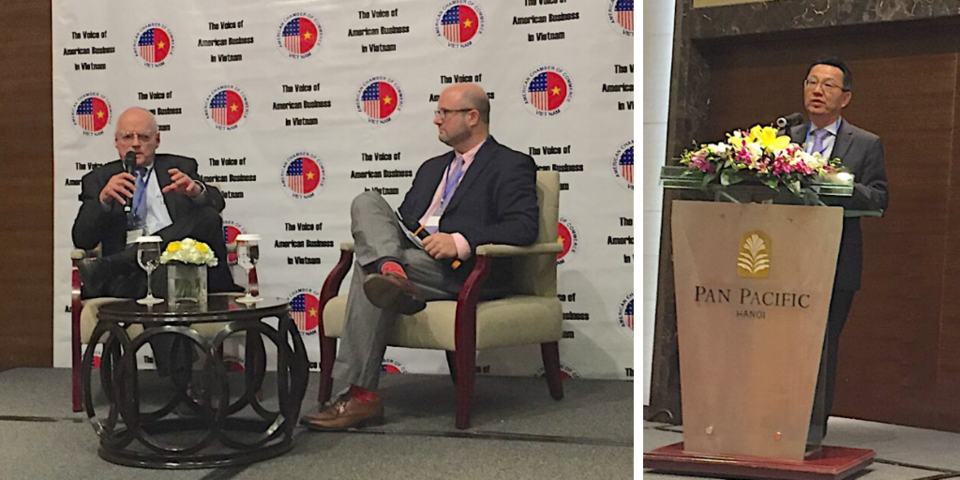
In the afternoon we were joined by members of the American Chamber of Commerce in Hanoi at an AmCham-hosted Lunch ‘n’ Learn session on Vietnam's challenges and opportunities amid the U.S.-China rivalry. The event featured Emmerson in conversation with AmCham Hanoi Executive Director Adam Sitkoff.

Image
Two men in conversation seated on stage and a man speaking at a podium

(Left) Donald Emmerson in conversation with Adam Sitkoff; (right) Gi-Wook Shin welcomes AmCham Hanoi members; December 10, 2019. 

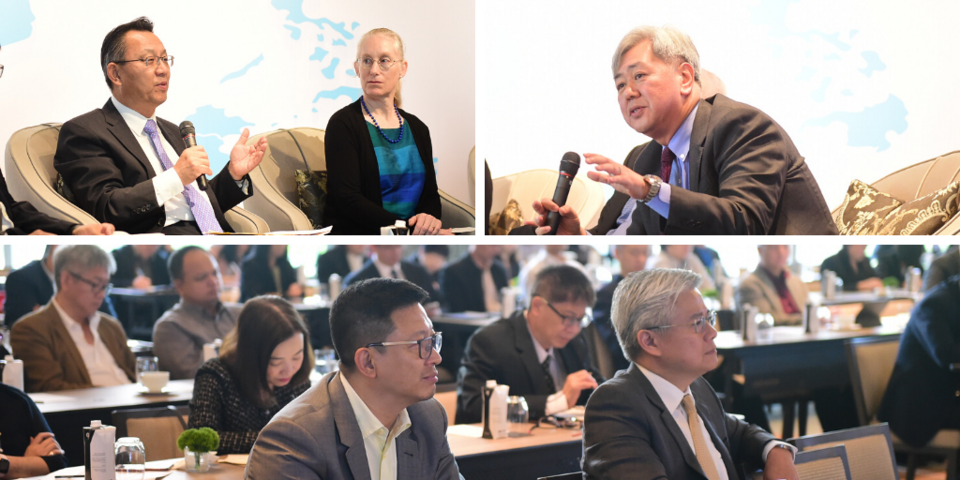
Moving to Bangkok, delegation members Shin, Eggleston, Emmerson, and Kim spoke on a panel for executives of the Charoen Pokphand Group (C.P. Group), one of Thailand’s largest private conglomerates, addressing some of the core issues that lie ahead for Southeast Asia in 2020 and beyond in the areas of geopolitics, innovation, and health.

Image
Participants at a panel discussion with APARC delegation hosted by the C.P. Group, Thailand

Top, from left to right: Gi-Wook Shin, Karen Eggleston, Andrew Kim; bottom: C.P. Group executive listening to the panel, December 12, 2019.

We also enjoyed a tour at True Digital Park, Thailand’s first startup and tech entrepreneur’s campus. Developed by the C.P. Group, True Digital Park aspires to be an open startup ecosystem that powers Thailand to become a global hub for digital innovation.

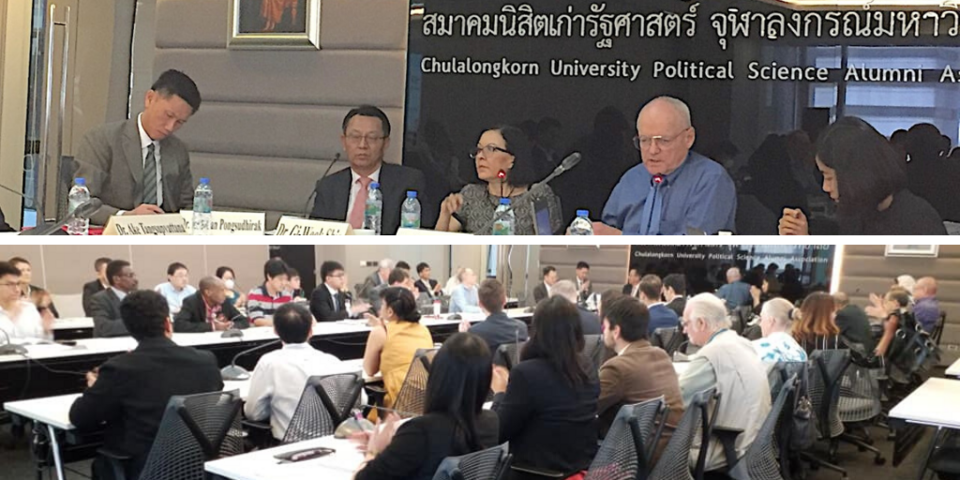
The following day, Shin and Emmerson participated in a public forum hosted by Chulalongkorn University’s Institute of Security and International Studies (ISIS Thailand), "Where Northeast Asia Meets Southeast Asia: The Great Powers, Global Disorder and Asia’s Future.” They were joined by ISIS Thailand Director Thitinan Pongsudhirak and Chulalongkorn University Faculty of Political Science Associate Dean for International Affairs and Graduate Studies Kasira Cheeppensook. The panel was moderated by Ms. Gwen Robinson, ISIS Thailand senior fellow and editor-at-large of the Nikkei Asian Review.

Image
Panelists and participants at a public forum held at Chulalongkorn University

ISIS Thailand forum participants and panelists, from left: Pngsukdhirak, Shin, Robinson, Emmerson, Cheeppensook; December 13, 2019.

As part of that discussion, Emmerson speculated that – driven by deepening Chinese economic and migrational involvement in Southeast Asia’s northern tier – Cambodia and Laos, less conceivably Myanmar, and still less conceivably Thailand could become incorporated de facto into an economically integrated “greater China” that could eventually reduce ASEAN to a more-or-less maritime membership in the region’s southern tier. Emmerson’s speculation was made in the context of his critique of ASEAN’s emphasis on its own “centrality” to the neglect of its lack of the proactivity that would serve as evidence of centrality and of a desire not to be rendered peripheral by the growing centrality-cum-proactivity of China. The event was covered by the Bangkok Post (although that report’s headline and quote of Emmerson are inaccurate, as neither the panel nor Emmerson predicted the “break-up of ASEAN.”)

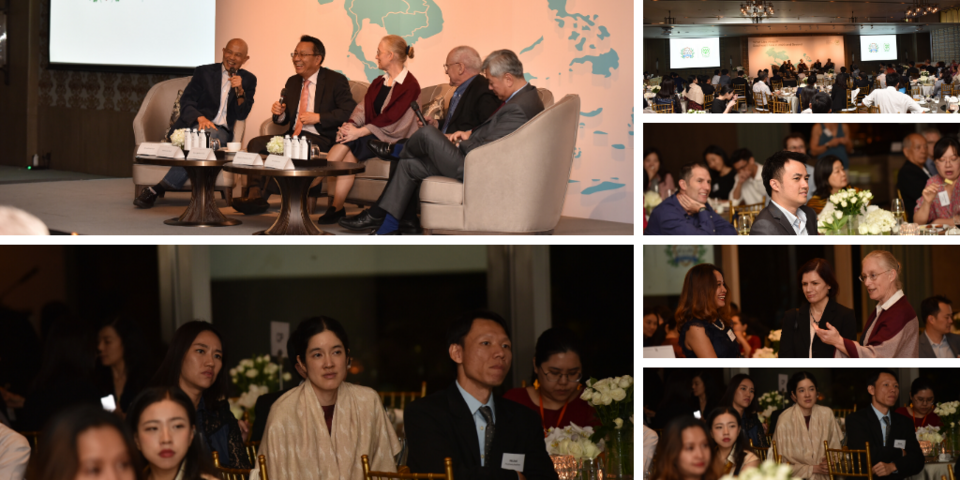
Our delegation visit in Bangkok concluded with a buffet dinner reception and panel discussion jointly with the Stanford Club of Thailand.

Image
alumni event

Stanford and IvyPlus alumni listening to the panel, December 13, 2019.

Moderated by Mr. Suthichai Yoon, a veteran journalist and founder of digital media outlet Kafedam Group, the conversation focused on the changing geopolitics of Southeast Asia, innovation and health in the region, and the opportunities and challenges facing Thailand-U.S. relations. It was a pleasure to meet many new and old friends from the Stanford and IvyPlus alumni communities.

APARC would like to thank our partners and hosts in Hanoi and Bangkok for their hospitality, collaboration, and the stimulating discussions throughout our visit. We look forward to keeping in touch!

Hero Image
APARC delegation speaking to Stanford and IvyPlus alumni, Bangkok
All News button
1
Paragraphs

Shorenstein APARC's annual overview for academic year 2018-19 is now available.

Learn about the research, events, and publications produced by the Center's programs over the last twelve months. Feature sections look at U.S.-China relations and the diplomatic impasse with North Korea, and summaries of current Center research on the socioeconomic impact of new technologies, the success of Abenomics, South Korean nationalism, and how Southeast Asian countries are navigating U.S.-China competition. Catch up on the Center's policy work, education initiatives, and outreach/events.

Read online:

All Publications button
1
Publication Type
Annual Reports
Publication Date
-

U.S.-China relations have evolved from past templates of  "responsible stakeholder" and "G2" to new ones emphasizing strategic competition.  What is the impact of this competition for broader stability in East Asia?  How does the ongoing U.S.-China trade war impact U.S. allies in Asia?   In particular, how does strategic competition between these two power affect the choices of key allied states like Korea?  Professor Cha will present some research-in-progress on these topics that seeks a broader conceptualization of the costs and benefits behind the latest turn in U.S.-China relations.

Image
victor cha small 1 3x2
Victor Cha is a 2019-20 Koret Fellow at Stanford's Shorenstein Asia-Pacific Research Center during the winter quarter.  He is Vice Dean and holds the D.S. Song-KF Chair in Government and International Relations at Georgetown University, and is also Senior Adviser at the Center for Strategic and International Studies (CSIS) in Washington D.C. He formerly served on the National Security Council staff and as the US Deputy head of delegation for the Six Party talks. Professor Cha received a PhD in political science and a master's in international affairs from Columbia University; an MA in philosophy, politics, and economics from the University of Oxford; and an AB in economics from Columbia University.

Victor Cha <i>Professor of Government, Georgetown University</i>
Seminars
-

North Korea’s international trade has increased by more than three times since mid-1990's. Using various data sources and a frontier theory of international trade, North Korea's economic gains from trade can be quantified to show the gains are substantial. This implies that the opportunity cost of abandoning economic openness is high, thus, this is an important leverage to promote North Korea’s political openness and denuclearization. However, the current economic openness of North Korea has a fundamental limitation because of its heavy reliance on China. The China-dependence pattern of its trades has only recently emerged. It is worth noting that North Korea’s trades were much more diversified before 2008. The comparative advantage analysis shows that North Korea’s trades can be diversified as before; and cooperation among North Korea, South Korea, and the United States can play an important role for the diversification if it is shaped from global perspectives rather than by the bilateral relations.

Image
hyeok jeong photo crop
Hyeok Jeong (PhD, University of Chicago) is a professor at the Graduate School of International Studies (GSIS), Seoul National University. His main research interests include economic growth and development, productivity and inequality dynamics in relation to financial deepening and labor market issues such as human capital and demographic transition. His recent research agenda also includes the influences of firm and product dynamics on international trade, higher education reform, Korea’s long-term development process, evolution of Korea’s demographic dividends, North Korean economy, and international development cooperation on issues such as knowledge sharing and development finance. Prior to joining the faculty of GSIS in 2015, he was a professor of economics at the University of Southern California and Vanderbilt University; National Graduate Institute for Policy Studies in Japan; and the KDI School of Public Policy and Management in Korea.


Hyeok Jeong <i>Professor, Seoul National University</i>
Seminars
Subscribe to Trade