
Scholar Traces Peru's Decade of Political Instability to "Democratic Hollowing"
Scholar Traces Peru's Decade of Political Instability to "Democratic Hollowing"
Political scientist Alberto Vergara argues Peru's crisis stems not from a power grab, but from the dissolution of power itself.
In Brief
- Peru's 2026 elections exposed deep democratic strain, with a month-long delay in results and a razor-thin 0.008% margin between runoff candidates Keiko Fujimori and Roberto Sánchez.
- Political scientist Alberto Vergara argues Peru is experiencing "democratic hollowing" rather than backsliding — democracy eroding through the dissolution of power rather than its concentration.
- Three forces drive this hollowing, per Vergara: electoral fragmentation, personalistic amateurism among politicians with no long-term stake in office, and the replacement of political identities with shared "anti-identities."

On May 15, the Stanford Society for Latin American Politics (SSLAP) and the Democracy Action Lab (DAL) at the Center on Democracy, Development and the Rule of Law (CDDRL) co-hosted Professor Alberto Vergara for a discussion on “Democratic Hollowing in Peru: The Underexplored Pathway of Democratic Erosion” as part of the DAL series Democracy at the Ballot Box: The 2026 Electoral Cycle in Latin America. The talk offered key reflections on Peru's political trajectory over the past decade and the emerging threats to its democracy.
Peru's 2026 General Elections
Over the past decade, Peru has had eight presidents — a clear indicator of ongoing political and institutional instability driven by recurrent impeachments by the Peruvian Congress. As a result, there has been massive social unrest, state repression, and an unprecedented rise in organized criminal activity.
Peru held general elections April 12-13, 2026. On the morning of May 15, the National Office of Electoral Processes (ONPE) confirmed the presidential runoff election on June 7 between Keiko Fujimori, leader of the right-wing populist party Fuerza Popular, and Roberto Sánchez of Juntos por el Perú, a left-wing coalition. This runoff closely resembles the 2021 election, when Fujimori faced Pedro Castillo in a highly polarized contest. However, the electoral process itself revealed the depth of democratic deterioration. The release of official results took about one month due to serious logistical failures by ONPE. Problems distributing electoral materials in several districts of Lima forced voting to extend into a second day, further undermining confidence in an already fragile electoral process.
Almost a week after Peru's runoff election, the country did not have official results of who would take office as president on July 28 (Independence Day). With 98% of votes counted, the June 7 runoff between Keiko Fujimori and Roberto Sánchez has revealed a highly polarized election, with a vote difference of only 0.008%. Early in the week, as vote counting began, Sánchez appeared to hold a lead. However, the results shifted dramatically when election officials began processing ballots from over 309,000 Peruvians living abroad across 73 countries. This shift has put Fujimori ahead, yet without any official declaration from ONPE, the result remains deeply contested. As Peruvians say, it is better to “no cantar victoria” — don't claim victory yet.
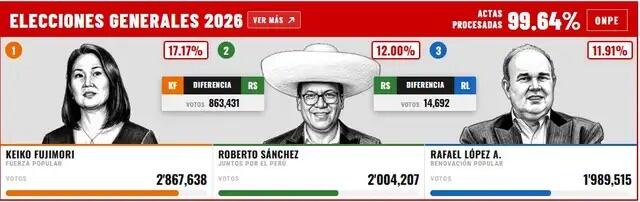
ONPE's near-final tally of Peru's 2026 general election, with 99.64% of ballots processed, showed Keiko Fujimori leading Roberto Sánchez and Rafael López A. ahead of the June 7 runoff. Credit: La Republicá
Democratic Hollowing
Alberto Vergara, along with his colleague Rodrigo Barnechea, introduced a new key political concept, democratic hollowing, to better explain Peru's democratic erosion and the political crisis during the past decade. Most of the current academic literature argues that “democracy backsliding” occurs when there is a structural shift toward authoritarianism and the concentration of power in the hands of a lone strongman or a political party. Across Latin America, this trend has been particularly visible in Venezuela under Chavismo, in Nicaragua under Daniel Ortega, and in Cuba under Communist Party rule. In Peru, however, Vergara argues that democracy can also die through the dissolution of power, which he calls democratic hollowing. This political landscape has been shaped by fragmented political parties, amateur politicians with no long-term incentives, and a weakened rule of law, producing chronic, self-reinforcing political instability.
Therefore, weak political representation and breaches of the rule of law have disincentivized the current political system from protecting and representing Peruvian citizens' interests. During the lethal repression of the 2022 and 2023 protests in Peru, under Dina Boluarte's regime, the Peruvian police and army left around 50 civilian protesters dead and more than 1400 people injured. These acts remained unpunished, with no justice delivered and no reparations provided to the victims or their families. Vergara argues that control over the judiciary becomes essential because politicians are implicated in informal or criminal activity, and in the outgoing Congress, 68 of 130 congressmen were under judicial investigation; in the current one, 60, for crimes including money laundering, criminal organization, and rape.
There are three main characteristics of democratic hollowing that Vergara has included:
Electoral fragmentation: Political parties have become "mere legal entities" with no real roots in society, and politicians have learned to rely on personal resources and reputations rather than party structures to get elected. The result is a system where loyalty to parties is almost nonexistent, politicians split off and regroup constantly, and each electoral cycle effectively “resets” the political landscape. The current Congress includes members from 12 different political parties and 11 unaffiliated congressmen.
Personalistic amateurism: Amateurism arises from the lack of established political parties that do not sustain political careers. Presidents Boluarte, Castillo, Sagasti, Merino, Vizcarra, and Kuczynski all had almost no political experience before the presidency. Without organizational ties or long-term incentives, these amateurs are prone to miscalculation, predatory behavior, and short-term rent-seeking that deepens Peru's institutional decay with every new government.
Absence of political linkages: Since Fujimori's authoritarian regime and the collapse of the party system, political parties have been replaced not by political identities but by "anti-identities.” Vergara argues that the most stable bond between politicians and citizens is not a shared agenda but a shared rejection, whether of Fujimorismo or, more recently, of the left. This is precisely what he observes in the current election. Rather than offering a vision or a program, both runoff candidates campaign purely on the message that the other is worse. Parties that are little more than names on a poster cannot hold politicians accountable, and outsiders who reach office have nothing to sustain them once they get there — no organization, no ideology, no base. The result is a political system where representation is performed but never actually delivered.
Professor Alberto Vergara's discussion of democratic hollowing in Peru invites us to reflect on how practices such as impunity, lack of access to justice, rent-seeking, and repeated breaches of the rule of law continue to be institutionalized. In this context, elections function only as a “band-aid” that, once removed, reveals the nation’s underlying fracture. Unfortunately, these patterns are historically rooted in the fact that “equality before the law never took deep root in Peru.” The State has never credibly guaranteed equal civil and political rights, which has deeply weakened citizens’ trust in institutions. This distrust is reinforced when those who claim to protect citizens are often the same actors who repress them during protests, or favor laws on illegal mining, criminal organizations, and money laundering. While these structural problems persist, Peruvians continue working hard to sustain their households amid growing insecurity and the rise of organized crime, often without any guarantee that they will return home safely. Ultimately, Peru’s democratic hollowing is not only a political crisis but a social reality that shapes everyday life, exposing the fragility of democracy and the urgent need for a state that can truly guarantee justice, representation, and security for all.

