
Missing Voters? An Analysis of the Effects on Turnout of the Election Administration Delays in the 2026 Peru First Round Presidential Elections
Missing Voters? An Analysis of the Effects on Turnout of the Election Administration Delays in the 2026 Peru First Round Presidential Elections
| Key Finding: The extraordinary delays in the installation of polling sites, albeit leading to a significant decline in turnout and an impact on vote margins between the second and third-placed candidates, were not enough to overturn electoral results. We estimate a reduction of 3 to 5 percentage points in turnout among affected polling stations, translating to approximately 27,000 foregone votes. |
Background
Peruvians went to the polls for the first round of general elections on April 12, 2026. However, major logistical failures delayed the opening of polling stations (mesas) across Lima, in some cases by more than eight hours. Using 29,229 polling-station records (actas) in PDF form to recover opening times, we estimate that at least 817,765 eligible voters were assigned to mesas that opened more than three hours late, 69,139 to mesas that opened more than eight hours late, and 54,362 to mesas that did not open until the following day.1
Peruvian democracy now finds itself at an inflection point: the margin between second and third place, with only one advancing to the runoff, is approximately 21,209 votes (0.09%), the narrowest since Peru's return to democracy in 2000. The third-place candidate, Rafael López Aliaga, has contested the results through what we term the missing voters theory: the claim that hundreds of thousands of voters were unable to cast ballots because mesas opened late or failed to open altogether. López Aliaga has called for the annulment of the election and the imprisonment of the head of the National Office of Electoral Processes (ONPE).
Although these delays to polling site installations should never have occurred, our analysis suggests the winners of the first round of the presidential election, based on current ballot counts, are still legitimate.
1 See accompanying technical working paper for full details: Missing Voters? Evidence from Polling Station Delays in the 2026 Peruvian Elections.
Methods
Estimating the effect of delays in opening polling stations on turnout is not straightforward because stations that open late are not necessarily random events. Our core statistical analysis leverages two complementary sources of variation to better approximate “apples-to-apples” comparisons: comparing neighboring polling tables within the same district, and then comparing each voting site against itself across four consecutive elections (2011 to 2026).
We define a polling station as “late” if a mesa opened more than three hours after its scheduled opening time of 7 am, while also varying this threshold hourly until 2 pm. In the previous three elections, almost no mesa opened more than three hours late, making it a reasonable cutoff for lateness. We additionally rely on the JNE’s official report identifying mesas confirmed to have opened after 2pm as a “ground truth” measure of delayed installations and separately examine mesas that opened the following day.
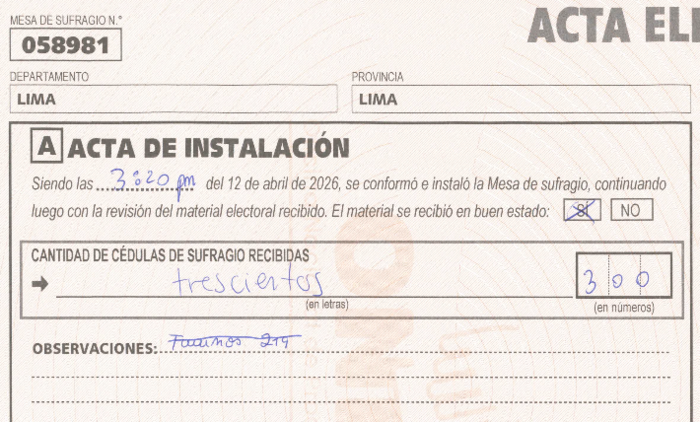
Figure 1. Example of a scanned acta (polling station record) used to recover opening times.
The Dataset
Because no official 2026 election database was available during our analysis, we construct our own dataset by scraping the near-universe of available polling-station records (actas) across mesas in Lima. To compare turnout over time, we additionally collect voting site-level electoral data from presidential elections since 2011.
Methodology
We processed over 87,000 scanned actas using a state-of-the-art multimodal large language model (Gemini 2.5 Pro via Google Vertex) to recover polling station opening times from both digital and handwritten records, which were then manually verified. We additionally incorporated the JNE's April 16 report identifying mesas confirmed to have opened after 2 pm.
Results
Our core result suggests that those mesas that opened after 10 am on Sunday experienced a decline in turnout by 3 percentage points. Among those mesas where we can confirm an opening time after 2 pm, this effect increases to a 5.3-percentage-point decline in turnout. Moreover, for those mesas that opened a full day late on Monday, we estimate a 5-percentage-point decline in turnout.
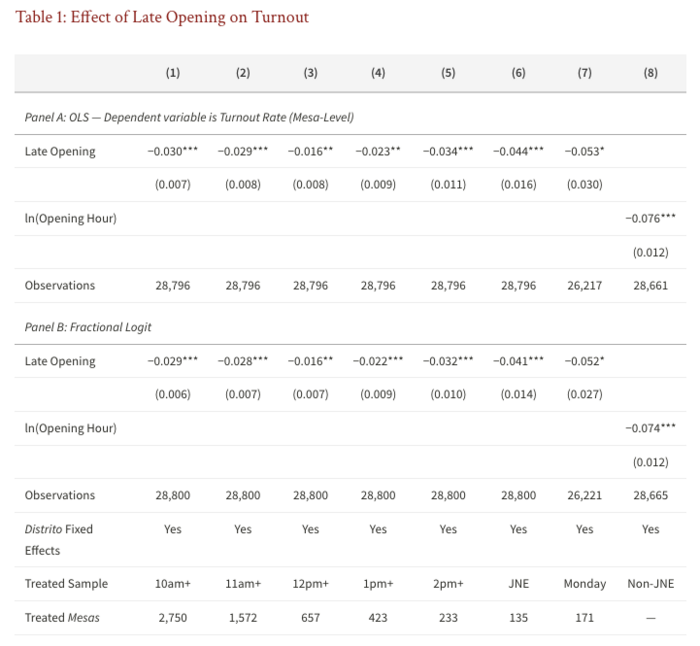
Note: *** p < 0.01, ** p < 0.05, * p < 0.10. Robust standard errors clustered by voting site in parentheses. Treated sample refers to the definition of the treatment variable. JNE refers to mesas observed opening after 2 pm by the Jurado Nacional de Elecciones report. Panel A reports OLS estimates. Panel B reports average marginal effects from fractional logit models. Column 7 only uses mesas that opened before 10 am on Sunday as the control group. Column 8 drops all mesas flagged in the JNE report given installation times cannot be confirmed before 2 pm.
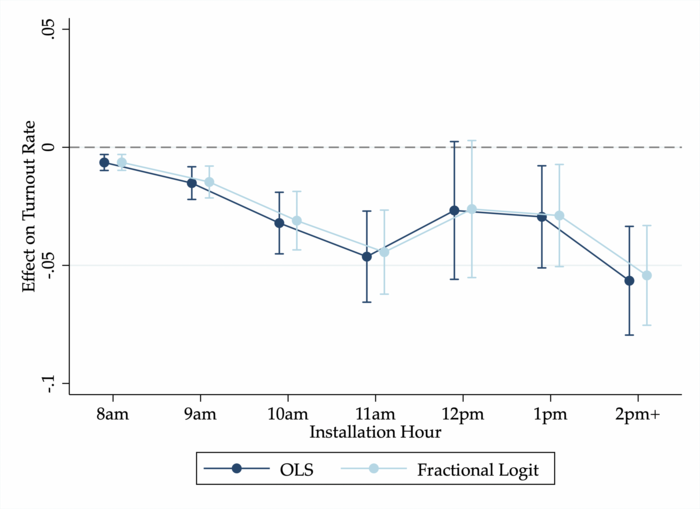
Figure 2. Binned estimates of mesa opening hour on turnout. Effects are relative to a “base” opening time of 7:00–7:59 am.
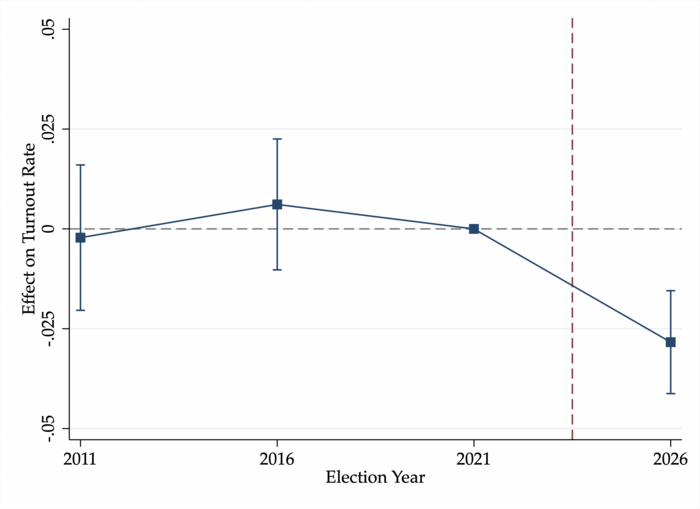
Figure 3. Event study results for 10 am+ openers. Analysis is at the voting site level.
When we “bin” the installation times of mesas into hourly intervals, we see an increasing pattern of turnout decline, as shown in Figure 2. However, this is not monotonic: there is a clear rebound for those mesas that opened around noon, as lunchtime gave voters a chance to return to the polls, although turnout continues to decline thereafter.
To show the impact of the delays relative to historical turnout rates, Figure 3 plots the results from an “event study,” focusing on those voting sites that comprise any mesa that opened after 10 am on Sunday. There is an evident drop in turnout for the delayed mesas of 2026, with no differential trends in turnout over the last three prior elections.
Estimating the “Missing Voters”
The key question emerging from the analysis is: exactly how many foregone votes resulted from the installation delays at voting stations? Using our estimates of turnout loss, we perform back-of-the-envelope calculations to quantify these “missing voters.” In Table 2, we estimate an overall loss of votes approximating 27,000 voters. This estimate combines the effects from voting stations opening after 10am on Sunday, in addition to the loss in turnout for Monday-openers.
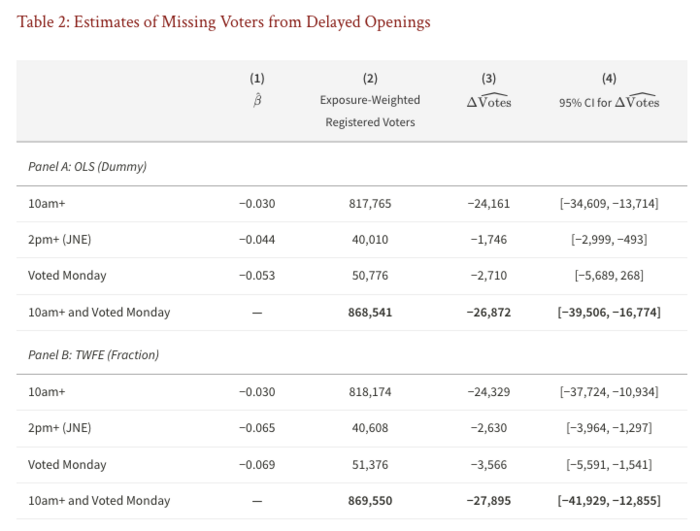
Note: Exposure-weighted registered voters refers to total registered voters among delayed polling tables or voting sites. Panel A reports OLS estimates. Panel B reports TWFE estimates using the continuous fraction of mesas that opened late within a site (Voted Monday is included as it is effectively a 100% fraction). Combined 10 am+ and Voted Monday sum the predicted foregone votes from the two constituent estimates, with uncertainty computed using a site-cluster bootstrap.
We then estimate how these foregone votes would have been distributed between the second- and third-place candidates. Because the observed López Aliaga–Sánchez margin was itself affected by the delays, we construct a counterfactual using vote shares from untreated mesas within the same district, or the nearest untreated district when necessary. In Figure 4, combining turnout losses from both 10am+ Sunday-openers and Monday-openers, we estimate that López Aliaga lost approximately 5,691 votes relative to Sánchez — comfortably below the roughly 21,209-vote gap separating the candidates.
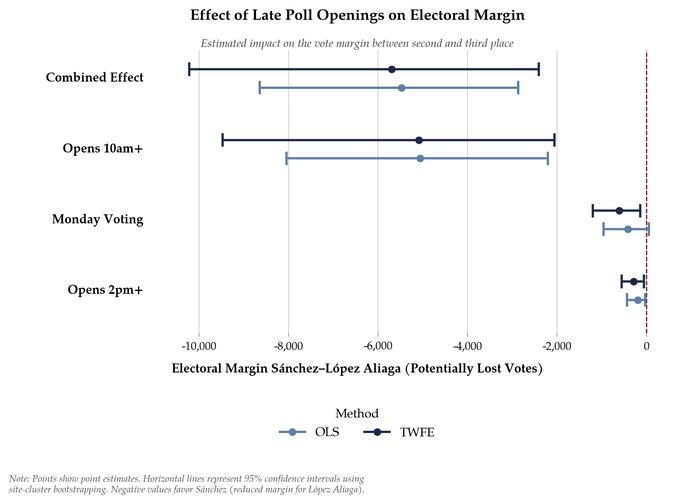
Figure 4. Estimated potential change in electoral margin from delayed openings. Points show point estimates; horizontal lines represent 95% confidence intervals using site-cluster bootstrapping. Negative values favor Sánchez (reduced margin for López Aliaga).
Conclusion
By tracking the first round of the Peruvian 2026 presidential election in real time, and using state-of-the-art LLMs combined with techniques in causal inference, our analysis reveals a strong decline in turnout, albeit not large enough to overturn electoral results.
Acknowledgments: This brief was prepared collaboratively by the Democracy Action Lab team, with special contributions by Christopher Dann and Marcelo Peña.
Available for Interviews
Dra. Beatriz Magaloni — Co-director of the Democracy Action Lab, Professor, Department of Political Science and Senior Fellow, FSI, Stanford University
Beatriz Magaloni is Graham H. Stuart Professor of International Relations in the Department of Political Science and Senior Fellow at the Freeman Spogli Institute for International Studies, where she co-directs the Democracy Action Lab and also the Poverty, Violence and Governance Lab (POVGOV), which she founded in 2010. In 2023, she was awarded the Stockholm Prize in Criminology, considered the equivalent of the Nobel Prize in this field, in recognition of her research on police violence and mechanisms to reduce it, particularly her studies in Mexico and Brazil that demonstrated that police militarization and torture do not improve public safety but do erode human rights.
Dr. Alberto Díaz-Cayeros — Co-director of the Democracy Action Lab and Senior Fellow, FSI/CDDRL, Stanford University
Alberto Díaz-Cayeros is Senior Fellow at the Freeman Spogli Institute and co-director of the Democracy Action Lab at the Center on Democracy, Development and the Rule of Law (CDDRL). He directed Stanford’s Center for Latin American Studies from 2016 to 2023, and his work focuses on federalism, poverty alleviation, indigenous governance, the political economy of health, violence, and citizen security in Mexico and Latin America.
Christopher Dann — Researcher, Democracy Action Lab
Chris Dann is a doctoral candidate at Stanford and a graduate fellow at POVGOV, with research focused on political economy. He was previously a pre-doctoral fellow with Professor Tim Besley at the London School of Economics.
Press Contact
Democracy Action Lab — CDDRL
Stanford University
Encina Hall, 616 Jane Stanford Way, Stanford, CA 94305
democracyactionlab@stanford.edu