Joseph Z. Perkins, a partner in Orrick's Silicon Valley office, is a member of the Technology Companies Group, which advises emerging companies and venture capital firms. Mr. Perkins focuses his practice on providing private venture financing and merger and acquisition services to Internet, high tech, and clean technology companies in the United States and Japan.
Some of Mr. Perkins's current and former clients include the following: • Bleacher Report (Sports media; acquired by Turner Broadcasting) • Doki Doki (stealth) • FOVE (Virtual reality hardware) • Getaround (Car sharing community) • Instagram (Photo social media; acquired by Facebook) • iSpace (Robotics) • Life360 (Family connectivity and safety) • Orchestra - aka Mailbox (e-mail management; acquired by Dropbox) • Ooma (VoiP hardware) • Pinterest (Social Media) • Say Media - fka VideoEgg (Advertising) • Social Finance (social lending) • UniversityNow (Online education) • WHILL (Personal Mobility)
Prior to receiving his Juris Doctor from Harvard Law School, Mr. Perkins spent four years as an officer of a company that provides language and travel services to Japanese travelers.
Seminar Description
The idea of raising money through venture capital can be daunting if you’ve never gone through that process before. In this presentation, we will discuss various aspects of the fundraise process, including how to choose your investor and prepare for a term sheet, key terms to look for in the financing, and how to get to close as quickly as possible. Learn about different types of investors, what they look for in their potential investments, and what they bring to the table in accelerating a startup’s growth. We’ll also review specific scenarios and how various liquidation preferences can impact your company’s exit.
Kenji Kushida will provide an overview of canonical works of Silicon Valley, including work of Martin Kenney and his classic co-edited volume "Understanding Silicon Valley" and other more recent work drawn from the Stanford Silicon Valley - New Japan project’s "Top Ten Reading List of Silicon Valley." He will also share insights from a recent report co-authored with Richard Dasher, Nobuyuki Harada, Takeo Hoshi, and Tetsuji Okazaki entitled "Institutional Foundations for Growth" which partially draws from research on Silicon Valley.
Kanetaka Maki will present his new research from a paper entitled "Milestones to University-Based Startup Success: What Is the Impact of Academic Inventor Involvement?” Based on the data analysis of 533 University of California startups, he will explain the impact of inventor involvement in the growth and success of university-based startups.
Technological advances have brought us to a potential tipping point in the delivery of financial services that will affect the individual, firm, the industry and the country. How important will this development be for potential growth in developed and developing countries? Will the changes occur without official intervention, or will they need the state’s guiding hand to ensure that they provide their benefits with minimal risk? What measures are needed from policy makers and regulatory authorities to clear the path for faster growth?
This seminar, co-sponsored by the Stanford Center for International Development and the Shorenstein Asia-Pacific Research Center, will look at how a group of companies, an industry and a country have effectively capitalized on conducive regulatory environment the opportunities offered by the technological advances and related disruptions. The talk will focus on the strategy of M-Pesa/Alibaba, Chinese Financial Sector and Singapore. The combination of Silicon Valley Technology and Smart Nation/City initiative may overcome some challenges of low productivity and low growth in many parts of the world especially in Asia and ASEAN.
David LEE Kuo Chuen is a visiting scholar at the Walter H. Shorenstein Asia-Pacific Research Center (APARC) for the fall of 2015. He is currently the Director of Sim Kee Boon Institute for Financial Economics. He holds the appointment of Practice Professor of Quantitative Finance, Lee Kong Chian School of Business, in Singapore Management University. He is also the founder of Ferrell Asset Management Group. His research interests encompass digital and Internet finance, digital banking, Asia finance, impact investing, financial inclusion and asset allocation. During his time as a Fulbright Scholar at Shorenstein APARC, his research will focus on harnessing Silicon Valley technology for connectivity and financial inclusion in ASEAN and Singapore. David is also an Independent Director of two SGX-listed companies and sits on the Investment Committee and Council of two charitable organizations. He is the Vice President of the Economic Society of Singapore. He was the Founding Vice Chairman of the Alternative Investment Management Association (Singapore Chapter), a member of the SGX Security Committee, and MAS Financial Research Council. He was also the Group Managing Director of OUE Limited and Auric Pacific Limited, as well as the Non-Executive Chairman of MAP Technology Limited. David speaks frequently in international conferences with occasional appearances in Bloomberg, Reuters and Channel NewsAsia. He has published in Financial Analyst Journal, Journal of Investing, Journal of Wealth Management, Journal of Statistical Computation and Simulation, Applied Financial Economics, and several books and chapters on Household Economics and Hedge Funds. His two books on Asia Finance focus on Banking, Sovereign Wealth Funds, REITs, Financial Trading & Markets, and Fund Performance. His latest book is on Digital Currency. He graduated from the London School of Economics and Political Science with a BSc (Econs), MSc (Mathematical Economics and Econometrics) and a PhD in Econometrics and Mathematical Economics.
Smart Nation, Silicon Valley Technology and Asia Growth Strategy
A Stanford-led team has discovered how to estimate crop yields with more accuracy than ever before with satellites that measure a special form of light emitted by plants. This breakthrough will help scientists study how crops respond to climate change.
As Earth's population grows toward a projected 9 billion by 2050 and climate change puts growing pressure on the world's agriculture, researchers are turning to technology to help safeguard the global food supply.
A research team, led by Kaiyu Guan, a postdoctoral fellow in Earth system science at Stanford's School of Earth, Energy, & Environmental Sciences, has developed a method to estimate crop yields using satellites that can measure solar-induced fluorescence, a light emitted by growing plants. The team published its results in the journal Global Change Biology.
Scientists have used satellites to collect agricultural data since 1972, when the National Aeronautics and Space Administration (NASA) pioneered the practice of using the color – or "greenness" – of reflected sunlight to map plant cover over the entire globe.
"This was an amazing breakthrough that fundamentally changed the way we view our planet," said Joe Berry, professor of global ecology at the Carnegie Institution for Science and a co-author of the study. "However, these vegetation maps are not ideal predictors of crop productivity. What we need to know is growth rate rather than greenness.
The growth rate can tell researchers what size yield to expect from crops by the end of the growing season. The higher the growth rate of a soybean plant or stalk of corn, for instance, the greater the harvest from a mature plant.
"What we need to measure is flux – the carbon dioxide that is exchanged between plants and the atmosphere – to understand photosynthesis and plant growth," Guan said. "How do you use color to infer flux? That's a big gap."
Solar-induced fluorescence
Recently, researchers at NASA and several European institutes discovered how to measure this flux, called solar-induced fluorescence, from satellites that were originally designed for measuring ozone and other gases in the atmosphere.
A plant uses most of the energy it absorbs from the sun to grow via photosynthesis, and dissipates unused energy as heat. It also passively releases between 1 and 2 percent of the original solar energy absorbed by the plant back into the atmosphere as fluorescent light. Guan's team worked out how to distinguish the tiny flow of specific fluorescence from the abundance of reflected sunlight that also arrives at the satellite.
"I think of it like crumbs falling to the ground as people are eating. It's a very small trail," said co-author David Lobell, associate professor of Earth system science at Stanford's School of Earth, Energy, & Environmental Science. "This glow that plants have seems to be very proportional to how fast they're growing. So the more they're growing, the more photosynthesis they're doing, and the brighter they're fluorescing." Lobell is also deputy director of the Center on Food Security and the Environment.
The research team saw an opportunity to use this new data to close the knowledge gap about crop growth, beginning with a major corn- and soybean-producing region of the U.S. Midwest.
"With the fluorescence breakthrough, we can start to directly measure photosynthesis instead of color," Guan said.
The fact that fluorescence can now be detected from space allows researchers to measure plant growth across much larger areas and over long periods of time, giving a much clearer picture of how yields fluctuate under changing weather conditions.
"One of the really cool things about fluorescence is that it opens up a whole new set of questions that we can ask about vegetation, and often times it's these new measurements that drive the science forward," Lobell said.
Next steps
The research team has already identified a number of potential uses of this approach by agricultural scientists, farmers, crop insurance providers and government agencies concerned with agricultural productivity.
If there is a day when the plant is really stressed, the fluorescence will drop significantly, Lobell said. Capturing these short-term responses to environmental changes will help scientists understand what factors plants are responding to on the daily time scale.
"That helps us, for example, figure out what we need to worry about in terms of stresses that crops are responding to," Lobell said. "What should we really be focusing on in terms of the next generation of cropping systems? What should they be able to withstand that the current crops can't withstand?"
At this early stage, fluorescence measurements are relatively low-resolution (a single measurement covers about 50 square kilometers) and because it is only collected once per day, cloudy skies can interfere with the fluorescence signal. For now, researchers have to supplement the data with other information and with on-the-ground observations to refine the measurements.
"Now that we have demonstrated the concept, we hope to soon be orbiting some new satellites specifically designed to make fluorescence measurements with better spatial and temporal resolution," Berry said.
The team plans to continue its research on U.S. crop yields while expanding measurements to other parts of the world.
"In the future, we hope to directly use this technology to monitor global food production, for example in China or Brazil, or even in your backyard," Guan said.
David Lobell is also deputy director of the Center on Food Security and the Environment, and William Wrigley Senior Fellow at the Freeman Spogli Institute for International Studies and the Stanford Woods Institute for the Environment. The study was also co-authored by Youngguan Zhang of the International Institute for Earth System Sciences at Nanjing University and the German Research Center for Geosciences (GFZ); Joanna Joiner of the NASA Goddard Space Flight Center Laboratory for Atmospheric Chemistry and Dynamics; Luis Guanter of GFZ; and Grayson Badgley of Stanford's Department of Earth System Science and Department of Global Ecology at the Carnegie Institution for Science.
CONTACTS:
p> Kaiyu Guan, Stanford School of Earth, Energy, & Environmental Sciences: kaiyug@stanford.edu
Laura Seaman, Stanford's Center on Food Security and the Environment: lseaman@stanford.edu, (650) 723-4920
Stanford students belong to the first generation that could witness the end of extreme global poverty — in what would be one of humankind's greatest achievements — the head of the World Bank said during a recent talk on campus.
But their generation, he said, is also likely to experience the first global pandemic since the 1918 influenza that killed more than 50 million people.
Jim Yong Kim, president of the World Bank, said innovations in health, education and finance are behind the World Bank's twin goals of ending extreme poverty and boosting shared prosperity for the bottom 40 percent of the global population.
Speaking at the inaugural conference of the Stanford Global Development and Poverty Initiative on Oct. 29, Kim lauded faculty and students for their multidisciplinary approach in tackling poverty and improving public health. He is an infectious disease physician who oversaw World Health Organization initiatives on HIV/AIDS.
"Seeking transformative solutions to challenges of development and poverty that are necessarily cross-disciplinary is exactly what a great university should be doing," Kim said in his speech at Stanford.
The World Bank announced last month that the number of people living on less than $1.90 a day is expected to drop to 9.6 percent of the global population by the end of the year. That is down from 36 percent in 1990.
The bank has pledged to cut that rate to 3 percent by 2030.
"We expect the extreme poverty rate to drop below 10 percent for the first time in human history," he said. "This is the best news in the world today. And this is the first generation in human history that has been able to see that potential outcome."
Promoting prosperity
One of the co-founders of Partners in Health, Kim was the keynote speaker at the daylong conference, "Shared Prosperity and Health," which drew together Stanford faculty and researchers, plus government and NGO officials from around the world.
Kim's talk was optimistic about the newly adopted U.N. Sustainable Development Goals, with an ambitious agenda to end poverty and hunger, ensure healthy lives, empower women and girls and attain quality education for all children by 2030.
While those goals seem lofty, Kim pointed to the accomplishment of bringing down extreme poverty to 10 percent, a figure many had once said was impossible.
Ninety-one percent of children in developing countries now attend primary school, up from 83 percent in 2000, he said. And the number of people on antiretroviral drugs for treatment of HIV in sub-Saharan Africa has increased eightfold in the last decade.
"But we're humbled by the challenges ahead," Kim said. "Rising global temperatures will have devastating impacts on poor countries and poor people – and, as we saw with Ebola, major pandemics are likely to disproportionately affect the poor."
Pandemic threats
Kim said that most virologists and infectious disease experts are certain a pandemic will sweep the world in the next 30 years. He said that would lead to more than 30 million deaths and anywhere from 5 to 10 percent of lost GDP.
He blasted the global community for taking eight months to respond to the Ebola crisis in West Africa, noting that Guinea, Sierra Leone and Liberia had among the fastest growing economies in Africa before the outbreak killed more than 11,000 people – most of whom were poor.
In an effort to speed up financial aid the next time such an outbreak occurs, the World Bank is developing the Pandemic Emergency Facility, which would disburse funding immediately to national governments and responding agencies.
Rajiv Shah, the administrator for the U.S. Agency for International Development from 2010-2015, spoke earlier at the conference about his work leading the U.S. efforts to contain Ebola.
"Three small countries with total population of maybe 30 million people had such weak health systems with so little domestic investment – in one country $6 per capita health investment per year – that when Ebola became a crisis there was no first-line of defense," he said.
By October 2014, the U.S. was pouring hundreds of millions of dollars into containment efforts, including the establishment of a 2,500-personnel military deployment to hit Ebola on the ground. Shah said President Obama "stayed extraordinarily true to the science" of containment at the source.
Image
Stunted children
Moving beyond containment of epidemics, Kim said the most important investment developing countries could make in their people starts when a woman becomes pregnant. Using a combination of health, nutrition and education will have lifelong benefits for each child, as well as for the country in which each prospers.
The World Bank estimates that 26 percent of all children under age 5 in developing countries are stunted, which means they are malnourished and under-stimulated, risking a loss of cognitive abilities that lasts a lifetime. The number climbs to 36 percent in sub-Saharan Africa, giving those children limited prospects in life."This is a disgrace, a global scandal and, in my view, akin to a medical emergency," Kim said. "Children who are stunted by age 5 will not have an equal opportunity in life. If your brain won't let you learn and adapt in a fast-changing world, you won't prosper and, neither will society. All of us lose."
From 2001 to 2013, the World Bank invested $3.3 billion in early childhood development programs in poor countries. Kim said innovative policymaking and financial tools allowed the bank to help Peru cut its rate of child stunting in half to 14 percent in just eight years.
"Progress is possible – and it can happen quickly. But we must do even more,"he said.
Kim said the world set a target in 2012 to reduce stunting in children by 40 percent. But that would still leave 100 million children malnourished and undereducated. The bank and world leaders should pledge to end stunting for all children by 2030, he said.
"With partners like the Global Development and Poverty Initiative and the entire Stanford community, I'm full of hope that we can indeed be the first generation in human history to end extreme poverty and create a more just and prosperous world for everyone on the planet."
Pilot program was designed to first ground students in the basics of empirical research, then provide an opportunity to apply that knowledge while conducting fieldwork in an international setting.
The Freeman Spogli Institute for International Studies (FSI) and Office of International Affairs (OIA) launched a pilot collaboration last year to provide a rigorous, immersive teaching and training program for students interested in international fieldwork. The result was a program that included a quarter-long course in the spring of 2015 followed by three weeks in Mexico during the summer to design and conduct a field research study. OIA spoke with Frank Wolak, the Holbrook Working Professor of Commodity Price Studies in Economics and Senior Fellow at FSI, to learn more about the project, titled International Field Research Training: Energy Reform in Mexico.
What was the impetus for designing a program for students with a field research component?
While students at Stanford have many opportunities to pursue independent research projects, they rarely have the opportunity to receive first-hand training in conducting interviews, research design and field implementation. With that in mind, we set out to design a program that would carry the students through the basics of empirical research and then give them the opportunity to apply that knowledge under close faculty supervision. Taking students out of the classroom and giving them the opportunity to see textbook methods in action is invaluable.
Our hope is that this training equips the students with the academic and logistical skills they need to execute their own robust research, be that for an honors thesis, a capstone project or an advanced degree.
How did the prerequisite course prepare students for working in the field?
The Stanford course taught the basics of the design, implementation and interpretation of social science field research. Building on a basic knowledge of statistical methods and economics, the course first introduced observational field research and compared it with experimental field research. Significant attention was devoted to explaining what can and cannot be learned through each type of field research.
Topics covered included sample size selection, power and size of statistical hypothesis tests, sample selection bias and methods for accounting for it. Examples of best practice field research studies were presented as well as examples of commonly committed experimental design and implementation errors. Practical aspects of fieldwork were also covered, including efficient and cost-effective data collection, data analysis, teamwork and common ethical considerations.
After completing the quarter-long course on statistical research methods, the students, under the guidance of the Program on Energy and Sustainable Development's research team, adapted an education-based research intervention for the Mexican electricity sector. The purpose was to see if providing individuals with information about how their energy bill was calculated and simple ways to reduce household electricity consumption would cause household energy bills to go down.
What was a typical day for the students gathering research?
Research was carried out in the city of Puebla, a city of 1.5 million people about 150 kilometers (93 miles) southeast of Mexico City. The Stanford students collaborated with students from the Universidad Popular Autónoma del Estado de Puebla (UPAEP). For the first few days, the students all met at an UPAEP classroom space to design and review the survey tool, making revisions and conducting practice interviews.
Once oriented in Puebla, the students set out daily in research teams to interview randomly selected households in middle-income neighborhoods in Puebla. The students branched out from a central meeting place in teams of three, pairing two Stanford students with one UPAEP student.
In the field, the students all wore nametags and UPAEP baseball caps to make themselves identifiable as surveyors to households. They worked in the field for eight to 10 hours a day, taking about an hour break for lunch. In the first few days, they were able to collect 15-20 surveys a day, but as they became more comfortable with their pitch and knocking on doors, they were able to increase their yield to a high of 44 surveys in one day. At the end of two weeks, they completed over 260 surveys in just 10 days of fieldwork.
The students were also active on social media documenting their daily activities. For more on the student perspective, their activities and impressions of the project, check out their blog on the FSI website.
What are the benefits for getting in-country field research experience?
There are a variety of situation-specific problems that are hard for any researcher to know fully without being immersed in the field. For example, one of the students' recommendations to improve energy efficiency was to switch household light bulbs from incandescent to compact fluorescents (CFL). This is a valid recommendation in the United States where most people still use incandescent bulbs in their homes, but – surprisingly to the team – most of the people interviewed had already converted to all CFLs in their home.
I was amazed with the students; the level of intellectual curiosity and engagement was impressive with ongoing discussions into the evening at times. The students were not only getting an in-country immersive experience while conducting research, but they were also developing critical thinking skills along the way.
Research aside, the in-country experience gave the students a keen understanding of how local residents live. The methodology employed for gathering data allowed the students to connect with many types of families, ranging from senior citizens living alone to multi-generational families living under one roof. Through direct contact with the community, the students developed an understanding of the local culture and learned local customs.
Conducting international research at Stanford can be challenging. Where did you turn to for advice on how to structure your activity?
At FSI, we have a great wealth of experiential knowledge on conducting field research all over the world. In addition to consulting with faculty and research managers at FSI, OIA had been enormously helpful in connecting us with resources across campus and facilitating some of the trickier logistics, such as processing stipend payments to our international collaborators and navigating the human subjects approval process. OIA was also able to discern that Puebla was a viable option as a research site.
How would you characterize the success of the pilot program?
The pilot program exceeded our expectations in the best possible ways. Much of its success was due to the work of Elena Cryst ,'10, program manager for FSI's Global Student Fellows Program, who also accompanied us on our trip. She was an invaluable team leader and organizer and worked tirelessly to ensure that both the research and logistical aspects of the trip ran smoothly.
We will definitely be offering the field research course and research project again. We hope to go to another part of Latin America next, such as Chile or Colombia. We are also still active in Mexico, with three of the students that went on the trip working for us as research assistants this academic year, analyzing the data as it comes in and developing a self-administered online version of the survey instrument with which we hope to reach thousands of households in Puebla.
In addition, Elena will be using our experiences from the Mexico pilot to inform other FSI field research programs in China, Guatemala, India and potentially new sites for next year.
This article was originally published in The Stanford Report on October 27, 2015.
Kan Suzuki holds professorships at both the Graduate School of Public Policy at The University of Tokyo and the Graduate School of Media and Governance at Keio University. He has also served as a visiting researcher at the University of Sydney, part-time lecturer in policy studies at Chuo University and associate professor at Keio University’s Faculty of Environment and Information Studies.
Mr. Suzuki received his bachelor’s degree in law from The University of Tokyo in 1986 and worked at Japan’s Ministry of Economy, Trade and Industry (METI). After leaving METI, he was a member of Japan’s House of Councilors for 12 years. He served two terms as senior vice minister of Japan's Ministry of Education, Culture, Sports, Science and Technology (MEXT), and is currently an executive committee member of the Japan Football Association.
Mr. Suzuki’s publications include “Advice on Deliberation Processes” (2013), “Policy Formulation Process in Japan’s Central Government” (1999) and “The Birth of the Voluntary Economy” (1998).
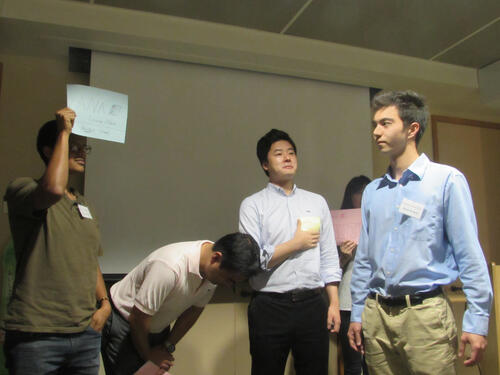
Stanford students worked together to pitch marketing ideas to a major Japanese airline at an event last Tuesday. The event, called an “ideathon,” is part of a series of events seeking to strengthen the U.S.-Japan relationship through exchange of ideas.
The ideathon was the first of its kind at the Shorenstein Asia-Pacific Research Center, led by the Japan Program under the rubric of the Stanford Silicon Valley-New Japan Project (SV-NJ). The project is supported in part by All Nippon Airways (ANA), the Japanese airline featured at the event.
Nineteen students participated, from both undergraduate and graduate levels and across disciplines – including students from the Graduate School of Business, and other majors including economics, mathematics, computer science, philosophy and East Asian studies.
Placed on a team with others they had just met, students were encouraged to assemble quickly and generate solutions to the challenge: how can ANA strengthen its brand awareness in the United States?
ANA is seeking to double in size in the next three years, yet it faces a few obstacles in this endeavor, including a customer base that is mostly in Japan and low brand visibility internationally, according to a senior employee that presented at the event.
“Who had heard of ANA before this event?” asked Hiroyuki Miyagawa, a marketing executive at ANA. Few hands raised in the audience.
Organized into four teams, each student team was joined by an ANA employee who listened in and offered guidance and a chance to learn from a longtime practitioner.
One and a half hours later, with Post-it notes and scribbled diagrams sprinkled across tables, each team emerged ready to present their 3-minute pitch to a panel of judges. The panel included executives from ANA, the World Innovation Lab (WiL), a venture capital firm in Palo Alto, and bTrax, a San Francisco based design firm.
Below are a few pictures from the event.
Image
Team Three acts out a skit. | They proposed that ANA establish lounges for the general public to gather in and purchase goods from Uniqlo and Muji, two Japanese lifestyle retailers. The lounges would offer a place to reinforce ANA's brand outside of the airport, they said.
Image
Team Four puts their heads together to generate ideas. | In their pitch, the team noted that baseball is a popular sport among Americans and Japanese. They recommended baseball be a focus of the marketing campaign, and said television and social media would best reach the target audience.
Image
Team Five explains their marketing approach. | Flying can lead to some unpleasant experiences, and a way ANA can set itself apart is to make those experiences manageable, and even enjoyable, they said. Their proposal was to bring new amenities to the in-flight experience such as a care package for people who sit in the middle seat.
Image
Team One poses for a picture after their presentation. | In their pitch, they recommended using ANA’s association with Japan to differentiate from other global airlines. Their approach included creating a film that features an American celebrity traveling on ANA.
The winning team was Team One whose concept was to use a celebrity figure – Ellen DeGeneres – in their advertising. They said that the target audience could relate to DeGeneres, and her already-established following would be an advantage.
The judges commended Team One for the creativity of their idea and its level of feasibility. Team One consisted of students Yaqian Fan, Michael Hong, Sam Ide, Lu Li and Adelbert Tan.
Kenji Kushida, a Stanford alumnus and project leader of SV-NJ, said:
“When I was a student, I craved for an opportunity to brainstorm solutions to real-world challenges and to do it in an environment that provided instant feedback,” he said, “We were able to make that happen here with the support of ANA and WiL, and are thrilled with the outcome."
The Korea Program at Stanford’s Walter H. Shorenstein Asia-Pacific Research Center is soliciting papers for the Koret Workshop on Globalization, Innovation and Culture in Korea at Stanford University.
South Korea has become an economic powerhouse, but faces multiple challenges. To maintain its dynamism and growth in the increasingly innovation-driven global knowledge economy, Korea needs to turn its attention to the more social, cultural and educational aspects of development.
Of paramount importance is the ability to welcome and embrace difference and creativity, upgrade pertinent social values of cultural diversity and social tolerance, promote innovation and effectively reflect and transmit such values through institutions. The conference will be interdisciplinary, problem-oriented and policy-relevant. A broad range of questions and approaches are welcomed, particularly those that address main challenges Korea will face going forward.
Possible research topics include:
• Higher education, cultural diversity and development.
• Social cohesion beyond nationalism and multiculturalism.
• Entrepreneurial culture and innovation.
• Causes and consequences of rising inequality.
• Demographic changes, skilled foreign labor and education/work culture.
The conference will be held on April 22, 2016 at Stanford University. Beyond research presentations, the conference also aims to foster connections among scholars with common interests. Travel (domestic or international economy class) and hotel costs as well as a modest honorarium will be covered for the presenters.
Papers may be submitted for consideration in a PDF file (6,000-8,000 words) to Yong Suk Lee by email at yongslee@stanford.edu. The submission deadline is Jan. 31, 2016.
The Koret Workshop is organized by the Korea Program to bring together an international panel of experts in Korean affairs. The Korea Program established the Koret Fellowship in 2008 with generous funding from the Koret Foundation.