Health and Medicine

FSI’s researchers assess health and medicine through the lenses of economics, nutrition and politics. They’re studying and influencing public health policies of local and national governments and the roles that corporations and nongovernmental organizations play in providing health care around the world. Scholars look at how governance affects citizens’ health, how children’s health care access affects the aging process and how to improve children’s health in Guatemala and rural China. They want to know what it will take for people to cook more safely and breathe more easily in developing countries.

FSI professors investigate how lifestyles affect health. What good does gardening do for older Americans? What are the benefits of eating organic food or growing genetically modified rice in China? They study cost-effectiveness by examining programs like those aimed at preventing the spread of tuberculosis in Russian prisons. Policies that impact obesity and undernutrition are examined; as are the public health implications of limiting salt in processed foods and the role of smoking among men who work in Chinese factories. FSI health research looks at sweeping domestic policies like the Affordable Care Act and the role of foreign aid in affecting the price of HIV drugs in Africa.

-

Background: Substance abuse has been an important social and public health problem in Thailand for decades. The National Household Survey on Substance and Alcohol Use in Thailand, which has been conducted 5 times, shows that substance abuse has steadily increased. Extrapolated country-wide in recent data, the estimated number of people who had ever used at least one addictive substance at some time in their life was 3,531,436 or 7.30% of the total population aged 12-65 years. Krathom, Methamphetamine, Ice, and cannabis were the most prevalent substances of abuse.

Methods: Historical documentation, policy reports, and group discussion with key professionals who work in the substance abuse community were used in this study. The objectives of this study were to complete a document review, determine the effectiveness of previous  Thai illegal substance measures, and consider options for the future.

Findings: Although the Thai government has dedicated human resources and an enormous budget to controlling drug use, substance abuse has become a more severe problem when compared with previous years. There are many organizations trying to create and develop programs, measures, and policies for dealing with substance abuse. These policies usually have had loopholes which resulted in corruption of officers, undercutting the public health value, creating dilemmas for impoverished families experiencing drug abuse, ignoring human rights, and creating a negative attitude among society toward drug users. Barriers to establishing successful drug abuse policies in Thailand include limited access to data and data management, a lack of efficiency and cost-benefit measures and policies, and limited use of evidence-based research.

Conclusion: To address illegal substance abuse in the future, the stakeholders should work to reduce the incidence of new sellers and the prevalence of new users. This would result in diminishing the health impact and criminal aspect of illegal substance use, increase social awareness, and motivate communities to participate in managing this issue. To reach these goals, the policy should concurrently aim at curtailing the supply of illicit drugs and reducing their demand. The strategies relevant to drug policy consist of primary prevention, services for chronic drug users, supply control and regulations, prescription regimes, and the use of criminal sanctions, especially consideration of decriminalization of krathom use.

Image
darika 4x6
Darika Saingam is a researcher from Thailand. Her research works have focused on patterns and consequences of alcohol, tobacco, and illegal substance use. Currently she joins the Walter H. Shorenstein Asia-Pacific Research Center as the Developing Asia Health Policy Postdoctoral Fellow for the 2015-16 year. She completed her doctorate in epidemiology at the Prince of Songkla University in 2012, and has worked as a researcher at the University’s epidemiology unit since, as well as a researcher at the Thailand Substance Abuse Academic Network since 2014.

Darika Saingam 2015-16 Developing Asia Health Policy Postdoctoral Fellow
Seminars

Y2E2 room 369
Stanford, CA 94305

0
sam_heft-neal.jpg PhD

Sam Heft-Neal is a research fellow at the Center on Food Security and the Environment and in the Department of Earth System Science. Sam is working with Marshall Burke to identify the impacts of extreme climate events on food availability and childhood nutrition in Africa. Specifically, they are examining the impacts of climate induced food shocks on child health measures including child mortality rates. Sam’s previous work examined the non-linear relationship between agricultural productivity and the environment and its effects on human health and the economy. Sam holds a Ph.D. in Agricultural and Resource Economics from the University of California, Berkeley and a B.A. in Statistics and Economics from the same institution.

Research Scholar
-

Please note: All research in progress seminars are off-the-record. Any information about methodology and/or results are embargoed until publication.

Abstract

Measuring and monitoring under-five mortality is a global priority and an important indicator of development. Among all the world’s regions, Sub-Saharan Africa accounts for the highest mortality rates and the largest number of under-five deaths. Under-five mortality is mostly monitored at the level of countries, especially in low- and middle-income countries, where estimates mostly rely on nationally representative surveys. However, learning about child mortality at a granular level can be very informative, so we did that at a 0.1 degree x 0.1 degree resolution. We look at some implications, including the existence and extent of mortality hotspots and the importance of "institutions" in accounting for the variation in mortality.
 

Encina Commons, Room 102,
615 Crothers Way,
Stanford, CA 94305-6019

(650) 723-0984 (650) 723-1919
0
Professor, Medicine
Professor, Health Policy
Senior Fellow, by courtesy, Freeman Spogli Institute for International Studies
Senior Fellow, Woods Institute for the Environment
eran_bendavid MD, MS

My academic focus is on global health, health policy, infectious diseases, environmental changes, and population health. Our research primarily addresses how health policies and environmental changes affect health outcomes worldwide, with a special emphasis on population living in impoverished conditions.

Our recent publications in journals like Nature, Lancet, and JAMA Pediatrics include studies on the impact of tropical cyclones on population health and the dynamics of SARS-CoV-2 infectivity in children. These works are part of my broader effort to understand the health consequences of environmental and policy changes.

Collaborating with trainees and leading academics in global health, our group's research interests also involve analyzing the relationship between health aid policies and their effects on child health and family planning in sub-Saharan Africa. My research typically aims to inform policy decisions and deepen the understanding of complex health dynamics.

Current projects focus on the health and social effects of pollution and natural hazards, as well as the extended implications of war on health, particularly among children and women.

Specific projects we have ongoing include:

  • What do global warming and demographic shifts imply for the population exposure to extreme heat and extreme cold events?

  • What are the implications of tropical cyclones (hurricanes) on delivery of basic health services such as vaccinations in low-income contexts?

  • What effect do malaria control programs have on child mortality?

  • What is the evidence that foreign aid for health is good diplomacy?

  • How can we compare health inequalities across countries? Is health in the U.S. uniquely unequal? 


CV
Eran Bendavid
Seminars
News Type
News
Date
Paragraphs


Grant Miller, associate professor of medicine and a Stanford Health Policy core faculty member and senior fellow at the Freeman Spogli Institute, has been working to help residents of a state in India access the micronutrients that they are lacking. The work, which involves a fortified rice, includes several Indian ministries, nonprofit organizations, and faculty from across the Stanford campus to assess and support the collaborative effort.

In this video, Miller says Stanford's collaborative community and institutes help projects like his in the southeastern India state of Tamil Nadu succeed. "Micronutrient deficiency rates in Tamil Nadu are extremely high," he says. "We're working with the government of Tamil Nadu to see if it's possible to introduce fortification into what's called the public distribution system — which distributes rice at no cost to all residents of Tamil Nadu."

And, Miller says, he would not be able to carry out that research without the teamwork generated here on campus.


Hero Image
grant miller team approach
All News button
1
-

Please note: All research in progress seminars are off-the-record. Any information about methodology and/or results are embargoed until publication.

Abstract:

For forty years, the Tuskegee Study of Untreated Syphilis in the Negro Male passively monitored hundreds of adult black males with syphilis despite the availability of effective treatment. The study's methods have become synonymous with exploitation and mistreatment by the medical community. We find that the historical disclosure of the study in 1972 is correlated with increases in medical mistrust and mortality and decreases in outpatient physician interactions for black men. Blacks possessing prior experience with the medical community, including veterans and women, appear to have been less affected by the disclosure. Our findings relate to a broader literature on how beliefs are formed and the importance of trust for economic exchanges involving asymmetric information.

Jointly with Marianne Wanamaker

Marcella Alsan
Seminars
-

Please note: All research in progress seminars are off-the-record. Any information about methodology and/or results are embargoed until publication.

Abstract

In the private market for Medicare supplemental insurance, also known as Medigap, policymakers have experimented with several regulatory solutions, including an initial open enrollment period, guaranteed renewal, bans on differential pricing, and bans on rejections. In this paper, I study how bans on differential pricing and rejections affect premiums and coverage levels, compared to a regime that combines an initial open enrollment period with guaranteed renewal. I document two important effects. First, bans on differential pricing and rejections lead to substantial cross-subsidization from young to old. Under a ban on differential pricing, the youngest buyers see premiums that are $240 (16 percent) higher; when this is combined with a ban on rejections, the youngest buyers see premiums that are $640 (36 percent) higher. Second, a ban on rejections undoes consumers’ incentives to buy early. A ban on differential pricing and rejections leads to a 12 percentage point (46 percent) reduction in early buying. I present evidence for the importance of this mechanism, which is often assumed in the theoretical literature but seldom documented empirically. This interpretation is corroborated by an event study of individuals who experience health shocks.

Vilsa Curto
Seminars
-

Please note: All research in progress seminars are off-the-record. Any information about methodology and/or results are embargoed until publication.

Abstract

Using modeling methodologies, at least three groups have suggested that the high expense of US healthcare is justified by the systematic increase in US life expectancy over the last 60 years. Papers describing these models are frequently cited in both the academic literature and in policy briefs. In this analysis, assumptions underlying the three models are linked to recent systematic literature reviews. Using estimates based on recent RCTs, the models are reconstructed and subjected to sensitivity analysis. The results suggest that the benefits of high-technology interventions have been overestimated, while the effects of social and behavioral factors, including cigarette smoking cessation, may have been underestimated. The analysis is highly sensitive to assumptions about the percentage of variance in outcomes attributable to medical technology.

Bio

Robert M. Kaplan, is currently a Fellow at the Center for Advanced Studies in the Behavioral Sciences at Stanford University, where he works with Stanford’s Clinical Excellence Research Center (CERC). He has served as Chief Science Officer at the US Agency for Health Care Research and Quality (AHRQ) and Associate Director of the National Institutes of Health, where he led the behavioral and social sciences programs.  He was formerly Distinguished Professor of Health Services and Medicine at UCLA, where he led the UCLA/RAND AHRQ health services training program and the UCLA/RAND CDC Prevention Research Center. He was Chair of the Department of Health Services from 2004 to 2009.  From 1997 to 2004 he was Professor and Chair of the Department of Family and Preventive Medicine, at the University of California, San Diego. He is a past President of several organizations, including the American Psychological Association Division of Health Psychology, Section J of the American Association for the Advancement of Science (Pacific), the International Society for Quality of Life Research, the Society for Behavioral Medicine, and the Academy of Behavioral Medicine Research. Kaplan is a former Editor-in-Chief of Health Psychology and of the Annals of Behavioral Medicine.  His 20 books and over 500 articles or chapters have been cited more than 28,000 times and the ISI includes him in the listing of the most cited authors in his field (defined as above the 99.5th percentile). Kaplan is an elected member of the National Academy of Medicine (formerly the Institute of Medicine).

Robert Kaplan
Seminars
-

"Modeling Disease for Effective Control: Tuberculosis in India"


Please note: All research in progress seminars are off-the-record. Any information about methodology and/or results are embargoed until publication.


Abstract:

Simulation and optimization frameworks that incorporate individual heterogeneity can be powerful tools to inform health policy decisions, particularly decisions about how to efficiently control infectious diseases in resource-constrained settings.  We apply such models to assess policies for control of tuberculosis (TB) in India, where more than two million people have TB.

We first use a microsimulation model to uncover the changing dynamics of drug-resistant (DR) TB. We find that nearly half of new DR TB cases in India are transmission-generated, as opposed to treatment-generated, and we project this proportion to continue to rise, implying that strategies that disrupt DR transmission may provide greater DR prevalence reductions over time.  We then incorporate healthcare costs into the simulation and find that both new diagnostics and institutional reform policies that refer patients in informal, private TB clinics to public clinics using approved treatment regimens would both be cost-effective ways of combatting TB in India. However, these institutional reforms should be prioritized if insufficient resources are available to implement both types of policies nationally. Building on the microsimulation results, we use dynamic programming methods to design patient-specific DR TB testing algorithms that can reduce over-testing, reduce costs, and quickly identify DR TB patients. We estimate that the optimal DR TB testing algorithm identified by our analysis will decrease healthcare costs by an average of $4000 per patient by averting downstream transmission.

Sze-chuan Suen
Seminars
-

Image
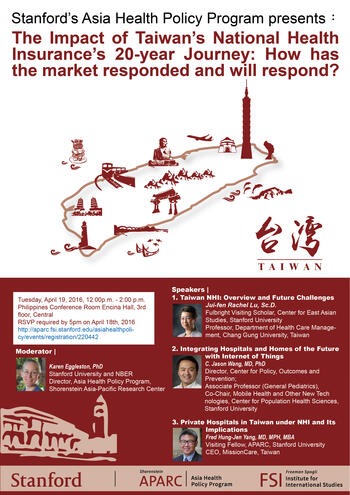
april 19 flyer
In 2015, Taiwan National Health Insurance (NHI) is celebrating its 20th anniversary since its historical inauguration in 1995. The NHI program, which provides universal health coverage (UHC) to Taiwan’s population of 23 million, has had a profound impact on Taiwan's health care market.   This seminar will showcase Taiwan's NHI scheme, the challenges encountered, and the market responses.

The single-payer NHI program, operated by National Health Insurance Administration (NHIA), was established through integrating three existing social insurance schemes and extended the coverage to the then uninsured 43% of the population. Taiwan NHI offers comprehensive benefit coverage that includes ambulatory care as well as inpatient services. On the service side, Taiwan has a market-oriented health care delivery system, reflecting its free-enterprise economy, as evidenced by the pluralistic organization of health services. Hospital ownership is mixed where public hospitals only account for 35% of all beds. Sixty-three percent of allopathic physicians are salaried employees of hospitals; the remainder, fee-for-service private practitioners. Over the years, hospitals have developed large outpatient departments and affiliated clinics for primary care in order to maintain inpatient volume and compete with private practitioners who operate free-standing clinics with beds. There is no gate keeping mechanism and the insured essentially enjoy complete freedom of choice which is likely a source of overuse.

NHI revenue mainly relies on payroll-based premiums, supplemented by a levy on non-payroll income and government subsidies. In 2013, NHI spent roughly NTD 492 (USD 16.4) billion on medical claims, accounting for approximately 52% of national health expenditures, and in total, Taiwan devoted 6.6% of GDP to health.  As a single payer, NHIA has effectively exploited its market power to experiment with various payment reforms in its 20-year history.  NHIA gradually set up separate global budgets for dental services, Chinese medicines, primary care services, and hospital services since 1998.  The annual growth rate of the total NHI budget is negotiated among stakeholders. 

Our seminar will look to the future with presentations on innovative healthcare delivery models and coping strategies by private hospitals.

Shorenstein APARC
Stanford University
Encina Hall E301
Stanford, CA 94305-6055

(650) 723-9072 (650) 723-6530
0
Senior Fellow at the Freeman Spogli Institute for International Studies
Center Fellow at the Center for Health Policy and the Center for Primary Care and Outcomes Research
Faculty Research Fellow of the National Bureau of Economic Research
Faculty Affiliate at the Stanford Center on China's Economy and Institutions
karen-0320_cropprd.jpg PhD

Karen Eggleston is a Senior Fellow at the Freeman Spogli Institute for International Studies (FSI) at Stanford University and Director of the Stanford Asia Health Policy Program at the Shorenstein Asia-Pacific Research Center at FSI. She is also a Fellow with the Center for Innovation in Global Health at Stanford University School of Medicine, and a Faculty Research Fellow of the National Bureau of Economic Research (NBER). Her research focuses on government and market roles in the health sector and Asia health policy, especially in China, India, Japan, and Korea; healthcare productivity; and the economics of the demographic transition.

Eggleston earned her PhD in public policy from Harvard University and has MA degrees in economics and Asian studies from the University of Hawaii and a BA in Asian studies summa cum laude (valedictorian) from Dartmouth College. Eggleston studied in China for two years and was a Fulbright scholar in Korea. She served on the Strategic Technical Advisory Committee for the Asia Pacific Observatory on Health Systems and Policies and has been a consultant to the World Bank, the Asian Development Bank, and the WHO regarding health system reforms in the PRC.

Director of the Asia Health Policy Program, Shorenstein Asia-Pacific Research Center
Stanford Health Policy Associate
Faculty Fellow at the Stanford Center at Peking University, June and August of 2016
CV
Date Label
Moderator Director, Asia Health Policy Program, Shorenstein Asia Pacific Research Center, Stanford University
Jui-fen Rachel Lu Professor, Department of Health Care Management Speaker Chang Gung University, Taiwan
C. Jason Wang Associate Professor (General Pediatric), Co-Chair, Mobile Health and Other New Technologies, Center for Population Health Sciences Speaker Stanford University
Fred Hung-Jen Yang Visiting Fellow, APARC, Stanford University Speaker CEO, MissionCare, Taiwan
Seminars
Subscribe to Health and Medicine