International Relations

FSI researchers strive to understand how countries relate to one another, and what policies are needed to achieve global stability and prosperity. International relations experts focus on the challenging U.S.-Russian relationship, the alliance between the U.S. and Japan and the limitations of America’s counterinsurgency strategy in Afghanistan.

Foreign aid is also examined by scholars trying to understand whether money earmarked for health improvements reaches those who need it most. And FSI’s Walter H. Shorenstein Asia-Pacific Research Center has published on the need for strong South Korean leadership in dealing with its northern neighbor.

FSI researchers also look at the citizens who drive international relations, studying the effects of migration and how borders shape people’s lives. Meanwhile FSI students are very much involved in this area, working with the United Nations in Ethiopia to rethink refugee communities.

Trade is also a key component of international relations, with FSI approaching the topic from a slew of angles and states. The economy of trade is rife for study, with an APARC event on the implications of more open trade policies in Japan, and FSI researchers making sense of who would benefit from a free trade zone between the European Union and the United States.

-

Image
Avi Tuschman, Adam Berinsky, David Rand

Please join the Cyber Policy Center for Exploring Potential “Solutions” to Online Disinformation​, hosted by Cyber Policy Center's Kelly Born, with guests Adam Berinsky, Mitsui Professor of Political Science at MIT and Director of the MIT Political Experiments Research Lab (PERL) at MIT, David Rand, Erwin H. Schell Professor and an Associate Professor of Management Science and Brain and Cognitive Sciences, and Director of the Human Cooperation Laboratory and the Applied Cooperation Team at MIT, and Avi Tuschman, Founder & CIO, Pinpoint Predictive. The session is open but registraton is required.

Adam Berinsky is the Mitsui Professor of Political Science at MIT and serves as the director of the MIT Political Experiments Research Lab (PERL). He is also a Faculty Affiliate at the Institute for Data, Systems, and Society (IDSS). Berinsky received his PhD from the University of Michigan in 2000. He is the author of "In Time of War: Understanding American Public Opinion from World War II to Iraq" (University of Chicago Press, 2009). He is also the author of "Silent Voices: Public Opinion and Political Participation in America" (Princeton University Press, 2004) and has published articles in many journals. He is currently the co-editor of the Chicago Studies in American Politics book series at the University of Chicago Press. He is also the recipient of multiple grants from the National Science Foundation and was a fellow at the Center for Advanced Study in the Behavioral Sciences.

David Rand is the Erwin H. Schell Professor and an Associate Professor of Management Science and Brain and Cognitive Sciences at MIT Sloan, and the Director of the Human Cooperation Laboratory and the Applied Cooperation Team. Bridging the fields of behavioral economics and psychology, David’s research combines mathematical/computational models with human behavioral experiments and online/field studies to understand human behavior. His work uses a cognitive science perspective grounded in the tension between more intuitive versus deliberative modes of decision-making, and explores topics such as cooperation/prosociality, punishment/condemnation, perceived accuracy of false or misleading news stories, political preferences, and the dynamics of social media platform behavior. 

Avi Tuschman is a Stanford StartX entrepreneur and founder of Pinpoint Predictive, where he currently serves as Chief Innovation Officer and Board Director. He’s spent the past five years developing the first Psychometric AI-powered data-enrichment platform, which ranks 260 million individuals for performance marketing and risk management applications. Tuschman is an expert on the science of heritable psychometric traits. His book and research on human political orientation have been covered in peer-reviewed and mainstream media from 25 countries. Previous to his career in tech, he advised current and former heads of state as well as multilateral development banks in the Western Hemisphere. Tuschman completed his undergraduate and doctoral degrees in evolutionary anthropology at Stanford.

0
George G.C. Parker Professor of Finance and Economics, Stanford Graduate School of Business
Director of the Corporations and Society Initiative, Stanford Graduate School of Business
Director of the Program on Capitalism and Democracy, Center on Democracy, Development and the Rule of Law
Senior Fellow, Stanford Institute for Economic Policy Research
Senior Fellow (by courtesy), Freeman Spogli Institute for International Studies
anat_admati-stanford-2021.jpg

Anat R. Admati is the George G.C. Parker Professor of Finance and Economics at Stanford University Graduate School of Business (GSB), a Faculty Director of the GSB Corporations and Society Initiative, and a senior fellow at Stanford Institute for Economic Policy Research. She has written extensively on information dissemination in financial markets, portfolio management, financial contracting, corporate governance and banking. Admati’s current research, teaching and advocacy focus on the complex interactions between business, law, and policy with focus on governance and accountability.

Since 2010, Admati has been active in the policy debate on financial regulations. She is the co-author, with Martin Hellwig, of the award-winning and highly acclaimed book The Bankers’ New Clothes: What’s Wrong with Banking and What to Do about It (Princeton University Press, 2013; bankersnewclothes.com). In 2014, she was named by Time Magazine as one of the 100 most influential people in the world and by Foreign Policy Magazine as among 100 global thinkers.

Admati holds BSc from the Hebrew University, MA, MPhil and PhD from Yale University, and an honorary doctorate from University of Zurich. She is a fellow of the Econometric Society, the recipient of multiple fellowships, research grants, and paper recognition, and is a past board member of the American Finance Association. She has served on a number of editorial boards and is a member of the FDIC’s Systemic Resolution Advisory Committee, a former member of the CFTC’s Market Risk Advisory Committee, and a former visiting scholar at the International Monetary Fund.

Date Label
News Type
Q&As
Date
Paragraphs

Image
Marietje Schaake


DOWNLOAD THE PAPER 


The European Union is often called a ‘super-regulator’, especially when it comes to data-protection and privacy rules. Having seen European lawmaking from close by, in all its complexities, I have often considered this qualification an exaggerated one. Yes, the European Union frequently takes the first steps in ensuring principles continue to be protected, even as digitization disrupts. However, the speed with which technology evolves versus the pace of democratic lawmaking leads to perpetual mismatches.  

Even the famous, or infamous, General Data Protection Regulation does not meet many essential regulatory needs of the moment. The mainstreaming of Artificial Intelligence in particular, poses new challenges to concepts of the protection of rights and the sustaining of the rule of law. In its White Paper on Artificial Intelligence, as well the Data Strategy, the European Commission references to the common good and the public interest, as well as societal needs as opposed to an emphasis on regulating the digital market. These are welcome steps in acknowledging the depth and scope of technological impact and defining harms not just in economic terms. It remains to be seen how the visions articulated in the White Paper and the Strategy, will translate into concrete legislation. 

One proposal to make concrete improvements to legal frameworks, is outlined by Martin Tisné in The Data Delusion. He highlights the need to update legal privacy standards to be more reflective of the harms incurred through collective data analysis, as opposed to individual privacy violations. Martin makes a clear case for addressing the discrepancy between the profit models benefitting from grouped data versus the ability of any individual to prove the harms caused to his or her rights. 

The lack of transparency into the inner workings of algorithmic processing of data further hinders the path to much needed accountability of the powerful technology businesses operating growing parts of our information architecture and the data flows they process.  

While EU takes the lead in setting values-based standards and rules for the digital layer of our societies and economies, a lot of work remains to be done. 

Marietje Schaake: Martin, in your paper you address the gap between the benefits for technology companies through collective data processing, and the harms for society. You point to historic reasons for individual privacy protections in European laws. Do you consider the European Union to be the best positioned to address the legal shortcomings, especially as you point out that some opportunities to do so were missed in the GDPR?

Martin Tisné: Europe is well positioned but perhaps not for the reasons we traditionally think of (strong privacy tradition, empowered regulators). Individual privacy alone is a necessary, but not sufficient foundation stone to build the future of AI regulation. And whilst much is made of European regulators, the GDPR has been hobbled by the lack of funding and capacity of data protection commissioners across Europe. What Europe does have though, is a legal, political and societal tradition of thinking about the public interest, the common good and how this is balanced against individual interests. This is where we should innovate, taking inspiration from environmental legislation such as the Urgenda Climate Case against the Dutch Government which established that the government had a legal duty to prevent dangerous climate change, in the name of the public interest. 

And Europe also has a lot to learn from other political and legal cultures. Part of the future of data regulation may come the indigenous data rights movement, with greater emphasis on the societal and group impacts of data, or from the concept of Ubuntu ethics that assigns community and personhood to all people. 

Schaake: What scenario do you foresee in 10 years if collective harms are not dealt with in updates of laws? 

Tisné: I worry we will see two impacts. The first is a continuation of what we are seeing now: negative impacts of digital technologies on discrimination, voting rights, privacy, consumers. As people become increasingly aware of the problem there will be a corresponding increase in legal challenges. We’re seeing this already for example with the Lloyd class action case against Google for collecting iPhone data. But I worry these will fail to stick and have lasting impact because of the obligation to have these cases turn on one person, or a class of people’s, individual experiences. It is very hard for individuals to seek remedy for collective harms, as opposed to personal privacy invasions. So unless we solve the issue I raise in the paper – the collective impact of AI and automation – these will continue to fuel polarization, discrimination on the basis of age, gender (and many other aspects of our lives) and the further strengthening of populist regimes. 

I also worry about the ways in which algorithms will optimize on the basis of seemingly random classifications (e.g. “people who wear blue shirts, get up early on Saturday mornings, and were geo-located in a particular area of town at a particular time”). These may be proxies for protected characteristics (age, gender reassignment, disability, race, religion, sex, marriage, pregnancy/maternity, sexual orientation) and provide grounds for redress. They may also not be and sow the seeds of future discrimination and harms. Authoritarian rulers are likely to take advantage of the seeming invisibility of those data-driven harms to further silence their opponents. How can I protect myself if I don’t know the basis on which I am being discriminated against or targeted? 

Schaake: How do you reflect on the difference in speed between technological innovations and democratic lawmaking? Some people imply this will give authoritarian regimes an advantage in setting global standards and rules. What are your thoughts on ensuring democratic governments speed up? 

Tisné: Democracies cannot afford to be outpaced by technological innovation and constantly be fighting yesterday’s wars. Our laws have not changed to reflect changes in technology, which extracts value from collective data, and need to catch up.  A lot of the problems stem from the fact that in government (as in companies), the people responsible for enforcement are separated from those with the technical understanding. The solution lies in much better translation between technology, policy and the needs of the public.  

An innovation and accountability-led government must involve and empower the public in co-creating policies, above and beyond the existing rules that engage individuals (consent forms etc.). In the paper I propose a Public Interest Data Bill that addresses this need: the rules of the digital highway used as a negotiation between the public and regulators, between private data consumers and data generators. Specifically: clear transparency, public participation and realistic sanctions when things go wrong.

This is where democracies should hone their advantage over authoritarian regimes – using such an approach as the basis for setting global standards and best practices (e.g. affected communities providing input into algorithmic impact assessments). 

Schaake: The protection of privacy is what sets democratic societies apart from authoritarian ones. How likely is it that we will see an effort between democracies to set legal standards across borders together? Can we overcome the political tensions across the Atlantic, and strengthen democratic alliances globally?

Tisné: I remain a big supporter of international cooperation. I helped found the Open Government Partnership ten years ago, which remains the main forum for 79 countries to develop innovative open government reforms jointly with the public. Its basic principles hold true: involve global south and global north countries with equal representation, bring civil society in jointly with government from the outset, seek out and empower reformers within government (they exist, regardless of who is in power in the given year), and go local to identify exciting innovations. 

If we heed those principles we can set legal standards by learning from open data and civic technology reforms in Taiwan, experiments with data trusts in India, legislation to hold algorithms accountable in France; and by identifying and working with the individuals driving those innovations, reformers such as Audrey Tang in Taiwan, Katarzyna Szymielewicz in Poland, and Henri Verdier in France. 

These reformers need a home, a base to influence policymakers and technologists, to get those people responsible for enforcement working with those with the technical understanding. The Global Partnership on Artificial Intelligence may be that home but these are early days, it needs to be agile enough to work with the private sector, civil society as well as governments and the international system. I remain hopeful. 



All News button
1
Subtitle

Protecting Individual Isn't Enough When the Harm is Collective. A Q&A with Marietje Schaake and Martin Tisne on his new paper The Data Delusion.

News Type
News
Date
Paragraphs

In recent months, tensions have once again flared between Pyongyang and Seoul, calling into question the state of inter-Korean and U.S.-Korea relations. As the future of denuclearization talks with North Korea remains uncertain and the United States looks towards the November 2020 presidential election, APARC gathered experts on Korea and international security to provide analysis of where we stand with the DPRK and what considerations future Korea policies should involve.

[Never miss a chance to participate in an APARC event. Sign up for our newsletters to stay informed about upcoming webinars.]

Gi-Wook Shin, APARC’s director and the director of the Korea Program, moderates the APARC-led discussion hosted by the Freeman Spogli Institute. Robert Carlin, a longtime analyst of North Korea and frequent visitor to the DPRK, joins the panel from the Center for International Security and Cooperation (CISAC). Leading North Korea and international affairs expert Victor Cha provides insight into the public statements and apparent policy goals of North Korea's leadership, while fellow Georgetown scholar and imminent APARC center fellow Oriana Mastro offers commentary on the ongoing need for military stability in the area. Siegfried Hecker, an internationally recognized expert in plutonium science, global threat reduction, and nuclear security, adds his expertise in nuclear nonproliferation and arms control to the discussion.


Read More

Brightly colored ribbons tied to fences around Imjingak Village in the DMZ on the North Korean Border.
News

Koret Conference Convenes Virtually to Discuss Human Rights Crisis in North Korea

Amid escalating inter-Korean tension and increasing economic and social strain on North Koreans in the era of COVID-19, the importance of keeping international attention on the DRPK’s human rights violations is more urgent than ever.
Koret Conference Convenes Virtually to Discuss Human Rights Crisis in North Korea
Women work a silk factory beneath a banner with Korean writing.
News

The Role of Human Rights in Policy Toward North Korea

The Role of Human Rights in Policy Toward North Korea
Michael McFaul, Xueguang Zhou, Karen Eggleston, Gi-Wook Shin, Don Emmerson, and Yong Suk Lee
News

FSI Hosts APARC Panel on COVID-19 Impacts in Asia

Scholars from each of APARC's programs offer insights on policy responses to COVID-19 throughout Asia.
FSI Hosts APARC Panel on COVID-19 Impacts in Asia
Hero Image
(From left to right) Siegfried Hecker, Victor Cha, Oriana Mastro, Gi-Wook Shin, Robert Carlin
(From left to right) Siegfried Hecker, Victor Cha, Oriana Mastro, Gi-Wook Shin, and Robert Carlin
All News button
1
Subtitle

Led by APARC, a panel of scholars hosted by the Freeman Spogli Institute weighs in on the implications of recent events on the Korean peninsula and the ongoing uncertainties in charting a future course with the DPRK.

-
Image
The rise of digital authoritarianism banner advertisement

There will be four events, with the first on September 29th; all dates listed below

REGISTER

  • September 29th, 9-11am PST
  • October 1st, 9-11am PST
  • October 6th, 9-11am PST
  • October 9th, 9-11am PST


The Rise of Digital Authoritarianism: China, AI and Human Rights

Day 1- September 29, 2020

Welcome Remarks

Larry Diamond | Senior Fellow, Hoover Institution and FSI, Principal Investigator, Global Digital Policy Incubator

Glenn Tiffert | Research Fellow, Hoover Institution

Jenny Wang | Strategic Advisor, Human Rights Foundation

Opening Remarks

Condoleezza Rice | Director, Hoover Institution, Former U.S. Secretary of State, Denning Professor in Global Business at the Graduate School of Business


Panel 1: How AI is powering China's Domestic Surveillance State - How is AI exacerbating surveillance risks and enabling digital authoritarianism? This session will examine both state-sponsored applications and Chinese commercial services.

Panelists

Bethany Allen-Ebrahimian | China Reporter, Axios

Paul Mozur | Asia Technology Correspondent, New York Times

Glenn Tiffert | Research Fellow, Hoover Institution

Xiao Qiang | UC Berkeley & Editor-in-Chief, China Digital Times

Moderator

Melissa Chan | Foreign Affairs Reporter, Deutsche Welle Asia


Day 2- October 1, 2020

Panel 2: The Ethics of Doing Business with China and Chinese Companies

Eric Schmidt | Former Executive Chairman and CEO, Google//Co-Founder, Schmidt Futures
Conversant: Eileen Donahoe, Executive Director of GDPI


Panel 2: The Ethics of Doing Business with China and Chinese Companies - What dynamics are at play in China's effort to establish market dominance for Chinese companies, both domestically and globally? What demands are placed on non-Chinese technology companies to participateWhat dynamics are at play in China's effort to establish market dominance for Chinese companies, both domestically and globally? What demands are placed on non-Chinese technology companies to participate in the Chinese marketplace? What framework should U.S.-based companies use to evaluate the risks and opportunities for collaboration and market entry in China? To what extent are Chinese companies (e.g..,TikTok) competing in Western markets required to comply with Chinese government instructions or demands for access to data?

Panelists

Mary Hui | Hong Kong-based Technology and Business Reporter, Quartz
 
Megha Rajagopalan | International Correspondent and Former China Bureau Chief, Buzzfeed News
 

Alex Stamos | Director, Stanford Internet Observatory & Former Chief Security Officer, Facebook

Moderator

Casey Newton | Silicon Valley Editor, The Verge


Day 3- October 6, 2020

Panel 3: China as an Emerging Global AI Superpower

Keynote & Conversation

Competing in the Superpower Marathon with China

Mike Brown | Director, Defense Innovation Unit

Conversant: Larry Diamond, Senior Fellow, Hoover Institution and FSI, Principal Investigator, Global Digital Policy Incubator

Panel 3: China as an Emerging Global AI Superpower- How should we think about China's growing influence in the realm of AI and the attendant geopolitical risks and implications? This session will explore China’s bid through Huawei to build and control the world's 5G networks, and what that implies for human rights and national sovereignty and security; China's export of surveillance technology to authoritarian regimes around the world; China's global partnerships to research and develop AI; and the problem of illicit technology transfer/theft.

Panelists

Steven Feldstein | Senior Fellow, Carnegie Endowment for International Peace 

Lindsay Gorman | Fellow for Emerging Technologies, Alliance for Securing Democracy, German Marshall Fund 

Maya Wang | China Senior Researcher, Human Rights Watch

Moderator

Dominic Ziegler | Senior Asia Correspondent and Banyan Columnist, The Economist


Day 4- October 9, 2020

Panel 4: How Democracies Should Respond to China’s Emergence as an AI Superpower

Keynote

Digital Social Innovation: Taiwan Can Help

Audrey Tang | Digital Minister, Taiwan

Panel 4: How Democracies Should Respond to China's Emergence as an AI Superpower- How should the rest of the world, and especially the world's democracies, react to China's bid to harness AI for ill as well as good? How do we strike the right balance between vigilance in defense of human rights and national security and xenophobic overreaction?

Panelists

Christopher Balding | Associate Professor, Fulbright University Vietnam

Anja Manuel | Co-Founder, Rice, Hadley, Gates & Manuel

Chris Meserole | Deputy Director of the Artificial Intelligence and Emerging Technology Initiative, Brookings Institution

Moderator

Larry Diamond | Senior Fellow, Hoover Institution and FSI, Principal Investigator, Global Digital Policy Incubator


Closing Keynote & Conversation

Strengthening Human-Centered Artificial Intelligence

Fei-Fei Li | Co-Director, Stanford Institute for Human-Centered Artificial Intelligence (HAI) Conversant: Eileen Donahoe, Executive Director of GDPi

Closing Remarks: Alex Gladstein & Eileen Donahoe

Seminars
Date Label
Authors
Callista Wells
News Type
News
Date
Paragraphs

To celebrate its May Release, the Stanford China Program hosted a virtual book launch event for Fateful Decisions: Choices That Will Shape China’s Future (Stanford University Press) on June 2nd. Joining co-authors Thomas Fingar (Shorenstein APARC Fellow, Stanford University) and Jean C. Oi (Director, Stanford China Program; William Haas Professor of Chinese Politics, Stanford University) were contributors Karen Eggleston (Senior Fellow at FSI; Director of the Asia Health Policy Program, Shorenstein APARC, Stanford University), Barry Naughton (Sokwanlok Chair of Chinese International Affairs, School of Global Policy and Strategy, UC San Diego), and Andrew Walder (Senior Fellow at FSI; Denise O'Leary and Kent Thiry Professor, Stanford University). As Fingar and Oi point out in their volume, despite China’s extraordinary growth over the past 40 years, the country’s future is uncertain. China has enjoyed optimal conditions for development since the 1980s, but new hurdles including an aging populace, the loss of comparative economic advantage, a politically entrenched elite, and a population with rising expectations will test the country’s leaders. With each focusing on a different facet of China’s challenges, the panelists gathered to share their expertise and provide the audience with a glimpse into what the future might hold for this important country.

Following an introduction from Professor Jean Oi, the program kicked off with Professor Barry Naughton of University of California, San Diego, who discussed his chapter entitled “Grand Steerage.” Professor Naughton argued that, as it plans for the future, China’s policymaking is becoming increasingly technology-focused, particularly in the realm of economic policy. Naughton further notes that China’s economy is becoming simultaneously more state-guided and more centered around technology. This decision is a gamble, though: China is investing heavily in high-tech industries, advancing massive, centrally steered projects like the Greater Bay Area initiative and the Xiong’an New District. If they are successful, says Naughton, this will indeed be an incredible success. But, if they are not, China’s losses will be major: “There’s not really a middle ground.”

After Professor Naughton was Professor Karen Eggleston, an expert on health policy in Asia. Professor Eggleston’s chapter, “Demographic and Healthcare Challenges,” deals with emerging obstacles for China’s healthcare system, including population aging and the problems that come with it, like chronic diseases and elder care. Although China’s healthcare system has improved dramatically in recent decades, it has done so unevenly, notes Eggleston: life expectancy has greatly increased, but with disparities according to income, region, and urban vs. rural status; universal healthcare is available, but the benefit level is low, effectively limiting the standard of care many can receive. The ratio of health spending to GDP is also increasing, yet it is still modest compared to high-income countries. The COVID-19 crisis has, of course, introduced even more challenges: Will China be able to distribute future vaccines equitably? Will this crisis negatively affect young people’s decisions to choose healthcare as a career? Will telemedicine, which has seen a surge under the pandemic, improve or exacerbate existing disparities? China faces a multitude of constraints and choices going forward if it hopes to meet its population’s healthcare needs.

The audience then had a chance to hear from co-editor Thomas Fingar, speaking on his chapter, “Sources and Shapers of China’s Foreign Policy.” Fingar noted three key takeaways from both his chapter and his talk: Firstly, China’s foreign policy is a fundamental part of its national policy. Secondly, the global political environment plays an important role in shaping both foreign and domestic policy which, thirdly, plays an important role in shaping foreign policy. The conditions that allowed China to flourish over the past 40 years, emphasized Fingar, are very different from those of the present. In the 1970s and 80s, China was able to take advantage of Cold War bipolarity, globalization was in its infancy, and “China was the only significant developing country willing to embark, at that time, on the export-led path of development.” In recent years, though, China’s behavior internationally has alienated other countries; there are many competitors pursuing its style of development; and its needs and aspirations have changed, requiring more raw materials and depending upon multi-national economic agreements. Fingar suggests two potential foreign policy options: China could continue with its wolf warrior diplomacy, which has “alienated essentially all China’s neighbors to some degree,” or it could return to a style more similar to that of the 1980s and 90s Reform and Opening era. It remains to be seen which style will win out.

Finally, Professor Andrew Walder concluded the program with his discussion of China’s political future at large. His chapter, “China’s National Trajectory,” follows China’s remarkable advancement in recent years and “tr[ies] to divine what a lower growth era will mean for China’s political future.” The last 40 years of rapid growth have generated support for China’s political system, more patriotism, the near eradication of democracy movements, and an elite unity not seen in the 1970s and 80s. However, low growth rates could mean a reversal for many of these trends, says Walder. While the aforementioned support for and stability of the Chinese government was maintained by ever-improving living standards and upward mobility, a low growth period (coupled with an aging population) means the government will no longer be able to rely on these trends for popular support. Rather, it will need to improve its provision of public services to address present-day challenges. Regardless, argues Walder, the low growth era will undoubtedly lead to “dynamic changes underneath the façade of stability of Chinese politics….”

For more insights on the modern obstacles China faces and what they mean for the country’s future, check out Fateful Decisions: Choices That Will Shape China's Future, available for purchase now.

Read More

Elderly Chinese citizens sit together on a park bench.
Q&As

Karen Eggleston Examines China’s Looming Demographic Crisis, in Fateful Decisions

Karen Eggleston Examines China’s Looming Demographic Crisis, in Fateful Decisions
Quote from Thomas Fingar and Jean Oi from, "China's Challeges: Now It Gets Much Harder"
Commentary

Now It Gets Much Harder: Thomas Fingar and Jean Oi Discuss China’s Challenges in The Washington Quarterly

Now It Gets Much Harder: Thomas Fingar and Jean Oi Discuss China’s Challenges in The Washington Quarterly
Hero Image
Fateful Decisions book cover
All News button
1
-

Image
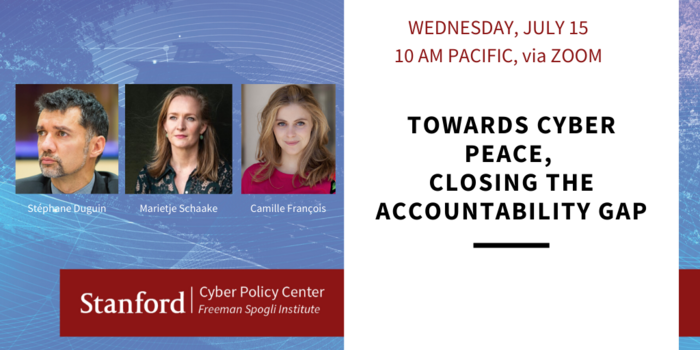
towards cyber peace

Please join the Cyber Policy Center for Towards Cyber Peace, Closing the Accountability Gap, hosted by Cyber Policy Center's Marietje Schaake, along with guests Stéphane Duguin, CEO of the Cyber Peace Institute and Camille François, CIO of Graphika and Mozilla Fellow. The discussion will focus on the challenges to cyber peace, and the work being done to chart a path forward. The session is open to the public, but registration is required. 

Marietje Schaake is the international policy director at Stanford University’s Cyber Policy Center and international policy fellow at Stanford’s Institute for Human-Centered Artificial Intelligence. She was named President of the Cyber Peace Institute. Between 2009 and 2019, Marietje served as a Member of European Parliament for the Dutch liberal democratic party where she focused on trade, foreign affairs and technology policies. Marietje is affiliated with a number of non-profits including the European Council on Foreign Relations and the Observer Research Foundation in India and writes a monthly column for the Financial Times and a bi-monthly column for the Dutch NRC newspaper. 

Camille François works on cyber conflict and digital rights online. She is the Chief Innovation Officer at Graphika, where she leads the company’s work to detect and mitigate disinformation, media manipulation and harassment. Camille was previously the Principal Researcher at Jigsaw, an innovation unit at Google that builds technology to address global security challenges and protect vulnerable users. Camille has advised governments and parliamentary committees on both sides of the Atlantic on policy issues related to cybersecurity and digital rights. She served as a special advisor to the Chief Technology Officer of France in the Prime Minister’s office, working on France’s first Open Government roadmap. Camille is a Mozilla Fellow, a Berkman-Klein Center affiliate, and a Fulbright scholar. She holds a masters degree in human rights from the French Institute of Political Sciences (Sciences-Po) and a masters degree in international security from the School of International and Public Affairs (SIPA) at Columbia University. François’ work has been featured in various publications, including the New York Times, WIRED, Washington Post, Bloomberg Businessweek, Globo and Le Monde.

Stéphane Duguin is the Chief Executive Officer of the CyberPeace Institute. His mission is to coordinate a collective response to decrease the frequency, impact, and scale of cyberattacks by sophisticated actors. Building on his hands-on experience in countering and analyzing cyber operations and information operations which impact civilians and civilian infrastructure, he leads the Institute with the aim of holding malicious actors to account for the harms they cause. Prior to this position, Stéphane Duguin was a senior manager and innovation coordinator at Europol. He led key operational projects to counter both cybercrime and online terrorism, such as the setup of the European Cybercrime Centre (EC3), the Europol Innovation Lab, and the European Internet Referral Unit (EU IRU). A leader in digital transformation, his work focused on the implementation of innovative responses to a large-scale abuse of the cyberspace, notably on the convergence of disruptive technologies and public-private partnerships.


-

Webinar recording: https://youtu.be/9eyHTMF2L7w


Upwards of 15,000 to 20,000 individual migrant Chinese laborers performed the bulk of the work constructing the Central Pacific span of the Transcontinental Railroad. Between 1864 and 1869, these Chinese also crossed the Pacific Ocean in what was then, and may still rank among the largest transnational labor migration movements. How do we find sources to uncover this forgotten and deliberately erased history? How did they live their daily lives? What kinds of enterprise did they innovate? How did their work on the railroad shape their lives in communities on both sides of the Pacific? We will look together at digital resources available at: http://web.stanford.edu/group/chineserailroad/cgi-bin/website/.

In 2018, the Stanford Program on International and Cross-Cultural Education (SPICE), which is a program of the Freeman Spogli Institute for International Studies, published four lessons on the Chinese Railroad Workers. These units adapt the research, primary sources, and insights of the Chinese Railroad Workers in North America Project for high school students and classes. Together, we'll engage in several activities from these lessons which are free for download from the SPICE website.

This webinar is a joint collaboration between the Center for East Asian Studies and SPICE at Stanford University.


Featured Speakers:

Roland Hsu, Ph.D.

Dr. Roland Hsu Dr. Roland Hsu

Roland Hsu is Director of Research for the Chinese Railroad Workers in North America Project at Stanford University. Hsu’s publications address migration and ethnic identity formation. His is the author of multiple essays in international scholarly collections, and in policy journals including Le Monde Diplomatique. Hsu’s most recent book is Migration and Integration. His writing focuses on the history of migration, and on contemporary immigration policy questions, combining humanistic and social science methods and materials to answer what displaces peoples, how do societies respond to migration, and what are the experiences of resettlement. Hsu earned his Ph.D. in Modern European History at the University of Chicago. He holds an M.A. in Art History from the University of Chicago, and a dual B.A. in Art History and also English Literature from the University of California, Berkeley.


Greg Francis

Image
Greg Francis

Greg Francis is a Curriculum Consultant for SPICE. Previously, he was Director of Impact Programs for Net Impact. In that role, he led a team that designed and executed experiential learning programs for college students. Before that, Greg was a director for The Broad Superintendents Academy, where he oversaw an executive training program for leaders of urban school districts. With SPICE, Greg has authored or co-authored 10 curriculum units, including Along the Silk Road; Security, Civil Liberties, and Terrorism; International Environmental Politics; and China’s Cultural Revolution. In 2007, Greg received the Franklin Buchanan Prize, which is awarded annually by the Association for Asian Studies to honor an outstanding curriculum publication on Asia at any educational level. Greg received a B.A. in International Relations from Stanford University and M.A. in Latin American Studies from the Universidad Andina Simón Bolívar in Ecuador.

Via Zoom Webinar. Registration Link: https://bit.ly/37XYffc.

Roland Hsu, Ph.D. Stanford University
Greg Francis Stanford University
Workshops
1
Oksenberg-Rohlen Fellow
scot_marciel.jpg

Scot Marciel was the Oksenberg-Rohlen Fellow at the Freeman Spogli Institute for International Studies, affiliated with the Walter H. Shorenstein Asia-Pacific Research Center from 2022-2024. Previously, he was a 2020-22 Visiting Scholar and Visiting Practitioner Fellow on Southeast Asia at APARC.  A retired diplomat, Mr. Marciel served as U.S. Ambassador to Myanmar from March 2016 through May 2020, leading a mission of 500 employees during the difficult Rohingya crisis and a challenging time for both Myanmar’s democratic transition and the United States-Myanmar relationship.  Prior to serving in Myanmar, Ambassador Marciel served as Principal Deputy Assistant Secretary for East Asia and the Pacific at the State Department, where he oversaw U.S. relations with Southeast Asia.

From 2010 to 2013, Scot Marciel served as U.S. Ambassador to Indonesia, the world’s fourth most populous country.  He led a mission of some 1000 employees, expanding business ties, launching a new U.S.-Indonesia partnership, and rebuilding U.S.-Indonesian military-military relations.  Prior to that, he served concurrently as the first U.S. Ambassador for ASEAN Affairs and Deputy Assistant Secretary of State for Southeast Asia from 2007 to 2010.

Mr. Marciel is a career diplomat with 35 years of experience in Asia and around the world.  In addition to the assignments noted above, he has served at U.S. missions in Turkey, Hong Kong, Vietnam, Brazil and the Philippines.  At the State Department in Washington, he served as Director of the Office of Maritime Southeast Asia, Director of the Office of Mainland Southeast Asia, and Director of the Office of Southern European Affairs.  He also was Deputy Director of the Office of Monetary Affairs in the Bureau of Economic and Business Affairs.

Mr. Marciel earned an MA from the Fletcher School of Law and Diplomacy, and a BA in International Relations from the University of California at Davis.  He was born and raised in Fremont, California, and is married with two children.

Date Label
News Type
News
Date
Paragraphs

Few nations have maintained the level of isolation and control the Democratic People’s Republic of Korea has orchestrated for decades. The advent of COVID-19 has seen even more stringent restrictions put in place along the DPRK’s borders and a dire increase in economic and social strain on North Koreans living throughout the peninsula.

Tomás Ojea Quintana, the UN special rapporteur on the situation of human rights in the DPRK, reports in a June 9, 2020 statement that the closure of the border between the DPRK and China has “exacerbated the food crisis, devastating cross-border trade and sapping income from merchants.” In Seoul, the South Korean Unification Ministry roused ire when it announced plans to prosecute groups of North Korean defectors for distributing anti-Pyongyang leaflets across the border. The action followed the DPRK’s abrupt shutoff of communication with South Korea over the leaflets and threats of unrest along the border.

On the morning of June 16, 2020, the DPRK further retaliated against the protest literature by destroying a joint liaison office in the border town of Kaesong. The building had functioned as a de facto embassy since 2018, and the action was meant to force North Korean defectors and their South Korean supporters “to pay dearly for their crimes.”

This dramatic escalation of tensions highlights the need for international attention to the ongoing humanitarian violations in the DPRK and for proactive, collective action to address the problem. This is the focus of the 2020 Koret Conference, which opens today, June 16. Each year, APARC’s Korea Program hosts the conference in partnership with the Koret Foundation. Held virtually this year due to COVID-19, the conference sessions aim to reestablish the human rights crisis in North Korea as an international priority.

[Sign up for our newsletters to stay informed about the latest updates from APARC].

Speaking to the importance of this topic in his welcome remarks, APARC Director Gi-Wook Shin states that, “human rights in North Korea have become a matter rivaling the nuclear issue in seriousness.” Michael Kirby, former chair of the Commission of Inquiry on Human Rights, echoes this view and warns that “the continuation of the present blindfolded approach [to human rights violations in North Korea] is perilous.”

The conference brings together international experts to discuss the intersections of multiple issues in addressing the North Korean human rights problem, such as inter-Korean relations, denuclearization, information flows to the DPRK, and international cooperation. Participants will discuss presentations released earlier this year and the conference proceedings will be collected into a forthcoming publication.

Read More

Women work a silk factory beneath a banner with Korean writing.
News

The Role of Human Rights in Policy Toward North Korea

The Role of Human Rights in Policy Toward North Korea
Opposing political rallies converge in South Korea
Commentary

Korean Democracy Is Sinking Under the Guise of the Rule of Law

Korean Democracy Is Sinking Under the Guise of the Rule of Law
A woman holding a balloon with Korean writing on it
Q&As

A Perfect Storm: Victor Cha Talks COVID-19 Threat to North Korea, Nuclear Deadlock

A Perfect Storm: Victor Cha Talks COVID-19 Threat to North Korea, Nuclear Deadlock
Hero Image
Brightly colored ribbons tied to fences around Imjingak Village in the DMZ on the North Korean Border.
Brightly colored ribbons tied to fences around Imjingak Village in the DMZ on the North Korean Border. The ribbons are often covered with messages of peace, prayers, and thoughts for family members living in the North.
Nigel Killeen, Getty Images
All News button
1
Subtitle

Amid escalating inter-Korean tension and increasing economic and social strain on North Koreans in the era of COVID-19, the importance of keeping international attention on the DRPK’s human rights violations is more urgent than ever.

Subscribe to International Relations