International Relations

FSI researchers strive to understand how countries relate to one another, and what policies are needed to achieve global stability and prosperity. International relations experts focus on the challenging U.S.-Russian relationship, the alliance between the U.S. and Japan and the limitations of America’s counterinsurgency strategy in Afghanistan.

Foreign aid is also examined by scholars trying to understand whether money earmarked for health improvements reaches those who need it most. And FSI’s Walter H. Shorenstein Asia-Pacific Research Center has published on the need for strong South Korean leadership in dealing with its northern neighbor.

FSI researchers also look at the citizens who drive international relations, studying the effects of migration and how borders shape people’s lives. Meanwhile FSI students are very much involved in this area, working with the United Nations in Ethiopia to rethink refugee communities.

Trade is also a key component of international relations, with FSI approaching the topic from a slew of angles and states. The economy of trade is rife for study, with an APARC event on the implications of more open trade policies in Japan, and FSI researchers making sense of who would benefit from a free trade zone between the European Union and the United States.

-

Korea is one of the leading countries in technology-driven global markets for semiconductors, HDTVs, and mobile phones; and in shipbuilding industry, but Korea has already faced challenges in its global markets.

Dr. Dongwook Lee, 2013 Visiting Scholar in Korean Studies, will discuss Korea's industrial convergence policies that would help Park administration achieve its national agenda, a creative economy.

Dr. Lee is Director General at the Ministry of Trade, Industry and Energy in Korea, and has served as a government official for the past twenty-two years. He led and took part in developing industrial convergence policies and laws. Dr. Lee holds a BA in business administration from Yonsei University, an MA in public administration from Seoul National University, and a PhD in economics from Konkuk University, in Korea. 

Philippines Conference Room

Dongwook Lee 2013 Visiting Scholar, Shorenstein APARC Speaker
Seminars
-

Speaker bio:

Karl Eikenberry is the William J. Perry Fellow in International Security at the Center for International Security and Cooperation and a faculty member of the Shorenstein Asia-Pacific Research Center at Stanford University.  He is also an affiliated faculty member with the Center for Democracy, Development, and Rule of Law, and researcher with The Europe Center.

Prior to his arrival at Stanford, he served as the U.S. Ambassador to Afghanistan from May 2009 until July 2011, where he led the civilian surge directed by President Obama to reverse insurgent momentum and set the conditions for transition to full Afghan sovereignty.

Before appointment as Chief of Mission in Kabul, Ambassador Eikenberry had a thirty-five year career in the United States Army, retiring in April 2009 with the rank of Lieutenant General.  His military operational posts included commander and staff officer with mechanized, light, airborne, and ranger infantry units in the continental U.S., Hawaii, Korea, Italy, and Afghanistan as the Commander of the American-led Coalition forces from 2005-2007. 

He has served in various policy and political-military positions, including Deputy Chairman of the North Atlantic Treaty Organization (NATO) Military Committee in Brussels, Belgium; Director for Strategic Planning and Policy for U.S. Pacific Command at Camp Smith, Hawaii; U.S. Security Coordinator and Chief of the Office of Military Cooperation in Kabul, Afghanistan; Assistant Army and later Defense Attaché at the United States Embassy in Beijing, China; Senior Country Director for China, Taiwan, Hong Kong and Mongolia in the Office of the Secretary of Defense; and Deputy Director for Strategy, Plans, and Policy on the Army Staff.

He is a graduate of the U.S. Military Academy, has master’s degrees from Harvard University in East Asian Studies and Stanford University in Political Science, and was a National Security Fellow at the Kennedy School of Government at Harvard.

Ambassador Eikenberry earned an Interpreter’s Certificate in Mandarin Chinese from the British Foreign Commonwealth Office while studying at the United Kingdom Ministry of Defense Chinese Language School in Hong Kong and has an Advanced Degree in Chinese History from Nanjing University in the People’s Republic of China. 

His military awards include the Defense Distinguished and Superior Service Medals, Legion of Merit, Bronze Star, Ranger Tab, Combat and Expert Infantryman badges, and master parachutist wings.  He has received the Department of State Distinguished, Superior, and Meritorious Honor Awards, Director of Central Intelligence Award, and Chairman of the Joint Chiefs of Staff Joint Distinguished Civilian Service Award.  He is also the recipient of the George F. Kennan Award for Distinguished Public Service and Harvard University Graduate School of Arts and Sciences Centennial Medal.  His foreign and international decorations include the Canadian Meritorious Service Cross, French Legion of Honor, Afghanistan’s Ghazi Amir Amanullah Khan and Akbar Khan Medals, and the NATO Meritorious Service Medal.

Ambassador Eikenberry serves as a Trustee for the International Institute for Strategic Studies, The Asia Foundation, and the National Committee on American Foreign Policy, and is a Fellow of the American Academy of Arts and Sciences.  He is a member of the Council on Foreign Relations, the American Academy of Diplomacy, and the Council of American Ambassadors, and was previously the President of the Foreign Area Officers Association.  His articles and essays on U.S. and international security issues have appeared in Foreign Affairs, The Washington Quarterly, American Foreign Policy Interests, The New York TimesThe Washington Post, Foreign Policy, and The Financial Times.  He has a commercial pilot’s license and instrument rating, and also enjoys sailing and scuba diving.

Reuben W. Hills Conference Room

Karl Eikenberry William J. Perry Fellow in International Security at CISAC, CDDRL, TEC, and Shorenstein APARC Distinguished Fellow; and Former U.S. Ambassador to Afghanistan and Retired U.S. Army Lt. General Speaker FSI
Seminars
-

Speaker bio:

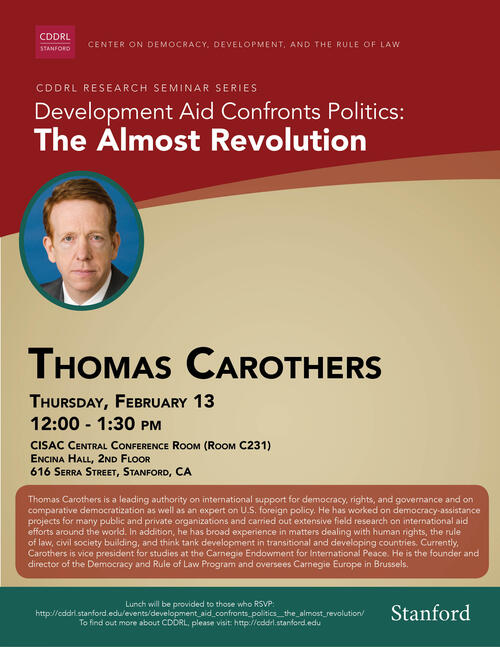
Thomas Carothers is vice president for studies at the Carnegie Endowment for International Peace. He is the founder and director of the Democracy and Rule of Law Program and oversees Carnegie Europe in Brussels.

Carothers is a leading authority on international support for democracy, rights, and governance and on comparative democratization as well as an expert on U.S. foreign policy. He has worked on democracy-assistance projects for many public and private organizations and carried out extensive field research on international aid efforts around the world. In addition, he has broad experience in matters dealing with human rights, the rule of law, civil society building, and think tank development in transitional and developing countries.

He is the author of six critically acclaimed books as well as many articles in prominent journals and newspapers. Carothers has also worked extensively with the Open Society Foundations (OSF), including currently as chair of the OSF Think Tank Fund and previously as chair of the OSF Global Advisory Board. He is an adjunct professor at the Central European University in Budapest and was previously a visiting faculty member at Nuffield College, Oxford University, and Johns Hopkins SAIS.

Prior to joining the Endowment, Carothers practiced international and financial law at Arnold & Porter and served as an attorney adviser in the Office of the Legal Adviser of the U.S. Department of State.

Carothers is the co-author (with Diane de Gramont) of Development Aid Confronts Politics: The Almost Revolution (Carnegie, 2013) and author of Confronting the Weakest Link: Aiding Political Parties in New Democracies (Carnegie, 2006); Promoting the Rule of Law Abroad: In Search of Knowledge (Carnegie, 2006); Uncharted Journey: Promoting Democracy in the Middle East, co-edited with Marina Ottaway (Carnegie, 2005); Critical Mission: Essays on Democracy Promotion (Carnegie, 2004); Funding Virtue: Civil Society Aid and Democracy Promotion, co-edited with Marina Ottaway (Carnegie, 2000); Aiding Democracy Abroad: The Learning Curve (Carnegie, 1999); and Assessing Democracy Assistance: The Case of Romania (Carnegie, 1996).

Image

CISAC Conference Room

Thomas Carothers Vice President for Studies Speaker Carnegie Endownment for International Peace
Seminars
-

At the November 2013 Third Plenum, China’s leaders committed to an ambitious program of economic reform.  Now their challenge is to convert those commitments into a realistic and sustained program of change.  Barry Naughton, just back from fall term at Tsinghua University in Beijing, examines the achievements and obstacles, and discusses how these fit in with the other initiatives of Xi Jinping’s complex emerging agenda.

Barry Naughton is a professor at the University of California, San Diego.  He is one of the world’s top experts on the Chinese economy, and a long-term analyst of Chinese economic policy. Naughton received his Ph.D. in Economics from Yale University in 1986.  Naughton was named the So Kuanlok Professor at the Graduate School of International Relations and Pacific Studies (IR/PS) of the University of California at San Diego in 1998.  He has consulted extensively for the World Bank, as well as for corporate clients.  Naughton is a member of the Council on Foreign Relations and is a non-resident fellow of the Brookings Institution in Washington, D.C.  

This event is co-sponsored with CEAS and is part of the China under Xi Jinping series.

Philippines Conference Room

Barry Naughton Professor of Chinese Economy Speaker UCSD
Seminars
-

This interdisciplinary workshop brings together scholars from the fields of law, political science and international relations, history, literature, film and digital humanities to examines the different ways societies address and judge war and conflict-related atrocities in the post-1945 era. 

Departing from the central role legal mechanisms and procedures play in the processed by which societies come to terms with their violent pasts, the workshop explores the various discourses that take part in such processes, and how they react to post-conflict legal institutions and shape different notions of justice that emerge from these transitional periods.

The event is organized and sponsored by the DLCL Research Unit with the support of CISAC, The Europe Center, DLCL, Department of Comparative Literature, Stanford Humanities Center and Jewish Studies.


VIDEOS:

Introduction:


Panel 1:


Panel 2: (Cooppan)


Panel 2:  (Viles)


Panel 3:


Keynote:

CISAC Conference Room

Workshops

Not in residence

0
Consulting Professor

Frederick Carriere teaches seminars on contemporary foreign policy and Track II diplomacy related to Korea. Currently, he also is a consulting professor at Stanford University’s Center for International Security and Cooperation. All of Carriere's professional experience is Korea-related, including a fifteen-year career (1994-2009) as the executive vice president of The Korea Society in New York City.

Prior to assuming that position, Carriere lived in Korea for a period of over twenty years (1969-1993). During most of those years he was employed by the Korea Fulbright Commission (Korean-American Educational Commission), initially as its educational counseling officer (1979-83) and later as its executive director (1984-1993). In the latter role, Carriere was also responsible for all the Korea-based programs of the East West Center, the Humphrey Fellowship Program and the Educational Testing Service.

He also was president of the Royal Asiatic Society–Korea Branch for two years (1989-91) and a councilor for over a decade. Other relevant professional activities include service as an instructor in the overseas division of the University of Maryland (1980-1982) and a translator at the Korean National Commission for UNESCO (1977-1980).

Paragraphs

The digital information technology (IT) revolution currently underway is profoundly reshap- ing economic activity, influencing politics, and transforming societies around the world. It is also forcing a reconceptualization of the global and local: many of the technologies, platforms, and fundamental disruptions are global in nature, but national or local contexts critically influence the uses and effects of IT.

The Asia-Pacific region provides a fascinating array of countries for examination of the political, economic, and sociocultural effects of digital media on the modern world. Economies range from developing to advanced. Governments include varied democracies as well as one-party regimes. The press enjoys relative freedom in some countries, undergoes limited constraints in others, and is tightly controlled in a few. Populations range from dense to sparse, and from diverse to relatively homogenous.

Held September 12–13, 2013, in Kyoto, Japan, the fifth Stanford Kyoto Trans-Asian Dialogue focused on the catalyzing effects of digital media for change in the Asia-Pacific. Four major themes were addressed:

  1. Digital Media versus Traditional Media
  2. Digital Media and Political Change in Asia
  3. Social Change and Economic Transformation
  4. Digital Media and International Relations
All Publications button
1
Publication Type
Policy Briefs
Publication Date
Journal Publisher
Shorenstein Asia-Pacific Research Center
News Type
News
Date
Paragraphs

The impact of immigration on Western European demographics will be the topic of Stanford political science professor David Laitin and co-writer Rafaela Dancygier's (Princeton University) soon to be published article "Immigration into Europe: Economic Discrimination, Violence, and Public Policy"

All News button
1
-

Historically, in Japan, out-of-court corporate restructurings have played a significant role in disciplining managers in the near-absence of hostile takeover activity and shareholder activism. This paper analyzes management turnover in a large sample of Japanese firms that underwent restructurings between 1981 and 2010. I find that restructurings that happen in later stages of financial distress, and those that are not initiated by the firm itself, are more likely to involve management turnover, as are restructurings in which the firm's main business operations are left intact. Furthermore, in restructurings after the reforms around the year 2000, management turnover is more likely to occur if the local potential managerial labor market is substantial. After controlling for firm characteristics and the firm's initial financial condition, it does not appear that management turnover is associated with an improvement in post-restructuring operating performance--in fact, the effect is significantly negative by estimates that address the non-random nature of management turnover. However, for restructurings led by equity funds, management turnover is associated with a more successful turnaround of the firm's performance. These results suggest that equity funds possess the ability to locate and recruit talented outside managers in a thin market for experienced managers.


Michael Furchtgott is an economist interested in corporate finance and governance. His current research investigates Japanese corporate restructurings and the behavior of firms and lenders when financial distress arises.

Furchtgott has completed his PhD in economics at the University of California, San Diego, where his research on corporate financial restatements has demonstrated that firms frequently circumvent laws designed to protect investors.

He holds a BA in economics and mathematics from Columbia University.

Daniel and Nancy Okimoto Conference Room

Shorenstein APARC
Encina Hall C331
616 Serra Street
Stanford, CA 94304-6055

(650) 724-9747 (650) 723-6530
0
Shorenstein Postdoctoral Fellow in Contemporary Asia
FURGHOTT,_Michael_3x4.jpg PhD

Michael Furchtgott is an economist interested in corporate finance and governance. His current research investigates Japanese corporate restructurings and the behavior of firms and lenders when financial distress arises.

Furchtgott has completed his PhD in economics at the University of California, San Diego, where his research on corporate financial restatements has demonstrated that firms frequently circumvent laws designed to protect investors.

He holds a BA in economics and mathematics from Columbia University.

Michael Furchtgott Postdoctoral Fellow in Contemporary Asia Speaker Shorenstein APARC
Seminars
-

Co-sponsored by the Stanford Center for International Development

Under what conditions is decentralization most likely to foster development and reduce poverty?  Plausible answers include:  a sufficiently committed central government; local checks against corruption; and sufficiently resourced actors able to deliver public services effectively. Indonesia is a good place to explore the explanatory power of these and other propositions, thanks to the country’s diverse local conditions and the rapid and sweeping (“Big Bang”) decentralization that it underwent in the late 1990s.  In his disaggregation of the Indonesian case since then, Dr. Sumarto will examine whether, how, and why poverty alleviation has been helped or hurt by particular economic, social, and political variations in the context and character of local governments across the archipelago.

Sudarno Sumarto was an Asia Foundation Visiting Fellow at APARC in 2009-2010.  In 2001-2009 he was the director of SMERU, a highly regarded independent institute for research and public policy studies in Jakarta.  He has served as a consulting economist for the World Bank, the Asian Development Bank, among other organizations, and has taught in Indonesia’s leading universities. His latest publication is Explaining Regional Heterogeneity of Poverty:  Evidence from Decentralized Indonesia (co-authored, 2013).  Earlier titles include more than sixty co-authored books, working papers, articles, chapters, and reports on topics such as poverty, decentralization, employment, vulnerability, and economic growth.  His degrees in economics include a PhD and an MA from Vanderbilt University and a BSc from Satya Wacana Christian University (Salatiga).

Lunch will be served.

Philippines Conference Room

Sudarno Sumarto Senior fellow Speaker SMERU Research Institute
Seminars
Subscribe to International Relations