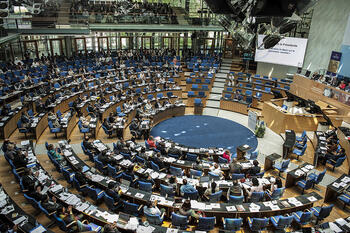
FSI researchers strive to understand how countries relate to one another, and what policies are needed to achieve global stability and prosperity. International relations experts focus on the challenging U.S.-Russian relationship, the alliance between the U.S. and Japan and the limitations of America’s counterinsurgency strategy in Afghanistan.
Foreign aid is also examined by scholars trying to understand whether money earmarked for health improvements reaches those who need it most. And FSI’s Walter H. Shorenstein Asia-Pacific Research Center has published on the need for strong South Korean leadership in dealing with its northern neighbor.
FSI researchers also look at the citizens who drive international relations, studying the effects of migration and how borders shape people’s lives. Meanwhile FSI students are very much involved in this area, working with the United Nations in Ethiopia to rethink refugee communities.
Trade is also a key component of international relations, with FSI approaching the topic from a slew of angles and states. The economy of trade is rife for study, with an APARC event on the implications of more open trade policies in Japan, and FSI researchers making sense of who would benefit from a free trade zone between the European Union and the United States.
Please join us for a seminar on the assessment of student learning in higher education. We will hear from internationally renowned experts in the field of higher education assessment and present preliminary results from a pathbreaking new study comparing university learning between the U.S., Russia and China.
Lydia Liu
Director of Research, Higher Education Educational Testing Service
Olga Zlatkin-Troitschanskaia
Professor of Business Education Johannes Gutenberg University
Prashant Loyalka
Center Fellow (FSI)
Assistant Professor, Teaching (FSE)
Stanford University
Central Conference Room
Encina Hall, second floor 616 Serra St. Stanford, CA 94305-6055
Lydia Liu
Director of Research, Higher Education
Educational Testing Service (ETS)
Olga Zlatkin- Troitschanskaia
Professor of Business Education
Johannes Gutenberg University
Prashant Loyalka
Center Fellow, FSI/GSE
Stanford University
A conference that honored the life and scholarly contributions of Stanford economist Masahiko Aoki was held at Stanford. Dozens of friends, family and community members paid tribute to Aoki, the Henri and Tomoye Takahashi Professor of Japanese Studies and Professor of Economics, emeritus, who died in July at the age of 77.
Eleven renowned economists and social scientists gave talks on Aoki’s extensive fields of research in economic theory, institutional analysis, corporate governance, and the Japanese and Chinese economies at the Dec. 4 conference, which was followed by a memorial ceremony the next day.
“When we contacted people to speak at this conference, few people turned us down,” said Stanford professor Takeo Hoshi. “The reason for this is Masa. It shows how much Masa was respected and how much his work is valued.”
The events were hosted by the Japan Program at the Walter H. Shorenstein Asia-Pacific Research Center, the Freeman Spogli Institute for International Studies (FSI), Graduate School of Business, Department of Economics and the Stanford Institute for Economic Policy Research (SIEPR).
Image
Aoki came to Stanford in 1967 as an assistant professor, held faculty appointments at Kyoto University and Harvard, and returned to Stanford in 1984. He retired to emeritus status at Stanford in 2005.
Throughout the conference, Aoki was described as an astute professor and colleague, valuable mentor and loyal friend by the many speakers and participants who shared works, stories and multimedia featuring their interactions with Aoki.
Aoki pioneered the field of comparative institutional analysis (CIA) with a team of scholars at Stanford: Avner Greif, John Litwack, Paul Milgrom and Yingyi Qian, among others. CIA analyzes and compares different institutions that evolve to regulate different societies.
Masahiko Aoki (far left) is pictured with colleagues on the Stanford campus in the late 1960s.
“Masa had a good background in looking at the economy as a whole, financial institutions as a whole – not just how numbers or actors economically interact – but also the people who interact within a given institutional framework,” said Koichi Hamada, a professor emeritus at Yale University.
“Masa had a good background in looking at the economy as a whole, financial institutions as a whole – not just how numbers or actors economically interact…”
-Koichi Hamada, Yale University
Aoki applied a systematic lens to everything he studied, a “take society as a total entity” approach, Hamada said.
Aoki grew up in Japan, and developed a deep interest in Japanese politics at an early age. He was actively involved in student movements in the early 1960s, at the heart of which was a campaign against a controversial U.S.-Japan security treaty. China became another great interest of his as the country began to undergo economic transformation and modernization.
Throughout his career, Aoki traveled to Japan and China often, and sought to better inform policy debates by engaging scholars, government leaders and journalists there.
He believed in sharing lessons learned from his own scholarly analyses on what constitute institutions, particularly the “people” aspects – the employees, their cognitive abilities and levels of participation.
[Continues below]
Caption TBD.
Caption TBD.
Top left to right: Yingyi Qian of Tsinghau University talks with Avner Greif of Stanford University and Hugh Patrick of Columbia University. / Koichi Hamada of Yale University delivers his remarks titled "Masahiko Aoki: A Social Scientist." Bottom: Reiko Aoki, the wife of Masahiko Aoki, listens in to Kenneth Arrow, a professor emeritus at Stanford University. Credit: Rod Searcey
Aoki was not only a scholar of institutions but also a builder of them.
“Amid a time of diplomatic tensions between China and Japan…Masa was able to bring Japanese, Chinese and American economists together to study and do research,” said Yingyi Qian, dean and professor at the school of economics and management at Tsinghua.
At Stanford, Aoki played a leading role in the creation of the Stanford Japan Center and a multi-day conference that convened annually in Kyoto on issues of mutual concern between Asia-Pacific countries and the United States.
“Masa Aoki’s legacy will serve as an integral guidepost for many years to come. May his soul rest in peace.”
-Kotaro Suzumura, Hitotsubashi University
Earlier this year, Aoki was hospitalized for lung disease. Even at that stage, he worked tirelessly to revise a paper that examines the institutional development of China and Japan in the late 19th to early 20th centuries.
Aoki was also fondly remembered for his mentorship of students at Stanford and other universities he taught at.
“He was an original and unique professor – quite different from others that I’ve met in many respects. He was generous with his time, not hierarchical,” said Miguel Angel Garcia Cestona, who studied for a doctorate at Stanford and now teaches at the Universitat Autonoma de Barcelona.
Garcia Cestona, among other former students, spoke of Aoki as a friend and shared memories of their former professor hosting them at his home.
Growing evidence demonstrates that climatic conditions can have a profound impact on the functioning of modern human societies, but effects on economic activity appear inconsistent. Fundamental productive elements of modern economies, such as workers and crops, exhibit highly non-linear responses to local temperature even in wealthy countries. In contrast, aggregate macroeconomic productivity of entire wealthy countries is reported not to respond to temperature= while poor countries respond only linearly. Resolving this conflict between micro and macro observations is critical to understanding the role of wealth in coupled human–natural systems and to anticipating the global impact of climate change. Here we unify these seemingly contradictory results by accounting for non-linearity at the macro scale. We show that overall economic productivity is non-linear in temperature for all countries, with productivity peaking at an annual average temperature of 13 °C and declining strongly at higher temperatures. The relationship is globally generalizable, unchanged since 1960, and apparent for agricultural and non-agricultural activity in both rich and poor countries. These results provide the first evidence that economic activity in all regions is coupled to the global climate and establish a new empirical foundation for modelling economic loss in response to climate change, with important implications. If future adaptation mimics past adaptation, unmitigated warming is expected to reshape the global economy by reducing average global incomes roughly 23% by 2100 and widening global income inequality, relative to scenarios without climate change. In contrast to prior estimates, expected global losses are approximately linear in global mean temperature, with median losses many times larger than leading models indicate.
This event is now full. We are no longer able to accept further RSVPs.
The Russian Economy is in a recession due to a perfect storm of the low oil prices, sanctions and the lack of reforms. First time since 1998, Russians see a major fall in their real incomes. How long will the recession continue? What can the Russian government do? What will happen after the recession is over?
Sergei Guriev is a professor of economics at Sciences Po in Paris, France. From 2004 to 2013, Dr. Guriev was a tenured professor of economics and rector of the New Economic School in Moscow. He will begin an appointment as Chief Economist of the European Bank for Reconstruction and Development in 2016.
Dr. Guriev’s research interests include contract theory, corporate governance, political economics and labor mobility. Dr. Guriev has published in international refereed journals including American Economic Review, Journal of European Economic Association, Journal of Economic Perspectives and American Political Science Review. In 2006, he was selected a Young Global Leader by the World Economic Forum. In 2011, he was a member of the World Economic Forum’s Global Agenda Council on Europe, in 2012-14 – a co-chair of the Global Agenda Council on the New Economic Thinking, and in 2014-15 – a member of the Global Agenda Council on the Geoeconomics. In 2000 and 2005, he was awarded Gold Medal for the Best Research in Development Economics by the Global Development Network. In 2001, he was announced the Best Academic Manager in Humanities by Russia’s Science Support Foundation. In 2009-11, he was included in the top 100 of the President of Russia’s Cadre Reserve. In 2009, he was also awarded the Bill Maynes Award by the Eurasia Foundation. In 2009 and 2010 he received the Independent Director of the Year prize from Russia’s National Association of Independent Directors. In 2010, he received a Certificate in Company Directorship from the Institute of Directors (UK) and was voted the Best Independent Director by the Association of Managers of Russia and the Russian Institute of Directors.
He has been a board member of Sberbank (2008-14), E.ON Russia (2013-14), Alfa-Strakhovanie Insurance Company (2009-13), Russia Venture Company (2009-13), Russian Home Mortgage Lending Agency (2008-12) and Russian Agricultural Bank (2008-09), a member of the President of Russia’s Council on Science, Technology and Education (2008-12), and a member of the board of the Dynasty Foundation (2007-2015). He is a member of the Scientific Council of the BRUEGEL think tank (Brussels), of the Advisory Council of the Peterson Institute on International Economics (Washington, DC), and of the Academic Advisory Board, Blavatnik School of Government, Oxford University. He is also a Research Fellow at the Centre for Economic Policy Research, London.
Sergei Guriev
Professor of Economics
Speaker
Sciences Po, Paris
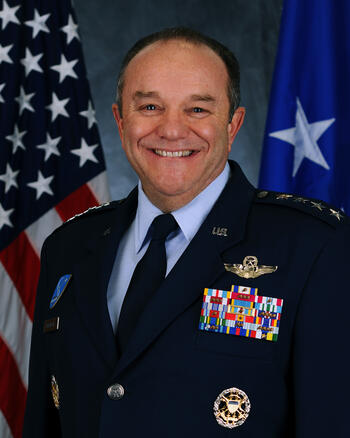
Upcoming talk by Supreme Allied Commander Europe, General Philip M. Breedlove.
"Europe at the Crossroads"
Date: November 9, 2015
Time: 12:00PM to 1:30PM
Location: Koret Taube Conference Center, Room 130 RSVP by 5:00PM November 5, 2015.
Image
General Philip M. Breedlove is a four-star general in the United States Air Force and the current Supreme Allied Commander Europe (SACEUR). In this position, General Breedlove is one of NATO's two strategic commanders and is the head of Allied Command Operations (ACO). General Breedlove became the Supreme Allied Commander, Europe on 13 May 2013. During his visit to Stanford, General Breedlove will discuss Europe's rapidly-evolving geopolitical climate and highlight many of the security challenges for which the United States and NATO must prepare.
General Breedlove has served in the United States Air Force since graduating from the Georgia Institute of Technology in 1977. Immediately prior to assuming his current position, General Breedlove served as Commander, U.S. Air Forces in Europe; Commander, U.S. Air Forces Africa; Commander Headquarters Allied Air Command, Ramstein; and Director, Joint Air Power Competence Centre, Kalkar Germany. We invite you to visit ourwebsite for additional information about this event.
Featured Faculty Research: Jens Hainmueller
We would like to introduce you to some of the faculty members that we support and the projects on which they are working. Our featured faculty member this month is Jens Hainmueller, who is an Associate Professor in the Department of Political Science.
Jens earned his Ph.D. in Government from Harvard University in 2009 and joined the faculty at Stanford University in 2014. His research interests include statistical methods, immigration, political economy, and political behavior. An example of Jens's research on immigration and migrant integration is his recent co-authored work with Dominik Hangertner at the London School of Economics and Giuseppe Pietrantuono at the University of Zurich, which examined the effect of naturalization on migrant political integration into the host society. Establishing the effects of naturalization on political integration is complicated by an unobservable selection process; a non-random sample of migrants chooses to apply for naturalization and a non-random sample of naturalization applicants is approved. As a result, previous work has neither been able to establish the direction of the relationship between naturalization and poitical integration nor isolate the effect of naturalization on political integration vis-à-vis alternatives. In order to limit the bias induced by this dual-selection process, Jens and his coauthors analyzed data from Switzerland, where some municipalities used referendums to make decisions on naturalization applications. By limiting the sample to those applications that were approved or rejected by only a few votes, the authors were able to establish treatment and control groups that were otherwise equivalent, thereby removing selection bias from their data. Using this unbiased sample, Jens and his coauthors found that naturalization indeed has a positive effect on migrant political integration by increasing political participation, political knowledge, and political efficacy, among others. This research was published in the Proceedings of the National Academy of Sciences. We invite you to visit our website for additional information about this research.
Publication Details: Hainmueller, Jens, Dominik Hangartner, and Guiseppe Pietrantuono. 2015. "Naturalization Fosters the Long-Term Political Integration of Immigrants." Proceedings of the National Academy of Sciences of the United States of America 112(41):12,651-12,656.
Featured Graduate Student Research: Jason Weinreb
We would like to introduce you to some of the students that we support and the projects on which they are working. Our featured student this month is Jason Weinreb (Political Science). Jason is a Ph.D. Candidate in the Department of Political Science at Stanford University.
Jason is a political economist who is interested in political risk, the politics of public finance, and economic history. His dissertation examines how newly-independent states finance themselves, focusing on former British colonies. Analysis of the London Stock Exchange in the quarter century following World War II reveals a surprising trend: colonial debt bond prices remained remarkably stable throughout decolonization. In his research at the British National Archives in London, funded in part by The Europe Center, Jason found that price stability was an insufficient indicator of investor confidence. Far from reflecting investors unperturbed by the uncertainty of decolonization, Jason's research uncovers evidence that investors were indeed concerned about the effects of independence on their investment. In fact, investor concerns manifested in higher interest rates, fewer colonial debt bond issues, and lower subscription rates relative to earlier periods. His archival research further uncovers factors that explain why colonial debt bond prices fail to reflect investor sentiment. Chief among these was the British government's intervention in the market. Its strategic purchase and holding of colonial debt bonds ensured price stability despite investor concerns.
Featured Event: Taking the Stand - A Film Presentation and Q&A with Survivors of the Holocaust
Pictured: Renée Firestone, Hermine Liska, and Bernhard Rammerstorfer
By: Christof Brandtner and Sebastian Schuster
This year we commemorate the 70th anniversary of the liberation of Auschwitz. At the same time, the number of people who can give us a personal account of the cruelties of the Holocaust is dwindling. Together with students from the Stanford Austria Club, The Europe Center hosted two survivors of the Holocaust and witnesses of the Nazi era: Renée Firestone (born in 1924 in today's Ukraine) and Hermine Liska (born 1930 in Austria). Firestone and Liska were introduced by TEC affiliated faculty Prof. Amir Eshel, interviewed by Austrian documentarian Bernhard Rammerstorfer, and answered engaging questions from students and community members in the audience. In their accounts, Firestone and Liska reported on the years leading up to their persecution, highlighted the importance of religion and family for their survival, and pointed out connections between the diaspora of the 1930s and 1940s and the current global refugee crisis. Rammerstorfer also presented his newest film and book project ‘Taking the stand: We have more to say’ which condenses the experience and memories of nine Holocaust survivors in response to 100 questions from high school students around the world.
Recap: Former NATO Secretary General Anders Fogh Rasmussen Visits Stanford
In his recent visit to Stanford University, former NATO Secretary General Anders Fogh Rasmussen painted a bleak picture of global politics. The hope of the Arab Spring has been replaced by new authoritarian regimes, civil war, and ISIS. Russia is becoming more internally authoritarian and externally aggressive. According to one measure, global levels of freedom have been in decline for the past nine consecutive years. "It looks", he said, "as if a Pandora's box of religious, ethnic, and political strife has been opened, and many nations have plunged into chaos and extremism." According to Rasmussen, successfully navigating these global challenges requires a concerted effort among liberal democratic states, spearheaded by American leadership. In order to create a strong global community of liberal democracies, he advocated strengthening the Transatlantic alliance. In addition to the existing military alliance forged through NATO, he proposed the creation of a Transatlantic Free Trade Area (TAFTA) and a Transatlantic peoples program, which would foster educational, scientific, and cultural exchanges among the partner states. More than 150 people attended the talk, which was held on September 25. To watch Rasmussen's talk in full, please visit our website.
Fall 2015 Graduate Student Grant Competition Winners Announced
Please join us in congratulating the winners of The Europe Center Fall 2015 Graduate Student Grant Competition:
Elena Dancu, Comparative Literature, "From Vienna to Rio de Janeiro: Stefan Zweig and a World in Ruins."
Mathilde Emeriau, Political Science, "Discrimination and Integration of Asylum Seekers in France."
William Parmer, Philosophy, "The Art of Cruelty."
Rebecca Perlman, Political Science, "The Politics of Protection: Health and Safety Regulation in a Globalized Marketplace."
Nicola Pierri, Economics, "Credit Constraints and Firms' Productivity: Evidence from the Italian Economy."
Jens Pohlmann, German Studies, "Capitalizing on the Avant-Garde? An Analysis of Adversarial Authors’ Marketing Strategies in the Second Half of the 20th Century."
Alice Underwood, Comparative Literature, "The Comrade's Deviant Body: Myth, Citizenship, and Socialist Decay in the Pre-Perestroika Soviet Union."
Ashley Walters, History, "The Evolution of a Modern Jewish Legal Defense Against Anti-Semitism in Late Imperial Russia ."
Jason Weinreb, Political Science, "Decolonization's Money Doctor: The Bank of England and Commonwealth Central Banks, 1955 - 1970."
Seth Werfel, Political Science, "Representation as Intermediation."
Duygu Yildirim, History, "Historicizing Nature: Approaches to The Natural History of Crete in the Eastern Mediterranean."
Please visit our website for more information about our Graduate Student Grant program.
The Europe Center Sponsored Events
November 5, 2015
6:30PM - 9:30PM
Romanian Film Festival (Stanford, Day 1)
"Travelling Shorts:Families Beyond Boundaries"
East Asia Library, Room 224, Lathrop Library Building
Please visit our website for additional information.
November 8, 2015
1:00PM - 8:45PM
Romanian Film Festival (Stanford, Day 2)
"Travelling Shorts:Families Beyond Boundaries"
Cubberley Auditorium
Please visit our website for additional information.
November 9, 2015
12:00PM - 1:15PM Mart Kuldkepp, Scandinavian Studies, University College London
"Russian deserters to Sweden in World War I"
Reuben Hills Conference Room, Encina Hall East Open to Stanford affiliates only. RSVP requested
This seminar is organized by the Center for Russian, Eastern European and Eurasian Studies and co-sponsored by The Europe Center.
European Security Initiative Events
November 9, 2015
12:00PM - 1:30PM
General Philip M. Breedlove, Supreme Allied Commander Europe and Commander, US European Command, NATO
"Europe at the Crossroads"
Koret-Taube Conference Center, Room 130, Gunn-SIERP Building RSVP by 5:00PM November 5, 2015.
November 10, 2015
5:30PM - 7:00PM
Lilia Shevtsova, Non-Resident Fellow, Brookings Institution and Associate Fellow Russia-Eurasia Program, Chatham House - The Royal Institute of International Affairs
"Russia as a Global Challenge"
Bechtel Conference Center, Encina Hall RSVP requested
Save the Date: January 5, 2016
Sergei Guriev, Professor of Economics, New Economic School, Moscow and Visiting Professor of Economics, Sciences Po, Paris
Other Campus Events of Interest
November 16, 2015
6:30PM - 8:15PM
"In the Crosswinds" (2014) Film Screening
Cubberley Auditorium, Cubberley Education Library RSVP requested
For more information, please visit the event website.
We welcome you to visit our website for additional details.
This conference aims to further our understanding of the institutional cultures, funding schemes and power structures underlying transnational institutions, with a particular focus on heritage bureaucracies. We bring together scholars working at the intersection of archaeology, anthropology, sociology and law to offer a broader understanding of the intricacies of multilateral institutions and global civic society in shaping contemporary heritage governance. Speakers will provide ethnographic perspectives on the study of international organizations, such as the UN and EU, in an effort to show the entanglement of political and technical decision-making.
A 2-day international conference organized by Claudia Liuzza and Gertjan Plets.
Speakers:
Brigitta Hauser-Shäublin (Institute of Ethnology, Göttingen University) Ellen Hertz (Institute of Ethnology, University of Neuchâtel) Miyako Inoue (Department of Anthropology, Stanford University) Claudia Liuzza (Department of Anthropology, Stanford University) Brigit Müller (Ecole des Hautes Etudes en Sciences Sociales, Paris) Elisabeth Niklason (Department of Archeaology, Stockholm University) Gertjan Plets (Stanford Archaeology Center, Stanford University) Cris Shore (Department of Anthropology, The University of Auckland) Ana Vrdoljak (Department of Law, University of Technology, Sydney)
Co-sponsored by Stanford Archaeology Center, Cantor Arts Center, Department of Anthropology, Center for Russian, East European & Eurasian Studies, Stanford Humanities Center, The Europe Center, France-Stanford Center for Interdisciplinary Studies, The Mediterranean Studies Forum.
-This event is now full and we are no longer able to accept RSVPs-
Image
Please join us as we celebrate the publication of David Laitin and co-authors Claire Adida (UC San Diego) and Marie-Anne Valfort's (Paris School of Economics and the Sorbonne) recent book Why Muslim Integration Fails in Christian-Heritage Societieswhich will be released in January 2016 by Harvard University Press.
Amid mounting fears of violent Islamic extremism, many Europeans ask whether Muslim immigrants can integrate into historically Christian countries. In a groundbreaking ethnographic investigation of France’s Muslim migrant population, Why Muslim Integration Fails in Christian-Heritage Societies explores this complex question. The authors conclude that both Muslim and non-Muslim French must share responsibility for the slow progress of Muslim integration.
Book signing to immediately follow. Copies of the book will also be available for sale.
David D. Laitin is the James T. Watkins IV and Elise V. Watkins Professor of Political Science at Stanford University. His specialty is comparative politics. In that field he conducts research on political culture, ethnic conflict, and civil war. His field expertise spans Somalia, Nigeria, Catalonia, Estonia and France.
Department of Political Science
Stanford University
Encina Hall, W423
Stanford, CA 94305-6044
(650) 725-9556
(650) 723-1808
0
dlaitin@stanford.edu
James T. Watkins IV and Elise V. Watkins Professor of Political Science
laitin.jpg
PhD
David Laitin is the James T. Watkins IV and Elise V. Watkins Professor of Political Science and a co-director of the Immigration Policy Lab at Stanford. He has conducted field research in Somalia, Nigeria, Spain, Estonia and France. His principal research interest is on how culture – specifically, language and religion – guides political behavior. He is the author of “Why Muslim Integration Fails in Christian-heritage Societies” and a series of articles on immigrant integration, civil war and terrorism. Laitin received his BA from Swarthmore College and his PhD from the University of California, Berkeley.
Affiliated faculty at the Center for International Security and Cooperation
Affiliated faculty at The Europe Center
James T. Watkins IV and Elise V. Watkins Professor of Political Science
Speaker
Department of Political Science
Associate Professor of French and Director, Department of French and Italian
Discussant
Division of Literatures, Cultures, and Languages
Amalia Kessler
Lewis Talbot and Nadine Hearn Shelton Professor of International Legal Studies
Discussant
Stanford Law School

 FSI researchers strive to understand how countries relate to one another, and what policies are needed to achieve global stability and prosperity. International relations experts focus on the challenging U.S.-Russian relationship, the alliance between the U.S. and Japan and the limitations of America’s counterinsurgency strategy in Afghanistan.

 Caption TBD.
 Caption TBD.



 Jason is a political economist who is interested in political risk, the politics of public finance, and economic history. His dissertation examines how newly-independent states finance themselves, focusing on former British colonies. Analysis of the London Stock Exchange in the quarter century following World War II reveals a surprising trend: colonial debt bond prices remained remarkably stable throughout decolonization. In his research at the British National Archives in London, funded in part by The Europe Center, Jason found that price stability was an insufficient indicator of investor confidence. Far from reflecting investors unperturbed by the uncertainty of decolonization, Jason's research uncovers evidence that investors were indeed concerned about the effects of independence on their investment. In fact, investor concerns manifested in higher interest rates, fewer colonial debt bond issues, and lower subscription rates relative to earlier periods. His archival research further uncovers factors that explain why colonial debt bond prices fail to reflect investor sentiment. Chief among these was the British government's intervention in the market. Its strategic purchase and holding of colonial debt bonds ensured price stability despite investor concerns.
 In his recent visit to Stanford University, former NATO Secretary General Anders Fogh Rasmussen painted a bleak picture of global politics. The hope of the Arab Spring has been replaced by new authoritarian regimes, civil war, and ISIS. Russia is becoming more internally authoritarian and externally aggressive. According to one measure, global levels of freedom have been in decline for the past nine consecutive years. "It looks", he said, "as if a Pandora's box of religious, ethnic, and political strife has been opened, and many nations have plunged into chaos and extremism." According to Rasmussen, successfully navigating these global challenges requires a concerted effort among liberal democratic states, spearheaded by American leadership. In order to create a strong global community of liberal democracies, he advocated strengthening the Transatlantic alliance. In addition to the existing military alliance forged through NATO, he proposed the creation of a Transatlantic Free Trade Area (TAFTA) and a Transatlantic peoples program, which would foster educational, scientific, and cultural exchanges among the partner states. More than 150 people attended the talk, which was held on September 25. To watch Rasmussen's talk in full, please visit our