
 FSI researchers strive to understand how countries relate to one another, and what policies are needed to achieve global stability and prosperity. International relations experts focus on the challenging U.S.-Russian relationship, the alliance between the U.S. and Japan and the limitations of America’s counterinsurgency strategy in Afghanistan.
Foreign aid is also examined by scholars trying to understand whether money earmarked for health improvements reaches those who need it most. And FSI’s Walter H. Shorenstein Asia-Pacific Research Center has published on the need for strong South Korean leadership in dealing with its northern neighbor.
FSI researchers also look at the citizens who drive international relations, studying the effects of migration and how borders shape people’s lives. Meanwhile FSI students are very much involved in this area, working with the United Nations in Ethiopia to rethink refugee communities.
Trade is also a key component of international relations, with FSI approaching the topic from a slew of angles and states. The economy of trade is rife for study, with an APARC event on the implications of more open trade policies in Japan, and FSI researchers making sense of who would benefit from a free trade zone between the European Union and the United States.


"How America Retrenches: Foreign Policy Pullbacks in Historical Perspective" - A Lecture by Stephen Sestanovich
-
Sorry, we've reached registration capacity. Please contact us if you would like to be added to the waitlist.
Barack Obama is not the first U.S. president to deal with the problem of overcommitment abroad. How does his record compare with earlier cases? Can the past help us understand the foreign policy debate of 2016? Can it tell us how, when—and whether—today’s retrenchment will end?
Stephen Sestanovich is a professor of international diplomacy at Columbia University's School of International and Public Affairs and a senior fellow at the Council on Foreign Relations. He is the author of Maximalist: America in the World from Truman to Obama (Knopf 2014).
From 1997 to 2001, Sestanovich was the U.S. State Department's ambassador-at-large for the former Soviet Union. In previous government assignments, he was senior director for policy development at the National Security Council, a member of the State Department’s policy planning staff, and legislative assistant to Senator Daniel Patrick Moynihan. He has also worked at the Carnegie Endowment for International Peace and the Center for Strategic and International Studies.
Ambassador Sestanovich received his BA summa cum laude from Cornell University and his PhD from Harvard University. He has written for Foreign Affairs, The New York Times, The Wall Street Journal and other publications. He is a member of the board of directors of the National Endowment for Democracy.
Event co-sponsored by the Center for International Security and Cooperation
Stephen Sestanovich
Columbia University
Lectures
China’s Growth Prospects and Implications for Southeast Asia
-
With the G-7 economies in the doldrums since 2008, the roller-coastal behavior of global commodity markets from 2010 to 2015 is convincing evidence of the huge impact that China’s economy now has on the prosperity of many regions, Southeast Asia notably included. The future course of the China’s economy will determine, among other things, the legitimacy of its government, the incentive to project force beyond its borders, and the ability to build an effective international coalition to advance its agenda in world affairs. Prof. Woo will examine (a) the recent marked slowdown in China’s growth, distinguishing temporary factors from the medium-term trend and comparing the policy options, and (b) the domestic and external implications of two scenarios of Chinese growth for two settings in Southeast Asia.
Wing Thye Woo, in addition to the positions noted above, is a special-term professor in the Fudan University School of Economics (Shanghai). He is co-editing a forthcoming book on the global economy and its Asian component. His many previous publications include Ranking the Liveability of the World’s Major Cities (co-author, 2012); The Asian Financial Crisis: Lessons for a Resilient Asia (co-editor, 2000); and Fiscal Management and Economic Reform in the People's Republic of China (co-authored, 1997). He is the convener of the Asian Economic Panel (AEP), a network of leading scholars on Asian economies who meet tri-annually, and the chief editor of Asian Economic Papers, a journal co-sponsored by research institutes in Indonesia, Malaysia, South Korea, and the US. He has also served as a special advisor to Malaysian prime minister Abdullah Badawi (2005-08), US treasury secretary Robert Rubin (1997-98), and officials of other governments.Image
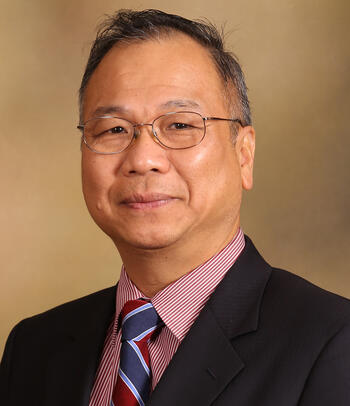
Wing Thye Woo
President, Jeffrey Cheah Institute on Southeast Asia, Sunway University, Kuala Lumpur, and Professor of Economics, University of California, Davis
Seminars
Payne Distinguished Lecture with R. Nicholas Burns: National Security Challenges for the Next President
-
Click below to view the recording:
Please join us for the upcoming Payne Distinguished Lecture, “NATIONAL SECURITY CHALLENGES FOR THE NEXT PRESIDENT," with R. Nicholas Burns, former Under Secretary of State for Political Affairs and the Roy and Barbara Goodman Family Professor of the Practice of Diplomacy and International Relations, Harvard Kennedy School of Government.
The lecture will take place on Friday, April 29 at 12 noon in the Bechtel Conference Center, Encina Hall. Please RSVP to Scott Nelson at snelson@stanford.edu.
Lectures
Open Sesame!: Alibaba and E-commerce in China
-
We have reached venue capacity and can no longer accept RSVPs.
Half the world is on the Internet. By the end of June 2015, China recorded a total of 667 million Internet users. Taobao and Tmall, Alibaba Group’s giant e-commerce platforms, posted a record-breaking RMB 91.2 billion on Singles' Day, 2015; and Alibaba Group with its annual sales volume of RMB 3 trillion, has surpassed Walmart to become the world’s largest retail platform. Dr. Ming Zeng, Chief Strategy Officer of Alibaba Group, will first give an insider’s account of how Alibaba was able to scale up its operations from Jack Ma’s humble operations into one of the world’s largest companies. He will further discuss how the Web technology is transforming China’s consumer and production economy.
 Dr. Ming ZENG currently serves as Executive Vice President of Alibaba Group Holding Limited and Chief Strategy Officer of Alibaba Group. Dr. Zeng is also the founding Dean of Hupan University of Entrepreneurship, an educational institution founded in 2015 by Jack Ma and other business leaders in China. He is a frequent contributor to leading management journals and is the author of Dragons at Your Door: How Chinese Cost Innovation Is Disrupting Global Competition (2007). Dr. Zeng previously served as a faculty member at INSEAD from 1998 to 2002 then helped to found the Cheung Kong Graduate School of Business in Beijing, the first private business school in China. Dr. Zeng obtained his Ph.D. in International Business and Strategy from University of Illinois at Urbana-Champaign in 1998, and his Bachelor's degree in International Economics from Fudan University, China, in 1991.
 Duncan Clark is the Chairman of BDA China, a consultancy he founded in Beijing in 1994 after four years as an investment banker with Morgan Stanley in London and Hong Kong. BDA China is an advisory firm serving investors in China’s technology and consumer sectors, employing over 100 mainland Chinese professionals in Beijing. An early advisor to leading Chinese Internet entrepreneurs, Mr. Clark is also the author of Alibaba: The House that Jack Ma Built (2016), an insider’s look at China’s e-commerce and technology giant and its founder Jack Ma.
This event is off the record.
Ming Zeng
Chief Strategy Officer, Alibaba Group
Duncan Clark (moderator)
Moderator
BDA China, Author of Alibaba: The House that Jack Ma Built
Seminars
America’s Pacific Future Is Happening Now
-
The United States has transformed its relationships across the Asia-Pacific region under President Obama’s “rebalance” policy. America’s top diplomat for the region will speak about the strategy the administration has pursued and what lies ahead.
Image

Prior to joining the NSC in January of 2009, he served as Director of the Office of Japanese Affairs and had assignments as U.S. Consul General in Osaka-Kobe, Japan (2005-2008); Deputy Chief of Mission at the U.S. Embassy in The Hague, Netherlands (2002-2005); Deputy Chief of Mission at the U.S. Embassy in Nicosia, Cyprus (1999-2002); Chief of Staff to the Under Secretary of State for Political Affairs, Ambassador Thomas R. Pickering (1997-99); Special Assistant to the Under Secretary of State for Political Affairs (1995-96); Political Section Unit Chief at U.S. Embassy Seoul, Republic of Korea (1992-95); Political Advisor to the Permanent Representative to the U.S. Mission to the United Nations, Ambassador Pickering (1989-92); Vice Consul in Osaka and Branch Office Manager in Nagoya, Japan (1987-89); and Assistant to the Ambassador to Japan, former Senate Majority Leader Mike Mansfield (1985-87).
In 1996, Mr. Russel was awarded the State Department's Una Chapman Cox Fellowship sabbatical and authored America’s Place in the World, (Georgetown University Press). Before joining the Foreign Service, he was manager for an international firm in New York City.
Mr. Russel was educated at Sarah Lawrence College, University College, UK and University of London, UK.
Sponsored by the U.S.-Asia Security Iniatitive
Daniel Russel
<i> Assistant Secretary of State for East Asian and Pacific Affairs, Department of State</i>
Seminars
"Ukraine: a turning point for the post-Soviet space or just another failure?" A Lecture by Ilya Ponomarev
-
Event is Full. To be added to the waitlist please email Karen Haley: khaley@stanford.edu
Ilya Ponomarev is an opposition member of the Russian Parliament (State Duma). He is a Social Democrat representing Novosibirsk – the capital of Siberia, and chairs the Innovations and Venture Capital (formerly Hi-Tech development) subcommittee which has introduced legislation to support emerging innovation economy in Russia.
Ilya Ponomarev is one of leaders of anti-Putin opposition in Russia. He played key role in protests of 2012; during 2013-2014 he opposed antidemocratic legislation introduced in the country, was the only MP in Duma to vote against annexation of Crimea.
Mr Ponomarev serves as the Advisor on International Business Development, Commercialization and Technology Transfer for the President of Skolkovo Foundation – managing company of the project chaired by Pres. Medvedev. He is member of Society of Petroleum Engineers (IT), Council for Foreign and Defense Policies, Council for National Strategy, fellow at “Open Russia” foundation. Hon. Ponomarev is supervising innovation policies research at Institute of Contemporary Development (INSOR, think-tank chaired by Pres. Medvedev), and political studies at Institute of Globalization Studies (IPROG). Ilya Ponomarev is a member of Global Science and Innovations Council (GSIAC), chaired by Prime Minister of Malaysia.
Previously, Mr. Ponomarev held various positions in private companies, including Vice President of Yukos Oil Company, the largest Russian oil and gas corporation, and Director for CIS Business Development and Marketing for Schlumberger Oilfield Services.
He is an author of numerous research papers and magazine articles about new economy development, regional policies, education and international relations.
Ilya Ponomarev
Russian Parliament Member
Lectures
Stanford historical memory project seeks WWII reconciliation in Asia
News Type
News
Date
Paragraphs
From atomic bombs to harsh military occupations in the World War II period, the past is very much the present in the Asia Pacific region.
Stanford scholars are striving to help heal these wounds from yesteryear. Helping old enemies better understand each other today is the aim of the Divided Memories and Reconciliation project, a multi-year comparative study of the formation of historical memory regarding the wartime period in countries such as China, Japan, South Korea, Taiwan and the United States.
Left unattended, misguided wartime narratives may exacerbate current disputes to the point of armed conflict, said Daniel Sneider, associate director of research at Stanford's Shorenstein Asia-Pacific Research Center. He leads the Divided Memories project along with Gi-Wook Shin, a Stanford sociology professor and the Shorenstein center director.
Sneider points out the critical importance of textbooks and what is taught in schools – especially given the rise of nationalism among youth in China, Japan, Taiwan and South Korea.
"Dialogue among youth of the different nations is needed, along with an appreciation for the diversity of views and the complexity of history," he said.
Shin said, "Each nation in northeast Asia and even the U.S. has selective or divided memories of the past, and does not really understand the views of the other side."
Education and history
Launched in 2006, the Divided Memories project has published research findings, issued recommendations and convened conferences. In the early days, the researchers examined high school history textbooks in China, Japan, Korea, Taiwan and America.
Image
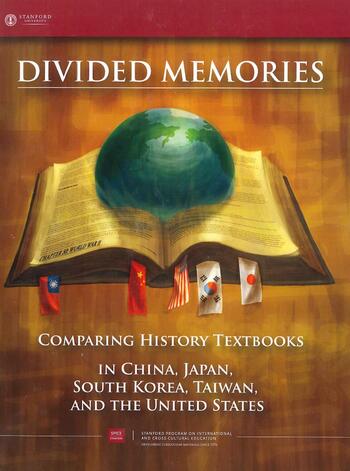
"Formal education is a powerful force in shaping our historical understandings," Sneider noted. "We wanted to look at the textbooks that have the most impact and usage."
A 2014 book, Confronting Memories of World War II: European and Asian Legacies, which was co-edited by Shin, Sneider and Daniel Chirot, a sociologist with the University of Washington, compared successful European WWII reconciliations with lagging Asian efforts. Another book, Divided Lenses, published earlier this year, examined the impact of dramatic film and other forms of popular culture on wartime memory. A new book is due out this summer, Divergent Memories: Opinion Leaders and the Asia-Pacific War, which focuses on leaders in politics, the media and academia in Japan, China, South Korea and the U.S.
The Divided Memories project aims to generate discussions and collaborations among those who create "historical memories" – educators, policymakers and government leaders. One report that grew out of such dialogues included suggestions for reconciliation:
- Create supplementary teaching materials on the issue.
- Launch dialogues among Asian, American and European historians.
- Offer educational forums for journalists, policymakers and students.
- Conduct museum exchanges and create new museums, such as one wholly dedicated to WWII reconciliation in Asia.
- Increase student exchanges among all the countries involved.
History is reflected in today's geopolitics, as noted in the revived disputes by these nations over rival claims to islands in the South China Sea and elsewhere. Without resolution, these disagreements can flare up into military conflicts, Sneider wrote.
"The question of history taps into sensitive and deeply rooted issues of national identity," he noted.
Whether recounting Japanese atrocities in China, China's exaggerated account of its Communist fighters' role in World War II, or the U.S. decision to drop atomic bombs on Japan, no nation is immune to re-creating the past to further its own interests today, Sneider wrote.
For example, Divided Memories research on Chinese textbooks shows how the Chinese government in recent decades embarked on a "patriotic education" campaign to indoctrinate young people by exaggerating its role in Japan's WWII defeat. This narrative suits the nationalistic desires of a Chinese government no longer exclusively motivated by communist ideology, Sneider said.
One project of APARC and its Japan Program that was also an outgrowth of Divided Memories involved Stanford scholars urging Japanese Prime Minister Shinzo Abe to show "clear, heartfelt remorse" in a 2015 speech on the 70th anniversary of the end of WWII. A 15-page report featured hypothetical statements suggesting what Abe might say to make amends for Japanese actions in China and Korea.
"While we cannot claim to have directly influenced the prime minister, his statement did go further in the direction of an expression of remorse over the war and the need to continue to look clearly and honestly at the past than many expected," said Sneider.
Image
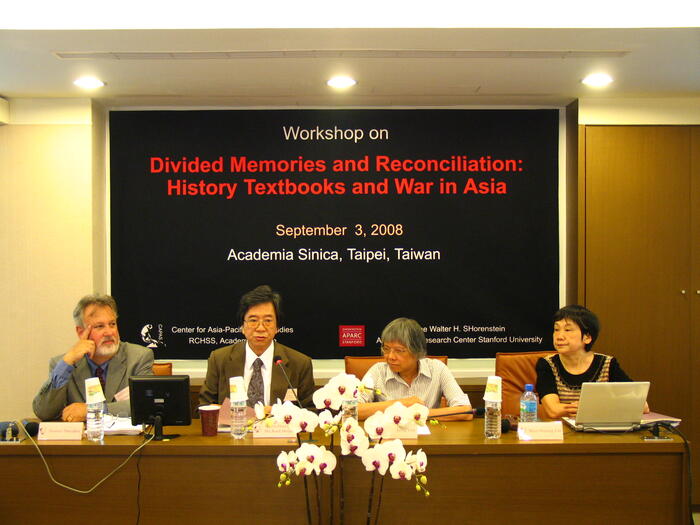
A workshop on history textbooks co-hosted by Shorenstein APARC and Academia Sinica's Center for Asia-Pacific Area Studies takes places in Taipei, Sept. 3, 2008.
Generations and grievances
Consciousness-raising on other fronts, however, is getting results, thanks to Stanford's Divided Memories project. A 2015 landmark agreement between Japan and South Korea over the WWII "comfort women" dispute was reached due to extensive U.S. involvement. Comfort women were women and girls who were forced into sexual slavery by the Imperial Japanese Army in occupied territories before and during World War II.
In an article, Sneider explained how the U.S. perceived that the dysfunctional relationship between South Korea and Japan over this issue, among others, threatened to undermine American strategic interests in Asia.
Shin highlights the importance of U.S. involvement. "The U.S. is not just an outsider to historical and territorial disputes in the region," he said. "From a geopolitical perspective, the U.S. has done a wonderful job in reviving the devastated region into a prosperous one after 1945, but from a historical reconciliation perspective, the U.S. has done a poor job."
He suggests that America should "play a constructive role in promoting historical reconciliation" among the countries involved. And so, the Divided Memories project has included the United States in its efforts.
According to Sneider, Divided Memories is unique among all reconciliation projects for its emphasis on the inclusion of the U.S.; comparative analyses across countries; and real-world policy impacts. As part of the Shorenstein research center, it is housed within Stanford's Freeman Spogli Institute for International Studies.
"This project reflects what Stanford, our center and the Freeman Spogli Institute are all about – true interdisciplinary research and engagement," Sneider said.
Clifton Parker is a writer for the Stanford News Service.
Hero Image

Japanese soldiers in Shanghai, March 23, 1927 | A Stanford project encourages World War II reconciliation and historical accuracy about the conflict and its consequences in Japan, China, Korea, Taiwan and the United States. Progress has been made on classroom textbooks and scholarly discussions and exchanges.
Getty Images
All News button
1
Advancing U.S.-Japan-ROK Trilateral Cooperation: A U.S. Perspective
Paragraphs
An analysis of the foundations and future of the trilateral relationship from a U.S. perspective, highlighting the critical role the United States has played in mediating tensions between the Republic of Korea and Japan.
The essay is also part of an expanded NBR Special Report with co-authors Yul Sohn and Yoshihide Soeya that offers insights into both the past and future of trilateral cooperation and provides recommendations for leaders in all three nations to move relations foward.
All Publications button
1
Publication Type
Policy Briefs
Publication Date
Journal Publisher
National Bureau of Asian Research (NBR)