International Relations

FSI researchers strive to understand how countries relate to one another, and what policies are needed to achieve global stability and prosperity. International relations experts focus on the challenging U.S.-Russian relationship, the alliance between the U.S. and Japan and the limitations of America’s counterinsurgency strategy in Afghanistan.

Foreign aid is also examined by scholars trying to understand whether money earmarked for health improvements reaches those who need it most. And FSI’s Walter H. Shorenstein Asia-Pacific Research Center has published on the need for strong South Korean leadership in dealing with its northern neighbor.

FSI researchers also look at the citizens who drive international relations, studying the effects of migration and how borders shape people’s lives. Meanwhile FSI students are very much involved in this area, working with the United Nations in Ethiopia to rethink refugee communities.

Trade is also a key component of international relations, with FSI approaching the topic from a slew of angles and states. The economy of trade is rife for study, with an APARC event on the implications of more open trade policies in Japan, and FSI researchers making sense of who would benefit from a free trade zone between the European Union and the United States.

Authors
News Type
News
Date
Paragraphs

Jeff Decker knows what war can do to a person. He lived it for four deployments, as an Army special operations squad leader in Iraq and Afghanistan who twice earned the Army Commendation Medal for valorous conduct in combat.

Decker, who now serves as a research assistant in Stanford’s Center for International Security and Cooperation under Joe Felter, is the founder of March on Veteran, an organization that supports veterans suffering from mental health issues, such as post-traumatic stress disorder, or PTSD. March on Veteran is a free, online program available to any former member of the military.

Decker joined CISAC in September, about a year after he launched March on Veteran. Felter, a special forces veteran, is a senior research scholar who studies counterinsurgencies, terrorism and political violence for CISAC.

Decker, after his military service, struggled with the transition to civilian life due to the anger, anxiety, chronic pain, and sleeplessness that PTSD caused. On top of this, he did not have access to a Veteran Affairs treatment facility. That’s when the native of Buffalo, N.Y. turned to self-educating himself on mental health treatments available to veterans.

“When I studied for my doctorate in Australia, I cobbled together a mental health program to help myself. Now I’m sharing that and making those resources available to other veterans with the same needs,” said Decker, who earned his doctorate in international relations from Bond University, where he wrote his dissertation “Enhancing the Effectiveness of Private Military Contractors.”

So far, about 83 veterans have begun March on Veteran’s pilot program, which is a web-based and self-directed study. Decker handles almost all of the human contact. He is currently expanding the program to incorporate the veteran-to-veteran peer element with the help of other veteran volunteers.
Image
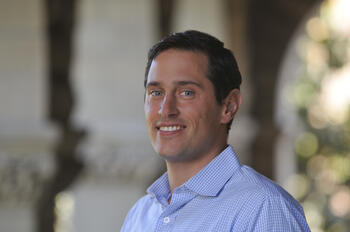
jeff decker

March on Veteran is, as Decker calls it, “support for veterans by veterans.” It is a recovery program personalized to one’s particular needs and is provided by people who have lived experience. It is not affiliated with any government organization like the VA or Department of Defense to maintain the veteran’s confidentiality. Veterans can access the program or sign-up to meet other veterans online.

“This program focuses on trying to help veterans reach their personal goals instead of focusing on ‘fixing’ them,” Decker said. “We are all about improving veteran quality of life, and a big part of that is connecting with other veterans.”

With Felter, Decker will be mostly working on his Hacking for Defense class project, which uses startup methodology to innovate and find solutions for critical challenges facing America’s defense and intelligence agencies.

Before arriving on campus, Decker conducted national security and international affairs research as a RAND Corporation summer associate for two summers in Washington, D.C.

Hero Image
gettyimages 124644169
U.S. Army soldiers salute during the national anthem during the an anniversary ceremony of the 9/11 terrorist attacks on Sept. 11, 2011 at Bagram Air Field, Afghanistan. CISAC research associate Jeff Decker, a former Army veteran, has launched a support group for veterans suffering from mental health issues, such as post-traumatic stress disorder, or PTSD.
John Moore/Getty Images
All News button
1
Authors
News Type
News
Date
Paragraphs

The consequences of state collapse anywhere in the world can be devastating and destabilizing for neighboring and even distant countries.

The complexity of each situation demands a tailored response, according to Stanford scholars embarking on a new American Academy Arts & Sciences project to identify the best policy responses to failing states embroiled in civil wars.

A failed state is that whose political or economic system has become so weak that the government is no longer in control. Such instability has already threatened or affected Syria, Libya, Yemen and other polities.

The project, Civil Wars, Violence and International Responses, is led by Stanford’s Karl Eikenberry and Stephen Krasner. Eikenberry is a faculty affiliate at Stanford’s Center for International Security and Cooperation (CISAC) and the former U.S. ambassador to Afghanistan. Krasner is a faculty member in the political science department and a senior fellow at the Freeman Spogli Institute for International Relations and Hoover Institution.

Other Stanford scholars involved include Francis Fukuyama and Steve Stedman of the Center on Democracy, Development, and the Rule of Law; CISAC's Martha Crenshaw, political scientist James Fearon; Paul Wise of the Center for Health Policy and the Center for Health Policy and the Center for Primary Care and Outcomes Research; and Michele Barry, the senior associate dean for global health at the medical school.

The effort will culminate in a two-volume issue in AAAS’s journal Dædalus. On Nov. 2-4, the academy will hold an authors’ workshop in Cambridge, Mass., to discuss journal content.

Different approaches

In an interview, Eikenberry said the problematic U.S. interventions in Iraq and Afghanistan make it clear that different approaches must be used for different countries.

“The robust counterinsurgency campaign that the U.S. employed for periods of time in both Afghanistan and Iraq was premised on the viability of the standard development model that aims to put countries on the path to economic well-being and consolidated democracy,” he said.

However, such an approach assumes that decision makers in those states have the same objectives as the intervening states, which typically seek to improve the lives of people in those countries, said Eikenbery. Prior to serving as the U.S. ambassador to Afghanistan from 2009 until 2011, Eikenberry had a 35-year career in the U.S. Army, retiring in 2009 with the rank of lieutenant general.

As Krasner points out, when intervention occurs, the hope is that improvements in one area – such as the quality of elections, rule of law, economic growth, or military recognition of civilian authority – would lead to improvements in other areas, according to Eikenberry.

But opposition and a constrained sense of “limited opportunities” can arise to thwart a well-meaning intervention, Eikenberry said.

He added, “Information asymmetries and the absence of mutually compatible interests between national and external elites, make it impossible to put target countries on a rapid path to prosperity and consolidated democracy. External actors must have much more modest goals.”

Syrian consequences

As for the case of Syria, Eikenberry noted that such civil wars can actually become more lethal and dangerous to global order than inter-state conflicts.

These types of conflicts like that in Syria tend to escalate into high levels of violence because of the costs that the losing parties believe they will incur, he said.

“This in turn leads to state fragmentation and the possibility of transnational groups with international ambitions getting involved,” he said. “Civil wars can result in an enormous number of civilian casualties, which generates large scale refugee flows” and puts huge pressure on neighboring states.

Eikenberry said Syria is being “internationalized by entangling regional and great powers in proxy wars,” which is exacerbating that conflict beyond Syria and throughout the greater Middle East. As for the immediate, direct threat to the U.S., that debate still continues, he added. 

On that note, one project goal is to assess risks to other countries that may emanate from civil wars and protracted intrastate violence like that in Syria, Eikenberry said. He and his colleagues will examine the effects of  international terrorism, massive displacements of people, proxy wars that escalate to interstate warfare, criminal organizations that displace governments, and pandemics. 

Policy implications

Eikenberry is hopeful the project influences policy and practice toward countries experiencing civil war and violence.

“Facilitating dialogue among a variety of constituencies with knowledge on the dynamics and impact of civil wars that might not normally or directly interact, including government and military officials, human rights organizations, academic and scholarly experts, and the media, will be one outcome of the project,” he said.

The idea is to allow “new ideas to emerge” regarding how to handle such states, as well as methods of applying such findings, he said.

“Exploring ways to create stability and more lasting peace, taking into consideration voices from academic and practical fields, should prove valuable to the policy community,” Eikenberry said.

Following publication of the volumes, the project will convene international workshops aimed at developing better regional perspectives. Such outreach activities will provide the feedback for the publication of another AAAS paper aimed at informing U.S. and international policy and research on the subject. A series of roundtable discussions in Washington is also planned.


Hero Image
Policy responses to failed states, civil war
Syrians walk amid the rubble of destroyed buildings following air strikes in Douma, Syria, in 2015. Stanford scholars Karl Eikenberry and Stephen Krasner are leading an American Academy Arts & Sciences project that seeks to understand the consequences of civil wars and state collapses and how best to respond to them through policy.
ABD DOUMANY/AFP/Getty Images
All News button
1
Authors
News Type
News
Date
Paragraphs

Three foreign policy experts explored U.S.-China relations in a panel discussion at Stanford earlier this week. In a wide-ranging conversation, they described current relations as often complementary, sometimes conflicting, and above all, unavoidably crucial.

The panel titled “The United States, China and Global Security” included He Yafei, former Chinese ambassador to the United Nations, and Stanford’s Michael Armacost, Shorenstein Distinguished Fellow and former U.S. ambassador, and Karl Eikenberry, a distinguished fellow and former U.S. ambassador to Afghanistan.

Jean Oi, a Stanford professor of political science, moderated the event, which was co-hosted by the China Program and the U.S.-Asia Security Initiative, two entities in the Shorenstein Asia-Pacific Research Center at the Freeman Spogli Institute for International Studies.

“The [U.S.-China] relationship is very complicated and full of complexity,” said He, a career diplomat who was recently appointed as a professor at Peking University.

Shifts in the international system that accompanied the end of the Cold War and China’s rapid growth have brought new demands and necessitated more engagement, He said, weighing the outcomes of “the great convergence,” or closing of the development gap between developed and developing countries, and its impact on the bilateral relationship.

“China has been a major beneficiary of the global system created by the United States,” He said, suggesting it would be unrealistic to assume China would have become the second largest economy without that context, moreover, that Beijing would seek its deterioration.

Uncertainty and the next U.S. administration

China and the United States, as two of the world’s most populous countries, face domestic politics and a range of challenges such as slowed economic growth, population aging and minority and ethnic issues.

“There’s a lot of uncertainty,” Oi said. “As you know, the U.S. presidential election will be taking place quite soon and China itself is going through a period of some uncertainty in its economic development.”

The panelists from the United States offered an optimistic view of the outcome of the presidential election. Armacost, who held a 24-year career in the U.S. government before coming to Stanford, said he foresees consistency in U.S. policy toward China, and more broadly, toward the region, during the next administration.

“Asia is destined to be a huge priority,” Armacost said. Two outstanding areas bound to be “sticking points” on the policy agenda are territorial issues in the South China Sea and international trade, he said. The Trans-Pacific Partnership, a trade agreement between 12 countries of which the United States is a party, has drawn tepid support in the U.S. Congress. And in July, China rejected a ruling by the Permanent Court of Arbitration on maritime rights in a case brought by the Philippines respective to the South China Sea.

Eikenberry shared a similar sentiment about the likelihood of policy continuity from the current U.S. administration to the next, and described the capacity for deepened cooperation between China and the United States as “profound.”

“And we’re already doing it,” he remarked. The Paris Agreement on climate change is one recent testament of the countries’ ability to successfully cooperate and galvanize support for solving global issues, he said.

The panelists agreed that the future of U.S.-China cooperation may well depend on youth, citing surveys of younger generations that show they are more amenable to engaging the other than older generations.

‘Global network of partnerships’

Asked to evaluate the China-Russia relationship, He said the countries have reached a “historic high” in their relationship, underscored by common interests, shared borders and a fraying U.S.-Russia relationship. Russia and China, however, have no intension of forming a formal strategic alliance, he added.

China’s approach to interaction with other countries is based on “a global network of partnerships” focused on trade, cultural exchange and relationships, He said.

The panelists highlighted the importance of striving for more dialogue and consultation between the United States and China on security, an area that is often superseded by economic aspects in bilateral talks.

Concluding the event, Oi emphasized the need for “frank discussions” about the challenges that affect the two countries. During the day, He held closed-door discussions with faculty members, senior research scholars and students focused on East Asia.

Hero Image
uschina relations panel
Stanford professor Jean Oi introduces Ambassadors He Yafei, Michael Armacost and Karl Eikenberry (left to right) at the event, "The United States, China and Global Security," on Oct. 3, 2016.
All News button
1
-

[[{"fid":"225053","view_mode":"crop_870xauto","fields":{"format":"crop_870xauto","field_file_image_description[und][0][value]":"","field_file_image_alt_text[und][0][value]":"","field_file_image_title_text[und][0][value]":"","field_credit[und][0][value]":"","field_caption[und][0][value]":"","field_related_image_aspect[und][0][value]":"","thumbnails":"crop_870xauto"},"type":"media","attributes":{"width":"870","style":"font-size: 13.008px; width: 300px; height: 367px; float: left; margin-right: 15px; margin-top: 60px;","class":"media-element file-crop-870xauto"}}]]


As the Trump administration prepares to take office, it joins with the previous incoming Bush and Obama administrations in promising to improve U.S.-Russian relations. However, both President Bush and Obama left office with relations far worse than when they took office. Andrey Kozyrev, the first Foreign Minister of the newly independent Russian Federation, will discuss his views on the future prospects of the relationship, and examine some of the deep-rooted issues that contribute to current political tensions between our countries.

Andrei Kozyrev is the former Foreign Minister of the Russian Federation. In 1974 he graduated from the Moscow State Institute for International Relations and subsequently earned a degree in Historical Sciences. He joined the Ministry of Foreign Affairs in 1974 and served as head of the Department of International Organizations from 1989-1990. He became the Foreign Minister of the Russian Soviet Federative Socialist Republic in October 1990 and retained his position when the Russian Federation gained independence in 1991.Kozyrev was an early proponent for increased cooperation between the United States and Russia and advocated for the end of the Cold War. He was a participant in the historic decision taken in December 1991 between the leaders of Russia, Belarus, and Ukraine to peacefully dissolve the Soviet Union. As Russia’s first Foreign Minister, Kozyrev promoted a policy of equal cooperation with the newly formed independent states of the former Soviet Union, as well as improved relations with Russia’s immediate neighbors and the West.Kozyrev left the post of Foreign Minister in January 1996, but continued in politics by representing the northern city of Murmansk in the Russian Duma for four years. Since 2000, Kozyrev has lectured on international affairs and served on the boards of a number of Russian and international companies. He is also a distinguished fellow with the Wilson Center’s Kennan Institute.

This event has reached full capacity, please email Magdalena Fitipaldi at magdafb@stanford.edu to get on the waiting list.

This event is co-sponsored by the Center on Democracy, Development and the Rule of Law.

Note location change:

Encina Hall, 2nd Floor

616 Serra St
Stanford, CA 94305


Andrei Kozyrev Former Foreign Minister of Russia
Lectures
-

Please note event's venue has changed to the Philippines conference room

Conditions of Entry:

Valid photo ID required all of attendees

No posters are allowed

No noise makers are allowed

On the surface, Thai-China relations have never been better, as the two countries work to raise their ties to a higher and broader plane. A five-year plan for strategic cooperation now under negotiation covers political, military, and security affairs; multi-sectoral trade and investment; health, education, information, technology, and culture; and regional and multilateral foreign policy. China is comfortable working with the military government that has ruled Thailand since 2014, and vice versa.

Beijing credits the exercise of Chinese “soft power” in Southeast Asia with having improved Thai views of China. Analysts characterize the warming as a new version of Thailand’s old habit of adapting to powerful outsiders by “bending with the wind.” Prof. Pavin will argue that, although the application of soft power has helped China’s cause in Thailand, it is not the main reason for the present warming of ties between the two countries. Indeed, in the long run, Chinese soft power could prove disastrous for Thailand.

Image
pavin4x4
Pavin Chachavalpongpun is currently a visiting scholar at the University of California-Berkeley’s Center for Southeast Asia Studies. He was recently at Stanford as a Lee Kong Chian NUS-Stanford Distinguished Fellow on Contemporary Southeast Asia (2015-16). His many publications include Good Coup Gone Bad: Thailand’s Political Development since Thaksin’s Downfall (edited, 2014); Reinventing Thailand: Thaksin and His Foreign Policy (2010); and A Plastic Nation: The Curse of Thainess in Thai-Burmese Relations (2005). He is the editor of the Kyoto Review of Southeast Asia. His PhD is from the University of London’s School of Oriental and African Studies (2003).

Pavin Chachavalpongpun Associate Professor, Center for Southeast Asian Studies, Kyoto University
Seminars
-

ABSTRACT

By now, those following the news on Syria have been saturated with analysis, data, information, and misinformation on developments there since 2011. Yet we observe an increasing gravitation to mutually exclusive narratives that adorn websites and publications on the situation in Syria: (a) the narrative of pure and consistent revolution versus that of (b) external conspiracy/designs on Syria. Both narratives carry grains of truth, but are encumbered by maximalist claims and fundamental blindspots that forfeit various potentials for enduring cease-fires and/or transitions, let alone mutual understanding. This talk will address these competing narratives in the context of international escalation marked by increasing US-Russian tension and continued multi-layered conflicts on the battlefield. It closes with addressing a framework for understanding and gauging potential prospects despite conflicting declarations by all parties involved.


SPEAKER BIO

Image
unnamed
Bassam Haddad is Director of the Middle East Studies Program and Associate Professor at the School of Policy, Government, and International Affairs (SPGIA) at George Mason University. He is the author of Business Networks in Syria: The Political Economy of Authoritarian Resilience (Stanford University Press, 2011) and Co-Editor of Dawn of the Arab Uprisings: End of an Old Order? (Pluto Press, 2012). Bassam serves as Founding Editor of the Arab Studies Journal a peer-reviewed research publication and is co-producer/director of the award-winning documentary film, About Baghdad, and director of a critically acclaimed film series on Arabs and Terrorism, based on extensive field research/interviews. Bassam is Co-Founder/Editor of Jadaliyya Ezine and the Executive Director of the Arab Studies Institute, an umbrella for five organizations dealing with knowledge production on the Middle East. He serves on the Board of the Arab Council for the Social Sciences and is Executive Producer of Status Audio Journal.


*This event is supported by the Stanford Initiative for Religious and Ethnic Understanding and Coexistence


[[{"fid":"224129","view_mode":"crop_870xauto","fields":{"format":"crop_870xauto","field_file_image_description[und][0][value]":"Bassam Haddad flyer","field_file_image_alt_text[und][0][value]":"","field_file_image_title_text[und][0][value]":"","field_credit[und][0][value]":"","field_caption[und][0][value]":"","field_related_image_aspect[und][0][value]":"","thumbnails":"crop_870xauto"},"type":"media","attributes":{"width":"870","class":"media-element file-crop-870xauto"}}]]

Reuben Hills Conference Room
2nd Floor East Wing E207
Encina Hall
616 Serra Street
Stanford, California 94305

Bassam Haddad Associate Professor George Mason University
Seminars
616 Serra StreetEncina Hall E301Stanford, CA94305-6055
(650) 723-6530
0

Taeho Kim joins Shorenstein APARC as a Visiting Scholar during 2016-2017 academic year.

Kim's research interest is in South Korea's national security issues and preparation for reunification of the Korean Peninsula. He was a National Assembly Member from 2011 to 2016 and governor of South Gyeongsang Province from 2004 to 2010 in Korea. He holds a BA and an MA in agricultural education, and a PhD in education from Seoul National University

Visiting Scholar
News Type
News
Date
Paragraphs

Image
Portrait of Prof. Andrew Walder

Stanford professor Andrew Walder has been awarded the Founder’s Prize from the journal Social Science History for his paper, “Rebellion and Repression in China, 1966-1971.” The journal’s editorial board selects one recipient annually for exemplary scholarly work.

Using data from 2,213 historical county and city annals, the paper charts the breadth of the Chinese Cultural Revolution, its evolution through time and the repression through which state structures were rebuilt in the post-Mao era.

Walder, who is a senior fellow in the Freeman Spogli Institute for International Studies and director emeritus of the Shorenstein Asia-Pacific Research Center, has long studied the sources of conflict, stability and change in communist regimes. He recently published China under Mao, a book that explores the rise and fall of Mao Zedong’s radical socialism.

Hero Image
Portrait of Prof. Andrew Walder
All News button
1
-

Please join us for a book event The Iran Wars: Spy Games, Bank Battles, and the Secret Deals That Reshaped the Middle East with author Jay Solomon, Foreign Affairs Correspondent, The Wall Street Journal. The event will be chaired by Abbas Milani, Director Hamid & Christina Moghadam Program in Iranian Studies.

Please RSVP by Wednesday, October 19 via email to iranianstudies@stanford.edu.

Jay Solomon, Foreign Affairs Correspondent, The Wall Street Journal
Jay Solomon Foreign Affairs Correspondent, The Wall Street Journal

615 Crothers Way,
Encina Commons, Room 128A
Stanford University
Stanford, CA 94305

(650) 721-4052
0
Research Fellow, Hoover Institution
abbas_milani_photo_by_babak_payami.jpg PhD

Abbas Milani is the Hamid and Christina Moghadam Director of Iranian Studies at Stanford University and a visiting professor in the department of political science. In addition, Dr. Milani is a research fellow and co-director of the Iran Democracy Project at the Hoover Institution.

Prior to coming to Stanford, Milani was a professor of history and political science and chair of the department at Notre Dame de Namur University and a research fellow at the Institute of International Studies at the University of California at Berkeley. Milani was an assistant professor in the faculty of law and political science at Tehran University and a member of the board of directors of Tehran University's Center for International Studies from 1979 to 1987. He was a research fellow at the Iranian Center for Social Research from 1977 to 1978 and an assistant professor at the National University of Iran from 1975 to 1977.

Dr. Milani is the author of Eminent Persians: Men and Women Who Made Modern Iran, 1941-1979, (Syracuse University Press, Syracuse, NY, 2 volumes, November, 2008); King of Shadows: Essays on Iran's Encounter with Modernity, Persian text published in the U.S. (Ketab Corp., Spring 2005); Lost Wisdom: Rethinking Persian Modernity in Iran, (Mage 2004); The Persian Sphinx: Amir Abbas Hoveyda and the Riddle of the Iranian Revolution (Mage, 2000); Modernity and Its Foes in Iran (Gardon Press, 1998); Tales of Two Cities: A Persian Memoir (Mage 1996); On Democracy and Socialism, a collection of articles coauthored with Faramarz Tabrizi (Pars Press, 1987); and Malraux and the Tragic Vision (Agah Press, 1982). Milani has also translated numerous books and articles into Persian and English.

Milani received his BA in political science and economics from the University of California at Berkeley in 1970 and his PhD in political science from the University of Hawaii in 1974.

Hamid and Christina Moghadam Director of Iranian Studies
Co-director of the Iran Democracy Project
CDDRL Affiliated Scholar
Date Label
Authors
News Type
News
Date
Paragraphs

When Harold Trinkunas joined CISAC in September, it was like coming home again.

Trinkunas will serve in the concomitant role of senior research scholar and associate director for research. One of the nation’s leading Latin America experts, he comes to CISAC from the Brookings Institution, where he was the Charles W. Robinson Chair and senior fellow as well as director of the Latin America Initiative in the Foreign Policy program.

“This is a great opportunity to work in collaborative ways with exceptional scholars around some very important themes in today’s world,” Trinkunas said, noting the urgency of such issues as risks posed emerging technology, the future of the global order, and international security.

CISAC co-directors Amy Zegart and David Relman wrote in their introduction of Trinkunas that his “leadership will continue to advance the center's mission of training the next generation of international security specialists; developing original policy-relevant scholarship; and extending our outreach to global policymakers to improve the peace and security of our world.”

Evolving global realities

Born and raised in Venezuela, Trinkunas earned his doctorate in political science from Stanford University in 1999 and has been a predoctoral fellow and later a visiting professor at CISAC.  His first exposure to CISAC took place when he served as a teaching assistant to Scott Sagan in 1992.

Image
trinkunas harold

Through the years, CISAC has evolved and adjusted its focus to reflect the global security realities, Trinkunas said. “CISAC has successfully adapted to the changing times since its inception.” Research at CISAC spans such topics, including biosecurity and global health, terrorism, cybersecurity, governance, and nuclear risk and cooperation, to name a few.

Trinkunas is looking forward to the mentoring aspect of working with predocs and postdocs while tapping into the CISAC alumni network to open doors for those rising scholars.

“The Center has developed so many positive connections to scholars, policymakers, foundations, and civil society and the private sector more broadly, both in this country and around the word. One of my goals will be to build on those relationships in a way that’s rewarding for all parties,” said Trinkunas, who also served as an associate professor and chair of the National Security Affairs Department at the Naval Postgraduate School.

Security and governance

His newest book, Aspirational Power: Brazil's Long Road to Global Influence, co-authored with David Mares of UC San Digo, was published this summer by Brookings Institution Press. 

Trinkunas is especially interested in the intersections of security and governance. In his research, he has examined civil-military relations, ungoverned spaces, terrorist financing, emerging power dynamics, and global governance.

“Latin America is the part of the world that I know most about,” he said, adding that the region particularly stands out due to the decreasing number of wars and conflicts between states over the past few decades, even as problems of criminal violence have become more salient.

Part of the reason for region-wide stability, Trinkunas explained, is that democratization led many elected leaders to de-emphasize the role of military responses to interstate disputes in an effort to reduce the importance of the armed forces in domestic politics.

In a region with a history of military dictatorship, many democratic leaders saw their own armed forces as a more significant threat to their permanence in power than their neighbors’ militaries, he said.

In addition, the U.S. foreign policy toward the region has tended to become less interventionist over time and has focused instead on minimizing the use of force as a solution to interstate disputes in the region. Recent efforts to normalize of the U.S.-Cuba relationship are a reflection of this trend, Trinkunas added.


Hero Image
encina CISAC
All News button
1
Subscribe to International Relations