International Relations

FSI researchers strive to understand how countries relate to one another, and what policies are needed to achieve global stability and prosperity. International relations experts focus on the challenging U.S.-Russian relationship, the alliance between the U.S. and Japan and the limitations of America’s counterinsurgency strategy in Afghanistan.

Foreign aid is also examined by scholars trying to understand whether money earmarked for health improvements reaches those who need it most. And FSI’s Walter H. Shorenstein Asia-Pacific Research Center has published on the need for strong South Korean leadership in dealing with its northern neighbor.

FSI researchers also look at the citizens who drive international relations, studying the effects of migration and how borders shape people’s lives. Meanwhile FSI students are very much involved in this area, working with the United Nations in Ethiopia to rethink refugee communities.

Trade is also a key component of international relations, with FSI approaching the topic from a slew of angles and states. The economy of trade is rife for study, with an APARC event on the implications of more open trade policies in Japan, and FSI researchers making sense of who would benefit from a free trade zone between the European Union and the United States.

-

Image
cover pic

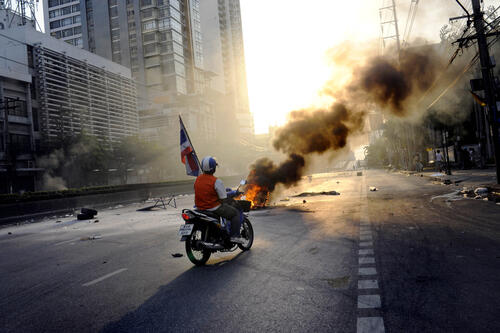
After the Cold War, Thailand became a poster child of democratizing processes in Southeast Asia. Student protests, farmers’ activism, a thriving civil society, and an expanding middle class suggested a model of successful democratic transition. In the last decades, however, many of the forces that supported that process turned sour on electoral politics. Dr. Sopranzettis book will explore how that happened—new class alliances, discourses of corruption and morality, questions of law.  In this context, he will portray Thailand as an experimental space for a new model of authoritarianism, inspired by Beijing and now spreading throughout the region.  The book, Owners of the Maps: Motorcycle Taxi Drivers, Mobility, and Politics in Bangkok, will be available for sale at the talk.


Claudio Sopranzetti is a Postdoctoral Research Fellow at All Souls College at the University of Oxford. He is the author of Owners of the Maps: Motorcycle Taxi Drivers, Mobility, and Politics in Bangkok and he is currently working on Awakened,  an anthropological graphic novel on Thai politics.

Claudio Sopranzetti Postdoctoral Research Fellow, All Souls College, Oxford University
Seminars
-

Come learn about the new China Studies in Beijing program! Professors Andrew Walder and Jean Oi will be there to answer any questions.

During the fall quarter of 2018, faculty from Stanford departments and the Freeman Spogli Institute will offer an intensive program of coursework on contemporary China to a select group of 12 Stanford students. The courses are open to upper-division undergraduates and graduate students. Students from Peking University will also participate in the classes. FSI will cover costs of travel, lodging and other living expenses for all participants.

Find out more on our website.

International Policy Studies Kitchen, ground floor, Encina Hall. 616 Serra Street Stanford, CA

Authors
News Type
News
Date
Paragraphs

This piece originally appeared in Stanford News.

Secretary of State Rex Tillerson visited the Hoover Institution on Wednesday to give a speech on U.S. policies in Syria. He said a continuing presence of U.S. troops in the country is needed to stabilize the area.

In its vision for Syria, the United States wants to see a peaceful, independent country, free of weapons of mass destruction, that could welcome back millions of Syrians displaced by the past years of war, U.S. Secretary of State Rex Tillerson told a Stanford audience on Wednesday.

As part of his prepared policy speech, titled “The Way Forward in Syria,” Tillerson said that in order for that to happen, the conflict between the Syrian people and the regime of Syrian President Bashar al-Assad has to be resolved through diplomatic means, and Assad has to step aside from power. He spoke at the Hoover Institution’s Hauck Auditorium in front of some 265 Stanford students and an additional 100 staff,  faculty members and Hoover fellows, such as former Secretary of State George Shultz.

The event was cosponsored by Hoover and the Freeman Spogli Institute for International Studies (FSI).
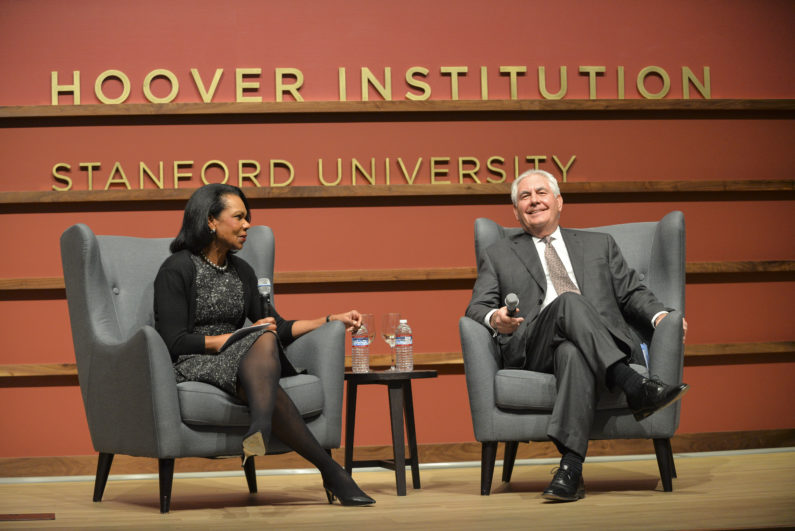
Condoleezza Rice and Rex Tillerson“A stable, unified and independent Syria ultimately requires post-Assad leadership in order to be successful,” Tillerson said.

While acknowledging that some Americans are skeptical of the continued military involvement in Syria, Tillerson said it’s vital for the U.S. be engaged in the area in order to continue fighting terrorist groups and the possibility of their resurgence.

“United States will maintain military presence in Syria, focused on ensuring ISIS cannot re-emerge,” Tillerson said. “Ungoverned spaces, especially in conflict zones, are breeding grounds for ISIS and other terrorist organizations. … The fight against ISIS is not over. … Similarly, we must persist in Syria to thwart al-Qaida, which still has substantial presence and base operations in northwest Syria.”

Tillerson said another major goal of the U.S. in Syria is to prevent Iran from growing its influence in the region, calling the country’s influence “malicious.”

In order to achieve these goals, the U.S. will continue to help de-escalate parts of Syria and to invest in stabilization initiatives, such as clearing unexploded landmines, restoring water and electricity and helping to reopen hospitals and schools, Tillerson said.

Tillerson said the U.S. will continue to work on these efforts and on overall peace negotiations with the United Nations and Russia.

“Once Assad is gone from power, the United States will gladly encourage the normalization of economic relations between Syria and other nations,” Tillerson said. “This process will take time. But we’re patient in the departure of Assad and in the establishment of new leadership.”

After his speech, Tillerson sat down with former Secretary of State Condoleezza Rice, the Denning Professor in Global Business and the Economy at Stanford Graduate School of Business, and a senior fellow at Hoover and at FSI.

As part of the conversation, Tillerson reflected on his upcoming anniversary as secretary of state. He said what he likes most about the job is the quality of the people he works with every day.

“Even if we talk about very complicated issues … the level of intelligence and the level of openness for us to have a good conversation about it is what I most look forward to,” he said.

On the flip side, he said, are the days when he has to deal with the loss of life. “Those are the days that are most difficult.”

In response to Rice’s question about the future of international assistance programs such as the President’s Emergency Plan for AIDS Relief (PEPFAR) and the Millenium Challenge Corporation, Tillerson said the United States’ commitment to provide humanitarian aid will remain but that a conversation over how much other countries contribute in aid is also important.

Tillerson also touched on the latest state of U.S. policies toward North Korea, the topic he discussed on Tuesday during a gathering of foreign ministers in Vancouver. He said that there is growing evidence that the latest tough sanctions against North Korea are working.

“We’ve never had a sanctioned regime that is as comprehensive as this one, and we’ve never had Chinese support for sanctions like we’re getting now,” Tillerson said. “We are committed – as is everyone in the international community – to denuclearize North Korea, and we’re gonna stay on that until we achieve it.”

 

Hero Image
tillerson shultz rice 2
Secretary of State Rex Tillerson meets with former Secretaries of State Condoleezza Rice and George Shultz after speaking with Stanford students about Syria.
Rod Searcey
All News button
1
-

Co-sponsor: Center for African Studies


Abstract:

Join the Center on Democracy, Development, and the Rule of Law (CDDRL) in partnership with the Center for Africa Studies for a rare opportunity to hear from one of Kenya’s leading human rights activists and the former United Nations Special Rapporteur on the Rights to Freedom of Peaceful Assembly and of Association (2011-2017) - Maina Kiai - in conversation with Larry Diamond on Kenya’s 2017 disputed presidential election. This discussion will also reflect on the growing democratic recession in Africa and how Kenya’s recent election has undermined the country's electoral democracy. Maina Kiai is a visiting practitioner at the Levin Center at Stanford Law School this quarter and was a 2007 Draper Hills Summer Fellow at CDDRL.


Speaker Bio:

Image
maina kai
Mr. Maina Kiai was the United Nations Special Rapporteur on the rights to freedom of peaceful assembly and of association from May 2011 until April 2017. A lawyer trained at Nairobi and Harvard Universities, Mr. Kiai has spent the last twenty years campaigning for human rights and constitutional reform in Kenya – notably as founder and Executive Director of the unofficial Kenya Human Rights Commission, and then as Chairman of Kenya’s National Human Rights Commission (2003-2008), where he won a national reputation for his courageous and effective advocacy against official corruption, in support of political reform, and against impunity following the violence that convulsed Kenya in 2008, causing thousands of deaths. From July 2010 to April 2011, Mr. Kiai was the Executive Director of the International Council on Human Rights Policy, a Geneva-based think-tank which used to produce research reports and briefing papers with policy recommendations. Mr. Kiai was also the Director of Amnesty International’s Africa Programme (1999-2001), and the Africa Director of the International Human Rights Law Group (now Global Rights, 2001-2003). He held research fellowships at the Danish Institute for Human Rights (Copenhagen), the Woodrow Wilson International Center for Scholars (Washington), and the TransAfrica Forum (Washington). Mr. Kiai has regularly been an advocate informing and educating Kenyans through various media about their human rights.


Speaker Bio:

Image
larry diamond 1
Larry Diamond is a senior fellow at the Hoover Institution and at the Freeman Spogli Institute for International Studies. For more than six years, he directed FSI’s Center on Democracy, Development, and the Rule of Law, and he continues to lead its programs on Arab Reform and Democracy and Democracy in Taiwan. He is the founding co-editor of the Journal of Democracy and also serves as Senior Consultant at the International Forum for Democratic Studies of the National Endowment for Democracy. His sixth and most recent book, In Search of Democracy (Routledge, 2016), explores the challenges confronting democracy and democracy promotion, gathering together three decades of his work on democratic development, particularly in Africa and Asia.  He has also edited or co-edited more than 40 books on democratic development around the world.


Maina Kiai Human Rights Activist, former United Nations Special Rapporteur on the rights to freedom of peaceful assembly and of association

CDDRL
Stanford University
Encina Hall, C147
616 Jane Stanford Way
Stanford, CA 94305-6055

(650) 724-6448 (650) 723-1928
0
Mosbacher Senior Fellow in Global Democracy at the Freeman Spogli Institute for International Studies
William L. Clayton Senior Fellow at the Hoover Institution
Professor, by courtesy, of Political Science and Sociology
diamond_encina_hall.png MA, PhD

Larry Diamond is the William L. Clayton Senior Fellow at the Hoover Institution, the Mosbacher Senior Fellow in Global Democracy at the Freeman Spogli Institute for International Studies (FSI), and a Bass University Fellow in Undergraduate Education at Stanford University. He is also professor by courtesy of Political Science and Sociology at Stanford, where he lectures and teaches courses on democracy (including an online course on EdX). At the Hoover Institution, he co-leads the Project on Taiwan in the Indo-Pacific Region and participates in the Project on the U.S., China, and the World. At FSI, he is among the core faculty of the Center on Democracy, Development and the Rule of Law, which he directed for six and a half years. He leads FSI’s Israel Studies Program and is a member of the Program on Arab Reform and Development. He also co-leads the Global Digital Policy Incubator, based at FSI’s Cyber Policy Center. He served for 32 years as founding co-editor of the Journal of Democracy.

Diamond’s research focuses on global trends affecting freedom and democracy and on U.S. and international policies to defend and advance democracy. His book, Ill Winds: Saving Democracy from Russian Rage, Chinese Ambition, and American Complacency, analyzes the challenges confronting liberal democracy in the United States and around the world at this potential “hinge in history,” and offers an agenda for strengthening and defending democracy at home and abroad.  A paperback edition with a new preface was released by Penguin in April 2020. His other books include: In Search of Democracy (2016), The Spirit of Democracy (2008), Developing Democracy: Toward Consolidation (1999), Promoting Democracy in the 1990s (1995), and Class, Ethnicity, and Democracy in Nigeria (1989). He has edited or coedited more than fifty books, including China’s Influence and American Interests (2019, with Orville Schell), Silicon Triangle: The United States, China, Taiwan the Global Semiconductor Security (2023, with James O. Ellis Jr. and Orville Schell), and The Troubling State of India’s Democracy (2024, with Sumit Ganguly and Dinsha Mistree).

During 2002–03, Diamond served as a consultant to the US Agency for International Development (USAID) and was a contributing author of its report, Foreign Aid in the National Interest. He has advised and lectured to universities and think tanks around the world, and to the World Bank, the United Nations, the State Department, and other organizations dealing with governance and development. During the first three months of 2004, Diamond served as a senior adviser on governance to the Coalition Provisional Authority in Baghdad. His 2005 book, Squandered Victory: The American Occupation and the Bungled Effort to Bring Democracy to Iraq, was one of the first books to critically analyze America's postwar engagement in Iraq.

Among Diamond’s other edited books are Democracy in Decline?; Democratization and Authoritarianism in the Arab WorldWill China Democratize?; and Liberation Technology: Social Media and the Struggle for Democracy, all edited with Marc F. Plattner; and Politics and Culture in Contemporary Iran, with Abbas Milani. With Juan J. Linz and Seymour Martin Lipset, he edited the series, Democracy in Developing Countries, which helped to shape a new generation of comparative study of democratic development.

Download full-resolution headshot; photo credit: Rod Searcey.

Former Director of the Center on Democracy, Development and the Rule of Law
Faculty Chair, Jan Koum Israel Studies Program
Date Label
Senior fellow at the Hoover Institution and at the Freeman Spogli Institute for International Studies
Panel Discussions
-

Over the last dozen years, Taiwan’s democracy has deepened in important ways. Executive power has rotated twice, from the DPP’s Chen Shui-bian to the KMT’s Ma Ying-jeou in 2008, and from Ma to the DPP’s Tsai Ing-wen in 2016. The majority in the legislature also changed for the first time in 2016, from the KMT to the DPP. Taiwan’s most recent overall Freedom House ranking is 93/100, significantly higher than the United States. Its freedom of the press ranking is the highest in all of Asia, ahead of Korea and even Japan, and its rule of law and anti-corruption scores are trending in a positive direction as well.

To be sure, serious concerns remain about the practice of democracy in Taiwan, including a poorly institutionalized and often chaotic lawmaking process, incomplete legislative oversight of executive branch actions, and a partisan and increasingly fragmented media environment. Nevertheless, the greatest threat to Taiwan’s continued place among the world’s liberal democracies now appears to be external, not internal. The People’s Republic of China (PRC) has always posed an existential threat to Taiwan, but its growing economic influence, rapid military modernization, assertive territorial claims in the region, and aggressive global efforts to isolate Taiwan have accelerated in recent years. Put simply, Taiwan’s long-term future as a democracy is imperiled by China’s rise.

The PRC’s growing power presents difficult security challenges for most of the countries in the Asia-Pacific region, not just for Taiwan. But these challenges are rarely considered from a multi-lateral perspective—most analyses of regional security issues instead tend to focus on bilateral or trilateral (US-China-Country X) relationships. This pattern is particularly common in discussions of Taiwan’s security, where the dominant focus is on Cross-Strait and US-Taiwan relations to the neglect of Taiwan’s other relationships in the region.

The goals of this workshop, then, are to place Taiwan’s security challenges in a broader, regional context, to consider possible obstacles to and opportunities for greater regional cooperation on security issues, and to devise a set of recommendations for Taiwan and its partners and allies. Workshop participants will include experts on a wide array of economic, diplomatic, and security topics from Taiwan, the United States, and elsewhere in the Asia-Pacific region.


Remarks are Off-the-Record.  Recording, reporting and citation of remarks is strictly prohibited.

AGENDA

Monday, March 5 - Koret-Taube Conference Center, John A. and Cynthia Fry Gunn Building

9:00-9:30am CONTINENTAL BREAKFAST

9:30-9:45am OPENING REMARKS
Larry Diamond, Senior Research Fellow, Center on Democracy, Development, and the Rule of Law
Karl Eikenberry, Director, U.S.-Asia Security Initiative, Asia-Pacific Research Center

9:45am – 11:30am: PANEL I.
Assessment of US Alliances and the Political and Military Situation in the Western Pacific
Chair: Tom Fingar (APARC, Stanford)
• Overview of Military Trends and US Strategy in Region. Karl Eikenberry (APARC, Stanford)
• US-Taiwan Relations. Robert Wang (Center for Strategic and International Studies)
• US-Japan Relations. TJ Pempel (UC Berkeley)
• US-Korea Relations. Kathy Stephens (APARC, Stanford)

11:30am-1:00pm LUNCH
Keynote Speaker: Robert Sutter (George Washington University) - "Will Trump administration advance support for Taiwan despite China's objections?"

1:15pm-3:00pm: PANEL II.
Trade and Economic Relations in the Western Pacific
Chair: Phillip Lipscy (APARC, Stanford)
• Regional Trade Agreements after TPP: RCEP vs TPP-11. Barbara Weisel (former Assistant US Trade Representative for SE Asia and the Pacific)
• China’s Institution-Building: OBOR, Maritime Silk Road, AIIB. Amy Searight (Center for Strategic and International Studies)
• Taiwan’s New Southbound Policy. Russell Hsiao (Global Taiwan Institute)

3:15-5:00pm: PANEL III.
Maritime Security Issues: The South and East China Seas
Chair: Karl Eikenberry (APARC, Stanford)
• Interpreting Chinese Maritime Strategy in the South China Sea, Don Emmerson (APARC, Stanford)
• China’s Maritime Militia. Andrew Erickson (Naval War College)
• Evolution of US Policy: FONOPS and Beyond. Dale Rielage (Captain, US Navy)
• Taiwan’s Role in Maritime Security Issues. Yeong-Kang Chen, (Admiral (Ret.), ROC Navy)


Tuesday, March 6 - McCaw Hall, Stanford Alumni Center

9:00-9:30am CONTINENTAL BREAKFAST

9:30-11:15am: PANEL IV.
Taiwan’s Key Asian Relations
Chair: Kharis Templeman (APARC, Stanford)
• A Taiwanese Perspective on Asian Relations. Lai I-chung (Prospect Foundation)
• NE Asia, Yeh-chung Lu (National Chengchi University)
• SE Asia, Jiann-fa Yan (Chien Hsin University of Science and Technology)

11:30-1:15pm: PANEL V.
Cross-Strait Relations
Chair: Larry Diamond
• The Domestic Politics of Security in Taiwan. Kharis Templeman (APARC, Stanford)
• Beijing’s Taiwan Policy after the 19th Party Congress. Alice Miller (Hoover Institution)
• US Role in the Trilateral Relationship. Raymond Burghardt (former chairman, American Institute in Taiwan)

1:15am-2:15pm LUNCH

March 5: Koret-Taube Conference Center, Gunn–SIEPR Building, 366 Galvez Street, Stanford, CA 94305

March 6: McCaw Hall, Frances C. Arrillaga Alumni Center, 326 Galvez St, Stanford, CA 94305

Conferences

Shorenstein APARC
Stanford University
Encina Hall E301
Stanford, CA 94305-6055

(650) 724-5667
0
rsd18_095_0131a_nr.jpg DPhil

Noa Ronkin joined APARC in 2018 and serves as the Center’s associate director for communications and external relations. She collaborates with the Center’s leadership to bring the work and expertise of APARC faculty and researchers to audiences including policymakers, industry leaders, and academics in the United States and in Asia. She also assists APARC programs to meet their goals and research mission.

Noa started her career at Stanford as a postdoctoral teaching fellow with the University’s freshman liberal arts program Introduction to the Humanities and later served as associate director of the McCoy Center for Ethics in Society. She subsequently worked as a fundraiser and communications manager at the software-for-good nonprofit Benetech and ran a communications and content marketing consultancy.

Noa earned her DPhil in Buddhist Studies from the University of Oxford, and her MA in Philosophy and a dual BA in Philosophy and Psychology from Tel Aviv University. She is the author of Early Buddhist Metaphysics: The Making of a Philosophical Tradition (Routledge, 2005) and of several articles on the Theravada Buddhist Abhidhamma tradition.


Associate Director for Communications and External Relations
News Type
News
Date
Paragraphs

Secretary Norman Y. Mineta is a person of many firsts. He was the first Asian-American mayor of a major city, San Jose, California; the first Japanese American from the mainland to be elected to Congress; and the first Asian American to serve in a presidential cabinet. Mineta served as President Bill Clinton’s Secretary of Commerce and President George W. Bush’s Secretary of Transportation. SPICE is honored to be collaborating with Mineta and Bridge Media, Inc., on making Mineta’s legacy more broadly known at the secondary and collegiate levels through the Mineta Legacy Project (MLP). The MLP will include a documentary and educational curriculum that are being developed with Mineta’s full involvement.

The documentary, titled An American Story: Norman Mineta and His Legacy, “delves into Mineta’s life, public service career, and unabashed love for his country… this, in spite of the fact that in 1942 his country betrayed him,” note producers Dianne Fukami and Debra Nakatomi.

Presidents Clinton and Bush were recently interviewed for the documentary and educational curriculum. “[Mineta’s] family was in a Japanese internment camp in World War II, and it could have made him bitter, angry,” commented President Clinton, “but instead he used that…to deepen his own commitment; to make sure that people weren’t discriminated against or held back or held down. In that sense, he represents the very best of America.”

This quote will be one of many presented to students in the educational curriculum, which pivots around the essential question, “What does it mean to be an American?” When asked this question, President Bush referred not only to key values such as freedom of speech and freedom of religion, but also to a sense of decency in the public square and to the nation’s communities of compassion. “It means that we care about each other. One of the real strengths of America [are] what I would call the ‘armies of compassion’…people in their communities who set up programs to feed the hungry or find shelter for the homeless, without the government telling them what to do.” He also referred to the United States’ long history of immigration, and said that being an American means recognizing that “although, on the one hand, we ought to enforce our laws, [on the other hand] we ought to welcome immigrants in a legal fashion, because immigrants reinvigorate our soul.”

Beyond Mineta’s groundbreaking achievements, Mineta epitomizes the dreams and aspirations of youth. He is the son of immigrants and his family was forcibly removed from his home to spend years in an internment camp for Japanese Americans during World War II. And yet, he remains a patriot, has led with integrity to achieve a long and distinguished career as a public servant, and continues to champion the underserved and mentor students.

The educational curriculum is being developed by Rylan Sekiguchi of SPICE in consultation with Fukami and Nakatomi and is targeted to high school and college educators and students. The curriculum will be offered free on the MLP and SPICE websites and is being developed in coordination with the documentary. The standards-aligned lesson plans will highlight six key themes connected to the life of Secretary Mineta—immigration, civil liberties & equity, civic engagement, justice & reconciliation, leadership & decision-making, and U.S.–Japan relations—and ask students to examine them in both historical and current-day contexts. Mineta himself has underscored the enduring relevance of these themes in U.S. society, for example drawing parallels between the Japanese-American experience following the Pearl Harbor attack in 1941 and the Arab-American and Muslim-American experience following 9/11. As our country debates contentious topics such as deportations, immigration bans and restrictions, surveillance, and registries, the lessons learned from Mineta’s life can help us.

To stay informed of SPICE-related news, follow SPICE on Facebook and Twitter.


Hero Image
mlp team with bush manual rotate 360
President George W. Bush with Producers Dianne Fukami (fourth from left) and Debra Nakatomi (third from right) and Rylan Sekiguchi (far right)
Mineta Legacy Project
All News button
1
-

Making Money: How Taiwanese Industrialists Embraced the Global Economy is a record of a thirty-year research project that Gary G. Hamilton and Kao Cheng-shu began in 1987.  A distinguished sociologist and university administrator in Taiwan, Kao and his research team (which included Prof. Hamilton during his frequent visits to Taiwan) interviewed over 800 owners and managers of Taiwanese firms in Taiwan, China, and Vietnam.  Some were re-interviewed over ten times during this period.  The length of this project allows them a vantage point to challenge the conventional interpretations of Asian industrialization and to present a new interpretation of the global economy that features an enduring alliance between, on the one hand, American and European retailers and merchandisers and, on the other hand, Asian contract manufacturers, with Taiwanese industrialists becoming the most prominent contract manufacturers in the past forty years.


Image
Gary Hamilton
Gary G. Hamilton is a Professor Emeritus of International Studies and Sociology at the University of Washington.  He specializes in historical/comparative sociology, economic sociology, with a special emphasis on Asian societies. He is an author of numerous articles and books, including most recently Emergent Economies, Divergent Paths, Economic Organization and International Trade in South Korea and Taiwan (with Robert Feenstra) (Cambridge University Press, 2006), Commerce and Capitalism in Chinese Societies (London: Routledge, 2006), The Market Makers: How Retailers Are Changing the Global Economy (co-editor and contributor, Oxford University Press, 2011; paperback 2012), and Making Money: How Taiwanese Industrialists Embraced the Global Economy (with Kao Cheng-shu, Stanford University Press, 2018).


This event is organized by the Taiwan Democracy and Security Project, part of the U.S.-Asia Security Initiative at Shorenstein APARC. Formerly the Taiwan Democracy Project at CDDRL.

Gary G. Hamilton <i>Professor Emeritus of International Studies and Sociology, University of Washington</i>
Lectures
-

Abstract:

In Navigation by Judgment (Oxford University Press, 2018) I argue that high-quality implementation of foreign aid programs often requires contextual information that cannot be seen by those in distant headquarters. Tight controls and a focus on reaching pre-set measurable targets often prevent front-line workers from using skill, local knowledge, and creativity to solve problems in ways that maximize the impact of foreign aid. Drawing on a novel database of over 14,000 discrete development projects across nine aid agencies and eight paired case studies of development projects, I argue that aid agencies will often benefit from giving field agents the authority to use their own judgments to guide aid delivery. This “navigation by judgment” is particularly valuable when environments are unpredictable and when accomplishing an aid program’s goals is hard to accurately measure.


Speaker Bio:

Image
honig daniel
Dan is an Assistant Professor of International Development at Johns Hopkins School of Advanced International Studies (SAIS). His research focuses on the relationship between organizational structure, management practice, and performance in developing country governments and organizations that provide foreign aid. Dan has also held a variety of positions outside the academy. He was special assistant, then advisor, to successive Ministers of Finance (Liberia); ran a local nonprofit focused on helping post-conflict youth realize the power of their own ideas to better their lives and communities through agricultural entrepreneurship (East Timor); and has worked in a wider range of countries (longer stints in India, Israel, Thailand; shorter in Somalia, South Sudan) for international NGOs, local NGOs, aid agencies, and developing country governments. A proud Detroiter, Dan holds a BA from the University of Michigan and a Ph.D. from Harvard's Kennedy School of Government.

Daniel Honig Assistant Professor of International Development at Johns Hopkins School of Advanced International Studies (SAIS)
Seminars
Subscribe to International Relations