Paragraphs

How and when can religious times become focal points for communal violence? In the context of Hindu-Muslim riots in India, I argue that incompatible ritual holidays where one religion's rituals are at odds with the other religion (e.g. sacrificing cows or engaging in processions with idolatry) explains the positive effect of sacred time on religious rioting. Holidays with incompatible rituals provide doctrinal differences that make riots more likely. I provide support for this argument by (1) analyzing riot data across 100 years of Hindu-Muslim riots, (2) exploring individual-level surveys responses on holidays, and (3) describing the way different holiday rituals play a role in violence. By focusing on the content of religion, this paper demonstrates how particular religious holidays can provide the underlying conditions that riot entrepreneurs use to incite religious violence.

All Publications button
1
Publication Type
Working Papers
Publication Date
Journal Publisher
CDDRL Working Papers
Authors
Authors
News Type
News
Date
Paragraphs

Indian politician Rahul Gandhi offered his perspectives on challenges to India’s democracy amid global transitions during a talk on May 31 at Stanford University.

“It’s in times like this, of great uncertainty and of turbulence, that you need acts of imagination,” he said during his address, "The New Global Equilibrium," which was sponsored by the Center on Democracy, Development and the Rule of Law (CDDRL), part of Stanford's Freeman Spogli Institute for International Studies (FSI).

Gandhi highlighted global innovations in mobility, energy systems, and artificial intelligence and big data, or connectivity. “They’re going to affect everything” in India and elsewhere.

Gandhi is a former member of the Indian Parliament, who represented the constituencies of Amethi, Uttar Pradesh, and Wayanad, Kerala in the Lok Sabha. He is a member of the main opposition party, the Indian National Congress, and was the party president from December 2017 to July 2019.

Gandhi reminisced about the ‘Unite India March,’ a democratic-inspired walk he led across the country that started with 125 people in September 2022 and ended with millions of people joining the 2,540-mile journey. And, although the ruling government had all the “force,” the instruments of control in society, the marchers were never stopped, he noted.

“This was a question that just kept rotating in my mind,” Gandhi said. “They have the force, but they don’t have power, and I realized that force and power are two completely different things. Most politicians confuse force and power, and they think they're the same thing. They’re completely different things. Power is an act of imagination, always in the present, and it is not linear. And power comes when you go close to the truth. That’s why we could not be stopped by force.”

Most politicians confuse force and power, and they think they're the same thing. They’re completely different things. Power is an act of imagination, always in the present, and it is not linear. And power comes when you go close to the truth.
Rahul Gandhi
Former President, Indian National Congress

He compared this to other moments of “power” in history, such as when President Kennedy said, ‘let’s go to the moon,’ or when Mahatma Gandhi stood up to the British Empire colonial powers in India, and when the American colonists created the Declaration of Independence to start separating from Britain.

Gandhi said acts of “force” did not drive these historical turning points; rather, they revealed the magnitude of the power of imagination that potentially exists among people to create a better, more just, and visionary world.

Such visioning needs to also inspire and transform the U.S.-India relationship, he believes.

“We already have a bridge between us, and it’s important that this bridge is not simply a bridge based on force, but that it is a bridge based on understanding of the realities of both our people,” said Gandhi, noting the software and technical skills of the Indian people in general match up extremely well with the leading-edge technology systems and markets in the U.S.

Dinsha Mistree and Rahul Gandhi
Rahul Gandhi (R) in conversation with CDDRL affiliated scholar Dinsha Mistree (L) during a speaking engagement at Stanford University on May 31, 2023. | Basil Raj Kunnel

U.S. Relationship, Manufacturing, China


After his remarks, Gandhi engaged in an audience Q&A and conversation with Dinsha Mistree, an affiliated scholar with CDDRL. Gandhi elaborated that the political disconnect in India is attributable to a concentration of wealth, inequality throughout society, the current political system, and technology that’s outpacing the ability of social systems and people to digest and manage all the connectivity.

“With social media and technology, there’s a bit of a lag between the political system and technological progress, and I think democracies are struggling with that. I think evolution in the systems is going to take some time, but it’ll happen,” he said.

With social media and technology, there’s a bit of a lag between the political system and technological progress, and I think democracies are struggling with that. I think evolution in the systems is going to take some time, but it’ll happen.
Rahul Gandhi
Former President, Indian National Congress

On economics, Gandhi said that while China’s Belt and Road Initiative, a massive infrastructure project that aims to stretch around the globe and seems to promote prosperity, it’s ultimately a non-democratic and authoritarian vision of the world. More visioning needs to be done by leading democratic countries on what prosperity entails for societies that may not be as wealthy as others.

“What’s the counter vision? So that’s where I see the gap. Of course, there is military cooperation (with the U.S.). That’s important. But it can’t just be military cooperation,” he said.

As for China, their top-down manufacturing policies are a challenge for democratic countries like India. Gandhi recommends that India follows a more decentralized manufacturing process.

“You cannot simply ignore the manufacturing might of China. You have to compete with. I don’t think it’s an option. So, what does that competition look like? I’m not talking about conflict, I’m talking about competition. How do we create an alternative vision?” he said, adding that it was a “fatal mistake” for the U.S. to parcel out its manufacturing in recent decades to China.

In response to an audience question on India’s position of formal neutrality in the Ukraine-Russia war, Gandhi said, “We have a relationship with Russia, and we have certain dependencies on Russia. So, I would have a very similar stance as the government of India. I mean, it might not be popular, but it is what it is. At the end of the day, we have to also look out for our interests.”

A packed auditorium of nearly 600 people gathered to hear Mr. Gandhi speak
A packed auditorium of nearly 600 people gathered to hear Mr. Gandhi speak. | Basil Raj Kunnel

Democracy and Political Opposition


Mistree shared in an email prior to the event that Gandhi believes that India and the U.S. could work together in better ways on trade and economics.

For example, Gandhi’s view is that India could become a manufacturing powerhouse, which is a departure from the current ruling party’s position, while the U.S. continues to innovate and turns to India for more of its manufacturing needs, Mistree said.

“There’s a lot of space for these two countries to work much more closely together,” he said, adding that the Indian diaspora in America represents the second largest immigrant group in the country right now, and both countries share common security challenges in Asia.

Larry Diamond, Mosbacher Senior Fellow in Global Democracy at FSI, noted that Gandhi is the leader of the most important opposition party in India.

“You can’t have a democracy unless you have a political opposition that is free to criticize the ruling party, and contest for power. He has also been questioning directly the concentration and abuse of power by the current government,” Diamond wrote in an email prior to Gandhi’s talk.

Diamond added that U.S. and India have important, economic and strategic interests that should move forward in partnership based on their own logic.

“We need to hear and take seriously the concerns of political opposition and civil society in India, and we need to make clear to the Indian government that violations of basic democratic standards present obstacles to the deepening of U.S.-Indian ties,” Diamond said.

We need to hear and take seriously the concerns of political opposition and civil society in India, and we need to make clear to the Indian government that violations of basic democratic standards present obstacles to the deepening of U.S.-Indian ties.
Larry Diamond
Mosbacher Senior Fellow in Global Democracy, FSI

Gandhi was on a six-day visit to the United States to interact with the Indian diaspora and express his party’s commitment to democratic values in India and across the world.

He said, “There are difficult times, but there are also times of opportunity. I think there are times when acts of imagination and acts of true power will resonate and can transform the way we think of ourselves.”

Rahul Gandhi takes photos with fans following his talk at Stanford University
Rahul Gandhi takes photos with fans following his talk at CEMEX Auditorium. | Basil Raj Kunnel

For additional coverage of this event, read "Rahul Gandhi emphasizes role of technology, imagining in India’s future," by Amina Wase in The Stanford Daily.

Read More

President Petro and Alberto Diaz-Cayeros
News

Colombian President Gustavo Petro Urges Transition to Green Energy

The event, which was largely student-driven, aimed to foster dialogue on how the Stanford community can engage with Latin America.
Colombian President Gustavo Petro Urges Transition to Green Energy
Michael McFaul, Oriana Skylar Mastro, Ken Jimbo, Kiyoteru Tsutsui, Larry Diamond, and Francis Fukuyama speaking at the Yomiuri Conference, Tokyo.
News

Stanford Experts Explore the Roles of Taiwan and Ukraine in Countering Autocratic Challenges to Democracy

At the Yomiuri International Conference, Freeman Spogli Institute scholars Larry Diamond, Francis Fukuyama, Oriana Skylar Mastro, Michael McFaul, and Kiyoteru Tsutsui examined lessons from the war in Ukraine, the risks of a crisis over Taiwan, and the impacts of both geopolitical flashpoints for defending democracy and for a coordinated approach to deterrence in the Indo-Pacific.
Stanford Experts Explore the Roles of Taiwan and Ukraine in Countering Autocratic Challenges to Democracy
Hero Image
Rahul Gandhi
Rahul Gandhi speaks at Stanford University on May 31, 2023.
Basil Raj Kunnel
All News button
1
Subtitle

Rahul Gandhi, an Indian politician and former president of the Indian National Congress, delivered a speech at Stanford University on May 31, emphasizing the power of imagination in overcoming challenges to India's democracy. Gandhi also discussed the need for a stronger U.S.-India relationship, addressed the impact of technological progress, and highlighted the importance of competition with China in manufacturing.

-
Global Perspectives of Caste and Race within UN Mechanisms

Ms. Ashwini K.P. (currently the UN Special Rapporteur on contemporary forms of racism, racial discrimination, xenophobia and related intolerance) will primarily focus on the analysis of race and caste within UN mechanisms in this talk. She will also focus on the history and the current situation of the process and the manner in which caste and race have been addressed within UN mechanisms.

This talk will be moderated by Prem Pariyar, Human Relations Commissioner in Alameda County. 

This event is co-sponsored by the Center for South Asia, the Program in International and Comparative Law in Stanford Law School,  and the Haas Center for Public Service.


Image
Ashwini K.P.

Ms. Ashwini K.P. is an activist and an academic. She has previously worked as an assistant professor at the Department of Political Science of St. Joseph’s College in Indiaserved as an assistant professor of Political Science. She has also worked with several civil society organizations and international human rights organizations. She is a co-founder of the civil society organization, Zariya: Women’s Alliance for Dignity and Equality. As part of her research and activism, she has focused on policies related to marginalized communities, in particular to support their livelihood and access to education. She has focused on social exclusion, particularly descent and occupation based discrimination in South Asia. Ms. Ashwini K.P. is currently the Special Rapporteur on contemporary forms of racism, racial discrimination, xenophobia and related intolerance. Ms. Ashwini K.P. has represented Indian Dalit women in various civil society groups helping them in strategizing on how to ensure that women from marginalised communities are empowered and are in decision-making roles in activism and mainstream social movements. Ms. Ashwini intends to work on overall empowerment of marginalized communities particularly with special focus on Dalit, Adivasi, minorities, and other marginalized communities.

This event is in-person only. Registration is required and may be capped once at capacity
 

Encina Commons, 123 615 Crothers Way, Stanford, CA 94305

Ashwini K.P.
News Feed Image
ashwini
Paragraphs
Building resilient inter-ethnic peace: Hindus and Muslims in South Asia

A key challenge that many nations face in the 21st century is to build societies that not only are able to peacefully accommodate increasing ethnic diversity but also to leverage its potential benefits. This is not a straightforward task. Ethnically diverse communities tend to provide fewer public goods to their citizens (e.g. Alesina et al. 2004, Alesina and La Ferrara 2005) and are less likely to voice common priorities (e.g. Ban et al. 2012). With ethnic identities often coordinating political competition as well, it is perhaps not surprising that violent conflict is more likely in ethnically polarised countries and regions (e.g. Montalvo and Reynal-Querol 2005, Esteban et al. 2012, Jha 2023 and Figure 1). With 82.1 million people around the world forcibly displaced due to persecution and conflict in 2020, and widespread economic migration, the challenge of building resilient inter-ethnic peace is one faced not only by societies that have been diverse historically but increasingly in nations and communities with less experience navigating a diverse setting.

What can economic theory, in combination with the historical experiences of these communities, tell us about the necessary conditions for resilient inter-ethnic peace, and how these can be fostered?


This book presents a synthesis of key recent advances in political-economy research on the various approaches and strategies used in the process of building nations throughout modern history. It features chapters written by leading scholars who describe the findings of their quantitative analyses of the risks and benefits of different nation-building policies. The book is comprised of 26 chapters organized into six sections, each focusing on a different aspect of nation-building. The first chapter presents a unified framework for assessing nation-building policies, highlights potential challenges that may arise, provides a summary of each of the other chapters, and draws out the main lessons from them. The following chapters delve into the importance of social interactions for national identification, the role of education, propaganda and leadership, external interventions and wars, and the effects of representation and redistribution. The book offers a nuanced understanding of effective nation-building policies.

All Publications button
1
Publication Type
Book Chapters
Publication Date
Subtitle

Chapter in Nation Building: Big Lessons from Successes and Failures, edited by Dominic Rohner and Ekaterina Zhuravskaya

Authors
Saumitra Jha
Book Publisher
CEPR Press
-
Kashmir After 370 event card with Photo of Anuradha Bhasin

On 5 August 2019, with no warning, the Indian government abrogated Article 370 of the constitution, which had earlier given the state of Jammu and Kashmir a degree of political autonomy from the central government. Jammu and Kashmir became a Union Territory, under closer control from New Delhi. The change in political status was accompanied by an increase in the already heavy security presence, as well as curfews and information black-outs. Years later, how has the abrogation of Article 370 changed the ground reality in Kashmir? This webinar will explore the impact of the political change on the ground reality for local people, examining changes in the experience of violence, the information landscape, and the daily encounters with the Indian state.

This event is co-sponsored by the Center for South Asia


Speaker:

Image
Square Photo Portrait of Anuradha Bhasin

Anuradha Bhasin is a John S. Knight Journalism Fellow at Stanford University in 2022-23. She is is executive editor of the Kashmir Times, one of the oldest English dailies in Jammu and Kashmir.  When the government of India blocked internet and phone service in the region in 2019, Bhasin launched a court challenge while leading her newsroom through finding ways to keep publishing in spite of the blackout. Bhasin has worked at the Times her entire journalism career, starting out as a reporter trainee. She was among the first journalists to have done in-depth investigation into the impact of landmines on the lives of the people living on the borders and psychological impact of the Kashmir conflict. 


Moderator:

Image
Square headshot photograph of Arzan Tarapore

Arzan Tarapore is the South Asia research scholar at the Shorenstein Asia-Pacific Research Center at Stanford University, where he leads the South Asia Initiative. His research focuses on military strategy, Indian defense policy, and contemporary Indo-Pacific security issues. Prior to his scholarly career, he served as an analyst in the Australian Defence Department. Arzan holds a PhD from King’s College London.

Arzan Tarapore
Arzan Tarapore
Anuradha Bhasin John S. Knight Journalism Fellow Stanford University
-
Marc Tessier-Lavigne gives remarks at the 2023 Stanford Asia Economic Forum in Singapore.

Stanford Asia Economic Forum


Saturday, January 14, 2023 | Capella Hotel, Singapore

In a world characterized by significant challenges, unprecedented opportunities, and dynamic business and political environments, the Stanford Asia Economic Forum is dedicated to fostering meaningful dialogue and collaboration between change-makers in the United States and across Asia.

The inaugural Stanford Asia Economic Forum brings together scholars, business leaders, and other change-makers to explore timely questions and issues affecting regional and global economies. Participants explore the role the United States and Asian countries can play in fostering the creation of new ideas, promoting sustainable practices, and pursuing sound economic policies that spur growth and economic development around the world.


Watch the Recording

Questions? Contact Tina Shi at shiying@stanford.edu

Capella Hotel, Singapore

Conferences
-


Image
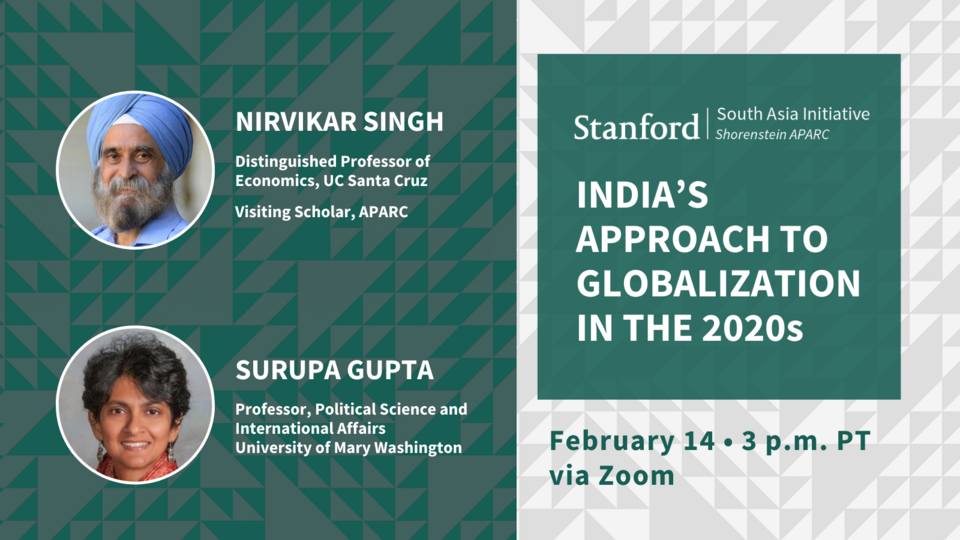
Event card with title "India's Approach to Globalization in the 2020s" featuring photos of spealers Nirvikar Singh and Surupa Gupta


Major economies around the world have re-evaluated their policy approach to globalization in recent years. The devastating pandemic exposed countries to the vulnerabilities of their supply chains, and the dangers of exposure to international markets. India has also begun to adjust its policy settings, with the government prioritizing Atmanirbharta, or self-reliance. Join two of the most insightful scholars of Indian political economy as we explore the feasibility and the implications of India’s policy approach to globalization. How much self-reliance can India realistically achieve, and what will that mean for the Indian economy? How is India applying the principle of “friend-shoring” in its political-economic partnerships? How deeply will India engage in international frameworks like the US-led Indo-Pacific Economic Framework for Prosperity, and what will that mean for its international position?


Speakers:

Image
Square photo portrait of Nirvikar Singh

Dr Nirvikar Singh is a visiting scholar at the Shorenstein Asia-Pacific Research Center at Stanford, and Distinguished Professor of Economics at UC Santa Cruz. He previously directed the UCSC South Asian Studies Initiative, and served as a member of the Advisory Group to the Finance Minister of India on G-20 matters, and Consultant to the Chief Economic Adviser of India. He is currently serving on the Expert Group on post-Covid-19 economic recovery formed by the Chief Minister of Punjab state in India. Professor Singh’s current research topics include entrepreneurship, information technology and development, electronic commerce, business strategy, political economy, federalism, economic growth, the Indian economy, and Sikh and Punjabi studies. He has authored over 100 research papers and co-authored or co-edited six books, and received his PhD from the University of California, Berkeley.


Image
Square photo portrait of Surupa Gupta

Dr Surupa Gupta is a professor of Political Science and International Affairs at the University of Mary Washington in Fredericksburg, Virginia. She also directs the university’s Women’s, Gender, and Sexuality Studies Program. Her current research focuses on the politics of agricultural and trade policies in India as well as India’s engagement with international organizations such as the IMF and WTO. Her most recent research on India’s engagement with the IMF was published in Contemporary South Asia in May 2022. She teaches courses on international political economy, South Asian politics and gender and development. She studied Economics and International Relations in India before getting her PhD in International Relations from the University of Southern California.


Moderator:

Image
Square headshot photograph of Arzan Tarapore

Dr Arzan Tarapore is the South Asia research scholar at the Shorenstein Asia-Pacific Research Center at Stanford University, where he leads the South Asia Initiative. His research focuses on military strategy, Indian defense policy, and contemporary Indo-Pacific security issues. Prior to his scholarly career, he served as an analyst in the Australian Defence Department. Arzan holds a PhD from King’s College London.

Arzan Tarapore
Arzan Tarapore

Online via Zoom

Shorenstein APARC
Stanford University
Encina Hall, E301
Stanford,  CA  94305-6055

0
Visiting Scholar at APARC, 2022-23
Nirvikar_Singh.jpg Ph.D.

Professor Nirvikar Singh joined the Walter H. Shorenstein Asia-Pacific Research Center (Shorenstein APARC) as a Visiting Scholar for the 2022-2023 academic year. Singh serves as a Distinguished Professor in Economics at the University of California, Santa Cruz. While at APARC, he researched the political economic dynamics of India and the role of innovation in driving economic growth, especially in Asia.

Nirvikar Singh Visiting Scholar Shorenstein Asia-Pacific Research Center
Surupa Gupta Professor of Political Science and International Affairs, Director, Women’s Gender, and Sexuality Studies Program University of Mary Washington
Paragraphs

What effect do gender quotas have on political responsiveness? We examine the effect of randomly imposed electoral quotas for women in Mumbai’s city council, using a wide variety of objective and subjective measures of constituency-level public service quality. Quotas are associated with differences in the distribution of legislator effort, with quota members focusing on public goods distribution, while non-quota members focus on individual goods, member perks, and identity issues. These differences in effort seem to influence institutional performance: perceived quality of local public goods is higher in constituencies with quota members, and citizen complaints are processed faster in areas with more quota members. We suggest that men’s more extensive engagement with extralegal and rhetorical forms of political action has led to men and women cultivating different styles of political representation.

AWARDS


Best Paper in Urban or Regional Politics, APSA 2021

All Publications button
1
Publication Type
Working Papers
Publication Date
Subtitle

What effect do gender quotas have on political responsiveness?

Journal Publisher
CDDRL Working Papers
Authors
Varun Karekurve-Ramachandra
-
Portraits of Sinderpal Singh and Arzan Tarapore with text about a webinar on the implications of the US-China competition for South Asia.

How is India posturing to manage strategic competition in the Indian Ocean? Thus far US-China security competition has been most acute in the western Pacific, but Chinese capability growth and strategic policies suggest that it also seeks a leading role in the northern Indian Ocean, in the not-too-distant future. India has traditionally considered itself the natural dominant power in the Indian Ocean region, but it has never faced the scale and types of competition that China will present. Does India have the wherewithal to maintain its leadership in the region? How will India work with the United States, bilaterally and through groupings such as the Quad, as they seek to maintain the status quo in the face of Chinese challenges? Is the Indian Ocean bound for militarized competition, or can India, the US, and China find a pathway to strategic coexistence?

Panelist

Image
Headshot photograph of Dr. Sinderpal Singh
Dr. Sinderpal Singh is Senior Fellow and Assistant Director, Institute of Defence and Strategic Studies, and concurrently Coordinator of the South Asia Programme at the S. Rajaratnam School of International Studies, Nanyang Technological University, Singapore. In the fall of 2022, he has been appointed as the McCain Fulbright Scholar in Residence at the United States Naval Academy. His research interests include the international relations of South Asia with a special focus on Indian foreign policy, the geopolitics of the Indian Ocean Region, and India-Southeast Asia relations. He is currently writing a book on India’s role in the Indian Ocean since 1992 and is the author of India in South Asia: Domestic Identity Politics and Foreign Policy from Nehru to the BJP (Routledge 2013). He received his Ph.D. from the University of Wales, Aberystwyth, his MA from the Australian National University, and his BA from the National University of Singapore.

Moderator

Image
Square headshot photograph of Arzan Tarapore
Dr. Arzan Tarapore is the South Asia research scholar at the Shorenstein Asia-Pacific Research Center at Stanford University, where he leads the newly-restarted South Asia Initiative. His research focuses on military strategy, Indian defense policy, and contemporary Indo-Pacific security issues. Prior to his scholarly career, he served as an analyst in the Australian Defence Department. Arzan holds a Ph.D. in war studies from King’s College London.

This webinar is co-sponsored by the Center for South Asia

Arzan Tarapore
Arzan Tarapore

Virtual via Zoom Webinar

Sinderpal Singh Institute of Defense and Strategic Studies, and South Asia Programme Senior Fellow, Assistant Director S. Rajaratnam School of International Studies, Nanyang Technological University
1
Shorenstein Postdoctoral Fellow on Contemporary Asia, 2022-23
Aidan_Milliff.jpg Ph.D.

Aidan Milliff joined the Walter H. Shorenstein Asia-Pacific Research Center (Shorenstein APARC) as the 2022-2023 Shorenstein Postdoctoral Fellow on Contemporary Asia. 

Milliff obtained his Ph.D. in Political Science at the Massachusetts Institute of Technology, where he was a predoctoral fellow at the Institute for Security and Conflict Studies at George Washington University, and a 2021-2022 USIP/Minerva Peace and Security Scholar. Aidan’s research combines computational social science and qualitative tools to answer questions about the cognitive, emotional, and social forces that shape political violence, migration, post-violence politics, and the politics of South Asia. His work appears or is forthcoming in journals and proceedings including AAAI, Journal of Peace Research, Political Behavior, as well as popular outlets including the Washington Post Monkey Cage Blog, War on the Rocks, and India’s Hindustan Times. Before MIT, Aidan was a James C. Gaither Junior Fellow in the South Asia Program at the Carnegie Endowment for International Peace. He holds a BA in political science and MA in international relations from the University of Chicago. He was born and raised in Colorado.

Aidan’s dissertation asks: in complex political violence scenarios, like inter-communal conflict in South Asia, what determines the strategies that people pursue to keep themselves safe? Aidan develops a political psychology theory, situational appraisal theory, which focuses on variation in individual interpretations of violent environments to explain civilian behavior. The dissertation first uses situational appraisal theory to explain the behavior of Indian Sikhs who encountered violence in rural insurgency and urban pogroms during the 1980s. Pairing original interviews with a novel method for applying multilingual text classification algorithms and automated video-analysis tools to analyze an archive of hundreds of oral history videos, the project shows that situational appraisals of control and predictability explain substantial variation in individuals’ choice of survival strategies when confronting violence.  The dissertation then demonstrates the generalizability of situational appraisal theory to international security domains, using a large survey experiment to show that control and predictability framing influences foreign policy preferences about hypothetical U.S.–China military confrontation.

At APARC, Aidan transformed his dissertation project into a book manuscript, and extend his ongoing research on decision-making, political violence, and Indian politics.


Date Label
Subscribe to South Asia