-

Co-sponsored by the Abbasi Program on Islamic Studies, CDDRL Program on Arab Reform and Democracy, the Europe Center, Stanford Humanities Center, the Mediterranean Studies Forum, and the Center for Russian, East European and Eurasian Studies.

Reuben W. Hills Conference Room

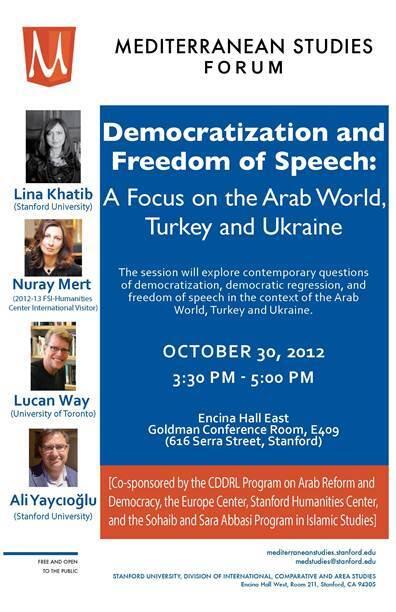
Nuray Mert 2012-13 FSI-Humanities International Visitor Speaker
Lina Khatib Speaker
Lucan Way Speaker
Ali Yaycioğlu Speaker
Panel Discussions
News Type
News
Date
Paragraphs

Steven Pifer, former United States Ambassador to Ukraine and senior fellow and director of the Arms Control Initiative at Brookings, offers his insight into the current status of nuclear arms control and the issues impacting future prospects for negotiation in a presentation posted on the Brookings Institute website

Steven Pifer’s career as a Foreign Service officer centered around Europe, the former Soviet Union and arms control. In addition to Kyiv, he has had postings in London, Moscow, Geneva and Warsaw as well as on the National Security Council. Ambassador Pifer is currently a Visiting Fellow at the Brookings Institution, focusing on Ukraine and Russia issues. He is a frequent invited expert speaker at The Europe Center. 

All News button
1
Authors
News Type
News
Date
Paragraphs

As the Soviet Union was dying in December 1991, a quiet collaboration between Russian and American scientists was being born. The Russians were bankrupt, the KGB was in disarray and nuclear scientist Siegfried S. Hecker – at the time director of the Los Alamos National Laboratory – was alarmed as tens of thousands of nuclear weapons and much of the more than 1,000 tons of fissile materials across the broken Soviet states stood poorly protected.

Thousands of Soviet scientists were suddenly in limbo and President George H.W. Bush worried some might turn to Iran or Iraq to sell their nuclear knowledge. Washington suddenly found itself more threatened by Russia’s weakness than its strengths. That recognition drove U.S. Senators Sam Nunn and Richard Lugar to launch cooperative threat reduction legislation, subsequently known as the Nunn-Lugar Cooperative Threat Reduction Act.

Secretary of Energy Admiral James Watkins echoed President Bush’s concern when he called a meeting in December 1991 with Hecker, today the co-director of Stanford’s Center for International Security and Cooperation (CISAC).

“I told him, I’ve been trying to get us together with the Russians for several years,” Hecker said. “Why don’t we go to their lab directors and say, `What’s it going to take to keep your guys home and from selling their knowledge someplace else?’”

Several weeks later, in February 1992, Hecker was on a tarmac in the once-secret Russian nuclear city of Sarov, shaking hands with Yuli Khariton. The Soviet physicist was the chief designer of Russia’s atomic bomb – their Robert Oppenheimer, creator of our nuclear bomb and first director of the Los Alamos laboratory in New Mexico.

Hecker would go on to make 44 trips to Russia in the name of nuclear nonproliferation and cooperation. His most recent was last month with CISAC researchers Peter Davis and Niko Milonopoulos and a dozen Americans scientists, to commemorate 20 years of laboratory-to-laboratory cooperation. They hosted a conference with their Russian counterparts in Sarov, the Russian version of Los Alamos 300 miles east of Moscow.

Some 100 Americans and Russians attended various legs of the conference, including the scientific directors of the three Russian nuclear weapons laboratories: Rady Ilkaev, Evgeny Avrorin and Yuri Barmakov. The American delegation included Jeffery Richardson, CISAC affiliate and former head of chemistry and proliferation prevention at Lawrence Livermore National Laboratory; James W. Toevs, former project leader for the Nuclear Cities Initiatives at Los Alamos; and K. David Nokes, former vice president of national security and arms control at Sandia National Laboratory. 


CISAC Co-director Siegfried Hecker and
Rady Ilkaev, a scientific director within
the Russian Federal Nuclear Center,
swap gifts during their April 2012
conference in Sarov, Russia.

Hecker is determined to reignite the collaboration efforts, which have diminished dramatically in the last decade due to stark differences at the highest levels of our governments and because the Russian secret service agency has again tightened their grip on the nuclear complex.

“The 1990s were the heydays for us,” he said. “The scientists played a major role; we actually pushed the envelope on what we could do cooperatively. We worked well with the Russians.”

The U.S. Department of Energy supported and financed the joint efforts of the American and Russian nuclear laboratories to secure and safeguard Russian nuclear facilities and materials. They enlisted the help of civilian institutes to make urgent security upgrades at their nuclear facilities and the Americans brought the Russians to the U.S. nuclear sites – including the plutonium facility at Los Alamos – to let them see firsthand how Americans handled protection, control and accounting of nuclear material.

“The Sandia National Laboratories actually helped provide Kevlar blankets to protect Russian nuclear weapons while they were transporting them so that in case somebody shot at them, you didn’t get a mushroom cloud,” Hecker recalled.

Then, Russian President Vladimir Putin came to power for the first time in 2000 and the Federal Security Service – formerly the KGB – started tightening the screws. U.S. visas became difficult to obtain after the 9/11 terrorist attacks ratcheted up consular bureaucracy. Scientists on both sides began to feel less welcome at the labs and sites they had readily visited for a decade.

During his April trip, Hecker felt as if he were under house arrest in the worst security squeeze he’d seen in the 20 years of visiting Russia. He was followed by a security agent when he jogged, until the mud along the river became too deep for the agent’s shiny black shoes; Davis and Milonopoulos had their access denied at the last minute and were not allowed to enter Sarov to attend the three-day portion of the conference.

Many lab-to-lab cooperative agreements were allowed to expire by the Russian side in the last decade; even collaborations on fundamental research have been restricted and there is little nuclear power engineering cooperation. Worst of all, Hecker said, joint efforts to battle nuclear terrorism and compare means by which each side keeps its nuclear warheads safe and secure without nuclear testing are now virtually nonexistent.

“We ought to be working together, for heavens sake,” he said. “We’re not going to terrorize each other; we’ve got to keep the terrorists away from the rest of the world. We just have to get back to working together.”


CISAC researchers Peter Davis, left, and Niko Milonopoulous, right, with the U.S. Ambassador to Russia Michael McFaul at the ambassador's residence in Moscow in April 2012.

Their first step will be to compile the proceedings of the meetings with their Russian counterparts in Sarov, Nizhny Novgorod and Moscow. The document will be provided to the U.S. Department of Energy and policymakers in the Obama administration, as well as the three current U.S. nuclear lab directors, who are making their first joint visit to Russia in June. Hecker said his Russian counterparts are trying to coax Moscow into jumpstarting the collaboration efforts while wooing a new generation of nuclear scientists to the table.

Hecker, along with two former Russian nuclear weapons lab directors, is working on a book to document 20 years of nuclear collaboration between Russian and American nuclear scientists.

“The book is going to do a thorough job of looking at: What we did, why did it matter, what conditions made it possible and, then, what lessons were learned that might allow us to reestablish the relationship,” he said.

Hecker had another mission on his recent trip to Sarov. He wanted to reassure his Russian counterparts that their personal relationships truly mattered.

With the collapse of the Soviet Union in 1991, scientists in Russia, Ukraine, Kazakhstan and Belarus were confronted with a new reality: They went from lives of privilege to poverty. Programs launched by the U.S. Departments of State and Energy brought financial support to Russia’s closed nuclear cities, showed the Russian nuclear workers that they had a future in non-weapons research – and that someone cared about their well-being.

“One thing that came out, talk after talk during this trip, was how important the social relationships were between the scientists; how they are absolutely crucial,” Hecker said. Those little-known relationships – many of which became enduring friendships that celebrate marriages and grandchildren – led to significant steps in the U.S.-Russian nuclear threat reduction program.

President Ronald Reagan used one of his signature phrases, “Trust, but verify,” when he and Soviet General Secretary Mikhail Gorbachev signed the Intermediate-Range Nuclear Forces Treaty in 1987, eliminating nuclear and conventional ground-launched ballistic and cruise missiles with intermediate ranges. The phrase was taken from an old Russian proverb.

A year later, that proverb was put in effect with Hecker’s hand on the nuclear button at the Nevada test site for the Joint Verification Experiment.

“In August of ’88, the Soviets were at our test sites in Nevada and I was in the control room, essentially pushing the button to blow up one of our nuclear devices down hole, while the Russians had a cable that ran down the hole with which they were going to measure the magnitude of the nuclear explosion,” Hecker said. The following month, American scientists were in Russia to do the same.

“So I was sitting there in our control room, with the Russians right across the table from me,” he recalls. “That introduced us to the Russian nuclear scientists for the first time. You know what we said? These guys are just like us. They just want to do exactly the same thing for their country that we were doing for ours: keep their country safe and secure. And that started the process of working together.”

Today, the Russian proverb made famous by an American president could be turned on its head if the Russian-American nuclear collaboration is allowed to thrive: Verify through Trust.

Hero Image
1 P1040839
All News button
1
-

This talk will address a primary foreign policy challenge for independent Ukraine which has been to strike a proper balance between its relations with the West and those with Russia.  Today, democratic backsliding is upsetting the balance, which will undermine President Yanukovych’s ability to achieve his professed foreign policy aims.


Steven Pifer
is a senior fellow at the Brookings Institution’s Center on the United States and Europe and director of the Brookings Arms Control Initiative.  He focuses on nuclear arms control, Russia and Ukraine.  He has offered commentary on these issues on CNN, Fox News, BBC, National Public Radio and VOA, and his articles have run in the International Herald Tribune, New York Times, Washington Post and Moscow Times, among others.

A retired Foreign Service officer, his more than 25 years with the State Department focused on U.S. relations with the former Soviet Union and Europe, as well as arms control and security issues.  He served as deputy assistant secretary of state in the Bureau of European and Eurasian Affairs with responsibilities for Russia and Ukraine (2001-2004), U.S. ambassador to Ukraine (1998-2000), and special assistant to the president and senior director for Russia, Ukraine and Eurasia on the National Security Council (1996-1997).

His publications include “Ukraine’s Perilous Balancing Act,” Current History (March 2012), “NATO, Nuclear Weapons and Arms Control,” Brookings Arms Control Series (July 2011); “The Next Round:  The United States and Nuclear Arms Reductions After New START,” Brookings Arms Control Series (November 2010); “Ukraine’s Geopolitical Choice, 2009,” Eurasian Geography and Economics (July 2009); and “Reversing the Decline:  An Agenda for U.S.-Russian Relations in 2009,” Brookings Foreign Policy Paper (January 2009).

Ambassador Pifer is a 1976 graduate of Stanford University with a B.A. in Economics.  He is a member of the Council on Foreign Relations. 


Co-sponsored by the Center for Russian, East European, and Eurasian Studies

Reuben W. Hills Conference Room

Steve Pifer Senior Fellow at the Brookings Institution’s Center on the United States and Europe and Director of the Brookings Arms Control Initiative Speaker
Seminars
News Type
News
Date
Paragraphs

The 2012 SPICE catalog is now available.  SPICE developed five new curriculum units in 2011.


Nuclear Tipping Point: A Teacher's Guide

The documentary Nuclear Tipping Point tells the story of how four Cold War-era leaders—former Secretary of State George Shultz, former Secretary of Defense Bill Perry, former Secretary of State Henry Kissinger, and former Senator Sam Nunn—came together to address the threat of nuclear power falling into the wrong hands. Produced by the Nuclear Threat Initiative (NTI), the film is narrated by actor Michael Douglas and earned wide media attention when it came out in 2010. 

Now, through a partnership between SPICE and NTI, the film is accompanied by a new teacher’s guide for classroom use of the documentary. The guide underscores the importance of teaching for critical literacy and addresses specific connections to the National Standards for History in the Schools. Student activities include multiple choice quizzes, persuasive writing and analysis, and ideas for creative projects. 

China in Transition: Economic Development, Migration, and Education

China in Transition introduces students to modern China as a case study of economic development. What are the characteristics of the development process, and why does it occur? How is development experienced by the people who live through it, and how are their lives impacted? How do traditional cultural values—such as China’s emphasis on education—contribute to and/or evolve as a result of modernization? Students examine these questions and others as they investigate the roles that migration, urbanization, wealth, poverty, and education play in a country in transition.


Legacies of the Vietnam War

The 20-year war in Vietnam was a prolonged and devastating conflict. In its aftermath, South Vietnamese civilians fled from the Communist takeover on perilous boat journeys that led to the formation of diasporic communities. Others faced lengthy detention in post-war re-education camps. This unit aims to help students learn and appreciate these and other important legacies that have shaped Vietnam and the world at large.


Angel Island: The Chinese-American Experience

Angel Island: The Chinese-American Experience is a graphic novel that tells the story of Chinese immigrants detained at Angel Island Immigration Station in San Francisco Bay between 1910 and 1940. It offers a stark contrast to the more celebrated stories of European immigrants arriving at Ellis Island on the East Coast and poses important questions about U.S. immigration policy, both past and present.


An Introduction to Ukraine

As the second-largest country in Europe, Ukraine has always stood at a crossroads of cultural influences. It is a key part of Europe–and the management of its relationships with other countries (in particular, Russia) is key to the future of the whole of eastern Europe. This unit seeks to provide high school teachers and students with a broad introduction to Ukrainian history with activities that touch upon Ukrainian culture.


Hero Image
catalog cover
All News button
1
News Type
News
Date
Paragraphs

About the Program

Launched in 2005, the Draper Hills Summer Fellowship on Democracy and Development Program  is a three-week executive education program that is hosted annually at Stanford University's Center on Democracy, Development, and the Rule of Law. The program brings together a diverse group of 25-30 mid-career practitioners in law, politics, government, private enterprise, civil society, and international development from transitioning countries. This training program provides a unique forum for emerging leaders to connect, exchange experiences, and receive academic training to enrich their knowledge and advance their work.

For three weeks during the summer, fellows participate in academic seminars that expose them to the theory and practice of democracy, development, and the rule of law. Delivered by leading Stanford faculty from the Stanford Law School, the Graduate School of Business, and the Departments of Economics and Political Science, these seminars allow emerging leaders to explore new institutional models and frameworks to enhance their ability to promote democratic change in their home countries.

Guest speakers from private foundations, think tanks, government, and the justice system, provide a practitioners viewpoint on such pressing issues in the field. Past program speakers have included; Carl Gershman, president of the National Endowment for Democracy; Kavita Ramdas, former president and CEO of the Global Fund for Women; Stacy Donohue, director of investments at the Omidyar Network; Maria Rendon Labadan, Deputy Director of USAID; and Judge Pamela Rymer, United States Court of Appeals for the Ninth Circuit. Fellows also visit Silicon Valley technology firms to explore how technology tools and social media platforms are being used to catalyze democratic practices on a global scale.

The program is funded by generous support from Bill and Phyllis Draper and Ingrid von Mangoldt Hills.

About the Faculty

The program's all-volunteer interdisciplinary faculty includes leading political scientists, lawyers, and economists, pioneering innovative research and analysis in the fields of democracy, development, and the rule of law. Faculty engage the fellows to test their theories, exchange ideas and learn first-hand about the challenges activists face in places where democracy is at threat. CDDRL Draper Hills Summer Fellows faculty includes; Larry Diamond, Kathryn Stoner-Weiss, Stanford President Emeritus Gerhard Casper, Erik Jensen, Francis Fukuyama, Steve Krasner, Avner Greif, Helen Stacy, and Nicholas Hope.

About our Draper Hills Summer Fellows
Image

Our network of 186 alumni who graduated from the Draper Hills Summer Fellows program hail  from 57 developing democracies worldwide. Their professional backgrounds are as diverse as the problems they confront in their home countries, but the one common feature is their commitment to building sound structures of democracy and development. The regions of Eurasia, which includes the former Soviet Union and Central Asia, along with Africa constitute over half of our alumni network. Women represent 40% of the network and the program is always looking to identify strong female leaders working to advance change in their local communities.

Previous Draper Hills Summer Fellows have served as presidential advisors, senators, attorneys general, lawyers, journalists, civic activists, entrepreneurs, academic researchers, think-tank managers, and members of the international development community. The program is highly selective, receiving several hundred applications each year.

Please see the alumni section of the website for a complete listing of our program alumni.

Our Summer Fellows include:

  • The former Prime Minister of Mongolia
  • Political activists at the forefront of the 2011 Egyptian revolution
  • Advocate for the high court of Zambia
  • Deputy Minister of the Interior of Ukraine
  • Peace advocate and human rights leader in Kenya
  • Journalists advocating for a greater role for independent media
  • Leading democratic intellectual in China
  • Social entrepreneur using technology for public accountability in India


 Funding

Stanford will pay travel, accommodation, living expenses, and visa costs for the duration of the three-week program for a certain portion of applicants. Participants will be housed on the Stanford campus in residential housing during the program. Where possible, applicants are encouraged to supply some or all of their own funding from their current employers or international nongovernmental organizations.


All News button
1
-

Synopsis:

Robin Niblett, Director of Chatham House, delivered the following talk in The Europe Center series “The European and Global Economic Crisis”.

With measured optimism about the prospect for a way out of the current Eurozone crisis, Dr. Niblett argues that the introduction of the common Euro, seen by many in past years as a vanguard tool for European integration, is now potentially a functional wedge between ‘debtor’ and strongly capitalized nations.  

Dr. Niblett, arriving directly from participating in the World Economic Forum in Dubai, and based on Chatham House research, described the “perfect storm” of the past two decades of credit-driven growth, divergence within the EU, rising debt-to GDP ratios of member nations especially in the cases of Italy and Greece.  His analysis combines these economic details with the following:

  • Demographics – high levels of unassimilated immigrants
  • European welfare economies still distributing resources at twentieth-century levels now in the twenty-first century
  • The rise of anti-immigrant and anti-free-trade populist parties
  • The weakening of Europe’s center parties
  • The “Russification” of Europe’s East – especially in recent events in Ukraine
  • The stalled integration of Turkey into the EU

The totality of the above paints a grim portrait of Europe under the weight of nearly impossible conditions.   And yet, Dr. Niblett underlines evidence for measured optimism:

  • Ireland is making strides to reform its economy
  • Ireland’s educated and yet unemployed workforce does have the possibility to immigrate to Europe
  • The UK is finally rebalancing its state budget and market liberalization
  • France is facing, albeit with massive labor protest, its state budget levels
  • Spain will likely turn over its government in the face of its massive youth protest
  • Italy is evaluating in its political process a series of budget reforms

These are the structural side of what Dr. Niblett sees as Europe’s tools for recovery.

On the side of European practice, the Franco-German proposals for European Central Bank “bailout funds” include new rules for transparency of internal government operations. This promises innovation to make the EU into an area of political and financial transparency, and to enable the EU to engage in direct investment, as evidence is beginning to show, in the world’s emerging economies.  In this sense, Dr. Niblett sees for Europe a competitive edge over the US in engaging in world markets.

Perhaps most sanguine of Dr. Niblett’s analysis is his reading of the Eurozone crisis as a force to push the member nations of Europe further towards supra-national economic strategies.  In order to participate in the investment in emerging markets, the Benelux countries, not to mention France, Germany, and neighboring European states, are responding to the crisis by considering policy that promotes investment and outsourcing for service-sector employment, instead of export commodities which have been undercut in recent years.

There is a risk, in Dr. Niblett’s view, that Europe will respond to the Eurozone crisis by fracturing into rival “clubs” of small and large or debt-restructuring and creditor nation-states.  But the European nations, especially those currently participating in the Eurozone, have untapped capacities for growth:

  • Educated youth
  • Underemployed female laborers
  • Outstanding higher educational institutions
  • Pent-up small- and medium-enterprise markets
  • Potential for growth in the service sector labor market
  • Room for more tightly integrating and rationalizing the region’s energy market.

Those interested in further detail and analysis are invited to visit the work and productivity at:

The Europe Center, at Stanford’s Freeman Spogli Institute for International Studies: http://tec.fsi.stanford.edu

Chatham House, at the Royal Institute for International Studies: http://www.chathamhouse.org/


Speaker bio:

Robin Niblett became the Director of Chatham House (the Royal Institute of International
Affairs) in January 2007. Before joining Chatham House, from 2001 to 2006, Dr. Niblett
was the Executive Vice President and Chief Operating Officer of Washington based
Center for Strategic & International Studies (CSIS). During his last two years at CSIS, he
also served as Director of the CSIS Europe Program and its Initiative for a Renewed
Transatlantic Partnership.

Most recently Dr. Niblett is the author of the Chatham House Report Playing to its
Strengths: Rethinking the UK’s Role in a Changing World (Chatham House, 2010) and
Ready to Lead? Rethinking America’s Role in a Changed World (Chatham House,
2009), and editor and contributing author to America and a Changed World: A Question
of Leadership (Chatham House/Wiley-Blackwell, 2010). He is also the author or
contributor to a number of CSIS reports on transatlantic relations and is contributing
author and co-editor with William Wallace of the book Rethinking European Order
(Palgrave, 2001). Dr Niblett is a frequent panellist at conferences on transatlantic
relations. He has testified on a number of occasions to the House of Commons Defence
Select Committee and Foreign Affairs Committee as well as US Senate and House
Committees on European Affairs.

Dr Niblett is a Non-Executive Director of Fidelity European Values Investment Trust. He
is a Council member of the Overseas Development Institute, a member of the World
Economic Forum’s Global Agenda Council on Global Institutional Governance and the
Chairman of the World Economic Forum's Global Agenda Council on Europe.

He received his BA in Modern Languages and MPhil and DPhil from New College,
Oxford.

CISAC Conference Room

Robin Niblett Director Speaker Chatham House, Royal Institute for International Affairs
Seminars
Subscribe to Ukraine