Authors
News Type
Commentary
Date
Paragraphs

Senior Ukrainian officials have voiced concern that NATO has provided no clarity regarding Ukraine’s membership prospects.  Specifically, when might Kyiv receive a membership action plan, known as MAP?

Ukraine has already waited a long time. It will have to wait longer. That is unfair, but that is the reality.

Speaking in New York on the margins of the United Nations General Assembly meetings, Foreign Minister Dmytro Kuleba complained that the MAP process “has been dragging on for an indecently long time…there can be no endless integration.  Everything must have its certainty and its clarity.”

President Volodymyr Zelensky expressed similar concerns earlier in the summer:  “If we are talking about NATO and MAP, I would really like to get specifics – yes or no.”

Kuleba and Zelensky’s frustrations are entirely understandable.  However, they will remain disappointed.

Over the past three decades, Ukraine’s interest in NATO has steadily grown.  In 1994, it was among the first to join NATO’s Partnership for Peace.  In 1997, NATO and Ukraine established a “distinctive partnership” aimed at deepening Kyiv’s relationship with the alliance.

In 2002, Ukraine announced that it would seek to join NATO, but Kyiv did little to prepare itself or follow up.  After the 2004 Orange Revolution, which led to the election of Viktor Yushchenko as president, the new Ukrainian government adopted a more serious approach. In the first half of 2006, it appeared headed for a MAP. Moscow did not express strong opposition, and many assumed that NATO leaders would approve a MAP at their November summit.  However, Yushchenko’s appointment of Victor Yanukovych as prime minister derailed things, especially in September when Yanukovych said he had no interest in a MAP.

Yushchenko asked again for a MAP in January 2008, with support from Prime Minister Yulia Tymoshenko. This time, the Kremlin made its opposition loud and clear. President George W. Bush nevertheless supported the request.  However, Washington curiously did no lobbying with other NATO members on Kyiv’s behalf.  Only when alliance leaders gathered in Bucharest in April did Bush urge his counterparts to approve a MAP for Ukraine, but having heard nothing from Washington, positions had set against the idea in key European capitals, including Berlin and Paris. Ukraine did not get a MAP, though NATO leaders stated “NATO welcomes Ukraine’s and Georgia’s Euro-Atlantic aspirations for membership in NATO.  We agreed today that these countries will become members of NATO.”

The language about “becoming” members seemed a concession to Bush, who failed in his MAP goal since, 13 years later, Ukraine continues to wait.

NATO has no fixed checklist of what countries must do to qualify for a MAP, that is, an aspirant for a MAP cannot present a fully checked scorecard and automatically claim one.  The decision to bestow one ultimately is a political call by alliance members. What is unfair is that Ukraine today arguably has made as much progress toward meeting the criteria for membership as had other countries when they received their MAPs, for example, Bulgaria and Romania in 1999 or Albania in 2007.  Indeed, Ukraine has probably done more.

The reason why Ukraine waits is also unfair. NATO’s 1995 enlargement study said, “No country outside the alliance should be given a veto or droit de regard over the process and decisions.”  Yet the Kremlin has, in effect, exercised such a veto. Allies appear unenthusiastic about a MAP now, particularly because there is no good answer to the question “if Ukraine joins NATO tomorrow, does the alliance then find itself at war with Russia?”

Unfortunately, life sometimes is not fair. That is the reality for Ukraine.  If the alliance could not reach a consensus on giving Kyiv a MAP in 2008, it will not do so now, when Ukraine remains mired in the low-intensity military conflict that Russia inflicted has inflicted on it since 2014.  Indeed, one reason why the Kremlin keeps that conflict simmering undoubtedly is to obstruct Ukraine’s efforts to forge stronger links with the West.

There should be candor between NATO and Ukrainian officials about the state of play with MAP, as there should be on Washington’s part.  True, corruption remains a problem that Ukrainians must deal more effectively with, but it does not block a MAP.

What should Kyiv do?  Here are three recommendations.

First, stop asking for a MAP, especially in public. In the current circumstances, the answer will either be silence or no. Neither helps NATO-Ukraine relations.

Second, load up Ukraine’s annual national program with the substance of a MAP – U.S., British, Polish, Lithuanian and Canadian diplomats at NATO can advise on this – but, critically, do not call it a MAP.  By all appearances, the negative reactions—both from Moscow and from within the alliance—are to the title, not the contents.

Third, having agreed a program with NATO, implement, implement and implement more.  Implementation has not always been Kyiv’s strong suit.  The more Ukraine does to strengthen interoperability with NATO military forces, meet alliance standards, and complete democratic, economic, military and security sector reforms, the better it will prepare itself for membership.

That should be Kyiv’s goal now.  It should seek, without a formal MAP, to do everything it can so that Ukraine is ready, when the political circumstances change, to take advantage and advance its membership bid.

Steven Pifer is a William J. Perry Fellow at Stanford’s Center for International Security and Cooperation and a former U.S. ambassador to Ukraine. 

Originally for Kyviv Post

Hero Image
Man smiling
All News button
1
Subtitle

Senior Ukrainian officials have voiced concern that NATO has provided no clarity regarding Ukraine’s membership prospects. Specifically, when might Kyiv receive a membership action plan, known as MAP?

Authors
Nora Sulots
News Type
News
Date
Paragraphs

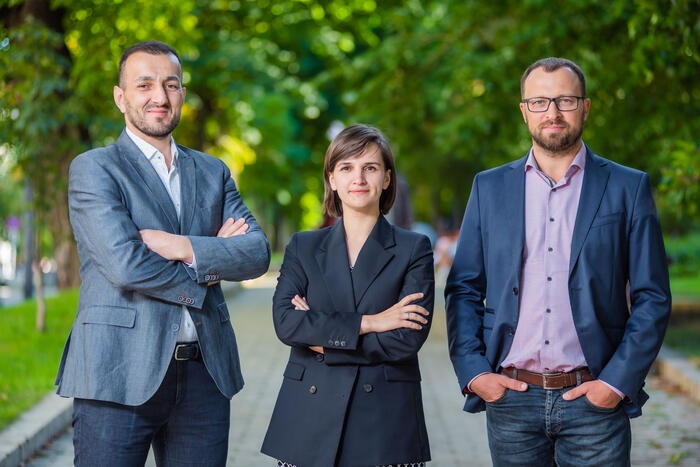
Now in its fourth year, the Ukrainian Emerging Leaders Program hosted at the Center on Democracy, Development and the Rule of Law at Stanford University is delighted to welcome three leading reformers and activists to campus for the 2021-2022 academic year.

Yulia Bezvershenko, Denis Gutenko, and Nariman Ustaiev will join the growing network of Ukrainian leaders to participate in the program. While at Stanford, they will work on projects to improve Ukraine’s education and innovation sectors, reform the civil service, and strengthen the self-governing institutions for the Crimean Tatars.

The Ukrainian Emerging Leaders Program (UELP) is a 10-month academic training fellowship hosted at Stanford University. The program was founded in 2016 by the Center on Democracy, Development and the Rule of Law at Stanford’s Freeman Spogli Institute together with Oleksandr and Kateryna Akymenko (Stanford John S. Knight fellows) as an initiative to address development challenges in Ukraine and across the broader region.

UELP provides a unique opportunity to three mid-career practitioners working actively as policy-makers, legal professionals, entrepreneurs, and leaders of civil society organizations in Ukraine to visit one of the world’s leading research universities for an academic year. The objective of the program is to strengthen fellows’ leadership skills and bolster their academic foundation and is supported by a committee of leading Stanford faculty at FSI. The program is designed to facilitate capacity building for fellows through faculty mentorship, community engagement, courses, events, and site visits to Silicon Valley technology firms.

UELP has been funded with generous support from Astem.Foundation (Rustem Umerov), Believe in Yourself Foundation (Victor and Iryna Ivanchyk), Dragon Capital (Tomas Fiala), MacPaw (Oleksandr Kosovan), Luminate, Liudy Maybutnoho (Svyatoslav Vakarchuk), and the Western NIS Enterprise Fund.

Join us for a conversation about the UELP fellows' work and political development in Ukraine on Tuesday, October 26, at 12:00 pm. Learn More

Yulia Bezvershenko, Ministry of Education and Science
 

DYulia BezvershenkoYulia Bezvershenko is Director General of Directorate for Science and Innovation at the Ministry of Education and Science. The Directorate was created for policy development and implementation in the research, development and innovation sector.

Since the Revolution of Dignity, Bezvershenko has been deeply involved in the reform of science development and implementation process. Her mission is to build knowledge-based Ukraine as an economy and society based on knowledge, science, and innovation. She has contributed to the Law on Science, which was adopted by Parliament in 2015. In cooperation with scientists and reformers she developed and actively participated in the creation of two new institutions, the National Council on Science and Technology and the National Science Fund. Bezvershenko currently works on both the implementation of the aforementioned law and its future iterations.

Bezvershenko holds a PhD in Theoretical Physics from the Bogolyubov Institute for Theoretical Physics (National Academy of Science of Ukraine) and a Master’s degree in Public Policy and Governance from the Kyiv School of Economics. She has diverse experience in the research and development sector, having worked as a researcher at the Bogolyubov Institute as well as a senior lecturer on quantum theory at Kyiv-Mohyla Academy. Until 2019, Yulia was a Deputy Head of Young Scientists Council of National Academy of Science of Ukraine and Vice-President of NGO "Unia Scientifica" aimed to promote science and to advocate reform of science in Ukraine.


Denis Gutenko, State Fiscal Service/Ministry of Economy
 

Image
Denis Gutenko
Denis Gutenko joins CDDRL after most recently serving as the head of the State Fiscal Service of Ukraine. Holding this position from 2019-20 he was responsible for dismantling the large-scale State Fiscal Service into three accountable units: Tax Administration, Customs and Tax police.

Before joining the State Fiscal Service, Gutenko had worked in the Ministry of Economy since 2015. Gutenko promoted deregulation and improvement of business climate agenda. He initiated and successfully lobbied Parliament to adopt laws on the liberalization of international trade and currency, the transparency of scrap metal exports, and the reform of a corrupt ecological tax policy. Gutenko also led the removal of administrative barriers and outdated currency restrictions, resulting in the increased flow of services and payments for Ukrainian freelancers and small and medium enterprises.

Prior to this Gutenko began his career in the private sector as a banker, auditor, and agribusiness manager, experiences that sparked his interest in improving the Ukrainian state bureaucracy and fighting widespread corruption.

Gutenko’s focus while at CDDRL will be on good governance and public administration reform, both of which remain significant opportunities and challenges for Ukraine. He looks forward to being an active member of the Leadership Network for Change, and to continuing to challenge himself while at Stanford.


Nariman Ustaiev, Gasprinski Institute
 

Nariman UstaievNariman Ustaiev is co-founder and Director at Gasprinski Institute for Geostrategy. He is also an external advisor for the Committee on Human Rights, Deoccupation and Reintegration of Temporarily Occupied Territories in Donetsk, Luhansk Regions and the Autonomous Republic of Crimea, National Minorities and Interethnic Relations of the Verkhovna Rada of Ukraine. 

His work explores the multiple dimensions of Ukraine’s foreign and security policy and their intersection with good governance based on human rights. His areas of expertise are foreign policy; political and security challenges in the Black Sea Region; and human rights and Crimean Tatar issues. 

Prior to this Nariman had worked for governmental institutions responsible for Ukraine’s security policy, namely the National Security and Defense Council, the Secretariat of the Cabinet Ministers, and the State Service for the Autonomous Republic of Crimea and Sevastopol for many years. 

Nariman graduated from the Diplomatic Academy at the Ministry of Foreign Affairs of Ukraine, the Ukrainian Academy for Foreign Trade, and Kyiv-Mohyla Business School.

Hero Image
Photo of Nariman Ustaiev, Yulia Bezvershenko, and Denis Gutenko
All News button
1
Subtitle

After the program was postponed in 2020, the Center on Democracy, Development and the Rule of law is pleased to have Yulia Bezvershenko, Denis Gutenko, and Nariman Ustaiev join us on campus this year.

-

There is an ongoing war between Ukraine and Russia. It is not a war solely for territories, resources, or people — it's an ideological war, indicative of the battle between authoritarianism and democracy. What is the real nature of this conflict and who are the parties involved? What tools does the Kremlin use to control the narrative and what can be done to stop it? And why is Ukraine the cornerstone of democracy in the region? Join former Prime Minister of Ukraine Oleksiy Honcharuk, the Bernard and Susan Liautaud Visiting Fellow at FSI, to discuss.


The Liautaud Fellowship was established to bring former heads of state or senior policymakers to Stanford, with the goal of promoting meaningful dialogue on the challenges world leaders face in crafting policy solutions for pressing global problems. Toomas Hendrik Ilves, the former President of Estonia, was the inaugural Liautaud Fellow in 2017, followed by H.R. McMaster in 2018.

ABOUT THE SPEAKER

Image
Oleksiy Honchaurk

Oleksiy Honchaurk was Ukraine’s 17th Prime Minister (August 2019 – March 2020). In just 5 months Mr. Honcharuk initiated important changes that other Ukrainian politicians had not dared to do for years (launched of large and small privatization processes, started of land market implementation, conducted Naftogaz unbundling, started combating shade markets – illegal gambling houses and petrol stations were closed, launched of Anti-Raider (illegal seizure of business or property) Office that would react within just 24 hours to any cases of such illegal seizure, etc).

Before he served as a Deputy Head of the Presidential Office of Ukraine and was a member of the National Reforms Council under the President of Ukraine. Previously for more than ten years, Mr. Honcharuk has been working in the legal sphere. He has established a reputation as a strong professional and qualified specialist. Mr. Honcharuk is also known as a strong fighter for business community rights. 2005-2008, he worked as a lawyer at PRIOR-Invest investment company and later on headed its legal department. 2008-2015, he worked as an arbitration manager and managing partner at Constructive Lawyers, a law firm he had founded, which provided legal services in the field of investment and financing real estate construction.

From 2015-2019, Oleksiy Honcharuk headed Better Regulation Delivery Office non-governmental organization (BRDO). Among his achievements as the head of the BRDO was the cancellation of around 1000 Government acts and adoption of more than 50 decisions, facilitating activity of business in Ukraine. Oleksiy Honcharuk also served as an external advisor to the First Deputy Prime Minister - Minister of Economic Development and Trade of Ukraine. He has a degree in law from Interregional Academy of Personal Management and in Public Administration from National Academy for Public Administration under the President of Ukraine. He was born on July 7, 1984, in Zhmerynka, Vinnytsia region.

Hybrid event: Online via Zoom, and in-person in Bechtel Conference Center

616 Jane Stanford Way,

Encina Hall,

Stanford, CA 94305-6055

0
Bernard and Susan Liautaud Visiting Fellow, 2021
rsd21_038_1181a.jpg

Ukraine’s 17th Prime Minister (August 2019 – March 2020). In just 5 months Mr. Honcharuk initiated important changes that other Ukrainian politicians had not dared to do for years (launched of large and small privatization processes, started of land market implementation, conducted Naftogaz unbundling, started combating shade markets –– illegal gambling houses and petrol stations were closed, launched of Anti-Raider (illegal seizure of business or property) Office that would react within just 24 hours to any cases of such illegal seizure, etc).

Before he served as a Deputy Head of the Presidential Office of Ukraine and was a member of the National Reforms Council under the President of Ukraine. Previously for more than ten years, Mr. Honcharuk has been working in the legal sphere. He has established a reputation as a strong professional and qualified specialist. Mr. Honcharuk is also known as a strong fighter for business community rights. 2005-2008, he worked as a lawyer at PRIOR-Invest investment company and later on headed its legal department. During 2008-2015, he worked as an arbitration manager and managing partner at Constructive Lawyers, a law firm he had founded, which provided legal services in the field of investment and financing real estate construction.

From 2015-2019, Oleksiy Honcharuk headed Better Regulation Delivery Office non-governmental organization (BRDO). Among his achievements as the head of the BRDO was the cancellation of around 1000 Government acts and adoption of more than 50 decisions, facilitating activity of business in Ukraine. Oleksiy Honcharuk also served as an external advisor to the First Deputy Prime Minister - Minister of Economic Development and Trade of Ukraine.

Oleksiy Honcharuk has a degree in law from Interregional Academy of Personal Management and in Public Administration from National Academy for Public Administration under the President of Ukraine. He was born on July 7, 1984, in Zhmerynka, Vinnytsia region.

CV
Former Prime Minister of Ukraine, Bernard and Susan Liautaud Visiting Fellow at FSI

FSI
Stanford University
Encina Hall C140
Stanford, CA 94305-6055

(650) 736-1820 (650) 724-2996
0
Satre Family Senior Fellow, Freeman Spogli Institute for International Studies
kathryn_stoner_1_2022_v2.jpg MA, PhD

Kathryn Stoner is the Mosbacher Director of the Center on Democracy, Development, and the Rule of Law (CDDRL), and a Senior Fellow at CDDRL and the Center on International Security and Cooperation at FSI. From 2017 to 2021, she served as FSI's Deputy Director. She is Professor of Political Science (by courtesy) at Stanford and she teaches in the Department of Political Science, and in the Program on International Relations, as well as in the Ford Dorsey Master's in International Policy Program. She is also a Senior Fellow (by courtesy) at the Hoover Institution.

Prior to coming to Stanford in 2004, she was on the faculty at Princeton University for nine years, jointly appointed to the Department of Politics and the Princeton School for International and Public Affairs (formerly the Woodrow Wilson School). At Princeton she received the Ralph O. Glendinning Preceptorship awarded to outstanding junior faculty. She also served as a Visiting Associate Professor of Political Science at Columbia University, and an Assistant Professor of Political Science at McGill University. She has held fellowships at Harvard University as well as the Woodrow Wilson Center in Washington, DC. 

In addition to many articles and book chapters on contemporary Russia, she is the author or co-editor of six books: "Transitions to Democracy: A Comparative Perspective," written and edited with Michael A. McFaul (Johns Hopkins 2013);  "Autocracy and Democracy in the Post-Communist World," co-edited with Valerie Bunce and Michael A. McFaul (Cambridge, 2010);  "Resisting the State: Reform and Retrenchment in Post-Soviet Russia" (Cambridge, 2006); "After the Collapse of Communism: Comparative Lessons of Transitions" (Cambridge, 2004), coedited with Michael McFaul; and "Local Heroes: The Political Economy of Russian Regional" Governance (Princeton, 1997); and "Russia Resurrected: Its Power and Purpose in a New Global Order" (Oxford University Press, 2021).

She received a BA (1988) and MA (1989) in Political Science from the University of Toronto, and a PhD in Government from Harvard University (1995). In 2016 she was awarded an honorary doctorate from Iliad State University, Tbilisi, Republic of Georgia.

Download full-resolution headshot; photo credit: Rod Searcey.

Mosbacher Director, Center on Democracy, Development and the Rule of Law
Professor of Political Science (by courtesy), Stanford University
Senior Fellow (by courtesy), Hoover Institution
CV
Date Label
Mosbacher Director of CDDRL
Lectures

616 Jane Stanford Way,

Encina Hall,

Stanford, CA 94305-6055

0
Bernard and Susan Liautaud Visiting Fellow, 2021
rsd21_038_1181a.jpg

Ukraine’s 17th Prime Minister (August 2019 – March 2020). In just 5 months Mr. Honcharuk initiated important changes that other Ukrainian politicians had not dared to do for years (launched of large and small privatization processes, started of land market implementation, conducted Naftogaz unbundling, started combating shade markets –– illegal gambling houses and petrol stations were closed, launched of Anti-Raider (illegal seizure of business or property) Office that would react within just 24 hours to any cases of such illegal seizure, etc).

Before he served as a Deputy Head of the Presidential Office of Ukraine and was a member of the National Reforms Council under the President of Ukraine. Previously for more than ten years, Mr. Honcharuk has been working in the legal sphere. He has established a reputation as a strong professional and qualified specialist. Mr. Honcharuk is also known as a strong fighter for business community rights. 2005-2008, he worked as a lawyer at PRIOR-Invest investment company and later on headed its legal department. During 2008-2015, he worked as an arbitration manager and managing partner at Constructive Lawyers, a law firm he had founded, which provided legal services in the field of investment and financing real estate construction.

From 2015-2019, Oleksiy Honcharuk headed Better Regulation Delivery Office non-governmental organization (BRDO). Among his achievements as the head of the BRDO was the cancellation of around 1000 Government acts and adoption of more than 50 decisions, facilitating activity of business in Ukraine. Oleksiy Honcharuk also served as an external advisor to the First Deputy Prime Minister - Minister of Economic Development and Trade of Ukraine.

Oleksiy Honcharuk has a degree in law from Interregional Academy of Personal Management and in Public Administration from National Academy for Public Administration under the President of Ukraine. He was born on July 7, 1984, in Zhmerynka, Vinnytsia region.

CV
0
CDDRL Visiting UELP Scholar, 2021-22
yulia_bezvershenko_2022.jpg

Yulia Bezvershenko is the former Director General of Directorate for Science and Innovation at the Ministry of Education and Science. The Directorate was created for policy development and implementation in the research, development and innovation sector.

Since the Revolution of Dignity, Bezvershenko has been deeply involved in the reform of science development and implementation process. Her mission is to build knowledge-based Ukraine as economy and society based on knowledge, science and innovation. She has contributed to the Law on Science, which was adopted by Parliament in 2015. In cooperation with scientists and reformers she developed and actively participated in the creation of two new institutions, the National Council on Science and Technology and the National Science Fund. Bezvershenko currently works both on implementation of the aforementioned law and on its future iterations.

Bezvershenko holds a PhD in Theoretical Physics from the Bogolyubov Institute for Theoretical Physics (National Academy of Science of Ukraine) and a Master’s degree in Public Policy and Governance from the Kyiv School of Economics. She has diverse experience in the research and development sector, having worked as a researcher at the Bogolyubov Institute as well as a senior lecturer on quantum theory at Kyiv-Mohyla Academy. Until 2019, Yulia was a Deputy Head of Young Scientists Council of National Academy of Science of Ukraine and Vice-President of NGO "Unia Scientifica" aimed to promote science and to advocate reform of science in Ukraine.


Authors
Melissa Morgan
News Type
News
Date
Paragraphs

In 2015, Volodymyr Zelenskyy was at the height of a successful career as an entertainer. Though trained as a lawyer at the Kryvyi Rih Institute of Economics in Eastern Ukraine, the then 37 year old Zelenskyy was a successful comedian and public personality. As the star of the popular TV show, Servant of the People, he played a local history teacher who inadvertently becomes the president of Ukraine following a viral video rant about corruption.

No one watching comedic President Zelenskyy then could have possibly imagined the real-life plot twist that would follow. In an incredible act of life imitating art, in April 2019, Volodymyr Zelenskyy once again stood on stage in front of a cheering crowd, but this time as the actual president of Ukraine.

He won in a landslide election against incumbent president Petro Poroshenko on a platform of systemic change and progress using an almost exclusively virtual campaign. Speaking from his headquarters on election night, he affirmed the exuberance and hope of his supporters: “I can say as a citizen of Ukraine to all countries of the post-Soviet Union: Look at us — everything is possible.”

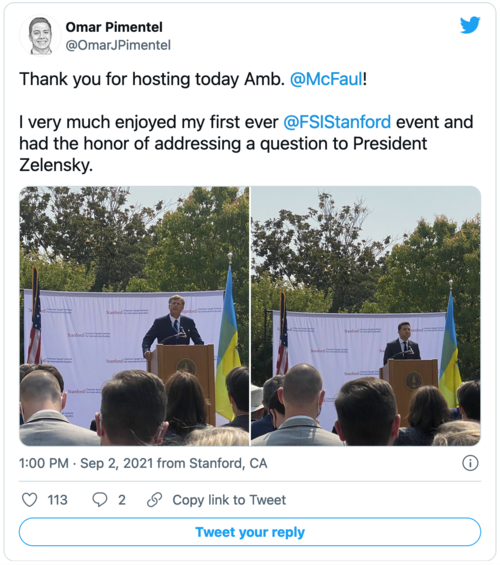
This same message shaped the theme of President Zelenskyy’s remarks at his historic address from the Freeman Spogli Institute for International Studies (FSI) at Stanford University on September 2. The first Ukrainian president to ever visit California, President Zelenskyy, First Lady Olena Zelenska and their delegation joined a group of FSI faculty members led by FSI Director Michael McFaul at an outdoor event held in the Encina Courtyard.

In his remarks, Zelenskyy drew inspiration from Steve Jobs’ famous "How to Live Before You Die" commencement address given at Stanford in 2005.

"This is one of the most famous speeches ever given at Stanford,” he said. “It's about believing in dreams and overcoming the impossible. This is the same as my story. I am just a common guy from a common family from a common industrial town in Eastern Ukraine. Yet here I am today at Stanford, because everything is possible."

He continued, “It is the same for Ukraine. Many people look at us and think that it will be impossible to achieve the goals we hope for. But we know that our critics are wrong. The people of our country love democracy and freedom and will not let threats take those things away. We know that anything is possible."

Looking to the future, Zelenskyy outlined the steps his administration is undertaking to bring increased digitization to Ukraine. These efforts include launching fully electronic passports, moving business and legal services online and expanding the scope of e-goverance. The hope is that this meld of new technology will help curb corruption while simultaneously creating more equitable opportunities and better access to public services for more Ukranians.

Speaking on the ambitious scope of these plans, the president acknowledged, “There will be resistance to the changes and innovations that we are going to make.” Nonetheless, he remains committed to the work ahead of strengthening democratic institutions in Ukraine and building on the progress that has already been made.  “We do not have a ‘Ukrainian Dream,’ yet,” he said. “But we have a ‘Ukrainian Goal’ and a ‘Ukrainian Mission’ to make the future we want for our country.” An edited recording of his remarks is below.

Keeping with Stanford tradition, Zelenskyy took questions from the audience after his prepared remarks. A variety of students and Stanford community members from Russia, Burma, Belarus and beyond had the opportunity to engage the president on a range of issues including U.S.-Ukraine relations, armament sales abroad and concerns over Russian aggression in Crimea and influence Eastern Ukraine. Of particular meaning was Zelensky’s affirmation and support for the democratic movement in Belarus led by Svaitlana Tsikhanouskaya, whom FSI hosted earlier this summer at a faculty roundtable.

Image
Tweet from Franak Viačorka

Students and faculty alike were appreciative of the president’s candor and good nature in addressing difficult topics.

Image
Tweet from Rose Gottemoeller
Image
Tweet from Graham Webster
Image
Tweet from Me Me Khant
Image
Tweet from Omar Pimentel

Following the formal remarks, President Zelenskyy and First Lady Zelenska had an opportunity to meet with Stanford President Marc Tessier-Lavigne in the Memorial Church Courtyard. Prior to leaving, the First Lady also sat down with leaders and students from Stanford's Office of Accessible Education (OAE), an area of interest she would like to support and better develop in Ukraine.

For FSI, the president’s visit was another affirmation of the special connection between Ukraine and the Stanford community. Since 2016, the Center on Democracy, Development and the Rule of Law has hosted the Ukrainian Emerging Leaders Program, which provides a 10-month academic training fellowship in support of mid-career practitioners working actively as policy-makers, legal professionals, entrepreneurs and leaders of civil society organizations in Ukraine.

Speaking to this shared history in his opening introductions, FSI Director Michael McFaul emphasized the crucial need for ongoing support and intellectual investment into Ukraine. “The fight for democracy and independence in Ukraine is one of the most important causes in the world today,” he affirmed. “Not just for Ukrainians, but for all who cherish the ideals of democracy, liberty and sovereignty.”

To President Zelenskyy, McFaul extended a future invitation: “You are always welcome back, either as president or in retirement as a professor.”

“With the classes you offer, I will think about it,” Zelenskyy replied with a smile.

Read More

President Zelenskky addresses Stanford students and community members via a live video address in the CEMEX auditorium.
News

President Volodymyr Zelenskyy Calls on Students to Lead as Future Ambassadors in a Special Video Address at Stanford

Ukraine’s President Volodymyr Zelenskyy spoke to the Stanford community in a special video address about his country’s war against Russia for independence, freedom, and global democracy, which he said requires the continued support of all the people of the free world.
President Volodymyr Zelenskyy Calls on Students to Lead as Future Ambassadors in a Special Video Address at Stanford
Larry Diamond speaking in the Bechtel Conference Center in Encina Hall
Commentary

"We Have Entered a New Historical Era": Larry Diamond on the Future of Democracy

Speaking at the April 2022 meeting of the FSI Council, Larry Diamond offered his assessment of the present dangers to global democracy and the need to take decisive action in support of liberal values.
"We Have Entered a New Historical Era": Larry Diamond on the Future of Democracy
Sviatlana Tsikhanouskaya discusses the future of democracy in Belarus with a roundtable of Stanford scholars.
News

Belarusian Leader Sviatlana Tsikhanouskaya Meets with Stanford Scholars for Roundtable on Democracy in Belarus

Democratic leader Sviatlana Tsikhanouskaya and her delegation joined an interdisciplinary panel of Stanford scholars and members of the Belarusian community to discuss the future of democracy in Belarus.
Belarusian Leader Sviatlana Tsikhanouskaya Meets with Stanford Scholars for Roundtable on Democracy in Belarus
Hero Image
President Volodymyr Zelenskyy of Ukraine speaks at the Freeman Spogli Institute for International Studies Rod Searcey
All News button
1
Subtitle

President Zelenskyy outlined the steps his administration is undertaking to bring increased digitization to Ukraine, curb corruption and create more equitable access to public services for more Ukrainians.

Authors
News Type
Commentary
Date
Paragraphs

President Volodymyr Zelensky visits Washington next week, with the highlight being a White House call on President Joe Biden. That offers the opportunity to reinvigorate the U.S.-Ukraine relationship at the highest level, following four years of Donald Trump.

This can be a very good meeting for the Ukrainian president. He should, however, take care in what he seeks. If he wants to return home with a clear success and having boosted U.S.-Ukraine relations, he should not ask for things he knows—or should know—he cannot get. Moreover, the more convincing the message that he brings regarding Kyiv’s commitment to domestic reform, the better will be his time in Washington.

Aug. 31 will be Mr. Zelensky’s first time to the White House, even though Trump offered him such a visit more than two years ago. Sadly, the former president showed no understanding of the import of Ukraine for American national interests and instead sought to extort Kyiv into interfering in U.S. politics.

When it comes to Ukraine, Biden gets it. The discussions between the presidents will undoubtedly focus on the two central challenges facing Kyiv. First, the conflict that Russia has inflicted on Ukraine since 2014, which has claimed some 14,000 lives. Zelensky can expect a strong reiteration of American support for Ukraine, including for non-recognition of Moscow’s illegal seizure of Crimea and for a settlement in Donbas that restores Ukrainian sovereignty.

The tricky part for Zelensky will turn on the specific asks he makes.

In the past, the Ukrainian president has called for a NATO membership action plan (MAP). In one sense, that is not unreasonable. Ukraine has made as much progress as many other new alliance members had made when they received MAPs.

NATO members, however, remain reluctant to put Ukraine, when it is engaged in a low-intensity war with Russia, on a membership track—despite the fact that NATO has stated that the question of membership is between the alliance and the prospective member, not any third party, i.e., not the Kremlin. That may seem unfair in Kyiv, but it is the reality.

So Zelensky should not seek a MAP. He could ask for an intensified and continuing discussion on the practical steps that Kyiv should take now so that, when a window opens for progress toward membership, Ukraine is fully ready to seize it. Mr. Zelensky can, in effect, have a MAP … if he accepts that it will not be called a MAP.

Ukraine—the biggest potential loser when Nord Stream 2 begins operation—understandably opposes it. Biden opposes it as well but remains unready to sanction German or European companies and risk a rift with Berlin and Brussels. (Kyiv should not want such a rift, which would erode U.S.-European Union unity on supporting Ukraine and sanctions against Russia.)

Zelensky thus should not urge sanctioning European companies to block the pipeline. He should instead ask how Washington, working with Berlin, intends to build with specifics on the July U.S.-German statement on supporting Ukraine, Europe’s energy security and climate goals and ensure that Russia will not use the pipeline against Kyiv. He could also propose continuing the discussion begun on Aug. 23 by the Ukrainian, German and American energy ministers about steps to strengthen Ukraine’s energy security.

Many in Kyiv have expressed frustration with the lack of progress toward settling the Donbas conflict in the “Normandy process” led by the Germans and French, and some even suggest alternative formats. Washington does not want to displace Berlin and Paris, and it benefits Kyiv to keep those key European Union members engaged. Still, Zelensky can and should press Biden to engage U.S. diplomacy more forcefully in support of the Germans and French.

He also may have an opening to ask for more. Washington reportedly has considered contingency military assistance for Ukraine. Given the Russian build-up last April, which was only partially drawn down, and the prospect that the September Zapad exercise will bring even more Russian troops close to Ukraine’s border, new U.S. military assistance would send a powerful signal of U.S. commitment to Ukraine as well as bolster its defensive capabilities.

The second central challenge facing Kyiv is putting in place the critical mass of reforms that will allow Ukraine’s economy to accelerate growth and realize its full potential, including encouraging open competition, strengthening the rule of law, curbing the outsized political and economic influence of the oligarchs, and beating back corruption. Kyiv’s record over the past two years has been mixed. These questions concerned  Biden when he had the senior lead on Ukraine in the Obama administration. If  Zelensky brings a credible, compelling message of his commitment to reform accompanied by specific ideas, he will find a receptive audience.

Zelensky’s U.S. visit can produce a major success for him and for U.S.-Ukraine relations. He should position himself to achieve such an outcome. That requires not overreaching by setting the bar impossibly high. And it means bringing a persuasive vision for how Kyiv will realize the ambitions of the Ukrainian people to become a prosperous democracy and a “normal” European state.

Steven Pifer is an affiliate of Stanford’s Center for International Security and Cooperation and a former U.S. ambassador to Ukraine.

Originally for Kyiv Post

Hero Image
Ukraine President Volodymyr Zelensky
Anastasia Vlasova/Getty Images
All News button
1
Subtitle

President Volodymyr Zelensky visits Washington next week, with the highlight being a White House call on President Joe Biden. That offers the opportunity to reinvigorate the U.S.-Ukraine relationship at the highest level, following four years of Donald Trump.

-

The Freeman Spogli Institute for International Studies (FSI) is honored to host the President of Ukraine, Volodymyr Zelensky, for an address on U.S.-Ukrainian relations. President Zelensky's visit to Stanford follows his August 31 meeting with United States President Joe Biden, and is the first visit to California by a Ukrainian president.

This event is publically available via Zoom. Please register in advance.

Lectures
-


The Crimean peninsula has always been an integral component of security in the Black Sea Region. In 2014 it became a flashpoint for the international order when Russia annexed the peninsula from Ukraine. Seven years later, it remains an important topic in international security and democracy promotion. Please join CDDRL and the Embassy of Ukraine in the US for a discussion on several topics related to the peninsula including:

• Political prisoners and human rights
• Security in Crimea
• Three Seas Initiative
• The Crimea Platform

This event is held in recognition of the political prisoners of Crimea, and to bring attention to the case of Osman Arifmemetov.

About the Speakers: 

Opening Remarks

Oksana Markarova is a Ukrainian politician and the current Ambassador of Ukraine to the United States. Markarova also served as former Minister of Finance.

Panelists

Emine Dzhaparova is a Crimean Tatar politician and stateswoman. She was formerly a journalist and currently serves as the first deputy minister at the Ministry of Foreign Affairs of Ukraine.

George Kent currently serves as Deputy Assistant Secretary in the European and Eurasian Bureau at the U.S. Department of State, overseeing policy towards Ukraine, Moldova, Belarus, Georgia, Armenia, and Azerbaijan. Previously, he was Deputy Chief of Mission in Kyiv, Ukraine (2015-18).

Steven Pifer is a fellow at the Robert Bosch Academy in Berlin and a non-resident senior fellow with the Brookings Institution.  He was a William J. Perry Research Fellow at the Center for International Security and Cooperation from 2018-2020. He served as deputy assistant secretary of state in the Bureau of European and Eurasian Affairs with responsibilities for Russia and Ukraine (2001-2004), ambassador to Ukraine (1998-2000), and special assistant to the president and senior director for Russia, Ukraine and Eurasia on the National Security Council (1996-1997).

Moderator
Francis Fukuyama is the Olivier Nomellini Senior Fellow at the Freeman Spogli Institute for International Studies (FSI), Mosbacher Director of FSI's Center on Democracy, Development, and the Rule of Law (CDDRL), and Director of the Ford Dorsey Master's in International Policy.  He is also a professor (by courtesy) of Political Science. 

Encina Hall, C148
616 Jane Stanford Way
Stanford, CA 94305

0
Olivier Nomellini Senior Fellow at the Freeman Spogli Institute for International Studies
Director of the Ford Dorsey Master's in International Policy
Research Affiliate at The Europe Center
Professor by Courtesy, Department of Political Science
yff-2021-14290_6500x4500_square.jpg

Francis Fukuyama is the Olivier Nomellini Senior Fellow at Stanford University's Freeman Spogli Institute for International Studies (FSI), and a faculty member of FSI's Center on Democracy, Development and the Rule of Law (CDDRL). He is also Director of Stanford's Ford Dorsey Master's in International Policy, and a professor (by courtesy) of Political Science.

Dr. Fukuyama has written widely on issues in development and international politics. His 1992 book, The End of History and the Last Man, has appeared in over twenty foreign editions. His book In the Realm of the Last Man: A Memoir will be published in fall 2026.

Francis Fukuyama received his B.A. from Cornell University in classics, and his Ph.D. from Harvard in Political Science. He was a member of the Political Science Department of the RAND Corporation, and of the Policy Planning Staff of the US Department of State. From 1996-2000 he was Omer L. and Nancy Hirst Professor of Public Policy at the School of Public Policy at George Mason University, and from 2001-2010 he was Bernard L. Schwartz Professor of International Political Economy at the Paul H. Nitze School of Advanced International Studies, Johns Hopkins University. He served as a member of the President’s Council on Bioethics from 2001-2004. He is editor-in-chief of American Purpose, an online journal.

Dr. Fukuyama holds honorary doctorates from Connecticut College, Doane College, Doshisha University (Japan), Kansai University (Japan), Aarhus University (Denmark), the Pardee Rand Graduate School, and Adam Mickiewicz University (Poland). He is a non-resident fellow at the Carnegie Endowment for International Peace. He is a member of the Board of Trustees of the Rand Corporation, the Board of Trustees of Freedom House, and the Board of the Volcker Alliance. He is a fellow of the National Academy for Public Administration, a member of the American Political Science Association, and of the Council on Foreign Relations. He is married to Laura Holmgren and has three children.

(October 2025)

CV
Date Label
Panel Discussions
Authors
News Type
Commentary
Date
Paragraphs

President Volodymyr Zelensky reportedly will soon travel to Paris to meet with French President Emmanuel Macron. That is a trip very much worth making. After German Chancellor Angela Merkel steps down this fall, Zelensky may find himself more dependent on Macron, both in the Normandy format and for leadership in the European Union regarding the conflict that Russia has inflicted on his country.

The sooner Zelensky gets to Paris, the better.

First, he could ask Macron to call explicitly on Vladimir Putin to deescalate the tensions Russia has caused by its large and continuing build-up of military forces near Ukraine.

On April 3, the German and French foreign ministries issued a statement calling for restraint on “all sides”—a wrongly balanced appeal given that Russian actions provoked the crisis.  Merkel corrected this on April 8, when she spoke with Putin and “demanded that this [Russian] build-up be unwound in order to de-escalate the situation.” Macron has yet to speak in such clear terms.

Second, Zelensky should strengthen Macron’s understanding of the conflict and Ukraine’s position.  The Germans and French have for six years sought to broker a settlement between the Ukrainians and Russians in the Normandy format, with Merkel playing the lead role.  Later this year, when she steps down, the leadership of that process may well pass from Berlin to Paris.

Ukrainians often express frustration with the Normandy format and the Minsk II agreement that it produced in February 2015.  The terms of the agreement were never fully implemented, and thousands of Ukrainians have since died.  Berlin and Paris have not found the key to getting Russian and Russian proxy forces to leave Donbas, to say nothing of occupied Crimea.  (In fairness, it is not clear that anyone could have.)

However, the Normandy process has kept the two large continental European powers engaged in trying to resolve the conflict. That is to Kyiv’s advantage. The Minsk II agreement has provided the basis for sustaining European Union sanctions on Russia, sanctions that have proven far more resilient than many would have predicted when EU member states first approved them in 2014.

Merkel and German diplomats deserve credit for maintaining EU unity on sanctions, despite calls from some member states to move back toward business as usual with Moscow.  She has taken a greater interest in the Russia-Ukraine conflict than Macron or his predecessor.  That reflects in part her background, having been raised in the German Democratic Republic, her understanding of Russia, and her command of Russian.

But Merkel steps down this fall after 16 years as chancellor. While the German election is still more than five months off, most predictions suggest one of two coalitions will result: a combination of the Christian Democratic Union/Christian Socialist Union and Greens Party, or a grouping of the Greens, the Social Democratic Party, and Free Democratic Party.

In the first combination, the likely candidates for chancellor are Armin Laschet and Markus Soeder.  Both come from what was West Germany.  Neither has real experience with or appears to have shown particular interest in the Russia-Ukraine conflict.  Either might question the investment that Merkel put into the Normandy discussions, given that they have not succeeded and offer little pay-off in terms of German domestic politics.

In the second combination, the chancellor likely would come from the Greens.  That could bode well for Kyiv, as the Greens are skeptical about Russia, criticize Moscow’s human rights record, and oppose the Nord Stream 2 gas pipeline.  However, the Greens have been out of government since 2005, and they might need time to get up to speed.

If the new German chancellor is uninterested in or needs time to engage in a meaningful manner, leadership within the Normandy format will move to Paris, something the Kremlin likely would welcome.  Macron has taken a less harsh tone on Russian misbehavior.  He has sought to regenerate links with Moscow.  For example, before the 2019 G7 summit in France, he hosted Putin for a bilateral meeting, seemingly seeking to make Paris a bridge between Moscow and the rest of the G7.

A pro-Russian tilt, even a small one, in the duo heading up the Normandy format process is hardly in Kyiv’s interest.  Zelensky needs to make his strongest possible case to Macron as regards the realities of the Russia-Ukraine conflict, for continuing to steward the Normandy format with Merkel’s steadiness, and for not succumbing to Putin’s blandishments, which would come at Ukraine’s expense.


Originally for Kyiv Post

Hero Image
Ukraine's President Volodymyr Zelenskiy (L) and French President Emmanuel Macron
AFP
All News button
1
Subtitle

President Volodymyr Zelensky reportedly will soon travel to Paris to meet with French President Emmanuel Macron. That is a trip very much worth making.

Subscribe to Ukraine