How should allies deal with a superpower they can no longer rely on? Former Canadian Deputy Prime Minister Chrystia Freeland joins CDDRL to discuss her new book, "Unreliable Boyfriend: An Insider's View of Dealing with a Chaotic Superpower, Plutocrats, and Other Complicated People."
Freeland has seen these questions from two sides. As a foreign correspondent, she covered the rise of Russia's oligarchs in the 1990s. As a senior Canadian official, she helped renegotiate the trade agreement between Canada, the U.S. and Mexico. The book draws on both careers to examine how power operates inside government, why trade, security and democracy can no longer be treated separately, and how democracies might build coalitions strong enough to resist authoritarian states and domestic oligarchs.
Freeman Spogli Institute (FSI) Satre Family Senior Fellow and Mosbacher Director of CDDRL, Kathryn Stoner will moderate the conversation, focusing on democratic resilience, international political economy, U.S. foreign policy, Russia and Ukraine. Audience Q&A will follow. Books will be available for purchase at the event.
ABOUT THE SPEAKER
Chrystia Freeland is Canada’s former Deputy Prime Minister, Foreign Minister, and Minister of Finance. With a background in Russian history, she first gained international acclaim as a foreign correspondent and editor for the Financial Times and Reuters, and later served as the deputy editor of The Globe and Mail. Her first book, Sale of the Century, told the story of the struggle between reformers and oligarchs in 1990s Russia. Her book, Plutocrats, established her as a leading voice on global economic inequality. After over a decade in federal politics, including a pivotal role in renegotiating the CUSMA, Freeland resigned from Parliament in early 2026. She has since served as a Resident Fellow at Harvard's Institute of Politics and an unpaid economic adviser to the Ukrainian government.
Only those with an active Stanford ID and access to the William J. Perry Conference Room in Encina Hall may attend in person. Others may attend virtually, via Zoom.
Registration required.
Chrystia Freeland
Canada’s former Deputy Prime Minister, Foreign Minister, and Minister of Finance
The November 5, 2025, Israel Insights webinar, hosted by the Jan Koum Israel Studies Program (JKISP) at the Center on Democracy, Development and the Rule of Law (CDDRL), featured a conversation between Amichai Magen, director of JKISP, and Ambassador Vivian Bercovici, former Canadian ambassador to Israel and a leading commentator on Israeli politics and society. Bercovici reflected on her work as a political appointee under Prime Minister Stephen Harper, describing tensions between Canada’s elected leadership and its foreign service bureaucracy, particularly related to Israel policy. She emphasized that her role was to implement, rather than shape, government policy, and she discussed efforts to strengthen Canada–Israel commercial and technological ties amid institutional resistance and limited subject-matter expertise within the bureaucracy.
Later, Ambassador Bercovici and Magen discussed Israel’s current political and social trajectory following the judicial reform crisis and the October 7, 2023, Hamas attack. Bercovici argued that Israel’s next election could be the most consequential in the country’s history, with the future of liberal democracy and civic responsibility at stake. She highlighted a growing divide within Israeli society over the state’s founding ethos of shared obligation, particularly surrounding debates centered on the return of hostages, unequal military and national service, and declining commitment among some groups to democratic norms. The webinar concluded with a discussion of how these tensions may reshape Israel’s political culture and determine the character of the state in the years ahead.
A full recording of the webinar can be viewed below:
Read More
News
Understanding the Persistence of the Israeli–Palestinian Conflict
In an Israel Insights webinar, Professor Azar Gat examined how unresolved questions of historical legitimacy have shaped decades of failed negotiations.
Dr. Yoav Heller on Rebuilding Centrist Politics and Uniting Israelis
Dr. Heller, founder of the Fourth Quarter, discussed how grassroots centrist movements can overcome identity-driven polarization in Israel by fostering unity, especially in the wake of national tragedy, and emphasized the need for long-term internal peace-building and reimagining Israeli society’s future.
Eugene Kandel on Tackling Israel’s Internal Existential Risks
Kandel's talk with Visiting Fellow in Israel Studies Amichai Magen focused on his work at the Israel Strategic Futures Institute (ISFI) in diagnosing what he and his colleagues identify as internal existential risks for Israel and the policy ideas generated by ISFI in response to those risks.
Virtual participation available via Zoom using the link above. Zoom Meeting ID: 997 4878 4037, Passcode: 998456
We invite our virtual participants to join in celebrating Marcel Fafchamps' distinguished career. Following the keynote address, at 10:00 AM PST, there will be an opportunity for online attendees to offer brief remarks or words of appreciation to honor Professor Fafchamps and his many contributions to scholarship, mentorship, and our academic community. Your reflections are a valued part of this special occasion.
Join us for a full-day academic symposium celebrating the career and contributions of economist Marcel Fafchamps, Satre Family Senior Fellow at the Freeman Spogli Institute for International Studies, on the occasion of his retirement. Featuring a keynote by Marcel himself, this tribute brings together colleagues, collaborators, and students to engage with the themes and ideas that have shaped his influential work in development economics, labor markets, and social networks.
The day will feature in-depth paper presentations, rapid-fire research talks, and engaging discussions with scholars, including Stefano Caria (University of Warwick), Pascaline Dupas (Princeton University), and Simon Quinn (Imperial College London), with more speakers to be announced soon. Topics span management practices, persuasion and diffusion, strategic reasoning, and mutual aid—from field experiments to economic theory.
Come celebrate the distinguished research career of Marcel Fafchamps with us.
Lunch and refreshments will be provided.
The symposium will be held in person, by invitation only. Professor Fafchamps' keynote will be livestreamed via Zoom.
This event is co-sponsored by the Center on Democracy, Development and the Rule of Law and the King Center on Global Development.
8:30 AM — Continental Breakfast available in 2nd Floor Lobby, Encina Hall Central
8:45 AM — General Welcome, Kathryn Stoner
9:00 AM — Keynote Address, Marcel Fafchamps: Behavioral Markets
10:00 AM— Virtual Attendees may join to share brief remarks and words of appreciation
10:15 AM — Morning Break
10:45 AM — Session Speaker: Stefano Caria,Competition and Management
11:45 AM — Rapid Fire Speaker: Tom Schwantje, Management Style Under the Spotlight: Evidence from Studio Recordings
12:15 PM — Lunch Break
1:15 PM — Session Speaker Pascaline Dupas: Keeping Up Appearances: Socioeconomic Status Signaling to Avoid Discrimination
2:15 PM — Rapid Fire Speaker: Deivy Houeix,Eliciting Poverty Rankings from Urban or Rural Neighbors
2:45 PM — Afternoon Break
3:00 PM — Session Speaker: Simon Quinn,Matching, Management and Employment Outcomes: A Field Experiment with Firm Internships
Marcel Fafchamps is a senior fellow at Stanford University’s Freeman Spogli Institute for International Studies (FSI) and a professor of economics. His research focuses on development economics, particularly how institutions, social networks, and market failures impact economic outcomes in low-income countries. He has published extensively on topics like agriculture, labor markets, and entrepreneurship, and has held academic positions at Oxford and Stanford. Fafchamps is known for combining rigorous empirical analysis with an understanding of real-world development challenges.
Stefano Caria is a Professor of Economics at the University of Warwick, affiliated with J‑PAL, CEPR, CAGE, and the IGC, serving as lead academic for Ethiopia. He earned his DPhil (and MPhil) in Economics from the University of Oxford and previously held positions at Oxford’s Department of International Development and the University of Bristol. He combines experimental and structural methods to study labor market frictions, refugee employment, childcare support, and firm-worker matching in low-income settings across Africa and the Middle East.
Tom Schwantje is a Postdoctoral Research Fellow at Bocconi University, where he is affiliated with IGIER and FINAFRICA. In his research, he focuses on the organizational economics and management of firms and banks in low-income countries. He is particularly interested in how managers operate in these settings, and how this is shaped by their environment. Most recently, he has started working on an exciting new research agenda on the organizational economics of banking in Ethiopia. Tom received his undergraduate and graduate degrees from Oxford University.
Deivy Houeix is a Prize Fellow at the Center for History and Economics at Harvard University. His primary field is Development Economics, with secondary interests in Organizational Economics. His research focuses on technology's role in lower-income countries, particularly in West Africa. Houeix explores how digital technologies reshape economic relationships and contract structures within and between firms, uncovering some key drivers and barriers to their adoption. Houeix is a graduate of the Massachusetts Institute of Technology, and has conducted research projects in Côte d'Ivoire, Ethiopia, Senegal, and Togo. In 2027, Houeix will join Columbia Business School as an Assistant Professor of Economics.
Pascaline Dupas is Professor of Economics and Public Affairs at Princeton University. She joined the Princeton faculty in July 2023. She was previously the Kleinheinz Family Professor of International Studies at Stanford University, where she spent 12 years on the faculty. She has also held faculty positions at Dartmouth College and UCLA. Dupas is a development economist studying the challenges facing poor households in lower-income countries and their root causes. Her goal is to identify interventions and policies that can help overcome these challenges and reduce global poverty. She conducts extensive fieldwork. Her ongoing research includes studies of education policy in Ghana, family planning policy in Burkina Faso, and government-subsidized health insurance in India, among others.
Simon Quinnis an Associate Professor of Economics at Imperial College Business School and Academic Director of its MSc in Economics & Strategy for Business. His research lies at the intersection of development and labor economics, with a focus on firms, markets, and institutions in low-income countries, especially in Africa. A Rhodes Scholar, he earned his MPhil and DPhil in Economics from Oxford, where he was also an Examination Fellow at All Souls College. Simon’s work includes field experiments on credit, management, and labor markets.
Kathryn Stoner is the Mosbacher Director of the Center on Democracy, Development and the Rule of Law (CDDRL), and a Senior Fellow at CDDRL and the Center on International Security and Cooperation at FSI. From 2017 to 2021, she served as FSI's Deputy Director. She is Professor of Political Science (by courtesy) at Stanford and she teaches in the Department of Political Science, and in the Program on International Relations, as well as in the Ford Dorsey Master's in International Policy Program. She is also a Senior Fellow (by courtesy) at the Hoover Institution.
Katherine Casey is a professor of political economy at the Stanford Graduate School of Business and Faculty Director of the King Center on Global Development. Her research explores the interactions between economic and political forces in developing countries, with particular interest in the role of information in enhancing political accountability and the influence of foreign aid on economic development. Her work has appeared in the American Economic Review, Journal of Political Economy and Quarterly Journal of Economics, among others. She teaches a course in the MBA program focused on firm strategy vis a vis government in emerging markets.
Melanie Morton, Faculty Affiliate, King Center on Global Development, is a development economist and associate professor in the department of economics at Stanford University. She is a senior fellow at the Stanford Institute for Economic Policy Research and the National Bureau for Economic Research. Dr. Morten is interested in how households respond to risk in developing countries, including using short term and temporary migration. Her work has been published in numerous journals including the Journal of Police Economy and the World Bank Economic Review. She received her PhD from Yale and was a postdoctoral fellow at the Minneapolis Federal Reserve.
The symposium will be held in the William J. Perry Conference Room, 2nd Floor, Encina Hall.
Event Location:
William J. Perry Conference Room Encina Hall, 2nd Floor, C-231 616 Jane Stanford Way Stanford, CA 94305-6165
Visitor Parking
There is no free parking on campus. Visitor and hourly parking permits are required through the ParkMobile app. Please download the app ahead of your visit and follow directions. Pay-by-space parking is available throughout campus; availability is limited. Please note that parking is monitored Monday - Friday, 8 am - 4 pm.
The parking areas closest to Encina Hall are located on surrounding streets and in the following parking garages:
Knight Management Center Parking Garage
Stanford Graduate School of Business (GSB), 655 Knight Way, Stanford, CA 94305
Manzanita Field Garage
742 Campus Drive, Stanford, CA 94305
For parking information, contact the Parking and Transportation Department's Visitor Parking page.
Rideshare Drop-off / Pick-up Address
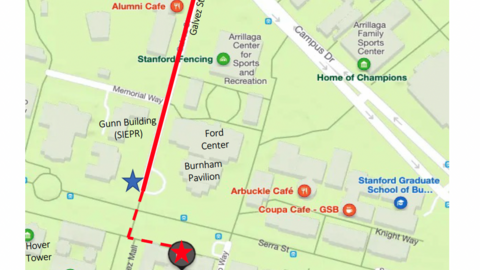
The closest drop-off location is: Gunn Building, 366 Galvez St., Stanford, CA 94305
From Galvez, walk South towards the Hoover Tower, and turn left at the intersection, onto Jane Stanford Way. Encina Hall is the large four-story building on your right. Enter through the main door, at the top of the stairs, and head up to the 2nd floor. An accessible entrance and ramp are located on the right side of Encina Hall, at the West Entrance.
Encina Hall
616 Jane Stanford Way
Stanford, CA 94305-6055
0
fafchamp@stanford.edu
Senior Fellow Emeritus at the Freeman Spogli Institute for International Studies
Professor, by courtesy, of Economics
marcel_fafchamps_2025.jpg
Marcel Fafchamps is a Senior Fellow Emeritus at the Freeman Spogli Institute for International Studies (FSI) and a member of the Center on Democracy, Development and the Rule of Law. Previously, he was the Satre Family Senior Fellow at FSI. Fafchamps is a professor (by courtesy) for the Department of Economics at Stanford University. His research interests include economic development, market institutions, social networks, and behavioral economics — with a special focus on Africa and South Asia.
Prior to joining FSI, from 1999-2013, Fafchamps served as professor of development economics in the Department of Economics at Oxford University. He also served as deputy director and then co-director of the Center for the Study of African Economies. From 1989 to 1996, Fafchamps was an assistant professor with the Food Research Institute at Stanford University. Following the closure of the Institute, he taught for two years at the Department of Economics. For the 1998-1999 academic year, Fafchamps was on sabbatical leave at the research department of the World Bank. Before pursuing his PhD in 1986, Fafchamps was based in Addis Ababa, Ethiopia, for 5 years during his employment with the International Labour Organization, a United Nations agency that oversees employment, income distribution, and vocational training in Africa.
He has authored two books: Market Institutions in Sub-Saharan Africa: Theory and Evidence (MIT Press, 2004) and Rural Poverty, Risk, and Development (Elgar Press, 2003), and has published numerous articles in academic journals.
Fafchamps served as the editor-in-chief of Economic Development and Cultural Change until 2020. Previously, he had served as chief editor of the Journal of African Economies from 2000 to 2013, and as associate editor of the Economic Journal, the Journal of Development Economics, Economic Development and Cultural Change, the American Journal of Agricultural Economics, and the Revue d'Economie du Développement.
He is a research associate of the National Bureau of Economic Research, an affiliated professor with J-PAL, a senior fellow with the Bureau for Research and Economic Analysis of Development, a research fellow with IZA, Germany, and with the Center for Economic and Policy Research, UK, and an affiliate with the University of California’s Center for Effective Global Action.
Fafchamps has degrees in Law and in Economics from the Université Catholique de Louvain. He holds a PhD in Agricultural and Resource Economics from the University of California, Berkeley.
We are living through challenging times — but not for the first time. History reminds us that in our struggle, we are not alone. Across generations, people have risen to meet hardship with courage, community, and conviction — organizing for justice, teaching with purpose, advocating for change, and imagining a better future.
Join us for a powerful, moderated conversation with today’s changemakers — leaders, educators, and activists who are carrying forward this legacy of resilience and hope. Together, we’ll explore how they stay grounded, what inspires their work, and how each of us can play a part in building a more just and compassionate world.
Event organized by Hakeem Jefferson and Gillian Slee.
MODERATORS: Hakeem Jefferson, Karina Kloos
SPEAKERS:
Alison Kamhi
Antonio López
DeCarol Davis
Pam Karlan
About the Speakers
Hakeem Jefferson
Assistant Professor of Political Science & Director, Program on Identity, Democracy, and Justice, Stanford University
Hakeem Jefferson is an assistant professor of political science at Stanford University and faculty director of the Program on Identity, Democracy, and Justice at the Center on Democracy, Development, and the Rule of Law. His research centers on questions of race, identity, and political behavior in the United States. He is currently completing a book based on his award-winning dissertation that explores why members of stigmatized groups sometimes engage in policing and punishing their own. His academic work has been published in The American Political Science Review, Public Opinion Quarterly, Perspectives on Politics, and Electoral Studies. In addition to his scholarly work, Jefferson is a frequent contributor to public conversations about race and American politics, with writing appearing in outlets such asThe New York Times, FiveThirtyEight, The Washington Post, and The San Francisco Chronicle. He is a proud graduate of the University of Michigan and South Carolina public schools.
Karina Kloos is the Executive Director for the Democracy Hub and the newly launched ePluribus Stanford initiative.
Karina has also co-led the design and implementation of other emergent programs at Stanford, including the signature faculty fellowship, postdoctoral fellowship, PhD fellowship and Scholars in Service programs with Stanford Impact Labs, and the RAISE (Research, Action and Impact through Strategic Engagement) Doctoral Fellowship with the Vice Provost of Graduate Education.
She has professional experience in the domestic nonprofit, international development, and philanthropy sectors, and has published in both academic and media outlets on land rights; women’s rights; indigenous rights; sustainability; nonprofit evaluation; social movements; and democracy, including co-authorship with Doug McAdam of the 2014 book Deeply Divided: Racial Politics and Social Movements in Postwar America.
Having spent more than a decade at Stanford – the place where she met her husband and has brought two wee ones into the world – Karina is invested in the vibrancy and health of our community, as well as leveraging the immense talent and resources we have to engage and contribute positively beyond the university. She received her PhD in Sociology from Stanford in 2014.
Alison Kamhi
Legal Program Director, Immigrant Legal Resource Center
Alison Kamhi is the Legal Program Director based in San Francisco. Alison leads the ILRC's Immigrant Survivors Team and conducts frequent in-person and webinar trainings on naturalization and citizenship, family-based immigration, U visas, and FOIA requests. She also provides technical assistance through the ILRC's Attorney of the Day program on a wide range of immigration issues, including immigration options for youth, consequences of criminal convictions for immigration purposes, removal defense strategy, and eligibility for immigration relief, including family-based immigration, U visas, VAWA, DACA, cancellation of removal, asylum, and naturalization and has co-authored a number of publications on the same topics. Alison facilitates the nine member Collaborative Resources for Immigrant Services on the Peninsula (CRISP) collaborative in San Mateo County to provide immigration services to low-income immigrants in Silicon Valley. Prior to the ILRC, Alison worked as a Clinical Teaching Fellow at the Stanford Law School Immigrants' Rights Clinic. Before Stanford, she represented abandoned and abused immigrant youth as a Skadden Fellow at Bay Area Legal Aid and at Catholic Charities Community Services in New York. She clerked for the Honorable Julia Gibbons in the U.S. Court of Appeals for the Sixth Circuit. Alison received her J.D. from Harvard Law School and her B.A. from Stanford University.
Antonio López
Poet Laureate, San Mateo County & Stanford Doctoral Candidate Modern Thought & Literature Program
Antonio López is a poetician working at the intersections of art, politics, and social change. Raised in East Palo Alto by Mexican immigrants from Michoacán, he is a first-generation college graduate with degrees from Duke University, Rutgers-Newark, and the University of Oxford, where he was a 2018 Marshall Scholar. His poetry and essays have appeared in Poetry Foundation, The Slowdown, Poetry Daily, and Latino Poetry: The Library of America Anthology. His debut poetry collection, Gentefication, won the 2019 Levis Prize from Four Way Books. In 2024, he received a Pushcart Prize. From 2020 to 2024, López served on the East Palo Alto City Council and also as its mayor, grounding his scholarship in community leadership and public service. He is completing his PhD in Modern Thought and Literature at Stanford University. His dissertation, Hood Playin’ Tricks on Me: Gentrification, Grief, and the Ghosts of East Palo Alto, won the Stanford Humanities Center Dissertation Book Prize. Structured as a Netflix-style miniseries, the project blends memoir, theory, oral history, and archival work to explore how gentrification haunts communities of color. López is the 5th Poet Laureate of San Mateo County (2025–2027). In fall 2025, he will be a Residential Fellow at the Stanford Humanities Center. He also serves as Associate Director of Research and Advocacy at ALAS, a nationally recognized Latinx cultural arts and justice organization working along the coastside of San Mateo County.
DeCarol Davis
Director, Community Legal Services Program, Legal Aid at Work
DeCarol Davis is the Director of the Community Legal Services program, which provides free legal services to low-wage workers at Workers’ Rights Clinics throughout California. Prior to joining Legal Aid at Work in 2020, Davis, in addition to bartending and managing house at Shotgun Players, Ashby Stage, conducted international legal research with the University of Sydney, Australia on the exploitation of migrant workers. Prior to her research, Davis litigated as a plaintiff-side employment attorney at Bryan Schwartz Law.
As a Truman Scholar, Davis received her J.D. from Berkeley Law in 2017, where she served as a student director of the Workers’ Rights Clinic, was a two-time mock trial national champion, including regional and national titles in the ABA Labor and Employment Law Competition, and earned the Francine Marie Diaz Memorial Award for distinguished public service.
Before becoming an attorney, Davis was an officer in the U.S. Coast Guard. Davis, who graduated top of her class at the Coast Guard Academy in 2008 with a degree in Electrical Engineering, served as a marine inspector, the author of Coast Guard field regulations, and a law enforcement officer. During her service, she was awarded the Judge Advocate General Field Regulations Award, Meritorious Team Commendation, and the Department of Defense STEM Role Model Award. In 2022, she received the Berkeley Law Kathi Pugh Award for Exceptional Mentorship.
Pamela Karlan
Kenneth and Harle Montgomery Professor of Public Interest Law, Stanford Law School
Pamela Karlan is the Kenneth and Harle Montgomery Professor of Public Interest Law and co-director of the Supreme Court Litigation Clinic at Stanford Law School. She has argued ten cases before the Court and worked on over one hundred.
Pam’s primary scholarship involves constitutional litigation. She has published dozens of articles and is the co-author of three leading casebooks as well as a monograph on constitutional interpretation—Keeping Faith with the Constitution. She has received numerous teaching awards.
Pam’s public service including clerking for Justice Harry Blackmun, a term on California’s Fair Political Practices Commission, and two appointments as a Deputy Assistant Attorney General in the Civil Rights Division of the United States Department of Justice. She was also an assistant counsel at the NAACP Legal Defense and Educational Fund.
Pam is a member of the American Academy of Arts and Sciences and the American Law Institute, where she serves on the ALI Council. In 2016, she was named one of the Politico 50 — a group of “thinkers, doers, and visionaries transforming American politics”; earlier in her career, the American Lawyer named her to its Public Sector 45 — a group of lawyers “actively using their law degrees to change lives.”
Shorenstein APARC
Stanford University
Encina Hall, Room E301
Stanford, CA 94305-6055
(650) 736-0656
(650) 723-6530
0
mbreger@stanford.edu
mike_breger.jpg
Michael (Mike) Breger joined APARC in 2021 and serves as the Center's communications manager. He collaborates with the Center's leadership to share the work and expertise of APARC faculty and researchers with a broad audience of academics, policymakers, and industry leaders across the globe.
Michael started his career at Stanford working at Green Library, and later at the Center for Russian, East European and Eurasian Studies, serving as the event and communications coordinator. He has also worked in a variety of sales and marketing roles in Silicon Valley.
Michael holds a master's in liberal arts from Stanford University and a bachelor's in history and astronomy from the University of Virginia. A history buff and avid follower of international current events, Michael loves learning about different cultures, languages, and literatures. When he is not at work, Michael enjoys reading, painting, music, and the outdoors.
Encina Hall
616 Jane Stanford Way
Stanford, CA 94305-6055
0
mbennon@stanford.edu
Research Scholar
mike_bennon_2022.jpg
Michael Bennon is a Research Scholar at CDDRL for the Global Infrastructure Policy Research Initiative. Michael's research interests include infrastructure policy, project finance, public-private partnerships and institutional design in the infrastructure sector. Michael also teaches Global Project Finance to graduate students at Stanford. Prior to Stanford, Michael served as a Captain in the US Army and US Army Corps of Engineers for five years, leading Engineer units, managing projects, and planning for infrastructure development in the United States, Iraq, Afghanistan and Thailand.
Program Manager, Global Infrastructure Policy Research Initiative
Scholars Corner is an ongoing SPICE initiative to share FSI’s cutting-edge social science research with high school and college classrooms nationwide and international schools abroad.
This Scholars Corner video features New York Times bestselling author Francis Fukuyama discussing the recent rise of identity politics, both in the United States and around the world. “In the 20th century we had a politics that was organized around an economic axis, primarily. You had a left that worried about inequality…and you had a right that was in favor of the greatest amount of freedom,” summarizes Fukuyama. “[N]ow we are seeing a shift in many countries away from this focus on economic issues to a polarization based on identity.”
According to Fukuyama, this shift in politics is reflected in such domestic social movements as Black Lives Matter and #MeToo, as well as in international movements like the Catalan independence movement, white nationalism, and even the Islamic State.
The rise of identity politics may have troubling implications for modern democracies. “In the United States, for example, the Republican party increasingly has become a party of white people, and the Democratic party has become increasingly a party of minorities and women. In general, I think the problem for a democracy is that you’ve got these specific identities…[but] you need something more than that. You need an integrative sense of national identity [that’s] open to the existing diversity of the society that allows people to believe that they’re part of the same political community,” says Fukuyama.
“That, I think, is the challenge for modern democracy at the present moment.”
To hear more of Dr. Fukuyama’s analysis, view the video here: “The Rise and Implications of Identity Politics.” For other Scholars Corner episodes, visit our Scholars Corner webpage. Past videos have covered topics such as cybersecurity, immigration and integration, and climate change.
"Identity" hardcover book by Francis Fukuyama
Francis Fukuyama is a Senior Fellow at FSI and the Mosbacher Director of the Center on Democracy, Development, and the Rule of Law. This video is based on his recent book Identity: The Demand for Dignity and the Politics of Resentment, which was recognized as The Times (UK) Best Books of 2018, Politics, and Financial Times Best Books of 2018.
Montek Singh Ahluwalia is an economist who trained at Oxford as a Rhodes Scholar. He spent several years at the World Bank before returning to India to serve as the Economic Advisor to the Finance Minister. The Government of India then appointed him to several senior positions, including Secretary of Commerce and Secretary in the Department of Economic Affairs at the Ministry of Finance. In 1998, he was appointed as a Member of the Planning Commission and Advisory Council to the Prime Minister of India. In 2001, he became the Director of Independent Evaluation Office at the International Monetary Fund, resigning this position in 2004 to become the Deputy Chairman of the Planning Commission.
He has written widely about India and the world economy, co-authoring Redistribution with Growth: An Approach to Policy, and editing Macroeconomics and Monetary Policy: Issues for Reforming the Global Financial Architecture with Y.V. Reddy and S.S. Tarapore.
The Payne Distinguished Lectureship is named for Frank and Arthur Payne, brothers who gained an appreciation for global problems through their international business operations. This lectureship, hosted by the Freeman Spogli Institute for International Studies, brings speakers with an international reputation for leadership and visionary thinking to Stanford to deliver a major public lecture.
Montek Singh Ahluwalia
Deputy Chairman, Planning Commission 2004-2014, Government of India
Deputy Chairman, Planning Commission 2004-2014, Government of India
Eric Nonacs is an independent consultant who focuses on building results-oriented collaborations among and between the private sector, governments, philanthropy, and NGOs to address global challenges such as climate change, pandemic disease, poverty, and economic inequality. Until recently, Eric was the Vice President for Alliances and Partnerships at the Skoll Global Threats Fund.
Previously, Eric was the Managing Director for Global Affairs at Endeavour Financial, a merchant bank based in Vancouver, Canada. Concurrently, he served as a Senior Advisor to the William J. Clinton Foundation (a position he still holds). From June 2002 until August 2007, he was the Foreign Policy Advisor to President Bill Clinton and the Clinton Foundation. Throughout his career, Eric has developed organizations and programs supporting sustainable economic and social development, conflict resolution, increased access to health services, food security, and climate change mitigation across Africa, Europe, North America, and Latin America.
Eric holds an AB from the University of Chicago, an MA from the London School of Economics, and an MBA from New York University. He is the Chairman of Building Markets, the President of the Clinton Giustra Enterprise Partnership (Canada), and an Advisor to the Clinton Global Initiative. Eric is also a Member of the Council on Foreign Relations.





 "Identity" hardcover book by Francis Fukuyama


