-

About the speaker
George C. Herring is Alumni Professor of History, Emeritus at the University of Kentucky. A leading authority on U.S. foreign relations, he is the former editor of Diplomatic History and a past president of the Society for Historians of American Foreign Relations. He is the author of America's Longest War: The United States and Vietnam, 1950-1975, among other books.

Dr. Herring’s From Colony to Superpower: U.S. Foreign Relations Since 1776 is the twelfth and latest book in the Oxford History of the United States, and the first book in the series to focus on a single subject, U.S. foreign policy.

Dr. Herring earned a PhD in history from the University of Virginia, and has been a Visiting Fulbright Scholar at the University of Otago in New Zealand.

About the moderator
David M. Kennedy is the Donald J. McLachlan Professor of History at Stanford University, a senior fellow at the Woods Institute for the Environment, and co-director of The Bill Lane Center for the Study of the North American West. Professor Kennedy is the winner of the 2000 Pulitzer Prize for his book, Freedom from Fear: The American People in Depression and War. Reflecting his interdisciplinary training in American Studies, which combined the fields of history, literature, and economics, Kennedy's scholarship is notable for its integration of economic and cultural analysis with social and political history. His 1970 book, Birth Control in America: The Career of Margaret Sanger, embraced the medical, legal, political, and religious dimensions of the subject and helped to pioneer the emerging field of women's history. One of his later books, Over Here: The First World War and American Society (1980), used the history of American involvement in World War I to analyze the American political system, economy, and culture in the early twentieth century. He is a graduate of Stanford University (BA, history) and Yale University (MA, PhD, American Studies).

About From Colony to Superpower: U.S. Foreign Relations Since 1776:

Image
rom Colony to Superpower: U.S. Foreign Relations since 1776
The newest volume in the acclaimed Oxford History of the United States series – a sweeping chronicle of American foreign relations from the nation’s founding to the present

From the American Revolution to the fifty-year struggle with communism and conflicts in Afghanistan and Iraq, From Colony to Superpower: U.S. Foreign Relations since 1776 tells the dramatic story of America’s emergence as a superpower—its birth in revolution, its troubled present, its uncertain future.

» Buy it from Oxford University Press: "From Colony to Superpower: U.S. Foreign Relations Since 1776" (Oxford University Press, 2008)

The Oxford History of the United States is the most respected multi-volume history of our nation in print. The series includes three Pulitzer Prize winners, a New York Times bestseller, and winner of prestigious Bancroft and Parkman prizes. From Colony to Superpower is the only thematic volume commissioned for the series.  Here, George C. Herring uses foreign relations as the lens through which to tell the story of America’s dramatic rise from thirteen disparate colonies huddled along the Atlantic coast to the world’s greatest superpower.

Quotes in praise of From Colony to Superpower: U.S. Foreign Relations Since 1776:

“George Herring’s well-paced, readable, and up-to-date history of U.S. foreign relations will be the authoritative account for this generation.”
- Emily S. Rosenberg, University of California, Irvine

“In this splendidly detailed account, George Herring expertly guides us through the rich and fascinating story of America’s foreign relations. This is history on a grand scale, clearly and elegantly rendered. Anyone who wants to understand how the Untied States has come to occupy its current place on the world stage should read this magisterial book."
- Fredrik Logevall, co-author of A People and a Nation

Bechtel Conference Center

George C. Herring Alumni Professor of History, Emeritus, University of Kentucky Keynote Speaker
David M. Kennedy Donald J. McLachlan Professor of History, Emeritus; Senior Fellow, Woods Institute for the Environment; and Co-Director, The Bill Lane Center for the Study of the North American West Moderator
Lectures
-

This event - the final in a series of 4 film screening which will be followed by a discussion with director Clint Eastwood - is part of the second phase of a three year research effort to compare the formation of the divided memories in Japan, China, South Korea, Taiwan and the United States. We will conduct a comparative study of popular cinema dealing with historical subjects focusing roughly on the period from 1931-1951.

Letters From Iwo Jima Synopsis

Sixty-one years ago, US and Japanese armies met on Iwo Jima. Decades later, several hundred letters are unearthed from that stark island's soil. The letters give faces and voices to the men who fought there, as well as the extraordinary general who led them.

The Japanese soldiers are sent to Iwo Jima knowing that in all probability they will not come back. Among them are Saigo (Kazunari Ninomiya), a baker who wants only to live to see the face of his newborn daughter; Baron Nishi (Tsuyoshi Ihara), an Olympic equestrian champion known around the world for his skill and his honor; Shimizu (Ryo Kase), a young former military policeman whose idealism has not yet been tested by war; and Lieutenant Ito (Shidou Nakamura), a strict military man who would rather accept suicide than surrender.

Leading the defense is Lt. General Tadamichi Kuribayashi (Ken Watanabe), whose travels in America have revealed to him the hopeless nature of the war but also given him strategic insight into how to take on the vast American armada streaming in from across the Pacific.

With little defense other than sheer will and the volcanic rock of the island itself, Gen. Kuribayashi's unprecedented tactics transform what was predicted to be a quick and bloody defeat into nearly 40 days of heroic and resourceful combat.

Almost 7,000 American soldiers were killed on Iwo Jima; more than 20,000 Japanese troops perished. The black sands of Iwo Jima are stained with their blood, but their sacrifices, their struggles, their courage and their compassion live on in the letters they sent home.

Cubberley Auditorium
485 Lasuen Mall
Stanford University
Stanford, CA 94305

Clint Eastwood Director Speaker
Seminars
-

This is the second phase of a three year research effort to compare the formation of the divided memories in Japan, China, South Korea, Taiwan and the United States.  We will conduct a comparative study of popular cinema dealing with historical subjects focusing roughly on the period from 1931-1951.

This is the third in a series of 4 film screening which will be followed by a discussion of the audience.

Yamato Synopsis

During late World War II, the Japanese army starts loosing the battle.  Special junior officers including Kamio (Kenichi Matsuyama) board Yamato and meet officer Moriwaki (Takashi Sorimachi) and Uchia (Shidou Nakamura).  However, this battle marks the virtual end of the combined fleet of the ikmperial Japanese Navy.  Then in April 1945. Yamato is ordered to carry out a suicide mission and sets out tot he waters of Okinawa...

Philippines Conference Room

Seminars
-

This is the second phase of a three year research effort to compare the formation of the divided memories in Japan, China, South Korea, Taiwan and the United States.  We will conduct a comparative study of popular cinema dealing with historical subjects focusing roughly on the period from 1931-1951.

This is the first in a series of 4 film screening which will be followed by a discussion of the audience.

Devils on the Doorstep synopsis

Renowned actor Jiang Wen directs this sweeping look at a small Chinese village located near the Great Wall during the closing days of WWII. As Japanese soldiers march up and down the village's main thoroughfare, Ma Dasan (Wen) is making love with his widowed lover Yu'er (Jiang Hongbo). Suddenly, there is a knock at the door and a gun at Ma's head. He is informed that for the next week he is to house two gagged and bound prisoners, one a fanatical Japanese soldier, the other a Chinese translator -- and to interrogate the pair. The village elders uneasily question the two, while the translator intentionally mistranslates the epithets and insults from the soldier. When the Chinese resistance fighters do not return to pick up the prisoners, the villagers panic and order Ma to execute them. Ma, in turn, panics and tries to hide the cantankerous duo in the Great Wall -- that is until the villagers discover his ruse and almost lynch him, despite a strongly worded defense by Yu'er. Six months later, the villagers become increasingly worried about boarding these prisoners, lest they all be branded collaborators. This film won the prestigious Grand Prix at the 2000 Cannes Film Festival.

Philippines Conference Room

Seminars
-

This is the second phase of a three year research effort to compare the formation of the divided memories in Japan, China, South Korea, Taiwan and the United States.  We will conduct a comparative study of popular cinema dealing with historical subjects focusing roughly on the period from 1931-1951.

This is the second in a series of 4 film screening which will be followed by a discussion of the audience.

Blue Swallow synopsis

An aspiring Japanese aviator longing to take flight from Japanese-occupied Korea enrolls in Tachikawa Flight Academy in director Yoon Jong-chan's lavish look at the life of pre-World War II aviatrix Park Gyeong-weon. Raised in the Korean countryside but longing to embrace her Korean heritage, Park Gyeong-weon (Jang Jin-yeong) longs to take to the sky "like a swallow." Park is convinced that she has what it takes to soar through the clouds, and in 1925 she begins to pursue her dreams by enrolling in the Tachikawa Flight Academy. An amiable cab driver by day, the tomboyish aeronaut eventually strikes up a close friendship with fellow Koreans Kang Se-gi (Kim Tae-hyeok) and Lee Jeong-heui (Han ji-men) while entering into a tenuous romance with handsome student Han Ji-hyeok (Kim Ju-hyeok). High up in the sky Park attempt to hold her own against airborne Nipponese nemesis Masako Gibe (Yuko Fueki), and as tensions begin to heat up between Japan and Korea the skillful pilot plans a high-profile "friendship" flight to Manchuria in hopes of encouraging peaceful relations between the two countries. - Jason Buchanan,

Philippines Conference Room

Seminars
Authors
News Type
Commentary
Date
Paragraphs

The civilian nuclear cooperation deal between the United States and India, which President George W. Bush signed into law last week, has been controversial from the moment it was first outlined in New Delhi about three years ago. It would allow Washington to trade nuclear technology with New Delhi despite the fact that India is a de facto nuclear weapons state outside of the Nuclear Non-Proliferation Treaty (NPT).

Critics of the deal insist, fairly convincingly, that doing so would cause irreparable harm to the nonproliferation regime, leaving the non-nuclear weapon states that abide by the NPT to question what tangible benefits exist for dutifully assuming their treaty obligations and submitting to NPT restrictions. Conversely, supporters of the deal legitimately point out that the benefits of a good relationship between India and the United States outweigh any potential harm. As with most things, the truth is probably somewhere in the middle--it's unlikely that the nonproliferation regime would remain unscathed, but it's quite possible that the damage could be contained.

A major sticking point for critics is that the deal actually makes it easier for India to continue producing fissile material for its nuclear weapons program by allowing New Delhi access to the world market in nuclear fuel for its power reactors, thereby freeing its scarce uranium resources for the production of weapons-usable plutonium in dedicated reactors that are exempt from any international safeguards. Moreover, India's breeder reactor program--another potential source of weapon-grade plutonium--is also free from safeguards. It's hardly encouraging that India would have the capability to increase its stock of weapon materials, but in reality, this doesn't much matter--probably the main reason why India got away with keeping that capability. There seems to be a worldwide consensus that once New Delhi crossed the nuclear threshold, the amount of weapons in its arsenal is unimportant. In fact, in some important aspects this is exactly the case--beyond its symbolic value India's nuclear arsenal hardly provides any security for the country. Indeed, if the U.S.-India nuclear deal helps strengthen this understanding, it provides some silver lining to the nuclear arrangement's drawbacks.

The deal could also provide a much needed incentive for a critical review of some of the current nonproliferation regime's assumptions. One such assumption is implicit in Article VI of the NPT--nuclear weapon states and their close allies have control over nuclear technologies. This is still largely true for advanced commercially viable technologies, but the monopoly on weapon-relevant technology is firmly in the past. An idea that emerged during discussion of the U.S.-India nuclear deal was to ban the transfer of enrichment and reprocessing technologies to India, supposedly to limit its ability to ramp up production of weapon materials. Limiting production of weapon-grade materials is a reasonable goal, but if the only approach is to deny a country access to advanced centrifuges or reprocessing plants, that battle is already lost.

Similarly, much ink has been spilled over the effort to have India commit to a moratorium on nuclear testing as part of the deal. The intent behind the idea was certainly laudable. But if the threat of cutting off the supply of fuel for nuclear reactors is our best hope to prevent India from nuclear testing, the effort to prevent new nuclear tests is in big trouble.

Without a doubt, the U.S.-India nuclear deal presents a serious challenge to the NPT. But it also presents an opportunity to strengthening the regime and its most important, relevant elements. In particular, for all of its problems and challenges, the NPT has successfully established a norm that assumes that countries shouldn't have nuclear weapons. The official signing of the U.S.-India nuclear deal is a good time to remind New Delhi that if it wants to be a responsible partner in the nuclear trade, it must assume the obligations that come with this norm--even if India never signed the NPT. Of course, this would require the nuclear weapon states to get serious about their NPT obligations and responsibilities as well. And that's not such a bad thing either.

All News button
1
News Type
Commentary
Date
Paragraphs

In video taken October 14, during a debate with former CIA Director James Woolsey, CDDRL Director Michael A. McFaul attacks the idea that America invaded Iraq solely to promote democracy. McFaul argues that, except in a few rare instances, the United States has never invaded a country unless there was a national security concern.

McFaul and Woolsey also discuss mistakes made in the Iraq War and argue whether or not it was beneficial for either America or Iraq. Woolsey believes a "failure" of the Bush Administration was giving Iraq a "constitution that we [the U.S.] drafted."

The event was sponsored by the Commonwealth Club of California in San Francisco, McFaul debated former CIA Director James Woolsey on international security and how it factors into each presidential campaign's plans for the country. McFaul is a foreign policy advisor to Sen. Barack Obama; Woolsey is an advisor to Sen. John McCain.

All News button
1
-

In addition to Iraq, Afghanistan, Pakistan, the financial crisis, and the housing crisis (as if that were not enough!), the next American president will have his hands full with matters on the Korean peninsula.  What will be the future of Six Party talks?  What is the status of the leadership in Pyongyang?  How do changes in leadership in Washington (and potentially in Pyongyang) affect outcomes?  What are the prospects for US-ROK relations?  And what of the KORUS FTA?  Victor Cha, former director of Asian affairs at the White House, will lead a discussion on these issues.

Professor Cha is director of Asian Studies and holds the D.S. Song Chair in the Department of Government and School of Foreign Service at Georgetown University.  He left the White House in May 2007 after serving since 2004 as Director for Asian Affairs at the National Security Council.  At the White House, he was responsible primarily for Japan, the Korean peninsula, Australia/New Zealand and Pacific Island nation affairs.   Dr. Cha was also the Deputy Head of Delegation for the United States at the Six Party Talks in Beijing, and received two Outstanding Service commendations during his tenure at the NSC.  

He is the award-winning author of Alignment Despite Antagonism: The United States-Korea-Japan Security Triangle (Stanford University Press) (winner of the 2000 Ohira Book Prize) and co-author of Nuclear North Korea: A Debate on Engagement Strategies (Columbia University Press, 2004).  He has written articles on international relations and East Asia in journals including Foreign Affairs, International Security, Political Science Quarterly, Survival, International Studies Quarterly, and Asian Survey.   Professor Cha is a former John M. Olin National Security Fellow at Harvard University, two-time Fulbright Scholar, and Hoover National Fellow,  CISAC Fellow, and William J. Perry Fellow at Stanford University.

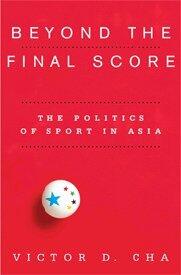
Image
beyond the final score
He serves as an independent consultant, and has testified before Congress on Asian security issues.  He has been a guest analyst for various media including CNN, ABC Nightline, NBC Today Show, CBS Morning Show, Fox News, MSNBC, CNBC, BBC, ESPN, Sports Illustrated, and National Public Radio.

His new book Beyond the Final Score: The Politics of Sport in Asia (Columbia University Press, 2008) looks at the politics of sports and the Beijing Olympics. Cha holds a BA and Ph.D. from Columbia University, MA from University of Oxford.

This event is sponsored by the Pantech Group in Korea.

Philippines Conference Room

Victor D. Cha Director of Asian Studies Speaker Georgetown University
Seminars
Authors
Daniel C. Sneider
News Type
Commentary
Date
Paragraphs

In the waning days of the Clinton administration, the momentum for engagement with North Korea, building from the earlier agreement to freeze its nuclear program and a moratorium on ballistic missile launches, accelerated to the brink of full-scale normalization of relations. The U.S. presidential election in 2000 brought that diplomatic freight train to an abrupt halt.

Will the 2008 election bring yet another dramatic change in U.S. Korea policy?

The answer, based on the published positions of the two candidates and conversations with his senior Asia policy advisors, seems to be NO. There are important differences of emphasis in the approaches of both candidates, which I will discuss, but the bottom line is that both men are likely to pick up where President George W. Bush leaves off.

There are two fundamental reasons why U.S. policy toward Korea – and more broadly in Northeast Asia --- will not change dramatically. First, Asia will continue to suffer from a deficit of presidential attention. The arc of crisis – Iraq, Iran, Afghanistan and Pakistan -- will necessarily still command, as it has for almost 8 years, the attention of senior American policymakers. Even that will have to fight for space with the growing global financial crisis.

Second, both candidates agree on the broad outlines of an Asia policy, one that does not depart radically from the one pursued by the Bush administration. As a senior McCain advisor put it to me: “There is not a huge difference on Asia between Obama and McCain.” Privately, Obama advisors also stress that there will not be a huge break with current U.S. policy.

Both campaigns are critical of the lack of attention paid to Asia and the need for the U.S. to be more proactive to strengthen existing alliances and to join the discussion about new forms of regional integration. Both candidates support the need to engage, rather than confront, a rising China. Both men call for the U.S. to pay more attention to management of our alliances with South Korea and Japan. And both Obama and McCain support the North Korean nuclear negotiations carried out by President Bush in his second term, although privately both campaigns are critical of the deal that has been struck.

If there are differences, they can be found in two areas – support for the Korea US free trade agreement and the willingness to directly engage North Korea and its regime.

Free Trade and the KORUS Free Trade Agreement

If there is one single issue regarding Korea on which Senators Obama and McCain clearly part company, it is the future of the free trade agreement negotiated with the Bush administration. Senator McCain is an unambiguous supporter of the FTA, not only as a trade pact but also as a symbol of the broader partnership between the U.S. and South Korea.

Senator Obama also supports free trade but is critical of this and other agreements, such as NAFTA, for failing to ensure market access and the protection of labor rights and the environment. Privately, Obama’s advisors understand the symbolic value of the FTA to the alliance, but they plan to ask Seoul to reopen talks on market access, particularly for the automobile industry. Their position reflects the importance of trade unions and the role of some key states – Michigan most of all – in the election outcome. Even if Obama loses, the Democrats are likely to strengthen their control of Congress, making approval of the FTA difficult under any circumstances.

Negotiating with Pyongyang: Back to the Future?

Both the McCain and the Obama camps publicly back the Bush administration’s negotiations with Pyongyang, but both are also privately critical, though for different reasons.

The Obama team is heavily populated by former Clinton administration officials who were involved in the negotiation of the 1994 Agreed Framework with North Korea. They see the current deal as an inevitably flawed bargain, the result of the refusal of the administration to seriously engage the North directly until it had crossed the red line of nuclear weapons testing. With little leverage, not least the credible threat of coercion, we are left with containing the plutonium production of the North, and hoping that a grand bargain down the line can yield full denuclearization.

Obama recognizes the need for “close coordination and consultation with our allies South Korea and Japan,” as one of his advisors put it in a published interview, and supports continuing the Six Party Talks. But the emphasis is clearly on direct talks with North Korea, though conducted with a principled toughness that the Bush administration has not exhibited in its final months in office.

That readiness to conduct direct negotiations, up to conclusion of a peace treaty with Pyongyang and full normalization of relations, is where the two candidates part company. The Republican nominee is clearly uncomfortable with direct dealings with Pyongyang – his position resembles the first term of the Bush administration more than the second in that respect. His advisory team combines realists, mainly veterans of the Powell State Department, and neoconservatives, reproducing the divisions that thwarted coherent policy-making in that first Bush term.

In the end, the views of McCain himself may be decisive. He was an opponent of the Agreed Framework, an agreement he characterized as “appeasement.” He maintained this stance into the Bush administration, vocally opposing any direct negotiations with the North Koreans as long as they maintained the right to develop nuclear weapons. He has been critical as well of the main deal struck by President Bush in his second term – “I didn’t believe in the KEDO agreement that President Clinton made and I don’t believe in this one,” he said in January.

McCain, according to an interview with one of his senior Asia advisors, would “seek a return to the core principles of denuclearization known as CVID, or complete, verifiable, irreversible, dismantlement.” The demand for CVID was the watchword of the Bush administration’s earlier stance, in effect a call for Pyongyang to abandon its nuclear option as a first step. But that demand was dropped after Pyongyang called the Bush administration’s bluff by exploding a nuclear device in October, 2006.

McCain also wants to “broaden our policy goals related to North Korea” beyond nuclear issues, to including human rights, economic and political reform, and reduction of the conventional military threat from North Korea, goals also set out at the outset of the Bush administration. McCain has repeatedly referred to the North Korean regime, and its leader, Kim Jong Il, in harsh terms and embraced a policy of “rogue state rollback.”

Realistically, however, McCain offers no credible, practical means to reach these goals. He reserves, as does Obama, the option to use force. But concretely he comes back to the strategy of pressing China to bring North Korea to heel. Unfortunately the Bush administration also relied on China and found there were clear limits to Beijing’s ability to control or its willingness to press its North Korean client. In the end, McCain may have little option but to follow Bush to Pyongyang’s doorstep.

One Caveat – Events Matter

Despite the powerful impetus to maintain continuity in U.S. policy toward the Korean peninsula, no matter whom is elected in November, there is one important caveat to keep in mind – events matter. Unplanned, and unforeseen, developments could force Korea to the top of the President’s agenda. Already we have seen the reports of Kim Jong Il’s serious illness trigger fresh concerns about a possible collapse of political authority in Pyongyang. A simultaneous rush by China, South Korea and the United States to fill a vacuum of power in the North could upset all calculations. For South Korea, and President Lee Myung-bak, it is always best to prepare for the unexpected.

Hero Image
sneider
All News button
1
Subscribe to North America