0
Einstein Moos Postdoctoral Fellow, 2024-25
screenshot_2023-09-13_at_7.49.08_pm_-_julieta_casas.png

Julieta Casas is the Einstein Moos Postdoctoral Fellow at the Center on Democracy, Development and the Rule of Law (CDDRL) at Stanford University. She is a scholar of comparative political development, using original historical data to study state-building and democratization in Latin America and the United States.

Her research agenda examines how countries achieve effective democratic governance in competitive settings. In her book project, she traces the origins of bureaucratic reform to different types of patronage and identifies the conditions under which countries can significantly reduce the politicization of the bureaucracy. This research draws from an in-depth case study of the United States and Argentina in the nineteenth century and from the study of broad patterns in bureaucratic reform across the Americas. She will receive her Ph.D. in Political Science from the Department of Political Science at Johns Hopkins University in the Summer of 2024.

Other projects explore the first surveys of bureaucrats in the United States, assess the possibility of situating American exceptionalism in comparative perspective, and analyze how personnel management institutions affect policy outcomes. 

Date Label
Authors
Rachel Owens
News Type
News
Date
Paragraphs

Can indigenous communities ruling through politically autonomous institutions better protect against cartel takeover? In a CDDRL seminar series talk, Beatriz Magaloni, the Graham H. Stuart Professor of International Relations, a Senior Fellow at Stanford’s Freeman Spogli Institute for International Studies, and Director of CDDRL’s Poverty, Violence, and Governance Lab argued that in Mexico, indigenous communities ruled by traditional governance have proven more resilient against cartel takeovers than comparable municipalities relying on state-backed security provision. 

Existing literature typically frames violence in developing countries as a manifestation of state weakness. But, in many areas of the world, organized criminal groups infiltrate the state, buying off intelligence, protection, and impunity. 

In Mexico, cartels infiltrate local governments by funding political campaigns, killing those who refuse to be bought off. In this context, the selection of leaders through conventional Western multi-party elections is an effective vehicle through which cartels can extend their influence. 

The capture of municipal political bodies is advantageous to cartels as it allows them to diversify their revenue generation. Access to intelligence, resources, and territory makes demanding regular payments and extracting natural resources far easier. It also allows cartels to gain discretionary power in the decision of who the state grants protection to or not. This bleak reality in which the borders between the state, organized crime, rule of law, and impunity are blurred elevates the urgency of investigating to what extent “opting out” of the state represents a viable alternative in the provision of security. 

In Oaxaca and other regions across Mexico, indigenous communities have the right to govern autonomously. In their traditional form of governance, known as “usos y costumbres,” local elections and political parties are banned. Authorities are instead selected through community assemblies, in which decision-making is highly participatory. Based on this traditional governance, a growing number of indigenous communities have established community police groups, which are detached from the state and constituted by local community members with little or no professional police training. 

Importantly, autonomous indigenous municipalities still receive state transfers and cannot be punished for opting out of the party system. In conducting extensive qualitative fieldwork, Magaloni sought to understand whether this traditional governance structure prohibits cartel infiltration and keeps communities safer. 

The team hypothesized that higher levels of cartel presence would increase violence – which they proxied with homicide rates. They expected less cartel presence and less violence in Usos (autonomous indigenous communities) relative to party-controlled municipalities. Lower levels of police corruption and better deterrence against criminal cells were also expected for communities ruled by Usos. 

The initial exploratory analysis showed that following the autonomous governance reform, Usos communities experienced a sharp decrease in violence. When the drug war began in 2006, these communities continued to see low levels of violence, whereas comparable municipalities suffered a sharp increase. 

Magaloni employed a variety of difference in difference analyses to control for possible confounders. Usos communities were compared to similarly sized, similarly indigenous communities. Using a geographic discontinuity design, Usos were also compared to municipalities just 1 km from the border of Oaxaca – those ruled by multi-party elections. The analysis controlled for opium poppy suitability and history of ancestral governance practices. 

The analysis confirmed that the more cartel presence, the more violence a community experienced. Across all models, the team was able to conclude that Usos communities saw significantly less cartel presence, fewer homicides, and less violence. 

Magaloni’s work highlights the state's limitations in creating order in circumstances where criminal groups have compromised it. It also suggests that in the context of these predatory regimes, indigenous political autonomy can serve as a powerful rampart to the corrosive presence of organized crime.

Read More

Alisha Holland
News

Infrastructure, Campaign Finance, and the Rise of the Contracting State

Harvard University Professor of Government Alisha Holland explains how the advent of public-private partnerships has shifted politicians’ orientation toward infrastructure projects.
Infrastructure, Campaign Finance, and the Rise of the Contracting State
Sophie Richardson
News

The Global Dimensions of the Chinese Government Human Rights Abuses

Why have democracies failed in curtailing Xi Jinping’s human rights abuses? And how can they better insulate themselves from Beijing's transnational threats? CDDRL Visiting Scholar and former China Director at Human Rights Watch Sophie Richardson presented her research on the Chinese government’s deteriorating human rights record.
The Global Dimensions of the Chinese Government Human Rights Abuses
Hero Image
Beatriz Magaloni presents during a CDDRL research seminar on April 11, 2024.
Beatriz Magaloni presents during a CDDRL research seminar on April 11, 2024. Photo: Rachel Cody Owens | Rachel Cody Owens
All News button
1
Subtitle

Beatriz Magaloni, the Graham H. Stuart Professor of International Relations, presented her latest research during a CDDRL seminar talk.

Date Label
-
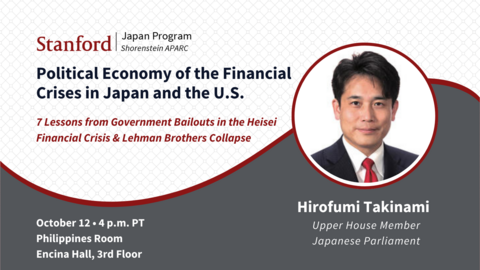
Banner image for October 12, 2023 APARC event Political Economy of the Financial Crisis in Japan and the U.S. featuring headshot of speaker Hirofumi Takinami


This spring, we saw the collapses of Silicon Valley Bank, Credit Suisse, etc., and now we are observing collapses of Chinese real estate giants: Evergrande, and Country Garden. Would be there another financial crisis? 
Now, it is highly worthy to review the ‘lessons' of historically recent financial crises with significant seriousness, which happened in the two largest economies, the United States and Japan.

During the 1990s-2000s, Japan and the United States each experienced the same type of financial crisis, notably triggered by the collapse of major financial institutions, stemming from the real estate bubble burst. Namely, the Heisei Financial Crisis and the Lehman Brothers Collapse.

Both were under the political-economic conditions of one of the largest economies in the world, as well as of an advanced democracy. Enormous shock happened politically, economically, and historically, due to these two financial crises.

Then, as the research question, what were the ‘lessons’ of the United States and Japan's financial crises, concerning crisis response through public money injection, from the viewpoint of political economy? Where is the ‘learning’ between Japan and the United States?
Also, as the related research ‘puzzle’, why the difference in speed between these countries to respond and recover?

Based on his Ph.D. thesis, Senator Takinami, an alumnus of Stanford APARC, will elaborate on these issues by covering up and amending Hoshi & Kashyap(2010), thus establishing ‘7 lessons’ throughout the Japan and the United States financial crises on government bailout from the political economy viewpoint.


Speaker

Square photo portrait of Hirofumi Takinami

Hirofumi Takinami (Ph.D.) is an Upper House Member of the Japanese Parliament, corresponding to a Senator in the U.S. He is a former Vice-Minister of Economy, Trade, and Industry, and also a former Vising Scholar, APARC, Stanford University. 

Dr. Takinami covers a wide range of policies, including not only energy, environment, and finance, but also innovation, infrastructure, welfare for the disabled, etc. He has been the Director of the Fisheries Division of LDP (Liberal Democratic Party) from last year.

Before starting his political career 10 years ago, he was a Director of the Ministry of Finance. During his about 20 years of service as a Japanese government official, he held management positions including Public Relations Director, and Deputy Budget Examiner at the Ministry of Finance. He also worked internationally, in charge of the Asia-Pacific Economic Cooperation (APEC) and the Asia Europe Meeting (ASEM) etc. 

He graduated from the University of Tokyo in 1994, earning a Bachelor of Law. He received a Master of Public Policy (MPP) from the University of Chicago in 1998. While in office as an upper house member, he obtained a Ph.D. in 2021 from Waseda University for the study on financial crises, which he started when he held research positions at Stanford University as a Visiting Fellow in 2009-2011 and as a Visiting Scholar in 2016. 

Hirofumi Takinami Upper House Member of Japanese Parliament, Ph.D. , Former Vising Scholar, APARC, Stanford University Upper House Member of Japanese Parliament
Seminars
Paragraphs

The term “deep state” originally referred to the hidden security bureaucracies in countries like Turkey and Egypt with sinister overtones. The term has been applied by American conservatives to the existing permanent US bureaucracy, which they argue is exerting tyrannical control over citizens and needs to be destroyed root and branch. The fact is that the US administrative state is highly transparent and plays a critical role in delivering services and outcomes that citizens demand. Modern government cannot function without a high degree of delegation to bureaucratic agents; as such the US “deep state” needs to be defended and not vilified. There are several critical mechanisms for democratic principals to exert control over bureaucratic agents. While there are instances of bureaucratic over-reach, the US system provides a number of checks on agency power that are under-utilised. A separate problem lies in under-delegation, where political principals write detailed rules constraining bureaucratic autonomy in ways that hinder effective and timely government action. Future efforts by conservatives to undermine the “deep state” will result in grave weakening of American government and return the country to the 19th century patronage system.

All Publications button
1
Publication Type
Journal Articles
Publication Date
Journal Publisher
Asia Pacific Journal of Public Administration
Authors
Francis Fukuyama
0
CDDRL Research Affiliate, 2025-26
Deliberative Democracy Lab Postdoctoral Fellow 2023-25
lodewijk_gelauff_1.jpg

Lodewijk Gelauff is a Postdoctoral Scholar at the Deliberative Democracy Lab in CDDRL. He is an interdisciplinary scholar and received his doctorate in Management Science and Engineering from Stanford in 2023 with his dissertation on "Design and Evaluation of Online Technologies for Societal Decision Making."

In his work, he works with societal decision-makers to use and improve tools to engage residents or stakeholders in their decisions. As part of this, he managed the development and use of a few tools, including a video chat platform to facilitate small-group discussions without a human moderator and a voting platform for participatory budgeting that is used by dozens of cities in the United States.

In his recent work, he focuses on designing experiments and developing data sets that allow more in-depth analysis of how stakeholders use these technologies in practice. Lodewijk is actively involved as a volunteer with the Wikimedia community and was named the Wikimedia Laureate (a career award) in 2021 for his volunteer activities. 

Date Label
-

Webinar Description:
The Stanford Program on International and Cross-Cultural Education (SPICE) and Stanford Global Studies (SGS) are excited to offer a professional development workshop for community college instructors who wish to internationalize their curriculum. The workshop will feature a talk by Stanford historian Dr. Bertrand Patenaude on the major famines of modern history, the controversies surrounding them, and the reasons that famine persists in our increasingly globalized world. Workshop participants will receive a copy of Dr. Patenaude’s book Bread + Medicine: American Famine Relief in Soviet Russia, 1921–1923 (Hoover Institution Press, 2023). Published in June, the book recounts how medical intervention, including a large-scale vaccination drive, by the American Relief Administration saved millions of lives in Soviet Russia during the famine of 1921–23.

Register at https: http://bit.ly/474cpK2.

Featured Speaker:

Dr. Bertrand M. Patenaude

Dr. Bertrand M. Patenaude headshot

Dr. Bertrand M. Patenaude teaches history, international relations, and human rights at Stanford, where he is a Lecturer for the International Relations Program, a Research Fellow at the Hoover Institution, and a Faculty Fellow at the Center for Innovation in Global Health (CIGH). Patenaude teaches courses at the Stanford School of Medicine as a Lecturer at the Center for Biomedical Ethics (SCBE). His seminars range across topics such as United Nations peacekeeping, genocide, famine in the modern world, humanitarian aid, and global health.


Via Zoom Webinar. Registration Link: http://bit.ly/474cpK2

Dr. Bertrand Patenaude Lecturer for the International Relations Program, a Research Fellow at the Hoover Institution, and a Faculty Fellow at the Center for Innovation in Global Health (CIGH)
Workshops
Paragraphs
Governance in California

Governance is the way that societies make decisions and solve problems. Good governance is difficult when a society is divided in its values, when trust in governing institutions is low, when political participation is biased along various social lines, and when there is not enough reliable information and structured debate in the media. Complicating matters further, governments may not be able to reach important decisions when there are too many veto points that enable small groups to delay or stop decisions, regardless of their merit or public support. Finally, even after a decision is made, governmental agencies may lack the personnel and capacity to implement and administer policies.

While California’s governance system has solved many problems, its governance system suffers from significant challenges in many areas. These include: hard problems (with large-scale challenges associated with climate change, housing, poverty, and more), multiple veto points in public decision-making, partisan division, and polarization, lack of trust in institutions, biased participation in public decisions, and the need to accelerate the modernization and strengthening of civil service in state and local government.

SCENARIOS FOR THE FUTURE


The following are presented as four possible scenarios for California’s governance, media, and civil society future.
 

Image
Scenarios for the future graphic
All Publications button
1
Publication Type
Reports
Publication Date
Subtitle

A California 100 Report on Policies and Future Scenarios

Journal Publisher
California 100
Authors
Francis Fukuyama
Michael Bennon
Paragraphs

Despite five decades of administrative practice and judicial development, there is a considerable gap in legal and empirical study on the impacts of the National Environmental Policy Act of 1970 (NEPA). Proponents of NEPA reform often claim that environmental litigation is a major obstacle for important federal actions. Others have studied the same issue and concluded that NEPA litigation is not a major contributor of project cost escalation or delays. This study addresses this gap by supplementing a data set of the largest 355 transportation and energy infrastructure projects in the United States which completed a federal environmental study between 2010 and 2018.

We observe predevelopment litigation on 28% of the energy and transport projects requiring an Environmental Impact Statement, 89% of which involve a claim of a NEPA violation. Of the major sectors, the highest litigation rate is in solar energy projects, nearly two-thirds of which are litigated. Light Rail Transit projects are litigated at nearly twice the rate of new highway projects and 2.5x the rate of highway improvement projects. Other high-litigation sectors include pipelines (50%), transmission lines (31%), and wind energy projects (38%). Energy sectors with higher rates of private financing have shorter permit durations, higher rates of litigation, and higher rates of cancellation but also higher completion rates relative to transport sectors, which have higher rates of public financing and lower rates of litigation, but extremely long permit timelines. Our findings shed additional light on the ways that NEPA impacts large, environmentally impactful infrastructure projects in various sectors in the United States.

All Publications button
1
Publication Type
Working Papers
Publication Date
Journal Publisher
Environmental Law Reporter
Authors
Michael Bennon
Paragraphs
Cover of Enhancing Resilience in a Chaotic World: The Role of Infrastructure

The United States is currently undergoing a period of massive change in its economy, which is being spearheaded by three major pieces of federal infrastructure and industrial policy legislation: the Infrastructure Investment and Jobs Act (IIJA), the Creating Helpful Incentives to Produce Semiconductors (CHIPS) Act, and the Inflation Reduction Act (IRA). These new programs represent not only a massive investment in select parts of the US economy, but also significant changes in how the US invests and manages its economy through the use of industrial policy.

This chapter reviews these changes in the “how” of US industrial policy and federal investment and discusses two of the challenges that the US government faces as it attempts to orchestrate major changes to its economy. The first is a regulatory system designed to slow or otherwise constrain capital investment and growth. The second consists of unique aspects of US governance and its role in the global economy that will make state-led direct investment and other industrial policy programs challenging to implement.

All Publications button
1
Publication Type
Reports
Publication Date
Subtitle

Chapter in Enhancing Resilience in a Chaotic World: The Role of Infrastructure, an ISPI-McKinsey & Company REPORT

Authors
Michael Bennon
Book Publisher
Italian Institute for International Political Studies
Paragraphs

In political science, one issue still in need of greater theorizing is the proper measurement of bureaucratic autonomy, that is, the degree of discretion that political principals should grant to bureaucratic agents. This article reviews the literature on bureaucratic autonomy both in US administrative law and in political science. It uses the American experience to define five mechanisms by which political principals grant and limit autonomy, then goes on to survey the comparative literature on other democratic systems using the American framework as a baseline. Other democracies use different mixtures of these mechanisms, for example by substituting stronger ex post review for ex ante procedures or using appointment and removal power in place of either. We find that the administrative law and social science literatures on this topic approach it very differently, and that each would profit from greater awareness of the other discipline.

All Publications button
1
Publication Type
Journal Articles
Publication Date
Journal Publisher
Annual Review of Political Science
Authors
Francis Fukuyama
Number
213-232
Subscribe to North America