-

ABSTRACT

Democracy promotion has been a longstanding goal of US foreign policy in the Middle East and elsewhere. President George W. Bush championed democracy promotion as a way to counter the ideology and extremism that led to the September 11, 2001 terror attacks against the United States. After Bush’s attempts ended in abject failure, President Barack Obama sought to repair relations with the Muslim world but also withdraw the US footprint in the Middle East. But Obama was forced to take a far more hands-on approach with the outbreak of the 2010-2011 uprisings known as the Arab Spring. President Donald Trump, who has displayed an almost allergic aversion to Obama’s policies, has openly embraced the region’s autocrats with little regard for their abuse of human rights or absence of attention to political or economic freedom. How the United States approaches the region matters – both for aspiring democrats and for those who wish to silence them. Despite the rise of Russia and China, the United States remains the sole superpower, with the loudest voice on the world stage. Thus, the shift from democracy promoter – albeit reluctantly at times – to authoritarian enabler has made the task of democratic political reform far more challenging for people across the Middle East. This discussion will examine the recent democracy promotion efforts of the United States, with a focus on the Obama and Trump years.

SPEAKER BIO

Image
yerkes color large 2017
Sarah Yerkes is a fellow in the Carnegie Endowment for International Peace’s Middle East Program, where her research focuses on Tunisia’s political, economic, and security developments as well as state-society relations in the Middle East and North Africa.  She has been a visiting fellow at the Brookings Institution and a Council on Foreign Relations international affairs fellow and has taught in the Security Studies Program at Georgetown University and at the Elliott School of International Affairs at the George Washington University. Yerkes is a former member of the State Department’s policy planning staff, where she focused on North Africa. Previously, she was a foreign affairs officer in the State’s Department’s Office of Israel and Palestinian affairs. Yerkes also served as a geopolitical research analyst for the U.S. military’s Joint Staff Strategic Plans and Policy Directorate (J5) at the Pentagon, advising the Joint Staff leadership on foreign policy and national security issues.

Online, via Zoom: REGISTER

Sarah Yerkes Carnegie Endowment for International Peace
Seminars
Authors
News Type
News
Date
Paragraphs

CDDRL’s Program on Arab Reform and Democracy held its annual conference at Stanford University on October 11 and 12, titled “The Struggle for Political Change in the Arab World.” The conference is an outgrowth of ARD’s efforts to support new research on the dynamics of political change in the countries of the Arab world. Scholars from across different disciplines sought to understand how social, economic, and political dynamics at the national level, as well as international and regional conflict and power rivalries, impact struggles for political and social change in the region.

Overview of Panels and Speakers

Image
larry diamond banner
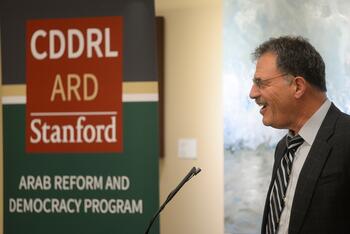
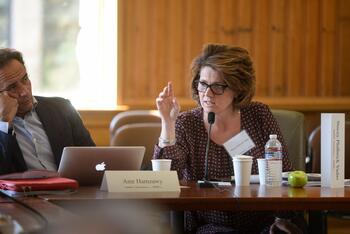
Following opening remarks by FSI Senior Fellow Larry Diamond, the first panel titled “The Boundaries of Authoritarianism post-Arab Uprisings” featured CDDRL Senior Research Scholar Amr Hamzawy. His paper examined how the regime of Abdel Fattah Al-Sisi has employed discursive strategies to discredit calls for democratic change in the country. Sean Yom, Associate Professor of Political Science at Temple University, outlined how the protest strategies of Jordanian youth have limited their effectiveness in advancing meaningful political change. University of California, Davis Scholar Samia Errazzouki discussed the failure of state-led political and economic reform in Morocco.

Chaired by Harvard University Fellow Hicham Alaoui, the second panel was titled “Popular Uprisings and Uncertain Transitions.” University of California, Santa Cruz Political Scientist Thomas Serres provided an overview of the economic disruptions that contributed to Algeria’s uprising. Lindsay Benstead, who is an Associate Professor of Political Science at Portland State University, analyzed the electoral successes of Tunisia’s Ennahda Party. Khalid Medani, Professor of Political Science at McGill University, explained how Sudanese protesters leveraged new strategies of contention to force Omar Al-Bashir out of power.

farrah al nakib and michael herb Farah Al-Nakib (right) and Michael Herb (left)
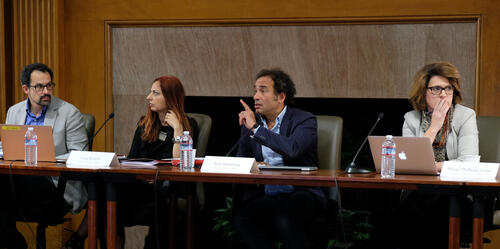
The third panel, titled “Politics, Succession and Sectarianism in the GCC States,” included Oxford University Fellow Toby Matthiesen, who discussed how Saudi Arabia and the GCC states have increasingly sought to protect their regimes by actively molding the politics of their autocratic patrons in the region, and by using new technologies to upgrade the effectiveness of their surveillance states. Georgia State University Political Scientist Michael Herb explained how the aging of the Saudi line of succession contributed to the political ascendancy of Crown Prince Mohammad Bin Salman and the decay of family rule in the country. Cal Poly Historian Farah Al-Nakib described how Kuwait’s royal family has used its sponsorship of large-scale development projects to sidestep the country’s political polarization, undermine the power of the parliament, and weaken public access to spaces of political contestation.

Image
hesham and toby matthiesen
The fourth panel focused on “Social Strife and Proxy Conflict in the Middle East.” Chatham House Scholar Lina Khatib described Syria’s transformation during the civil war from a highly centralized security state to a transactional state in which the regime depends heavily on local powerbrokers. Stacey Philbrick Yadav, Associate Professor and Chair of the Department of Political Science at Hobart and William Smith Colleges, discussed differences in how local communities in Yemen have been affected by the country’s conflict. David Patel, who serves as Associate Director for Research at the Crown Center for Middle East Studies at Brandeis University, argued that Iraq’s democratic institutions have been impressively robust to a series of existential challenges, but he also highlighted a widespread feeling among the Iraqi public that its parliamentary system is failing to deliver.

Image
lisa blaydes
Finally, the fifth panel examined the topic of “International Forces in the Arab Political Arena.” Stanford University Political Scientist Lisa Blaydes suggested that China’s efforts to involve itself in the regional economy may improve its reputation among economically-frustrated Arab citizens, but that such efforts also spell trouble for democracy and human rights in the Middle East. Hamid & Christina Moghadam Director of Iranian Studies at Stanford University Abbas Milani argued that Iran’s ideological commitment to exporting the Islamic Revolution has been remarkably consistent for several decades. Colin Kahl, Co-director of the Center for International Security and Cooperation at FSI, reviewed the strategies of US administrations toward the Middle East, and posited that President Trump’s approach of pursuing maximalist objectives with minimal commitments is particularly likely to heighten instability in the region. FSI Scholar Ayca Alemdaroglu emphasized that Turkey’s neo-Ottoman foreign policy has failed to achieve its objectives in the face of mounting regional upheaval.

Common Themes of Political Change and Continuity

Image
hamzawy khatib patel stacey
Several themes emerged from conference presentations. First, across the panels, scholars discussed the lessons learned by autocrats and activists alike in the aftermath of the Arab Spring, and the ways in which these lessons have transformed regional politics. Hamzawy emphasized that the Sisi regime in Egypt has increasingly relied on intensive repression over cooptation to maintain stability, while at the same time refusing to grant even limited political openings as existed under Hosni Mubarak’s presidency. In part, this change appears to be rooted in the regime’s belief that relaxing the state’s authoritarian posture had contributed to the revolutionary upheaval of 2011. Likewise, Matthiesen suggested that Saudi Arabia and the Gulf Cooperation Council States have learned to become more aggressive in strengthening their surveillance apparatus and policing popular discourse transnationally. By contrast, Serres discussed how the Algerian military and bureaucracy have responded to mass protests not by intensifying repression, but instead by attempting to coopt anti-corruption initiatives and democratic reforms to limit political and economic change. Similarly, regarding Kuwait, Al-Nakib illustrated how the restructuring of urban spaces has proved itself a subtle but successful strategy for the royal family to rehabilitate its reputation while limiting geographic focal points for popular politics.

Image
sean yom
Activists have also learned their own lessons from the aftermath of the Arab Spring. According to Yom, Jordanian activists continue to look to the leaderless revolutions of Tunisia and Egypt as a model to be emulated. As a result, they prioritize agility and horizontality in their protests, and they forgo the organization of formal political movements. This approach has succeeded in acquiring short-term concessions from the regime but has failed to generate broader structural changes. On the other hand, activists in Sudan appear to have been more successful at using lessons from the Arab Spring to push for systematic transformations of their political system. According to Medani, Sudanese protesters developed novel tactics to avoid the repression of the coercive apparatus, and they were effective at gradually forging a counterhegemonic discourse that clearly exposed the regime’s failures to the public. Following the overthrow of Omar Al-Bashir, activists in Sudan have also insisted on dismantling the political and economic might of the deep state to avoid following Egypt’s path.

Image
hicham alaoui at conference
Second, the conference discussion indicated widespread dissatisfaction with formal political institutions across the region. For instance, Hamzawy suggested that Sisi’s regime has been relatively successful at discrediting civilian political institutions, including the legislature and civilian-led ministries. Errazzouki highlighted widespread dissatisfaction in Morocco with existing political institutions. Likewise, Yom’s discussion of activists in Jordan emphasized their lack of interest in entering formal politics. In Kuwait, the royal court has found an opening to pursue urban development projects outside of normal institutions in part because of the public’s frustration with gridlock in the legislature. Patel speculated that frustration with the parliament and muhasasa system in Iraq may finally prompt major changes to the country’s political process.

Image
thomas serres and khalid medani
Third, despite this disillusionment with formal politics, these political institutions have proved remarkably durable in countries across the region. For example, though current frustrations may finally prompt change in Iraq, Patel also highlighted the resilience of the parliamentary system in the face of a sectarian civil war, US troop withdrawal, the rise of ISIS, and a number of other major challenges. For both Algeria and Sudan, Serres and Medani stressed that militaries continue to exercise significant influence despite the popular uprisings. Meanwhile, for Egypt, Hamzawy noted the firm grip of the current military regime on power, and for Morocco, Errazzouki described the lack of systematic changes to the country’s ruling monarchy, even after years of popular pressure.

Image
stacey yadav
Fourth, this durability has not precluded a number of important shifts within existing political institutions. Regarding Syria, for instance, Khatib explained how the survival of Bashar al-Asad’s presidency has depended on moving state institutions away from a centralized security state to a transactional state reliant on local actors with a degree of independence from the regime. Herb described how the consensus-based family rule of the Saudi monarchy fell victim to deaths among the aging senior princes, which opened up opportunities for the king to appoint more officials in a manner that heightened his direct influence. Herb suggested that Mohammad Bin Salman recognized this change and knew that he would likely lose relevance upon his father’s death; as a result, he was motivated to gamble on consolidating his control while his father still held the power to issue royal decrees. In Algeria, the influence of the military and bureaucracy may remain paramount for now, but Serres also pointed out that protesters have succeeded in stripping away the civilian intermediaries who used to protect these institutions. Regarding the durability of local institutions, Yadav noted how pre-conflict and even pre-unification institutions in Yemen have continued to operate effectively in a number of local communities around the country.

Image
colin kahl with abbas and ayca
Fifth, foreign interventions will continue to destabilize the region and impede prospects for democratization or post-conflict reconstructions in the coming years. Khatib noted that Russia has positioned itself as the agenda setter who can bring the Syrian state back to its feet, but also that Russia and Iran are competing to profit off the country’s reconstruction. For Yemen, Yadav argued that fragmentation at the local level has important implications for best practices in the international community’s reconstruction efforts, but that current actors are not well positioned to understand these trends. Kahl predicted that the Middle East strategy of the Trump administration would likely contribute to further destabilization of the region because of its emphasis on empowering allies to do what they want and go after Iran while the United States maintains its distance. Meanwhile, Blaydes’ presentation on China’s regional involvement, Milani’s discussion of Iran’s efforts to export the Islamic Revolution, and Matthiesen’s observations about the GCC States’ authoritarian coordination all illustrated how intervening states are reducing prospects for democratic political change.

Image
milani with audience
Sixth, even as interventionist countries have contributed to the destabilization of the region, they have also confronted major obstacles themselves – and in some cases have failed outright to achieve their primary objectives. Khatib noted that Iran has faced backlash in Syria, while Abbas Milani and David Patel pointed to backlash against Iran in Iraq. Kahl emphasized that the Trump administration’s Middle East policy was unlikely to achieve its goals. Blaydes observed that China has not acquired greater salience in the Middle East despite its more active economic involvement, and individuals in many of the region’s countries – particularly those that are more developed – do not see China’s growth as a positive force. She also stressed the reputational risks China is taking in pursuing potentially unpopular investments through the Belt and Road Initiative. The GCC States are attempting to prop up strongmen in both Libya and Sudan, but this strategy has struggled in the face of local political dynamics; furthermore, the intervention in Yemen has been a disaster for Saudi Arabia and the UAE. Finally, Alemdaroglu stressed that Turkey’s ambitious “neo-Ottoman” foreign policy, which reflects a desire to revive Turkish influence in areas ruled by the Ottoman Empire, has largely failed. In particular, the architect of the policy, former foreign minister Ahmet Davutoglu, lost his job; the country miscalculated badly in how it handled the aftermath of the Arab Spring; and Turkey’s relations with many of its neighbors have soured.

Hero Image
group photo from annual conference
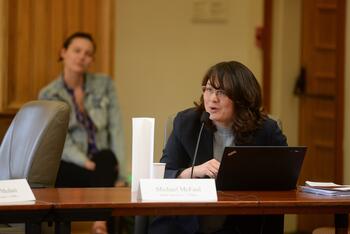
ARD 2019 Annual Conference participants. Front row (from left): Sean Yom, Stacey Philbrick Yadav, Lindsay Benstead, David Patel, Michael Herb. Middle row (from left): Colin Kahl, Lina Khatib, Hicham Alaoui, Larry Diamond, Samia Errazzouki, Lisa Blaydes, Hesham Sallam. Back row (from left): Toby Matthiesen, Ayca Alemdaroglu, Abbas Milani, Amr Hamzawy, Michael McFaul, Scott Williamson
All News button
1
Authors
News Type
News
Date
Paragraphs

Under the title “Political Contestation and New Social Forces in the Middle East and North Africa,” the Program on Arab Reform and Democracy convened its 2018 annual conference on April 27 and 28 at Stanford University. Bringing together a diverse group of scholars from across several disciplines, the conference examined how dynamics of governance and modes of political participation have evolved in recent years in light of the resurgence of authoritarian trends throughout the region.

Image
adel iskandar
Delivering the opening remarks of the conference, Freeman Spogli Institute (FSI) and Hoover Institution Senior Fellow Larry Diamond reflected on the state of struggle for political change in the Middle East and North Africa (MENA) region. In a panel titled “Youth, Culture, and Expressions of Resistance,” FSI Scholar Ayca Alemdaroglu discussed strategies the Turkish state has pursued to preempt and contain dissent among youth. Adel Iskandar, Assistant Professor of Communications at Simon Fraser University, explained the various ways through which Egyptian youth employ social media to express political dissent. Yasemin Ipek, Assistant Professor of Global Affairs at George Mason University, unpacked the phenomenon of “entrepreneurial activism” among Lebanese youth and discussed its role in cross-sectarian mobilization.

The conference’s second panel, tilted “Situating Gender in the Law and the Economy,” featured Texas Christian University Historian Hanan Hammad, who assessed the achievements of the movement to fight gender-based violence in Egypt. Focusing on Gulf Cooperation Council states, Alessandra Gonzales, a Visiting Postdoctoral Fellow at the Stanford Institute for Economic Policy Research, analyzed the differences in female executive hiring practices across local and foreign firms. Stanford University Political Scientist and FSI Senior Fellow Lisa Blaydes presented findings from her research on women’s attitudes toward Female Genital Mutilation (FGM) in Egypt.

Image
conference speakers
Speaking on a panel titled “Social Movements and Visions for Change,” Free University of Berlin Scholar Dina El-Sharnouby discussed the 2011 revolutionary movement in Egypt and the visions for social change it espouses in the contemporary moment. Oklahoma City University Political Scientist Mohamed Daadaoui analyzed the Moroccan regime’s strategies of control following the Arab Uprisings and their impact on various opposition actors. Nora Doaiji, a PhD Student in History at Harvard University, shared findings from her research examining the challenges confronting the women’s movement in Saudi Arabia.

The fourth panel of the conference, “The Economy, the State, and New Social Actors,” featured George Washington University Associate Professor of Geography Mona Atia, who presented on territorial restructuring and the politics governing poverty in Morocco. Amr Adly, an Assistant Professor of Political Science at the American University in Cairo, analyzed the relationship between the state and big business in Egypt after the 2013 military coup. Rice University Professor of Economics Mahmoud El-Gamal shared findings from his research on the economic determinants of democratization and de-democratization trends in Egypt during the past decade.

Image
image 1 3
The final panel focused on the international and regional dimensions of the struggle for political change in the Arab world, and featured Hicham Alaoui, a Research Fellow at Harvard University’s Weatherhead Center for International Affairs, Georgetown University Political Scientist Daniel Brumberg, and Nancy Okail, the Executive Director of the Tahrir Institute for Middle East Policy.

The conference included a special session featuring former fellows of the American Middle Eastern Network at Stanford (AMENDS), an organization dedicated to promoting understanding around the Middle East, and supporting young leaders working to ignite concrete social and economic development in the region. AMENDS affiliates from five different MENA countries shared with the Stanford community their experiences in working toward social change in their respective countries.

Hero Image
group photo from conference
ARD 2018 Annual Conference participants.
Front row (from left): Hanan Hammad, Hamza Arsbi, Ayca Alemdaroglu, Mahdi Lafram, Lior Lapid.
Second to front row (from left): Dina El-Sharnouby, Daniel Brumberg, Radidja Nemar, Mona Atia.
Third to front row (from left): Hesham Sallam, Joel Beinin, Nora Doaiji, Hicham Alaoui, Mohamed Daadaoui, Salma Takky, Larry Diamond, Amr Adly, Sultan Al Amer, Heba Al-Hayek.
Back row (from left): Amr Gharbeia, Mahmoud El-Gamal, Amr Hamzawy
All News button
1
Authors
News Type
Commentary
Date
Paragraphs

Islamism has imitated, or colluded with, the state autocracies it claims to oppose. It has failed to suggest its own answers to economic problems, social justice, education or corruption, writes Hicham Alaoui in Le Monde diplomatique. Click here to read the full article, which is based on research that Alaoui presented at UC Berkeley and CDDRL on October 10 and 11, respectively.

Hero Image
800px supporters of president mohammed morsi at a massive rally organized by the muslim brotherhood just miles from the presidential palace
Supporters of former Egyptian President Mohammed Morsi at a Muslim Brotherhood rally. December 12, 2012.
Yuli Weeks for VOA
All News button
1
Authors
News Type
News
Date
Paragraphs

In a talk dated April 20, 2016, American University of Kuwait Scholar Farah Al-Nakib discussed her recently released book Kuwait Transformed: A History of Oil and Urban Life (Stanford University Press, 2016). The book traces the relationships between the urban landscape, patterns and practices of everyday life, and social behaviors and relations in Kuwait, from its settlement in 1716 through the bridge of oil discovery to the twenty-first century. The history that emerges reveals how decades of urban planning, suburbanization, and privatization have eroded an open, tolerant society and given rise to the insularity, xenophobia, and divisiveness that characterize Kuwaiti social relations today. However, over the past decade several social forces and youth-based movements—from political protesters to architects and small entrepreneurs—have been staking claims to the city and demanding a different kind of urban experience. Beyond simply reviving the declined urban center, Al-Nakib argues, their efforts have the potential to restore Kuwaiti society’s lost urbanity.


Hero Image
screen shot 2016 05 17 at 11 26 11 am
All News button
1
Paragraphs

First paragraph of the article:

If the Syrian civil war and, in particular, the horrific Ghouta attack this August have reminded the world of the persistent danger of chemical weapons, it is worth remembering that this is not the first time the United States has confronted a Middle Eastern dictator armed with weapons of mass destruction. During the 1991 Gulf War, Saddam Hussein possessed large stockpiles of chemical weapons, which he had used frequently in his 8-year war with Iran during the 1980s. And yet Iraq did not use these weapons against the U.S.-led coalition forces, even as they soundly defeated the Iraqi army, pushing it from Kuwait. For two decades, the question has been, why no

All Publications button
1
Publication Type
Commentary
Journal Publisher
Foreign Policy
Authors
Scott D. Sagan
Paragraphs

National oil companies (NOCs) produce most of the world’s oil and natural gas and bankroll governments across the globe. Although NOCs superficially resemble private-sector companies, they often behave in very different ways. To understand these pivotal state-owned enterprises and the long shadow they cast on world energy markets, the Program on Energy and Sustainable Development (PESD) at Stanford University commissioned Oil and Governance: State-owned Enterprises and the World Energy Supply. The 1000-page volume, edited by David Victor, David Hults, and Mark Thurber, explains the variation in the performance and strategy of NOCs, and provides fresh insights into the future of the oil industry as well as the politics of the oil-rich countries where NOCs dominate. It comprises fifteen case studies, each following a common research design, of NOCs based in the Middle East, Africa, Asia, Latin America, and Europe. The book also includes cross-cutting pieces on the industrial structure of the oil industry and the politics and administration of NOCs.

NOCs are distinguished from private companies by their need to respond to state goals beyond profit maximization. Governments seeking to retain their hold on power use NOCs to deliver benefits to influential elites (“private goods”) or to the broader population (“social goods”). Oil and Governance finds a strong correlation between such non-hydrocarbon burdens on the NOC—which include providing employment, subsidizing fuel, or handing out plum jobs to the politically connected—and deficiencies in oil and gas performance. The highest-performing NOCs, like Norway’s Statoil and Brazil’s Petrobras, face relatively circumscribed non-oil demands from their governments.

How governments administer their oil sectors also proves to be a crucial determinant of NOC performance. Democracies (e.g., Norway, Brazil) and autocracies (e.g., Saudi Arabia, Angola) alike are capable of grooming successful NOCs. What matters most for outcomes is not regime type per se but rather that governance systems provide unified signals to the NOC. (By contrast, regime type is observed to be an important driver of whether governments nationalize their oil sectors in the first place, or privatize existing NOCs.) Fragmented governance, in which multiple government actors assert their interests but no one assumes strategic responsibility, appears uniformly fatal to NOC performance. Nascent democracies like Mexico’s can be particularly vulnerable to oil sector dysfunction stemming from fragmentation. Governance systems must also be matched to a country’s institutional and political realities. Nigeria has arguably set back its progress in oil through attempts to slavishly imitate Norway’s forms of oil organization in the absence of Norway’s mature political and civil service institutions.

The close ties between the NOC and its government can have a detrimental effect on the ability of the NOC to manage the risks that are so characteristic of the oil and gas industry. Whereas private companies are forced to hone their geological knowledge and skills through global competition for capital and hydrocarbon licenses, NOCs for the most part are comfortably sheltered from competitive threats at home. They therefore fail to develop the global reach that helps private players (the international oil companies, or IOCs) manage risk by means of a diversified global portfolio and the ability to link resources to customers around the world. (Some NOCs have begun to internationalize in recent years, but it is striking that none of the NOCs studied in Oil and Governance went down this path until forced to by domestic resource scarcity, or at least of the perception of future scarcity.) The soft budget constraint faced by the NOC also discourages the cost efficiencies that help mitigate risk.

This gulf in risk management capabilities between IOCs and most NOCs suggests that the resource dominance of NOCs does not pose an existential threat to private oil companies. Private players will continue to play a key role in the frontiers of oil and gas development—frontiers like shale gas, oil sands, and the remote Arctic. NOCs will continue to control low-cost oil around the world, while a select few of the most focused and unencumbered among them start to build up their own risk management skills through partnerships with IOCs.

NOC control over resources has important implications for the world oil price. The NOCs studied in the book produce their reserves at half the rate of the major IOCs—whether due to lower performance or a deliberate attempt to preserve resources for the future. Moreover, governments tend to rely most heavily on the risk management skills of IOCs when prices are low and then swing back towards NOCs in high price periods when they can afford to focus on delivering benefits to favored constituencies. The result of this dynamic, which is observed in the case studies of Oil and Governance, can be “backward bending supply curves” that exaggerate price volatility in the world oil market.

This effect of NOCs on global oil supply and price appears to be much more important than any geopolitical fallout from NOC primacy around the world. Oil and Governance finds very little evidence that NOCs act as effective foreign policy weapons on behalf of their host states. Even where politicians may desire to employ NOCs in this way, the incentives of the NOC itself are usually strongly opposed to such an exercise of power. As one example, Europe’s Gazprom depends overwhelmingly on revenues from gas exports to Europe because gas is so heavily subsidized in Russia. When NOCs do venture abroad, as in the case of China’s CNPC, they are often motivated to do so precisely by the desire to achieve more autonomy from their political masters at home.

All Publications button
1
Publication Type
Books
Publication Date
Journal Publisher
Cambridge University Press
Authors
David G. Victor
David Hults
Mark C. Thurber
Authors
Hicham Ben Abdallah
News Type
Q&As
Date
Paragraphs
The following interview with Prince Moulay Hicham, consulting professor at the Center on Democracy, Development, and the Rule of Law at the Freeman-Spogli Institute, on the ongoing events of the “Arab Spring” was published in the May 15 issue of the French newsmagazine, "L’Express."

After his death, will Osama Bin Laden become a myth?

For the West perhaps, but not for Arabs. Bin Laden’s influence has been in decline since 2004, when people realized that most of his victims were Muslims.

You have never stopped making the case for the democratization of the Arab world. It got to the point, in 1995, that Hassan II banned you from the palace for several months. How do you explain the wave of protests that we see today, from the Gulf to the Atlantic, sparing no country?

Aside from the conjunctural factors, there are some underlying reasons. To begin with, there is the character of the regimes that exists. Some are completely closed, while others have a façade of openness. All of a sudden, the structures of mediation — parties, unions, associations, etc. — that were supposed to represent civil society were completely discredited. At the end of the day, we were left with the dominant elites, alienated and cut off from the rest of the country, relying on the security apparatus. Also, in reality, the economic opening imposed by globalization and promoted by international financial institutions only profited the elites. In the absence of any serious policy of redistribution, GDP growth was accompanied up by an increase in poverty and social insecurity that made life more precarious even for the middle classes. Finally, we cannot ignore the demographic evolution of these countries. The transition from the extended family to the nuclear family, and the entrance of women into active public life on a greater scale considerably changed the social landscape. At the same time, widespread access to new means of communication broke the spell of the state’s monopoly on information, and brought more and more people into contact with the wider world. Even before the rise of new media technologies, the arrival of Al-Jazeera in the living rooms of the region had created a revolution!

And what was the trigger?

The sense of insult. The sense that one’s dignity was being insulted. This notion of dignity is essential to understanding what is happening right now. Until now, the prevailing concepts, especially that of national honor, were elements of a collective attitude. Dignity is a demand of the individual. I will add that the WikiLeaks revelations played a role in laying bare the disdain in which the governments held their citizens.

This revolt led to a set of demands that were democratic, and virtually never religious, even if Islamist movements tried to hop aboard the train.  Why?

Because this is a movement of the citizen! Its young organizers are challenging at once the authoritarianism of the regimes and the ideological discourse of the Islamists. They want neither despotism nor theocracy. They belong to a globalized, post-ideological generation, which privileges the autonomy of the subject and the individual. They refuse the identity gambit, Islamist or not, and aspire to universal values. We are in the full enthusiasm of the 1848 “springtime of the peoples,” with the romantic twist of May ’68. It remains to be seen if these young protesters will be able to transform their efforts into something that has a more concrete political content. Right now, we are entering into the kind of trench warfare between the besieged regimes and the democratic movements.

How do you understand the evolution of the situation in Tunisia and Egypt?  Are you optimistic?

The two situations are not identical. I’m optimistic regarding the transition to democracy in Tunisia, and more circumspect regarding Egypt. In Egypt, the army was always the spine of the regime. Under the pressure of the street, it broke from the head of state, but it remains very much in business, and will, in my opinion, hold onto its role as kingmaker for a long time. The temptation to reconstitute a party that would restore an order from the bits and pieces of the old regime – bringing together Islamists, businessmen, former dissidents, etc.— to the detriment of the reformers, is very real.

Do you think the regime in Syria will fall in turn?

Yes, if the revolt persists, and widens so much that the regime would be obliged to call on the army, which might hesitate to fire on the people. Right now, it’s the Republican Guard, controlled by the Alaouite minority, with the support of paramilitary groups, which is carrying out the repression. But it’s not clear that they would be able to stand against a general uprising. This is the problem that all the closed regimes face, once they’re confronted with an insurrection.

In the monarchies, the demonstrators don’t demand that the sovereign “leave,” but that the system be reformed. Could it be that Kings are more legitimate and republican dictators? The monarchy is at once an institution of arbitration and the symbol of national identity. For the most part, the populations of these countries accept this concept. But, eventually, this could cease to be the case, if these monarchies do not respond to their peoples’ aspiration for change. Right now, they — especially the divine-right monarchies — are struggling to find a response to this urgency.

To that point: In Morocco, where Mohammed VI named a commission to consider the reform of institutions, the religious powers of the king are today widely debated. The youth who organized the February 20th movement and the following demonstrations are calling into question the article of the constitution that emphasizes the sacred character of the person of the king. They are also questioning his role as commander of the faithful. How far must this reform go?

“Sacrality” is not compatible with democracy. One can understand that the person of the king should be inviolable, because he is the representative of the nation. One can preserve the role of “commander of the faithful,” if it is understood as having a moral dimension --somewhat like the Queen of England is the head of the Church of England and Defender of the Faith. But it’s necessary to give up the idea of the sacred character of the person of the king. If one keeps that notion, which was copied from French absolutism, in the midst of an institutional arrangement that is otherwise democratic, everything will be skewed. In the end, that won’t work.

Can the commission named by Mohamed VI go so far as to propose the suppression of the sacrality of the person who of the king?

I think that the Moroccan monarchy has understood the depth of the challenge, even if it has barely responded to it.  The commission is advisory. It’s the king who will decide.

In Morocco today, the ultraleft is part of the February 20 Movement, demanding the election of a constituent assembly…

That’s unrealistic. That would mean the end of the regime. Historically, constituent assemblies consummated the end of a regime.

Fundamentally, must it move towards a Spanish-style monarchy, as some demand? Or should we rather have a constitution in which the king would more or less have the powers of the French president, with a two-headed executive, as one sometimes hears in Morocco?

In France, the Head of State and the Prime Minister are both determined by popular sovereignty. In Morocco, there are two sources of legitimacy – that of ballots, and that of tradition. One can’t transpose the logic of the philosophy of cohabitation with that of a protected space. We have to turn the page, and do it without ambiguity. Morocco should draw on the experiences of the European monarchies, while preserving its own traditions and culture.

Do you think the reform will go that far?

Either the reform will stop short, because it doesn’t go far enough, and the contestation will continue. Or the king will choose to take the process to its conclusion. But in that case he risks to be brought to account, particularly for the choices of his entourage. Because the regime has waited too long, and time is pressing, there is a risk that everything will have to be done all at once. It’s an enormous challenge, without precedent. To reform the constitution is not only to define the equilibrium of power and give a moral dimension to the “commander of the faithful,” it is also to make sure that all the activities of state are inscribed in a legal and rational framework.

Is the challenge the same for the other Arab monarchies?

The problem is practically the same in Jordan, with the added fragility that derives from the institution’s lack of historical depth. In the Gulf, a process will take longer because civil society is not as well developed. Oil rents also allow problems to be postponed. That being said, in Bahrain, the monarchy, by choosing one side rather than another, is playing a dangerous game. And in Kuwait, they have already known ten years of repetitive crises.

How do you evaluate the West’s attitude toward the “Arab Spring”?

Westerners are blinded by the Islamist bogeyman. But France, in particular, which should rejoice to see young Arabs coming into the street in the name of its own values, seems to me turned in on itself and completely confounded. The United States is more pragmatic. It is acting in accordance with its strategic interests, case by case.

Is it true that you were one of the consultants who, in 2009, participated in crafting Barack Obama’s speech in Cairo?

Among others, I was consulted. Unlike other American presidents, Obama knows and understands the region. But when he made that speech he was not as well aware as his predecessors had been of the constraints of the American system – particularly the strength, in the United States, of the pro-Israel lobby.

How does one become the advocate of the democratic opening of the Arab monarchies when one is the nephew of Hassan II?

From studying abroad, undoubtedly an opening to the world. And an interest, acquired very early, in social problems…

But you remain a monarchist?

Yes. I remain convinced that a change in the framework of a reformed monarchy represents the least costly solution for Morocco. I would be lying if I were to claim that biology had nothing to do with this conviction.

The stands that you’ve taken have caused you several difficulties with your Uncle Hassan II. Then with your cousin Mohammed VI…

With Mohammed VI above all, insofar as his entourage brings more influence to bear than did that of Hassan II, I have been hassled, and made the object of campaigns against me…

How are your relations with him today?

During the last ten years, I was in the royal palace once. I have only seen the king two or three times, in the context of family reunions. The memories of the shared childhood and youth remain. The sense also of belonging to the same family. This is a constitutive element of my identity.

 

Hero Image
Hicham
All News button
1
Authors
Larry Diamond
News Type
Commentary
Date
Paragraphs

Each president of the United States enters office thinking he will be able to define the agenda and set the course of America's relations with the rest of the world. And, almost invariably, each confronts crises that are thrust upon him-wars, revolutions, genocides, and deadly confrontations. Neither Woodrow Wilson nor FDR imagined having to plunge America into world war. Truman had to act quickly, and with little preparation, to confront the menace of Soviet expansion at war's end. JFK, for all his readiness to "bear any burden" in the struggle for freedom, did not expect his struggle to contain Soviet imperial ambitions would come so close to the brink of nuclear annihilation. Nixon was tested by a surprise war in the Middle East. Carter's presidency was consumed by the Shah's unraveling and the Iranian revolution. George H.W. Bush rose to the challenge of communism's collapse and Saddam Hussein's invasion of Kuwait. Clinton squandered the opportunity to stop a genocide in Rwanda and waited tragically too long before stopping one in Bosnia. George W. Bush mobilized the country to strike back after September 11, but, in the view of many, he put most of his chips in the wrong war.

In the eye of the historical storm, and in the absence of a challenge as immediate and overpowering as September 11, Pearl Harbor, or the Nazis' march across Europe, it is risky to identify any set of world events as game-changing. Yet that is what many analysts, including myself, believe the Arab revolutions of 2011 are. And a surprising number of specialists-including hard-eyed realists like Fareed Zakaria-have seized upon the crisis in Libya as a defining moment not just for the United States in the region but for the foreign policy presidency of Barack Obama as well.

To date, one could say that Obama has had a surprisingly good run for a foreign policy neophyte. He has revived the momentum for arms control with a new START treaty with Russia, while pressing the issue of human rights within Russia. He has managed the meteoric rise of China decently, while improving relations with India. He has not cut and run from Iraq-as most Republicans were convinced he would. And he has ramped up but at least set limits to our involvement in Afghanistan. As the Arab revolutions have gathered momentum, he has increasingly positioned the United States on the side of democratic change. His statements and actions have not gone as far as democracy promotion advocates (like myself) would have preferred, but they have overridden cautionary warnings of the foreign policy establishment in the State Department, the Pentagon, think tanks, and so on. Without Obama's artful choreography of public statements and private messages and pressures, Hosni Mubarak might still be in power today.

All of this, however, may appear in time only a prelude to the fateful choice that Obama will soon have to make-and, one fears, is already making by default in a tragically wrong way-in Libya. Why is Libya-with its six million people and its significant but still modest share of global oil exports-so important? Why must the fight against Muammar Qaddafi-a crazy and vicious dictator, but by now, in his capacity for global mischief, a largely defanged one-be our fight?

When presidents are tested by crisis, the world draws their measure, and the impressions formed can have big consequences down the road. After watching Jimmy Carter's weak and vacillating posture on Iran, the Soviets figured he'd sit on the sidelines if they invaded and swallowed Afghanistan. They misjudged, but Afghanistan and the world are still paying the price for that misperception. In the face of mixed messages and a long, cynical game of balance-of-power, Saddam too, misjudged that he could get away with swallowing up Kuwait in 1991. When the United States did not prepare for war as naked aggression swept across Asia and Europe, the Japanese thought a quick strike could disable and knock out the slumbering American giant across the Pacific. When Slobodan Milosevic and his Bosnian Serb allies launched their war of "ethnic cleansing," while "the West"-which is always to say, first and foremost, the United States-wrung its hands, many tens of thousands of innocent people were murdered and raped before President Bill Clinton finally found the resolve to mix air power and diplomacy to bring the genocidal violence to a halt.

If Muammar Qaddafi succeeds in crushing the Libyan revolt, as he is well on his way to doing, the U.S. foreign policy establishment will heave a sad sigh of regret and say, in essence, "That's the nasty business of world politics." In other words: nasty, but not our business. And so: not their blood on our hands. But, when we have encouraged them to stand up for their freedom, and when they have asked for our very limited help, it becomes our business. On February 23, President Obama said: "The United States ... strongly supports the universal rights of the Libyan people. That includes the rights of peaceful assembly, free speech, and the ability of the Libyan people to determine their own destiny. These are human rights. They are not negotiable. ... And they cannot be denied through violence or suppression." Yet denying them through murderous violence and merciless suppression-with a massacre of semi-genocidal proportions likely waiting as the end game in Benghazi-is exactly what Qaddafi is in the process of doing.

Barack Obama has bluntly declared that Qaddafi must go. The Libyan resistance, based in Benghazi, has appealed urgently for the imposition of a no-fly zone. Incredibly, the Arab League has endorsed the call, as has the Gulf Cooperation Council. France has recognized the rebel provisional government based in Benghazi as Libya's legitimate government-while Obama studies this all. Can anyone remember a time when France and the Arab League were ahead of the United States on a question of defending freedom fighters?

There is much more that can be done beyond imposing a no-fly zone. No one in their right mind is calling for putting American boots on the ground in Libya. But we can jam Qaddafi's communications. We can, and urgently should, get humanitarian supplies and communications equipment, including satellite modems for connection to the Internet, to the rebels in Benghazi, where they can be supplied by sea. And we should find a way to get them arms as well. Benghazi is not a minor desert town. It is Libya's second largest city, a major industrial and commercial hub, and a significant port. Through it, a revolt can be supplied. If Benghazi falls to Qaddafi, it will fall hard and bloodily, and the thud will be heard throughout the world.

Time may be running out. As the Los Angeles Times reported yesterday, "All that stands between Kadafi and rebel headquarters in Benghazi are disorganized volunteers and army defectors spread thinly along the coastal highway." They have passion and courage, but they lack weaponry, strategy, and training. Like so many rebel movements, they need time to pull these all together. Time is what a no-fly zone and an emergency supply line can buy them.

Libya's rebels are pleading for our help. "Where is America?" asked one of them, quoted in the L.A. Times, who was manning a checkpoint in Port Brega. "All they do is talk, talk, talk. They need to get rid of these planes killing Libyan people." The "they" he was referring to was the Americans, beginning with their leader-one would hope, still the leader of the "free world"-President Obama.

Many prudent reasons have been offered for doing nothing. It is not our fight. They might lose anyway. We don't know who these rebels really are. We have too many other commitments. And so on. The cautions sound reasonable, except that we have heard them all before. Think Mostar and Srebrenica. And we had a lot of commitments in World War II as well, when we could have and should have bombed the industrial infrastructure of the Holocaust. As for the possibility that the rebels might lose-a prospect that is a possibility if we aid them and a near certainty if we do not-which would be the greater ignominy: To have given Libya's rebels the support they asked for while they failed, or to have stood by and done absolutely nothing except talk while they were mowed down in the face of meek American protests that the Qaddafi's violence is "unacceptable"?

Oh yes. There is also the danger that China will veto a U.N. Security Council Resolution calling for a no-fly zone. Part of us should hope they do. Let the rising superpower-more cynical than the reigning one ever was-feel the first hot flash of hatred by Arabs feeling betrayed. Go ahead, make our day.

Presidents do not get elected to make easy decisions, and they certainly never become great doing so. They do not get credit just because they go along with what the diplomatic and military establishments tell them are the "wise and prudent" thing to do. This is not Hungary in 1956. There is no one standing behind Qaddafi-not the Soviet Union then, not the Arab League now, not even the entirety of his own army. That is why he must recruit mercenaries to save him. Qaddafi is the kind of neighborhood bully that Slobodan Milosevic was. And he must be met by the same kind of principled power. For America to do less than that now-less than the minimum that the Libyan rebels and the Arab neighbors are requesting-would be to shrink into global vacillation and ultimately irrelevance. If Barack Obama cannot face down a modest thug who is hated by most of his own people and by every neighboring government, who can he confront anywhere?

For the United States-and for Barack Obama-there is much more at stake in Libya than the fate of one more Arab state, or even the entire region. And the clock is ticking.

Hero Image
Larry Diamond website pic
All News button
1
Paragraphs

What accounts for variation in the durability of authoritarian regimes in the post-colonial Middle East?  This working paper presents a new explanation that underscores how the geopolitical environment mediated outcomes of domestic conflicts pitting early rulers against social opposition. Comparative analysis of six historical cases (Iraq, Iran, Jordan, Bahrain, Tunisia, Kuwait) reveal that at the post-colonial dawn, foreign patrons empowered and constrained autocratic elites facing social opposition in distinctive ways, leaving pervasive legacies over consequent state-building efforts.  The more that incumbents enjoyed exogenous assistance to crush early societal challengers, the less likely they would thereafter rally broad bases of mass support in the succeeding decades; conversely, when leaders were forced to confront their own weakness and bargain with contentious popular sectors, they had stronger incentives to reach out and mobilize cross-class coalitions as they consolidated power.  Such differing early coalitional commitments engendered divergent kinds of economic and political institutions linking state and society over time, which in turn explains the scope and intensity of opposition decades after these regimes' contentious origins.

All Publications button
1
Publication Type
Working Papers
Publication Date
Journal Publisher
CDDRL Working Paper
Authors
Sean Yom
Subscribe to Kuwait