


CANCELED: Saudi Arabia, Iran, and the Forty-Year Rivalry that Unraveled Culture, Religion and Collective Memory in the Middle East
-
CISAC will be canceling all public events and seminars until at least April 5th due to the ongoing developments associated with COVID-19.
------------------------------------------------------------------------------------------------------------------------------------------------------
With discussant: Brett McGurk
Payne Distinguished Lecturer at the Center for International Security and Cooperation
This event is co-sponsored with the Hamid and Christina Moghadam Program in Iranian Studies
About this Event: Kim Ghattas's most recent book Black Wave tells the story of the rivalry between Saudi Arabia and Iran, a conflict born from the 1979 Iranian revolution. Ghattas, a native of the region, explores the distortion and deployment of religion in a competition that went beyond geopolitics, where each side proceeded to strategically feed intolerance, suppress cultural expression and encourage sectarian violence from Egypt to Pakistan.
About the Speaker: Kim Ghattas is an Emmy Award-winning journalist and writer who covered the Middle East for twenty years for the BBC and the Financial Times. She has also reported on the U.S State Department and American politics. She has been published in The Atlantic, the Washington Post, and Foreign Policy and is currently a non-resident scholar at the Carnegie Endowment for International Peace in Washington. Her first book, The Secretary, was a New York Times bestseller. Born and raised in Lebanon, she now lives in Beirut and Washington, D.C.
Kim Ghattas
Non-resident Scholar
Carnegie Endowment for International Peace
Seminars
Iran and the Limits of Economic Statecraft: Sanctions, Energy, and the Effectiveness of Maximum Pressure
-
Seminar Recording: https://youtu.be/yIthWPC99bI
About this Event: Since the United States left the Iran nuclear deal in May 2018, the Trump administration has pursued a maximum economic pressure campaign toward Iran. The U.S. use of sanctions has gone far beyond what previous administrations have done to try to change Iran's policies, targeting large swathes of the Iranian economy, high-ranking Iranian government officials, and threatening other countries if they do not curtail their own private sector's activities with Iran. The economic consequences of these measures, particularly for Iran's domestic economy, Iran's ability to procure food and medicine from abroad, and for Iran's flagship energy industry, have been profoundly disruptive. The U.S. economic pressure strategy has also had direct impacts on the global shipping and energy industries. To better understand the impacts of the current U.S. strategy toward Iran, Elizabeth Rosenberg will discuss how the Trump administration has used unprecedented economic coercion, and how U.S. partners and adversaries have responded. She will focus on what role sanctions are likely to play going forward and whether they will be used now as a form of deescalation or escalation in U.S.-Iran tensions, which are particularly heightened following the U.S. killing of Qods Force commander Qasem Soleimani.
About the Speaker: Elizabeth Rosenberg is a Senior Fellow and Director of the Energy, Economics, and Security Program at the Center for a New American Security. In this capacity, she publishes and speaks on the national security and foreign policy implications of the use of sanctions and economic statecraft as well as energy market shifts. Current geographic areas of focus include Iran, Russia, China, North Korea, and Venezuela. She has testified before Congress on an array of banking and trade issues, and on energy geopolitics and markets topics. She is widely quoted by leading media outlets in the United States and abroad.
From May 2009 through September 2013, Ms. Rosenberg served as a Senior Advisor at the U.S. Department of the Treasury, to the Assistant Secretary for Terrorist Financing and Financial Crimes, and then to the Under Secretary for Terrorism and Financial Intelligence. In these senior roles, she helped to develop and implement financial and energy sanctions. Key initiatives she helped to oversee include the tightening of global sanctions on Iran, the launching of new, comprehensive sanctions against Libya and Syria and modification of Burma sanctions in step with normalization of diplomatic relations. She also helped to formulate anti-money laundering and counter-terrorist and counter-proliferation financing policy and oversee financial regulatory enforcement activities.
Prior to her service in the U.S. government Ms. Rosenberg was an energy policy correspondent at Argus Media in Washington D.C., analyzing U.S and Middle Eastern energy policy, regulation and trading. She spoke and published extensively on OPEC, strategic reserves, energy sanctions and national security policy, oil and natural gas investment and production, and renewable fuels.
Ms. Rosenberg received an MA in Near Eastern Studies from New York University and a BA in Politics and Religion from Oberlin College.
Outside CNAS, Elizabeth Rosenberg is providing exclusive advice on foreign policy and national security as an informal advisor to the Elizabeth Warren campaign.
Elizabeth Rosenberg
Senior Fellow and Director of the Energy, Economics, and Security Program
Center for a New American Security
Seminars
Why Invading Iran Would Be a Military Disaster
News Type
Commentary
Date
Paragraphs
In the wake of a rollercoaster week of escalatory and de-escalatory signaling between the United States and Iran, both sides appear to have taken a step back from the abyss. Iran’s retaliatory missile barrage did not kill any U.S. personnel and President Trump has not signaled any plans to escalate beyond the killing of General Qasem Suleimani. But the core political stakes of the contest have risen. In response to the killing, Iran sloughed off the remaining limits on its nuclear hedge. Trump reflexively tightened sanctions.
Read the Rest at The National Interest
Hero Image

All News button
1
Trump Is Playing With Fire in the Middle East
News Type
Commentary
Date
Paragraphs
With Suleimani’s death, the months-long tit-for-tat cycle of pressure and provocation between Washington and Tehran has entered a much more dangerous phase. The risk of a regionwide conflagration is higher than ever. Shortly before the strike, U.S. Secretary of Defense Mark Esper threatened preemptive action to protect U.S. forces, saying "the game has changed." But this is not a game—and the stakes for both sides could not be higher.”
Read the Rest at Foreign Policy
Hero Image

All News button
1
The Strike on Qassem Soleimani: Implications for Iran, the Middle East and the World
-
Panel discussion with Stanford international affairs experts on escalating U.S.-Iran tensions.
Register: Click here to RSVP
Livestream: Please click here to join the livestream.
About this Event: U.S.-Iran tensions are at a new high following the U.S. drone strike that killed Iranian Major General Qassem Soleimani. Both sides continue to exchange threats of violence, and the implications for Iran’s nuclear ambitions, the fight against ISIS, and the U.S. presence in Iraq are expected to be profound. Join us for a panel discussion with Lisa Blaydes, Colin Kahl, Brett McGurk and Abbas Milani, moderated by Michael McFaul, on how recent developments may reshape the geopolitical landscape in one of the most volatile regions of the world.
This event is co-sponsored with Hamid and Christina Moghadam Program in Iranian Studies, Freeman Spogli Institute for International Studies, and the Middle East Initiative at the Center for International Security and Cooperation.
Speaker's Biographies:
Lisa Blaydes is a Professor of Political Science at Stanford University and a Senior Fellow at the Freeman Spogli Institute for International Studies. She is the author of Elections and Distributive Politics in Mubarak’s Egypt (Cambridge University Press, 2011). Her articles have appeared in the American Political Science Review, International Studies Quarterly, International Organization, Journal of Theoretical Politics, Middle East Journal, and World Politics. She holds degrees in Political Science (PhD) from the University of California, Los Angeles and International Relations (BA, MA) from Johns Hopkins University.
Colin Kahl is co-director of the Center for International Security and Cooperation, the inaugural Steven C. Házy Senior Fellow at the Freeman Spogli Institute for International Studies, and a Professor, by courtesy, in the Department of Political Science at Stanford University. He is also a Strategic Consultant to the Penn Biden Center for Diplomacy and Global Engagement.
From October 2014 to January 2017, he was Deputy Assistant to the President and National Security Advisor to the Vice President. In that position, he served as a senior advisor to President Obama and Vice President Biden on all matters related to U.S. foreign policy and national security affairs, and represented the Office of the Vice President as a standing member of the National Security Council Deputies’ Committee. From February 2009 to December 2011, Dr. Kahl was the Deputy Assistant Secretary of Defense for the Middle East at the Pentagon. In this capacity, he served as the senior policy advisor to the Secretary of Defense for Egypt, Iran, Iraq, Israel and the Palestinian territories, Saudi Arabia, Syria, Yemen, and six other countries in the Levant and Persian Gulf region. In June 2011, he was awarded the Secretary of Defense Medal for Outstanding Public Service by Secretary Robert Gates.
From 2007 to 2017 (when not serving in the U.S. government), Dr. Kahl was an assistant and associate professor in the Security Studies Program at Georgetown University's Edmund A. Walsh School of Foreign Service. From 2007 to 2009 and 2012 to 2014, he was also a Senior Fellow at the Center for a New American Security (CNAS), a nonpartisan Washington, DC-based think tank. From 2000 to 2007, he was an assistant professor of political science at the University of Minnesota. In 2005-2006, Dr. Kahl took leave from the University of Minnesota to serve as a Council on Foreign Relations International Affairs Fellow in the Office of the Secretary of Defense, where he worked on issues related to counterinsurgency, counterterrorism, and responses to failed states. In 1997-1998, he was a National Security Fellow at the John M. Olin Institute for Strategic Studies at Harvard University.
Current research projects include a book analyzing American grand strategy in the Middle East in the post-9/11 era. A second research project focuses on the implications of emerging technologies on strategic stability.
He has published numerous articles on international security and U.S. foreign and defense policy in Foreign Affairs, Foreign Policy, International Security, the Los Angeles Times, Middle East Policy, the National Interest, the New Republic, the New York Times, Politico, the Washington Post, and the Washington Quarterly, as well as several reports for CNAS.
His previous research analyzed the causes and consequences of violent civil and ethnic conflict in developing countries, focusing particular attention on the demographic and natural resource dimensions of these conflicts. His book on the subject, States, Scarcity, and Civil Strife in the Developing World, was published by Princeton University Press in 2006, and related articles and chapters have appeared in International Security, the Journal of International Affairs, and various edited volumes.
Dr. Kahl received his B.A. in political science from the University of Michigan (1993) and his Ph.D. in political science from Columbia University (2000).
Brett McGurk is the Frank E. and Arthur W. Payne Distinguished Lecturer at the Freeman Spogli Institute and Center for Security and Cooperation at Stanford University.
McGurk’s research interests center on national security strategy, diplomacy, and decision-making in wartime. He is particularly interested in the lessons learned over the presidencies of George W. Bush, Barack Obama, and Donald Trump regarding the importance of process in informing presidential decisions and the alignment of ends and means in national security doctrine and strategy. At Stanford, he will be working on a book project incorporating these themes and teaching a graduate level seminar on presidential decision-making beginning in the fall of 2019. He is also a frequent commentator on national security events in leading publications and as an NBC News Senior Foreign Affairs Analyst.
Before coming to Stanford, McGurk served as Special Presidential Envoy for the Global Coalition to Defeat ISIS at the U.S. Department of State, helping to build and then lead the coalition of seventy-five countries and four international organizations in the global campaign against the ISIS terrorist network. McGurk was also responsible for coordinating all aspects of U.S. policy in the campaign against ISIS in Iraq, Syria, and globally.
McGurk previously served in senior positions in the George W. Bush and Barack Obama administrations, including as Special Assistant to President Bush and Senior Director for Iraq and Afghanistan, and then as Deputy Assistant Secretary of State for Iraq and Iran and Special Presidential Envoy for the U.S. campaign against the Islamic State under Obama.
McGurk has led some of the most sensitive diplomatic missions in the Middle East over the last decade. His most recent assignment established one of the largest coalitions in history to prosecute the counter-ISIS campaign. He was a frequent visitor to the battlefields in both Iraq and Syria to help integrate military and civilian components of the war plan. He also led talks with Russia over the Syria conflict under both the Trump and Obama administrations, initiated back-channel diplomacy to reopen ties between Iraq and Saudi Arabia, and facilitated the formation of the last two Iraqi governments following contested elections in 2014 and 2018.
In 2015 and 2016, McGurk led fourteen months of secret negotiations with Iran to secure the release of Washington Post reporter Jason Rezain, U.S. Marine Amir Hekmati, and Pastor Saad Abadini, as well as three other American citizens.
During his time at the State Department, McGurk received multiple awards, including the Distinguished Honor Award and the Distinguished Service Award, the highest department awards for exceptional service in Washington and overseas assignments.
McGurk is also a nonresident senior fellow in the Middle East Program at the Carnegie Endowment for International Peace.
McGurk received his JD from Columbia University and his BA from the University of Connecticut Honors Program. He served as a law clerk to Chief Justice William H. Rehnquist on the U.S. Supreme Court, Judge Denis Jacobs on the U.S. Court of Appeals for the 2d Circuit, and Judge Gerard E. Lynch on the U.S. District Court for the Southern District of New York.
Abbas Milani is the Hamid & Christina Moghadam Director of Iranian Studies at Stanford University and a Professor (by courtesy) in the Stanford Global Studies Division. He is also one of the founding co-directors of the Iran Democracy Project and a research fellow at the Hoover Institution. His expertise include U.S.-Iran relations as well as Iranian cultural, political, and security issues. Until 1986, he taught at Tehran University’s Faculty of Law and Political Science, where he was also a member of the Board of Directors of the university’s Center for International Relations. After moving to the United States, he was for fourteen years the Chair of the Political Science Department at the Notre Dame de Namur University. For eight years, he was a visiting Research Fellow in University of California, Berkeley’s Middle East Center.
Professor Milani came to Stanford ten years ago, when he became the founding director of the Iranian Studies Program. He also worked with two colleagues to launch the Iran Democracy Project at the Hoover Institution. He has published more than twenty books and two hundred articles and book reviews in scholarly magazines, journals, and newspapers. His latest book is a collection he co-edited with Larry Diamond, Politics & Culture in Contemporary Iran: Challenging the Status Quo (Lynne Rienner Publishers, 2015).
Michael McFaul is the Ken Olivier and Angela Nomellini Professor of International Studies in Political Science, Director and Senior Fellow at the Freeman Spogli Institute for International Studies, and the Peter and Helen Bing Senior Fellow at the Hoover Institution, all at Stanford University. He was also the Distinguished Mingde Faculty Fellow at the Stanford Center at Peking University from June to August of 2015. He joined the Stanford faculty in 1995. He is also an analyst for NBC News and a contributing columnist to The Washington Post. McFaul served for five years in the Obama administration, first as Special Assistant to the President and Senior Director for Russian and Eurasian Affairs at the National Security Council at the White House (2009-2012), and then as U.S. Ambassador to the Russian Federation (2012-2014).
He has authored several books, most recently the New York Times bestseller, “From Cold War to Hot Peace: An American Ambassador in Putin’s Russia.” Earlier books include Advancing Democracy Abroad: Why We Should, How We Can; Transitions To Democracy: A Comparative Perspective (eds. with Kathryn Stoner); Power and Purpose: American Policy toward Russia after the Cold War (with James Goldgeier); and Russia’s Unfinished Revolution: Political Change from Gorbachev to Putin. His current research interests include American foreign policy, great power relations between China, Russia, and the United States, and the relationship between democracy and development.
Prof. McFaul was born and raised in Montana. He received his B.A. in International Relations and Slavic Languages and his M.A. in Soviet and East European Studies from Stanford University in 1986. As a Rhodes Scholar, he completed his D. Phil. in International Relations at Oxford University in 1991.
Lisa Blaydes
Encina Hall West, Room 408
Stanford, CA 94305-6044
0
blaydes@stanford.edu
Senior Fellow at the Freeman Spogli Institute for International Studies
Professor of Political Science
Lisa Blaydes is a Professor of Political Science at Stanford University. She is the author of State of Repression: Iraq under Saddam Hussein (Princeton University Press, 2018) and Elections and Distributive Politics in Mubarak’s Egypt (Cambridge University Press, 2011). Professor Blaydes received the 2009 Gabriel Almond Award for best dissertation in the field of comparative politics from the American Political Science Association for this project. Her articles have appeared in the American Political Science Review, International Studies Quarterly, International Organization, Journal of Theoretical Politics, Middle East Journal, and World Politics. During the 2008-2009 and 2009-2010 academic years, Professor Blaydes was an Academy Scholar at the Harvard Academy for International and Area Studies. She holds degrees in Political Science (PhD) from the University of California, Los Angeles, and International Relations (BA, MA) from Johns Hopkins University.
Affiliated faculty at the Center on Democracy, Development and the Rule of Law
Affiliated faculty at the Center for International Security and Cooperation
Hide publication sections
Off
Colin H. Kahl
Encina Hall
616 Jane Stanford Way
Stanford, CA 94305-6055
0
Director, Freeman Spogli Institute for International Studies
Steven C. Házy Senior Fellow, Freeman Spogli Institute for International Studies
Professor, by courtesy, of Political Science
Colin Kahl is director of the Freeman Spogli Institute for International Studies and the Steven C. Házy Senior Fellow. He is also the faculty director of CISAC’s Program on Geopolitics, Technology, and Governance, and a professor of political science (by courtesy).
From April 2021-July 2023, Dr. Kahl served as the under secretary of defense for policy at the U.S. Department of Defense. In that role, he was the principal adviser to the secretary of defense for all matters related to national security and defense policy and represented the department as a standing member of the National Security Council Deputies’ Committee. He oversaw the writing of the 2022 National Defense Strategy, which focused the Pentagon’s efforts on the “pacing challenge” posed by the PRC, and he led the department’s response to Russia’s invasion of Ukraine and numerous other international crises. He also led several other major defense diplomacy initiatives, including an unprecedented strengthening of the NATO alliance; the negotiation of the AUKUS agreement with Australia and the United Kingdom; historic defense force posture enhancements in Australia, Japan, and the Philippines; and deepening defense and strategic ties with India. In June 2023, Secretary of Defense Lloyd Austin III awarded Dr. Kahl the Department of Defense Distinguished Public Service Medal, the highest civilian award presented by the secretary of defense.
During the Obama Administration, Dr. Kahl served as deputy assistant to President Obama and national security advisor to Vice President Biden from October 2014 to January 2017. He also served as deputy assistant secretary of defense for the Middle East from February 2009 to December 2011, for which he received the Outstanding Public Service Medal in July 2011.
Dr. Kahl is the co-author (along with Thomas Wright) of Aftershocks: Pandemic Politics and the End of the Old International Order (New York: St. Martin’s Press, 2021) and the author of States, Scarcity, and Civil Strife in the Developing World (Princeton, NJ: Princeton University Press, 2006). He has also published numerous article on U.S. national security and defense policy in Foreign Affairs, Foreign Policy, International Security, the Los Angeles Times, Middle East Policy, the National Interest, the New Republic, the New York Times, Politico, the Washington Post, and the Washington Quarterly, as well as several reports for the Center for a New American Security (CNAS), a non-partisan think tank in Washington, DC.
Dr. Kahl previously taught at Georgetown University and the University of Minnesota, and he has held fellowship positions at Harvard University, the Council on Foreign Relations, CNAS, and the Penn Biden Center for Diplomacy and International Engagement.
He received his B.A. in political science from the University of Michigan (1993) and his Ph.D. in political science from Columbia University (2000).
Hide publication sections
Off
Abbas Milani
Michael A. McFaul
Encina Hall
616 Jane Stanford Way
Stanford, CA 94305-6055
0
Senior Fellow, Freeman Spogli Institute for International Studies
Ken Olivier and Angela Nomellini Professor of International Studies, Department of Political Science
Peter and Helen Bing Senior Fellow, Hoover Institution
Michael McFaul is the Ken Olivier and Angela Nomellini Professor of International Studies in Political Science, Senior Fellow at the Freeman Spogli Institute for International Studies, and the Peter and Helen Bing Senior Fellow at the Hoover Institution, all at Stanford University. He joined the Stanford faculty in 1995 and served as FSI Director from 2015 to 2025. He is also an international affairs analyst for MSNOW.
McFaul served for five years in the Obama administration, first as Special Assistant to the President and Senior Director for Russian and Eurasian Affairs at the National Security Council at the White House (2009-2012), and then as U.S. Ambassador to the Russian Federation (2012-2014).
McFaul has authored ten books and edited several others, including, most recently, Autocrats vs. Democrats: China, Russia, America, and the New Global Disorder, as well as From Cold War to Hot Peace: An American Ambassador in Putin’s Russia, (a New York Times bestseller) Advancing Democracy Abroad: Why We Should, How We Can; and Russia’s Unfinished Revolution: Political Change from Gorbachev to Putin.
He is a recipient of numerous awards, including an honorary PhD from Montana State University; the Order for Merits to Lithuania from President Gitanas Nausea of Lithuania; Order of Merit of Third Degree from President Volodymyr Zelenskyy of Ukraine, and the Dean’s Award for Distinguished Teaching at Stanford University. In 2015, he was the Distinguished Mingde Faculty Fellow at the Stanford Center at Peking University.
McFaul was born and raised in Montana. He received his B.A. in International Relations and Slavic Languages and his M.A. in Soviet and East European Studies from Stanford University in 1986. As a Rhodes Scholar, he completed his D. Phil. in International Relations at Oxford University in 1991.
International Working Group on Russian Sanctions
The International Working Group on Russian Sanctions aims to provide expertise and experience to governments and companies around the world by assisting with the formulation of sanctions proposals that will increase the cost to Russia of invading Ukraine, and support democratic Ukraine in the defense of its territorial integrity and national sovereignty.
Read more
Global Populisms
A new project examining the global surge in populist movements and what it means for established democratic rules and institutions.
Read More
CV
Document
mcfaul-cv-1-25-2026.pdf
(473.05 KB)
Hide publication sections
Off
Seminars
Ratcheting up the Pressure: Assessing the Risks of Trump's Iran Policy
News Type
Q&As
Date
Paragraphs
Interview with Colin Kahl
In May 2018, President Trump withdrew the United States from the Iran nuclear deal, and re-imposed crippling economic sanctions against Tehran. Iran responded by restarting elements of its nuclear program and sponsoring militant attacks against US interests and allies in the Middle East. Trump claims he will keep the pressure on until Iran agrees to a better nuclear deal, while Iranian leaders insist they will not negotiate under duress. Colin Kahl, Steven C. Házy senior fellow at the Freeman Spogli Institute for International Studies' Center for International Security and Cooperation and former national security advisor to the vice president of the United States, speaks with WorldAffairs CEO Jane Wales about Trump's Iran strategy and how it risks igniting war with the country.
Listen to More on World Affairs
Hero Image

All News button
1
ARD Conference Examines Authoritarian Upgrading, Popular Uprisings and Foreign Interventions in the Middle East
News Type
News
Date
Paragraphs
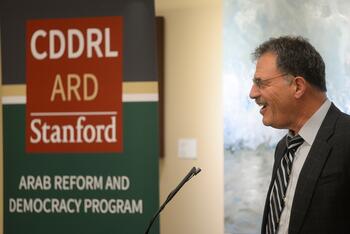
CDDRL’s Program on Arab Reform and Democracy held its annual conference at Stanford University on October 11 and 12, titled “The Struggle for Political Change in the Arab World.” The conference is an outgrowth of ARD’s efforts to support new research on the dynamics of political change in the countries of the Arab world. Scholars from across different disciplines sought to understand how social, economic, and political dynamics at the national level, as well as international and regional conflict and power rivalries, impact struggles for political and social change in the region.
Overview of Panels and Speakers
Image
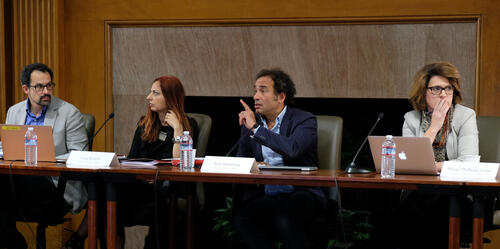
Chaired by Harvard University Fellow Hicham Alaoui, the second panel was titled “Popular Uprisings and Uncertain Transitions.” University of California, Santa Cruz Political Scientist Thomas Serres provided an overview of the economic disruptions that contributed to Algeria’s uprising. Lindsay Benstead, who is an Associate Professor of Political Science at Portland State University, analyzed the electoral successes of Tunisia’s Ennahda Party. Khalid Medani, Professor of Political Science at McGill University, explained how Sudanese protesters leveraged new strategies of contention to force Omar Al-Bashir out of power.
 Farah Al-Nakib (right) and Michael Herb (left)
Image

Image
Common Themes of Political Change and Continuity
Image
Image

Image

Image

Image
Image

Image

Hero Image

All News button
1
In First-Ever History of the National Intelligence Council, Thomas Fingar Recounts His Tenure as Chair
News Type
News
Date
Paragraphs
Formed in 1979, the National Intelligence Council (NIC) works to provide policymakers with the U.S. intelligence community’s best judgments on crucial international issues. As a locus for coordinated intelligence analysis, the NIC’s work reflects the coordinated judgments of multiple agencies and departments in the broader intelligence community. But while it may be less shrouded in secrecy than many other intelligence offices, in some respects it is less well known.
In Truth to Power, published by Oxford University Press, editors Robert Hitchings and Gregory Treverton shed light on this little-understood intelligence agency. The volume provides the first-ever history of the NIC as recounted through the reflections of its eight chairs in the period from the end of the Cold War until 2017. APARC Fellow Thomas Fingar, who chaired the NIC from 2005 to 2008, is one of the contributors to the book.
In his chapter “New Mission, New Challenges”, Fingar discusses some of the challenges during his service with the agency. In particular, he reflects on two specific obstacles he faced during his tenure: executing the intelligence reforms drafted in the wake of 9/11, and repairing damage done to the NIC’s credibility by the failures of the National Intelligence Estimate (NIE) on Iraqi weapons of mass destruction (WMD).
During his tenure, Fingar wore not one but two hats; along with the NIC chairmanship, he concurrently served as deputy director of national intelligence for analysis (DDNI/A). He describes actions taken not only to restore confidence in the intelligence community, but also to effectively execute its expanded brief. For instance, having national intelligence officers take the DDNI’s seat at meetings afforded senior officials the opportunity to perceive their value and thereby rebuild confidence in the broader intelligence community.
The Council’s reforms would soon be put to the test by way of the production of an NIE on Iranian WMD. Fingar recognized that the estimate would be a strong indicator of whether the NIC had learned its lessons following the flawed 2002 Iraq WMD estimate, and that policymakers were certain to finely examine the end product for flaws (whether made unintentionally or with political purposes in mind). As such, Fingar needed to produce an NIE that was accurate, timely, and non-political, all while handling and incorporating newly received intelligence. Through the Iran NIE, Fingar found an opportunity to redress the often-fraught relationship between Congress and the intelligence community.
Fingar closes with a review of the NIC’s pathbreaking work in the area of climate change. At the behest of a U.S. senator, the NIC took on the task of producing an NIE on the strategic implications of climate change. The resulting study categorized countries according to both their vulnerabilities and ability to manage impacts, as well as the broader implications it had for U.S. national security over the next twenty years. And while policymakers ultimately did not use the report as Fingar had hoped, he takes justified comfort in pointing out how it laid the groundwork for additional reports that followed, such as the National Research Council’s 2013 report Climate Change and Social Stress: Implications for Security Analysis.
Hero Image

All News button
1
Diplomacy Turned Personal for Brett McGurk and Jason Rezaian
News Type
News
Date
Paragraphs
Secret negotiations between the U.S. government and Iran’s intelligence services over the fate of political prisoners led to a lasting friendship.
When Secretary of State John Kerry first asked Brett McGurk to lead secret negotiations with Iran to secure the release of Jason Rezaian, Brett’s initial reaction was that he did not have the time to give the new mission the attention it deserved.
“I was incredibly busy building this huge coalition [to defeat ISIS], developing a military campaign, and developing a diplomatic campaign plan,” said McGurk at a recent talk he and Jason delivered at Stanford about Jason’s new book, Prisoner.
McGurk was recently appointed the Freeman Spogli Institute’s (FSI) Payne Distinguished Lecturer. Prior to his arrival at Stanford, he served as the Special Presidential Envoy for the Global Coalition to Defeat ISIS at the U.S. Department of State, a position he held in both the Obama and Trump administrations.
Sign up for the FSI newsletter to receive more stories like this directly to your email inbox.
Secretary Kerry was persistent, and Brett agreed to take on the sensitive assignment to secure the release of Jason, his wife Yegi, as well as four other Americans detained in Iran.
Jason, the Washington Post’s bureau chief in Tehran at the time, spent 544 days in the city’s notorious Evin Prison, much of it in solitary confinement.
Jason and Yegi’s ordeal began in June 2014. “[My wife and I] exited the apartment to go down to the garage. The elevator doors opened, and there was a guy standing there with a gun pointed directly at my face,” said Jason.
What ensued was prolonged captivity at the hands of the Iranian intelligence apparatus. But an unexpected friendship was a surprise result.
The diplomatic process to free Jason and the other American political prisoners began in the fall of 2014. Brett started by reading everything he could find about Jason and getting to know him through his brother Ali and other family members.
“As a diplomat working on these very difficult missions in the world, they’re rarely as personal as this,” said Brett. “This became very personal to me. It’s even more so now that I’ve read Jason’s book about what he was experiencing at the time, which really, honestly, I didn’t know.”
Jason was eventually released in January 2016, shortly after the historic nuclear deal, also known as the Joint Comprehensive Plan of Action, between Iran, the United States, and a number of other global powers, was implemented.
Brett boarded the Swiss plane carrying Jason and the other freed prisoners when it finally touched down in Geneva. “It was quite emotional,” said Brett. “I told Jason, ‘you don’t know who I am but we’re glad you’re home. You’re going to be taken good care of.’ Jason and I have become close friends, partially due to the experience that we both had,” he said.
As someone so directly affected by U.S. policy, Jason feels fortunate to have gotten to know Brett in return.
“It would have been impossible to predict the way our lives have criss-crossed the last couple of years,” said Jason. “Yegi and I ended up being Brett and Gina’s (Brett’s wife) neighbor, more or less, in Washington D.C. Even today, we just arrived in town and ran into Gina in the parking lot of the Stanford Mall.”
The book talk with Jason Rezaian and Brett McGurk was co-sponsored by Stanford’s Iranian Studies Program and the Center for International Security and Cooperation’s Middle East Initiative.
Hero Image

All News button
1