This conversation with Behlul Özkan (Marmara University)and Mehmet Ali Tuğtan(Bilgi University) will examine the adverse and long-lasting impact of the US-led anti-communism on Turkish democracy. We will trace the roots of current authoritarianism in the top-down Islamization of society and institutions since the 1950s, paying special attention to the role of the military- an institution often regarded as the protector of secularism.
This event is a part of the Program on Turkey. It is co-organized by the Ottoman Turkish Studies Association and supported by OTES@Stanford.
About the Speakers
Behlül Özkan received his PhD from Fletcher School of Law and Diplomacy, Tufts University in 2009. He is currently Associate Professor in the Department of International Relations at Marmara University, Istanbul. Özkan is the author of From the Abode of Islam to the Turkish Vatan: Making of a National Homeland in Turkey (Yale University Press, 2012). He also contributed op-eds to New York Times, Huffington Post, Open Democracy. Özkan is also a board member of European Council on Foreign Relations (ECFR). In recent years his academic studies has been focused on Political Islam in Turkey and Europe.
Mehmet Ali Tuğtan is assistant professor in International Relations at Istanbul Bilgi University. He has a PhDin Political Science from Boğaziçi University. His research focuses on Turkish-American Relations, Contemporary World Politics and Security Studies. Dr. Tugtan has edited a book on the Turkish involvement in the Korean War (Kore Savaşı: Uzak Savaşın Askerleri) published in 2013.
Encina Hall, E108
616 Jane Stanford Way
Stanford, CA 94305-6055
650.736.3750
0
ayca@stanford.edu
Research Scholar
ayca_2022.jpg
Ayça Alemdaroğlu is the Associate Director of the Program on Turkey and a Research Scholar at the Center on Democracy, Development, and the Rule of Law at Stanford University. She is also a Global Fellow at the Peace Research Institute Oslo (PRIO). As a political sociologist, Ayça explores social and political inequalities and changes in Turkey and the Middle East.
Previously, she was an Assistant Professor of Sociology and the Associate Director of the Keyman Modern Turkish Studies Program at Northwestern University.
She received her Ph.D. in sociology from the University of Cambridge, her MA in political science from Bilkent University, and her BSc. degrees in political science and sociology from the Middle East Technical University.
She serves on the editorial committee of the Middle East Report.
Encina Hall, E108
616 Jane Stanford Way
Stanford, CA 94305-6055
650.736.3750
0
ayca@stanford.edu
Research Scholar
ayca_2022.jpg
Ayça Alemdaroğlu is the Associate Director of the Program on Turkey and a Research Scholar at the Center on Democracy, Development, and the Rule of Law at Stanford University. She is also a Global Fellow at the Peace Research Institute Oslo (PRIO). As a political sociologist, Ayça explores social and political inequalities and changes in Turkey and the Middle East.
Previously, she was an Assistant Professor of Sociology and the Associate Director of the Keyman Modern Turkish Studies Program at Northwestern University.
She received her Ph.D. in sociology from the University of Cambridge, her MA in political science from Bilkent University, and her BSc. degrees in political science and sociology from the Middle East Technical University.
She serves on the editorial committee of the Middle East Report.
CDDRL’s Program on Arab Reform and Democracy held its annual conference at Stanford University on October 11 and 12, titled “The Struggle for Political Change in the Arab World.” The conference is an outgrowth of ARD’s efforts to support new research on the dynamics of political change in the countries of the Arab world. Scholars from across different disciplines sought to understand how social, economic, and political dynamics at the national level, as well as international and regional conflict and power rivalries, impact struggles for political and social change in the region.
Overview of Panels and Speakers
Image
Following opening remarks by FSI Senior Fellow Larry Diamond, the first panel titled “The Boundaries of Authoritarianism post-Arab Uprisings” featured CDDRL Senior Research Scholar Amr Hamzawy. His paper examined how the regime of Abdel Fattah Al-Sisi has employed discursive strategies to discredit calls for democratic change in the country. Sean Yom, Associate Professor of Political Science at Temple University, outlined how the protest strategies of Jordanian youth have limited their effectiveness in advancing meaningful political change. University of California, Davis Scholar Samia Errazzouki discussed the failure of state-led political and economic reform in Morocco.
Chaired by Harvard University Fellow Hicham Alaoui, the second panel was titled “Popular Uprisings and Uncertain Transitions.” University of California, Santa Cruz Political Scientist Thomas Serres provided an overview of the economic disruptions that contributed to Algeria’s uprising. Lindsay Benstead, who is an Associate Professor of Political Science at Portland State University, analyzed the electoral successes of Tunisia’s Ennahda Party. Khalid Medani, Professor of Political Science at McGill University, explained how Sudanese protesters leveraged new strategies of contention to force Omar Al-Bashir out of power.
Farah Al-Nakib (right) and Michael Herb (left)
The third panel, titled “Politics, Succession and Sectarianism in the GCC States,” included Oxford University Fellow Toby Matthiesen, who discussed how Saudi Arabia and the GCC states have increasingly sought to protect their regimes by actively molding the politics of their autocratic patrons in the region, and by using new technologies to upgrade the effectiveness of their surveillance states. Georgia State University Political Scientist Michael Herb explained how the aging of the Saudi line of succession contributed to the political ascendancy of Crown Prince Mohammad Bin Salman and the decay of family rule in the country. Cal Poly Historian Farah Al-Nakib described how Kuwait’s royal family has used its sponsorship of large-scale development projects to sidestep the country’s political polarization, undermine the power of the parliament, and weaken public access to spaces of political contestation.
Image
The fourth panel focused on “Social Strife and Proxy Conflict in the Middle East.” Chatham House Scholar Lina Khatib described Syria’s transformation during the civil war from a highly centralized security state to a transactional state in which the regime depends heavily on local powerbrokers. Stacey Philbrick Yadav, Associate Professor and Chair of the Department of Political Science at Hobart and William Smith Colleges, discussed differences in how local communities in Yemen have been affected by the country’s conflict. David Patel, who serves as Associate Director for Research at the Crown Center for Middle East Studies at Brandeis University, argued that Iraq’s democratic institutions have been impressively robust to a series of existential challenges, but he also highlighted a widespread feeling among the Iraqi public that its parliamentary system is failing to deliver.
Image
Finally, the fifth panel examined the topic of “International Forces in the Arab Political Arena.” Stanford University Political Scientist Lisa Blaydes suggested that China’s efforts to involve itself in the regional economy may improve its reputation among economically-frustrated Arab citizens, but that such efforts also spell trouble for democracy and human rights in the Middle East. Hamid & Christina Moghadam Director of Iranian Studies at Stanford University Abbas Milani argued that Iran’s ideological commitment to exporting the Islamic Revolution has been remarkably consistent for several decades. Colin Kahl, Co-director of the Center for International Security and Cooperation at FSI, reviewed the strategies of US administrations toward the Middle East, and posited that President Trump’s approach of pursuing maximalist objectives with minimal commitments is particularly likely to heighten instability in the region. FSI Scholar Ayca Alemdaroglu emphasized that Turkey’s neo-Ottoman foreign policy has failed to achieve its objectives in the face of mounting regional upheaval.
Common Themes of Political Change and Continuity
Image
Several themes emerged from conference presentations. First, across the panels, scholars discussed the lessons learned by autocrats and activists alike in the aftermath of the Arab Spring, and the ways in which these lessons have transformed regional politics. Hamzawy emphasized that the Sisi regime in Egypt has increasingly relied on intensive repression over cooptation to maintain stability, while at the same time refusing to grant even limited political openings as existed under Hosni Mubarak’s presidency. In part, this change appears to be rooted in the regime’s belief that relaxing the state’s authoritarian posture had contributed to the revolutionary upheaval of 2011. Likewise, Matthiesen suggested that Saudi Arabia and the Gulf Cooperation Council States have learned to become more aggressive in strengthening their surveillance apparatus and policing popular discourse transnationally. By contrast, Serres discussed how the Algerian military and bureaucracy have responded to mass protests not by intensifying repression, but instead by attempting to coopt anti-corruption initiatives and democratic reforms to limit political and economic change. Similarly, regarding Kuwait, Al-Nakib illustrated how the restructuring of urban spaces has proved itself a subtle but successful strategy for the royal family to rehabilitate its reputation while limiting geographic focal points for popular politics.
Image
Activists have also learned their own lessons from the aftermath of the Arab Spring. According to Yom, Jordanian activists continue to look to the leaderless revolutions of Tunisia and Egypt as a model to be emulated. As a result, they prioritize agility and horizontality in their protests, and they forgo the organization of formal political movements. This approach has succeeded in acquiring short-term concessions from the regime but has failed to generate broader structural changes. On the other hand, activists in Sudan appear to have been more successful at using lessons from the Arab Spring to push for systematic transformations of their political system. According to Medani, Sudanese protesters developed novel tactics to avoid the repression of the coercive apparatus, and they were effective at gradually forging a counterhegemonic discourse that clearly exposed the regime’s failures to the public. Following the overthrow of Omar Al-Bashir, activists in Sudan have also insisted on dismantling the political and economic might of the deep state to avoid following Egypt’s path.
Image
Second, the conference discussion indicated widespread dissatisfaction with formal political institutions across the region. For instance, Hamzawy suggested that Sisi’s regime has been relatively successful at discrediting civilian political institutions, including the legislature and civilian-led ministries. Errazzouki highlighted widespread dissatisfaction in Morocco with existing political institutions. Likewise, Yom’s discussion of activists in Jordan emphasized their lack of interest in entering formal politics. In Kuwait, the royal court has found an opening to pursue urban development projects outside of normal institutions in part because of the public’s frustration with gridlock in the legislature. Patel speculated that frustration with the parliament and muhasasa system in Iraq may finally prompt major changes to the country’s political process.
Image
Third, despite this disillusionment with formal politics, these political institutions have proved remarkably durable in countries across the region. For example, though current frustrations may finally prompt change in Iraq, Patel also highlighted the resilience of the parliamentary system in the face of a sectarian civil war, US troop withdrawal, the rise of ISIS, and a number of other major challenges. For both Algeria and Sudan, Serres and Medani stressed that militaries continue to exercise significant influence despite the popular uprisings. Meanwhile, for Egypt, Hamzawy noted the firm grip of the current military regime on power, and for Morocco, Errazzouki described the lack of systematic changes to the country’s ruling monarchy, even after years of popular pressure.
Image
Fourth, this durability has not precluded a number of important shifts within existing political institutions. Regarding Syria, for instance, Khatib explained how the survival of Bashar al-Asad’s presidency has depended on moving state institutions away from a centralized security state to a transactional state reliant on local actors with a degree of independence from the regime. Herb described how the consensus-based family rule of the Saudi monarchy fell victim to deaths among the aging senior princes, which opened up opportunities for the king to appoint more officials in a manner that heightened his direct influence. Herb suggested that Mohammad Bin Salman recognized this change and knew that he would likely lose relevance upon his father’s death; as a result, he was motivated to gamble on consolidating his control while his father still held the power to issue royal decrees. In Algeria, the influence of the military and bureaucracy may remain paramount for now, but Serres also pointed out that protesters have succeeded in stripping away the civilian intermediaries who used to protect these institutions. Regarding the durability of local institutions, Yadav noted how pre-conflict and even pre-unification institutions in Yemen have continued to operate effectively in a number of local communities around the country.
Image
Fifth, foreign interventions will continue to destabilize the region and impede prospects for democratization or post-conflict reconstructions in the coming years. Khatib noted that Russia has positioned itself as the agenda setter who can bring the Syrian state back to its feet, but also that Russia and Iran are competing to profit off the country’s reconstruction. For Yemen, Yadav argued that fragmentation at the local level has important implications for best practices in the international community’s reconstruction efforts, but that current actors are not well positioned to understand these trends. Kahl predicted that the Middle East strategy of the Trump administration would likely contribute to further destabilization of the region because of its emphasis on empowering allies to do what they want and go after Iran while the United States maintains its distance. Meanwhile, Blaydes’ presentation on China’s regional involvement, Milani’s discussion of Iran’s efforts to export the Islamic Revolution, and Matthiesen’s observations about the GCC States’ authoritarian coordination all illustrated how intervening states are reducing prospects for democratic political change.
Image
Sixth, even as interventionist countries have contributed to the destabilization of the region, they have also confronted major obstacles themselves – and in some cases have failed outright to achieve their primary objectives. Khatib noted that Iran has faced backlash in Syria, while Abbas Milani and David Patel pointed to backlash against Iran in Iraq. Kahl emphasized that the Trump administration’s Middle East policy was unlikely to achieve its goals. Blaydes observed that China has not acquired greater salience in the Middle East despite its more active economic involvement, and individuals in many of the region’s countries – particularly those that are more developed – do not see China’s growth as a positive force. She also stressed the reputational risks China is taking in pursuing potentially unpopular investments through the Belt and Road Initiative. The GCC States are attempting to prop up strongmen in both Libya and Sudan, but this strategy has struggled in the face of local political dynamics; furthermore, the intervention in Yemen has been a disaster for Saudi Arabia and the UAE. Finally, Alemdaroglu stressed that Turkey’s ambitious “neo-Ottoman” foreign policy, which reflects a desire to revive Turkish influence in areas ruled by the Ottoman Empire, has largely failed. In particular, the architect of the policy, former foreign minister Ahmet Davutoglu, lost his job; the country miscalculated badly in how it handled the aftermath of the Arab Spring; and Turkey’s relations with many of its neighbors have soured.
Hero Image
ARD 2019 Annual Conference participants. Front row (from left): Sean Yom, Stacey Philbrick Yadav, Lindsay Benstead, David Patel, Michael Herb. Middle row (from left): Colin Kahl, Lina Khatib, Hicham Alaoui, Larry Diamond, Samia Errazzouki, Lisa Blaydes, Hesham Sallam. Back row (from left): Toby Matthiesen, Ayca Alemdaroglu, Abbas Milani, Amr Hamzawy, Michael McFaul, Scott Williamson
U.S.-Turkish relations have plunged to a new nadir. In the past month, a senior Republican senator has suggested suspending Turkey’s membership in the NATO alliance, while the secretary of state implied a readiness to use military force against America’s wayward ally.
In these circumstances, U.S. nuclear weapons have no business in Turkey. It is time to bring them home.
The signs of a strained and deteriorating relationship are hard to miss. President Recep Tayyip Erdogan, Turkey’s increasingly autocratic leader, has turned away from both Europe and the United States. He instead is actively cultivating a close relationship with fellow authoritarian Vladimir Putin, as evidenced by their eight meetings just this year.
Erdogan rejected buying U.S. Patriot air defense missiles in favor of Russian S-400s—missiles that are incompatible with NATO’s integrated air defense system. As a result, the United States excluded Turkey from taking part in the F-35 Joint Strike Fighter program, leaving the question of Turkey’s next-generation fighter literally up in the air.
Following President Donald Trump’s rash decision to withdraw the small U.S. military contingent from eastern Syria, Erdogan launched the Turkish army on a major offensive. In doing so, he showed no regard for the Kurdish forces that did so much in collaboration with the U.S. military to destroy ISIS at great cost—some ten thousand Kurdish fighters killed. At one point, Turkish artillery bracketed a position still occupied by U.S. troops. Trump has threatened various sanctions and repeatedly expressed his readiness to “devastate” the Turkish economy.
One other worrying matter. Erdogan says he wants nuclear weapons. In September, he told his political party: “Some countries have missiles with nuclear warheads. But the West insists ‘we can’t have them.’ This, I cannot accept.”
Turkey is not the place to host U.S. nuclear arms.
According to the Federation of American Scientists, the U.S. military maintains 150 B61 nuclear gravity bombs in Europe for use in conflict by the U.S. and certain allied air forces. Reportedly, fifty of those are located at an American facility at the Turkish airbase at Incirlik (bases in Germany, the Netherlands, Belgium and Italy host the other one hundred). The 39th Weapons Systems Security Group, numbering about five hundred U.S. Air Force personnel, secures and maintains the bombs at Incirlik.
The United States has deployed nuclear weapons in Europe going back to the 1950s, though the number today is drastically lower than the peak of more than seven thousand in the 1970s. The long-stated purpose of these deployments has been to help deter an attack against NATO member states in Europe while reassuring European allies of America’s commitment to their defense.
Ten years ago, many in Europe questioned the need for such forward-basing of U.S. nuclear arms. That talk has become muted as Moscow adopted a belligerent attitude toward the West, and the Russian military seized Crimea and provoked an armed conflict in eastern Ukraine.
Washington and NATO still see a need for American nuclear bombs in Europe. While any use of a nuclear weapon would have a military effect, the Alliance has come to regard these bombs as having primarily a political purpose: deterrence and, should deterrence fail and a conflict break out, to signal (by their use) that matters are about to escalate to potentially horrific levels and thus bring the conflict to an end.
The one hundred B61 bombs deployed at bases in NATO countries other than Turkey can fulfill those requirements. There is no requirement to have U.S. nuclear weapons on the territory of five NATO members in order to deter attack and provide assurance to the twenty-seven European members of the Alliance; that can readily be done with B61 bombs based in four countries.
Moreover, while the U.S., German, Dutch, Belgian and Italian air forces each have dual-capable aircraft certified to carry nuclear weapons and crews trained in nuclear delivery, questions arose some time ago as to whether that is so with the Turkish Air Force. In that case, the most likely scenario in which a Turkish-based nuclear bomb would be used would envisage a U.S. fighter flying into Incirlik, loading a B61 bomb, and then taking off to fly to and strike its target. It would seem much simpler to launch a nuclear-armed U.S. F-16 from its base at Aviano, Italy.
The rationale for maintaining nuclear weapons at Incirlik becomes more dubious by the day. It is time for the U.S. Air Force to bring them home.
Steven Pifer is a William Perry research fellow at Stanford University’s Center for International Security and Cooperation, and a retired U.S. Foreign Service officer.
Under the title “Political Contestation and New Social Forces in the Middle East and North Africa,” the Program on Arab Reform and Democracy convened its 2018 annual conference on April 27 and 28 at Stanford University. Bringing together a diverse group of scholars from across several disciplines, the conference examined how dynamics of governance and modes of political participation have evolved in recent years in light of the resurgence of authoritarian trends throughout the region.
Image
Delivering the opening remarks of the conference, Freeman Spogli Institute (FSI) and Hoover Institution Senior Fellow Larry Diamond reflected on the state of struggle for political change in the Middle East and North Africa (MENA) region. In a panel titled “Youth, Culture, and Expressions of Resistance,” FSI Scholar Ayca Alemdaroglu discussed strategies the Turkish state has pursued to preempt and contain dissent among youth. Adel Iskandar, Assistant Professor of Communications at Simon Fraser University, explained the various ways through which Egyptian youth employ social media to express political dissent. Yasemin Ipek, Assistant Professor of Global Affairs at George Mason University, unpacked the phenomenon of “entrepreneurial activism” among Lebanese youth and discussed its role in cross-sectarian mobilization.
The conference’s second panel, tilted “Situating Gender in the Law and the Economy,” featured Texas Christian University Historian Hanan Hammad, who assessed the achievements of the movement to fight gender-based violence in Egypt. Focusing on Gulf Cooperation Council states, Alessandra Gonzales, a Visiting Postdoctoral Fellow at the Stanford Institute for Economic Policy Research, analyzed the differences in female executive hiring practices across local and foreign firms. Stanford University Political Scientist and FSI Senior Fellow Lisa Blaydes presented findings from her research on women’s attitudes toward Female Genital Mutilation (FGM) in Egypt.
Image
Speaking on a panel titled “Social Movements and Visions for Change,” Free University of Berlin Scholar Dina El-Sharnouby discussed the 2011 revolutionary movement in Egypt and the visions for social change it espouses in the contemporary moment. Oklahoma City University Political Scientist Mohamed Daadaoui analyzed the Moroccan regime’s strategies of control following the Arab Uprisings and their impact on various opposition actors. Nora Doaiji, a PhD Student in History at Harvard University, shared findings from her research examining the challenges confronting the women’s movement in Saudi Arabia.
The fourth panel of the conference, “The Economy, the State, and New Social Actors,” featured George Washington University Associate Professor of Geography Mona Atia, who presented on territorial restructuring and the politics governing poverty in Morocco. Amr Adly, an Assistant Professor of Political Science at the American University in Cairo, analyzed the relationship between the state and big business in Egypt after the 2013 military coup. Rice University Professor of Economics Mahmoud El-Gamal shared findings from his research on the economic determinants of democratization and de-democratization trends in Egypt during the past decade.
Image
The final panel focused on the international and regional dimensions of the struggle for political change in the Arab world, and featured Hicham Alaoui, a Research Fellow at Harvard University’s Weatherhead Center for International Affairs, Georgetown University Political Scientist Daniel Brumberg, and Nancy Okail, the Executive Director of the Tahrir Institute for Middle East Policy.
The conference included a special session featuring former fellows of the American Middle Eastern Network at Stanford (AMENDS), an organization dedicated to promoting understanding around the Middle East, and supporting young leaders working to ignite concrete social and economic development in the region. AMENDS affiliates from five different MENA countries shared with the Stanford community their experiences in working toward social change in their respective countries.
Hero Image
ARD 2018 Annual Conference participants.
Front row (from left): Hanan Hammad, Hamza Arsbi, Ayca Alemdaroglu, Mahdi Lafram, Lior Lapid.
Second to front row (from left): Dina El-Sharnouby, Daniel Brumberg, Radidja Nemar, Mona Atia.
Third to front row (from left): Hesham Sallam, Joel Beinin, Nora Doaiji, Hicham Alaoui, Mohamed Daadaoui, Salma Takky, Larry Diamond, Amr Adly, Sultan Al Amer, Heba Al-Hayek.
Back row (from left): Amr Gharbeia, Mahmoud El-Gamal, Amr Hamzawy
Islamism has imitated, or colluded with, the state autocracies it claims to oppose. It has failed to suggest its own answers to economic problems, social justice, education or corruption, writes Hicham Alaoui in Le Monde diplomatique. Click here to read the full article, which is based on research that Alaoui presented at UC Berkeley and CDDRL on October 10 and 11, respectively.
Hero Image
Supporters of former Egyptian President Mohammed Morsi at a Muslim Brotherhood rally. December 12, 2012. | Yuli Weeks for VOA
My research examines political extremism, destigmatization, and radicalization, focusing on the role of popularity cues in online media. My related research examines a broad range of threats to democratic governance, including authoritarian encroachment, ethnic prejudice in public goods allocation, and misinformation.
My dissertation won APSA's Ernst B. Haas Award for the best dissertation on European Politics. I am currently working on my book project, Engineering Extremism, with generous funding from the William F. Milton Fund at Harvard.
My published work has appeared in the American Political Science Review, Governance, International Studies Quarterly, Public Administration Review, and the Virginia Journal of International Law, along with an edited volume in Democratization (Oxford University Press). My research has been featured in KQED/NPR, The Washington Post, and VICE News.
I received my Ph.D. in Political Science at the University of California, Berkeley in 2020. I was a Predoctoral Research Fellow at the Center on Democracy, Development and the Rule of Law at Stanford University and the Stanford Program on Democracy and the Internet. I hold a B.A. (Magna Cum Laude; Phi Beta Kappa) from Cornell University and an M.A. (with Distinction) from the University of California, Berkeley.
Bringing together more than 25 scholars from Europe, Turkey, and the United States, the conference will explore the contemporary Turkey through the conceptual lenses of space, narrative, and affect/emotion. The event will start with a public screening of “Clair Obscur” (Dir. Yesim Ustaoglu) on April 27 and conclude with a public screening of “The Last Schnitzel” (Dir. Ismet Kurtulus & Kaan Arici) on April 29.
Please take a moment to review the conference program, which includes speaker bios, paper titles, and abstracts. The conference sessions will be open only to faculty members, students, and researchers who register in advance at this link. The venue information will be provided only to the confirmed RSVPs.
The Abbasi Program is delighted to organize this event in collaboration with Stanford’s Mediterranean Studies, The Europe Center, CDDRL Arab Reform & Democracy Program, Global Studies Division, and CDDRL.
Venue information will be provided to the confirmed RSVPs.


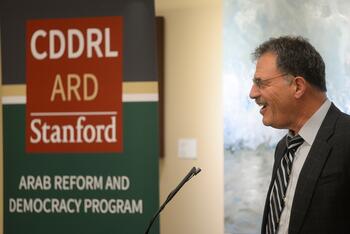
 Farah Al-Nakib (right) and Michael Herb (left)