0
CDDRL Honors Student, 2025-26
zoya_fasihuddin.jpg

Major: Economics
Minor: Human Rights
Hometown: Karachi, Pakistan
Thesis Advisor: Mona Tajali

Tentative Thesis Title: From Dhabas to Mosques to Walls: A Cross Comparative Analysis of Women’s Campaigns for the Right to Public Spaces in Muslim-Majority Countries

Future aspirations post-Stanford: I’m interested in a variety of different fields, including policy research, strategy, law, and academia, and essentially want to work at the intersection of human rights, business, and international policy. Whether pursuing an MA in International Development or even doing a joint JD-MBA, I definitely want to keep learning and writing.

A fun fact about yourself: I went to 7 weddings this December!

Date Label
News Type
News
Date
Paragraphs

Introduction


Generative AI has become an incredibly attractive and widespread tool for people across the world. Alongside its rapid growth, AI tools present a host of ethical challenges relating to consent, security, and privacy, among others. As Generative AI has been spearheaded primarily by large technology companies, these ethical challenges — especially as viewed from the vantage point of ordinary people — risk being overlooked for the sake of market competition and profit. What is needed, therefore, is a deeper understanding of and attention to how ordinary people perceive AI, including its costs and benefits.

The Meta Community Forum Results Analysis, authored by Samuel Chang, James S. Fishkin, Ricky Hernandez Marquez, Ayushi Kadakia, Alice Siu, and Robert Taylor, aims to address some of these challenges. A partnership between CDDRL’s Deliberative Democracy Lab and Meta, the forum enables participants to learn about and collectively reflect on AI. The impulse behind deliberative democracy is straightforward: people affected by some policy or program should have the right to communicate about its contents and to understand the reasons for its adoption. As Generative AI and the companies that produce it become increasingly powerful, democratic input becomes even more essential to ensure their accountability. 

Motivation & Takeaways


In October 2024, the third Meta Community Forum took place. Its importance derives from the advancements in Generative AI since October 2023, when the last round of deliberations was held. One such advancement is the move beyond AI chatbots to AI agents, which can solve more complex tasks and adapt in real-time to improve responses. A second advancement is that AI has become multimodal, moving beyond the generation of text and into images, video, and audio. These advancements raise new questions and challenges. As such, the third forum provided participants with the opportunity to deliberate on a range of policy proposals, organized around two key themes: how AI agents should interact with users and how they should provide proactive and personalized experiences for them.

To summarize some of the forum’s core findings: the majority of participants value transparency and consent in their interactions with AI agents as well as the security and privacy of their data. In turn, they are less comfortable with agents autonomously completing tasks if this is not transparent to them. Participants have a positive outlook on AI agents but want to have control over their interactions. Regarding the deliberations themselves, participants rated the forum highly and felt that it exposed them to alternative perspectives. The deliberators wanted to learn more about AI for themselves, which was evidenced by their increased use of these tools after the deliberations. Future reports will explore the reasoning and arguments that they used while deliberating.


Image
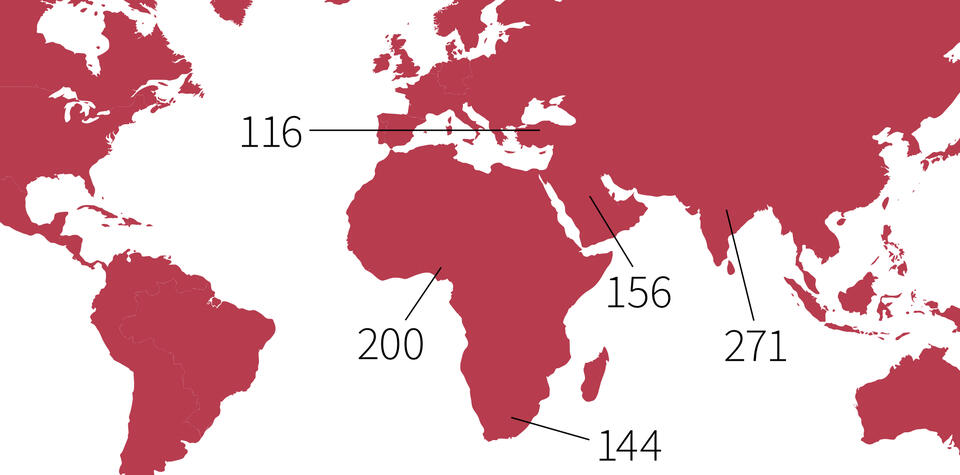
Map of where participants hailed from.


The participants of this Community Forum were representative samples of the general population from five countries - Turkey, Saudi Arabia, India, Nigeria, and South Africa. Participants from each country deliberated separately in English, Hindi, Turkish, or Arabic.


Methodology & Data


The deliberations involved around 900 participants from five countries: India, Nigeria, Saudi Arabia, South Africa, and Turkey. Participants varied in terms of age, gender, education, and urbanicity. Because the deliberative groups were recruited independently, the forum can be seen as five independent deliberations. Deliberations alternated between small group discussions and ‘plenary sessions,’ where experts answered questions drawn from the small groups. There were around 1000 participants in the control group, who did pre- and post-surveys, but without deliberating. The participant sample was representative with respect to gender, while the treatment and control groups were balanced on demography as well as on their attitudes toward AI. Before deliberating on the proposals, participants were presented with background materials as well as a list of costs and benefits to consider.

In terms of the survey data, large majorities of participants had previously used AI. There was a statistically significant increase in these proportions after the forum. For example, in Turkey, usage rates increased from nearly 70% to 84%. In several countries, there were large increases in participants’ sense of AI’s positive benefits after deliberating, as well as a statistically significant increase in their interest. The deliberations changed participants’ opinions about a host of claims; for example, “people will feel less lonely with AI” and “more proactive [agents] are intrusive” lost approval whereas “AI agents’ capability to increase efficiency…is saving many companies a lot of time and resources” and “AI agents are helping people become more creative” gained approval. After deliberating, participants demonstrated an improved understanding of some factual aspects of AI, although the more technical aspects of this remain challenging. One example here is AI hallucinations, or rather, the generation of false or nonsensical outputs, usually because of flawed training data.


Image
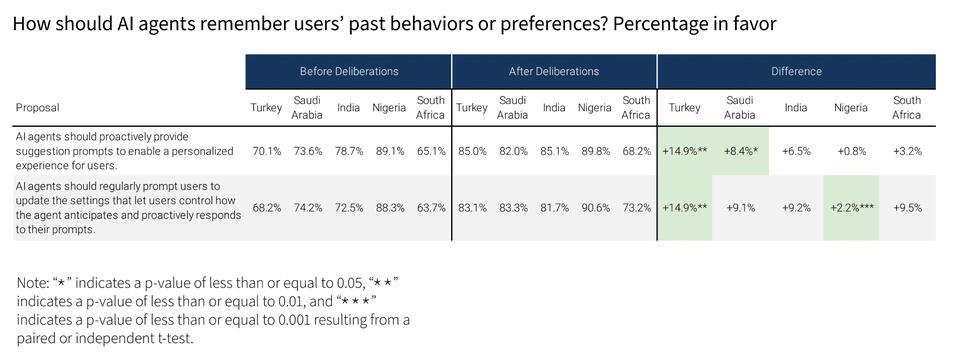
Chart: How should AI agents remember users' past behaviors or preferences? Percentage in favor


Proposals


Participants deliberated on nineteen policy proposals. To summarize these briefly: In terms of whether and how AI remembers users’ past behaviors and preferences, participants preferred proposals that allowed users to make active choices, as opposed to this being a default setting or only being asked once. They also preferred being reminded about the ability of AI agents to personalize their experience, as well as agents being transparent with users about the tasks they complete. Participants preferred that users be educated on AI before using it, as well as being informed when AI is picking up on certain emotional cues and responding in “human-like” ways. They also preferred proposals whereby AI would ask clarifying questions before generating output. Finally, when it comes to agents helping users with real-life relationships, this was seen as more permissible when the other person was informed. Across the proposals, gender was neither a significant nor consistent determinant of how they were rated. Ultimately, the Meta Community Forum offers a model for how informed, public communication can shape AI and the ethical challenges it raises.

*Research-in-Brief prepared by Adam Fefer.

 
Hero Image
Agentic AI Workflow Automation, Artificial intelligence AI driven decision-making concept illustration blue background
iStock / Getty Images
All News button
0
Subtitle

CDDRL Research-in-Brief [4-minute read]

Date Label
Paragraphs

This essay analyzes Turkey’s 2024 local elections as a case of democratic resilience under authoritarian rule. Despite national setbacks, the opposition Republican People’s Party (CHP) achieved significant municipal victories through decentralized strategies, grassroots engagement, and pragmatic candidate selection. These wins challenged Erdoğan’s dominance and disrupted regime patronage networks, prompting intensified state repression, including the 19 March 2025 arrest of Istanbul mayor Ekrem İmamoğlu. Drawing on field research from key districts, the authors highlight how localized, service-oriented governance and inclusive coalitions can revive opposition credibility. However, sustaining these gains depends on navigating internal pressures and regime crackdowns. Turkey’s experience offers broader lessons for opposition movements confronting hybrid authoritarian systems.

All Publications button
1
Publication Type
Journal Articles
Publication Date
Journal Publisher
Journal of Democracy
Authors
Ayça Alemdaroğlu
Aytuğ Şaşmaz
Number
Number 3
-

Encina Commons Room 123
615 Crothers Way, Stanford

0
CDDRL Visiting Scholar, 2024-25
01_ali_carkoglu_08_-_ali_carkoglu.jpg

I am a political scientist specializing in elections, voting behavior, public opinion, and Turkish politics. I have led and participated in major cross-national and national projects such as the Turkish Election Study (TES), Turkish Giving Behaviour Study, International Social Survey Program (ISSP), and Comparative Study of Electoral Systems (CSES). I took part in the planning committees for Modules 5 and 6 in CSES and ISSP modules on family and changing gender roles (2012, 2022), religion (2018), and social networks (2017). I am the founding PI in TES and developed the campaign media content data program, which documents daily campaign content for over ten national newspapers since 2002. My work can be accessed here.

My current research is an exploration of the secularization process in Turkey, a topic where the evidence has so far been mixed. Some scholars find the Turkish experience to possess reflections of secularization, as expected following classical modernization theory, while others present evidence that contradicts these expectations. The most recent contributions to this literature now focus on outliers where resistance to secularization exists, and one even finds a resurgence of religiosity in various dimensions of social life. I focus on Turkey, which can be considered an outlier. In the past, I have contributed to this literature through several projects and articles and touched upon the enduring influence of religion in political life.

My main argument in this project is that Turkish society's dual character, where a potentially secularizing group faces an increasingly resacralizing group, is responsible for the contrasting findings about secularization and creating the Turkish outlier. I follow historical and quantitative research, bringing together comprehensive data that focus on the country's critical areas of social development. I argue that underlying Turkish ideological and affective polarization is the dual character of Turkish society with opposing secularization trends.

Date Label
Seminars
Date Label
Paragraphs

In October 2024, Meta, in collaboration with the Stanford Deliberative Democracy Lab, implemented the third Meta Community Forum. This Community Forum expanded on the October 2023 deliberations regarding Generative AI. For this Community Forum, the participants deliberated on ‘how should AI agents provide proactive, personalized experiences for users?’ and ‘how should AI agents and users interact?’ Since the last Community Forum, the development of Generative AI has moved beyond AI chatbots and users have begun to explore the use of AI agents — a type of AI that can respond to written or verbal prompts by performing actions for you, or on your behalf. And beyond text-generating AI, users have begun to explore multimodal AI, where tools are able to generate content images, videos, and audio as well. The growing landscape of Generative AI raises more questions about users’ preferences when it comes to interacting with AI agents. This Community Forum focused deliberations on how interactive and proactive AI agents should be when engaging with users. Participants considered a variety of tradeoffs regarding consent, transparency, and human-like behaviors of AI agents. These deliberations shed light on what users are thinking now amidst the changing technology landscape in Generative AI.

For this deliberation, nearly 900 participants from five countries: India, Nigeria, Saudi Arabia, South Africa, and Turkey, participated in this deliberative event. The samples of each of these countries were recruited independently, so this Community Forum should be seen as five independent deliberations. In addition, 1,033 persons participated in the control group, where the participants did not deliberate in any discussions; the control group only completed the two surveys, pre and post. The main purpose of the control group is to demonstrate that any changes that occur after deliberation are a result of the deliberative event.

All Publications button
1
Publication Type
Reports
Publication Date
Subtitle

April 2025

Authors
James S. Fishkin
Alice Siu
-

Encina Commons 123
615 Crothers Way, Stanford

1
CDDRL Postdoctoral Scholar, 2021-22
aytug.jpg

I am a political scientist (PhD degree expected in July 2021 from Harvard) working on political parties, social welfare policies and local governance, primarily in the Middle East and North Africa. My dissertation project focuses on secular parties in the region and explores why they could not form a robust electoral alternative to the Islamist parties in the post-uprisings period. In other projects, I explore voters' responses to executive aggrandizement (focusing on Turkey), and social welfare in the context of ethnic and organizational diversity (focusing on Lebanon). Prior to PhD, I worked as an education policy analyst in Turkey, managing several research projects in collaboration with the Ministry of Education, World Bank and UNICEF. I hold a BA degree in Political Science from Boğaziçi, and Master's degrees from the LSE and Brown. 

Aytuğ Şaşmaz
Seminars
Date Label
-

Encina Commons, 123
615 Crothers Way, Stanford

0
CDDRL Visiting Scholar, 2024-25
01_ali_carkoglu_08_-_ali_carkoglu.jpg

I am a political scientist specializing in elections, voting behavior, public opinion, and Turkish politics. I have led and participated in major cross-national and national projects such as the Turkish Election Study (TES), Turkish Giving Behaviour Study, International Social Survey Program (ISSP), and Comparative Study of Electoral Systems (CSES). I took part in the planning committees for Modules 5 and 6 in CSES and ISSP modules on family and changing gender roles (2012, 2022), religion (2018), and social networks (2017). I am the founding PI in TES and developed the campaign media content data program, which documents daily campaign content for over ten national newspapers since 2002. My work can be accessed here.

My current research is an exploration of the secularization process in Turkey, a topic where the evidence has so far been mixed. Some scholars find the Turkish experience to possess reflections of secularization, as expected following classical modernization theory, while others present evidence that contradicts these expectations. The most recent contributions to this literature now focus on outliers where resistance to secularization exists, and one even finds a resurgence of religiosity in various dimensions of social life. I focus on Turkey, which can be considered an outlier. In the past, I have contributed to this literature through several projects and articles and touched upon the enduring influence of religion in political life.

My main argument in this project is that Turkish society's dual character, where a potentially secularizing group faces an increasingly resacralizing group, is responsible for the contrasting findings about secularization and creating the Turkish outlier. I follow historical and quantitative research, bringing together comprehensive data that focus on the country's critical areas of social development. I argue that underlying Turkish ideological and affective polarization is the dual character of Turkish society with opposing secularization trends.

Date Label
Seminars
Date Label
Authors
Khushmita Dhabhai
News Type
News
Date
Paragraphs

Ali Çarkoğlu, a political scientist specializing in elections, voting behavior, and Turkish politics, presented an analysis of Turkey's electoral dynamics from 1990 to 2023 at a CDDRL research seminar. His study focused on the interplay between social cleavages, democratic backsliding, and their impact on political competition and voter behavior. Using data from the World Values Survey and Turkish Election Studies, Çarkoğlu explored the rise of the Justice and Development Party (AKP) and the enduring influence of cultural divides on Turkey’s political landscape.

Central to his analysis was the "alla Turca kulturkampf," a concept describing the deep-rooted center-periphery divide in Turkish politics. This cleavage reflects a cultural conflict between two contrasting societal visions: the Kemalist ideal of secularism, gender equality, and scientific rationalism versus the pro-Islamist focus on tradition, religion, and family values. Despite the AKP’s success in bringing peripheral groups into the state’s institutional core, these cultural divides persist as a primary source of polarization. Çarkoğlu argued that this polarization has entrenched partisan loyalty and overshadowed other factors in shaping voter behavior.

A key theme of the presentation was Turkey's democratic backsliding, characterized by the erosion of democratic institutions, curtailment of civil liberties, and electoral manipulation. Çarkoğlu noted that Turkey ranks 148th on the liberal democracy index, illustrating its significant democratic decline. He linked these trends to heightened polarization, which weakens opposition forces and reduces the influence of traditional electoral cleavages. Instead of fostering competitive elections, the political landscape is increasingly dominated by entrenched party loyalties and identity-driven politics.

The presentation also highlighted the significant social and economic changes Turkey has undergone since 1990. Urbanization surged from 61% in 1992 to 78% in 2024, while agriculture’s share of employment dropped from 45% to 17%. Economic growth has raised per capita income from $2,000 to $10,000, but inequality remains pervasive, and safety nets are inadequate. Women’s labor force participation remains low at 35%, and educational disparities persist. Household sizes have decreased, and the dependency ratio has dropped from 65 to 47 over 30 years. However, these societal shifts have had limited political consequences, as electoral dynamics remain anchored in longstanding cultural cleavages.

Çarkoğlu’s findings indicated that Turkey’s party system has remained "frozen" for the past three decades. While socio-demographic factors play a declining role in explaining voter behavior, attitudinal variables such as group identity and cultural values have gained prominence. This shift reflects how polarization has solidified, with partisan loyalty reinforcing competitive authoritarianism.

Çarkoğlu emphasized that the weakening of electoral cleavages has facilitated democratic backsliding by reducing opposition effectiveness and enabling strategic manipulation. Despite rapid social change, entrenched cultural divides and polarization have prevented political transformation. His research underscores the importance of addressing institutional decline, polarization, and social inequality to combat democratic erosion. Turkey’s experience offers critical lessons for other unconsolidated democracies facing similar challenges.

Read More

Yoshiko Herrera presented her research in a REDS Seminar co-hosted by CDDRL and TEC on January 16, 2025.
News

Identities and War: Lessons from Russia’s War on Ukraine

Political Science scholar Yoshiko Herrera examines how identity shapes the causes, conduct, and consequences of war, especially in the wake of Russia’s invasion of Ukraine.
Identities and War: Lessons from Russia’s War on Ukraine
Alberto Díaz-Cayeros presents his research in a CDDRL seminar.
News

Colonialism, Epidemics, and Resilience: Rethinking Demographic Collapse in Tepetlaoztoc

FSI Senior Fellow Alberto Díaz-Cayeros explores how demographic collapse, epidemic disease, and colonial rent extraction were interconnected in Tepetlaoztoc, a city-state in the Acolhua Kingdom of the Aztec Empire.
Colonialism, Epidemics, and Resilience: Rethinking Demographic Collapse in Tepetlaoztoc
Alex Mierke-Zatwarnicki
News

Understanding Identity Politics: Strategies for Party Formation and Growth

CDDRL Postdoctoral Fellow Alex Mierke-Zatwarnicki explores how identity politics — strategies of political mobilization based on group identity — shape the development of new political parties, particularly those trying to establish themselves in a competitive environment.
Understanding Identity Politics: Strategies for Party Formation and Growth
Hero Image
Ali Çarkoğlu
All News button
1
Subtitle

Using data from the World Values Survey and Turkish Election Studies, CDDRL Visiting Scholar Ali Çarkoğlu explores the rise of the Justice and Development Party (AKP) and the enduring influence of cultural divides on Turkey’s political landscape.

Date Label
Subscribe to Turkey