Jews vs. Rome: Barry Strauss & Erich Gruen in Conversation
Building 380, Math Corner
450 Jane Stanford Way, Building 380, Stanford, CA 94305
380X
Building 380, Math Corner
450 Jane Stanford Way, Building 380, Stanford, CA 94305
380X
Retaliation (or the threat thereof) is a central component of human behavior. It plays a key role in sustaining cooperation — such as in international organizations or free trade agreements — because those known to retaliate come to acquire a reputation of being hard to exploit. But how does the use and function of retaliation vary across cultures, and how does it interact with formal forms of punishment?
In “Cross-cultural differences in retaliation: Evidence from the soccer field,” Alain Schläpfer tackles these questions using data on retaliation from association football. Retaliation is simply defined in terms of fouling: player B retaliates against player A if and only if, after A fouls B, B then fouls A. Among other findings, Schläpfer shows that players from cultures emphasizing revenge are more likely to retaliate on the football field. This form of ‘informal punishment’ by players also interacts with ‘formal punishment’ by referees: retaliation by B is less likely when A is sanctioned with a yellow card. Schläpfer’s paper increases our knowledge of the causes and consequences of retaliation, while showing how informal cultural norms interact with the formal rules of football.
Schläpfer creates a data set of fouls committed over three football seasons (2016-2019) in nine of the world’s top professional men’s leagues. This includes the European leagues of Premier League (England), Serie A (Italy), Bundesliga (Germany), LaLiga (Spain), and Ligue 1 (France), as well as Série A (Brazil), Liga Profesional (Argentina), Liga MX (Mexico), and Major League Soccer (United States). The dataset comprises 9,531 games, 230,113 fouls committed by 10,928 unique perpetrators from 139 countries against 11,115 unique victims from 137 countries.
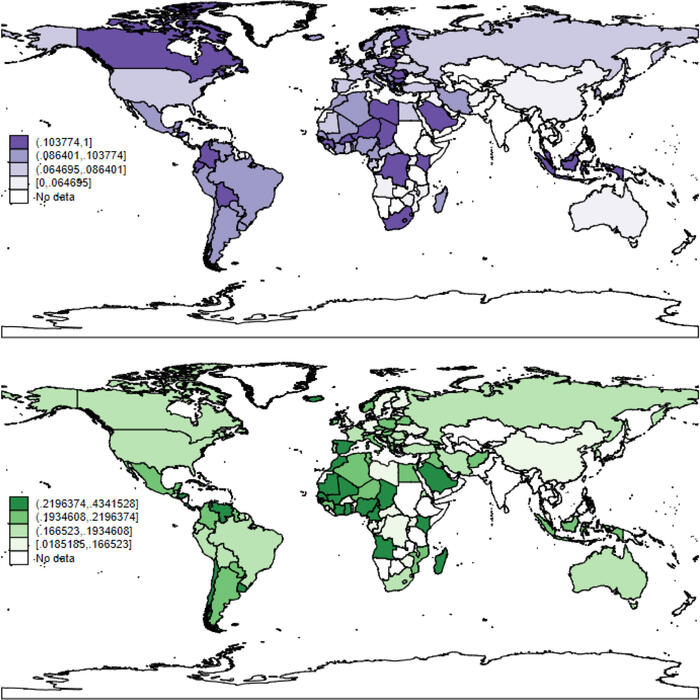
Because Schläpfer hypothesizes that being from more revenge-centric cultures explains on-field retaliation, the key independent variable is measured using a dataset from Stelios Michalopoulos and Melanie Meng Xue that identifies revenge motifs in a culture’s folklore. Examples of this include supernatural forces avenging human murders or animals avenging the death of their friends by humans. Schläpfer uses a host of other independent variables, such as country-level survey data about the desire to punish — as opposed to rehabilitate — criminals, which is also theoretically linked to revenge. As stated above, retaliation is measured in terms of fouls committed. Schläpfer shows that there is substantial variation in retaliation rates among players from different countries, from Gabon (8%) to Iceland (31%). Can the folklore in the country of origin explain the behavior of players on the field?
Fig. 1. The share of fouls retaliated in soccer games (top) and the prevalence of revenge motifs in folklore (bottom). Both variables tend to have higher values for players and folklore from the Middle East, Central Africa, Eastern Europe, and parts of South America.
Retaliation:
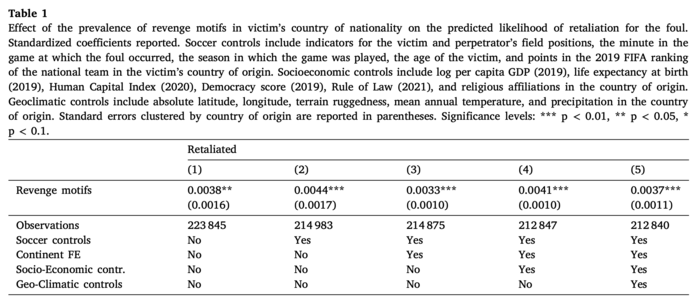
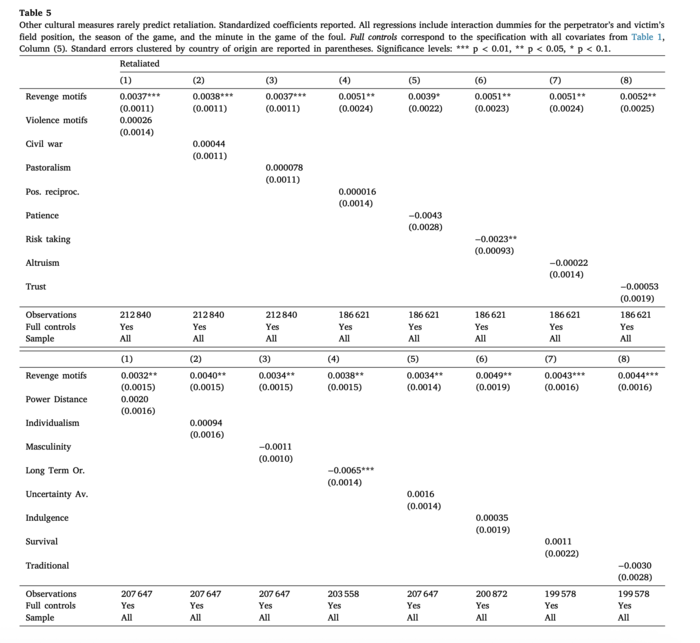
Schläpfer finds evidence that players from cultures that value revenge are indeed more likely to retaliate for fouls. However, they are not more likely to commit fouls overall, cautioning us against conflating the concepts of retaliation and violence. Indeed, Schläpfer demonstrates that motifs of violence in a culture's folklore do not predict retaliation. Players are also found to be more retaliatory early on in a game, which is consistent with its use as a signal or aspect of one’s reputation. In other words, retaliation serves to deter future fouls. Victims of fouls also retaliate quickly. Indeed, retaliation rates are stable or slightly increasing during the first 30 minutes of a game, but then fall consistently thereafter.
Evidence is also provided to show that retaliation deters future transgressions: perpetrators are less likely to foul again if victims retaliate for the initial foul. However, this deterrence finding is only observed when the perpetrator is from a revenge culture. In other words, for retaliation to support cooperation (the absence of fouls), players must share a similar cultural background.
Schläpfer’s findings hold even when soccer-related or socioeconomic factors are taken into account. Further, the paper considers, but finds little support for, alternative explanations of why retaliation varies. These include that some teams encourage players to retaliate more or employ more players from revenge cultures. Further, retaliation does not appear to be driven by emotions; otherwise, it would be less likely to occur after halftime when players have had a chance to cool down, but this is not the case.
Informal and Formal Sanctioning:
Finally, Schläpfer analyzes the interaction between player retaliation and refereeing. Most importantly, retaliation is significantly less likely if a foul is sanctioned with a yellow card. This illustrates the theoretical principle of formal punishment “crowding out” informal punishment, such as religious excommunication, which carries greater weight than social shunning or police fines compared to peer pressure. Both retaliation and referee sanctioning are shown to reduce the frequency of repeated offenses by perpetrators, especially among players from revenge cultures. However, Schläpfer finds that formal sanctioning is roughly three times more effective than retaliation. This suggests that football referees are doing a better job managing conflict between players than players themselves.
Schläpfer concludes by mentioning a few of the paper’s limitations. First of all, retaliation is measured only by what referees sanction. However, referees may miss crucial incidents for which retaliation is a response, such as Zinedine Zidane’s 2006 World Cup headbutt after a verbal insult (that was not sanctioned). This is important because individuals from revenge cultures are likely to be particularly offended by verbal insults. Second, the paper does not capture retaliation that occurs across games played by the same teams over time, particularly when rivalries and hostilities have intensified. Similarly, it does not account for preemptive retaliation that does not follow a foul. Ultimately, Schläpfer deepens our understanding of retaliation in a domain where many would expect it not to operate or to do so with minimal significance. The article impressively marshals large-scale data from both sports and cultural history to clarify the causes and consequences of retaliation.
*Research-in-Brief prepared by Adam Fefer.

CDDRL Research-in-Brief [4-minute read]
The Center on Democracy, Development and the Rule of Law proudly congratulates its 2025 graduating class of honors students on their outstanding original research conducted under CDDRL's Fisher Family Honors Program. Among those graduating is Charles Sheiner, an International Relations major, who has won a Firestone Medal for his research on the electoral impact of Biden-era spending programs. Additionally, two students were selected as recipients of the CDDRL Outstanding Thesis Award. Adrian Feinberg, an International Relations major who is also minoring in History, Film & Media Studies, was honored for his research revealing how postwar Yugoslavia utilized the justice system to build state power and suppress dissent. Adelaide Madary, a Political Science major, was honored for her research exploring how local leadership shapes the responses of rural Calabrian communities to immigration, fostering hospitality in some towns and resistance in others.
The Firestone Medal for Excellence in Undergraduate Research recognizes Stanford's top ten percent of honors theses in social science, science, and engineering among the graduating senior class. Charles's thesis is entitled The Limits of Payout Politics: How Biden-Harris Federal Spending Shaped (and Didn't Shape) the 2024 Presidential Vote. His thesis examines whether the Biden-Harris administration’s signature spending programs — the Bipartisan Infrastructure Law, Inflation Reduction Act, and CHIPS Act — yielded electoral rewards in the 2024 presidential election. Using an original dataset of over 40,000 geocoded federal projects representing $227 billion in county-level investments, Charles finds no statistically significant association between per-capita spending and shifts in Democratic vote margins, even when accounting for partisan context and project visibility. Through interviews with federal and local officials, he identifies three explanatory mechanisms: implementation lags prevented most projects from reaching completion before Election Day, administrative and policy bottlenecks systematically delayed development, and Republican messaging successfully reframed spending as inflationary. These findings suggest that retrospective voting operates primarily through immediate, visible benefits rather than campaign promises or announced investments, with significant implications for how policy initiatives must be designed to deliver outcomes within electoral cycles.
Adrian's thesis is entitled The Gavel and the Gun: Post-War Trials and State-Building Politics in Yugoslavia (1945-1949). His thesis explores how the Communist Party of Yugoslavia (KPJ) authorities used the post-World War II justice process to consolidate power from 1945 to 1949. Drawing on trial transcripts, newspapers, and other archival materials, the study argues that the Yugoslav state instrumentalized judicial structures in three distinct stages: first, using honor courts to assert basic state capacity; second, conducting public-facing war crimes trials to promote the state’s ideological legitimacy; and third, orchestrating espionage trials to suppress dissent and entrench single-party rule. While affirming that the KPJ often subordinated judicial integrity to its state-building project, the thesis complicates conventional narratives by attending to the moral ambiguities, partial truths, and undeniable moments of justice present in even the most politicized of trials. In doing so, it offers broader insights into the fraught intersection of law, memory, and power in postwar societies.
Adelaide's thesis is entitled Philoxenia: Local Responses to Immigration in Calabria, Italy. Over recent decades, many nations across Europe and the Americas have responded to mass migration movements across the globe with hostile policies, xenophobic sentiment, and poorly managed immigration systems. At the same time, several municipalities in Calabria, Italy that struggle with severe depopulation and economic hardship have experienced positive transformations upon opening refugee reception centers, including reversals to declining population trends, job creation and the continuation of important public goods, such as elementary schools — but not all towns that have a demand for immigration respond in the same way. Many Calabrian municipalities have not opened refugee resettlement centers, and others have become a breeding ground for labor exploitation among migrant workers. This thesis employs a mixed-methods approach to consider how structure, agency, and culture account for the variation in local responses to migrants and refugees throughout the relatively homogenous region of Calabria. A systematic analysis of quantitative municipal-level data paired with four granular case studies suggests that a municipality’s structural characteristics alone do not explain the variance in local responses to immigration. Rather, the presence of an entrepreneurial local actor, such as a mayor or non-profit leader with strong humanitarian commitments, is necessary to recognize and actualize the aligned interests between locals and newcomers and bring about cultures of hospitality. While much of the literature on local responses to immigration has focused on urban settings, this thesis aims to widen academic discussions to include more rural contexts and contributes to the underdeveloped literature on hospitality, rather than hostility, toward newcomers.
Charles, Adrian, and Adelaide are part of a cohort of 13 graduating CDDRL honors students who have spent the past year working in consultation with CDDRL-affiliated faculty members and attending honors research workshops to develop their thesis projects. The theses this year covered topics as wide ranging as authoritarian repression, conflict and state-building, regulation and governance, and democratic accountability. Students embarked on original research across multiple countries, conducting interviews, fielding surveys, plumbing archives, and building datasets.
“We are so proud of this year’s cohort of seniors in the Fisher Family Honors Program,” shared Didi Kuo, Center Fellow at FSI and co-director of CDDRL’s Fisher Family Honors Program. “Our multidisciplinary students brought a range of methods and analytical approaches to inform their understanding of democracy and development. They asked a range of trenchant research questions and brought a collaborative spirit to the research enterprise that improved everyone’s projects.”
In addition to the Firestone Medal and CDDRL Outstanding Thesis Awards, members of the Class of 2025 have received several other honors heading into graduation:
CDDRL's Fisher Family Honors Program trains students from any academic department at Stanford to prepare them to write a policy-relevant research thesis with global impact on a subject touching on democracy, development, and the rule of law. Honors students participate in research methods workshops, attend honors college in Washington, D.C., connect to the CDDRL research community, and write their thesis in close consultation with a faculty advisor to graduate with a certificate of honors in democracy, development, and the rule of law.
Charles Sheiner ('25) is a recipient of the 2025 Firestone Medal, and Adrian Feinberg ('25) and Adelaide Madary ('25) have won CDDRL's Outstanding Thesis Awards.
Major: Political Science
Minor: Modern Languages & Data Science
Hometown: Lodi, California
Thesis Advisor: Anna Grzymala-Busse
Tentative Thesis Title: Combating Agricultural Labor Exploitation among Migrant Workers in Italy and California
Future aspirations post-Stanford: After Stanford, I would like to attend graduate school, continue to learn languages, and participate in public service projects.
A fun fact about yourself: I ran my first half marathon in Rome while studying abroad in Florence this past winter!
Part of the symposium, "For a Better Democracy: Proportional Representation."
An increasing number of wholesale electricity markets employ locational pricing mechanisms where energy prices account for some or all aspects of the transmission network configuration. A major concern of regulators is that suppliers may have the ability to exercise unilateral market power by impacting the extent to which transmission constraints bind. We extend the residual demand curve as a measure of the ability to exercise unilateral market power from a single price market to residual demand hypersurfaces in locational pricing markets. We show that accounting for the fact that firms face residuai demand surfaces improves our ability to explain the offer curves submitted by strategie suppliers. A supplier's residuai demand surface also explains why the location of a firm's capacity is an important factor in analyzing the extent to which divestment of generation capacity or a transmission network expansion ultimately benefits final consumers.
We extend the competitive benchmark pricing model of Borenstein et al. (2002) to locational-pricing markets. We further extent this model to account for transmission network security constraints as well as technical constraints on thermal power plants that introduce non-convexities in their operating cost functions. We apply both models to assess the performance of the Italian wholesale electricity market for the year 2018. Hourly competitive benchmark locational prices that ignore the impact of non-convexities in generation unit operation fail to provide credible estimates for the intra-day benchmark price profile. Augmenting the model to account for transmission network security constraints and non-convexities resolves this issue. We find that the average day-ahead market-clearing prices throughout the day are close to average competitive benchmark prices throughout the day during 2018. However, accounting for the cost of the re-dispatch market that makes final schedules from the day-ahead financial market physically feasible, raises the average hourly cost of serving demand. Our preferred competitive benchmark pricing model implies annual market inefficiencies in the range of 1 to 2 billion Euros in the actual annual cost of serving load in 2018 in ltaly.
Using hourly offer curves for the Italian day-ahead market and the real-time re-dispatch market for the period January 1, 2017 to December 31, 2018, we show how thermal generation unit owners attempt to profit from differences between a simplified day- ahead market design that ignores system security constraints as well as generation unit operating constraints, and real-time system operation where these constraints must be respected. We find that thermal generation unit owners increase or decrease their day- ahead offer price depending on the probability that their final output will be increased or decreased because of real-time operating constraints. We estimate generation unit- level models of the probability of each of these outcomes conditional on forecast demand and renewable production in Italy and neighbouring countries. Our most conservative estimate implies an offer price increase of 50 EUR/MWh if the predicted probability of day-ahead market schedule increases from zero to one. If the predicted probability of a day-ahead market schedule increases from zero to one the unit owner’s offer price is predicted to be 60 EUR/MWh less. We find that these re-dispatch costs averaged approximately nine percent of the cost of wholesale energy consumed valued at the day-ahead price during our sample period.
Angela Stent is Professor of Government and Foreign Service at Georgetown University and directs its Center for Eurasian, Russian and East European Studies. She has also served in the State Department’s Office of Policy Planning and as National Intelligence Officer for Russia and Eurasia at the National Intelligence Council. She is the author of Russia and Germany Reborn: Unification, the Soviet Collapse and the New Europe; The Limits of Partnership: U.S-Russian Relations in the Twenty-First Century and Putin’s World: Russia Against the West and with the Rest.
Roberto D’Alimonte is professor of political science at Luiss-Guido Carli in Rome and chair of the department of political sciences. Until 2010 he had taught for over 30 years at the University of Florence, Italy. Professor D’Alimonte has been Ford Foundation Fellow at Yale and American Council of Learned Societies Fellow at Harvard and taught as visiting professor in the political science departments at Yale and Stanford. At Stanford he has also given courses on Europe in the MBA program at the Graduate School of Business and he has been for many years a speaker in the Stanford Business School’s Executive Program. Since 1995 he has taught at New York University Florence Center as adjunct professor. His most recent research interests have to do with political and electoral change in Western democracies. Since 2005 he has been the director of the Italian Center for Electoral Studies. Well-known as a political journalist, Professor D’Alimonte covers political events for Il Sole 24 Ore, Italy’s major financial newspaper. He is often sought out by international media for commentary on current Italian and European affairs. His quotes have appeared in the New York Times, Financial Times, The Times, New Yorker, Le Monde, Asahi Shimbun, Bloomberg, Reuters.