Authors
News Type
News
Date
Paragraphs

Motivation & Contribution


Over the past 10-15 years, both longstanding and relatively new democracies have suffered from backsliding and erosion, including India, the United States, Brazil, Turkey, and many others. Many social scientists have explained this wave of backsliding in terms of either (a) elected autocrats who undermine democracy from within or (b) declining popular support for democrats who have failed to deliver economic growth and prosperity. However, recent scholarship by Thomas Carothers and Brendan Hartnett has questioned the wisdom of the latter. For example, India enjoyed strong economic growth prior to its backsliding under Narendra Modi.

In “Delivering for Democracy,” Francis Fukuyama, Chris Dann, and Beatriz Magaloni set out to more systematically evaluate the evidence connecting popular support for democracy with delivery, examining both backsliding and non-backsliding countries. After finding preliminary evidence for the democracy-delivery relationship, they offer an explanation of why delivery is simultaneously so important and so elusive under democratic governance.

Evidence


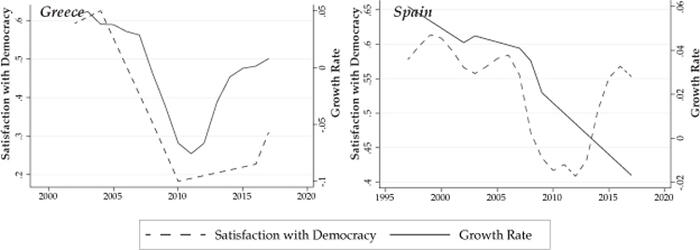
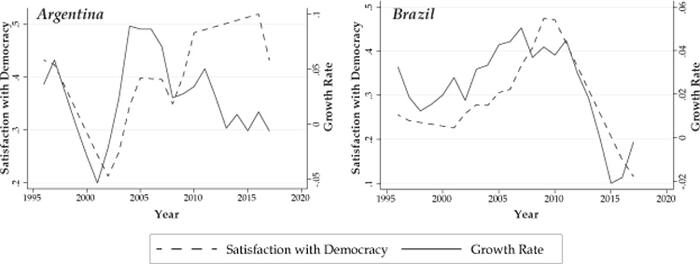
Using ten data sources covering 650,000 people in both old and new democracies, the authors find a strong, positive correlation between satisfaction with democracy and economic performance. This relationship holds not only for many countries at one point in time but for pairs of countries over time. In two developing democracies — Argentina and Brazil — as well as in two developed democracies — Greece and Spain — satisfaction and delivery have been closely connected since 2005, plummeting during economic crises and rising during periods of prosperity. These patterns call for an explanation for why voters care so much about delivery, such that they may be willing to sacrifice their democratic freedoms for it.


Image
Graphs showing satisfaction with democracy and growth rate in Argentina and Brazil


Image
Graphs showing satisfaction with democracy and growth rate in Greece and Spain


The Argument


Delivery is Important

The authors begin from the axiom that stable political life depends upon citizens perceiving their governments as legitimate. Legitimacy can be thought of in terms of both performance — the effective delivery of goods and services — and procedure, which encompasses policies that reflect the democratic will of the people. As the examples of China, Turkey, Saudi Arabia, and Singapore show, however, plenty of autocracies and backsliding democracies have not only delivered, but have also arguably outperformed their democratic peers. From China’s Belt and Road Initiative to Turkey’s Yavuz Sultan Selim Bridge, authoritarian leaders and ruling parties have achieved remarkable performance legitimacy. 

Although autocracies, by definition, cannot be procedurally legitimate, this may carry little weight for democratic citizens who experience prolonged unemployment or must deal with dilapidated infrastructure. Indeed, public engagement through procedural channels — such as voting or jury service — has steadily declined across the democratic world. Democratic voters are increasingly willing to support outsider candidates who build new infrastructure or promise to fight crime, but who nonetheless restrict their political freedoms. Many citizens of El Salvador — which now claims the world’s highest incarceration rate — continue to view Nayib Bukele’s administration as the surest way of delivering security, despite a years-long state of emergency that has seriously eroded democratic freedoms. 

Meanwhile, established democracies built much of their infrastructure decades ago, so investments primarily maintain these systems, rather than showcasing new projects that can garner public support. In some cases, democracies have struggled to even maintain their existing infrastructure, perhaps best exemplified by the collapse of Baltimore’s Francis Scott Key Bridge. All of this creates the conditions for voters to support far-right, anti-democratic parties, which often blame immigrants for economic problems and propose illiberal solutions.

Yet Democratic Delivery is Difficult

Elected democrats seeking to deliver may find themselves hamstrung in ways that autocrats are not. For one, democratic institutions are composed of ‘veto players’ who can stymie the introduction of badly needed policies: national and subnational governments, multiple legislative chambers, judges who review and overturn executive action, and so on. At the same time, democrats must worry about election cycles and term limits, decreasing their incentives to deliver for the long term when later politicians may take credit. Meanwhile, legal and regulatory systems, such as those intended to protect the environment, may prevent the building of critical infrastructure. Property rights prevent the forcible displacement of communities for development, while civil liberties prevent the repression of those who refuse to be displaced. Rules meant to prevent regulatory capture often become arenas where powerful interest groups block and delay government action. 

Independent news media present another potential impediment to delivery, as criticism from journalists can make incumbents wary of undertaking new projects. In addition, media bias can convince voters to remove politicians who do, in fact, deliver. By contrast, autocrats who censor media and arrest journalists can focus on delivery alone, even while their development schemes often rest on corrupt and nepotistic practices. Popular discontent with democratic government ultimately creates a damaging feedback loop: voters are unwilling to fund government projects, in turn leading government to function worse, generating further discontent.


Autocrats have figured out ways to deliver the goods and services their citizens want, but this does not make autocracy a just political system.


Prospects


Autocrats have figured out ways to deliver the goods and services their citizens want, but this does not make autocracy a just political system. By the same token, democracies may struggle to deliver, but their procedural legitimacy — especially voters’ ability to hold representatives to account — entails a powerful means of generating fair and inclusive delivery. As such, the authors call on democracies to examine their past and that of their peer countries — both developed and developing — for inspiration. For example, the U.S. New Deal was exemplary in building ambitious and popular infrastructure, as well as providing broad social and economic protections. (Of course, most of these projects would be hamstrung by modern-day regulatory frameworks.)

Meanwhile, Australia’s citizens have both benefited from a recent infrastructure boom and have demonstrated strong support for democracy. Finally, many Latin American countries have implemented popular and effective programs like conditional cash transfers. For the authors, addressing the issues most pressing to voters — such as job creation, which is especially salient to young people, who are most dissatisfied with democracy — will require democratic governments to strike the right balance between democracy and delivery.

*Research-in-Brief prepared by Adam Fefer.

Hero Image
Group of people protesting in Ibadan, Nigeria, holding a sign reading "#EndSARS #EndBadGov"
Group of people protesting in Ibadan, Nigeria.
Oladipo Adejumo via Unsplash
All News button
0
Subtitle

CDDRL Research-in-Brief [4-minute read]

Date Label
Authors
Nora Sulots
News Type
News
Date
Paragraphs

Please join us in congratulating Vicky Fouka, Associate Professor of Political Science at Stanford University and affiliated faculty at the Center on Democracy, Development and the Rule of Law, on being honored with the Bodossaki Distinguished Young Scientist Award in Social Sciences.

Presented biennially by the Bodossaki Foundation, the award celebrates exceptional Greek scientists under the age of 40 for their groundbreaking research, commitment to excellence, and contributions to Greece’s global visibility.

The Foundation's press release shared the following about Professor Fouka's selection:
 

Her presentation explored how she uses a blend of historical and statistical analysis to study societies that have experienced large migratory flows over time. She examines how various factors and state policies have shaped migrant integration and social identities. Drawing on models of human behaviour from economics and social psychology, she brings together a range of theoretical and empirical approaches. This convergence, she believes, ‘will help deepen our understanding of some of the most pressing challenges in contemporary society, such as political polarisation, the rise of political violence, and conflicts between social groups and nations.’

Vicky Fouka (second from left) and fellow laureates at the 2025 Bodossaki Distinguished Young Scientist Awards Ceremony
Vicky Fouka (second from left) and fellow laureates at the 2025 Bodossaki Distinguished Young Scientist Awards Ceremony in Athens, Greece. | Bodossaki Foundation

In addition to her roles at Stanford, Professor Fouka is a Faculty Research Fellow at the National Bureau of Economic Research (NBER) and a Research Affiliate at the Center for Economic Policy Research (CEPR). She is a political economist with interests in group identity and intergroup relations, culture, and historical social dynamics. Her articles have been published in journals such as the American Political Science Review, the Review of Economic Studies, the Journal of Politics, the Economic Journal, Public Opinion Quarterly, and Nature Human Behaviour. Her work has received the Joseph L. Bernd Award for the best paper published in the Journal of Politics, the Economic Journal's Austin Robinson Prize, and the Best Article Award from the APSA Migration and Citizenship section. She holds a PhD in Economics from Pompeu Fabra University.

The 2025 award ceremony, held on June 17 at the Zappeion in Athens, brought together leaders from government, academia, science, business, and culture to honor Fouka and her fellow laureates for advancing knowledge and inspiring future generations.

Read More

Vicky Fouka
News

National Stigmas and Past Atrocities in Germany

Stanford Associate Professor of Political Science Vicky Fouka shares her research on how public recognition of collective culpability has affected German national identity.
National Stigmas and Past Atrocities in Germany
Professor James S. Fishkin was presented with the Medal of Friendship certificate by Zandanshatar Gombojav.
News

Professor James S. Fishkin Awarded Friendship Medal of Mongolia

The award, decreed by President Ukhnaa Khurelsukh, is Mongolia’s highest state honor and recognizes Fishkin for his pioneering contributions to deliberative democracy.
Professor James S. Fishkin Awarded Friendship Medal of Mongolia
Stephen J. Stedman
News

Stephen J. Stedman Appointed Faculty Director of Stanford’s Program in International Relations

Professor Stedman is a Senior Fellow at the Freeman Spogli Institute for International Studies and director of CDDRL's Fisher Family Honors Program in Democracy, Development and Rule of Law.
Stephen J. Stedman Appointed Faculty Director of Stanford’s Program in International Relations
Hero Image
Vicky Fouka received the Bodossaki Distinguished Young Scientist Award in Social Sciences in Athens, Greece, on June 17, 2025.
Bodossaki Foundation
All News button
1
Subtitle

Recognized for her groundbreaking research on migration, identity, and intergroup relations, Fouka joins an elite group of Greek scientists shaping global scholarship.

Date Label
-

Abstract

From the point of view of institutional economics, growth is related to the implementation and enforcement of property rights. The system that emits, and enforces those rights needs to have very low transactions costs leading to the least possible frictions. The lowest the transactions costs the highest the level of security of investment, as well as the benefits of direct and indirect socioeconomic impacts. However, traditional economic development models do not focus on transactions costs and property rights systems, both of which seem to be the suspects for low productivity, slow growth, and informality. Many developing countries suffer from systems of property rights that are unpredictable because they are inundated with overwhelming bureaucracy, difficult to follow, track, and measure. The speaker has developed a methodology to best diagnose the reasons why a country has such high transactions costs and how to reduce them systematically. This diagnostic method is called Reality Check Analysis (RCA) and its outcomes allow for the best design of policy reforms and strategic application. The presentation will focus on the theoretical definition of the problem, the analysis of Reality Check Analysis, its application and important results measured through a socioeconomic 3,000 household survey. This survey presented the direct benefits of applying a simple property rights system to investment, savings, property values, trust, child labor, to mention a few.

Speaker Bio

Image
panaritis photo
Elena Panaritis until recently served as a senior economic advisor, handling the Euro and Greek Economic Crisis, to two Greek Governments (2009; 2015). In 2015 she also served as the Special Envoy for Negotiating the Greek Sovereign debt and lending program of Greece. Elena worked directly with 3 Greek Prime Ministers and the Minister of Finance, as well as EU and IMF high-level officials, lenders to Greece. In 2015 she was appointed the Alternate Director to the IMF of Italy, Greece, Portugal, Malta, Albania and San Marino, from which position she resigned the same year after strong political pressures. In 2009 she was appointed honorary Member of the Hellenic Parliament until 2012. She is the founder of Panel Group, a triple-bottom-line business that focuses in the informal sector, transforming the wealth base of poor property holders, to proud middle class owners. She has also founded Thought4Action, an Action Tank that works as an educational foundation to create awareness and calls for action, about transforming countries under solvency, economic crisis and informality. Elena Panaritis has taught economic development, housing finance and property markets reform courses at the Wharton Business School, University of Pennsylvania, INSEAD, and the Johns Hopkins University- School of Advanced International Studies (SAIS).

Elena Panaritis Founder and CEO Thought 4 Action - Panel Group
Seminars
Encina Hall West, Room 403 / Bldg. 20-22N


(650) 724 0868
0
Constantine Mitsotakis Professor in the School of Humanities and Sciences
Professor of Political Science
Professor of Classics
Professor, by courtesy, of Philosophy
josiah_ober_headshot.jpg

Josiah Ober, Mitsotakis Professor in the School of Humanities and Science, works on historical institutionalism and political theory, focusing on democratic theory and the contemporary relevance of the political thought and practice of the ancient Greek world. He is the author of Demopolis: Democracy before Liberalism (2017), The Rise and Fall of Classical Greece (2015) and other books, mostly published by Princeton University Press, including Mass and Elite in Democratic Athens (1989), Political Dissent in Democratic Athens (2008), and Democracy and Knowledge (2008). He has also published about 100 articles and chapters, including recent articles in American Political Science ReviewPhilosophical StudiesPolisPublic ChoiceCritical Review, and Transactions of the American Philological Association. Work in progress includes books on instrumental rationality in classical Greek thought and the role of civic bargains in the emergence and persistence of democratic government.

Affiliated faculty at The Europe Center
CV
News Type
News
Date
Paragraphs

Appeared in Stanford Report, May 29, 2014

By Clifton B. Parker

The electoral eruption of anti-European Union populism is a reflection of structural flaws in that body but does not represent a fatal political blow, according to Stanford scholars.

In the May 25 elections for the European Parliament, anti-immigration parties won 140 of the 751 seats, well short of control, but enough to rattle supporters of the EU, which has 28 member nations. In Britain, Denmark, France and Greece, the political fringe vote totals stunned the political establishments.

Stanford political scientist Francis Fukuyama said the rise of extremism and anti-elitism is not surprising in the wake of the 2008 economic downturn and subsequent high levels of unemployment throughout Europe. In one sense, the EU elites have themselves to blame, he said.

"The elites who designed the EU and the eurozone failed in a major way," he said. "There was a structural flaw in the design of the euro (monetary union absent fiscal union, and the method of disciplining countries once in the zone)," said Fukuyama, the Olivier Nomellini Senior Fellow at Stanford's Freeman Spogli Institute for International Studies and the Center for Democracy, Development and the Rule of Law, and Research Afflilate at The Europe Center.

Some have argued that the European Union should adopt a form of fiscal union because without one, decisions about taxes and spending remain at the national level.

As Fukuyama points out, this becomes a problem, as in the case of a debt-ridden Greece, which he believes should not have qualified for EU membership in the first place. In fact, he said, it would have been better for Greece itself to leave the euro at the outset of the 2008 crisis.

Still, Fukuyama said the big picture behind the recent election is clear – it was a confluence of issues and timing.

"It is a bit like an off-year election in the U.S., where activists are more likely to vote than ordinary citizens," he said.

Fukuyama believes the EU will survive this electoral crisis. "I think the EU will be resilient. It has weathered other rejections in the past. The costs of really exiting the EU are too high in the end, and the elites will adjust, having been given this message," he said.

Meanwhile, the populist parties in the different countries are not unified or intent on building coalitions with each other.

"Other than being anti-EU, most of them have little in common," Fukuyama said. "They differ with regard to specific positions on immigration, economic policy, and they respond to different social bases."

Ongoing anger

Dan Edelstein, a professor of French, said the largest factor for success by extremist candidates was "ongoing anger toward the austerity policy imposed by the EU," primarily by Germany.

Edelstein estimates that a large majority of French voters are still generally supportive of the EU. For the time being, the anti-EU faction does not have a majority, though they now have much more representation in the European Parliament.

Edelstein noted existing strains among the anti-EU parties – for example, the UK Independence Party in Britain has stated that it would not form an alliance with the National Front party in France.

Immigration remains a thorny issue for some Europeans, Edelstein said.

"'Immigration' in most European political debates, tends to be a synonym for 'Islam.' While there are some countries, such as Britain, that are primarily worried about the economic costs of immigration, in most continental European countries, the fears are cultural," he said.

As Edelstein put it, Muslims are perceived as a "demographic threat" to white or Christian Europe. However, he is optimistic in the long run.

"It seems a little early to be writing the obituary of the EU. Should economic conditions improve over the next few years, as they are predicted to, we will likely see this high-water mark of populist anger recede," said Edelstein.

Cécile Alduy, an associate professor of French, writes in the May 28 issue of The Nation about how the ultra-right-wing National Front came in first place in France's election.

"This outcome was also the logical conclusion of a string of political betrayals, scandals and mismanagement that were only compounded by the persistent economic and social morass that has plunged France into perpetual gloom," she wrote.

Historian J.P. Daughton said that like elsewhere in the world, immigration often becomes a contentious issue in Europe in times of economic difficulties.  

"High unemployment and painful austerity measures in many parts of Europe have led extremist parties to blame immigrants for taking jobs and sapping already limited social programs," he said.

Anti-immigration rhetoric plays particularly well in EU elections, Daughton said. "Extremist parties portray European integration as a threat not only to national sovereignty, but also to national identity.

Edelstein, Alduy and Daughton are all Faculty Affiliates of The Europe Center.

Wake-up call

Russell A. Berman, a professor of German studies and comparative literature, said many Europeans perceive the EU as "somehow impenetrable, far from the civic politics of the nation states."

As a result, people resent regulations issued by an "intangible bureaucracy," and have come to believe that the European Parliament has not grappled with major issues such as mustering a coherent foreign policy voice, he said.

"The EU can be great on details but pretty weak on the big picture," said Berman, who is the Walter A. Haas Professor in the Humanities, Senior Fellow at the Hoover Institution, and Faculty Affiliate of The Europe Center. "It is this discrepancy that feeds the dissatisfaction."

Yet he points out that the extremist vote surged in only 14 nations of the EU – in the other 14, there was "negligible extremism," as he describes it.

"We're a long way from talking about a fatal blow, but the vote is indeed a wake-up call to the centrists that they have to make a better case for Europe," Berman said.

Hero Image
A man walks past a board displaying provisional results of the European Parliament election at the EU Parliament in Brussels
A man walks past a board displaying provisional results of the European Parliament election at the EU Parliament in Brussels May 25, 2014.
REUTERS / Francois Lenoir
All News button
1
-

The presentation summarizes preliminary findings of my research project on Allied policy towards resistance groups during World War II and its impact on post-war political and ideological divisions.

The research is linked with a multiplicity of historical problems: the western Allies’ balance of political and military considerations during World War II; the Anglo-American cooperation and competition in the field of intelligence; the use of special operations as an instrument of foreign policy, especially in regard to countries where the development of resistance movements had a strong impact on post-war settlement (e.g. Yugoslavia, Greece and Poland); the politics of communist movements between war and revolution in Central and Eastern Europe; the relationship between the Western Allies and the Soviet Union and the Allies’ perception of the latter.

The particular contribution of the project is to bring together aspects which are usually addressed separately: the different national scenarios, whose connections and mutual influence will be investigated; the two Western intelligence agencies, which have been researched mostly in separate ways by scholars of the corresponding nationalities; the Soviet and Western allies’ policies.

Tommaso Piffer is a Marie Curie Postdoctoral Fellow at the Davis Center for Russian and Eurasian Studies at Harvard and at the University of Cambridge. Among his publications is a biography of Alfredo Pizzoni, the political chief of the Italian Resistance (Il Banchiere della Resistenza, 2005), an account of the relationship between the Allies and the Italian Resistance during World War II (Gli Alleati e la Resistenza Italiana, 2010) as well as several essays. He also edited a book in memory of Victor Zaslavsky on Totalitarian societies and democratic transition (Società totalitarie e transizione alla democrazia, 2011, with Vladislav Zubok) and the collection of essays on the political mass murder of Porzus (Porzus. Violenza e resistenza sul confine orientale, 2012). He is an affiliate at the Harvard Center for European Studies and a contributor to the cultural insert of the Italian newspaper Corriere della Sera.

Open to Stanford affiliates

Sponsored by the Center for Russian, East European and Eurasian Studies and co-sponsored by The Europe Center

History Corner, Room 307

Tommaso Piffer Marie Curie Postdoctoral Fellow, Davis Center for Russian and Eurasian Studies, Harvard and University of Cambridge Speaker
Seminars
Authors
News Type
News
Date
Paragraphs

Europe is benefiting from tough, painful economic reforms in the wake of the 2008 downturn, according to the leader of the European Union.

"Europe had to evolve dramatically because reality forced it to," said José Manuel Barroso, president of the European Commission, in a May 1 talk on campus. "This change came about with the economic and financial crisis initiated with the collapse of the Lehman Brothers back in 2008, and that has caused me many sleepless nights."

The title of Barroso's presentation was "Global Europe, from the Atlantic to the Pacific." The event was co-sponsored by Stanford's Freeman Spogli Institute for International Studies, The Europe Center and the Center for Russia, East European and Eurasian Studies. The European Commission is the executive body of the European Union.

Barroso acknowledged that the financial meltdown hit Europe especially hard, given the "serious flaws" in the way some countries were running their economies, living beyond their means and lacking the competitiveness required in a globalized world.

The crisis revealed, he added, the "economic interdependence inside Europe," and the fact that the 28-member union did not have the capability to handle large-scale financial emergencies or prevent unsound policies on the part of member nations like Greece.

"So we had to adapt and reform as we have done many times in the European Union," Barroso said.

Economic reforms, regulations

And so, the European Union adopted a more extensive system of economic and budgetary governance to ensure member states stick to their financial commitments and become more competitive. Today, each country sends their national budget to the EU headquarters in Brussels before approving it at the national level, he said.

Barroso added that the EU created a "European stability mechanism," or safety net, worth about $1 trillion to help member states adopt key reforms and assist them in times of crisis. There are also more detailed banking regulations that give the EU more authority over national banks.

"Now the control is exercised at European level through the European Central Bank and there are common rules for banks so that we avoid having to use taxpayers' money to rescue them," he said.

Barroso dismissed criticism that the EU moves too slowly, saying that is inevitable in a system that depends on the will of national governments and citizens to work together rather than coercion.

Still, high unemployment persists in Europe, especially among the young, he said. But he is hopeful about Europe's prospects in the long run.

He added, "We have now returned to growth after some painful but necessary reforms."

Upheaval in Ukraine

With the situation in Ukraine worsening by the day, Barroso said that Europe "stands ready" to support that country in becoming a democratic, prosperous and independent country. He described the Ukrainian crisis as the "biggest threat to Europe's stability and security since the fall of the Berlin Wall."

He said the people of Ukraine expressed a "clear wish to take their future into their own hands and come closer to the European Union" through an agreement that would have given them political association and economic integration.

"Instead of accepting the sovereign choices of Ukraine, Russia decided to interfere, to destabilize and to occupy part of the territory of a neighboring country in a gesture that we hoped was long buried in history books," said Barroso.

He noted, "Europe cannot accept nor condone this type of behavior." Russia's aggression will carry political, diplomatic and economic costs, he said, adding that the issue looms larger than Europe, the United States or even the G7.

"It should concern the rest of the world as well, as it is a direct threat to international law and to international peace," he said.

Barroso served as the prime minister of Portugal from 2002 to 2004. He has been the president of the European Commission for the past 10 years.

Clifton B. Parker is a writer for the Stanford News Service. 

All News button
1
Date
Paragraphs

By 

Europe is benefiting from tough, painful economic reforms in the wake of the 2008 downturn, according to the leader of the European Union.

"Europe had to evolve dramatically because reality forced it to," said José Manuel Barroso, president of the European Commission, in a May 1 talk on campus. "This change came about with the economic and financial crisis initiated with the collapse of the Lehman Brothers back in 2008, and that has caused me many sleepless nights."

The title of Barroso's presentation was "Global Europe, from the Atlantic to the Pacific." The event was co-sponsored by Stanford's Freeman Spogli Institute for International Studies, the Europe Center and the Center for Russia, East European and Eurasian Studies. The European Commission is the executive body of the European Union.

Barroso acknowledged that the financial meltdown hit Europe especially hard, given the "serious flaws" in the way some countries were running their economies, living beyond their means and lacking the competitiveness required in a globalized world.

The crisis revealed, he added, the "economic interdependence inside Europe," and the fact that the 28-member union did not have the capability to handle large-scale financial emergencies or prevent unsound policies on the part of member nations like Greece.

"So we had to adapt and reform as we have done many times in the European Union," Barroso said.

Economic reforms, regulations

And so, the European Union adopted a more extensive system of economic and budgetary governance to ensure member states stick to their financial commitments and become more competitive. Today, each country sends their national budget to the EU headquarters in Brussels before approving it at the national level, he said.

Barroso added that the EU created a "European stability mechanism," or safety net, worth about $1 trillion to help member states adopt key reforms and assist them in times of crisis. There are also more detailed banking regulations that give the EU more authority over national banks.

"Now the control is exercised at European level through the European Central Bank and there are common rules for banks so that we avoid having to use taxpayers' money to rescue them," he said.

Barroso dismissed criticism that the EU moves too slowly, saying that is inevitable in a system that depends on the will of national governments and citizens to work together rather than coercion.

Still, high unemployment persists in Europe, especially among the young, he said. But he is hopeful about Europe's prospects in the long run.

He added, "We have now returned to growth after some painful but necessary reforms."

Upheaval in Ukraine

With the situation in Ukraine worsening by the day, Barroso said that Europe "stands ready" to support that country in becoming a democratic, prosperous and independent country. He described the Ukrainian crisis as the "biggest threat to Europe's stability and security since the fall of the Berlin Wall."

He said the people of Ukraine expressed a "clear wish to take their future into their own hands and come closer to the European Union" through an agreement that would have given them political association and economic integration.

"Instead of accepting the sovereign choices of Ukraine, Russia decided to interfere, to destabilize and to occupy part of the territory of a neighboring country in a gesture that we hoped was long buried in history books," said Barroso.

He noted, "Europe cannot accept nor condone this type of behavior." Russia's aggression will carry political, diplomatic and economic costs, he said, adding that the issue looms larger than Europe, the United States or even the G7.

"It should concern the rest of the world as well, as it is a direct threat to international law and to international peace," he said.

Barroso served as the prime minister of Portugal from 2002 to 2004. He has been the president of the European Commission for the past 10 years.

All News button
1
News Type
News
Date
Paragraphs

REAP co-director Scott Rozelle begins a ten-part series for Caixin Magazine titled, "Inequality 2030: Glimmering Hope in China in a Future Facing Extreme Despair." Rozelle explains why continued high income inequality could spell trouble for China's future growth and stability.

REAP co-director Scott Rozelle begins a ten-part series for Caixin Magazine titled, "Inequality 2030: Glimmering Hope in China in a Future Facing Extreme Despair." Rozelle explains why continued high income inequality could spell trouble for China's future growth and stability.

To read the column in Chinese, click here.

> To read Column 2: China's Inequality Starts During the First 1,000 Days, click here

> To read Column 3: Behind Before They Start - The Preschool Years (Part 1), click here

> To read Column 4: Behind Before They Start - The Preschool Years (Part 2), click here.  

> To read Column 5: How to Cure China's Largest Epidemic, click here.

> To read Column 6: A Tale of Two Travesties, click here


Image


Inequality 2030:

Glimmering Hope in China in a Future Facing Extreme Despair


Column 1: Introduction and why we need to worry about inequality


Inequality is underrated

China’s growth slowed in 2012 and in the first half of 2013. And, the world is holding its collective breath. Can China’s once white-hot economy be re-ignited and continue to blaze ahead? Or has its economy finally begun its inevitable slow down, a braking that all countries that reach middle income levels of development experience.

While the financial pundits and economic crystal ball gazers are focused on growth rates and world economy spillovers, we are worrying about another indicator: China’s level of inequality. In fact, we believe that what happens to inequality in the future is probably more important in the long run than growth. Whether high or low, we believe the nation’s income distribution will be one of the most important determinants of the quality of life in China in the 2030s.

Why is inequality more important than growth? Of course, nominally both are important. China needs to maintain 6 to 8 percent over the next 10 years. China needs to continue to grow 4 to 6 percent until 2030. However, we believe that as China’s economy matures over the next two decades, growth will slow. The growth rates of healthy, developed economies are never more than 2 to 3 percent. This slowing is inevitable. It is a done deal. Inequality, on the other hand, could be high or low. And, if it is high: China could be in for a troubled adulthood. It could even be headed for stagnation. High inequality could even lead to collapse and the loss of all things good that have been built up over the past three decades.

Remedial learning about Inequality and the Middle Income Trap

So what allows some countries to successfully transition from middle to high income? Solid banking practices: important. Good corporate governance: a must. Competition policy: few would argue. In this part of the column we want to put forth an argument that an equitable income distribution is also a necessary ingredient for long-run, stable growth. The basis of this statement is an empirical regularity that characterizes nearly every case of successful development (during the shift from middle to high income) in the last half of the 20th century.

Since 1945, we can divide the world into three groups of countries. The high income countries, like the US, the UK, Germany and France; the poor and chronically underdeveloped; and the new members of the OECD club. Somewhat surprisingly, over the past 70 years, there have been only 15 or so countries that have graduated from poor to middle to high income. The list includes two East Asian countries/regions (South Korea and Taiwan); four Mediterranean countries (Portugal; Spain; Greece and Israel); six Eastern European countries (Croatia; Slovenia; Slovak Republic; Hungary; Czech Republic and Estonia; and two other countries (Ireland and New Zealand).

Most salient for our column is that in the case of all of these successful countries an equitable income distribution is feature they all share. This is true goingback as early in their development paths as possible. Using a popular measure of inequality, the Gini ratio (where 0 is perfect equality and 100 is perfect inequality), it can be shown that the average Gini ratio of the new members of the OECD club is only 33, a level of the Gini that is relative low. The range of the Gini measures for these successfully graduating countries is from 26 to 39. Not one of the Gini ratios is more than 40. Such a pattern of income distributions suggests that, on average, those countries that were successful in moving from low to middle to higher income not only share a common growth path, successfully took them from middle to high income, all of the nations did so with fairy low levels of inequality.

Such low levels of inequality for the successfully developed countries can be seen to be in stark contrast to the countries in the world that grew, hit middle income status and then ultimately stagnated or collapsed. Argentina, Brazil, Iraq and Mexico are examples of countries that had rapid spurts of growth, joined the ranks of the world’s middle income countries, only to find their growth aspirations squashed. These countries all were striving to become high income, industrialized, developed countries. At some point during the past 70 years, however, each of these countries experienced either dire collapse or long and frustrating stagnation.

What is a characteristic that all of these failed-to-move-up-from-middle-income countries share? When comparing the Gini ratios of these wannabe-but-never-made-it nations with those that successfully graduated, there could not be a greater contrast. Whereas there were no successful developed countries with a Gini ratio over 40, there were no countries that experience growth and stagnation/collapse with Gini ratios under 40. The Gini ratios of Brazil and Mexico and Iraq were all around 50.

So where is China on this list? China’s level of inequality, according to one of the most complete and internationally comparable study done at Beijing Normal University by Professor Li Shi and his colleagues, is among the highest in the world. As of 2007, it was 50 (or 49.7 to be precise). Between 2003 and 2007 it rose more than any country in the world. Others say it is higher—see the work of Li Gan from Sichuan University. Hence, although China has attained middle income status in the past decade, it also is part of a group of countries that is trying to transition to high income status at levels of inequality which have not ever been associated with successful transition—at least not in the past 70 years.

What is the problem with high inequality?

So why is it that inequality is so inimical for a middle income country striving to reach high income? We believe the reason is twofold. The first has to do with the inevitability of growth slow down and expectations. When a country is growing fast (as countries can do when they are moving from poor to middle income—as China has been over the past three decades), even if there is a high level inequality, most people in society have expectations that they will be better off if they stick inside the system. In China during the past several decades, even for those at the lower end of the income distribution, their standard of living is higher now than 10 years ago. Relying on extrapolations from the past, most people believe that they will continue to become better off. At the very least they will tell you that they expect their children will be able to live a better life in the future.

High growth has made these rising expectations possible—even for the poor. There has been enough for all to “go around.” Hence, with positive expectations about being able to get better in the future, even facing long working hours, cruel living conditions and low wages, individuals have chosen to work “inside the system.” For most, working in the system mean that they get a job, save as much as possible and look forward to making even more and having more savings in the future.

This whole system, however, is predicated on growth trickling down to the poor. If growth slows, it is possible that the expectations may not be realized. We believe that it is these expectations that have produced the glue holding society together—despite the high levels of inequality.  The key question or the real fear is that when expectations are popped, individuals may decide to opt out of the system into the informal or even the gray/black economy.

The second problem with high income inequality is that it often is accompanied by high inequality in education, nutrition and health. So why is this a problem? In a high income, developed economy, by definition wages are high. Because wages are high, however, employers will demand that employees are equipped with the requisite skills—math, language, science, English, computer skills—to perform tasks that create earnings that help offset the high wages. If individuals do not have such skills, employers may take actions to layoff such employees or not hire them in the first place. Employers will look to replace labor with capital and/or move low-skilled jobs off shore. The problem with many countries that have grown fast from poor the middle income and are currently trying to push onto high income status is that there was a disconnect between what students learned in the previous decade or so and what job skills are needed. If a high enough proportion of the labor force is not equipped with the skills needed for a high wage economy, a share of the labor force might become unemployable. As before, if this polarization of the labor force occurs, the only choice of those that are unemployable by the formal labor force would be to move into the informal labor force and/or gray/black economy.

While all economies have such polarized segments of their economy, there are several problems facing middle income countries—especially those that had grown fast in recent years. Dealing with large shares of population in an informal economy requires lots of resources—for unemployment insurance, disability, retraining, health, etc. Since these countries have not yet graduated to high income status, by definition, their level of wealth might make it difficult to spend large sums of money to contain disruption out of the informal economy. If the disruption continues, it can lead to escalating violence and unrest, which will require even more resources to contain. Ironically, the very disruption that is being created by the slowing growth could very well lead to a further slowing of growth if fewer resources are spent on productive investments (instead of containment) and if the disruption itself diminishes interest in investment inside the country. In addition, many of those in the informal economy may exhibit particularly unsatisfied behavior (read anger and disaffection) since the may well feel their original expectations were undermined by the formal establishment. If the size of this part of the population is big enough, the country could find itself atop a powder keg.

In summary, then, the problem with inequality is complicated but real. Inequality in the face of slow growth can lead to unfulfilled expectations and diminished opportunities. Individuals can be polarized into two groups: those inside the system and those outside the system. If inequality is particularly great, the number of those outside the system could be large. Since middle income countries are not rich yet, resources may be insufficient to contain the anger and violence of those in the gray/black economies and/or support the needs of those in the informal economy (who are not contributing a lot to the overall economy). If the disruption is large enough, there could be negative feedback onto growth which could serve to further exacerbate the problem. An end point of stagnation or collapse is certainly plausible.

Our column’s real title: 10 ways to battle inequality; 10 ways to save China’s future

This column is going to be a series of ten articles about China’s inequality. It is a column about how managing that inequality may mean the difference between a bright and vibrant China in 2033 and a China teetering on the edge of collapse. Despite the potential doom, however, this is a column of hope because we believe inequality can be managed—given aggressive, enlightened and motivated decisions TODAY … or at least in the very near future.

However, this column is not about inequality today. We are not going to analyze the accuracy of the estimates of income inequality produced by the China National Bureau of Statistics. We are not going to vote for the higher estimate of Li Shi and his group from Beijing Normal University or the even higher one from Sichuan University’s Li Gan. We are simply going to live with the status quo, one that virtually everyone agrees with: China’s income distribution in 2013 is highly unequal.

Instead we are going to be writing about inequality tomorrow. However, one of the most basic axioms of poverty economics—especially given China’s high inequality today—means that we need to be engaged in this battle against high inequality tomorrow today. The axiom that we are talking about has been made famous both by Nobel Laureates who are spinning their advice for the global economy and by retiring economic planners-cum-policy makers as they write their memoirs. The iron rule of income distribution—lets call this Axiom 1, at some point in the future is:

Tomorrow’s income inequality = Today’s income inequality + Today’s human capital inequality.

This simple formula, above all, embodies on important lesson. Tomorrow’s income inequality is what we are interested in. The first installment of our column today has tried to motivate that this has to be low – or at least not too high – for China to enjoy long-run sustained growth and stable prosperity. We also know—by assumption or by common sense—that Today’s income inequality is high. Hence: to get to where we want to go—that is, low income inequality in the 2030s—we have one and only one degree of freedom. We need to put tremendous attention on reducing human capital inequality today.

If you are following our argument, and if you know anything about the gap between health and education in China today, this column would appear to be one of despair. In fact, this column will fuel that despair. Why? Because are going to show that the human capital gap in China today is ugly. Ugly as in wide. The gap is wide for education. The gap is wide for nutrition. The gap is wide for health. It is wide for babies, preschoolers, elementary school kids, those in middle and high school and for the college-bound. If China does not do anything—and, we mean act seriously—about this gap, and you believe in Axiom 1, it may be time for you to begin to plan for the worst in the coming years.

However, this column will also try to be a source of hope. We will discuss a large number of interventions that work. There are actions that can reduce the human capital gaps at all age levels—from infants to those in elite universities. They are proven. Many are cheap. Many are simple. Some need fundamental rethinking. But, when you add up the price tag of them all and you compare it to the possible costs in the future, we believe a War on Rural Education, Nutrition and Health Inequality is the Best Buy that the government can make.

Stay tuned, then, in the coming months—one column per month. We are going to write about inequality in baby health, nutrition and cognitive abilities between infants in the Qingling Mountains in Southern Shaanxi and China’s tiny princes and princesses in the cities in October. We are going to write about preschool inequality in November. December, January and February will examine the health, nutrition and education crises in poor rural elementary schools and in schools in China’s migrant communities. The rest of the months will talk about inequality in middle school, vocational high school, academic high school and college. There is not a lot of pretty about the gaps that exist in each of these age groups. However, as we stated above, we also will offer solutions—ones that we have evaluated; others that others have initiated. Many of them work. Others need more effort. We will try to inform you of the choices and the hope that can be created by trying. Seriously trying.

Hero Image
14523870718 49105ee43e z
All News button
1
-

This seminar is part of the "Europe and the Global Economy" series.

With the creation of the euro, the European Union embarked on a grand experiment. From the beginning, member countries had widely different degrees of budget, or fiscal, transparency. Early warnings about the potential of moral hazard in public finances as a consequence of asymmetric information about fiscal decisions were largely disregarded. In this paper, we analyze the political origins of differences in adherence to the fiscal framework of the euro. We identify in detail how manipulation of subcomponents of Stock-Flow Adjustments in national accounts is used to produce electoral cycles under the radar of the budget surveillance system of the EU. We show how these domestic incentives to use fiscal policy for electoral purposes and respond to fiscal rules at the supranational level interacted with limited budget transparency at the level of national fiscal authorities to produce a systematic undermining of the Economic and Monetary Union through employment of fiscal gimmicks or creative accounting.

David Dreyer Lassen (PhD 2002, Copenhagen) is Professor of Economics at the University of Copenhagen. His research is in empirical political economy and public economics, and includes work on fiscal transparency, political budget cycles, the politics of budgeting, and quasi-experiments in political behavior and political attitudes. His publications includes articles in American Economic Journal-Economic Policy, American Journal of Political Science, American Political Science Review, Journal of Public Economics and the Journal of Law, Economics and Organization. He has been a visiting scholar at IQSS, Harvard University, and currently holds a Starting Grant from the European Research Council.

CISAC Conference Room

David Dreyer Lassen Professor of Economics Speaker the University of Copenhagen
Seminars
Subscribe to Greece